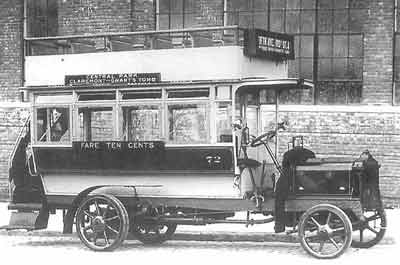
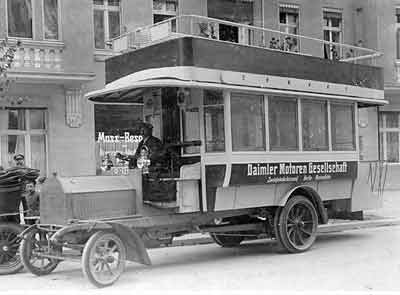
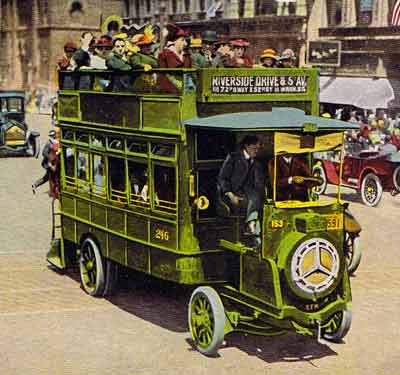
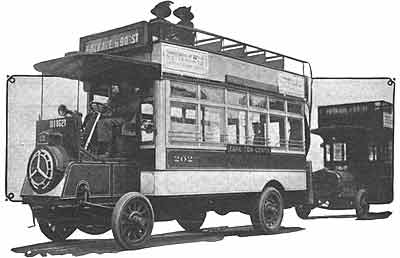
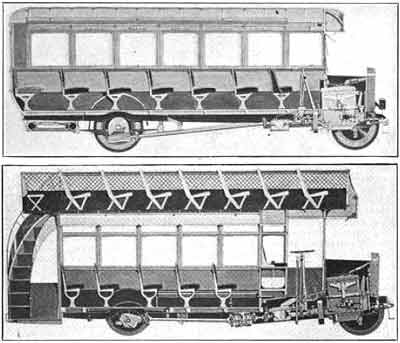
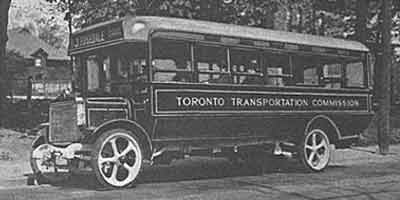
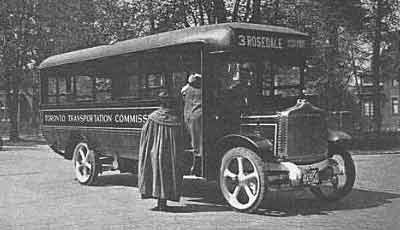
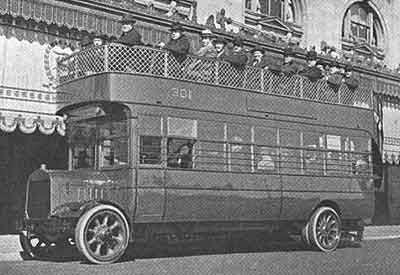
|
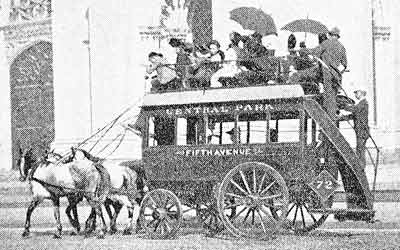
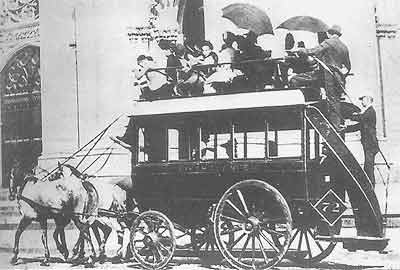
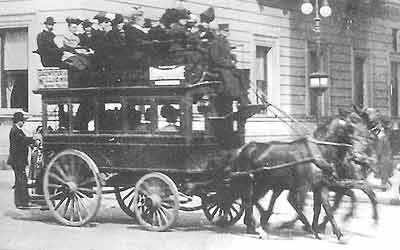
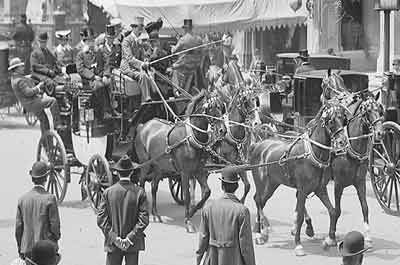
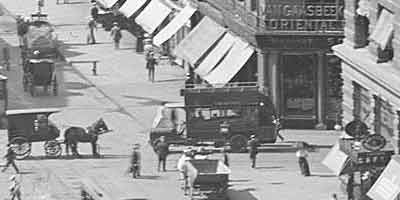
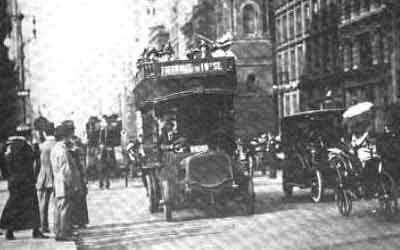
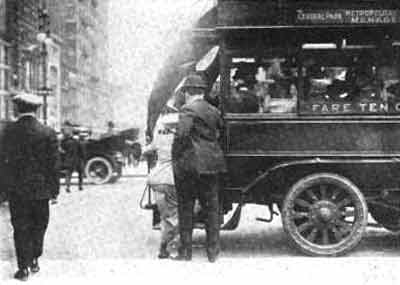
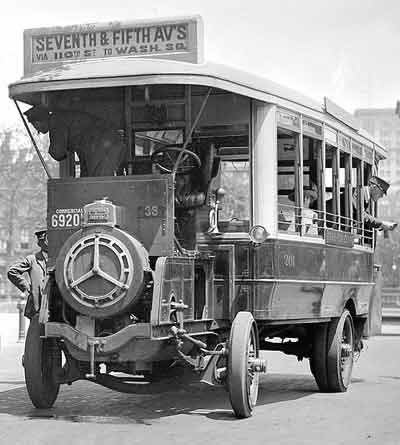
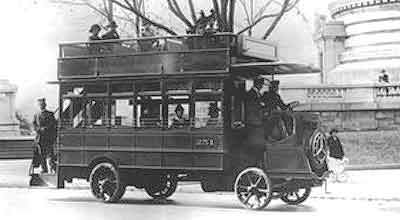
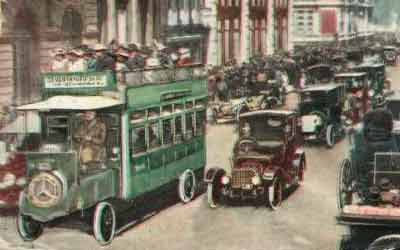
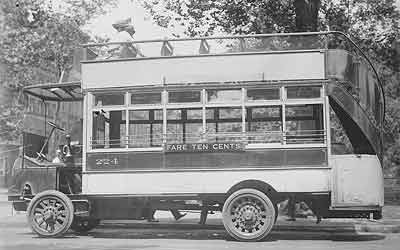
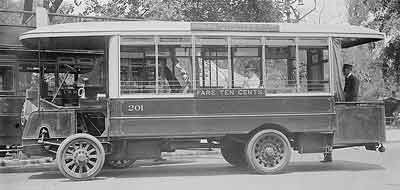
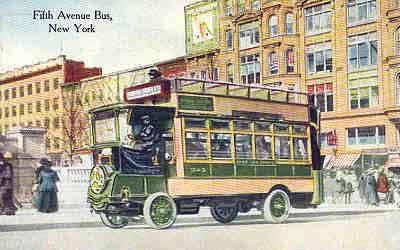
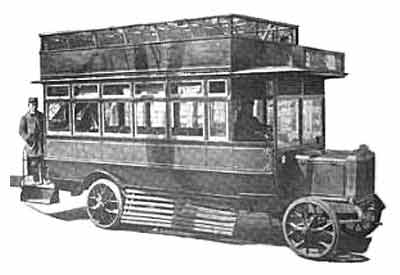
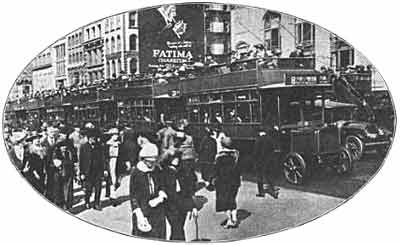
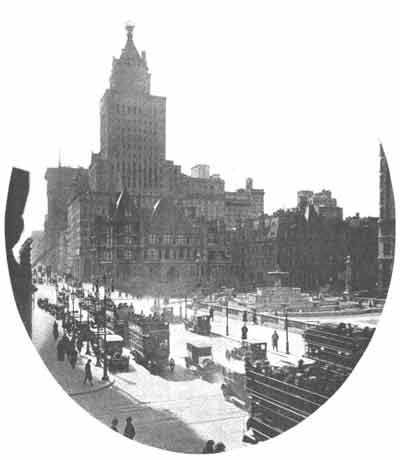
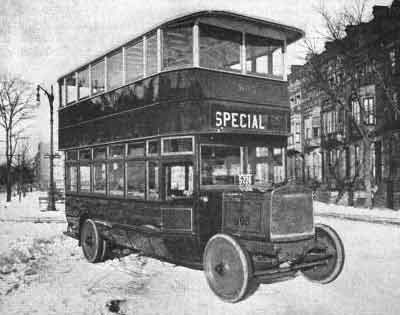
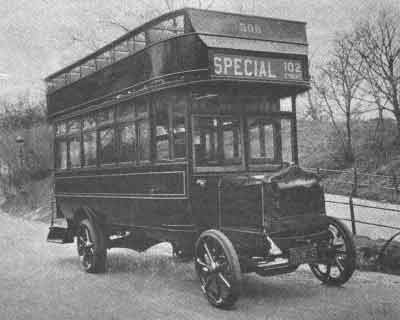
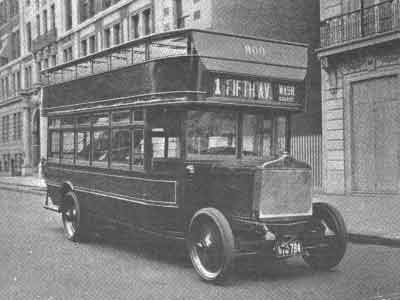
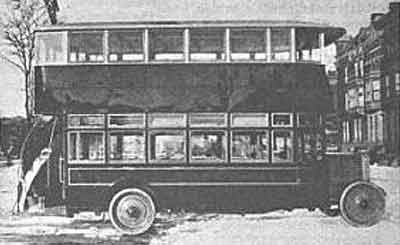
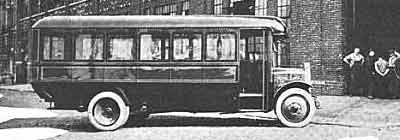
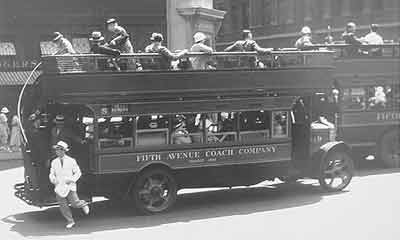
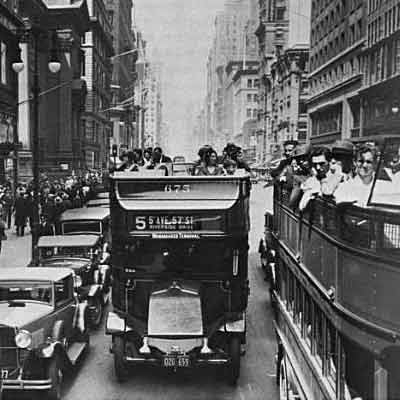
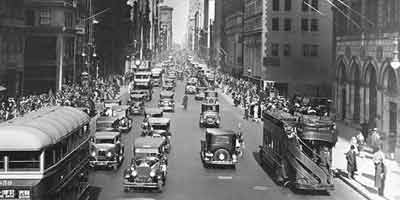
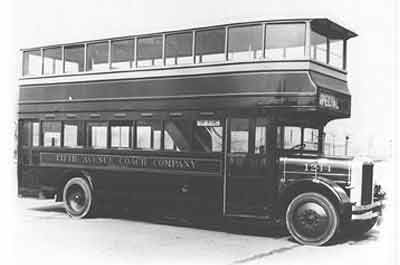
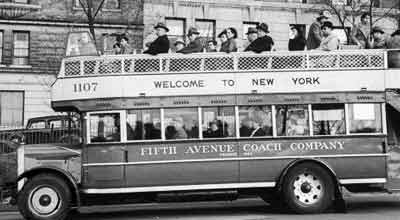
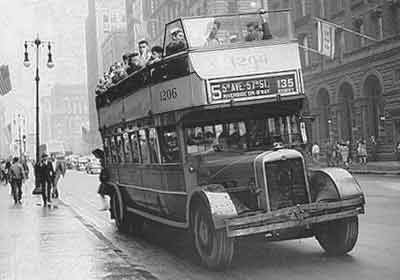
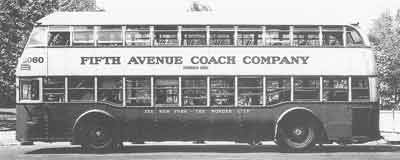
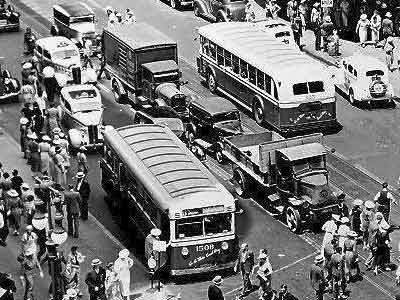
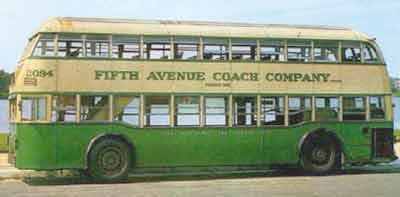
The Fifth Avenue Coach Company is fondly remembered today for their
fleets of double-decker buses that plied the streets of Manhattan during the
first half of the Twentieth century. Although all of the firm's later
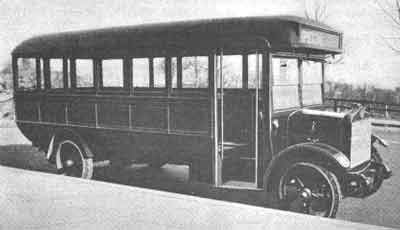
coaches were supplied by General Motor's Yellow Truck & Coach Company, for a
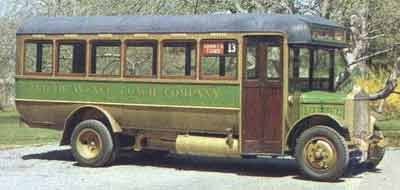
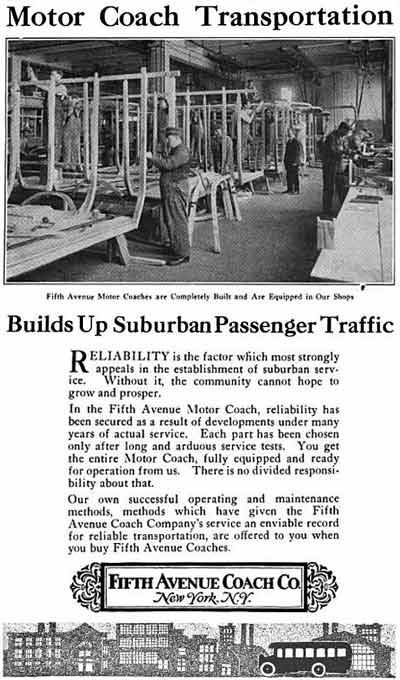
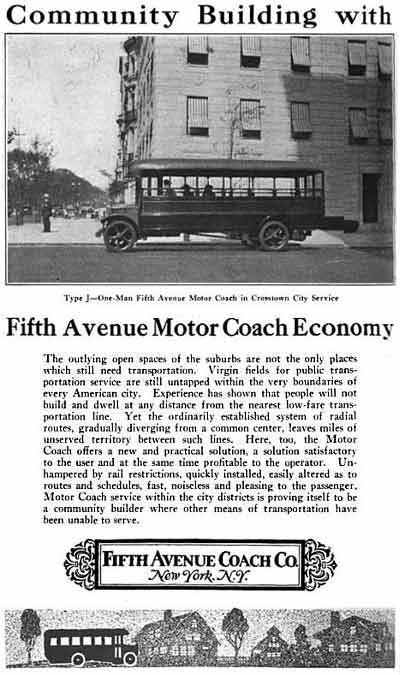
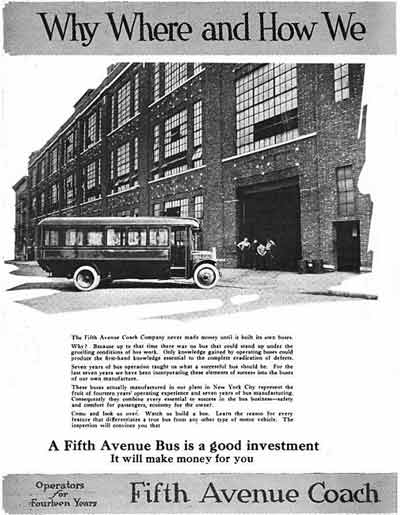
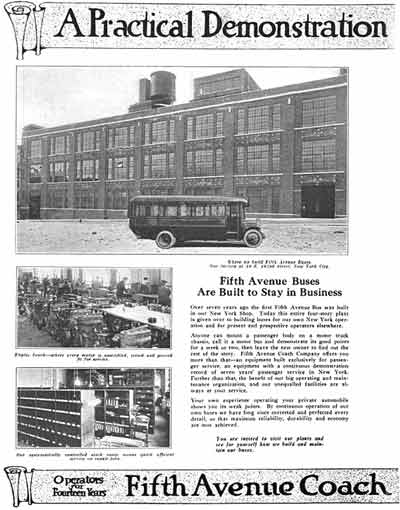
little over two decades, they built their own coachwork, and even built
their own chassis for a short period of time, some of which were sold to
other transit operators, most notably in Detroit, Michigan.
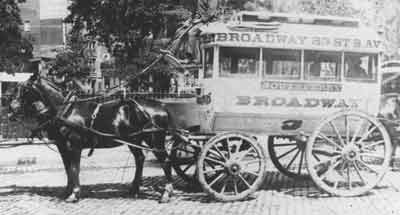
Like most other large twentieth century transit operators, the Fifth
Avenue Coach Company was descended from an earlier horse-drawn stage
operator. In his landmark 1946 history of the Cravath law firm, Robert T. Swaine
details the Fifth Avenue Coach Company's beginnings:
“The Fifth Avenue Railroad Company filed with the Board of Aldermen, late
in 1885, an application for a franchise for a surface railroad to run from
South Fifth Avenue at Canal Street northerly through Washington Square and
along Fifth Avenue to Fifty-ninth Street. Its promoters included James A
Roosevelt, Thomas Fortune Ryan, William C. Whitney and others of the same
group who were promoting the Metropolitan in its fight with Jake Sharp.
“The property owners along the Avenue were stirred into immediate action.
A group, including Cornelius Vanderbilt, Chauncey M. Depew, John Sloane,
Bradish Johnson and William Waldorf Astor, organized the Association for the
Protection of the Fifth Avenue Thoroughfare. Clarence Seward was president,
and August Belmont, Josiah M. Fiske, Robert Goelet, Darius Odgen Mills, John
Jacob Astor and James Kernochan were on its executive committee. Its
purposes were: first, opposition to a railroad on the Avenue; and second,
support of a line of stages. The stage line was to be the Fifth Avenue
Transportation Company. The Sward firm became counsel for the association
and the company.
“Seward’s first move was to induce the Attorney General to give an
opinion that an existing Act forbidding a railroad on Fifth Avenue was
constitutional. The Attorney General gave the requested opinion but refused
to sue the aldermen. Seward had to arrange a suit by a resident of the
Avenue.
“His second step was to stimulate as much propaganda as possible. Most of
the respectable promoters of the proposed Fifth Avenue Railroad lived on or
near the Avenue and might be sensitive to the adverse opinion of the
neighbors and friends. Editorials appeared in the Times, the World and the
Herald, whose burden was the analogy of what was happening on Fifth Avenue
to the Broadway Scandal. The ‘respectable projectors’ could hardly ‘afford
to incur the double disgrace of buying the Board of Aldermen and of being in
turn bought off by the residents of Fifth Avenue.’ The Times concluded that
the ‘most important thing to be done at present is to shame the reputable
people engaged in intriguing for the new road out of their connection with
this disreputable project. When they are shamed out, it will be
comparatively easy to deal with the avowed and shameless strikers who will
succeed them.’ (Times Nov. 19, Dec. 5, 1885)
“At a hearing before Mayor William R Grace in December Seward opposed the
railroad project and supported the application of the Fifth Avenue
Transportation Company for a stage line. His timing was good, for the
Attorney General’s opinion, adverse to the proposed Fifth Avenue Railroad,
came down on the morning of the hearing, and must have been a substantial
factor in inducing the Council to reject the railroad application. The
public fury induced by the Fifth Avenue Association had so frightened the
proponents of the railroad that they ‘made no real showing before the Board
of Alderman.’
“Commented the Herald (Herald Dec. 12, 1885): ‘They are beaten for this
time, but the organization of property owners that has been formed to repel
their predatory attack should be maintained against the inevitable
repetition of the attack.’
“The Herald’s prediction proved well founded. Shortly thereafter, an
application was made by the New York Cable Company for a franchise to
operate cable cars on Fifth Avenue from Washington Square to Forty-second
Street. The Fifth Avenue Association announced that it would ‘resist this
attempt to steal the avenue with all it means in [its] power.’
“In a public statement Seward said: This is another attempt to grab Fifth
avenue. The most dangerous invention for a city’s use in the transportation
of passengers are the cable cars. The records of San Francisco and Chicago
show that vast numbers of people, especially women and children, have been
killed in thoroughfares where the cable railroads have been introduced. A
large number of the horses and a vast amount of property has been destroyed
by them. The reason is obvious. They move noiselessly and swiftly and
attract no attention in the dark. Carriages and wagons driving at a trot
from the side-streets are run into without any warning, the horses killed
and the carriages broken up. The cars cannot be stopped under a distance of
twenty-five feet, and having no horses, which could be turned aside to
prevent collision. Their work of destruction goes steadily on.’
“Meanwhile the Fifth Avenue Transportation Company, which had applied for
a permit to run 50 stages from Bleeker Street and South Fifth Avenue to
Eighty-second Street and Fifth Avenue, found itself opposed by a new
venture, the Fifth Avenue Omnibus Company, which proposed that the northern
terminus should be at the Harlem River. While the railroad and cable
projects were defeated and Mayor Grace approved the proposed route of the
Transportation Company, saying that the Omnibus Company’s proposal went
further than was necessary, he held that neither he nor the aldermen had any
power other than to determine the advisability of the route proposed: ‘Only
that person or corporation can obtain the privilege, when decided upon, who
bids the largest sum per annum to the city, with adequate security.’
(Commercial Advertiser, Dec. 12, 1885)
“Seward found that the ubiquitous Jake Sharp held a 30-year-old license
in the name of the Fifth Avenue Stage Company for the operation of stages
from Forty-third Street down Fifth Avenue to Eleventh Street, thence to
Broadway, Fulton Street, Fulton Ferry and return. Seward bought the license
for $10,000 plus the $300 originally paid for it. As it was expressed to be
non-transferable, he had Sharp endorse it, ‘I hereby deputize the Fifth
Avenue Transportation Company, Ltd., to run on Fifth Avenue between the
designated Streets and not elsewhere, the Stage authorized by the within
License.’
“The Fifth Avenue Transportation Company then petitioned the Board of
Alderman to change the old route to let stages go through Washington Square
to the Bleeker Street elevated station and return, and also to extend it
above Forty-third Street to Eighty-ninth Street. But the Broadway Surface
investigation was well on its way toward tracing the boodle of the Broadway
Surface franchise to the aldermen of 1884; and Jaehne, who was still
vice-president of the Board, moved that a favorable report on the
Transportation Company’s application be laid on the table. After several
months, Seward reported, ‘it lies there yet.’ To circumvent the opposition
of the aldermen, ‘accommodate the local traffic and gratify the wished of
the residents,’ the Transportation Company applied to the Legislature for an
Act granting the requested change and extension of the earlier route. The
bill passed the Legislature and was signed by Governor Hill in June, 1886.
“The Transportation Company was not an immediate success, and required
additional funds. Dissension developed between the directors and Elliot F.
Shepard, who bought up more than a third of the outstanding stock. To
augment revenues the directors in early 1888 began to run stages on Sundays.
Shepard brought suit for an injunction on the ground that this was ‘an act
of Sabbath breaking.’ Seward defeated Shepard’s suit but the continued
controversies between the directors and the principal stockholder became
intolerable. Shepard offered to provide funds for ‘permanent stable
accommodations’ and to meet other ‘present wants’ if he were given control
and allowed to discontinue the Sunday buses. Accordingly a number of the
directors, including Morawetz, resigned and permitted Shepard to take
control. This terminated the Steward counselship.”
Although the firm appeared to be prosperous, for many years Shepard had
augmented the firm’s meager proceeds using his own funds (the wealthy
attorney and newspaper publisher - NY Mail and Express - was married to the
eldest daughter of William H. Vanderbilt) and after his death on March 24,
1893 his family lost interest in propping up the money-losing enterprise.
His brother was allegedly placed in charge of the enterprise and proceeded
to run it into the ground. An article describing the pitiful state of the
firm’s horses, drivers and equipment; entitled was published in the October
22, 1893 New York Times, its long title:
‘OLD AND DECREPIT STEEDS; PITIABLE EQUINE WRECKS ON FIFTH AVENUE STAGES.
No Horses Have Been Bought by the Company This Fall, and Those in Service
Are Not Fit To Do the Work -- Some Mystery as to Who Are the Officers of the
Concern -- Superintendent Hankinson's Efforts in Behalf of the Poor Beasts.”
Before long the inevitable bankruptcy took place and the firm was placed
in the hands of a receiver on February 7, 1895. The auction of the firm’s
assets was recorded by the October 18, 1895 issue of the New York Times as
follows:
“FIFTH AVENUE STAGE LINE SOLD; The Company's Property and Leases Bought
for $10,450 by a Representative of F.S. Smithers & Co.
“All the property of the Fifth Avenue Transportation Company, Limited,
held by Receiver Daniel T. Hoag, was sold at auction by Smith Ryan at the
Broadway Real Estate Salesroom, yesterday, for $10,450.
“The first lot offered included the right to run, drive, or cause to be
run and driven, a line of stages for the transportation of passengers for
hire form Eighty-ninth Street down Fifth Avenue, across Washington Square,
and along South Fifth Avenue, to Bleeker Street, and return; also about 349
horses, 71 stages, trucks, carts, harness, tools, feed. &c., and two
promissory notes made by J. Rosenfeld for the payment of $300.
“The bidding started at $3,000, and was continued until $10,250 was
reached, at which price Ward Campbell, representing F.S. Smithers & Co. of
87 Wall Street, was the purchaser.
“The next parcel offered was the lease of the stables at 55 to 65 East
Eighty-eighth Street, subject to a rental of $14,000 a year. The lease runs
for twenty-one years from Jan. 1, 1890, and the buyer assumed all taxes,
assessments, &c. It was sold subject to back taxes from Jan. 31, 1895. Mr.
Campbell was again the purchaser, at $200, for F.S. Smithers & Co.
“Mr. Campbell refused to give any of the plans of the syndicate he
represents, saying that the sale is still subject to confirmation by the
court.”
The Fifth Avenue Coach Company was incorporated July 25, 1896, under the provisions of the Stock
Corporation Law, to take and possess the property and franchises of
the Fifth Avenue Transportation Company, Limited. The latter company was
incorporated, October 29, 1885, under the Business Corporations Laws,
chapter 611 of the Laws of 1875. Franchise for original routes was granted
by a special act of the Legislature, chapter 53G, Laws of 1886. Suit for
dissolution on the ground of insolvency was brought by the People of the
State against the Fifth Avenue Transportation Co., Ltd., in the Supreme
Court, New York City, resulting on February 7 and July 17, 1895, in a decree
of dissolution, receivership and sale. As the outcome of this, all the
property and franchises of the company were conveyed to the Fifth Avenue
Coach Company under order of the Supreme Court dated November 18, 1895. The
company's routes were extended under section 23 of the Transportation
Corporation Law, as constituted by chapter 657 of the Laws of 1900, by
proceedings resulting in certificates filed with the Secretary of State,
August 4, 1900, February 23, 1901, and April 22, 1912, in pursuance of said
act.
[The Receiver of the Fifth Avenue Transportation Company, Limited, Daniel
T. Hoag, was appointed February 7, 1895. On October 17, 1895, he sold for
$10,450 all the property to Ward Campbell who subsequently became one of the
incorporators and original directors of the new company. On November 3,
1897, said Ward Campbell transferred nil rights, licenses, privileges,
franchises and property so acquired and all rights and properties
subsequently acquired to the respondent for $40,000. The certificate of
incorporation provided that maximum amount of the company's capital stock
should be $300,000, consisting of 3,000 shares of common stock. By a special
meeting held for that purpose on September 3, 1597, the capital stock was
reduced to $50,000, divided into 500 shares of common stock, at which amount
it still stands.]
The Fifth Avenue Coach Company was incorporated on July 24, 1896, under
the provisions of the Stock Corporation Law, to take and possess the
property and franchises of the Fifth Avenue Transportation Company, Limited.
This latter company was incorporated October 29, 1885, under chapter 611 of
the Laws of 1875, of the State of New York. On February 7, 1895,
the Supreme Court, New York County, appointed Daniel T. Hoag, receiver of
all the property of the Fifth Avenue Transportation Company, Limited, and on
July 17, 1895, said court ordered its sale, which sale was made on October
17, 1895, for a consideration of $10,450, to Ward Campbell, who subsequently
became one of the incorporators and original directors of the new company.
On November 3, 1897, said Ward Campbell transferred all rights, licenses,
privileges, franchises and property acquired from the receiver of the Fifth
Avenue Transportation Company, Limited, and all properties and rights
acquired by subsequent purchase, to the Fifth Avenue Coach Company, for a
consideration of $40,000. The property as purchased contained the right to
run or drive stages from 89th street down Fifth avenue, across Washington
park, along West Broadway to the Bleecker street elevated station and
return. Under the provisions of chapter 657 of the Laws of 1900, and by
approval of the Board of Railroad Commissioners, this route has been twice
extended on August 2, 1900, and on February 21, 1901.
The certificate of incorporation provided that the maximum amount of the
company's capital stock should be $300,000, consisting of 3,000 shares, and
all shares should be common stock. By a special meeting held for that
purpose on September 3, 1897, the capital stock was reduced to $50,000,
divided into 500 shares of common stock at which amount it still stands.
August 21, 1897 New York Times:
“Motors For Fifth Avenue; Coach Company Making Preparations to Abandon
the Old-Fashioned Horse Stages.
“The Fifth Avenue Coach Company has employed has employed an expert to
examine all the patents now on the market providing for horseless
transportation with a view of abolishing their present system and
establishing a more modern form of transportation for Fifth Avenue.
“One of the officers of the company, speaking of the proposed change
yesterday, said: ‘When the first horseless carriage rolled down Broadway it
became evident to the principal stockholders of our company that only a
short time would elapse before the Fifth Avenue line would have to do away
with its horses not only for the sake and comfort of its patrons but also as
a matter of economy. At present the market is flooded with all kinds of
patents and inventions providing for horseless carriages. We cannot select
one of them at random, for they cover a wide range of usefulness, and are of
all prices.’
‘“I cannot say exactly when the change will be made, but it will be made
as soon as a suitable invention is offered to us.’
‘“When the horses are abandoned we can give better service to the public.
During certain hours of the day the fare will remain the same as it is now,
but it is possible that the fare for the late hours of the night, when
travel is comparatively light, will be increased. It is also a project of
the company to run express coaches on a regular schedule, stopping only at
certain stations, so as to give its patrons the benefit of rapid transit.”’
December 22, 1898 New York Times:
“Fifth Avenue Line Sold
“The interest of the Shepard estate and individuals in the Fifth Avenue
Coach Company have been acquired by Henry Hart, A.J. Elias, and Edward
Lauterbach of the Third Avenue Railroad Company. The service of this line of
stages will be auxiliary to that of the Third Avenue Railroad, of which
system it will in time become a feature, as the stage service will be
improved and put on a modern footing with, it time perhaps, horseless
carriages.
“Of the change in ownership of the service, Edward Lauterbach said last
evening: “Negotiations for the purchase of all the capital stock of the
Fifth Avenue Coach Company, owner principally by the Shepard estate, are
concluded, ant the franchise and plant and equipment are owned by Third
Avenue Railroad interests, Mr. Henry Hart being the principal acquirer. I
cannot give the terms of the transaction. The stage service of the company
will be reorganized as quickly as possible, and the road will be an
auxiliary service to the Third Avenue system. The Fifth Avenue Coach Company
was not at the time of the change in a very prosperous or efficient
condition. The line will be well equipped, and, as a feeder for the Third
Avenue, will be made useful to the public by transfer systems. At present
the principal one will be Forty-second Street. It will be operated for
transfers wherever practicable. In time it will be a very desirable adjunct
to city transportation, and a plant to equip it with automobile carriages,
for which both electricity and compressed aid will be used, will no doubt be
carried out.
“The Fifth Avenue Coach Company has had this title about a year. It has
been known as the Fifth Avenue Transportation Company Limited, and the Fifth
Avenue Stage Line. It was first operated sixteen years ago but was never a
paying corporation. It now operated on Fifth Avenue, between Eighty-eighth
Street and the Washington Arch, in Washington Square. The stables and
offices are at 55 East Eighty-eighth Street, and the equipment is fifty
coaches, with a rear end entrance, and horses to furnish a team for each.
The President of the late company was E.C. Converse, and the Secretary
W.G.A. Hemming.
“The late Col. Elliott F. Shepard was largely identified with this stage
line. It was regularly earning a deficit, and the stockholders favored
increasing its gross receipts by running the stages on Sundays, but Col.
Shepard opposed this, and to gain his end obtained proxies which enabled him
to oust President E. Ely Goddard and get control of the road. Then Col,
Shepard levied an assessment of 95 per cent on the stock and froze out
enough stockholders to obtain complete but unprofitable sway. His burdens
were increased by an act of the Legislature, which required stages to have
both a conductor and a driver, but this measure was finally repealed.
“The time schedule of the stage service at present is 7 A.M. to 9:30 P.M.
This will be changed so as to give early morning and after theatre service.”
May 9, 1899 New York Times:
“FIFTH AVENUE STAGE LINE SOLD; Said to Have Been Bought by Electric
Vehicle Transportation Company or Auto-Truck People.
“Henry Hart, the Vice President of the Third Avenue Railroad Company, has
sold all of the stock of the Fifth Avenue Coach Company, of which he is the
President, to another corporation. The sale was made through the banking
house of Strong, Sturgis & Co.
“A report was current yesterday that the purchase of this stock was for
the account of the New York Electric Vehicle Transportation Company, which
operated the Electric Vehicle Company’s auto-mobiles in this city. President
Hayes of this company refused to either deny or confirm this report. He said
that no official action in regard to the matter had been taken by the Board
of Directors of his company.
“F.K. Sturgis of the firm through which the purchase was made said that
it was a cash transaction and that he was not at liberty to disclose the
names of his firm’s clients. Edward Lauterbach, the personal counsel of
Henry Hart said: ‘Mr. Hart sold his stock in the Fifth Avenue Coach Company,
and he owned about all of it, some days ago. He got more than he paid for
the stock, but I cannot tell you who bought it. The details will probably be
made public within a few days.’
“The capital stock of the Fifth Avenue Coach Company is $50,000. The
officers for the past year have been: President – Henry Hart; Vice President
– Albert J. Elias; Directors – Henry Hart, Albert J. Elias, Edward
Lauterbach, David C. Andrews, S. Howland Leavitt, John Beaver, and John H,
Robertson. The company holds a franchise which has several years to run.
“One Wall street rumor had it that the purchaser of the Fifth Avenue
Coach Company’s stock was Richard Croker’s New York Auto-Truck Company.
Joseph H. Hoadley, the President of that company, was out of town, but
another officer of the company said that he had looked over the franchise of
the Fifth Avenue Coach Company, but he did not care to say anything about
the recent sale of Mr. Hart’s stock. He remarked that his company was making
progress in the work of getting auto-trucks ready to be operated in the
city.
“From another source it was ascertained that an order for two-score of
auto-stages had already been awarded. The new vehicles were described as
being out of the ordinary, in that they are to be ornamental and handsomely
appointed. Each auto-stage will accommodate thirty persons.”
May 10, 1899 New York Times:
“Fifth Avenue Coach Line; Believed that the Whitney-Elkins Syndicate Has
Obtained Control
“Those who were interested in the transfer of stock and franchise of the
Fifthe Avenue coach line from the control of the Third Avenue Railroad
Company to that of another corporation were as reticent yesterday as on the
previous day, when the transaction was first made known. It was ascertained
on excellent authority, however, that the other ‘corporation’ was
practically the Whitney-Widener-Elkins syndicate, which owns the
Metropolitan Street Railway system in this city.
“This syndicate also has a large interest in the Electric Vehicle Company
and the recently organized New York electric Vehicle Transportation Company.
The original report that the old Fifth Avenue stage line had been bought by
the New York electric Vehicle Transportation Company was not, probably,
therefore, far from correct. It is believed that automobiles will be
operated in Fifth Avenue shortly by the last-named company.
“Henry Hart, Albert J. Elias, Edward Lauterbach, and the other Directors
of the old Fifth Avenue Coach Company resigned yesterday after electing a
new President in place of Mr. Hart. The new President is William H.
Stonebridge of 31 Nassau Street, who refused to say anything for
publication. He was busty during the day arranging for the election of a new
Board of Directors. The names of the new Directors, it is expected, will
clearly disclose the identity of the new owners.”
November 14, 1899 New York Times:
“Fifth Avenue Line Deal; Wall Street Says Mr. Whitney’s Electric Company
has bought it.
“The Fifth Avenue stage line, it was reported in Wall Street yesterday,
has passed into the formal control of the New York Electric Vehicle
Transportation Company. The stock of the Fifth Avenue Company was purchased
some time since by William C. Whitney, and it was said at the time that Mr.
Whitney had bought the stock with the intention of turning it over to the
New York Electric Vehicle Transportation Company, a subsidiary company of
the Electric Vehicle Company, which is controlled by Whitney interests.
“It is said that Mr. Whitney received from a Philadelphia syndicate an
offer of $1,000,000 for the franchise of the Fifth Avenue Company, which is
supposed to be much in excess of the amount paid for the stock by Mr.
Whitney. The price paid was not made public, but it was said that the stock
has been turned over to the New York Electric Vehicle Transportation Company
for what it actually cost.
“An officer of the New York Electric Vehicle Transportation Company said
yesterday:
‘We know of no such deal having been consummated. It has been talked
about for some time. When Mr. Whitney obtained control of what was the Fifth
Avenue Coach Company, formerly Elliot F. Shepard’s Fifth Avenue Stage
Company, it was announced that the stages would be succeeded by automobiles.
So far as we know no automobiles to take the place of the present stages on
Fifth Avenue have yet been decided upon. The vehicles would need to have the
capacity of from sixteen to eighteen inside passengers. A vehicle with half
that capacity now exists, but it would not suit Fifth Avenue, as its weight
is 3,500 pounds. The project, then, so far as the vehicles are concerned, is
in the air.’”
January 3, 1900 New York Times:
“AUTOMOBILE STAGE TRIED; Electric Omnibus Makes Its First Appearance on
Fifth Avenue - Trial Trip Satisfactory.
“No one would have predicted several years ago, when the Fifth Avenue
Stage Company and the Society for the Prevention of Cruelty to Animals were
having so much trouble, that some day or other, and in all likelihood before
the end of the century, horseless vehicles would take the places of the
antiquated stages then running on Fifth Avenue. But the horseless era in the
history of Fifth Avenue ended yesterday, and within the year it is likely
that automobiles will have completely taken the place of the old Fifth
Avenue stages.
“At present the stages care for a heavy traffic during shopping hours,
and the animals used to haul the ‘buses are fairly representative of the
genus equine, but the Fifth Avenue Coach Company which operates the line, is
seeking cheaper motive power, as well as more stylish vehicles, and the
proposition made by a Hartford concern to use automobiles. The proposition
was taken to kindly by the management, and yesterday, for the first time, a
trial trip of an automobile over the line was made. The trip was not a
regular one for passengers, although some of the patrons along the lines
seemed to think it was. It was for the benefit of the officers of the
company and their guests, a body of newspaper men, and it was a successful
one from all standpoints. The vehicle was the largest suitable for the
purpose that could be obtained at present, and it will be run daily with the
horse stages for probably a month, in order that its advantages or
disadvantages for transportation purposes may be thoroughly tested.
“The proper size for an automobile ‘bus, the power necessary to operate
it, the capacity of the batteries, and the average speed when taking up and
letting down passengers will all be determined upon through the test
vehicle, and when the test is completed the company will, if it deems the
automobile more suitable, order a sufficient number built.
“The trip yesterday was novel one to those who made it. Manager Howard
Scribner and two of his guests occupied the outside seat, while eight others
sought more comfortable quarters within. On down grade the ‘bus ran freely,
even under the motorman’s brake, and on up grade its speed slackened
perceptibly. Pedestrians along the line looked at the’ bus curiously, and at
Forty-fourth Street a pair of horses, attached to a fashionable Brougham,
shied to one side as it approached. A young woman at Fortieth Street did not
consider the ‘bus anything extraordinary, for she stepped out briskly and
hailed the motorman as she would have done ordinarily to the stage driver,
and them looked embarrassed when the vehicle did not pull up.
“The new ‘bus made the trip from the stage barn to the terminus, on
Washington Square South, and return in one hour, which is a gain of about
forty minutes over the schedule time of the horse stages.”
August 3, 1900 New York Times:
“New Stage Coach Line; Extensions Granted to Fifth Avenue Company
“The State Board of Railroad Commissioners held two sessions yesterday,
at the Fifth Avenue Hotel, at which a number of matters were disposed of,
among them the application of the Fifth Avenue Stage Coach Company for an
extension of its lines. The extensions, which will give the company an east
and a west side line to Harlem were granted.
“Fifth Avenue from Washington Square to One Hundred and Thirty-fifth
Street, will be the route of the eastern line. For the western branch the
following route has been selected; Fifth Avenue, to Fifty-seventh Street, to
Broadway, to West Seventy-second Street. Here the line divides, one division
going up Central Park West and Eighth Avenue, the other up Riverside Drive.
Both branches will extend as far north as One Hundred and Twenty Fourth
Street. Cross-town lines between the east and the west side will be
established at intervals.”
January 22, 1901 New York Times:
“AUTOMOBILE OMNIBUSES. Fifth Avenue Line Leases Three from New Haven
Company.
“Manager Howard Scribner of the Fifth Avenue Stage Coach Line has
completed arrangements for the transfer of the New Haven Stage Line to the
Fifth Avenue line. A deal by which the New Haven automobiles come into the
possession of the Fifth Avenue line was closed yesterday in New Haven by
him.”
September 16, 1905 New York Times:
“MOTORS MAY REPLACE FIFTH AVENUE STAGES; Company Experiments with a
Specially Modeled Car. SEAT FOR EVERY PASSENGER New Vehicle Designed for
Speed and Comfort -- Saves Forty-five Minutes in Round Trip.
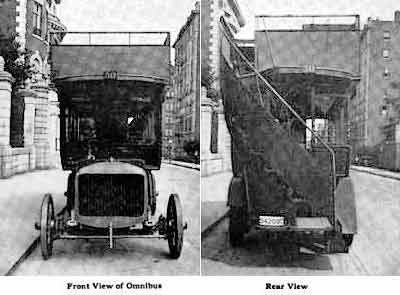
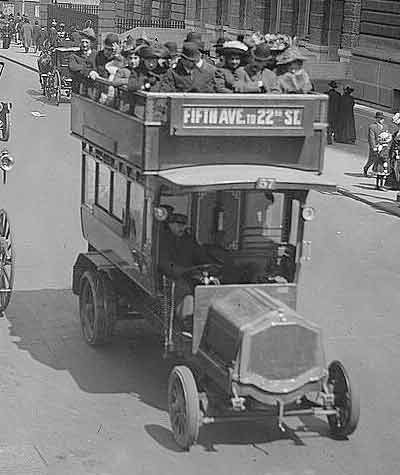
“The Fifth Avenue Coach Company has placed on trial for Fifth Avenue
service a gasoline-electric motor omnibus, which will begin running on
regular schedule between Washington Square and Eighty-eighth Street within
the next few days. It is now being run for experimental purposes in the
evening.
“In designing this bus the object was to produce a vehicle that could be
operated with safety and speed through the heavy traffic on the avenue. The
vehicle has cross seats, with a centre aisle, so that passengers face
forward and have a good view of the sights as they go along. The company
declares that five-cent fares would not yield a profit, but in return for
the ten-cent fare it is proposed to give every passenger a seat and allow no
one to stand in the aisles.
“The motive power of the omnibus is the design of the General Electric
Company, and consists of a forty-horse power engine and two
forty-five-ampere motors. It is brilliantly lighted from a small storage
battery, which also supplies current to start the engine, thereby avoiding
the ‘cranking’ operation customary on gasoline cars.
“This is the latest of a series of experiments which the Fifth Avenue
Coach Company has been conduction for several years to obtain a satisfactory
motor omnibus for its stage routes. When a vehicle is found which is
adequate to its needs the route will be completely equipped and horse
operation discontinued.
“The ‘bus makes the round trip from Eighty-eighth Street to Washington
Square in about an hour as against an hour and forty-five minutes with the
old horse omnibus.”
October 17, 1905 New York Times:
“300 Horses Saved At Fire; Blaze in the Fifth Avenue Coach Company’s
stables.
“These was a little fire last night in the Fifth Avenue Coach Company’s
stables at 68-70 East Eighty-ninth Street. Manager William O’Halloran, with
the assistance of neighbors got out the 300 horses that had been stabled at
the building after the day’s work.
“When the firemen arrived they found that the fire, which was probably
caused by the overturning of a lamp, had taken hold of the entire northeast
wing of the building. The soon had it out. One of the coaches was badly
damaged. The total damage was estimated at $1,000.”
November 1905 Cycle and Automobile Trade Journal:
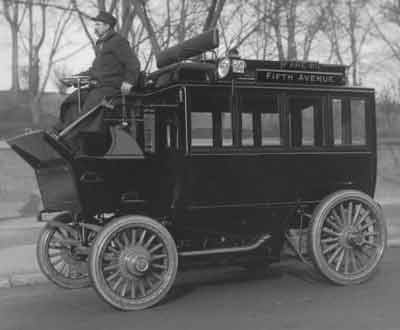
“The General Electric Company has just placed in
service on the Fifth Avenue Bus Line of the New York Transportation Company,
in the nature of a test, a 30 passenger motor omnibus equipped with the
combination gasoline electric propelling system developed by them. The
vehicle is equipped with a 40 H.P. 4-cylinder vertical 6 x 6 in. engine, to
which is direct connected a 12 kilowatt generator. The speed is almost
entirely controlled by means of a foot pedal. The weight of the omnibus with
load is about 9 tons, and the gearing is calculated to give a normal speed
of 10 miles per hour. The wheels are shod with 7-inch solid tires. The
running gear was constructed by the Vehicle Equipment Company, of Brooklyn,
and is of that company's well known pedestal type. The body was built by G.
J. Brill & Co., Philadelphia.”
August 10, 1907 Ogden Standard:
“Fifth Avenue Auction Sale Marks the Passing of the
Historical Coach
“New York, Aug. 9, 1907—With the auction sale on
Wednesday of all the Fifth Avenue Coach company's horses, omnibuses, stages
and harness, the last of the stage coaches passed away from New York. The
new electric omnibuses, with a fare of ten cents have now completely
replaced the old system on Fifth avenue.
“The first public stage for local service made its
appearance in New York —June 1830. It ran hourly between Wall and Bleecker
streets. In time the stages ran on all the principal streets and connected
all the principal points of the city. They came to represent an invested
capital of more than a million dollars. Instead of street car accidents and
automobile collisions, people in these days read of stage drivers striking
against the rule compelling them to wear tall hats, or, stage coach races
between rival drivers down Broadway. One by one the stage lines were
supplanted by street cars and now their last Stronghold has been stormed by
the automobile.”
September 5, 1907 New York Times:
“Coach Line Wants Right to Put Advertising on Its Vehicles.
“The Fifth Avenue Coach Company, which operates automobile buses in Fifth
Avenue, and which was formerly owned by Elliott F. Shepard, and was known as
the Fifth Avenue Transportation Company, applied for an injunction in the
Supreme Court yesterday to restrain the city from interfering with its
putting advertising signs on its buses.
“Some time ago the Corporation Counsel caused the arrest of one of the
operators of the buses and had him brought before Magistrate Barlow in the
Jefferson Market Court on a charge of violating Section 41 of the Code of
Ordinances, which forbids ‘any advertising truck, van, or wagon being
operated or driven through the streets of the Borough of Manhattan,’ and
which makes the penalty $10 fine for each offense. Magistrate Barlow threw
the case out of court and said it must be tried by civil process.
“The company contends that putting advertising signs on its buses is not
illegal, that they do not obstruct or interfere with traffic, and that they
are tightly secured. The company now seeks to prevent the city from
attempting to bring prosecution of further interference. Decision was
reversed.”
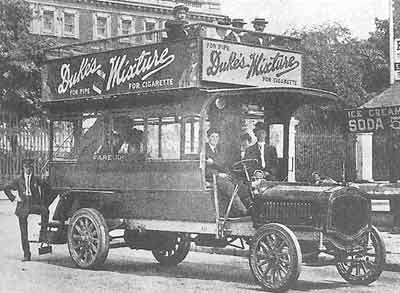
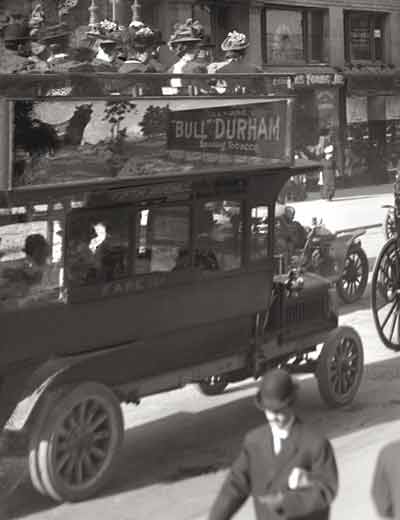
Despite a number of appeals by 5th Ave Coach, the city ordinance stood
and the signs were removed from the exterior of the vehicles, however
advertising inside the omnibus remained a lucrative sideline for the carrier
for the next half century.
The May 2, 1908 issue of Motor Traction included an
article on Manhattan’s Delahaye taxicabs which were operated by the New York
Transportation Company, the holding company that owned Fifth Avenue Coach:
“The New York Transportation Company, which operates
the fifty Delahaye cabs, is controlled by, and is really a part of, the big
street railway combination of the city. A subsidiary organization of the
Transportation Company, which is known as the Fifth Avenue Coach Company,
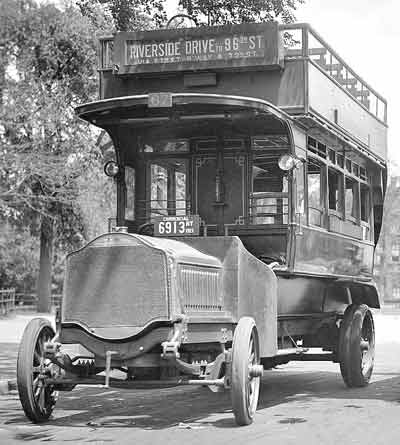
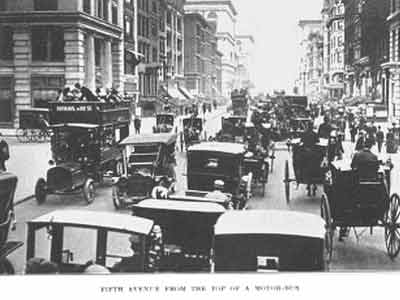
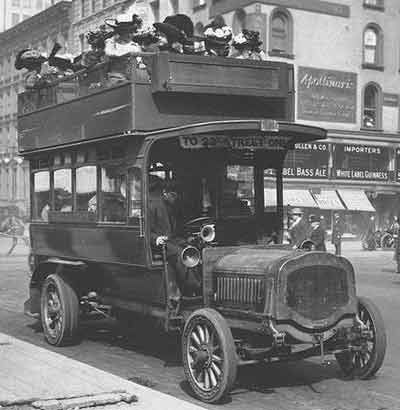
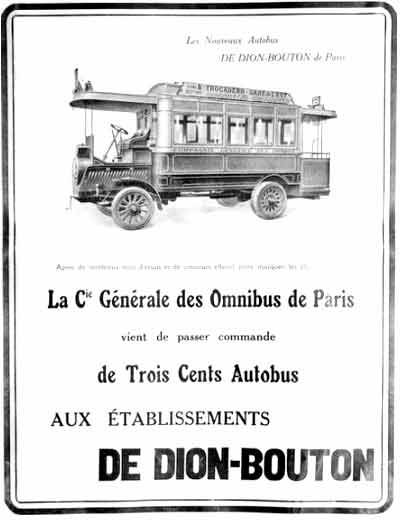
operates twenty De Dion motor 'buses on Fifth Avenue—the fashionable drive
that extends down through the centre of the island city. A first lot of
twenty motor cabs were received from France by the New York Transportation
Company last August at about the same time that the New York Taxicab Company
got its first shipment of Darracqs. They were followed in the fall by the
other thirty.”
June 11, 1908 New York Times:
“More Motor Omnibuses
“The Fifth Avenue Coach Company, which operated a line of motor omnibuses
on Fifth Avenue, will to-day inaugurate a new service by which cars of the
same type will run from Washington Square up Fifth Avenue to Fifty-seventh
Street, thence over to Broadway, up Broadway to Seventy-second Street and
across to Riverside drive, returning by the same route. The round trip will
take about an hour, and the omnibuses will be run on a ten-minute headway.
“Ten new omnibuses will be put on this line soon, and the service will be
extended up Riverside drive, over the viaduct, to 135 th Street. The
Riverside Drive cars will carry a red ball by day and a red light by night,
to distinguish them from the cars which run only on Fifth Avenue, and which
carry a green light at night.”
The Commercial Vehicle, November 1908:
“MIXED-SYSTEM OMNIBUSES FOR NEW YORK.; Details of the
Gas-Electric Machines Built by the General Electric Company for Passenger
Service on Fifth Avenue— Features of the Electric Drive
“In previous issues we have illustrated and described
the foreign built De Dion motor 'buses with which the old established
passenger service has been maintained on Fifth avenue, New York, since the
abandonment of horsed vehicles, and now through the courtesy of Mr. H. S.
Baldwin of the General Electric Company we are able to present illustrations
and data of the mixed-system 'buses of American build which have recently
been added to the equipment. The 'buses of this type were ordered by the New
York Transportation Company, which operates the line, with the intention of
eliminating the clash change-speed gears, that in 'bus operation, with the
frequent necessary stops, demand a considerable degree of expertness on the
part of the driver and create a not inconsiderable item of expense in the
upkeep account. In a round trip of a Fifth Avenue 'bus fifty to sixty stops
are made on the average during the busy hours.
“In the mixed-system or gas-electric machine the
gasoline motor is employed to drive an electric generator which supplies
current to electric motors that in turn are geared to the rear road wheels.
Thus instant changes of speed of the vehicle or reversal of the direction of
motion can be made quite independent of the rotative speed of the gasoline
motor. There are other advantages derived from the use of the gas-electric
drive. In the G. E. 'buses the series motor employed gives high torque at
low speeds and ability to pick up rapidly, and as two series motors are
used, one to each wheel, two objects are gained: first, the motors may be
operated in series or parallel with each other, giving either large torque
or high speed; and, second, when the motors are run in parallel—on Fifth
avenue the motors are parallel for most of the time its own work, and the
danger of skidding, which is not eliminated by the use of a mechanical
differential gear, is greatly decreased.
“In working out a suitable gasoline motor and electric
generator for the work it was found that the complete set need not weigh
more than 1,000 to 1,200 pounds for a 34-passenger omnibus. The generator
should preferably be compound wound, with dropping characteristic and
designed electrically for practically constant output. It should be able to
withstand heavy overloads for short intervals of time, with good commutation
throughout its operating range. Further, it should be self-exciting,
otherwise sluggish acceleration would result; and, finally, it should be
mechanically substantial and rugged. Such a generator can be short-circuited
at full load, or high overload, without stalling the gasoline engine.
“These requirements are embodied in the machines built
for the Fifth avenue service by the General Electric Company, and which are
here illustrated. The bodies are of the standard London type, and the
chassis are specially designed to accommodate the electric motors and
generator. While there is a controller in the electric circuit, it serves
mainly for reversing or throwing the driving motors into series connection
for hill climbing or very rough roads. Ordinarily, it is not used during a
trip on the Avenue, since it is not necessary to open the generator circuit;
for, by reducing the engine speed, only sufficient energy is developed to
move the 'bus slowly. This action is equivalent to letting the friction
clutch slip, in the case of an omnibus with mechanical transmission. With
the gas-electric omnibuses, aside from steering wheel and brake levers,
there is only one control lever required for driving. This is a
spring-returned throttle pedal operated by the driver's right foot. If, for
any reason, the driver were thrown from his seat or incapacitated, the
omnibus would very shortly come to rest, as the throttle would automatically
close when released.
“It may be thought that the electrical drive would have
considerably more weight than has the mechanical transmission, but actual
comparison under the same conditions shows that the gas-electric omnibus
outweighs the ordinary type 'bus by less than 100 pounds, its weight being
9,150 pounds complete with supplies. The passenger load brings the total
weight up to about 14,550 pounds.
“Road trials have demonstrated that the gas-electric
omnibus has a speed, when loaded, of about 18 miles an hour on the level.
For straight-away service it will run from four to five miles on one gallon
of gasoline; but on the Avenue, these figures are somewhat reduced.
“A very noticeable feature, due to the electric
transmission, is the smooth acceleration of the new omnibus. Measurements
show this to be about 1¼ miles per hour per second, or substantially that of
the omnibus with mechanical transmission. The acceleration of the
gas-electric omnibus is somewhat deceptive, owing to the freedom from the
shock which accompanies the operation of clutch and change gears in the case
of an omnibus of conventional construction, and has been the cause of
favorable comment. This advantage is especially pleasing to the passengers.
“Another important feature of the gas-electric omnibus
is its quietness of operation, which can be accounted for by the
comparatively small number of gears required in the transmission with chain
drive.
“A brief description of the generator, used in the G.
E. bus, will be of interest. It is a six-pole machine, each pole being
slotted on the entering side, forming a small auxiliary pole about which
most of the series turns are wound. By saturation of this tip, series
excitation is limited, and a drooping characteristic is the result. A
further effect of this saturation is to give good commutation at times when
the field is otherwise weak. Several series turns entirely encircle the
pole, the shunt winding being placed over all. Here is, in effect, a
commutating pole generator, with high overload characteristics and fine
commutation at all loads; which is quickly self-exciting and at the same
time is of light weight. This machine is known as the TD-6-7½ kw.
generator, and is rated at 125 volts, 60 amperes, at 900 r.p.m. It may be
run at 100 per cent, overload for two hours with a 70° C. rise of
temperature, and at 50 per cent, overload continuously. It has an efficiency
of 85 per cent, at normal load, and weighs about 435 pounds. When in
operation it has been short-circuited, without stalling the engine, taking
285 amperes at 2 volts.
“The two electric motors are of the GE-1026 back-geared
type, rated at 125 volts, 30 amperes. These are practically small railway
motors having the back gear brackets and supporting lugs all cast on the
magnet frame in a one-piece steel casting. A hardened steel herring-bone
pinion, with teeth of large pitch, meshes with a phosphor bronze gear, both
being enclosed in an aluminum alloy housing which is grease tight. All
bearings are waste-packed lubricated. Provision is made on the inner end of
the countershafts for motor brake drums.
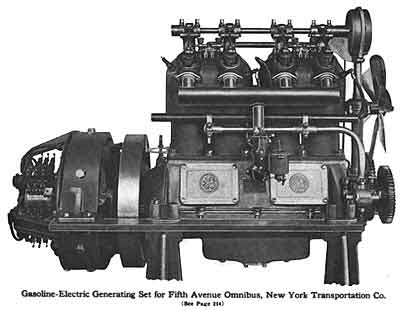
“The gasoline engine which is used to drive the
generator is of special design, and is of the four-cycle type with four
cylinders, each 5 by 5 inches. It is rated at 27-30 horsepower, and weighs
about 700 pounds complete. All valves, both intake and exhaust, are located
in the cylinder heads, which arrangement tends to high efficiency and power
for a given displacement.
“The chassis construction includes a main frame of
double armored wood with pressed steel cross members, all hot riveted with
stout gussets and corners. The subframe for the engine and generator has
three points of suspension, which arrangement relieves the motive unit from
undue twists and strains. Both electric motors are suspended from a strong
cross member, side by side, somewhat forward of the rear axle. As has
already been stated, each motor is complete with back gearing. Transmission
from the motor countershafts to the driving wheels is by roller chain of 1¾
inch pitch, and the total ratio of reduction of gears and sprockets is about
14½ to 1. Long half springs support the omnibus at front and rear in an
effective manner, resulting in easy riding. Steering and driving wheels are
of artillery design, 34 and 40 inches diameter, respectively. The tire
equipment consists of 4-inch single solid tires for the steering wheels, and
3½-inch twin tires of the same kind for the driving wheels.
“The front axle is a steel forging, the steering wheels
being mounted on pivots of the inverted Elliott type. An axle of the
built-up construction is used at the rear. This consists of a large steel
tube with heavy walls, on each end of which is securely fastened a steel
casting forming not only anchorage for the main driving wheel brakes, but a
support for the axle arm stubs. All wheels run on conical roller bearings.
The chassis has a wheel base of 168 inches, with front and rear wheel gauges
of 67½ inches and 72½ inches respectively.”
General Electric Review, November 1908:
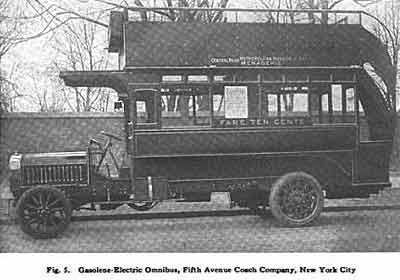
“GASO-ELECTRIC MOTOR OMNIBUSES ON FIFTHE AVENUE, NEW
YORK CITY. By H.S. Baldwin
“For many years the transportation facilities on Fifth
Avenue, New York City, were not in keeping with one of the finest and most
wealthy thoroughfares in the world. In the early days dilapidated omnibuses
were drawn by decrepit horses, and the service was inadequate and
precarious. Later, ownership of the omnibus line changed hands, and it was
recognized that both good business judgment and the public demanded better
horses, which were accordingly purchased and placed on the Avenue. This was
a marked step in advance, but the old omnibuses still survived. Not that the
operating company was wanting in a desire to improve matters, but with the
advent of the automobile, some ten or a dozen years ago, it was obviously
only a question of a short time before motor omnibuses would be available,
and any extraordinary expenditure of money on horse-drawn equipment would be
inexpedient from a business standpoint. They therefore turned to the new
idea, and many an embryotic omnibus, either electric, steam, or gasoline,
wended its way up and down the Avenue in an attempt to meet the demands of
the public, as a rule, exciting as much criticism as did the horse
omnibuses. None of these long survived the experimental period; but in the
meantime the omnibuses with their animal motors were depreciating, and
public opinion was not to be set aside.
“The development of reliable and practical motor
omnibuses had been made the subject of much study and experiment in Europe,
competent engineers having utilized the material which had been rapidly
accumulated in the art of pleasure automobile manufacture, adapting and
proportioning it for commercial uses, both in the transportation of
passengers and merchandise. The result was soon visible in the hundreds of
motor omnibuses in London, Paris, and some of the larger Continental cities.
It is not difficult to find a reason for the impetus that this line of
activity obtained abroad, since the surface street railway is not so
extensively found there as here.
Progress abroad was closely observed by American
engineers and business men; and the New York Transportation Company, having
acquired the Fifth Avenue Coach Company, purchased, about two years ago, a
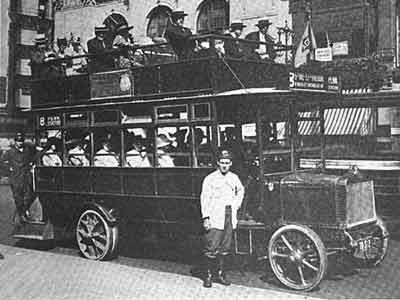
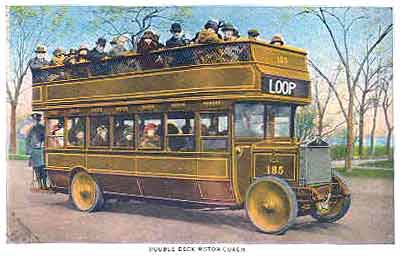
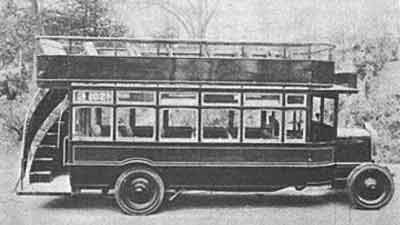
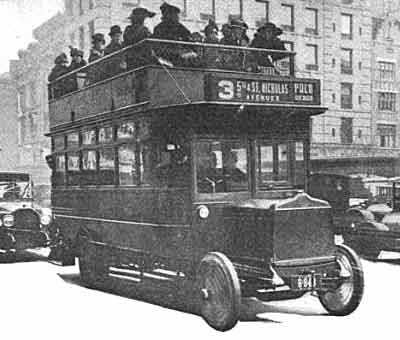
DeDion motor omnibus having a double deck body of the London type, capable
of carrying thirty-four passengers in addition to a driver and conductor.
Eighteen passengers were accommodated in crosswise seats on the upper deck,
and sixteen inside.
“This was a step in the right direction; and about a
year ago fifteen of the same type were placed in operation, being followed
six months later by ten more, making a total of twenty-six, all of which are
now in active service.
“The prime mover of the DeDion omnibus is a 4-cylinder
gasoline engine, which, through clutch and change gears, drives the rear
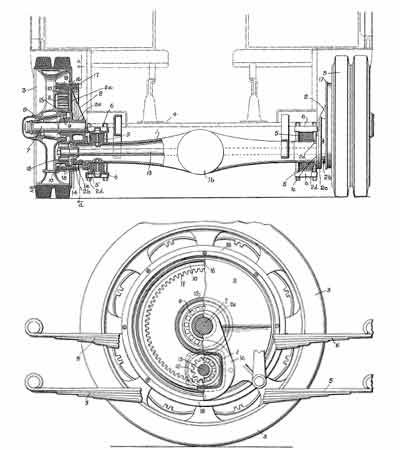
wheels. In a general way the arrangement of parts is the same as is found in
the modern touring car, except that the rear wheels are mounted on a dead
rear axle and receive their motion from spur pinions engaging with large
internal gears bolted to each wheel.
“This combination is known as the ‘DeDion drive,’
which, for omnibus work, has the advantage that it permits the use of the
propeller shaft transmission without necessitating a live rear axle.
“Information from abroad as to the maintenance of clash
change gears of motor omnibuses, especially from London, indicates that the
frequent stops and starts necessitated by the nature of the service and
general traffic conditions introduce a serious item of expense not
encountered in the touring automobile, where frequent change of gear is not
required. Motor omnibuses may, for example, stop as often as once in every
two blocks, of which there are twenty to the mile in New York City. On this
basis, it is easily estimated that in a round trip on Fifth Avenue, of
approximately eight miles, there would be eighty stops. Actual figures
indicate from fifty to sixty stops during the hours of maximum traffic.
Assuming again that each omnibus makes ten round trips a day, it is clear
that the change gears receive frequent use, and, without doubt, much abuse.
It is of course understood that at each stop some change of gear is
necessary, unless on a down grade, even though the driver should start on
the second speed without going through first.
“It is well known that a gasoline engine cannot give
high torque at low speed; also, that this peculiarity demands some
compensating device, usually a series of trains of spur gears, which can be
shifted at will by the driver to meet the conditions of road grade or load
at any given instant. Again, it is not practicable to reverse the gasoline
engine; hence an additional set of gears must be used for running backwards.
As has already been pointed out, some form of friction clutch is essential,
since it would be impossible to shift gears under load without first
disconnecting the engine.
“With automobiles of small size, carrying from one to
six or seven passengers and used mostly for touring or short runs, little
objection is found to clash change gears; since as a rule such cars have
relatively large engines, and are often run for many miles without a change
of gear. With the public motor omnibus it is different, and engineers
throughout the world have long sought a satisfactory solution of the
problem. Given a gasoline motor omnibus, find the transmission or change gearing
which shall correct the lack of flexibility of the gasoline engine as to
torque; give reversibility; insure smooth yet rapid acceleration; and withal
be simple and have low cost of maintenance. To fulfill the conditions and
solve the problem is to eliminate one of the greatest objections to public
motor service, especially in large cities.
“The series electric motor has many of the desired
characteristics; namely, high torque at low speeds, ability to pick up
rapidly, and to reverse without gearing. If two series motors are used to
drive the omnibus, one for each wheel, two objects are gained: first, the
motors may be operated in series or parallel with each other, giving either
large torque or high speed; and second, when the motors are run in
parallel—and on Fifth Avenue the motors are in parallel for most of the
time—each will do its own work, and the danger of skidding, which is present
when a mechanical differential gearing is used, is largely eliminated.
“The series motor is to a marked degree an automatic
torque and speed changing device, reversible, and of simple, durable
construction, not easily injured, and at the same time easily repaired. It
has but one rotating part, the armature, provided with two plain bearings;
and there are no other highly machined or closely fitted parts, of expensive
material, as in the mechanical transmission. The motor is controlled by a
small drum switch, and does not require a multiplicity of levers and rods,
all in proper adjustment and alignment with relation to each other.
Lubrication of the motor is most simple. When two motors are used, as on the
omnibus, no accurate alignment is required, and each can be suspended from
the running frame or dismounted with little delay. There is no complicated
countershaft or propeller shaft with several universal joints.
“In order to profit by these advantages, there must be
a supply of electric energy to drive the motors. The storage battery first
offers itself, but owing to its comparatively small capacity, rendering
either frequent change of battery or long intervals of charging necessary,
it has not been found suitable for long distance omnibus work.
“If, now, a specially designed generator be directly
coupled to a gasoline engine, so as to furnish energy to the motors, the
mileage of the omnibus will only be limited by the supply of gasoline. The
engine and generator together need not weigh over 1000 to 1200 pounds for a
34-passenger omnibus. A generator suitable for the purpose can be made of
simple construction and the gasoline engine of to-day presents no unusual
difficulties. The generator should preferably be compound wound, with
drooping characteristic, and designed electrically for practically constant
output. It should be able to withstand heavy overloads for short intervals
of time, with good commutation throughout its operating range. Further, it
should be self-exciting, otherwise sluggish acceleration would result; and
finally, it should be mechanically substantial and rugged. Such a generator
can be short-circuited at full load, or high overload, without stalling the
gasoline engine.
“The General Electric Company has developed apparatus
which meets in a practical manner the requirements of an ideal transmission
or change gear, as set forth above, and has built for the New York
Transportation Company, a number of equipments for omnibuses, embodying the
electric transmission.
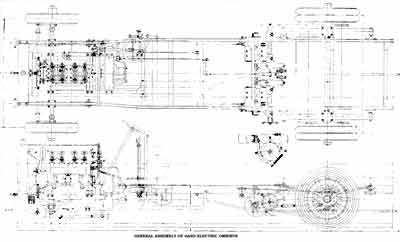
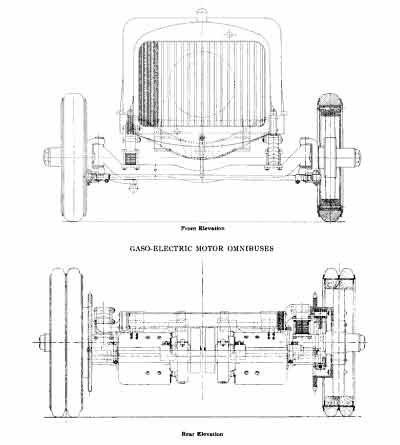
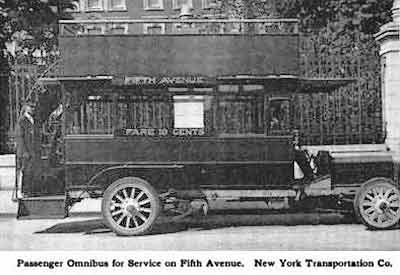
“The accompanying illustrations will give a good idea
of the appearance of these omnibuses; while the assembly drawing will show
the relative location of the several parts of the motive system.
“The bodies are of the standard London type, and the
running gears are specially designed to accommodate the electric motors and
generator. While there is a controller in the electric circuit, it serves
mainly for reversing or throwing the driving motors into series connection
for hill climbing or very rough roads. Ordinarily, it is not used during a
trip on the Avenue, since it is not necessary to open the generator circuit;
for, by reducing the engine speed, only sufficient energy is developed to
move the omnibus slowly. This action is equivalent to letting the friction
clutch slip, in the case of an omnibus with mechanical transmission.
“All motor vehicles suitable for use on highways must
have a steering gear and one or two brake levers. With the ordinary gasoline
omnibus there are provided, in addition to these, the change gear lever, the
throttle and spark levers, and the clutch pedal. With the gaso-electric
omnibuses, aside from steering wheel and brake levers, there is only one
control lever required during the round trip from 88th Street to Washington
Square. This is a spring-returned throttle pedal operated by the driver's
right foot. If, for any reason, the driver were thrown from his seat or
injured, the omnibus would very shortly come to rest, as the throttle would
automatically close when released.
“It may be thought that the electrical apparatus
described would have considerably more weight than has the mechanical
transmission, but actual comparison under the same conditions shows that the
gaso-electric.omnibus outweighs the gaso-mechanical omnibus by less than 100
pounds, its weight being 9,150 pounds complete with supplies. The passenger
load brings the total weight up to about 14,550 pounds.
“Road trials have demonstrated that the gaso-electric
omnibus has a speed, when loaded, of about 18 miles per hour on the level.
For straight-away service, it will run from four to five miles on one gallon
of gasoline; but with the frequent stops on the Avenue, these figures are
somewhat reduced.
“A very noticeable feature, due to the electric
transmission, is the smooth acceleration of the new omnibus. Measurements
show this to be about 1¼ miles per hour per second, or substantially that of
the omnibus with mechanical transmission. The acceleration of the
gaso-electric omnibus is somewhat deceptive, owing to the freedom from the
shock which accompanies the operation of clutch and change gears in the case
of an omnibus of conventional construction. This advantage is especially
pleasing to the passengers.
“Another important feature of the gaso-electric omnibus
is its quietness of operation, which can be accounted for by the comparatively small
number of gears required in the transmission with chain drive.
“It is claimed for electric transmission that it will
maintain its full original efficiency with little repair, even after long
usage, while mechanical gearing will require constant attention, and unless
kept in good condition will decrease rapidly in efficiency.
“A brief description of the generator may be of
interest. It is a six pole machine, each pole being slotted on the entering
side, forming a small auxiliary pole about which most of the series turns
are wound. By saturation of this tip, series excitation is limited, and a
drooping characteristic is the result. A further effect of this saturation
is to give good commutation at times when the field is otherwise weak.
Several series turns entirely encircle the pole, the shunt winding being
placed over all. Here is, in effect, a commutating pole generator, with high
overload characteristics and fine commutation at all loads; which is quickly
self-exciting, and at the same time is of light weight. This machine is
known as the TD-6-7½ k.w. generator, and is rated at 125 volts, 60 amperes,
at 900 r.p.m. It may be run at 100 per cent, overload for two hours with a
70° C. rise of temperature, and at 50 per cent, overload continuously. It
has an efficiency of 85 per cent, at normal load, and weighs about 435
pounds. When in operation it has been short-circuited without stalling the
engine, taking 285 amperes at 2 volts.
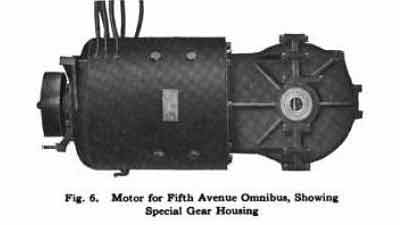
“The two electric motors are of the GE-1026 back-geared
type, rated at 125 volts, 30 amperes. These are practically small railway
motors having the back gear brackets and supporting lugs all cast on the
magnet frame in a one-piece steel casting. A hardened steel herring bone
pinion, with teeth of large pitch, meshes with a phosphor bronze gear, both
being enclosed in an aluminum alloy housing which is grease tight. All
bearings are waste-packed lubricated. Provision is made on the inner end of
the countershafts for motor brake drums.
“The gasoline engine which is used to drive the
generator is of special design, and is of the 4-cycle type with 4 cylinders,
each 5 in. by 5 in. It is rated at 27-30 h.p., and weighs about 700 pounds
complete. All valves, both intake and exhaust, are located in the cylinder
heads, which arrangement tends to high efficiency and power for a given
displacement.
“The chassis or running gear of the new gaso-electric
omnibus is designed and made specially for the purpose. The following is a
short description of its principal features:
“The running frame is of double armored wood with
pressed steel cross members, all hot riveted with stout gussets and corners.
The sub-frame for the engine and generator has three points of suspension,
which arrangement relieves the motive unit from undue twists and strains.
Both electric motors are suspended from a strong cross member, side by side,
somewhat forward of the rear axle. As has already been stated, each motor is
complete with back gearing. Transmission from the motor countershafts to the
driving wheels is by roller chain of 1½ in. pitch, and the total ratio of
reduction of gears and sprockets is about 14½ to 1. Long half springs
support the omnibus at front and rear in an effective manner, resulting in
easy riding. Steering and driving wheels are of artillery design, 34 and 40
in. diameter, respectively. The tire equipment consists of four inch single
solid motor tires for the steering wheels, and three and one-half inch twin
tires of the same kind for the driving wheels. The front axle is a steel
forging, the steering wheels being mounted on pivots of the inverted Eliot
type. An axle of the built-up construction is used at the rear. This
consists of a large steel tube with heavy walls, on each end of which is
securely fastened a steel casting, forming not only anchorage for the main
driving wheel brakes but a support for the axle arm stubs. All wheels run on
conical roller bearings. The chassis has a wheel base of 168 in., with front
and rear wheel gauges of 67½ in. and 72½ in., respectively. There are two
independent sets of brakes of liberal dimensions. A foot pedal operates the
two motor brakes, while a hand emergency lever actuates two large internal
brakes on the driving wheels. Steering is effected in the usual manner by
means of a hand wheel operating through gear and sector.
“On trial tests, the first gaso-electric omnibus
chassis, with a load of 6,500 pounds, was run up grades of 12 to 15 per
cent, without stalling. At this time the two motors were in series
connection. For grades of 4 to 5 per cent, it was not necessary to change
from the parallel position.
“It is thought that there is a large field for the
equipment which the General Electric Company has developed, and the
operation of the new omnibuses is being watched with much interest.”
March 3, 1909 New York Times:
“WOULD BAR RIVERSIDE 'BUSES; Chauffeur Arrested in a Test Case to Oust
Them.
“A test case was begun in the Morrisania Court yesterday as to the right
of the Fifth Avenue motor omnibuses to use Riverside Drive. Park
Commissioner Henry Smith contended that the 'buses were so high that the
low-hanging limbs of the park trees along the drives were injured.
“Recently the Park Department issued an order that no vehicles more than
ten feet high should be allowed in the Drive, and accordingly the Park
Commissioner on Feb. 15 had Eugene Schellenberg arrested for running one of
the big twelve-foot double-decked Fifth Avenue ‘buses in the Drive.
“To the assertion of the Park Department in its order officers of the
Fifth Avenue Coach Company, which owns the Fifth Avenue ‘buses, replied that
it has a franchise from the State of New York giving it the right to
operated its vehicles in Fifth Avenue, Seventy-second Street, and Riverside
Drive, and that the vehicles in present use do not injure the trees of the
park nor endanger the passengers on top of the ‘buses.
“It is also asserted that the company has just purchased for $125,000
twenty-five additional vehicles with the purpose of extending the ‘bus
service up the Drive to 135th Street, and that this sum will be a dead loss
if the Park Commissioner’s contention is sustained.”
April 12, 1909 New York Times:
“STOP AUTO BUSES IN RIVERSIDE DRIVE; Many Chauffeurs Arrested When
Company Tries to Start a Stage Line There. VIOLATES NEW PARK LAW
Commissioner Smith Declares the Double-Decked Vehicles Damage the Trees
Along the Drive
“With the appearance in Riverside Drive yesterday afternoon of the
double-decked automobile stages belonging to the Fifth Avenue Coach Company,
the concern controlled by the New York Transportation Company, which runs
the Fifth Avenue Stage Line, the bicycle police promptly began to arrest the
chauffeurs of the vehicles, charging that they violating an ordinance of the
Park Board, which prohibits the use of vehicles on any road of a park or
parkway which are more than ten feet in height from the tread of the wheel
to the highest part. Any vehicle over that height, the park authorities say,
damages the trees.
“Before the day was over the schedule of the company, which had
undertaken to run the two-decked automobiles on a six-minute headway, was
shattered. Ten drivers with their stages and in many cases most of their
passengers went to the West 100th Street Police Station. The passengers sat
outside in the coaches while the drivers were arraigned....”
April 1909 Commercial Vehicle:
“MOTOR OMNIBUS SERVICE ON RIVERSIDE DRIVE
“THE first of a lot of new De Dion motor omnibuses
were put in operation in New York City in March on a route extending
from Washington Square out Fifth avenue, across town to Riverside Drive,
and north on that boulevard to Grant's Tomb and Claremont Inn. These
machines are the first of an order for twenty-five given by the New York
Transportation Co. to the De Dion factory in France. The first fifteen
have been landed, five more are on the ocean, and the rest are ready for
shipment. The chassis only are imported, the bodies being built in
Philadelphia by the Fulton & Walker Co. With the exception of a number
of minor improvements, all tending to the more satisfactory operation of
the machines, the vehicles are practically the same as those which the
company has been operating on Fifth avenue for more than a year and
which have given great satisfaction to both the operating company and
the public.
Up to the present time the service has extended
only from Washington Square to Seventy-second street and Riverside
Drive, but, with the additional equipment, the route has been extended
north on the Drive to One Hundred and Twenty-fifth street. This gives a
ride of 7½ miles for 10 cents, and makes one of the most popular and
attractive rides in the city, affording the only direct transportation
to the city's magnificent public park extending along the bank of the
Hudson River. The right to operate public stages on this route was
granted by the State under a franchise acquired by the New York Coach
Co., a subsidiary organization controlled by the New York Transportation
Co., during the governorship of Theodore Roosevelt, the ex-President.
The same franchise gives the right to run stages as far north as the
Harlem River at One Hundred and Fifty-fifth street.
“Although the operation of the new motor 'buses,
which replaced the decrepit old horse stages formerly run on the Fifth
avenue route, has proved increasingly popular with the public, which
patronizes them liberally, the Park Board controlling Central and
Riverside Parks and the streets contiguous thereto for a distance of 350
feet from the park edge, recently passed an ordinance prohibiting the
running on the parkways of vehicles of a greater height than 10 feet.
Practically the only vehicles affected by this order are the motor
omnibuses, which have a height of 12 feet to the top of the rail that
encloses the seats on the upper deck. The order is clearly aimed at the
'buses with the object of excluding them in this way from enjoying the
privileges granted by the State franchise, the reason given by the Park
Commissioner for the move being that the 'buses, because of their
height, injure the branches of the trees along the driveways. The matter
is now being tested in the courts of the city, the driver of one of the
'buses having been arrested and the case continued, to come up later for
trial.
“Meanwhile, the company intends to continue running
the motor 'buses as planned, said President Richard Meade, of the New
York Transportation Co., when seen by a representative
of The Commercial Vehicle. Mr. Meade pointed out the absurdity of the
allegation that the 'buses injure the trees, making it evident that the
upper seats could not be occupied by passengers if the branches hung low
enough to be damaged by the vehicles. He also called attention to the
fact that the machines used in New York are identical in general form
and dimensions with the public conveyances that are used by thousands in
London, Paris, Berlin and other European cities where they are
recognized as standard, and that similar 'buses are operated on the
famous Champs Elysees and other boulevards of Paris which are bordered
by magnificent chestnut trees that are the pride of the capital.
“In some of the European cities motor 'buses are
operated which are fitted with an ‘imperial,’ or roof, covering the
seats on the upper deck and which increases the over-all height to 15
feet. It is further asserted by the officers of the company that the new
self-propelled omnibuses on Fifth avenue and Riverside Drive arc no
higher than the old horse-drawn stages which it operated for twenty
years on Fifth avenue, and which were withdrawn and replaced by the
modern form of transportation after years of criticism and ridicule
directed at the antiquated horse service.
“These and other arguments are being incorporated
in the answer which the attorneys for the company arc making to the
charge brought by the Park Commissioner against the company in the case
now pending. As this is the first case of its kind in America directed
at the operation of motor omnibuses, it will be watched with interest
because of the precedent which it will establish. If a park board can
enforce such a ruling, it is probable that one of the same nature can be
enforced by a board of councilmen for an entire city, which would
prevent the operation of motor 'buses of the double-deck type anywhere
in the city where such action might be taken.
“Secretary William H. Palmer, of the New York
Transportation Co., speaks with enthusiasm of the service that the De
Dion 'buses are rendering. They have been operated continuously through
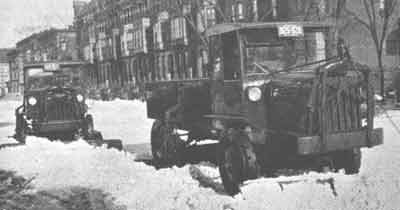
two winters without serious interruption even during heavy snowfalls;
have not been the cause of serious collisions due to careless operation,
failure of brakes to hold, or as a result of skidding; have developed
only a few minor objectional constructional features that have been
corrected in the new ones now being added to the service, and have not
been the object of complaint by property owners anywhere along the
routes covered, Mr. Palmer asserted. The company is especially pleased
with the fact that they are very easy on tires, despite the great weight
that the tires have to carry. This is attributed to the construction by
which the weight of the driving parts is removed from the rear axle and
carrier! by the springs. Some of the Goodyear tires that were fitted to
the first machines put in operation in October, 1907, are still in use,
having run 15,000 miles, and evidently having enough rubber left for
5,000 more miles.
“The twenty-five new 'buses are being equipped
chiefly with Hartford tires, a contract having been given recently for
twenty-five pairs of single tires for the front wheels and an equal
number of twin tires for the rear wheels, constituting the largest
single order for motor omnibus tires ever placed in America. It is a
‘repeat’ order, as many of the earlier vehicles were already fitted with
Hartfords. Not all of the tires on the new 'buses will be Hartfords,
however, as about ten spare rear wheels and half as many front wheels
are held in reserve to be supplied in case of damage to tires or wheels
on 'buses in use.
“Consequently, a considerable number of Goodyear
tires will be put on the new machines, while a very large proportion of
them are fitted to the thirty vehicles of this class previously put in
operation.
“The company is operating ten American-built
gas-electric omnibuses, constructed by the General Electric Co., and
fully illustrated and described in the November, 1908, issue
of The Commercial Vehicle. These machines are particularly economical of
tires, due in large measure to the flexible electric drive which permits
of gradual pick-up of the load in starting after the frequent stops. The
electric transmission, with its smoothness of operation and freedom from
noise, is especially pleasing. Most of the troubles that have taken the
cars out of service temporarily have been due to the gas engines, which
were in the nature of experimental motors, built quickly for this
especial purpose, because no other of suitable type were available
within the required time. These are now being replaced by De Dion
engines, this make having been selected because of the satisfactory
service the engines in the imported 'buses have given, and also with the
object of having the equipment as much alike as possible, which has its
obvious advantages in the repair shop and garage.”
December 6, 1909 New York Times:
“Fifth Ave. ‘Bus Profits; Report To Utilities Board Shows Annual Returns
of $144,700.
“The first annual report of the Fifth Avenue Coach Company to the Public
Service Commission, covering the year ending June 30, 1909, was issued
yesterday. This company operated the electric stage coaches in Fifth Avenue.
“The company has a total investment of about $400,000. total revenue from
passengers carried comes to $369,405; total expenses of bus operation to
$225,566, leaving a gross income of, approximately, $144,700. There is
marked off to depreciation about $65,595.”
February 15, 1910 New York Times:
“New York City Park Commissioner Stover:
“I have most decidedly not ‘eagerly granted’ the Fifth Avenue Coach
Company permission to resume it route up Riverside Drive. What I did was to
allow it to go up to Seventy-ninth Street, then cross the Park and up the
west side. As for hurting or detracting from the beauty of Central Park. I
won’t even destroy the spirit that broods over it.”
The December 8, 1910 issue of the Automobile reports:
“ACCORDING to announcement made by Mr. Lascaris,
manager of the American branch of the De Dion-Bouton Company, shipment has
been made direct from the factory of the De Dion-Bouton Co. at Puteaux,
France, to Manila, P. I., of the cars purchased last September by the Bureau
of Insular Affairs of the War Department on the recommendation of Mr. W.
Greene, Director of Public Works in the Philippine Islands.
“This shipment comprises three 8-cylinder, 50
horsepower cars for mail and passenger service, four 40-horsepower trucks,
one double-decker 34-passenger auto-bus, a duplicate of the auto-buses used
by the Fifth Avenue Coach Co. on Fifth avenue, N. Y., and four trailers of
two tons each carrying capacity.
“The omnibus and the trucks are provided with a
4-cylinder. cast separate, motor of 120 millimeter bore by 130 stroke :
high-tension Bosch magneto, and except for the radiators and hoods, which
are of the same design as those used on the 8-cylinder cars, the
construction of these vehicles does not differ from the usual De
Dion-Bouton cars.”
May 30, 1911 New York Times:
“CAN'T ADVERTISE ON 'BUSES.; Supreme Court Decides Against the Fifth
Avenue Conveyances.
“WASHINGTON, May 29. -- No advertisement signs will adorn the outside of
the omnibuses on Fifth Avenue, New York, hereafter.
“The Supreme Court of the United State to-day upheld the
constitutionality of the city ordinance against such advertisements.
“The question of the advertising signs on the Fifth Avenue stage came up
in the Fall of 1907. The Corporation Counsel had caused the arrest of the
driver of a stage on the grounds that the carrying of advertisements was in
violation of Section 41 of the City Code of Ordinance. Which prohibits ‘any
advertising truck, van or wagon being operated or driven on the streets of
the Borough of Manhattan’ under penalty of a fine of $10.
“The Fifth Avenue Coach Company applied on Sept. 4, 1907 to Supreme Court
Justice Leventritt for an injunction restraining the city from interfering
with its signs on the ground that the ordinance was unconstitutional. It
also argued that it made $10,00 a year by letting space on its stages.
“On Jan. 18, 1908 Justice Leventritt refused the injunction, and declared
that he could not authorize a breach of the city’s ordinances even if
thereby money would be made. He also pointed out that the signs were painted
in startling colors with no thought of artistic effect.”
November 24, 1911 New York Times:
“LOSS FOR FIFTH AVE. 'BUSES.; Show Deficit for Year, Though Carrying
Nearly 6,000,000 Fares.
“Running motor buses along Fifth Avenue does not appear to be a paying
business, according to the annual report of the Fifth Avenue Coach Company
for the year ended June 30, given out yesterday by the Public Service
Commission. It operated at a net loss of $34,761, though it took in $599,737
in fares, made $13,002 from its livery service, $17,875 from advertising,
and had a total revenue of $631,310.
“The company carried 5,997,372 passengers and the average amount each
omnibus eared fore each mile it ran was 44.28 cents, but the running
expenses were very heavy. Reckoning that the life of each of its eighty
buses is only three years, the company wrote off to its depreciation account
$101.511, and the cost of conduction transportation was $249,989. Then the
item for new tires alone came to $67,563, so that, though the number of
passengers increased by 242,151 and the number of round trips was decreased
by 22,987, the result of the year’s operations was deficit.
“This it was explained at the commission, is more apparent that real on
account of the steady building up of the company’s reserve. An allowance for
damages and injuries at the rate of 3 cents a bus mile is charged, and this
totals $41,080, more than double the amount set aside in 1910, but actually
only $19,092 was expended in this account. The accidents for which this fund
will have to be used consisted last year of one death and thirty-four
injuries.”
July 1912 Power Wagon:
“Motor Buses in New York.; A Service Which Would Be Highly Profitable
With American Machines. By P. C. JENNINGS.
“Introduction.—Although the motor bus Service In New York, according
to the bookkeeping figures of the operating company shows a small
deficit for the year 1911, an examination of the statistics herewith
presented proves that this deficit is more apparent than real. With
receipts at 47.08 cents per bus mile, all other precedents in motor bus
operation prove that there should be a handsome profit on the
undertaking. The depreciation charge of 33 1/3 per cent on the buses and
motors is not justified by any other known example of public motor
vehicle operation on such a scale under similar conditions. This
depreciation charge, which is a purely arbitrary book account, amounts
to the enormous sum of $112,583.28 for the year 1911. A reduction of
this charge to 20 per cent — still a very high figure — would convert a nominal book
loss of $38,820.89 into a profit of $6,212.42. The figures given are not
complete enough to permit of a correct cost accounting of the service,
but it is quite certain that the deficit is only a book loss. There are
some other points it is well to add here. The machines are imported, and
thus subject to a high import tax. All spares must be imported, and the
loss of time which must necessarily accrue in many cases is undoubtedly
one of the reasons why only an average of 54 out of 80 buses are in
constant service. There is no good reason why at least 70 machines
should not be always available for the road. If this were the case, the
presumed increase in revenue would be nearly $180,000, against which
there would be only a comparatively small increase in working expenses,
as depreciation, fixed and administrative costs would remain practically
the same as before. It is worthy of note that De Dion-Bouton buses of
Identical design are giving a profitable account of themselves in London
and Paris, where they are employed in greater numbers than in New York.
No reflection is intended here on the proved abilities of President
Meade. Probably the chief reason for the deficit, as pointed out by Mr.
Jennings in his article, is that the company is a subsidiary of the
Metropolitan Street Railway Company, and ‘does not care to appear too
prosperous.’—The Editor.
“OF THE THREE methods of surface transportation in New York City,
street railways, cabs and motor buses, the street railways are so far
ahead in numbers carried that no comparison is possible with the other
methods. The cab service is second in numbers carried and the motor
buses third, though not greatly inferior to the cab service. The motor
buses are thus by no means as proportionately popular as in London, and
they do not cut a very important figure in the city transportation,
although their annual haul amounts to over six million passengers.
“Various reasons are ascribed for the failure of the motor buses to
carry a larger amount of traffic, among them being the difficulties of
securing franchises, opposition of the public to having the streets
filled with vehicles so large and ungainly, veritable camels of
transportation, and the fact that as a business proposition bus
transportation under the methods employed in New York is far from being
as profitable a means of conveyance as street cars and cabs. The surface
car carries a greater number of passengers over far greater distances at
greater speed and with less expense, while the cab derives a greater
revenue per passenger and gives a higher value in transportation than
the bus.
“In New York City there is but one company of any consequence. It is
now known as the Fifth Avenue Coach Company. This company showed a
deficit for the year 1911 of $38,820.89, and this in spite of the fact
that heavy traffic was carried largely under a three minute headway.
“The company operates several lines of buses, mostly from Washington
Square up Fifth Avenue and branching off in a number of directions. The
various routes are given in full later in this article. The mileage of
the longest route, from Washington Square to 135th Street and Broadway,
is between seven and eight miles, and the total mileage of the routes
covered is slightly over 19 miles.
“The buses carry 35 passengers, and make an average speed of 7.2
miles an hour, including stops, which is about the speed of a trotting
horse driven to a buggy at a good clip without stopping. The average
time lost in making stops is about half a minute, although considerable
time is lost by traffic delays, particularly along the central portion
of Fifth Avenue from Twenty-third to Fifty-ninth Streets.
“The buses are very popular with visitors and sightseers because the
principal routes of travel are up Fifth Avenue, past the houses of the
wealthy, including the residences of the Astors, Vanderbilts, Carnegie
and others, and along ‘Millionaire's Row’ on the east side of Central
Park and also up Riverside Drive on the west side, past the Soldiers and
Sailors' Monument. Grant's Tomb and Riverside Viaduct.
“The buses are mostly double-deckers, and the upper deck offers
unexcelled facilities for sightseeing, superior even to the special
sightseeing or ‘rubberneck’ buses devoted to that particular purpose and
operated by private owners and small corporations. Riding on the upper
decks of the Fifth Avenue buses is a sort of exercise in itself, since
any small inequality in the street is magnified, and the sensation is
not unlike that of riding on a camel or an elephant.
“As will be seen from the illustrations, access to the upper deck is
gained by an exterior stairway at the rear, a rather dangerous looking
climb, but one which on that account perhaps does not prove particularly
so as passengers are put on their guard and exercise greater caution
that would ordinarily be the case. During rainy weather the upper decks
are exposed so that travel is considerably cut down at such times.
“There is a large traffic carried by the bus lines of residents of
New York who ride simply to take the air, as the ride is undoubtedly one
of the most interesting and enjoyable that it is possible to take in the
city. On Sunday there is always a great rush of business, the bus line
forming the principal route to the Metropolitan Museum of Art in Central
Park.
“The buses were formerly horse drawn, and were at that time most
primitive looking affairs with small seating capacity. The passenger was
compelled to deposit his own fare in a small box at the front of the
coach, receiving change from the driver through a small hand hole from
the front. The present buses, while considerably larger, are by no means
all that could be desired. They have, however, conductors to whom the
fares are paid. The coins are dropped into a small metallic box attached
to their persons, a tiny bell being rung at the same time.
“The change from horse drawn to gasoline motor buses was made about
twelve years ago, and the fare was at the same time increased from five
to ten cents. The traffic increased slightly in spite of the added fare.
“The horse drawn buses carried advertisements on the exterior, and
the motor buses have attempted to do so, and recently another effort was
made to display advertisements on the exterior, as was also done by the
receiver of the Second Avenue Street Railway, which runs the blue lines
of street cars, but these efforts were promptly discouraged by the city
authorities.
“A few years ago the motor bus operators experienced considerable
difficulty retaining their Riverside Drive route, because the trees
along that thoroughfare interfered with the cars, but after a while the
trees were pruned and the traffic was allowed to continue, although a
determined effort was made by the wealthy residents of the drive to
prevent the continuance of the bus line. The buses are not, however,
allowed to invade the parks.
“A considerable part of the objection raised to them is due to their
inartistic and clumsy outlines, as they are heavy and ungainly in
appearance and look stuffy and crowded. They appear to be a sort of
traffic juggernaut, but as a matter of fact they do not prove in
operation to be particularly dangerous, as compared with other methods
of street transportation. During 1911 five persons were struck by the
buses, of whom three were killed, while 25 persons were injured in other
ways, mostly passengers hoarding and alighting from the cars. Damages
paid during the year 1910 for injuries to persons amounted to
$35,996.44, while damages to property amounted to $3,999.59, mostly in
collisions with other vehicles. During the year 1911 there were filed 51
damage suits, while there were 23 suits for claims and damages against
the company up to June 20, 1911. Forty-four of these were settled
subsequent to June 20, and 30 remained unsettled.
“It will be seen from these figures that the operation of the buses
is carried on in as safe a manner as can well be asked, especially
considering the great weight of the vehicles, the crowded condition of
the streets and the heavy traffic carried. The appearance of the buses
themselves is one of the causes for the safety with which they are
operated. They are large green monsters which approach with considerable
noise, and are well calculated to strike terror to all other occupants
of the highways. They appear far more dangerous than a street car or
even an automobile going at a high speed, and the pedestrian holds them
in no little respect, exercising good care to dodge them, which is,
indeed, a wise precaution, for while few persons are struck, the killing
of three out of five of those that were struck during the year shows
that it is no chance to be taken lightly.
“It would appear that the buses would do well to be fitted with
fenders or cowcatchers, after the manner of a new type of street car
that is being tried out in New York. In this form of street car the
entrance is through a door at the middle of the side of the car and the
main floor is but one short step above the level of the street.
“There is no good reason why the present motor buses could not be
similarly arranged, as at present the first passenger floor is as high
as, if not higher, than that of the ordinary street car, while the upper
deck towers above everything on the street. A lowering of at least two
feet could be easily accomplished. This would greatly lessen the weight
of the vehicles, which now amounts to 9,500 pounds. The lessening of
weight would make their operation much more economical through lessened
fuel consumption, since the mere hauling around of so much lumber
amounts to a large sum annually. Their handling would be facilitated and
their speed increased without an increase in the size of the motors.
“Wear and tear would also be greatly reduced and a great saving made
in tire expense. This at present amounts to $2.21 per day per bus. This
is figuring the total number of buses in service, 80 in all, but as an
average of only 34 buses are in service, the remainder being in reserve
or under repair, the daily tire cost for actual service is $3.43 per
bus. The tire cost for the year amounts to $67,563.96, or $844.55
for each of the 80 buses. Any appreciable saving in this respect would
be an important item, for as the gross receipts of a bus average $30.59
per day it will be seen that the tire expense is more than 10 per cent
of the gross receipts.
“A considerable saving should result in this department with a
lighter and better designed bus. A low, rakish, roomy, easily accessible
bus, with a prow or fender such as is used on the form of street car
mentioned above; one of a design that would please the eye and give an
appearance of speediness and style, would not only thus be highly
desirable from an economical point of view, but would increase the
patronage of the lines, its psychological effect inviting greater
traffic. At the present time, the lines of pleasure cars are highly
developed and have reached a point from which nothing further can very
well be expected, but such is not yet the case with motor buses and
trucks, which appear unnecessarily heavy and cumbersome. The prospective
passenger has to summon a good deal of moral courage to stop a Fifth
Avenue bus. It becomes almost an event in his life. It is as if a
mountain were rolling up and an entire reorganization of the surface of
the earth were necessary to get him aboard and started on his way again.
This of course is much more apparent than real, as the buses can stop
within ten feet if necessary and are quickly under way, but the
appearance of a great operation is there, and the passenger, once on
board, is considerably relieved; but when the time for alighting comes
his nervous tension increases and he begins to make preparations several
blocks in advance, and is much worried for fear he will never get safely
on the ground again. All this has a great effect on traffic, since the
average person would rather walk half a dozen blocks than go through the
process of hailing a bus and getting off again.
“A speedier looking bus, stopping and starting more gracefully, and
built on better lines, would undoubtedly change the operations of the
company from loss to profit and perhaps considerable profit, while being
a great benefit to the city in every way.
“The present buses have a life of only three years. Their cost is
$5,400, so that the depreciation charge is quite high. This is one of
the principal causes why the lines do not show a profit. With lighter
vehicles, the depreciation and garage expenses would be very much less.
“During 1911 the buses made some 153,609 round trips, carrying
6,305,175 passengers, so that there was an average of 41 passengers
carried per round trip. The average receipts of the buses in service
amounted to $30.59 per day, while 26 buses on the average were idle,
being in reserve and undergoing repairs and renovation.
“The gross receipts amounted to 47.08 cents per bus mile, or 1.36
cents per bus seat per mile. As the blocks in New York run 20 to the
mile along most of the route this means that a new passenger was taken
on about once every three blocks.
“The daily earnings of the line amounted to $1,652.54. The 54 buses
in active service make each 2,844 round trips a year, or 7.7 round
trips per day. The average number of hours a bus is in service during
the year is 2,222, or 6.1 hours per day. This applies to the whole 80
buses. Each bus in active service, that is, each of the 54, averages
23,716 miles in a year, which is 64.9 miles a day, or 7.2 miles an hour.
The average number of hours that the 54 buses in active service travel
in a year is 3,293, or 9.01 hours per day, making 64.9 miles, or the
average of 7.2 miles per hour in service.
“The number of passengers carried in each bus is limited to the
seating capacity and no one is allowed to stand in aisles or on
platforms, except where a passenger has been deprived of his seat after
paying his fare. Children in the arms of adults are carried free. Hand
baggage is also carried free, but the company assumes no responsibility
for the safety of baggage or other property.
“The company employs 277 men, of which 80 are conductors, 80 are
drivers and 115 are in the garages. The wages amounted to $218,326.03
last year. Any material saving in this department would result in
turning the balance sheet well toward a profit.
“Two repair shops are maintained by the company, the principal one
being located at the main garage, Eighty-eighth to Eighty-ninth Street,
between Park and Lexington Avenues. This main shop is equipped with
three lathes, two grinding machines, two planers, a milling machine, a
shaper and two drill presses, besides other small machinery necessary in
making repairs.
“Of the 115 men employed outside of the men conducting the traffic,
12 are cleaners. A large number of the men are engaged in overhauling
the buses, as they are repainted and gone over thoroughly once a year.
“The location of the main shop and garage is placed at a favorable
point, about midway of the routes of traffic. The smaller repair shop is
near the lower end of the line.
“The routes of the company are mainly up Fifth Avenue branching off
into four great stems, and penetrating the most desirable and
interesting residential parts of the city, furnishing a means of travel
between the shopping and residential districts.
“There are ten routes at present, no new ones being added during the
past year. The routes are as follows:
(1) From Washington Square up Fifth Avenue to Ninetieth Street. This
is a direct line up Fifth Avenue and passes along ‘Millionaires' Row,’
that is, the east side of Fifth Avenue from Fifty-ninth Street to
Ninetieth Street, adjoining Central Park. At Fiftieth Street is St.
Patrick's Cathedral and on either side of the avenue are noted
residences, the Plaza and Gotham and St. Regis Hotels, to Fifty-ninth
Street, where the park begins.
(2) From Washington Square up Fifth Avenue to Fifty-seventh Street,
where the line crosses to Broadway, goes up Broadway to Seventy-second
Street, thence across to Riverside Drive, past the Soldiers and Sailors'
Monument, Grant's Tomb, over the Riverside Drive viaduct to 135th
Street, crossing to Broadway. This route affords a splendid view of the
west side of the city and runs for several miles along the Hudson River.
(3) From Washington Square up Fifth Avenue to 110th Street, being an
extension of route No. 1; westward on 110th Street, which is the
northern boundary of Central Park, to Riverside Drive and thence to
135th Street and Broadway along the route of No. 2. This route adjoins
the east and north sides of Central Park and the south side of
Morningside Park, with a splendid view of the new cathedral of St. John
on Morningside Heights and Columbia University.
(4) A limited portion of route No. 2, up Fifth Avenue from Washington
Square to Fifty-seventh Street, thence over to Broadway, up Broadway to
Seventy-second Street and thence across to a terminal point at
Seventy-second Street and Riverside Drive, the lower end of the drive.
Many leave the bus at this point to walk up the drive.
(5) From Washington Square up Fifth Avenue to 120th Street, thence
westward a short distance and up Mount Morris Park west to 124th Street,
back to Fifth Avenue and up Fifth Avenue to 135th Street. This route
circles three sides of Mt. Morris Park, but is not as interesting as the
west side routes.
(6) From Washington Square up Fifth Avenue to Seventy-second Street
and eastward to First Avenue.
(7) From Washington Square up Fifth Avenue to 110th Street, west to
Seventh Avenue, up Seventh Avenue to 153rd Street to Central Bridge over
the Harlem River, via Macomb's Dam Road.
(8) From Washington Square up Fifth Avenue to 110th Street, thence
via Manhattan Avenue, St. Nicholas Avenue, St. Nicholas Place, 155th
Street Viaduct to Central Bridge. This is a route somewhat more westerly
than No. 7. and affords a good view of the Harlem River, Jumel mansion,
speedway and polo grounds, as well as the University of the City of New
York.
(9) From Washington Square up Fifth Avenue to Fifty-seventh street,
thence via Broadway to Central Bridge.
(10) From Washington Square south along South Fifth Avenue, now known
as West Broadway, to Bleecker Street. This is a short route in a
tenement and manufacturing district.
“The routes all follow Fifth Avenue, since that is the only
longitudinal avenue in the city without railway transudation, street,
elevated or subway. In addition, there is a short spur to the Queensboro
Bridge at Fifty-ninth Street and East River. An excellent knowledge of
the middle and upper portions of the city is gained from traveling the
bus routes.
“The following table gives the principal statistics of the various
lines during 1911:
|
|
Fifth Ave. and East Side |
Fifth Ave. and West Side |
Queensboro Bridge |
other small routes |
total |
|
Passengers carried |
2,985,175 |
2,707,664 |
549,954 |
62,382 |
6,305,175 |
|
Amount of passenger fares in $ |
298,517 |
270,766 |
27,497 |
6,238 |
603,019 |
|
Average number of buses per day |
23 |
21 |
9 |
1 |
54 |
|
Round trips during the year |
70,132 |
65,018 |
15,904 |
2,555 |
153,609 |
|
Bus miles during year |
557,316 |
646,565 |
56,185 |
20,598 |
1,280,664 |
|
Bus seat miles |
18,948,744 |
21,983,210 |
1,910,290 |
700,332 |
43,542,576 |
|
Bus hours traveled |
82,624 |
85,164 |
7,041 |
3,003 |
177,832 |
“The number of bus seat miles taken in consideration with the number
of passengers carried indicates that it was necessary to carry a seat
6.9 miles for the accommodation of a passenger, the proportion of vacant
seats being indicated by the difference between this figure and whatever
length of the ride the passengers actually averaged, which, of course,
is not ascertainable.
“The amount charged to depreciation of vehicle service was
$101,511.53. Wages were $218,326.03, cost of tire renewals, $67,563.96,
and maintenance and equipment, $99,809.62. There was a net loss of
$38,820.89 for the year 1911.
“An itemized statement of the operating expenses for 1910 shows, in
an interesting way, the division of costs among the various departments.
“Maintenance
|
Superintendence |
$ |
3,424.32 |
|
Repairs of bodies |
$ |
14,387.98 |
|
Repairs of running gear |
$ |
13,462.75 |
|
Repairs of transmission |
$ |
24,105.94 |
|
Repairs of motors |
$ |
18,083.86 |
|
Repairs of buildings and factories |
$ |
4,288.91 |
|
Repairs of shop tools and machinery |
$ |
883.52 |
|
Tires |
$ |
55,125.76 |
|
Other expenses |
$ |
574.91 |
|
Depreciation of vehicle equipment |
$ |
112,583.28 |
|
|
|
|
|
Total (maintenance) |
$ |
246,921.23 |
“Conducting Transportation
|
Superintendence and clerks |
$ |
4,731.17 |
|
Starters, receivers and inspectors |
$ |
8,819.51 |
|
Oilers and washers |
$ |
7,395.92 |
|
Shifters and other garage laborers |
$ |
6,256.96 |
|
Drivers and conductors |
$ |
115,263.23 |
|
Gasoline |
$ |
37,360.61 |
|
Oil and waste |
$ |
6,744.58 |
|
Water |
$ |
378.90 |
|
Light for buses |
$ |
4,587.82 |
|
Light, heat and power |
$ |
3,006.51 |
|
Other garage expenses and supplies |
$ |
1,393.88 |
|
Rent of buildings and other property |
$ |
14,086.12 |
|
Damage to property |
$ |
3,999.59 |
|
Damages to persons |
$ |
35,996.44 |
|
Other expenses |
$ |
14,651.46 |
|
General expenses |
$ |
21,179.71 |
|
Total salaries of officers and clerks |
$ |
6,197.88 |
|
Insurance |
$ |
3,490.89 |
|
Stationery and printing |
$ |
783.69 |
|
Legal expenses |
$ |
7,576.37 |
|
Other expenses |
$ |
2,697.54 |
| |
|
|
|
Total operating expenses |
$ |
532,773.64 |
“The buses are equipped with 35-horsepower DeDion-Bouton motors, four
cylinder, vertical, 110 and 130 millimeters bore and stroke,
respectively. The life of the motors is taken as three years. Some of
the buses are chain driven, while the others employ different forms of
transmission. Various types of tires and wheels are used.
Charges for depreciation appear high, and the life of the buses and
motors short, but this may be more a matter of bookkeeping than a true
index of the cost, so that the company may in reality be in better
condition than its books seem to indicate.
“The officers of the company are Richard W. Meade, president and
general manager; Samuel E. Morrow, auditor and assistant secretary, and
George L. Willems, assistant treasurer. Arthur H. Kink is the company's
attorney.
“The company has a legislative franchise which was issued on June 2,
1886, to the New York Transportation Company. This franchise was
confirmed in 1900 by legislative action, Chapter 657, of the laws of
1900.
“A license fee of five per cent of the gross receipts is paid to the
city for its franchise rights. The company is capitalized at $50,000 and
was incorporated in 1886. It has no bonds outstanding and its franchise
is perpetual.
“The lines are now operated by the Fifth Avenue Coach Company, which
has outstanding 30,000 shares of stock $100 par value amounting to
$3,000,000. On June 10, 1910, all the stock was held by the Metropolitan
Street Railway Company, except the director's classified shares. The
lines thus are supplementary to the surface railway system. The total
voting power of all the members of the company is 300. The stockholders
number ten and all reside in New York State.
“No dividends were declared during the year 1911, owing to the
deficit above noted. It would seem likely, however, that the deficit is
more apparent than real, as the company, being a subsidiary of the
surface lines and charging ten cents fare over a route that was formerly
five cents with horse drawn vehicles, probably does not care to appear
too prosperous, lest a demand arise for a reduction of the fare to the
former figure.”
Volume 15 of the General Electric Review, published
in 1912, included an article by H.S. Baldwin, an engineer in General
Electric Company’s Automobile Motor Department. The article, ‘Some
Special Applications of Gasolene-Electric and Storage Battery Automobile
Equipments’ included pictures and a short description of the system
produced by G.E for the Fifth Avenue Coach Company:
“The specially designed generator of light weight and
high overload capacity has been successfully employed in conjunction with
electric motors, to replace the regular change gear box on vehicles for
passenger and mercantile service. A number of examples descriptive of this
development are herewith briefly cited. While this form of drive and control
is as yet not widely known and appreciated, it has been proven entirely
practicable, and the possibilities of the system in the near future are
exceedingly attractive.
“Fifth Avenue Gasolene-Electric Omnibuses
“Over three years ago ten gasolene-electric omnibuses,
equipped with the General Electric system of drive, were placed in
commission on Fifth Avenue, New York City, and with the exception of a short
interval, have been in regular operation since that time. Records show that
they have covered to date an aggregate of 350,000 miles. They are run daily
over the same route with other gasolene vehicles of practically the same
design, capacity, weight, engine and constructional details, but having the
regular sliding gear drive and clutch. It will readily be seen that an
unusual opportunity has been afforded for a comparison between the two
systems of drive, under identical conditions of service and when operated by
the same company.*
(*A description of the gasolene-electric busses will be
found in the General Electric Review for November, 1908)
“For years, numerous gasolene-electric systems have
been devised and tried out, both in this country and abroad, but as a rule
they have been too complicated to last. The Fifth Avenue record is without
doubt unique as to duration, and probably stands as the first instance of an
engineering and commercial success of the gasolene-electric road vehicle on
any considerable scale.
“One of the greatest difficulties found with mechanical
drive omnibuses, is the rapid wear of change gears and clutch rigging,
entailing high expense for maintenance, and what is almost as bad, noisy
operation. The frequent change of gear accompanied by the use of the clutch,
not always in skillful or careful hands, racks both transmission and engine.
As a result, acceleration is uneven, with excessive back-lash, in spite of
constant attention. It was to overcome these objections that the electric
drive was suggested and tried, and it is generally admitted as a result of
observation and experience that the claims of simple and easy control,
relatively low cost of maintenance, reduction of wear and tear of
transmission and engine, and smooth acceleration and quietness, have been
substantiated.
“Omnibuses of both types operate under the same
conditions of headway, although the later models with mechanical drive have
somewhat larger engines and are therefore more powerful. The mechanical
system has a slight advantage in fuel consumption, as was anticipated, but
this is practically negligible as compared with the factors already referred
to.
“The electrically driven omnibuses, as originally
designed, were equipped with two 125 volt, 30 ampere double reduction motors
and a 7½ k.w. generator which was specially designed for gasoline-electric
work, being provided with split poles and possessing exceptional overload
capacity for its weight.
“During the past year a single motor equipment has been
developed using a 125 volt, 60 ampere motor with a special gear housing on
its pinion end head to receive the bevel gear and differential of the
mechanical omnibus. This motor is interchangeable with the gear box and can
therefore be used to replace it. Omnibus No. 15, show in Fig. 5, is so
equipped, and also has the modified generator with double bearings. The
omnibus is in regular service on Fifth Avenue.”
November 7, 1912 The Automobile:
“NEW De Dion Bus — The Fifth Avenue Bus Company,
Aeolian Building, New York City, recently purchased a De Dion bus. Its
horsepower is 36, bore 110 millimeters, stroke 130 millimeters; the
wheelbase is 13 feet, and the weight 10,000 pounds. Its inside carrying
capacity is 25 and the outside is 22. It has three speeds forward and one
reverse. The above photograph gives a comparison of the old style of bus and
the new.”
December 1912 Power Wagon:
“MORE BUSES FOR NEW YORK.
“Sixteen new motor buses were recently installed in New York City by
the Fifth Avenue Coach Company. These machines are double-deckers and
have a capacity for 48 passengers, as compared with 34 for the old
double-deck buses and 32 for the single-deck vehicles put in service
about a year ago.
“The new buses, like the others, are mounted on De Dion-Bouton
chassis. They have 30-horsepower motors and have a carrying capacity,
including body and passengers, of 12,000 pounds. The bodies weigh about
3,000 pounds, so that an allowance of close to 200 pounds is made for
each of the 48 passengers.”
November 11, 1913 New York Times:
“BUS COMPANY PROSPERS.; More Coaches, More Trips, and Accumulated Deficit
is Cut.
“The Fifth Avenue Coach Company, one of the corporations which is trying
to obtain permission to extend the motor bus service of the city, for which
it at present holds the monopoly, has filed its report for its operations up
to June 30, 1913, with the Public Service Corporation. From this it appears
that the company made last year a net profit of $130,351.
“This was applied to the reduction of its accumulated deficit, and cut
that down to $286.057. During the year the company laid aside 33.33 per cent
of the cost of its equipment for depreciation, and also paid into a reserve
to meet claims for damages and injuries the sum of $66,034. The actual
amount paid out last year in payment of such claims was only $18,028, so
that it increased by $48,005 the reserve created to take care of these
possible liabilities. The reserve now is $142,941.
“During the last year the company increased the number of its ‘buses by
24 to 105, and made 81,325 more round trips. Altogether it operated
2,176,790 ‘bus miles, an increase of 735,949, and carried 8,884,534
passengers at 10 cents each, an increase of 2,545,462 passengers.”
November 30, 1913 New York Times:
“MODEL GARAGE THAT SAVES TIME; Home of the Omnibuses Has Rainbow Piping
and Many Other Improvements.
“Time saving and efficiency are vital factors in garage management on a
large scale. It was with the realization of this fundamental that the Fifth
Avenue Coach Company planned its new garage on East 102d Street, where there
is accommodation for about 150 big motor omnibuses, sufficient to take care
of the present lines on the eastern side of the city and allow for growth.
“Some of the devices installed to make the handling of cumbrous buses
less difficult ate ingenious and have a direct application in the motor
truck field. On the main floor, where the buses roll it, there is an
abundance of natural light, and the floor has been pitched so that drainage
is to a central grill, and the machines may be washed wherever they stand.
A row of tile-lined repair pits runs along the north wall. These are of
course, fitted with electric light and with pneumatic supply for power
tools, &c. At several points on the walls are gasoline outlets connected
with a huge fuel tank sunk in the floor, which is equipped with a settling
tank, in addition to the separator required by law. When a bus comes in its
fuel supply is measured with a dipping stick, and the new fuel put in is
also measured by a meter.
“One of the odd things that strike the visitor on this and the other
floors of the building is the brilliant painting of the exposed pipe system.
This is known as ‘rainbow painting’, and makes for simplicity. The red pipes
are the sprinkler connections; the aluminum, steam; green, gasoline; yellow,
electric wire carriers; and gray, compressed air.
“By this method it is possible to identify any desired pipe at once by
its color when there is a leak or other trouble. The practical value of this
identification can be realized if one will glance at the maze of pipes that
all look alike when they are exposed by a little excavating in the street.
“Opposite the main entrance of the model garage is the largest elevator
for vehicles in the city. It can handle the biggest bus with ease and
deliver it to any desired floor. There is also a passenger elevator near by,
and an electric dumbwaiter for sending up small parts or materials for which
the big freight elevator is not needed. On the upper floors are the body
shops for repairing, the room where the chasses are assembled as they come
from France and the forge shops. Overhead craneways make the transportation
of parts or even whole chasses about the floors an easy matter. On the north
side of the building one of the upper floors is the supply department where,
in steel bins, tier upon tier, are the spare parts for a dozen different
models of buses. The bins run into the thousands. In another part of the
building, handy to the machine shops, is a washing room where the larger
engine parts, such as clutches and the differentials are cleansed of road
dirt and grease in a huge bath of kerosene.
“Watchfulness has been found to be a paying habit in this modern plant so
that now every bus receives an overhauling at the pits on the ground floor
after each 1,400 miles of travel. Then, if necessary, it is taken down and
sent upstairs for more radical repairs. But by constant tuning up this is
rendered comparatively infrequent. Every bus, however, is taken down and
completely overhauled once each year.”
An article on Gasoline-Electric Vehicles in the 1914
edition of SAE Transactions makes brief mention of Fifth Avenue Coaches’
gasoline-electric DeDion-Bouton buses:
“FIFTH AVENUE BUSES
“Prof. W. C. Marshall: - How does the Fifth Avenue Bus
Company find that this electric transmission compares with the mechanical?
There is a case of buses running under the same conditions exactly, some of
which are running electrically.
“R. McA. Lloyd:—I think we have a pretty big subject
and that it is impossible to cover it all. There is not any doubt in my mind
that there are special fields for the application of the electric
transmission. I think that it was desired more ten years ago than it is now,
because people used to be afraid of sliding gears. Now everybody is used to
them and there is less demand for the electric transmission in the case of
the ordinary pleasure vehicle.
“There are inherent reasons why the electric
transmission cannot be a success as so far applied. It is never big enough
to transmit the power that you can get out of the engine.
“The transmission described by Mr. Parkhurst is
undoubtedly about the same thing as that on the Fifth Avenue stages. In the
system applied to some of these buses there is a 35 horsepower engine, a
7-kilowatt generator and two 3-horsepower electric motors. The best you can
get out of the two motors is 18 horsepower when they are slowed down to a
bus speed of about two miles an hour, at which time the engine develops 35
horsepower. If they put in a motor big enough and generators big enough to
chase the straight mechanical transmission over the streets, the weight and
cost of construction would be prohibitive. The system can be used only in
places where you do not object to going slowly on hills. It has been for
that reason more or less cut out of calculations on commercial vehicles,
excepting where it is difficult to get in a mechanical transmission.
“There is no particular advantage in an electric
transmission, it seems to me. A good many men would rather run a gas car
with a mechanical transmission than an electric car with an electric
control. The beauty of the electric transmission is that the motors respond
to the demands upon them; when you strike a steep hill they do not stop
going. On the other hand, you are converting all the mechanical energy into
electrical energy, with some loss, and back into mechanical, with some more
loss, and are bound to get greater consumption of gasoline over a long
period. The Fifth Avenue Bus Company gas-electric buses consume twenty-five
per cent, more gasoline in the long run than those with ordinary gear-box. .
If you look over the field you will find there are forty or fifty systems,
.and more coming out every day, particularly abroad, where they drive direct
part of the time. Something can be said in favor of the addition of a small
storage battery to help on hills. This can be charged going downhill. Here
there is the disadvantage of additional weight.
“I do not mean to say that I have exhausted the field,
but I have certainly investigated most of the systems that are known. I
think all have inherent disadvantages in the way of cost construction and
inefficiency, and that the only thing they offer is the possibility of a
little easier control, which I do not think is necessary, and certainly is
not in as great demand as it was ten years ago.
“M. R. Machol:—The hydraulic transmission with a
gasoline engine will enable you to get on the rear wheels any torque from
zero up to maximum, regardless of the speed of the gasoline engine. That is,
as long as the gasoline engine is running fast enough to overcome its own
internal friction, and give any appreciable power at all, the hydraulic
transmission will enable you to get any drawbar pull that you happen to
want. In climbing a hill it is not a question of horsepower; you can get up
any hill that the motor is capable of climbing if you have only two
cylinders going; on five or six horsepower you can climb the steepest hill
the truck is capable of climbing at any time. At the same time you still
have the absolute range of horsepower. I think that is an advantage.
“W. P. Kennedy:—What Mr. Lloyd says merely expresses
the opinion that the electric transmission equipment is very much more
expensive than the mechanical transmission. Yet when we consider the
commercial or manufacturing side, it must be recognized that when a device
is put out in experimental quantities, as is the case with these Fifth
Avenue gas-electric stages, the price of such equipment is bound naturally
to be very much higher than if it were the product of a very large factory
making a great quantity of machines.
We have heard that the operating cost is very much
higher than with the mechanical transmission in the consumption of gasoline.
My information may not be correct, but I am of the impression that when
the Fifth Avenue Coach Company undertook to place these electric
transmission buses on Fifth Avenue they were prompted to do so by the
existing high cost of mechanical transmission upkeep, and that when these
electric transmission buses went into service their cost of upkeep was
remarkably low. Therefore it would seem rational that even though the
gasoline consumption were higher than with the straight mechanical
transmission bus, if the cost of that increased consumption were not so high
as to compare unfavorably with the cost of mechanical transmission
maintenance, this ought to be given due weight.
“We also have, aside from the Fifth Avenue bus
application, considerable evidence of the practicability or utility of this
type of device in the Coupled Gear gasoline-electric machine. Of course that
is a motor truck or tractor, and it is not expected to go very fast. In the
majority of cases which I have been able to investigate, the service
rendered has been very satisfactory. I know of one case where a machine
having a gasoline-electric transmission did work in moving heavy weights
that never could have been moved with any other form except perhaps the
hydraulic transmission. An engineering contractor who wanted to transport
structural material and equipment from a railroad station over a nine-mile
course to a point where he was constructing a hydro-electric power plant,
used successfully a Couple Gear gasoline-electric tractor. He told me that
he never missed a single trip in his schedule of operation, and was able
with this machine on one occasion to transport something like fifteen tons
with the use of a trailer, up a 13 per cent, grade.
“Do we not condemn the gasoline-electric type of
machine for engineering or theoretical considerations rather than practical,
for instance, by laying stress, as pointed out, on the gasoline consumption
or some minor consideration without reference to its economy or
practicability as a whole? I would like to have Mr. Lloyd's expression on
that with reference to the Fifth Avenue bus case.
“R. McA. Lloyd:—I know that the
gasoline-electric-transmission buses cost several hundred dollars more than
those with mechanical transmission. I do not say it is impossible to reduce
the cost. In the meantime, the cost of mechanical transmission has gone down
enormously and the cost of the electric dynamo and motor has not gone down
very much.”
In 1914 the SAE held a discussion of electric
transmissions in which Percy K. Hexter, the designer of the Hexter
Gas-Electric truck and chief engineer of the Conklin Brothers’ Gas-Electric
Motorbus Corporation, presented his experience with gas-electric
drive-trains. The discussion included a reference to the Fifth Avenue Coach
Company's experience with their gas-electric buses. The following is
transcribed from a 1914 edition of SAE Transactions:
“P. K. Hexter: — I will give you from my experience
what I have found out about the gasoline-electric and my ideas upon the
particular points some of the gentlemen here have taken exception to. One of
the greatest difficulties I found in the mechanically-driven car was the
cost of upkeep, due to the inexperience of the man we had to drive it. This
was in the taxicab business. I started to look for something that would
eliminate the human element more or less. I investigated the Fifth Avenue
gasoline-electric buses. I found the company had fifteen buses, seven years
old, running. They are still running every day in the week. The trouble they
had was due entirely to the way the buses were driven, not to electrical
troubles. The same identical electric equipment is in there today that was
in the buses when they were first put out. The trouble was due to the gas
engines, springs and steering gears employed, some of which have been
replaced entirely by new units.
“Gas-electrics have been in use for five years as
five-ton trucks for the United States Express Company in Chicago. They have
been most successful.
“Relative to the upkeep of the gas-electric, as far as
gasoline consumption goes I will concede that if you take a straight
mechanically-driven car and a gas-electric car and put them on a level road,
where the former can run on direct drive and conditions are ideal, you will
find an economy of gas consumption in favor of the mechanical drive. But
this docs not hold good in practice. In tests we have made using the same
identical motor that the mechanically-driven has used, we ha\e shown a
better gas consumption than the mechanical drive has shown. The main saving,
however, with the gas-electric is in the upkeep of the transmission. Taking
the ordinary mechanically-driven car and figuring out the item grease alone,
I know that in the case of a car I used to sell and handle instructions were
given to the customers to fill the transmission case every month with
grease. It used to take thirty pounds of grease to fill it. When you follow
that up with the other items of expense and compare them with the case of
the electric transmission that does not have to be filled more than once a
year, there is a saving more than offsetting any disadvantages in gasoline
consumption.
“Design of the gas-electric and certain things
installed have brought down the gasoline consumption considerably. We made a
thirteen-day run in this city, eighty-four miles a day, with an average load
of four tons, the truck making eight scheduled stops to the mile. During the
time we had some of the severest weather. We never had to stop for any
mechanical or electrical trouble. I have some figures here which are
authentic:
Cost per bus per mile for City Type of bus operation and maintenance
|
City |
Motive Power |
|
Cost Per Mile |
|
New York |
Gasoline |
$ |
0.41.298 |
|
Paris |
Gasoline |
$ |
0.21.66 |
|
London |
Gasoline |
$ |
0.17.00 |
|
London |
Steam |
$ |
0.16.60 |
|
London |
Gas-electric |
$ |
0.14.264 |
“The London General Omnibus Company are operating a
number of Tillings-Stevens gas-electric buses; I believe the number is about
260. The Tillings-Stevens people guarantee a tire mileage on their buses of
14.000. It is impossible to start the bus off with a jerk.
“The main feature in favor of the gas electric from a
practical standpoint in ease of operation. The truck can be handled and
moved at the rate of one-sixteenth of a mile an hour, without any jerk
whatever. A speed of ten miles per hour can be obtained within ten seconds.
We have another factor of safety, that of bill climbing, or rather going
downhill. With an ordinary truck going downhill it is necessary to apply the
brakes: on a steep hill, such as that at Englewood or Fort George, it is
necessary to apply both the service and emergency brakes. In this type of
construction we can take the truck down a hill without any brake on at all.
In fact a man can get off the truck and practically lead the car down the
hill, by just putting a hand on the steering gear and guiding it.
“R. McA. Lloyd:—We refer to the fact that the Fifth
Avenue buses were badly designed, that that was the cause of the bad
results. The Fifth Avenue stage company knew all about that; in seven years
they have had time to find out what the matter was. If, in spite of the bad
chassis design, they had satisfied themselves that the gasoline-electric
transmission is all tight, they probably would be going further with it.
They had one that was not a bad design, a DeDion bus in which they
substituted a single electric motor for the transmission and added a
generator to the engine; that bus was a fair illustration of what could be
done. I think the whole trouble was that the bus did not have the animation
the mechanically-driven buses had. Neither the men who drove the buses nor
the people who rode in them liked them. I think they will never get any more
of that type than they have at the present time.”
The 1914 Fifth Avenue Coach Company Annual Report reveals:
“Stockholders and Members.— The number of stockholders at the end of the
year was reported as one; number of shares held by the New York
Transportation Company, 500.
“Important Changes During the Year.— Leasehold acquired on September 1,
1913, of garage, Nos. 4 to 20 East 102d street, New York City. The term was
for 20 years and 10 months with option of renewals. On February 6, 1914, the
company acquired $100,000 par value of Canadian Pacific Railway Company's 6
per cent note certificates, cost, $101,125.
“On June 1, 1914, a $5,000 mortgage on No. 643 West 130th street. New
York City, matured and was paid. During the year $12,750.60 was expended in
the reconstruction of the 88th street garage.
“George L. Williams was appointed Assistant Secretary, August 27, 1913.
“Officers.— President and General Manager, Richard W. Meade;
Vice-President, Herbert H. Vreeland; Secretary and Auditor, Samuel E.
Morrow; Treasurer and Assistant Secretary, George L. Williams; Claim Agent,
Louis Goldstein; Chief Engineer, G. A. Green. (H.H. Vreeland was formerly
president of the New York City Railway – 1908)
“Directors.— Philip I. Dodge, Andrew Freedman, Horace M. Fisher. Richard
W. Meade, W. Leon Pepperman, Henry Sanderson, Theodore P. Shonts, Herbert H.
Vreeland, Edmond E. Wise.
“Main Business Office.— 10 East 102d street. New York City.
Report verified by Richard W. Meade, President and General Manager,
September 30, 1914.
“Fifth Avenue Coach Company Rents Payable Charged to Operating Expeneee.—
Garage, 57-65 E. 88th street, payable to Margaret L. V. Shepard, (4,471.47;
garage, 4-20 E. 102nd Btreet, payable to New York Transportation Co.,
341,916.82; starter's booth, 90th street and Fifth avenue, payable to
Heracles Paragisticlis, $240; basement used by starters and crews, 244
Thomson street, payable to Italian Benevolent Institute, $300; storage lot,
Fifth avenue and 102nd street, payable to John J. Halleron, $200; general
offices, 33-35 W. 42nd street, $845.83, payable to Aeolian Co.; total,
$48,034.12.”
March 5, 1915 New York Times:
“FINER FIFTH AVENUE BUS.; Many Improvements in New Type of Passenger
Vehicles
“The Fifth Avenue Coach Company, which operates the buses on Fifth
Avenue, riverside Drive, and other thoroughfares, tried out yesterday a new
style of bus. They announced it to be ‘almost the last word in omnibus
comfort.’
“The heaters are under the floor, giving more foot room for the
passengers. There is a push button for each seat and double handrail on the
rear stairway to insure greater safety. Ten square feet more of glass has
been added to the window space, and the electric lighting facilities of the
interior are increased. By the use of aluminum panels and high-test alloy
steel, the company states, it has been able to economize space without
sacrificing strength. Cross seats have been installed for twenty-two
passengers on the lower deck, all but two of which face forward.”
August 1, 1915 New York Times:
“Fifth Avenue Buses Have Been Fitted With Fenders
“Long wooden safety fenders have been hung beneath the bodies of all
motor buses operated by the Fifth Avenue Coach Company on Fifth Avenue,
Riverside Drive and other thoroughfares in the city. The fenders are hung on
either side of the buses, between the front and rear wheels, and curve
outward toward the rear, so that the rear wheels of each vehicle are
protected.
“Oddly enough, the majority of accidents to pedestrians in the streets of
both New York and London on account of the motor bus have been rear-wheel
accidents. People have a way of waiting for the front wheels of the bus to
pass them and then heedlessly walking into the path of the rear wheels. New
York bus accidents last year were only one pedestrian injured to over
1,500,000 miles of service. With the installation of the fenders it is
believed that mishaps to persons standing in the streets are very much a
thing of the past as regards the motor bus.
“The installation of the fenders called for an interesting bit of shop
management at the company’s garage on 102d Street, just east of Fifth
Avenue. It was desirable that the full fleet of vehicles should appear upon
the streets with fenders attached. This called for rapid work on a wholesale
way. Everything was in readiness for the installation when the crews brought
in their buses late Saturday night, July 17, after the last trips. A corps
of mechanics was on hand and the fenders, fully assembled, were piled at
convenient points nearby. As each big green vehicle rolled in, it was
quickly attacked by the workmen. And long before daybreak the installation
had been accomplished upon each of the 150 buses.”
August 16, 1915 New York Times:
“BUS KILLS WOMAN.; Confused, She Ran in Motor’s Path and Was Crushed.”
May 26, 1916 New York Times:
“PLAN TO REDUCE CAPITAL.; New York Transportation Co. to Vote on
Proposition June 14.
“Stockholders of the New York Transportation Company, owning all of the
stock of the Fifth Avenue Coach Company, which operates the motor buses on
Fifth Avenue and Riverside Drive, will meet in Jersey city on June 14 to
vote on a proposed reduction in the corporation’s capital from $5,000,000 to
$2,500,000. The reduction will be effected by cutting the par value of the
shares from $20 to $10. R.W. Meade, President, says that while earnings,
both present and prospective, are highly satisfactory and would seem to
justify from this date a distribution of profits, the books still show a
deficit, owing to heavy losses sustained by the company in its earlier and
experimental days.”
June 25, 1916 New York Times:
“REMEMBER FIGURES BETTER THAN COLORS; Interesting Test on Public Made by
the Fifth Avenue Coach Company.
“New York people have better memories for figures than they have for
colors or letters is the conclusion arrived at by the operating department
of the Fifth Avenue Coach Company, which has been trying for several months
to fix upon the form of sign which will best distinguish the different
destinations of its big green buses. For a long time the buses carried signs
of assorted colors, and the public was urged, if it wished to take in the
beauties of Riverside Drive, to hail a vehicle bearing a sign with white
letter on a red ground, or if its immediate objective chanced to be the
Pennsylvania Station one with white letters on a black ground, and so on and
Down through all the half dozen or more routes over which the buses ply
their way.
“The public, however, showed but little ability to profit by these
chromatic expedients. Attempts to designate the buses by means of capital
letters, a different one for each route, were no more successful. Now, for
the past few weeks a few of the buses have carried a brand-new sign, of
which the striking featured is a large numeral boldly outlined in the left
hand corner. For example, all those displaying a big ‘5’ are engaged in
transporting their passengers between various points along the ‘avenue’ and
Riverside Drive, while the figure ‘3’ presumably indicates a coachload of
happy enthusiast on their way to the Polo Grounds via the scenic St.
Nicholas Avenue route. Thus far the public mind has responded much more
readily to the call of the figures than to that of either the colors or the
letter, and so the company proposes to equip all its buses with signs of
this kind.”
June 29, 1916 New York Times:
“5TH AV. BUS SERVICE TIED UP BY A STRIKE; Chauffeurs of the Coach Co.
Quit Work, Demanding Increase in Pay. EVERY LINE AT STANDSTILL A Few Cars
Operated Early in the Day, but Traffic Completely Paralyzed by 6 P.M.
“The Fifth Avenue bus service was paralyzed by a strike yesterday that
put out of commission all but a dozen of the 140 buses of the Fifth Avenue
Coach Company. Service in the Riverside Drive line ceased and, although a
semblance of service was kept up on the Fifth Avenue, Seventh Avenue and St.
Nicholas Avenue lines during the day, until, between 4:30 and 5 o’clock
yesterday afternoon, only one bus passed Fifth Avenue and Thirty-fourth
Street. A statement by the company last night said, ‘There was practically
no service after 6 o’clock’.
“The strike followed the organization two weeks ago of the chauffeurs as
members of the Chauffeurs’ and Cab Drivers’ Union. At a meeting Tuesday
night the men decided to strike and yesterday morning only a handful of the
chauffeurs appeared for work at the bus garage at 102nd Street and Madison
Avenue and pickets were placed about the place.
“The demands of the men were that membership in the union should not
imperil their jobs and that they should get an increase in pay. The
chauffeurs demanded a flat rated of $3.50 for an eleven-hour day, with an
hour for dinner, the chauffeurs now receiving from $2.80 to $3.30 a day,
according to the length of service. For the conductors there was demanded 28
cents an hour during the first year of serviced and 30 cents an hour after
the first year. Although the conductors reported for work yesterday morning,
they could not go out because of lack of chauffeurs and from union
headquarters at 806 Eighth Avenue, it was said that the conductors had
joined the union yesterday afternoon.
“The men asserted that the discharge of seven men who were known to the
company as members of the union was the immediate cause of the strike.
Richard W. Meade, President of the Fifth Avenue Coach Company, said the men
had made no demands and that, even after talking with a number of strikers,
he couldn’t tell just what they wanted. The strikers replied that they had
sent a committee to treat with the officials of the company but had met with
no success, and that the strike had followed.
“Last night Mr. Meade sent this letter to the striking drivers:
‘“It ought to be well known to all our employees that the company’s
officers have always been ready to confer with the, either singly or by
committees, whenever they felt they had cause for complaint. Therefore it is
very disappointing to have our men adopt the wasteful and unfriendly plan of
striking, instead of coming to us straightforwardly and stating their
grievances.’
‘“We would regret being obliged to replace the old men with new material,
but unless they report for work and appoint a committee to take up with the
management the adjustment of any grievances, we shall be compelled to resort
to that course as the only alternative.’
“Mr. Meade said he expected this letter would bring the men back at
once.”
July 3, 1916 New York Times:
“MANY 5TH AV. BUSES RUN.; Company Able to Maintain Three-Minute Headway
All Day
“The Fifth Avenue Coach Company succeeded in maintaining yesterday a
fairly adequate bus service over its Fifth Avenue line. The company’s whole
service of 140 buses had been more or less paralyzed since the strike of
chauffeurs last Wednesday morning. The company waited three days for its
chauffeurs to return in response to an offer of higher wages, offered
individually and not to the union, and then started in to hire and train new
chauffeurs.
“The buses which ran on a three-minute schedule all day on the Fifth
Avenue were operated by a few chauffeurs who did not go on strike and by new
men. Three buses ran on unfrequented uptown streets all through the day on
which new men were trained in handling the heavy cars. On each of the cars
which operated on Fifth Avenue a guard was seated by the side of the driver
to prevent interference with him by the strikers. All of the buses were
crowded. The company had a number of plain clothes policeman on duty to
watch the garages for any disorderly tactics of the strikers.
“There was practically no service on the Riverside Drive line yesterday.
The company announced last night that today the regular service would be
restored on the Fifth Avenue line. President Meade of the company said:
‘“We find no difficulty in obtaining plenty of competent chauffeurs who
are eager to take the places of the strikers and have kept three training
cars busy all day breaking them in. We are agreeably surprised by the good
quality of the men who apply for work and are confident of being able to get
sufficient men to restore service over the principal routes in a very few
days.”’
July 6, 1916 New York Times:
“ALL BUSES RUNNING AGAIN.; Men Accept Higher Pay, Ending Strike Without
Union Recognition
“The Fifth Avenue bus strike ended yesterday when the Fifth Avenue Coach
Company succeeded in restoring complete service o its 140 buses on all
lines. The officials of the company said that practically all the men who
had struck one week before had returned to work yesterday. The chauffeurs
and motormen both received increases in pay, although the reinstatement of
seven chauffeurs, who were discharged, and the recognition of the union,
both demanded by the strikers, were not granted by the company. The
Riverside bus line was in operation yesterday for the first time in a week.
‘“The men came back,’ said President Meade of the coach company, ‘because
they preferred to work for good wages to being on strike at the call of
union agitators, Most of the men who quit work were forced to it through
intimidation.’
‘“I wish to thank Borough President Marks for the part he played.
Although the protocol he drew up was rejected by the union, his good offices
were responsible for a better understanding all around.’
‘“The men simply found they had made a mistake; they did not understand
the willingness of the company to listen to their demands, but went on
strike while we were planning to grant the increase which they summarily
demanded when they went on strike and tied up the service. They came back to
work this morning and were hired as individuals. We made no settlement with
the union.’
“A union headquarters satisfaction at the outcome of the strike was
expressed.
“The strike caused the loss of the fares of 500,000 passengers,
representing $50,000 in receipts. It was said at the office of the company.
Of this amount the men who struck lost about $10,000 in wages and the city
lost $2,500, as it receives half a cent for every dime taken in by the
company.”
September 12, 1916 New York Times:
“Talk Of a Bus Strike,; Police Hear Fifth Avenue Coach Company’s Men Are
Restless.
“Rumors that the Fifth Avenue Coach Company’s bus drivers and conductors
might join in the transit strike today arose last night from the fact that
the operatives held a meeting in Mozart Hall, in East Eighty-sixth Street.
“Police Inspector Cohen said that he had been informed that the men were
organizing, but that they had reached no decision about going our.
“The bus workers struck last June after affiliating with the Chauffeurs
and Cab Drivers’ Union. The strike lasted only a few days.
“President Richard W. Meade of the company could not be reached for
comment.”
October 25, 1916 New York Times:
“5th Av. Bus Co. Earns $458,672 Net
“A synopsis of the report of the business done by the Fifth Avenue Coach
Company, operated by the New York Transportation Company, for the year ended
June 30, shows that the total revenue for the year was $1,689,726, and the
net revenue $458,672. Accidents and damages during the year cost the company
$52,678, and livery service yielded $16,281, and advertising privileges
brought $31,140.”
November 26, 1916 New York Times:
“HIGHER COST OF BUS OPERATION; Fifth Avenue Company Reports Average
Advance Is More Than 100 Per Cent.
“Increased costs for motor bus operation due to the European war average
considerably more than 100 per cent., according to a report sent out by the
Fifth Avenue Coach Company of New York. The company says:
“‘When one considers that in some cases the increase in price amounts to
more than 300 per cent, and many times to more than 200 per cent, it is not
to be wondered that a quietus has been placed on jitney buses and that
public transportation lines throughout the country are feeling the cost of
living.’
“‘Some of the most noticeable increases in the cost of raw materials are
in the electrolyte used in the lighting batteries, which has risen 388 per
cent; aluminum, which has risen 248 per cent; and sheet brass, 188 per cent.
Gasoline, which is consumed by buses by the carload, has doubled in price.
Strangely enough, green paint, which is the official dress of the bid
double-deck buses so familiar to New Yorkers, has had the smallest
proportional advance of all the materials necessary to bus operation – only
9 per cent.’”
In a 1916 Meeting of the SAE Standards Committee, of
which George A. Green was a member, the discussion turned to tires and the
Fifth Avenue Coach Company. The Meeting was transcribed in Volume 12 of SAE
Transactions, published in 1917:
“G. A. Green: - I believe some figures obtained in the
operation of the Fifth Avenue Coach Company's equipment bear on the subject.
Our new "A" type buses, which are equipped with 4-in. dual rear tires, under
conditions of maximum load carry 2965 lb. per tire or 74 per cent in excess
of the 1700 lb., as shown by the proposed table. This new equipment has
covered more than half a million miles, and from results obtained so far we
have every reason to believe that we are working in the right direction. I
confidently anticipate that when we are operating only standard ‘A’ type
buses our tire cost will be less than 1 cent per bus-mile. This low cost is
obtainable largely because our unsprung weight has been reduced to the
minimum.
“The fitting of larger tires means an immediate
increase in unsprung weight. Every time such weight is added tire mileage is
reduced. There is a distinct dividing line between the tire that is too
large and the tire that is too small. I think we have found the happy
medium, and as far as I am concerned—while I, of course, do not speak
officially—we would be willing to forego the tire companies' guarantee
rather than increase the size of the tires. The additional weight of
oversize solid tires, their steel bands, etc., is not the only factor one
must take into account. The use of larger tires means larger wheels and, in
fact, a general strengthening up becomes necessary. It may be said that no
comparison can be made between the operation of the Fifth Avenue
Coach Company's buses and that of trucks; while this may or may not be the
case, I believe that the table should receive further study.”
April 28, 1917 Winnipeg Free Press:
“GREEN OF N.Y. GOES TO FRANCE.; Takes Captaincy of
Corps of Armored Tanks on Somme Front.
“New York, Apr. 28, 1917 - George Allan Green, chief
engineer and superintendent of the Fifth Avenue Coach Co., which operates
about 200 motor buses in New York, has sailed for France to take the
captaincy of a corps of armored tanks on the Somme front.
“The British government offered Mr. Green the
appointment because of his thorough knowledge of Knight sleeve-valve
engines, which are used in British tanks. As engineer of the Fifth Avenue
Coach Co., Mr. Green has had much experience with this type of engine, his
company having bought 250 Moline-Knight engines for use in Fifth Avenue
buses. Before his connection with the New York concern, Mr. Green was
superintendent of the London General Omnibus Co. He has been in various
engineering positions connected with transportation for nineteen years,
fourteen of which had to do with design, construction and operation of
gas-propelled vehicles.
“With the Fifth Avenue Coach Co. Mr. Green reduced the
cost per mile of operation more than 100 per cent. One of his recent
activities was that of developing a complete snow-removal system for the
company, by which it removes snow from more than 30 miles of New York
streets, on which the buses operate, without interfering with the regular
schedule.”
The Fifth Avenue Coach Story
is continued on the next page © 2004 Mark Theobald - Coachbuilt.com
|
|
|