|
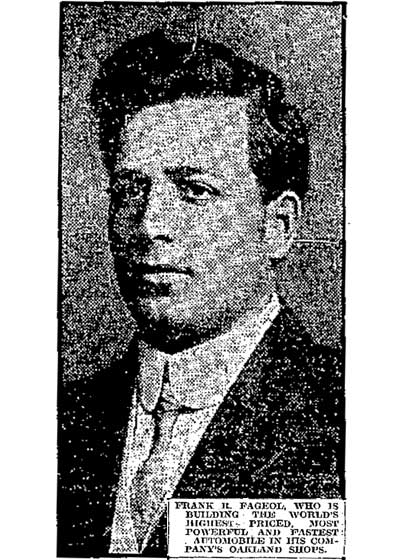
This biography encompasses the business
careers of Frank R. and William B. Fageol, two of the four Fageol
(pronounced fadjl) brothers, Rollie, Frank, William and Claud, an
amazingly
productive family of French, Prussian and Welsh descent who held over
125 US
Patents between them, many of which were influential in the development
of
early motor trucks and buses. The Fageols held numerous early
automobile
distributorships and were responsible for the manufacture of the Fadgl
road
train, Fageol automobile, Fageol motor truck, Fageol tractor, Fageol
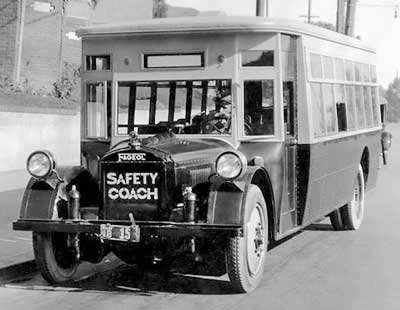
Safety
Coach, Eight-Wheel Motor bus and truck, and the Twin Coach bus and Twin
Coach/Fageol
line of delivery trucks.
Before the family relocated to California in
the early 1900s
the Fageols had been involved in various automotive ventures in and
around Des
Moines, Iowa, the city where their parents (John J. Fageol & Mary
M. Jones)
had relocated to after their September 7, 1876 marriage in Hancock
County,
Illinois.
The family patriarch, John Jacque Fageol,
was born on
November 15, 1854 in Nauvoo, Hancock County, Illinois to Antoine
and Anna
Mary (Albrecht) Fageol. Antoine Fageol (b. June 8, 1812-d.Feb. 27,
1877) was a
French national and the 1850 US Census list his occupation as farmer,
Anna Mary
(Albrecht) Fageol was born in Prussia.
John’s siblings included Eugenia (b. 1850);
Mary (b.1852-d.Oct
6, 1931 – mar. to Joseph Jamison); Frederick (b. Nov. 7, 1859-d.1860);
Louis H.
(b. 1866 d- 1924) and Magdaline (aka Lena) Elizabeth (b. Apr 3,
1861-mar. to Wilson)
Fageol. Although Antoine and Mary were both residents of Hancock
County,
Illinois at the time of the 1850 US Census, they are noticeably absent
from
subsequent enumerations.
Mary Maria Jones (John’s wife) was
born on March
16, 1857 in Appanoose, Hancock County, Illinois to William (b.1827
in
Ohio) and Elizabeth (b.1834) Jones, two Welsh-American farmers. Her
siblings
included Alathier (b. 1859) Emma A. (b.1860); Diantha (b. 1862); and
William B.
(b.1868) Jones. The 1870 US Census reveals that her father William, and
sister Alathier
had either left home or passed away and, as in the 1860 Census, the
Jones
family was living on the farm of Mary’s paternal grandfather, Samuel
Jones
(b.1796 in Md.)
The 1880 US Census (enumerated on June 24,
1880) lists the
Fageols of our story in Lincoln township, Polk County, Iowa, the
household
consisting of John J. (25yo) a farmer, Mary M. (23yo) keeping house and
Rollen
B. (2yo) Fageol.
The 1885 Iowa State Census lists the family
as residents of
Douglas Township, Polk County, Iowa. John’s occupation being farmer,
the
household consisting of John (30yo); Mary (28yo); Rollen Belle (6yo);
William
Burton (4yo); and Frank Raymond (2yo) Fageol.
Rollen Belle Fageol, John and Mary’s eldest
son, went by
various first names throughout his career, the most common being Rollie
B.,
although Rollen and Rowley were sometimes used.
Vital statistics of the Fageol family
follows:
John Jacque Fageol was
born November 15, 1854
in Nauvoo, Hancock County, Illinois and died on October 20, 1925
in St. Helena, Napa County, California.
Mary Maria Jones (John’s wife) was
born on March
16, 1857 in Hancock County, Illinois and died on August 19, 1928
in Oakland, Alameda County, California.
Rollen (aka Rollie & Rowley)
Belle Fageol was
born on May 3, 1878 in Ankeny, Polk County, Iowa and died
on April 4, 1942 in Los Angeles County, California.
William Burton* Fageol was
born on July 29,
1880 in Ankeny, Polk County, Iowa and died on October 24,
1955
in Kent, Portage County, Ohio.
Frank Raymond Fageol was born on
September 14,
1882 in Des Moines, Polk County, Iowa and died on August 8,
1965
in Contra Costa County, California.
Claud Harrison Fageol was born on
November 6, 1888
in Des Moines, Polk County, Iowa and died on December 24, 1968
in Portland, Multnomah County, Oregon.
Hazel Elizabeth Fageol was born on
March 19, 1890
in Des Moines, Polk County, Iowa and died on August 20, 1978
in Modesto, Stanislaus County, California.
*Correspondence
with William B. Fageol's grandson, William Bertram Fageol III, reveals
his grandfather's middle name was Bertram, not Burton, however there's
some disagreement within the family
as to which is correct (not surprisingly he's in the Bertram camp).
Regardless, William III reports that to the best of his knowledge his
grandfather never used it.
Ankeny, Polk County, Iowa – Rollie and
William’s birthplace
- was a northern suburb of Des Moines located approximately 6 miles
from the
city center.
Although numerous ‘biographies’ of the firm
claim the Fageol
brothers built their own 8-passenger steam bus in 1899, Frank R.
Fageol,
in an article entitled
‘Fageol
Reviews Transit Milestone’ which appeared in a 1946 issue of
Metropolitan (pp328) states they “owned and operated”, not built, the
vehicle:
“My late brother, Mr. R. B. Fageol, and I
each operated a
small Dos-a-Dos type four-passenger steam automobile at the
country fairs
in Iowa in 1898, where we hauled passengers in the fairgrounds as a
novelty at
ten cents per ride.
“We owned and operated an eight-passenger
mobile steam
bus in Des Moines, Iowa, in 1899, operating between
downtown Des
Moines and the State Fair Grounds at Des Moines under
the name
of Fageol Auto Livery.”
Later that year Frank and Rollie constructed
a
gasoline-powered cycle car in their father’s barn (located at 1728 Des
Moines
St., Des Moines) that was powered by a two-cylinder air-cooled Crest
engine
equipped with a novel carburetor/throttle consisting of a lamp wick set
in the
top of the gas tank, the engine speed regulated by raising or lowering
the wick
in the gasoline. The Crest engine was a product of the Crest Mfg. Co.
of
Cambridge, Mass., a pioneer air-cooled engine manufacturer who also
offered the
Crest and Crest-Mobile air-cooled gasoline cars during the early 1900s.
Frank
recalled the Fageol bros.’ prototype in a 1954 issue of Metropolitan:
“Fageol Predicts - by Frank
R. Fageol Chairman of the Board Twin Coach Company
“In 1900 F.R. Fageol and Rollie B.
Fageol made and
drove this first gasoline automobile to be built in Des Moines, Iowa.
First, I
consider by far the most important transit happening in the last fifty
years to
be the growth of passenger automobiles from 32,929 in 1903 to the
present
staggering 45 million, accompanied by some two million miles of hard
surfaced.”
Frank and Rollie’s car was mentioned in the
February 27,
1900 issue of the Des Moines Daily News:
“R. B. Fageol, son of J. J. Fageol of East
Seventeenth and
Des Moines streets has invented an automobile that promises to make a
stir in
manufacturing circles. It is to run by gasoline. A company is to be
formed for
making the machine In Des Moines. Contracts are prepared and will
probably be
signed soon, by Stillwell of Kansas City, Evans of the Essex block,
this city,
Tood of New York and W.P. Chase Co. of this city, by which about
$100,000 is to
be raised to start the plant. The machine weighs 350 pounds and is said
to be a
wonder.”
The same paper’s
July
10, 1900 issue reported on a possible problem with Rollie’s patent:
“COMPANY RUNS AMUCK
“AUTOMOBILE CONCERN FINDS CONFLICTING PATENT
“A London Machine Just Completed and
Patentee Conflicts With
Des Moines Auto—Settlement May be Made.
“A company recently formed for the
manufacture of
automobiles under the invention and expected patent of Mr. Fageol of
this,
city, has run amuck.
“While negotiating for a patent at
Washington, the
representatives of Mr. Fageol discovered a London patent, which is said
to
slightly conflict with the patent applied for on the Des Moines
machine. As a
result, negotiations were immediately begun for a settlement of the
difficulty,
which is now thought will be completed within a few days, after which
the
company will be incorporated here, and begin business.
“It was originally intended to use a portion
of the
Warfield-Chase building on Sixth-street, but the entire seven floors
are
occupied with the wholesale ware of this company. Another building will
be
secured with more commodious quarters, and the manufacture of
automobiles
begun.”
Rollie B. Fageol applied for a US Patent on
the vehicle on
September 11, 1900 which was awarded on June 4, 1901 (Automobile -
US675379 -
Grant - Filed Sep 11, 1900 - Issued June 4, 1901 – Rollie B.
Fageol) but I
could locate no further evidence that the vehicle got beyond the
prototype stage.
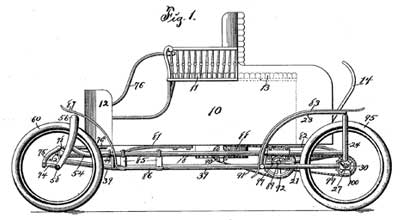
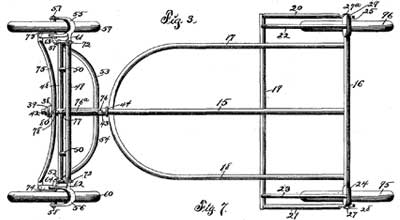
The most novel feature of the vehicle was its novel front and rear
suspension -
the front tires were mounted in twin bicycle forks – but no information
was offered
on its power-plant or transmission.
The 1895-97 Des Moines city directories list
Rollin B.
Fageol, machinist, for J.M. Ferree, sewing machines, staying with his
parents
at 1728 Des Moines. The 1899-1902 directories lists him as a
representative of
the W.P. Chase Co., a local bookstore and stationer. The 1902 directory
has his
occupation as machinist, but the 1903 directory lists him as president
of the
National Crude Oil Burner Co. The 1904 directory lists him as mech.
eng., Fageol-Aldrich
Mfg. Co.; res. 1115 E. Walnut.
Although the financing for his car fell
through, Rollie
enjoyed some success with his crude oil burner (Crude Petroleum Burner
– US
Pat. No. 719573 - Granted - Filed Apr 18, 1902 - Issued Feb 3, 1903
- R.B.
Fageol) that was offered by the National Crude Oil Burner Co. Organized
in July
of 1902, and capitalized at $15,000, N.C.O.B. Co.’s offices were
located at No.
604 Iowa L & T building, its factory at 214 Locust St., Des Moines.
Its
officers included: R.B. Fageol, pres.; J.C. Tate, v-pres. and genl.
mgr.; W.F.
Farrah, sec.; E.L. Forbes, treas.
The Des Moines city directories reveal the
family patriarch,
John J. Fageol, had a number of occupations during his time in the
city. In
1894 he’s listed as a carpenter; 1895 the proprietor of a meat market
at 1536
E. Grand av.; by 1897 he had taken in a partner, Owen McClay, and
relocated to
1504 E. Grand Av., in the style of Fageol & McClay, Meats, 1504 E.
Grand
Av. and by 1899 had replaced him with N.S. Edwards, in the style of
Fageol-Edwards Meats, 1504 E. Grand Av., a firm which continued into at
least 1902.
The 1903 Des Moines directory lists John as
foreman street
sweeping dept., Board of Public Works, and the 1904 directory as
President of Fageol-Aldrich
Mfg. Co., 721 Walnut St. Des Moines, the official name of the family’s
automobile distributorship which was financed in part by Des Moines
druggist
Frank S. Aldrich. The officers of Fageol-Aldrich were as follows; J.J.
Fageol,
pres.; W.B. Fageol, v-pres.; F.S. Aldrich, sec.; F.R. Fageol, treas.
The formation of the firm was mentioned in
an April 1903 issue
of the Des Moines News who reported that the Hopkins Bros., a
well-established
Des Moines sporting goods retailer who also carried bicycles and the
some early
automobiles which included Autocar, Buckboard, Oldsmobile and Winton,
were in
the process of selling their automobile business to a new firm composed
of
Fageol brothers.Although the
announcement was a bit premature, the move was finalized within the
year and
reported in the April 21, 1904 issue of Motor Age:
“Hopkins Bros., Des Moines, Ia., have
transferred their
automobile and accessories business to the Fageol-Aldrich Co., at
409-411 Ninth
street. The new concern will have the agency for the Oldsmobile,
Autocar, and
buckboard besides carrying a full line of appurtenances and supplies.”
The Fageol-Aldrich partnership dealership
was short-lived as
the August 17, 1904 issue of Horseless Age reported that Olds had
purchased the
firm’s Oldsmobile distributorship:
“The Fageol Aldrich Co. of Des Moines, la.,
is reported to
have sold out a part of its business to the Olds Motor Works.”
The 1899-1902 Des Moines directories lists
William B.
Fageol’s employer as Henry Plumb, jeweler, staying with his brothers at
the
home of his parents at 1728 Des Moines. The 1903 directory list his
occupation
as machinist, and the 1904 directory states he had “removed to San
Francisco.”
After a false start in Seattle, William B.
Fageol migrated south
to California where he got a job with the California Motor Company as a
salesman (one source says mechanic), the 1905 San Francisco directory
lists him
at 129 Grove St., San Francisco. The California Motor Co., an early
automobile
distributor headed by Louis H. Bill, the former Manhattan branch
manager of the
H. A. Lozier Co., manufacturers of the Cleveland bicycle. Bill was the
younger
brother of John T. Bill, who was a partner with John W. Leavitt in the
well-known San Francisco bicycle dealer Leavitt & Bill.
The October 17, 1901 issue of Bicycling
World and Motocycle
Review announced the formation of the California Motor Co:
“To Make Motocycles in California
“The California Motor Co. has been organized
at San
Francisco with Louis H. Bill, president; J. W. Leavitt, vice president,
and J.
F. Bill, secretary and treasurer. While automobiles are in view, the
immediate
purpose of the company is the manufacture of a motor bicycle invented
by R. C. Marks, formerly of Toledo, Ohio, who with E. E. Stoddard
and H.
A. Burgess constitute the firm.”
Originally located at 2212 Folsom St., the
California Motor
Company eventually relocated next door to Leavitt & Bill at 305
Larkin St.
(corner of McAllister), San Francisco where they sold Reading Standard
motorcycles
and Overland, Knox & Reo cars.
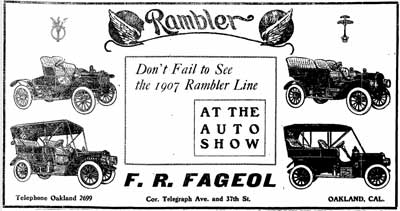
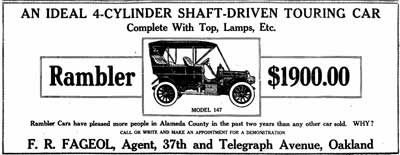
At much the same time Louis H. Bill became
San Francisco’s
first Rambler distributor, establishing the firm at 1331 Market St.,
San
Francisco. Bill hired Fageol as a Rambler salesman and was soon
convinced to
hire Fageol’s younger brother Frank who was given a position as
chauffeur/salesman with the firm.His
status as chauffeur is confirmed by his 1905 driver’s license
application which
provides the address, 1331 Market St., as the address of his employer.
Frank R. Fageol’s employment history starts
with a position
as an apprentice/laborer at the Kratzer Carriage Co. of Des Moines. The
heavy
work did not agree with him and within the year he had taken a position
as a
sales associate with the W.C. Chase Co., the very same Des Moines
bookseller
and stationer his older brother Rollen also worked for. His
first listing in the Des Moines directory
appears in 1899 where his occupation is listed as machinist. His
listing
remained consistent until the 1904 edition which lists him as “treas.,
Fageol-Aldrich
Mfg. Co.”
In the months preceding the San Francisco
Earthquake (April 18,
1906), Louis H. Bill established a satellite Rambler agency, known as
the
‘Rambler Garage’ in Oakland, putting the Fageol brothers in charge of
the sales
and service departments.
Within a few short months the brothers had
proved themselves
capable of handling the enterprise on their own, and in late 1906
acquired the
Oakland Rambler distributorship from Bill, the real-estate transactions
column
of the October 13, 1906 issue of the Oakland Tribune announcing the
sale of the
property to Frank R. Fageol:
“F. R. Fageol, one-story two-room
garage, southeast
corner of Thirty- seventh street and Telegraph avenue; $3000.”
Frank and William Fageol were two of the
many unsung heroes
in the aftermath of the San Francisco Quake, and the December 23, 1906
issue of
the Des Moines Daily News brought their story to the citizens of their
old
hometown:
“RESCUED MANY IN FRISCO DISASTER; Frank
Fageol, Des Moines
Man Was a Hero. HE ALMOST LOST HIS LIFE
“Probably no one in the recent Frisco
disaster had no more
exciting experience than a former Des Moines man, Mr. Frank Fageol, who
for a
number of years resided in this city and has many friends here. Mr.
Fageol has
been living in Oakland, Cal., for some time engaged in the automobile
business.
The story of his heroism in the awful earthquake has been related by a
Des
Moines woman who is intimately acquainted with the Fageol family and
who has
just returned from a western trip.
“As soon as the disaster occurred Mr. Fageol
at once
hastened to San Francisco in an automobile to ascertain the safety of
his wife,
who had gone there on a visit. No sooner had he reached the doomed
city,
however, than he was seized by a United States soldier, who ordered him
to use
his car in rescuing the injured. For seventy-two hours Mr. Fageol sent
his big
car whirling between tottering walls or climbing over masses of ruins.
In this
city he and his brother used up three automobiles. For three days and
nights
they did not get a wink of sleep. When, through sheer exhaustion, his
eyes went
shut he would be aroused by the soldier who, bayonet in hand, sat
beside him
and ever urged him to go closer to the tottering ruins.
“Scores of people were rescued by Mr. Fageol
and the
soldier. They came very near losing their lives in the work of rescue.
At one
time when they were running slowly up a street behind tottering walls,
a big
building came down with a crash behind them, effectually cutting off
their
return. A moment later and with a roar, a building in front of them
came down
piling a mass of brick and debris which filled the street. Thus they
were
hemmed in in a square of flaming ruins. Seeing there was no other way,
Mr.
Fageol put on full steam and sent the cur rushing at the mass of ruins
in front
of them. How they got over he says he does not know, but they did it
and got
away safely, although the car was badly crippled.
“Mr. Fageol saw many harrowing sights on
this remarkable
tour. People who were hopelessly pinned under burning timbers were
given
chloroform or put out of their misery with a merciful bullet from some
soldier's rifle.”
The 1908 Oakland directory reveals that by
that time the
entire Fageol family had relocated to Oakland, and were all busy
working at
Frank’s Rambler dealership:
“F.R. Fageol, Automobiles & Garage, Agt.
For Rambler
Automobiles; Telegraph Av. sw cor. 37th
“Claud H. Fageol, mach. Rambler Garage, bd.
463 37th.
“Frank R. Fageol, pres. F.R. Fageol, r. r.
6425 Regent
“John J. Fageol, salsn F.R. Fageol; r. 463
37th.
“Hazel E. Fageol, b. 463 37th.
“Rolen B. Fageol, mach. F.R. Fageol, b. 720
39th
“William B. Fageol foreman, F.R. Fageol, b.
720 39th”
Claud H., the youngest of the four Fageol
brothers, had
various scrapes with the law, the first being a charge that he held up
a fire
engine, the January 1, 1907 issue of the Oakland Tribune reported:
“HELD UP FIRE ENGINES; Such Is Charge Placed
Against Claude
Fageol, a Local Chauffeur.
“Charged with preventing fire engines from
gaining access to
a hydrant, Claude Fageol, a chauffeur, was arrested yesterday
afternoon. The
engines answered a call at Twelfth and Broadway, where a live wire was
generating some alarm, and found Fageol in his machine in front of the
hydrant.
“He is said to have refused to move at the
request of
Fireman T. J. Roberts of Engine Company No. 2, so he was taken to Jail
by
Policeman Tillerson. He was later released on $25 bail.”
Frank R. Fageol’s Rambler Garage had become
quite successful
in a short period of time, and the May 3, 1908 issue of the Oakland
Tribune
reported on the sale of the business to Adams & Co.:
“The Rambler garage and salesrooms formerly
owned and
managed by Frank Fageol corner Telegraph and Thirty-seventh street,
have been
sold by Mr. Fageol and in future will be known as the Adams Company,
his
successors, who will maintain the high standard set by the former owner
in his
successful business career in the automobile business in Oakland and
vicinity.
Every type of the well-known Rambler will be kept by Adams & Co.,
and an
expert force of salesmen and mechanics will be employed. Mr. Fageol is
retiring
from the automobile field.”
No further mention of Adams & Company
was forthcoming
and F.R. Fageol continued to be Oakland’s Rambler distributor for the
next
decade. He also took on other lines as evidenced by the September 22,
1910
issue of the Oakland Tribune:
“FAGEOL TAKES ON DETROIT ELECTRIC; Rambler
Agent Will
Represent Well Known Line Here.
“By J. A. HOULIHAN
“A most important change in the local
automobile circles is
the taking on of the agency, for Detroit Electric by Frank R Fageol.
“Here-to-fore this well known, line of
electrics has been
handled by the Western Electric vehicle company, who have relinquished
it in
favor of Fageol.
“The new company will be known as the
Detroit Electric
agency.The quarters occupied by the
Western Electric Vehicle company have been secured by the new company.
Mr. R.H.
Morris will serve in the capacity of manager of the new agency.
“Fageol is one of the best known of the
automobile dealers
on the Pacific coast. Success has
attended him while representative of the Rambler here. There are a
number of
these cars in the country. The electric industry appealing to him as
one with
unlimited possibilities he seized the opportunity to take on the
well-known
electric line.”
Within the month, Fageol folded his Detroit
Electric agency
into a new firm, the Electric Vehicle Co., the October 8, 1910 issue of
the Oakland
Tribune reporting:
“ABSORBS BAY CITIES CO.
“During the past few weeks final articles of
incorporation
were filed by the Electric Vehicle Co. which has just absorbed the
Detroit
Electric agency and the Bay Cities Electric Co.
“Prominent in the newly organized company
will be R.H.
Morris, F.R. Fageol and W.D. Vance, the first two being interested
previously
in the Detroit agency and the latter, Mr. Vance, in the Bay Cities Co.
“Detroit and Columbus Electrics will be
handled and a high
class electric garage maintained. The new concern as it now stands is
one of
the strongest companies on the Pacific coast.”
Fageol’s success in the automobile business
was celebrated
with the construction of a new garage and salesroom located three
blocks south of
his previous location at the corner of Thirty-fourth St. and Telegraph
Ave. The
grand opening was announced in the October 15, 1911 issue of the
Oakland
Tribune:
“Rambler Agent In New Home; F.R. Fageol Now
Housed in
Magnificent and Spacious Quarters.
“The latent of the local dealers to seek new
and better quarters
is F.R. Fageol. On Monday night he held an informal opening, to which
were
invited many motor car owners of this city. Present was nearly every
owner of a
Rambler car in the county.
“His new garage and salesroom at
Thirty-fourth and Telegraph
avenue, is without doubt one of the most magnificent in this vicinity.
Both are
spacious and provide ample room—the one to show the new Rambler models
and the
other to house the numerous owners of these cars.
“In point of service and representing one
car Fageol now is
about the oldest dealer in the State of California, the Rambler having
been
distributed by him for the last six years.
“Frank has made a success of the motor car
agency business
by his method of treating with owners, any one of whim will vouch, for
his
liberality in taking care of his cars. Evidence of this is the number
of owners,
from year to year, seek him out when buying a new model.”
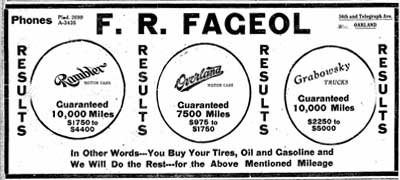
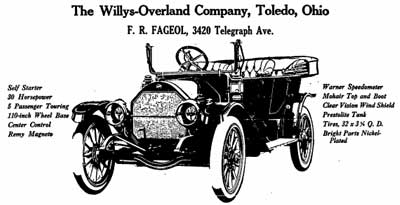
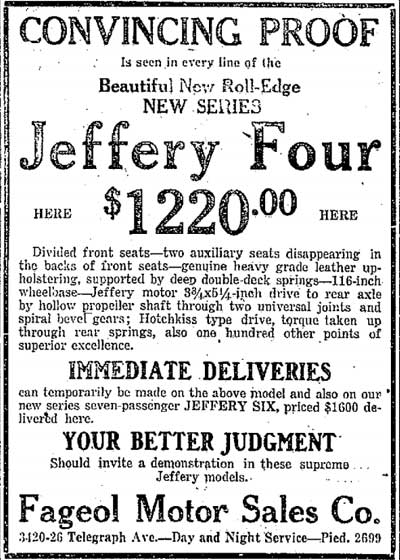
Fageol added Thomas B. Jeffrey Co.’s line of
4 and
6-cylinder passenger cars in 1911, and Willys-Overland in early 1912,
the January
7, 1912 issue of the Oakland Tribune reporting:
“Fageol Is Made Overland Agent; Well Known
Local-Dealer Will
Represent Popular Make of Motor Car.
“Through a deal of no small import,
consummated during the
past week, Frank R. Fageol becomes the distributor in Alameda county
for the
complete line of Overland motor cars.
“Fageol, at the present time is the oldest
dealer, in point
of active participation, in the automobile business in this county.
Since his
advent into the motor car agency line he has handled Rambler cars and
at this
time Is about the largest Individual dealer in the state.
“The Overland, which is one of the best
known of the popular
priced cars on the market today, could not have fallen in better hands.
Present
owners and prospective purchasers can feel sure of the treatment from
Fageol
which adds to the pleasure of motoring.
“A service department for the care of owners
and a liberal
guarantee with every car sold is part of the policy which has been
outlined by
the new representative.”
In early 1913 Louis H. Bill, Frank and
William Fageol’s
former employer, good friend and longtime Thomas B. Jeffrey Co.
(Rambler
automobile)distributor, was promoted to assistant general manager of
the
Jeffrey organization, in charge of both the factory and sales. Frank R.
Fageol
penned the following announcement which appeared in the January 19,
1913 issue
of the Oakland Tribune:
“JEFFERY FACTORY INCREASES STAFF: Promotion
of Coast Manager
Is Source of Much Gratification
“One of the most important moves in the
strengthening of the
eastern motor factory organizations of the year was the announcement
made
recently by the president of the Thomas B. Jeffery company, maker of
the
Cross-Country cars at Kenosha, Wisconsin. The announcement caused much
comment
here on the coast through the promotion of L. H. Bill who has for years
been
western representative for the Jeffery factory In the San Francisco
branch
house and through Bill's close friendship with Frank R. Fageol who
represents
the car in Alameda county. Fageol says:
“‘With the beginning of the new year the
board of directors
includes Charles T. Jeffrey, Harold W. Jeffrey and George M. Berry,
while the
officers of the company are president, Charles T. Jeffery, who is also
general
manager; vice-president, Harold W. Jeffery; second vice-president and
Treasurer, George M. Berry; secretary, Edward S. Jordan; assistant
secretary,
Edward S. Maddock.’
“‘The first addition to the executive staff
is that of Louis
H. Bill. He is appointed assistant general manager, in charge of both
factory
and sales. Mr. Bill has for many years been in charge of the Pacific
Coast
business. He was with the H. A. Lozier company in the bicycle days
first as a
general salesman and subsequently as New York branch manager. Following
this
experience he entered business for himself in San Francisco, and
although
actively engaged in the management of the branch of The Thomas B.
Jeffery
company since 1904 he continued his interest in his own business until
a few
months ago.’
“‘Mr. Bill is to be assisted in the
management of the
factory by J. W. DeCou, and in sales by H. E. Field. Mr. DeCou, who
will be
factory manager, has been factory superintendent for the past two
years. In
point of service with the Jeffery interests Mr. De Cou surpasses all of
the
others, having started as an employee of the Rambler bicycle factory in
1897.
He served with that company until the business was sold and again
became
identified with Rambler business in 1903, when he was made purchasing
agent for
the motor car factory.’
"The business of the Jeffery company for the
six months
ending December 31, shows the greatest growth for any corresponding
period in
its history. Its business has always grown steadily and consistently,
but more
rapid growth for the past eighteen months makes necessary the new men
and a new
distribution of responsibilities."
Success in the automotive field did not
escape Rollie, the
eldest Fageol brother. While working for his brother’s Rambler agency
as a
mechanic he had developed and patented a line of aftermarket automobile
bumpers
whose manufacture was subsequently licensed to the Hartford Suspension
Co.
In the early days of the automobile, many
low and
medium-priced vehicles were not equipped with bumpers from the factory,
leaving
the aftermarket field wide open for third party manufacturers, who sold
their
wares through car dealers and auto parts stores. Two of the major
players in
the field at that time were the American Chain Co. of Bridgeport,
Connecticut
and the Hartford Suspension Co., of Jersey City, New Jersey.
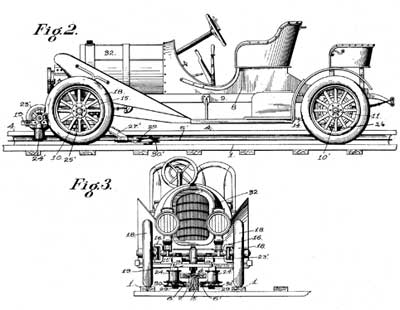
Rollie's next project was the design of people
movers for the
planned Panama-Pacific International Exposition which was to be held in
San
Francisco during 1915. The Fair celebrated the completion of the Panama
Canal
and helped showcase the city’s amazing recovery from the devastating
1906
Earthquake. The exposition grounds encompassed 635 acres located along
San
Francisco Bay between Fort Mason and the Presidio extending to Chestnut
St., in
what is today’s Marina District.
J.H. Fort writes
in
The Fageol Success:
"When the Panama-Pacific Exposition was being
planned,
the problem of transportation within the grounds confronted the
directors. Many
proposals were submitted and considered, but none seemed as practical
as that
of R. B. Fageol and F. R. Fageol. The latter, over a period of fifteen
years,
had been automotive inventor, mechanic, and salesman.
"The Fageols proposed to solve the problem
by building
a small tractor, using the motor of a popular automobile, to draw the
passenger
trailers. The idea amused and appealed to the directors; the Fageols
were
awarded their transportation concessions"
Edward P. Brinegar, president of the Pioneer
Automobile Co.,
one of the most influential early automobile dealers on the coast
(Chalmers, Oldsmobile,
Thomas, and Winton, etc.), provided Rollie with the working capital to
get the
project rolling, his brother Frank R. Fageol provided the workshops for
their
construction, and Brinegar provided an office for the firm adjacent to
the
Pioneer showrooms at 702 Market St., San Francisco.
The ‘Recent Incorporations’ column of the
Horseless Age
announced the formation of the firm in its November 11, 1914 issue:
“Fageol Auto Train Inc., San Francisco,
Cal.; Capital stock
$100,000; Incorporators: F.R. Fageol, R.B. Fageol, E.P. Brinegar, A.T.
O’Connell.”
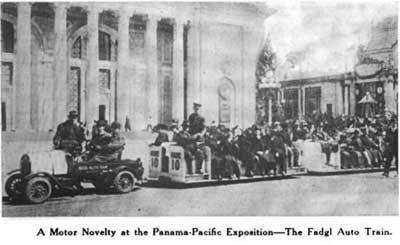
In a bizarre move, Brinegar, Fageol Auto
Train’s president,
insisted that the firm’s products be marketed as the ‘Fadgl’ Auto
Train, fearing
that prospective customers would have great difficulty pronouncing the
actual surname
of its inventor. As he was providing the cash, the Fageol brothers
ceded to his
request and the name stuck.
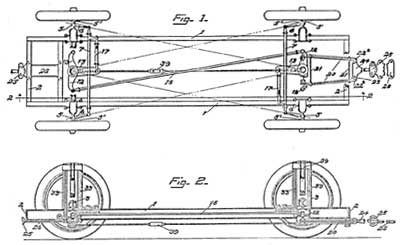
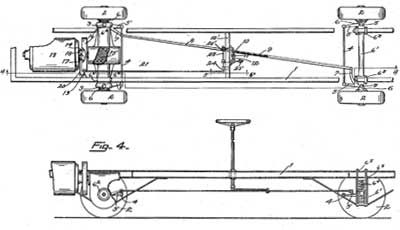
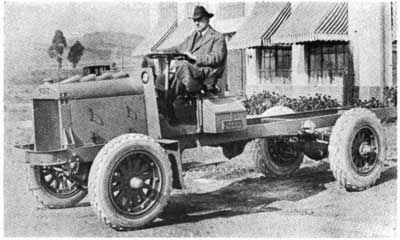
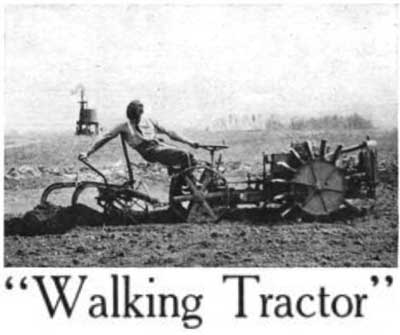
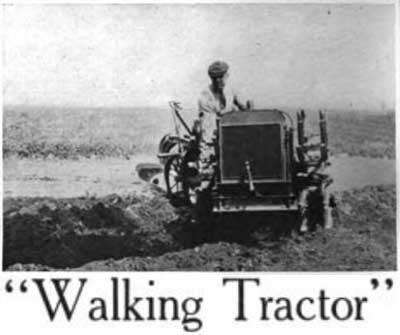
The Ford Model T was selected as the motive
power unit for
the auto train. The frame of the Ford tractors were modified with a
beefed-up frame
and a Rollie B. Fageol-designed reduction gear-set that limit its speed
while
providing the greatest amount of torque from the seemingly overtaxed
4-cylinder
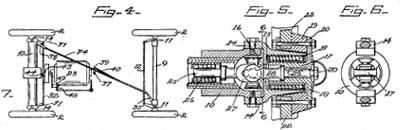
Ford engine. A clever inter-steering device made up of diagonal
steering arms
controlled the trailer’s steering and an automatic brake was installed
the
brought the vehicle to a controlled stop whenever the accelerator was
lifted.
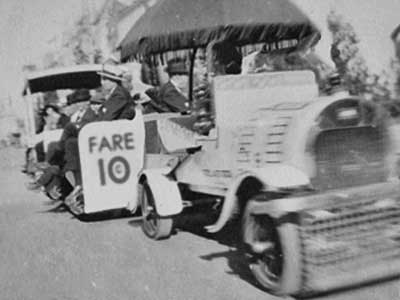
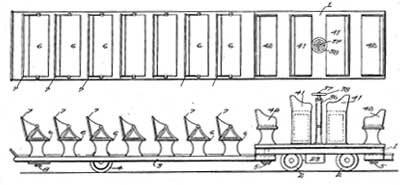
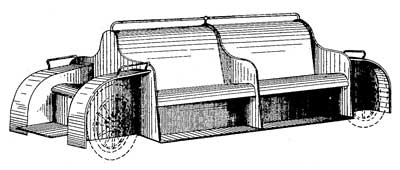
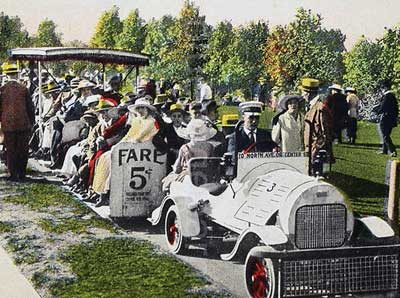
The four wheels of the double-axled trailer
coaches were
shrouded to protect the clothes and feet of its passengers. Both units
of the
tractor-trailers were constructed in a facility leased by Frank R.
Fageol and
located at Thirty-eighth St. and San Pablo Ave. (38th St. is
now
known as W. MacArthur Blvd.) during the winter and early spring of 1915.
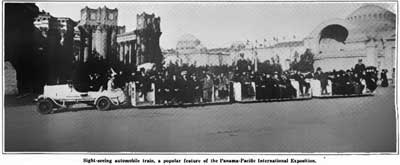
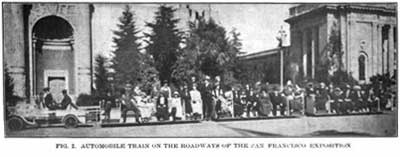
The May 10, 1915 issue of the Automobile
Journal provided a
detailed description of the Fadgl ‘motor train’:
“MOTOR TRAINS AT EXPOSITION.
“Seventeen Ford motor engines are used in
the transportation
system established to haul visitors about the exposition grounds in San
Francisco. They pull 17 small motor trains which run from Machinery
hall to the
Massachusetts building and back, a distance of three miles.
“These trains were designed and built
by R. B.
Fageol of Oakland. Power is supplied by small tractors, which have
36-inch
tread and a wheelbase in proportion. Each one carries a Ford motor. The
steering wheel is set like the usual automobile steering post, and a
single
seat for the driver is provided on the tractor. An inter-steering
arrangement
has been perfected so that by the use of a ball and socket draw bar
each car
steers the one that immediately follows. Brake shoes work against the
surface
of the pavement instead of against a drum on the cars themselves. The
trains
are operated with perfect safety among the largest crowds that visit
the
exposition.
“Around the grounds the trains run at an
average speed of 10
miles per hour, although the tractors running empty are said to be able
to make
20 miles an hour. The cars, two of which make a train, are like long
settees
placed back to back with a passage way between in which the conductor
operates.
The wheels have five by 25 solid tires and are completely hidden.
“The cars are very low, so that it is only a
short step off
the ground to a seat. This feature does much to make the conveyance
popular.
“Each of the trains is travelling about 100
miles per day,
at a cost of five cents for fuel, wages for the crew, and mechanical
upkeep and
depreciation. The fare charged is 10 cents. Twenty passengers per train
is a
good load, but on some days, when the crowds have been especially
large, as
many as 50 have been carried. Sixty-five men are employed in operating
the
system.”
The most detailed account of the train’s
engineering
appeared in the October 21, 1915 issue of Engineering News:
“A more novel means of transportation is
that afforded by
trackless trains operated on the driveways, each consisting of an
automobile
and trail cars. This system was invented by R. B. Fageol, of Oakland,
Calif.,
and is operated by the Fadgl Auto Train Co., of San Francisco.
“The automobile, or tractor, is of special
design, weighing 6,000
lb. and having 20-in. wheels with solid rubber tires. It carries four
passengers. The tractor hauls three trailers, each weighing 1,500 lb.
and
carrying 20 passengers. These cars have 24-in. wheels and 12-ft.
wheelbase.
They have side seats back to back, with a passage between for the use
of the
conductor. At the ends the seats are raised to clear the wheels. The
couplings
are of special design, causing the trailers to track with the
automobile. A
shoe brake is operated in connection with the couplings, being lowered
to
contact with the ground when the couplings are slackened by reduction
of speed.
The speed limit is 12 mi. per hr.”
The June 1915 issue of The American
Chauffeur contained a
more detailed account that was originally published in the Commercial
Car
Journal:
“Automobile Trains At Exposition
“Viewed from outside the entrance gates a
popular vote would
undoubtedly select the Tower of Jewels as the chief attraction of the
Panama-Pacific
International Exposition. Inside the accurately clicking turnstiles
there is
nothing which so quickly catches and holds the eye as the spic and span
white
auto trains that are quickly skimming about the beautiful jewel City,
conveying
thousands of visitors over the extensive grounds, affording the former
a
complete and comprehensive view of the great fair in its exterior
aspect which
they could not otherwise obtain.
“The Fadgl Auto Train is the name
under which this wheeled fleet operates. Its popularity cannot be
questioned, for every
train is loaded to capacity. It is a midget train by comparison, but a
big thing
from the standpoint of its commercial success.
“A Californian, R.
B. Fadgl, invented it. He is a
well-known Oakland automobile dealer. It was while in Philadelphia on a
business trip three years ago that the idea had its birth.
“Being of an inventive and practical turn
of mind, Fadgl set
about putting into concrete form something to meet this need. The
motive power
was simple enough, but a passenger coach combining comfort and
practicability,
a mechanical complement to the engine, gave Fadgl a pretty problem.
“Followed a few weeks of the transformation
of theories to
blueprints and blueprints to models, until at last Fadgl produced
a
four-wheeled trailer, incorporated in which was a clever inter-steering
device
made up of diagonal steering arms.
“In detail each train consists of a special
miniature Auto
Tractor of 36-inch tread, with 25x5inch solid tires, and two specially
designed
trailers or cars resembling a double settee, with the conductor’s aisle
in the
center.
“The braking system consists of a shoe
connected midway in
the draw-bar, which is forced downward when the motion of the train is
slackened. the action being automatic and in unison with the tractor,
making it
absolutely safe in crowds. The system is an entirely new invention,
which
successfully solves a hitherto perplexing problem.
“The whole car is but one step off the
ground, running on
four invisible wheels, all controlled by a draw—bar connection to the
tractor
in such a way that the two cars follow in exactly the same tracks as
the
tractor when rounding a turn in the road. This feature eliminates any
cutting
off on turns or crowding of people off the road. Each train seats forty
people
comfortably, and the cars are most convenient in getting on
or off.
“The twenty Fadgl auto trains are
operated in a
manner which is similar to that of a street car system. A similar chart
is used
and similar schedule system. This similarity of operation is carried
out in all
its details.”
Specifics of the auto train’s route,
capacity and income
were detailed in the July 10, 1915 issue of the Electric Railway
Journal:
“Transportation by Fadgl Auto Train at San
Francisco Exposition
“The Fadgl Auto Train Inc., has been
carrying approximately
one fourth of all Panama-Pacific Exposition visitors in eighteen, three
car
trains of sixty-six seating capacity, or 105 total capacity per train.
The
longest run one way is 1 1/2 miles and the shortest is 3/8 mile. The
initial
fare is either 5 or 10 cents, according to the character of the run.
Zone fare
additions of 5 cents each are charged when passengers make partial or
complete
circuits. On Feb. 20, the opening day, fifteen two-car trains and one
one-car
train carried $3,246.95 of business. Up to June 1, about 1,250,000
passengers
were carried, but it is expected that heavy summer business will bring
the
total for the year in excess of 4,000,000. The number of fares during
four days
of June averaged 15,150 a day. All fare collections during this period
were
handled with Rooke registers.”
Between February 20, 1915, when the gates
opened and
December 4, when the Exposition closed, a fair number of the fair’s 18
million visitors
rode on the popular Fadgl Auto trains, which took in a reported
$307,000 in
nickels and dimes. When the Exposition ended a number of the trains
were sold
to a Chicago-based firm that operated the concessions at that City’s
Lincoln Park.
The total number of trains constructed is
believed to have
been 18 although contemporary reports list a total of 16, 17 and 20,
one source
mentioned a total of 30. Further exploitation of the trains was
envisioned and
on February 21, 1916 Brinegar and Rollie B. Fageol organized a second
firm,
Fadgl
Flexible Systems Inc., in Carson City, Nevada. The firm was capitalized
at
$100,000 and an office established in San Francisco’s Hobart Building
at 582
Market St. As Frank and William were not directly involved with the
firm, its history is continued on the Fadgl
Flexible/Eight-Wheeled Motor Co. page.
Frank R. Fageol continued to operate
his very
successful Oakland automobile distributorship which now encompassed
Garford
trucks and the entire Jeffrey line, which now included the Jeffrey
Quad, a
heavy-duty all-wheel drive workhorse that had become popular with
California
miners.
In 1916 Frank made a calculated
move to get into
the lucrative heavy truck manufacturing business, which up until that
time had
been dominated by firms located in East. His success with the
distribution of
Garford and Jeffrey trucks convinced him there was an increasing demand
for the
vehicles in the Pacific Northwest. His only competition would be from
Moreland,
which was located in Los Angeles, a two day’s journey from his home
base of
Alameda County, and almost a week from Seattle, Washington (San
Francisco’s Kleiber Motor Truck Co.
didn’t start manufacturing trucks until after the end of the First
World War).
The first sign that he was up to something
came via the
announcement that he was getting out of the retail automobile business,
which
was included in the April 2, 1916 issue of The Oakland Tribune:
“Fageol Sells Automobile Business; Pioneer
Dealer Retires;
New Company Takes Possession
“Without doubt one of the most interesting
topics of
conversation along auto row yesterday was the announcement of the
purchase by
the newly formed Fageol Motor Sales Company of the automobile interests
of
Frank R. Fageol, Jeffery car dealers and one of the best known
automobile
retail dealers in the west.
“This move marks the retirement of Frank
Fageol from the
retail automobile business. Fageol is to devote all of his time
hereafter to
his other interests, chief, of which is the Fageol trains. The new
company,
which has been incorporated by W.C. Morse and C.R. Tate for the purpose
of
carrying on the business as usual took possession yesterday. No changes
are
contemplated by the new owners, both of whom have been with Frank
Fageol in the
handling of the business for years. Morse has had charge of the truck
department of the business and Tate has for years had control of the
accessory
and supply department for Fageol. Both men thoroughly understand the
business.
The same lines will be handled by the Fageol Motor Sales Company as
were
represented by Fageol personally. The Jeffery cars and trucks and the
Garford
trucks constitute the motor car agency line. The new big six Jeffery
cars are
expected to arrive In Oakland within a few weeks’ time.”
Within the year C.R. Tate had reorganized
the Fageol Motor
Sales Co. as the Western Motor Sales Co., a firm which regularly
advertised in
the Oakland Tribune, their earliest advertisements stating:
“Western Motor Sales Co. -formerly
the Fageol Motor
Sales Co., 3420 Telegraph Avenue.”
Frank’s older
brother
William joined him in making plans for the proposed auto truck which
would be
offered in sizes ranging from 2 ½ to 6 tons capacity. John J. Fageol,
the
family patriarch, retired and his youngest son, Claud H. Fageol, found
employment with another Oakland dealer, George Peacock - the April 16,
1916
issue of the Oakland Tribune reporting:
“Dailey and Fageol Join Chandler Staff
“Two of the most important of recent changes
in the
personnel of auto row was announced this week by George Peacock of the
Peacock
Auto Company of this city, who announces the acquisition to his
Chandler car
staff of experts C. H. Fageol and Frank H. Dailey.
“Both Fageol and Dailey are well known here
in motoring
circles, Fageol, who is to devote all of his time to the selling of
Chandler
Six cars here was for years identified with his brother, Frank R.
Fageol, in
the Jeffery car business.
“Dailey was formerly the Reo car agent in
Oakland and later
the Pacific Coast distributor for the Premier line of the motor cars
with
headquarters In Oakland. He also handled the Oakland car line here for
a
season. Dailey is to handle Chandler cars in the outside territory for
the Peacock
Auto Company.
“Both men are experienced in the automobile
business and
their choice of the Chandler car in carrying out their work is a matter
of much
gratification to the local Chandler people.”
Of greater significance to the truck
manufacturing project
were events taking place in Kenosha., Wisconsin, the July 23, 1916
issue of the
Oakland Tribune announcing:
“Nash Takes Control of the Jeffery Factory
“A bigger, greater Jeffrey organization is
seen by automobile
world prophets as a result of yesterday's sale of the mammoth Kenosha
manufacturing plant.
“Foremost among the purchasers of the Thomas
B. Jeffrey
Company is Charles W. Nash, of Flint, Mich., a man with a nation-wide
reputation for his constructive conservatism in the motor car Industry.
Nash
takes active charge of the management of the big plant on August 1, at
which
time his connection with the General Motors Company will be completely
severed.
“Announcement of the sale of the company
which is capitalized
at $13,000,000, came as a surprise to the automobile world. Exact
figures giving
the price for the entire stock were not made public.”
Nash’s takeover of Jeffery was significant
as Frank R.
Fageol’s longtime friend and former employer Louis H. Bill was now out
of a job
as Charles W. Nash wished to install his own men at the Jeffrey Works.
During the summer Bill and Fageol put
together a business
plan which included the construction of a showpiece that would bring
attention
to the firm and by association its line of heavy-duty trucks, both of
which
were totally unknown outside of metropolitan San Francisco. The bait,
as it
were, would be ‘the World’s Most Expensive Car’ which could only be
powered by
‘the World’s Largest Engine’, the very same 6-cylinder Hall-Scott aero
engine that
would power the firm’s trucks. The 824.67-cu. in. overhead-valve
straight-six
Hall-Scott was guaranteed to produce 125+hp at 1,300 r.p.m.
The car and the truck, whose conventional
chassis were
designed by Detroit-based powertrain engineer Cornelius T. Meyers,
would be marketed
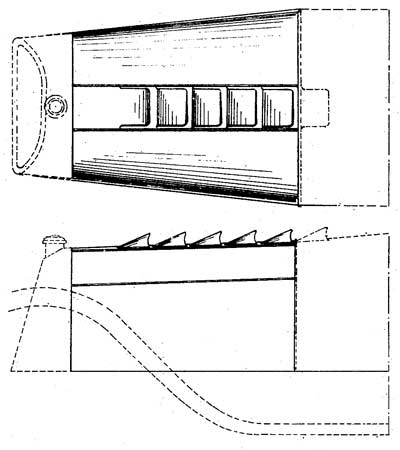
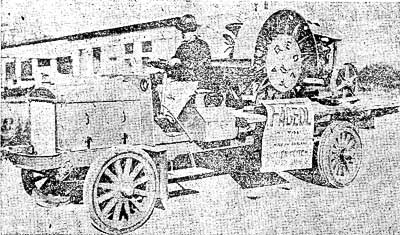
as the Fageol. Both would feature a distinctive row of top-mounted
jagged
ventilators that ran from the back of the radiator to the cowl –making
it easy
to identify any Fageol product from a distance. Frank R. Fageol
patented the
design and they remained a distinctive and endearing feature of the
firm’s vehicles
into the mid-1930s.
The Fageol 100 automobiles featured a
distinctive sloping
nickel-plated radiator while the firm’s trucks and buses used a more
traditional body-colored cast radiator shell with the firm’s name
embossed at
the top, although nickel plating was an option.
The car was constructed in a leased factory
located at
Thirty-eighth St. and San Pablo Ave. (38th St. is now known
as W.
MacArthur Blvd.) and was first mentioned in the Oakland Tribune via an
announcement that a catalog featuring the Fageol car was forthcoming:
The ‘Manufacturing and Industrial News’
column of the November
11, 1916 issue of the Oakland Tribune reported:
“The Fageol
Motors
Company have in preparation a catalog descriptive of the Fageol car
which will
be one of the finest pieces of automobile literature ever published in
the
United States. This catalog is to be ready for distribution at the New
York
Automobile Show in February, and its preparation is in the hands of K.
L. Hamman.”
The ‘Manufacturing and Industrial News’
column of the November
18, 1916 issue of the Oakland Tribune announced that Fageol was going
to use a
locally sourced aircraft engine built by Berkeley, California’s
Hall-Scott
Motor Car Company:
“The first order of Hall-Scott motors to be
used in the new
Fageol automobile manufactured by the Fageol Motors Company will be
delivered
shortly. By the use of the Hall-Scott aeroplane motor it will be
possible to
attain a speed from 100 to 110 miles per hour with the car fully
equipped.
“The Hall-Scott Motor Company made a
shipment of twenty
aeroplane motors to the Russian government during the week.”
The ‘Manufacturing and Industrial News’
column of the November 25, 1916 issue of the Oakland Tribune:
“The designs for the bodies of the new
Fageol car – an
automobile made in Oakland in which a $4,200 Hall-Scott aviation motor
is to be
used – have been completed. These new body designs are a step forward
in the
body construction, and it is expected they will attract immediate
attention
among automobile connoisseurs.”
The ‘Manufacturing and Industrial News’
column of the December
2, 1916 issue of the Oakland Tribune:
“The Fageol Motors Company is placing in its
new factory at
Thirty-eighth and San Pablo avenue the machinery to be used In
manufacturing
and assembling the various parts of the new Fageol car.”
The December 31, 1916 issue of the Oakland
Tribune announced
that the first Fageol automobile would be ready in time for a debut at
the
Chicago Auto Show:
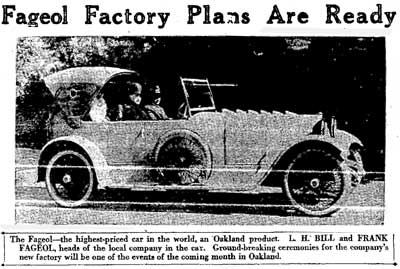
“$12,000 Autos Are Oakland Product
“Frank Fageol Makes Highest Priced Cars in
the World.
“150-Horsepower Motor Will Deliver 100 Miles
Per Hour Speed.
“With an Oakland made six-cylinder motor
that will develop
135-horsepower at a speed of 1350 r.p.m. and has horsepower range up to
150 at
higher speeds, the first of the new Fageol cars is nearing completion
in the
Oakland shops of the Fageol Motors Company and will be ready for
shipment by
express in a few days for the East where it will be exhibited in the
Chicago
Auto Show.
“The new Fageol car is something entirely
different from any
motor car ever built before, either in America or abroad. It will be
guaranteed
to deliver a road speed of 100 miles per hour carrying four passengers
and full
equipment. The chassis alone will cost in the neighborhood of $8,500 in
Oakland.
“Each body will be custom built and the cost
of bodies for
the car will range in prices from two to three thousand dollars
additional. The
lowest price Fageol car will exceed a cost of $10,000 to the buyer. It
will be
the highest priced car in the world.
“Two sample bodies are now being built for
the Fageol cars,
one by C. P. Kimball of Chicago, and the other by Larkin of San
Francisco.
These two bodies are to be used to complete the two chassis now being
built for
the big eastern shows. The Fageol cars will feature the famous
Hall-Scott
motors which are also built here in Oakland. The cost of each motor at
the local
plant is $4,200. They are the same identical motor that the government
has specified
for use in 95 per cent of the new aeroplanes. It has a 5 in. bore by 7
in. stroke.
The Fageol car with its powerful 125 h.p. motor will be geared 1 1/4 on
high.
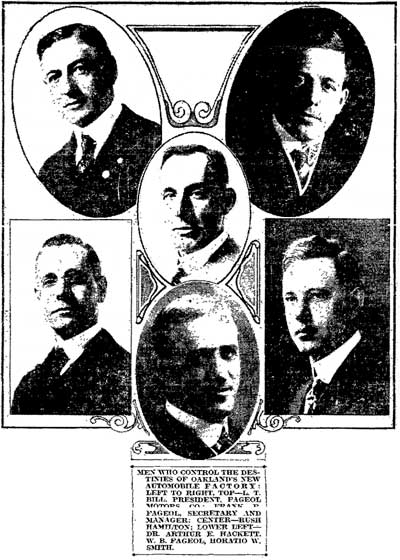
“The car is the product of the Fageol Motors
Company of
which L. H. Bill is president; Frank Fageol secretary, treasurer and
general
manager and Webb Jay of Chicago, vice-president. All three men are
exceptionally well and favorably known in the automobile trade
throughout the
United States. It is the intention of the company to market 200 of
these high priced
cars during the first season's production.
“Every one of these cars will be the very
last word in motor
car construction, every detail in the finishing of the cars shows an
extravagance
of attention that brings the cost of construction to a figure that the
ownership of one of the new Fageol cars will be the equivalent to
double ‘A’
rating in the financial world.”
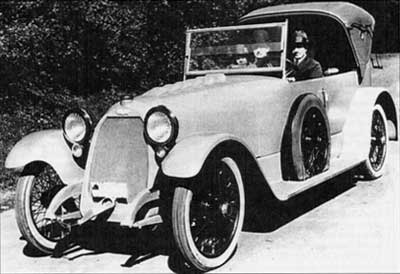
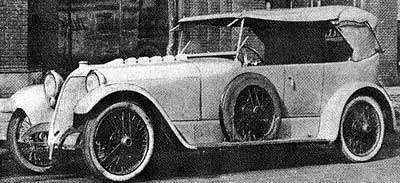
The Fageol 100, as it became known, was
so-named as it was
guaranteed to hit 100 m.p.h., and one period road test claimed to have
hit 116
m.p.h. The car shared the distinction with the Pierce-Arrow 66 (which
had
exactly the same dimensions, in terms of cubic displacement—over 13 1/2
liters)
as being the largest displacement engines to have appeared in an
American‘production’ automotive – even
larger than
the significantly more famous 12 ½ liter Type 41 Bugatti Royale.
The January 13, 1917 issue of the Oakland
Tribune announced
that the first car had been shipped to Chicago:
“The Fageol Motors Co. have completed the
first two Fageol
cars to be used for demonstration purposes. One of these $11,000 cars
has been
shipped to Chicago by Wells Fargo Express and will be exhibited at the
Chicago
Motor Show while the other will be exhibited in San Francisco. The
Hall-Scott
aviation motor is used, making possible a speed of 100 miles per hour
with the
car fully equipped.”
Although the Fageol automobile was the
subject of much
discussion in and around San Francisco and Oakland, it wasn’t until the
following item appeared in the January 18, 1917 issue of The Automobile
that
the national automotive trade became aware of the car:
“Fageol Has 125 Hp. Motor and Sells for
$9,500
“Chicago, Jan. 15 - One of the most
interesting cars at the
Chicago show will be the Fageol, which has one of the highest priced
chassis in
the world, if not the very highest.
“The chassis sells for $9,500. The will be
exhibited as a four-passenger
touring speedster and is equipped with Hall-Scott six-cylinder aviation
motor
rated 125-150 hp. A special custom is now being fitted to the chassis
at the shops
of the C.P. Kimball Co. The motor is equipped with Bosch electric
lighting,
starting and ignition apparatus and with the gearset takes up about
three-fourths
of the length of the chassis. Connection between the gearset and the
Kardo axle
is by a short shaft and universal. Light weight is a distinctive
feature of the
car which is different in appearance from any other on the market and
is
characterized by a wedge shaped radiator and an unusually low body.”
The February 1917 issue of the Hub included
a description of
the Kimball-built Fageol exhibited at the Salon Exhibit of the Chicago
Auto
Show:
“At the Salon held in the Elizabethan room
of Congress Hotel
there were 20 cars and one chassis. Two new cars not exhibited in New
York were
the Fageol and Disbrow.
“The Fageol is the product of the Fageol
Motors Co., of
Oakland, Cal, and sells for $9,500 for chassis alone. Body work in
connection
with chassis is additional, and optional with the purchaser.
“The body work of the car on exhibition is
the product of
Kimball, of Chicago, and is a sumptuous affair. A green-gray touring
body, with
eider down cushions, plush lined top and body, polished mahogany
flooring,
glass panel instrument board, and ivory-mounted handles on doors,
contributed
to an atmosphere of regal splendor. The car has adjustable front seats
which
slide back and forth to suit the occupants. It is fitted with a
Victoria top
lined with silk plush. The outside of the top is mohair. The floor
coverings
are also of silk plush over the mahogany floorboards. The ventilators
in the
top of the hood are striking and tend to relieve the long line of the
hood
covering the Hall-Scott aviation motor housed within. The sale price of
the
engine alone is $5,400. It develops 150 horsepower.
“One of the most distinctive features of the
car is the
sloping radiator, which overhangs the front axle, completely masking
it, and
presenting a most formidable appearance. It also contributes to cooling
efficiency owing to the downward pitch of the air passages. The
radiator shell
slants backward and upward at practically the same angle as the
windshield; the
core is likewise slanted. In consequence, the air passages through it
slant
downward toward the engine, so that incoming air currents impinge
directly
against the walls of the passages, instead of rushing through them with
only
surface streamline contact.”
The February 1, 1917 issue of the Automobile
described it as
follows:
“Fageol Priced at $12,000
“Probably the most expensive car on the
floor is the Fageol
with the Kimball gray green touring body. As it stands it is listed at
$12,000.
It has adjustable front seats which slide back and forth to suit the
occupants.
It is fitted with a Victoria top lined with silk plush. The outside of
the top
is mohair. The floor coverings are also of silk plush over the mahogany
floorboards. The ventilators in the top of the hood are striking and
also tend
to relieve the long line of the hood covering the Hall Scott aviation
engine
housed within. The sale price of the engine alone is $5,400.”
The brochure distributed at the Chicago show
offered eight
exclusive designs ‘suggested by America's foremost body builders.’ Two
wheelbases, 135” and 145” were offered as was the choice of a four- or
six-cylinder Hall-Scott, the resulting drivetrain fully occupying over
75% of
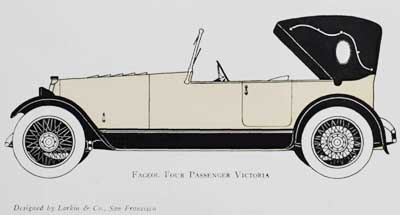
the car’s wheelbase. The two prototypes known to have been constructed
were
fitted with the Four-Passenger Victoria coachwork depicted in the
brochure. The
bodies were fitted with ivory adorned hood latches, door handles and
control
knobs – even the ivory badge on the radiator was backlit when the
lights were
turned on.
Text from the brochure follows:
“The Fageol Car was conceived and created to
increase the
luxury of living and to satisfy the demand of the connoisseur for a car
of
American make that would meet idealized requirements.
“In every age and every clime man has
expressed his love of
luxury in his mode of travel. He has striven for perfection that he
might enjoy
to the full the pleasure and happiness denied to his less fortunate
neighbor.
“Real luxury of motion has only come with
the refinement of the
motor car of quality. The queen in her open landau of gold, the prince
with his
gorgeously bedecked elephants, milady with her coach and four—all were
stylish
and splendid—yet all lacked the qualities now so necessary to real
luxury of
traveling.
“For luxury today is something more than
style, something
more than comfort, something more than speed. It is more than a
combination of
these three. Luxury not only Consists of the many little refined
appointments,
but in beauty of design—in the smart appearance of the car. Luxury
means not
only a motor that will propel the car, but a power plant that will
instantly
respond to the driver's slightest wish, be it the pace of a snail
through the
crowded traffic center or the onrushing speed of an aeroplane over an
unobstructed highway.
“The driving of a Fageol car satisfies every
sense of
physical comfort, of mental ease and of love of speed, and brings to
the
fortunate owner the vivid realization of the luxury of motion.
“In the Fageol, you will find the excellence
of construction
and the close attention to details that has only characterized the
production
of European cars now practically impossible to obtain on account of the
war.
“The use of the Hall-Scott Aviation
Powerplant is a new but
sound departure from the usual practice. This engine —excelling in
every known
test for speed and endurance—today ranks at the very pinnacle of
Aeroplane
motors, and its use places the Fageol Car above imitation.
“The custom made bodies are smart, original
and
distinctive—beautiful to look upon. There is every opportunity for the
expression of the individual taste—that the car might truly express the
personality of the owner.
“It is not too much trouble to build
precisely what the
buyer wants, and therefore the production of these luxurious Fageol
cars is
limited in order that much time may be devoted to each individual car.”
The ‘Progress Of Motor Car Industry’ column
in the February
10, 1917 issue of Michigan Manufacturer and Financial Record included
the
following:
“Fageol, A Car For The Ultra Wealthy.
“Cornelius T. Meyers, of Detroit, is
consulting engineer for
the Fageol $12,500 car which is to be made in San Francisco.
The Fageol is the last word in motor construction. Mr. Myers
is at
present at work on the motor trucks which the company will put out.
These will
be "laid down" in Detroit and will utilize Detroit made parts, but
will be assembled in California finally. Fageol, Webb Jay and
Louis
Bill formed the company and put up $25,000 each at the start, but the
organization is now a big business body with large capital to
manufacture for
the most exclusive trade. Even at $12,500 or $11,000, or whatever the
price may
be in that neighborhood, there will be sale for a limited number of the
cars to
the wealthy people who want the best.”
The February 3, 1917 issue of the Oakland
Tribune reported
that the car was being well-received in Chicago:
“The Fageol Motors Co. report the receipt of
a telegram from
Frank Fageol in Chicago to the effect that Fageol car now on display at
the
Chicago Motor Show is attracting the attention of motor car
connoisseurs and
dealers from all over the country and that there is no question
regarding the
sale of the first year's output. The Fageol car is manufactured in
Oakland and
is the highest priced motor car made in America.
“Hall-Scott Motor Company continues the
erection of
additional factory buildings, some five being- constructed during 1916
at their
works. Fifth and Snyder, Berkeley. The latest construction consists of
two new
buildings to house department work, foundation being laid this week.
Contracts
are in hand to justify continuous night and day operation for a
considerable
period. The principal buyers are Army and Navy Departments at
Washington and
foreign powers—principally Russia.”
The next day’s issue (Oakland Tribune
February 4, 1917)
proclaimed it ‘the Hit of the Show’:
“Fageol Makes Hit Of Auto Show
“Oakland Built Car Gets Great Attention of
Chicago Affair.
“Oakland was given another very substantial
boost for
distinction in the automobile world during the past week at the Chicago
Automobile Show through the medium of the new Fageol car which was
built in
Oakland and exhibited in the big Chicago auto event. The Fageol car
which is the
world's highest priced, fastest and biggest horse-powered automobile,
was the
talk of the show according to Louie Bill of the Fageol Company who sent
the
following wire to the Automobile Editor of the TRIBUNE:
“‘Hoorah for California. We are again to the
front in the
automobile Industry. Fageol car most talked of machine at the Chicago
show. Our
car has created more interest and discussion among motorists and
automobile
engineers than any car ever shown in this country. Manufacturers
congratulate
Californians for applying famous Hall-Scott aeroplane motor to their
car. We
Americans now have finer product than any foreign manufacturer. We will
exhibit
at San Francisco show. You can use this now.’
“’Best wishes. Will see you in few days, -
LOU H. BILL.’”
By the end of the week the February 5, 1917
issue of the
Horseless Age was on the newsstands, who proclaimed it ‘A Car of Many
Refinements’:
February 5, 1917 Horseless Age:
“What the Dealer Should Know About: The
Fageol – A Car of
Many Refinements
“With Six Cylinder Hall Scott Aviation
Engine Cylinders Cast
Singly and Machined to Form a Solid Block. A Gearcase of Bronze and
Aluminum a
Slanting Radiator and a Special Sub Frame
Evidently recognizing the truth the
statement that ‘there is
always room at the top’ the new chassis announced by the Fageol Motors
Company,
Oakland, Cal., is listed at $9,500: a figure which is however not
excessive
when the unusual specifications of the product are taken into
consideration. In
the first place the Hall-Scott engine of aviation type used in the
Fageol is
essentially similar to the regular airplane engine listed by the
Hall-Scott
Company at over $4,000 and throughout the entire construction of the
chassis
there is ample evidence of the full realization of a desire to provide
the
best, and the best only, in both major and minor details.
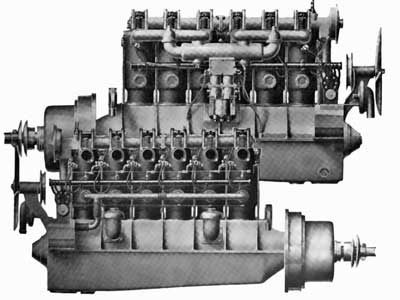
“Although the cylinders present the
appearance of being a
block casting they are in reality cast singly from a special mixture of
gray
and Swedish iron and are so machined on the sides that they form a
block when
assembled. Bore and stroke are 5x7 inches and it is stated that one of
these
engines has developed 130 horsepower at 1300 revolutions per minute
during a
continuous sixty-four hour factory test, at the conclusion of which
every part
was found to be in perfect condition. The crankshaft is of seven
bearing type,
with oversized bearing surfaces and steel oil scuppers and the
one-piece
camshaft is carried in an aluminum housing. The crankcase is of
aluminum alloy
and the lower oil case can be removed without breaking any oil line
connection.
“Lubrication is of high pressure type and is
operated by a
large gear pump. Oil is first drawn from a strainer in the sump to a
long
jacket around the intake manifold and is then forced under a pressure
of from
five to thirty pounds to the main distributor pipe in the crankcase.
The oil in
the manifold jacket assists in the cooling of the engine and a uniform
cylinder
temperature is maintained by the use of internal outlet pipes running
through
the head of each cylinder. Slots cut in these pipes permit of cold
water being
drawn directly around the exhaust valves.
“Ignition is furnished by two high tension
magnetos, both
interrupters being connected to a rock shaft integral with the engine,
an
arrangement which makes outside connections unnecessary. The ignition
system is
so installed that should one magneto become inoperative, the other will
continue to give efficient service. A twelve volt system of electric
starting
and lighting has been developed especially to suit Fageol requirements
and a
feature of interest in connection with the double Zenith carburetor is
an
arrangement which permits of oil being taken from the crankcase and run
around the
manifold to assist perfect carburation.
“A Hele- Shaw clutch in which V- grooved
twin plates of
phosphor bronze against steel revolve in an oil bath, is fitted and the
especially designed transmission is mounted in an aluminum and bronze
case. The
main case and supporting arms are of manganese bronze, the former being
so
designed that the main and counter shafts, mounted one above the other,
are in
reality just half in the case and manganese bearing caps, when in
position,
completely encircle the bearings. Twisting and torque strains are taken
up by
chrome nickel studs which extend vertically through the aluminum case.
These
and the general layout of the transmission are shown in one of our
illustrations.
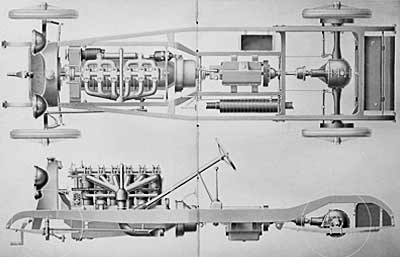
“A sub frame which carries the rear engine
arm and the
transmission is designed to allow great flexibility for rough road
traveling
and the main chassis frame is of alloy pressed steel with main sills
directly
under those of the body to insure rigidity.
“SPECIFICATIONS:
Chassis price $9,500
Cylinder number Six
Bore and stroke 5x7 inches
Carburetor Zenith
Ignition Two magnetos
Starting and lighting 12 volt system
Clutch type Hele-Shaw
Number of speeds Three
Rear axle Semi floating
Wheelbase 135 to 145 inches
Tires 34 x 4 inches
“Manufactured by the Fageol Motors Company,
Oakland, Cal.”
Although he is not recorded as being
involved in the Fageol
Motors Co., Rollie B. Fageol’s bumper business must have been doing
well as
March 11, 1917 issue of the Oakland Tribune announced that he was
constructing
a new $15,000 home:
“New Home In Rockridge.
“R.B. Fageol, one of the Fageol brothers of
automobile fame
who made both name and fortune in operating the little automobile
trains at the
San Francisco Exposition, has had plans completed for a $15,000
residence on Alpine
terrace in Rockridge Park. The new home will be of old English type,
with
twelve, rooms and a ball room in the attic. It will be one of the
finest
residences in this exclusive residence district, and work will be
commenced at
once. The plans were prepared by J. Hudson Thomas of Berkeley.”
The Fageol 100 was shown at a lavish
presentation in the
ballroom of the Oakland Hotel where, on a specially constructed 75 foot
long
platform, the Fageol was accelerated from 0 to 25 mph to a full stop in
40 feet
with six persons aboard, the April 5, 1917 issue of the Oakland Tribune
reporting:
“Claims New Record
“One of the most unique records in the
annuls of the
automobile industry was made Friday night in the Hotel Oakland ballroom
before
the members of the Manufacturers’ committee of the Chamber of Commerce
when a
Fageol car attained a speed of twenty-five miles an hour from a
standing start
and came to a full stop again all within the confines of a sixty-five
foot room
- taking the length of the car itself out of the sixty-five foot
distance it
really means that the car attained this twenty-five mile an hourspeed
and came to a stop again in a space of
less than fifty feet.
“Loose planking was spread across the room
to protect the
hardwood floors of the ballrooms. It is stated that the Silverton cord
tires of
the car fairly burned their way into the planking with the terrific
friction
engendered in stopping and starting the car on the test.”
During the next few years, Claud H. Fageol,
the family
daredevil, conducted most of the road-tests conducted by Fageol Motors,
the
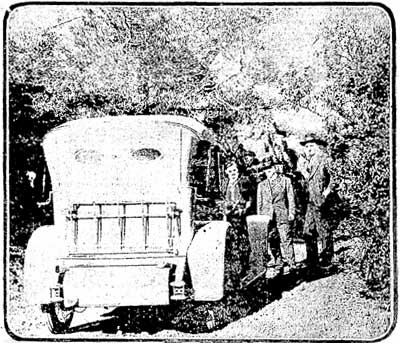
April 15, 1917 issue describing his timed climb of Mt. Daiblo, a local
peak
that had a notoriously steep grade:
“Climbs Mt. Diablo in High Gear
“Fageol car at the end of its remarkable
high gear test run
up Mt. Diablo. Photo, with fir tree in background, shows the point
reached by
the car on the last steep pitch of the Diablo grade. This powerful
motor car,
carrying four passengers weighing in an aggregate of 763 pounds, and
with two
spare wheels with tires mounted, achieved a point on the Mt. Diablo run
on a
gear rations of 2 ½ to 1 high.
“CLAUDE FAGEOL pointing to the stake marking
the point
reached by the Fageol car on the Mt. Diablo grade in its wonderful high
gear
demonstration conducted under the official observance of the Automobile
Editor
of The TRIBUNE.”
“Reaching a point fully fifty yards further
up the last
steep pitch on Mt. Diablo than the record set by the present holder of
the
Tribune Mt. Diablo high-gear trophy a Fageol car driven by Claude
Fageol, gave
a wonderful demonstration of its hill-climbing abilities during the
past week
when it climbed practically to the Fir Tree on high gear under the
rules of The
Tribune and with the Automobile editor of The Tribune as an official
carrying a
total passenger weight of driver, official and observers of 763 pounds
in
addition to two spare Silverton cord tires mounted on spare wheels and
all of
the regular equipment.
“The car made the run via the Danville toll
gate and made
every inch of the way as far as the Fir Tree on the last steep pitch
without
once removing the high gear from mesh. After having raised The Tribune
Mt.
Diablo high gear cup record by about fifty yards and complying with all
of the
other rules and regulations governing the coveted Tribune trophy, the
recognized symbol of Mt. Diablo high gear attainments, the car was
examined for
gear ratio upon its return and the committee appointed certified that
the car was
geared 2 1/2 to 1 on high gear. The committee appointed comprised the
following: Charles B. Jones of the P.B. Anspacher agency; Harrison B.
Wood of
the Oldsmobile agency and A.G. Sommerville, automobile dealer.
“The Fageol car's claim to The Tribune cup
was challenged by
P. B. Anspacher, the Stearns-Knight car dealer, who is the present
holder of
the cup and the committee appointed to decide the points at issue
sustained the
challenge of Anspacher. It was held that although the Fageol car was a
stock
car to all intents and purposes yet it could not qualify as such under
the Three
A rules governing stock cars and while The Tribune contest is not under
Three A
sanction, yet the rules made by that governing body are to be followed
on The Tribune
Mt. Diablo high gear contest.
“Therefore The Tribune trophy is still in
the possession of the
Stearns-Knight eight-cylinder car, which will remain until the mark set
by the
Stearns-Knight car is passed by a car able to qualify as a strictly
stock car
under the Three A rulings. The committee deciding the cup challenge
comprised
the following automobile men: Manager C. A. Penfield of the John F.
McLain
Company; Manager Harold D. Knudson of the Willys-Overland of
California; Homer Le
Ballister of the McDondal Green Motor Company; R.G. Bartlett of the
Mercer
Jordan Company; M. Hessel of the H.O. Harrison Company and A.G.
Sommerville.
“The Fageol is, according to Frank R. Fageol
the builder and
designer, to be delivered to buyers with gear ratios from 2 ½ to 1, 2
to 1, 1 ½
to 1, and 1 ¼ to 1. Yes the gear ratio given out by the company at the
first,
mentioned only the 1 ½ to 1 gear for high. Also the company having just
started
is unable, until a certain quantity production has been reached to
qualify as a
stock car, for under the Three A interpretation, a certain number of
cars of
the type in question must be built, sold and delivered to buyers before
claims
can be made as to its being a stock automobile.”
Claud’s run was mentioned in the May 1, 1917
issue of Motor West:
“Fageol Performs Acceleration Feat
“From Standing Start Attains Speed of 40
Miles Per Hour and
Stops Within 40 Feet.
“A speed of 25 miles an hour from a standing
start to a full
stop in 40 feet was the remarkable record of the Fageol car in Oakland,
Cal.
the other night. This feat was accomplished at the Hotel Oakland at the
annual
banquet of the Alameda County Manufacturers before some 300 guests.
Immediately
following the speech of A.L. Garford, president of the Garford Truck
Co., this
$12,000 automobile was run into the ball room on its own power to a
position
near the performer’s stage. Frank Fageol, secretary of the Fageol
Motors Co.,
announced that they would try for a world's record.
“‘We will attempt to establish what we
believe will be a
world's acceleration record,’ he said. ‘The runway which we have laid
for the
purpose is just 75 feet long. Subtracting twice the length of the car
or 36
feet we have just 40 feet in which to gain the speed. It is our
intention to
get under way to 25 miles per hour from a standing start and bring the
car to a
stop before the length of the ball room is reached.’
“With Claude Fageol at the wheel and five
guests as
passengers the demonstration was made. The speedometer indicator
reached the 25
mile point and the timers announced that just four seconds had elapsed
from the
time the start was made until the car came to a stop. This unique test
demonstrated the quick get-away of the Fageol car made possible by the
use of
the Hall-Scott aviation motor.”
The publicity attached to the automobile put
the focus on
the upstart California firm and plans for the Fageol truck proceeded,
the May
6, 1917 issue of the Oakland Tribune announcing the firm had purchased
four
acres for construction of a factory:
“Fageol Signs Up For New Factory
“Four acres of ground have been bought by
the Fageol Motors
Company of Oakland between Foothill and Hollywood boulevards and One
Hundred
and Seventh avenue, just north of Elmhurst for a $1,000,000 auto and
truck
plant. The deal was closed yesterday and the city council of Oakland
has been
asked to close several streets there for the improvement.
“The first unit of the plant will be built
immediately at
Hollywood boulevard and One Hundred and Seventh avenue at a cost of
$100,000,
with a floor space of more than 15,000 square feet. Thestructure will
be of steel and brick and
cement.
“Plans have been drawn for the entire plant,
but the units
will be put up as the business expands. The company will go in for the
manufacture of motor trucks as well as pleasure cars, according to
President
L.H. Bill.
“The company will announce formally its
plans within the
week with reference to its expansion, according to Secretary Frank R.
Fageol.”
The purchase coincided with the announcement
of the Fageol
Truck, which appeared in the May 15, 1917 edition of Motor West:
“Fageol to Build Trucks in Oakland
“The opening of a motor truck plant in
Oakland, Cal., is
planned by the Fageol Motors Co. of that city, builders of the
extremely high-priced
Fageol car. The first allotment will call for 150 trucks ranging from 2
ton to
5 ton in size and deliveries are scheduled to begin July 1. The first
unit of
the factory will be of concrete and steel construction and will have
dimensions
of 50x250 feet. A four acre site at Foothill Blvd. and One Hundred
Seventh Ave.,
has been purchased. It was announced some time ago that no more Fageol
passenger cars would be produced for a while since the Government has
contracted for the entire output of Hall-Scott airplane engines which
were used
in the Fageol passenger cars.”
The May 20th, 1917 Oakland
Tribune stated the:
“Fageol Plant Will Be Rushed To Completion
“The announcement recently made by the
officials of the
Fageol Motors Company to the effect that they will break ground for
their new
motor truck, tractor and automobile factory as soon as preliminary work
on the
plans of the plant are completed, has made a deep impression on the
commercial
interests of Oakland and Alameda county. Working in conjunction with
the
Chamber of Commerce, the company proposes to make the ground breaking
date a
gala event and one to be long remembered in this city.
“From present indications the ground
breaking will take
place somewhere about the 6th of June, the exact date to be announced
later.
The Fageol factory will be located on 107th Ave., near the Foothill
Boulevard,
in the same locality as the Chevrolet plant, giving an air of motor car
industrialism to this district which is apt to draw other automobile
factories
in the future.
“The company has ten acres of choice land on
which to erect
their various buildings and plans to build the succeeding units of the
plant as
rapidly as the need for them arises. As soon as the first unit of the
new plant
is completed machinery for building Fageol motor trucks, tractors and
automobiles
will be installed so that Oakland will be able to boast of one of the
most
complete factories of this type in the country.
“At a meeting held last Monday, the
following committee was
appointed to co-operate with the Fageol officials and see that the
forthcoming
ground-breaking ceremonies will be a huge success. The committee
consists of
Theo. Schluter, F. Williamson, Grant D. Miller, Robert Martland, Jos.
Chrysostone, and Geo. W. Flick.”
The June 1, 1917 issue of Motor West
reported on the
ground-breaking ceremony:
“GROUND BROKEN FOR FAGEOL PLANT
“Oakland City Officials Join Company Heads
in Celebrating
Event - Trucks and Tractors to Be Built
“Ground breaking ceremonies for the erection
of the new
Fageol Motor Co. motor car truck and tractor factory in Oakland, Cal.,
were
held recently. The event called for a large celebration in which
Oakland city
officials and citizens and Fageol company officials joined. The new
factory
heads were feted at a down town hotel followed by an automobile parade
out to
the factory site at One Hundred and Seventh Ave. and Hollywood Blvd.
Speeches
were made by John L. Davie, mayor of Oakland, Frank R. Fageol,
secretary and
manager of the Fageol Motors Co., and Joseph H. King, president of the
local
Chamber of Commerce. After the ground breaking the large gathering of
spectators were entertained by three short racing events, one of them
for cars
fifteen years old or older. The celebration closed with a demonstration
of the
new Fageol tractor. L.H. Bill is president of the Fageol company and
Frank R.
Fageol, secretary and manager. W.B. Fageol will be associated with his
brother
in the company. The tractor to be manufactured by the company is the
invention
of Rush Hamilton who will probably direct this phase of the Fageol
company's
activities.”
The same periodical announced in the very
same issue that
the firm was ‘nearly ready’ to ship, surprising since the plant hadn’t
even
been constructed:
“Nearly Ready to Ship Fageol Trucks
“Cornelius T. Myers, consulting engineer of
Detroit has
completed the designs for the 3 1/2 ton and 5 ton motor trucks for the
Fageol
Motors Co. of Oakland, Cal. and quantity orders for materials have been
placed.
The company is pushing its truck production forward and expects to be
shipping
2 ton trucks shortly.”
During the spring of 1917 Fageol Motors Co.
acquired the
rights to manufacture an unusual ‘Walking Tractor’ designed by Rush E.
Hamilton
of Geyserville, Sonoma County, California. The unusual tractor featured
afront mounted power unitequipped with self-cleaning front wheels (aka
grousers) behind which rode the operator and whatever implement was
being used
at the time albeit a plow or trailer.The
grousers broke up the soil, making it significantly easier for the
attached
plow to turn the soil over.
The power unit was connected to the trailing
implement unit
via an articulated union which also served to steer the tractor, and
its
awkward movement gave it the appearance as if it was walking over the
ground.
Hamilton was awarded three patents related
to the device all
of which were assigned to the Hamilton Tractor Co. of San Francisco,
Calif.; Power
Interrupting Device For Tractors - US Pat. No. 1220982 - Grant - Filed
Nov 26,
1915 – Issued Mar 27, 1917; Wheeled Farming Implement - US Pat. No.
1235891 - Grant
- Filed Nov 26, 1915 - Issued Aug 7, 1917; and Self-Cleaning Tractor
Wheel - US
Pat. No. 1274710 - Grant - Filed Apr 27, 1916 - Issued Aug 6, 1918.
Hamilton was provided with stock in the
Fageol Motor Co. in return
for the use of his patents, and was given as seat on the firm’s board
of
directors, who in 1917 included: F.R. Fageol, L.H. Bill, W.B. Fageol,
Dr.
Arthur E. Hackett, Horatio W. Smith and R.E. Hamilton.
The June 3, 1917 issue of the Oakland
Tribune announced the
new product to the community:
“Fageol Motors Company To Build Farm Tractor
“As soon as the Fageol Motors Company's new
motor truck
automobile and tractor factory is built and making of the various
Fageol
products under way, one of the first of these mechanical products to be
turned
out and placed within the reach of the farmers of the West will be the
new
tractor—the invention of Rush Hamilton - a farmer and mechanic of years
of
experience.
“Hamilton, whose experimentation with
tractors and whose
labors along these lines were called forth in his efforts to meet his
own wants
and a desire to get a tractor that would do the things he knew a farm
tractor
should do, after working on his Ideas for several years, invented and
evolved
an entire new type of farm and general tractor which, working en new
principles, proved perfectly satisfactory.
“The Fageol factory officials who had been
looking for a
tractor which would stand up under the various and trying conditions
which
beset the path of farm work, upon investigating and thoroughly trying
out the
Hamilton found that it passed every quality claimed for it by its
inventor with
the result that they acquired all the rights to build and market the
same.
“Built upon an entirely new principle, the
new tractor does
not depend upon the …..
“Big band wheel for its traction. Realizing
that while these
types of tractors pulled the plows or other farm machinery along that
at the
same time they packed the ground in front of the plow, thereby making
for a
greater expenditure of power.
“Hamilton provided his machine with two
front wheels which
have a series of steel projections about a foot long which, as the
tractor
advances, dig their way into the soil, thereby getting traction for the
pulling
of plows or whatever other machinery being used and by agitating the
ground as
it moves along loosens up the soil for the plow.
“Another feature of the new Fageol tractor
as its
adaptability to do all kinds of farm traction work. It is built so as
to run in
near to the ground, enabling the farmer or orchardist to plow or
cultivate near
and beneath his trees and bushes without harming them at all.
“‘The beauty of these new tractors,’
remarked F. R. Fageol,
‘is that they are adapted to so many farming needs, that they are
economical in
running expense, they use either kerosene or distillate or gasoline for
fuel,
and that they provide a world of power where the farmer needs it.'
“The new tractor will be demonstrated at the
ground-breaking
ceremonies at the Fageol new factory site on Saturday, June 9 so that
all who
are interest in this new machine and have a chance to see it in action.”
The September 1, 1917 issue of Motor West
included a
detailed article describing the new Fageol tractor to the trade:
“Fageol ‘Walking Tractor’
“Small, Light and Powerful, It is Well
Adapted to Pacific
Coast Soil Conditions— Listed at $ 1,085
“The Fageol Tractor, just placed
on the market, is
the latest product of the Fageol Motors Co. of Oakland. Cal.
This
company is the builder of the Fageol car —the $12,000 automobile
that took
the East by storm during the national show in Chicago last Winter. This
company
is also the builder of the Fageol truck in a number of
different
capacities.
“The Fageol ‘walking tractor’
embodies many
distinctive and remarkable features. It is small, light and powerful—
making it
especially adaptable for the orchardist and small farmer.
“Perhaps the most distinctive feature is the
novel but
practical method of traction employed. The traction wheels—two in
number—are so
constructed as to ‘walkin and out of the ground.’ The long U-shaped
prongs or
grousers simply penetrate the ground's harder sub-soil, and in coming
out break
up the ground instead of packing it.
“The wheels will
negotiate any kind of soil—either wet or dry. It is impossible for the
wheels
to stick with mud. Weighting but 1750 pounds, or slightly more than a
single
horse, and having the pulling power of four horses at the draw-bar,
this
tractor is able to accomplish results not found possible by heavier
tractors of
other types.
“The Fageol tractor ‘literally
grew’ on a
California farm. The inventor, Rush Hamilton, is a practical orchardist
and
farmer of ten years' successful experience, and withal a mechanical
genius.
“He realized that the tractor would someday
replace the
horse, lie looked about for a tractor that would fill his needs. Unable
to find
one, he started to build a tractor on the 'walking principle' of the
horse, and today the Fageol ‘walking tractor’ is the result.
During
his three years of experimentation on the farm, he put his tractor to
every
possible test. He used it for plowing, disking, hauling, etc.—in fact,
he used
it successfully for all work formerly done by horses.
“The Fageol tractor can be used
profitably by
practically every orchardist and small farmer in the country. The
narrow width
permits a center hitch for the plow, enabling it regardless of
direction of
plowing to get right up to the trunk of the tree without any side draft
at all.
In manipulation about the tree base, this tractor is as flexible as a
single
horse. In fact, the tractor and plow will turn in a 6 1/4-foot radius.
“Interesting features of construction of
this machine are
the enclosed bearings, dust-proof and running in oil or grease. Freedom
from
grease cups and from wear and tear of the excessive dust of orchard
work upon
exposed bearings, effect a rare combination of advantages. An ingenious
band is
furnished to go over the lug on the driving wheel so that the tractor
can be
put in shape for road driving within a few minutes.
“Transmission gears run in oil and are
enclosed. The final
drive is by internal gear. The pinions and the removable gears are
accurately
centered in the drive wheel to prevent any side strain on the axle. The
gear
reduction of 65 to 1 gives the tractor a speed of about 2
1/2 miles
per hour, which makes possible the plowing of about four acres per day
with a
fuel consumption of 1 1/2 to 1 3/4 gallons per acre,
depending on
soil and depth of plowing
“The four-cylinder motor, with 3 1/8-inch
bore and 5-inch
stroke, develops 18.23 horsepower. Lubrication is by splash and pump.
The
cellular type radiator has an exceptionally large cooling surface, the
water
being circulated by the thermo-syphon system. The float-feed carburetor
is
provided with a patent dust arrester. Ignition is by high-tension
magneto.
There are two speeds—one forward and one reverse. The drive wheels are
46
inches in diameter, being about 38 inches out of the ground when in
operation.
There are sixteen 10-inch U-shaped grousers on each drive wheel. The
over-all
length of the tractor is 100 inches, and the tread 41 inches. Gasoline,
distillate or kerosene may be used for fuel. The tractor is listed at
$1,085
f.o.b. Oakland.”
The new Fageol automobile was put to good
use during the
summer of 1917 by the firm’s new sales manager, J.L. Olsen, the July
22, 1917
Oakland Tribune reporting:
“Sales Manager For Fageol Firm
“J.L. Olsen, well known in coast automobile
circles, has
been appointed sales manager of the Fageol Motors Company, and took
over his
duties in his new position last week.
“Olsen left a few days ago on a tour of
California in the
Fageol pleasure car, the highest priced car in America, for the purpose
of
getting in touch with country dealers and closing up agencies for the
Fageol motor
truck.
“Needless to say that wherever Olsen stops
the beautiful car
which he is driving will be the big object of interest in the
community, but it
is on the other Fageol products, the truck and the tractor, that he
expects to
interest automobile men from the financial standpoint.
“He will close with dealers through Central
and Southern
California and Arizona on this trip and return to San Francisco and
from here
make another trip this time to the Northwest. Olsen has a wide
experience in
the automobile business, having been engaged in the selling of motor
trucks and
cars on the coast for the last ten years.
“According to a statement made by Olsen
before he left, the
Fageol Company is able to make deliveries on the two ton trucks now and
will be
able to make deliveries on the tractor by September 1. The Fageol
Company
expects to be in first unit of the new Oakland factory in within thirty
days.”
The August 1, 1917 issue of Motor West
announced that a
portion of Fageol’s new factory complex was completed:
“Build First Unit Of Fageol Plant
“Another Unit to Be Started Immediately and
Six Buildings to
Be Completed by End of Year.
“The Fageol Motors Co., Oakland, Cal., has
completed and
occupied the first unit of its new plant. The building is surrounded by
a
concrete roadway 20 feet wide used for loading space for incoming
materials. In
the factory the process of assembly is so arranged that frames will
come first,
axles next, then springs and so on, keeping the assembling operation
moving in
one direction toward a completed machine. Pneumatic tools handle all
materials.
To simplify the handling of smaller parts, rolling assembly tables are
used,
each containing a blue print number. This enables the mechanics to have
sufficient material always on hand. Another unit of the plant will be
started
immediately and it is expected that by the end of the year there will
be a
group of six buildings involving an investment of approximately
$500,000.”
The August 19, 1917 Oakland Tribune
announced the firm’s new
factory would be using cranes and
rolling assembly jigs and tables, which were standard practice before
the days
of the assembly line, which was still in its infancy in the days
leading up to
the First World War:
“First Fageol Unit Is Ready
“Company to Move Into New Quarters Before
End of Week
“The first unit of the great Fageol Motors
Company is now
complete and before the end of the week the firm will be established in
its new
quarters.
“With the first building completed and the
machinery
installed a real start has been made by the Fageol Motors Company in
the
production of the various Fageol products, the passenger car, the truck
and the
tractor.
“The plant when completed will be one of the
most modern and
efficiently organized factories in America.
“Every device is included to make for
continual, thorough
and modern handling of truck and tractor parts, moving always towards a
complete machine that will give the Fageol service under all conditions.
“The first unit is surrounded by a concrete
roadway 20 feet
in width which is used for loading space for incoming materials. Inside
the
factory the assembly leg is so arranged that assemblage will be
completed in
its regular order, that is, frames first, axles next, then springs, and
so on,
thus keeping assemblage moving in one direction toward a completed
machine.
“Pneumatic tools handle all materials from
the time they are
hoisted into the building by pneumatic cranes, drills, wrenches, etc.,
forming
part of the equipment of each assembly leg. This tends greatly to
reduce labor
and operating costs in the factory.
“To facilitate the handling of smaller
parts, roiling
assembly tables are used, each containing a blue-print number. This
enables the
mechanics to keep sufficient material on hand always. Upon completing a
unit
the mechanic signs an assembly card in order that the checking up may
be
simplified. The chief inspector carefully checks up all work and gives
a
thorough inspection of all parts before permitting any single piece of
work to go
outside the factory. This affords a double check on error or
carelessness.
“A feature of interest to the general public
in connection
with the completion of the first unit of the Fageol Motors Company
factory in
Oakland last week is the special care which is taken by officials of
the
company for the comfort and welfare of their employees.
“Numerous recreation centers have been
constructed in the
first building where much healthful sports as baseball, handball,
tennis and
track, can be enjoyed. Locker rooms and special wash rooms and shower
baths complete
the gymnasium equipment.
“In the office the employees’ interests are
also looked
after. There is a large safe deposit vault, a part of which is devoted
to the
care of valuable papers, Liberty bonds or cherished valuables of the
employees.”
The September 15, 1917 issue of Motor West
announced the somewhat surprising news that Fageol had actually
delivered one of its
cars to the Hester Motors Co of New York:
“Fageol Shipping Cars To the East
“Demand From That Section Due to Display
Made at the
National Shows in New York and Chicago. The first Fageol motor car of a
consignment of the twenty-five costly models ordered by the Hester
Motors Inc.,
New York City, will be shipped east this week. The placing of the order
is the
result of the distinctive display of the Fageol Motors Co., Oakland,
Cal., at
the 1917 automobile shows at New York and Chicago. Twenty five
Hall-Scott
engines have been secured by special arrangement the Hall-Scott Motor
Car Co.,
Oakland, being at present engaged in government work.”
Alas, the twenty-five Hall-Scott engines
mentioned above,
never made it to the Fageol plant, and the preceding announcement is
the only
evidence I could find that a ‘production’ Fageol automobile was
delivered. The
car in question was delivered to Dr. Antonio S. de Bustamante, Jr. of
Havana,
Cuba, and the remaining car, the prototype originally displayed at the
Chicago
Salon, was eventually sold to William Andrews Clark, Jr. ,the wealthy
Los
Angeles-based son of Montana ‘Copper King’ (and two-time US Senator)
William
Andrews Clark, Sr.
Historians familiar with the firm believe
only two cars were
completed – the prototype seen in Chicago, and the ‘production‘ Fageol
mentioned above. A Fageol was also reported to have been displayed at
the 1917
San Francisco Auto Salon which was held Dec 18-20, 1916 at the Palace
Hotel,
but I could locate no further information on exactly which car, if any
was
displayed. It’s possible the car was displayed at the 1917 Pacific
Automobile
Show which was held from February 10-17 at San Francisco’s Exposition
Auditorium.
However, Beverly Rae Kimes & Henry Austin
Clark claim
there was a third car stating:
“A third, and no doubt final, Fageol was
built
in 1921 for company president Louis H. Bill. A custom four-passenger
speedster,
it was fitted with an eight-cylinder Rutenber engine and Fageol's own
seven-speed compound transmission.”
A
grainy picture (seen to the right) labeled '1921 Fageol Touring',
is likley the car mentioned by Kimes & Clark. The main difference
between it and the earlier Fageol automobiles can be seen in the hood
ventilators - the six jagged units seen on the 1917 Fageol have been
discarded in favor of a more streamlined 2-ventilator setup.
Although Rollie B. Fageol was no longer
involved in his
brother’s business activities he remained hard at work developing
heavy-duty
suspensions and drivetrains for Fadgl Flexible Systems and various
third
parties, one of which was the Pacific Electric Railway, the September
29, 1917 issue
of the Electric Railway Journal reporting:
“Flexible Buses in Larger Sizes
“The Pacific Electric Railway has under
construction
additional buses of the Fadgl flexible type which will be put into
auxiliary
service at an early date. The first of these cars to be put in service
by the
company is still in use at Fresno, Cal. They were described on page 314
of the
Electric Railway Journal for Aug. 10, 1916.
“The new buses will have a seating capacity
of thirty
passengers and there are also improvements in the design of the bus
body. A
more powerful motor has been used in the larger cars and by employing
heavier
construction throughout it is expected that the life of the bus will be
materially increased. The new type is shown in the accompanying
illustration.”
Fadgl Flexible Systems also developed an ore
train that
based upon the auto trains Fageol had developed for use at the
Panama-Pacific
International Exposition. The August 26, 1917 issue of the Oakland
Tribune
announced the formation of a new firm that hoped to exploit the new ore
trains to
regional mining operators:
“Fadgl Ore Cars
“San Francisco, Aug. 20 – The Mines
Transportation Company
is the name of a new $200,000 concern, fathered by Rollie Fageol and
Harry F.
Davis of Oakland, and George W. Murphy of San Francisco, which filed
articles
of incorporation here today. The concern proposes to use the Fadgl car
which
was operated for passenger transportation at the Panama-Pacific
Exposition to carry
ore from mines to railroads doing away with the necessity of laying
tracks. It
is claimed that the Fageol machine is particularly adapted to this
purpose.”
There were a number of firms named ‘Mines
Transportation
Co.’ active in the west, and the San Francisco firm appeared just as
the Mines
Transportation Co. of Murray, Utah, failed. The latter firm was a known
user of
Fadgl Flexible Systems ore trains and their pending bankruptcy was
covered in
the August 30, 1916 issue of the Deseret News:
“The Mines Transportation Company was
managed by its
president, James Austin, and its vice-president, Abe Mecking, both
active
spirits in the concern and both signing its checks. It purchased
tractor
engines and cars for hauling of the ores of the Cardiff Mining Company
down Big
Cottonwood canyon, but after a short trial found that the grades were
too
steep, and that the brakes were not powerful enough to hold the cars
back. The
contract was therefore thrown up and the California company which had
supplied
the engines and cars took them back and re-shipped them to California
as they
had only been partly paid for.”
Cardiff Mining Company’s spokesman, Ezra
Thompson, had the
following to say in regards to the tractor trains:
“‘The tractor trains were a failure’, Mr.
Thompson said.
‘The grade proved too great for them, and they could not be operated
successfully despite guarantees which were made to the contrary.’”
Although the ore train concept was sound,
the product needed
improvement and Rollie B. Fageol commenced to beef up the drivetrain
and soon
had a redesigned vehicle that found favor with a San Francisco
millionaire named
Commander Emory Winship.
In 1918 Winship, who owned several
Magnesite mines in
and around Livermore, California, hired Rollie B. Fageol to head a team
of
engineers to design trucks to replace the mule trains that were
currently hauling
ore out of his mines. Well acquainted with the problems associated with
such an
operation, Fageol created a number of vehicles for Winship between
1918-1920
that experimented with various combinations of axles and drivetrains.
Back in Oakland sales of the Fageol-Hamilton
‘walking
tractor’ were few and far between and in 1918 Fageol brought out a
totally new
conventional 4-wheeled unit equipped with a unusual ‘spudded’ drive
wheels that
were clearly influenced by the Hamilton’s. It also included Fageol’s
distinctive
hood ventilators, making it easily identifiable as a Fageol.
The tractor included a Lycoming
four-cylinder 3 1/2 x 5-inch
bore and stroke engine and a single speed transmission - 1 forward gear
and 1
reverse - that was engaged without the use of a clutch. Also included
was a
Tillotson carburetor, Dixie magneto and ball and roller bearings
throughout.
Total weight was 3,600 lbs. and the price; $1,525, rather high
considering it
featured only a single forward gear.
Regardless sales increased dramatically and
the April 28,
1918 issue of the Oakland Tribune announced the firm was constructing a
new
building:
“Add Fourth Unit to Fageol Plant
“Increasing demand for Fageol products, both
truck and
tractor, throughout the west have made necessary a further enlargement
of the
big Oakland manufacturing plant. To the three units already constructed
a
fourth is now being built at a cost of approximately $12,000 This is in
line
with the original building plans of the company and the fourth unit is
being
constructed in the rear of the other three. It will be used as a parts
and
stock department, and when all of the buildings of the plant are
finished
according to the original plan, this unit will be in the center of the
big
manufacturing plant."
Frank R. Fageol suffered an acute attack of
appendicitis in
the fall, the September 14, 1918 Oakland Tribune reporting:
“Frank Fageol to Recover, Say Doctors
“Frank R. Fageol of the Fageol Motors
Company is reported as
convalescent at Merritt Hospital, where he was operated on last
Wednesday by
Dr. M. L. Emerson for an acute attack of appendicitis and indications
point to
his early recovery.”
The January 15, 1920 issue of Motor West
reveals that the
Fageol distribution network, which was handled by Berkeley, Calif.’s
Butler-Veitch Co. in northern California, included as many as 60
individual dealers:
“Fageol Dealers Meet
“The Fageol Motors Co. recently held its
second annual
dealers convention at its Oakland, Cal., plant. More than sixty
distributors
and dealers of the Fageol truck from all parts of the Coast were
present, a 100
per cent attendance.
“The company has lately announced the Fageol
seven-speed
compound transmission installed in its trucks, adding 36 per cent more
truck
speed and 91 per cent more pulling power, without added engine power.”
Details of the new transmission were
published in the March
15, 1920 issue of Motor West:
“Seven-Speed Truck is Fast
“Double Round Trip from San Francisco to Los
Angeles and
Return, by Fageol, at 25 Miles Per Hour.
“As a forerunner of fast inter-city express
freight service
by motor trucks the double round trip test run of a Fageol 3
½ - 4
ton model, between San Francisco and Los Angeles, is pointed to as
indicative
of what may be the performance with trucks equipped with the new
seven-speed
compound transmission. An average speed of approximately 25 miles per
hour on
the double round trip run between the two principal cities of
California—a
distance of 1,765 miles—was maintained with capacity loads of freight
consigned
to business concerns in San Francisco and Los Angeles.
“Following the California state highway
along the Coast on
the southward trip, the first test started from Third and Market
streets, San
Francisco, at 9:15 p. m., January 5, and ended 19 hours 53 minutes
later at
First and Broadway, Los Angeles, after 460 miles of strenuous driving.
The
actual running time, with stops for gasoline and meals deducted, was 17
hours 5
minutes, an average of 26.5 miles per hour. This may be compared with
the
schedule of the crack passenger trains on the Southern Pacific
Railroad, the
Lark via the coast line taking 14 hours 50 minutes, and the Owl,
through the
valley, doing the trip in 15 hours 30 minutes.
“The return trip was made via the Ridge
Route, over the
Tehachapi mountains, and through the San Joaquin Valley on the state
highway.
The distance was 427 miles and was covered in an elapsed time of 16
hours 39 ½ minutes.
The actual running time was at 27.3 miles per hour.
“In the first round trip test run of 887
miles more than 30
towns and cities, two mountain ranges of considerable importance, and
numerous
ranges of hills, with varying steep grades and slow going, presented
traffic
and pulling tests that proved the value of the new equipment. With such
hindrances to speed, even though the roads were practically all good,
it
necessitated making a speed of from 30 to 40 miles per hour on the open
stretches
of level highway.
“That such a speed is attainable with a
motor truck carrying
a capacity load, and can be maintained over long reaches of roadway
without
seriously affecting the motor or truck mechanism through excessive
vibration is
regarded as little short of marvelous. With the ordinary three or
four-speed
gearset it is a practical impossibility, as the truck and motor would
be shaken
to pieces. It is accomplished through the fifth forward speed—an over
gear
which, while not increasing the engine revolutions per minute or
consuming more
fuel, still gives the truck 36 per cent more speed than a truck fitted
with a
standard transmission.
“The steep pitches on the grades through
Gaviota Pass, the
long steady pull up Cuesta grade between Atascadero and San Luis
Obispo, and
the no less severe trip up San Juan grade, with more than four tons of
pay
load, showed the great advantages of the new seven-speed compound
transmission
when in extreme low gear. The additional low increases the pulling
power of the Fageol, it
is claimed, 91 per cent above the best obtainable pulling power with an
ordinary three-speed transmission.
“A second round-trip test run was made,
beginning in Oakland
January 8, and ending with the return of the heavily
laden Fageol to
San Francisco, January 12, in which the actual mileage traveled was 878
miles,
at an average speed of 26.8 miles per hour for actual running time.
“On the first run south, Goodyear pneumatic
cord tires on
steel wheels were used, coming through the hard trip without a scar. On
the
second run Goodrich DeLuxe solid tires on Sewell patented wooden
cushion wheels
were used, and one of the surprises of the two trips was the better
time on the
solid tires. On the pneumatics an average of 25.1 miles per hour was
maintained, while on the solids 26.8 miles was the average speed. On
the rear
wheels, on the solid-tire trip, the tires were dual. Although on the
solid-tire
trip, especially on the return trip from Los Angeles to Oakland, the
elapsed
time was shorter than with pneumatics, this was perhaps due to several
delays
to the latter on the way down, including an arrest for driving through
Santa
Barbara at almost 40 miles an hour. The solid tires showed wear on
their return
trip and General Sales Manager Fort, of Fageol, believes they
would not
stand up under the terrific strain of the speed possible with the
seven-speed
transmission.
“For the speed of the two round trips and
the heavy loads
carried the gasoline consumption was low. On the first trip an average
of 8
miles per gallon was proof of the Fageol Motor Co.'s claim
that
economy of operation is possible on motor trucks traveling at high
speed with
the help of the new seven-speed compound transmission.
“On the first round-trip test, the weight of
truck and load,
southward, was 17,400 pounds; on the return, 14,800 pounds. On the
second round
trip the total weight on the southward run was 15,500 pounds; on the
return,
15,000 pounds.
“On each return trip, after arrival at
Oakland, the truck
was taken to San Francisco and driven over the famous Fillmore Street
hill, a
25 per cent grade as shown on the official map of the city engineer.”
In order to increase their share of the
national truck
market, the firm needed to expand into the eastern markets, a move
which was
spearheaded by Frank R. Fageol – the April 25, 1920 Oakland Tribune
reporting:
“Frank Fageol Goes East To Close Contract
“Frank Fageol, manager of the Fageol Motors
company of this
city, left for Cleveland and other Eastern points last Monday.
“As this trip is a most important one, in
that it is made
particularly for the closing of pending contracts which will insure the
early
delivery of materials required for the contemplated greatly increased
production of Fageol products, and as Fageol expects to be away for
several
weeks, the event was made the occasion Sunday evening of a surprise
party to
him at his residence in Claremont, at which some hundred or more of his
employees gathered and presented him with a token of their regard and
esteem.
Monday morning there was a large gathering at the station of his heads
of
departments and of the officials of Butler-Veitch, the distributors of
Fageol
products, to wish him God speed.”
The trip East brought about a number of
changes in
operations, the most important being the formation of the Fageol Motors
Company
of Ohio which was floated through a $200,000 stock offering that first
appeared
in the September 2, 1920 Oakland Tribune. The new corporation’s
officers
included Frank R. Fageol, president; Webb Jay, vice-president; Calvin
Eib,
vice-president of sales; Maj. S.E. Hutton, secretary-treasurer; A.E.
Jurs,
general manager and I.H. Crow, supt. of the machine shop. Its formation
of the
firm was announced in the August 28, 1920 issue of Automobile Topics:
“Fageol Trucks Are To Be Made in Ohio
“Fageol Motors Company of Ohio Formed in
Cleveland - A
Separate Company from California Plant -Oakland Men Included in
Personnel.
“Fageol trucks, which for the past three
years have been
manufactured in Oakland, Cal., are now to be built in Cleveland. For
this
purpose a new organization has been formed to take over the Ohio
manufacturing
project. The Fageol Motors Company (of Ohio) is the name
of the
new enterprise and its executive personnel is made up of men who were
formerly
identified with the California company. A plant in the Ohio city,
formerly
occupied by a motorcycle manufacturer, has just been secured, and
additional
factory units will be added, according to present plans. Limited
production is
to start in September, gradually increasing the output until the
proposed
schedule of 60 trucks a month by January is attained.
“F.R. Fageol, founder of the Oakland company
and largely
responsible for the truck’s design and its development, is president of
the
newly formed company, having resigned as president of, although
retaining an
interest in the California plant. Fageol, for a number of years a car
and truck
distributor himself, has learned by such experience just what the
demands of
the truck user are, and also the value of factory cooperation with the
dealer.
This plus his truck and tractor building experience fits him for his
new post.
“Calvin C. Eib, who, as told in these
columns last May, left
the management of the Denver branch of the Willys-Overland Company to
direct
the sales of the Ohio plant, although it was not known at that time
that a
separate company would be formed, assumes the post of vice-president in
charge
of sales. The other executives Fageol brings with him from California,
they
being I.H. Crow, who was superintendent of machine shop production for
the
Oakland Fageol plant.; Major S.E. Hutton, secretary and treasurer of
the Ohio
company, and A.E. Jurs, general superintendent of production. Webb Jay,
whose
name is well-known in connection with the vacuum tank, is a director
and
vice-president.
“The Ohio company, while entirely friendly
to the Oakland
organization, is to be conducted as an independent enterprise.Under the
arrangement consummated, the
Cleveland plant will turn out exactly the same truck as made on the
Coast, and
has at its disposal the engineering department of the Oakland outfit,
which,
incidentally, will carry on all the development work for the two
companies. The
Ohio company has exclusive rights to all territory east of the Rockies
and such
export sales as are ordinarily handled from the Atlantic seaboard. The
eastern
organization will concentrate on but two of the Fageol truck modes, a
medium
duty, 2 ½ - 3 tons capacity, and a heavy duty, for loads from 3 ½ tons
upward.
Both of these feature the Fageol seven-speed compound transmission,
which has
been described previously in Automobile Topics.”
The September 25, 1920 edition of Michigan
Manufacturer and
Financial Record announced the new firm had leased the former plant of
the National
Bronze & Aluminum Foundry Co.:
“Fageol Locates In Cleveland
“It is announced in Cleveland that the
Fageol Motors
Company, of Oakland, Cal., maker of trucks, has taken a short time
lease on the
plant formerly occupied by the National Bronze & Aluminum Foundry,
and will
use the 35,000 square feet of floor space as a branch plant pending the
erection of a factory. The Cleveland business will be entirely
independent of
that in California, and for this reason the Fageol Motors Company of
Ohio has been organized, in which men well known in the automobile
industry of Cleveland and elsewhere are financially interested, among
them
being F. C. Chandler, founder and president of the Chandler Motor Car
Company.
At the Cleveland plant only two Fageol models will be made—a 2 ½ to
3-ton model
and a heavy duty model for loads of from 3 ½ tons up. The vehicles will
be
duplicates to those made on the coast.”
September 15, 1920 issue of the Commercial
Car Journal
included further details of the new firm as well information about the
firm’s
new 7-speed transmission:
“Fageol Trucks Now Also Being Built in
Cleveland
“The Fageol Compound Truck which for the
past three years
has been built in Oakland, Calif., is now being manufactured also in
Cleveland,
Ohio, in order to meet the demand that has been coming to the
California plant
from truck buyers of the east and middle west. Fageol trucks are built
in four
sizes 1 ½, 2 ½, 3 ½ - 4, and 5-6 tons capacity. Detailed specifications
will
found in the specification table in this issue. The Fageol organization
has for
several years been convinced that the truck of the future must be
capable of a
wider range of operation. The following description tells their
solution of the
problem:
“The 7-speed compound transmission which is
largely
responsible for Fageol success on the Pacific coast, gives
the truck
a range of power declared by its makers to be 91 per cent greater than
is
possible with the conventional 4-speed type of transmission, as well as
36 per
cent more road speed, without in the least increasing the speed of the
engine.
The Fageol transmission, used exclusively in this truck, is in
appearance
quite the same as the 4-speed type, having exactly the same number of
gears,
shafts, etc. Yet the Fageol transmission provides five speeds
forward
and two reverse.
“The extra speeds or gear ratios of
the Fageol are
obtained through a very simple device developed and perfected by F.R.
Fageol, and
the engineering department of the Fageol Company. This
device, upon
which patents are pending, makes it possible to run the countershaft of
the
ordinary transmission at two speeds instead of one. The fifth forward,
or high,
is an over-gear which, while not increasing the number of engine
revolutions
per minute, gives the truck 36 per cent more road speed, thus reducing
the gas
consumption per mile. The first speed forward in
the Fageol is an
extra low gear which gives the truck 91 per cent more pulling power.
“The range of power and speed made possible
by this
transmission has been found especially desirable by truck owners of the
Pacific
coast where are found the most exacting traffic conditions in America.
There, a
successful motor truck must be able to haul a full load up 25 per cent
to 30
per cent grades over all kinds of mountain road. It must be capable of
withstanding the rapid transition from summer heat to freezing
temperature to
compensate for lowered efficiency clue to high altitude—25 per cent at
7000
ft.—it must have a reserve of power far beyond sea level requirements.
“In addition to its compound transmission,
the Fageol embodies also ease of control and comfort for the
driver.
The truck is said to steer with unusual ease. All operating levers such
as
throttle, brake and gear-shaft, are most conveniently located and so
constructed as to insure comfort when being maneuvered.
“The driver is relieved of the necessity of
continuously
oiling springs, etc., by the oil reservoir spring hangers which keep
all of the
springs on the truck lubricated. A very complete set of tools is
conveniently
located in a substantially built tool box. To provide for the driver's
comfort
a well upholstered form-fitting seat is furnished.
“The Fageol Motors Company (of
Ohio) as the new
Cleveland company is known, is headed by F.R. Fageol, founder
of the
California company, who is largely responsible for the development of
the truck
as well as its success west of the Rockies, where it is one of the
three or four
big leaders in the trucking field. Mr. Fageol attributes much
of his
success as a truck manufacturer to the fact that for a number of years
he was a
distributor of cars and trucks. This experience, he declares, has been
of
inestimable help in enabling him to build a truck which meets the
demand of the
truck user and consequently is easily handled by the dealer. This same
experience has taught him the value of factory co-operation with the
dealer.
Associated with Mr. Fageol is Calvin Eib, who will assume the position
of vice
president in charge of sales for the Fageol Company (of Ohio). Mr
Fageol has
brought with him from California, I.H. Crow, who has been the
superintendent of
machine shop production for the Oakland plant, Major S.E. Hutton,
secretary and
treasurer of the new company, and A.E. Jurs, general superintendent of
production. Webb Jay, of Vacuum Tank fame, is a director and vice
president of
the company.”
In partnership with a San Francisco-based
father & son
team - Samuel A. & Horace W. Moss - Rollie B. Fageol formed the
Fageol-Moss
Shock Absorber Co. late in the year.Organized with a capital stock of
$150,000 in order to
manufacture shock
absorbers, Fageol-Moss’ factory was located at 3512 Piedmont Ave.,
Oakland,
Calif. Samuel A. Moss is better known
today
as the developer of the Moss Supercharger, a Rateau-type of turbo
compressor
developed for the Liberty aero engine during his tenure as chief of
turbine
research at the General Electric Co. Exactly what products were
developed by
Fageol-Moss is unknown and the firm disappeared by the time the 1923
Oakland
directory was published.
Rollie’s younger brother Claud continued to
work in
Oakland’s retail automobile business as manager of the Oakland
Scripps-Booth
and HCS distributor and at the end of 1921 as manager of the Pacific
Nash
Motors Co., the August 24, 1921 issue of Motor World reporting:
“Claude Fageol, Oakland, Cal., one of best
known men in the
motor car industry of northern California, whose connection with the
automobile
business dates back to the days when the old Rambler was the car of the
day,
has been appointed sales manager of the Pacific Nash Motors Co. with
headquarters in Oakland.”
The November 20, 1921 issue of the Oakland
Tribune marked
the official unveiling of Rollie B. Fageol’s most famous creation, the
eight-wheeled motor bus:
“Car Builder Is Pioneer In Bus Designs
“Rollie Fageol, builder of the Fadgl trains
which served as
the transportation system within the exposition grounds during 1915,
has
designed and completed for the American Highway Transportation Company
of San
Francisco an eight-wheeled, twenty-passenger motor bus which gives
excellent
promise of revolutionizing the present type of motor buses.
“Twenty-five hundred miles of service has
thus far brought
to light only a few minor changes in construction and the Fadgl bus
will still
work its way through the experimental stage by being subjected to
27,500
additional more miles in order to reveal any hidden bugs.
“Increased riding safety and greater riding
comfort are the
two main points advanced by Fageol as the basic reasons for future
success his
eight-wheeled motor bus will experience. Increased safety is possible
because
skidding has been eliminated and little danger of accident is likely
from tire
trouble even when the bus is traveling at a high rate of speed.
“Greater riding comfort comes from the use
of the four extra
wheels and because of the smaller tires used.
“Fageol declares that the eight-wheeled idea
is an evolution
of the six-wheel type, which, in turn, he says, was an evolution of the
successful Fadgl motor train.
“On the first experimental run, from Oakland
to Los Angeles,
via the coast route, the Fadgl bus made the run of 455 miles in fifteen
hours
on a gasoline performance which showed ten miles to gallon as an
average.
“The four front wheels steer in tandem and
Fageol states
that this system provides a safer and easier control of the car.
“In the present job a Continental motor is
used, but on the
next and subsequent buses a special Hall-Scott motor will constitute
the power
plant. The wheel base is sixteen feet in length and the length over all
is
twenty-six feet. The bus turns on a twenty-six foot radius. The present
experimental bus weighs 8,000 pounds and this weight will be
considerably
reduced on the next job that is turned out.
“From the 32 x 4 1/2 tires Fageol uses he
expects from
25,000 to 30,000 miles of service and if this record is obtained
passenger bus
operators will get a somewhat rude shock, inasmuch as 10,000 miles is
considered a fine showing on the existing large sized tires equipped on
present
day four-wheeled types.
“Fageol is trying the eight-wheeler out
today on the experimental
track at Pittsburg in order to find out just what road shocks it
produces and
to what extent, if any, it affects the longevity of concrete roads.
Because the
road impact is lighter than four-wheel type produces, Fageol believes
his new
passenger-carrying vehicle will show up favorably on the accurate
recording
instruments that are in use on the Pittsburg course.
“An equalized load, almost perfectly
balanced, is obtained
under any driving conditions.”
The eight-wheeled truck/bus chassis was not
a new design,
the July 1917 issue of Popular Science Monthly included pictures and
schematics
of a ‘Ten-Ton Motor-Truck on Eight Wheels’.
The January 1922 issue of The Timberman
included an article
on another new Rollie B. Fageol design, a six-wheel-drive road train
constructed
for Col. Emory Winship,a San
Francisco-based mine owner:
“Six-Wheel Drive Road Train
“System of Transportation Said To Rival
Three Separate Trucks
and Drivers
“By distributing the load over a number of
trailers, and by
developing a power unit with traction on all six of its wheels,
Emery Winship of San Francisco, has evolved a system of motor
haulage
calculated to give greater efficiency than three separate trucks and
three
individual drivers.
“Train With Six-Wheel Drive Unit
“This road train consists of a 10-ton truck
with 6-wheel
drive and two 5-ton trailers of special design. There are four wheels
and two
axles in the rear of the power unit over which the load is carried. By
putting
the 10-ton load over the four wheels in the rear instead of over two as
in the
4-wheel trucks it doubles the bearing surface of the train and only
brings half
the pressure on any one point of pavement. This practice will greatly
increase
the life of roads and pavements. The 6-wheel drive eliminates the
slippage and
gives a traction of 100 per cent.
“The fact that one man can drive the train
without
assistance and more economically than three drivers for three trucks
reduces
the gas consumption and overhead.
“The power unit steers on the two front and
two rear wheels.
All steering wheels intersteer so that when the front wheels are turned
the
rear wheels automatically turn in the opposite direction so that the
train is
practically on a pivot, giving a very short turning radius. All four
wheels of
the two trailers intersteer, and follow in the exact path of the wheels
of the
power unit, consequently one driver can drive the train around a
sharp
corner without looking around to see if the trailers are striking
anything.
“The power unit is equipped with a hydraulic
steering gear
which automatically throws into hand gear should anything happen to the
hydraulic steering device. This enables the train to be steered with a
minimum
of effort on the part of the driver.
“Each wheel of the motor truck and trailers
have their own
brake which is a combination of pneumatic and hydraulic device, and is
so
arranged that should one or more of the trailers get loose the brakes
are
automatically applied. There is also a device that automatically puts
the
proper amount of brake on the trailers when they are crowding the power
unit in
going down grade.
“Various devices are installed on the
trailers which
absolutely eliminate any wobble in the trailers, thereby eliminating
the menace
to other traffic. The road train is 62 feet in length and can be turned
in a
circle 60 feet in diameter.
“For a better understanding of some of the
features of the
road train, a series of photographs is reproduced.
“No. 1 shows the method of connecting the
front trailer to
the power unit. It also shows the hose for controlling the brakes on
the
trailers. No. 2 shows how the power unit can run over obstructions.
This block
is 12 inches high, and the truck run up onto the top and back again
without any
trouble whatever. The front wheels were held in this position for
several
minutes, while the photo was being taken. This photo also shows the
cylinder
and mechanism of the hydraulic steering device.
“Four-Ball Universal Joints.
“No. 3 at the arrow at A. shows one of the
four-ball
universal joints on the drive shaft. These universal joints are covered
to
retain grease. The universal joint consists of a driving fork, double
slotted
ball and driven fork. Two forks are arranged to accommodate the gear in
one
case and the driving member of the wheel in the other. The slotted ball
acts as
transmitter of power between the two fork members. This is so arranged
as to
permit the front wheels to turn at an angle of 30 degrees.
“The arrow at B, in photo No. 3, shows the
shaft for
steering the two rear wheels. The arrow shows two universal joints in
the shaft
which permits the two rear wheels to turn to an angle of 14 degrees. in
the
opposite direction from the front wheels, when turning corners. Tires
used on
the equipment are 36 x 7 inches.
“The Rogers-Unit Drive Corporation,
Sunnyvale, Cal., is the
builder of the 6-wheel type of truck and trailer attachment.”
The eight-wheeled bus pictured and described
in the November
20, 1921 issue of the Oakland Tribune was featured in the February 1922
issue
of Bus Transportation:
“Eight Wheels Improve Riding Qualities
“An eight-wheel bus, which is a radical
departure in
both design and construction has just made its appearance in
California.
Instead of a single axle at both front and rear, the vehicle has double
axle
construction so that virtually it has two trucks. The front four wheels
steer
in unison, while the drive to the four rear wheels is through two sets
of worm
and gear axles. The rear worm is driven from the front through a shaft
with
universals at both ends. The two axles making one unit are placed at
centers of
about 3 ft.
“Double semi elliptic springs on each side
between each pair
of axles support the chassis frame. This suspension allows the
ascension or
depression of any one or any combination of wheels, because each set of
wheels
behaves somewhat similarly to a single car of short wheelbase and any
distortion or rocking motion of that unit is not imparted to the
chassis frame.
It is claimed that this sort of design which is made possible by the
use of
eight wheels, has produced a machine with riding qualities which
surpass those
of any four-wheel vehicle. The car is driven by a special 60 hp.
four-cylinder
motor designed by Mr. Hall, the designer of the Hall-Scott airplane
engine. The
bore and stroke of the cylinders are 4 1/2 x 5 1/2 in. With this power
a
maximum speed of 50 m.p.h. is possible. An economy of 10 miles per
gallon of
gasoline was obtained on a fifteen hour trip made between San Francisco
and Los
Angeles. The car, which weighs 8,000 lb., is fitted all around with 32
x 44-in.
tires which need be inflated but to the customary pressure of 70 lb.
“The length over all is 26 ft. and the
seating capacity is
twenty, with the six seats extending entirely across the body with an
individual door for each on the right-hand side. The small size of the
wheels
combined with the off-set chassis frame construction over the two rear
axles
has prevented this novel construction from increasing the body height
over the
usual height. Because of the cross-seat construction it has been
possible to
provide a large space in the rear for baggage. Both front and rear of
the car
are protected by heavy steel bumpers.
“The machine was designed and constructed
by R. B.
Fageol of the American Highway Transportation Company, San
Francisco, Cal.
“No. 1—The high-speed eightwheel
twenty-passenger
interurban bus.
No. 2—Each axle conforms independently to
inequality in road surface.
No. 3—The bus is steered with all four front
wheels.
No. 4 — Chassis showing the raised frame over
the
rear axles.”
An illustration of Rollie’s eight-wheeled
bus appeared on
the cover of the February 1922 issue of Popular Mechanics which also
contained
an article by H.A. Lane that referenced the vehicle inside:
“Motor Bus Travel Attains World Scope
“Astonishing Developments in This Mode
Transportation –
Tourists of the Future may Prefer Busses To Railroads – Motor-Car
Touring will
be Brought Within the Reach of All.
“by H.A. Lane
“Noteworthy departures from the usual manner
of travel by
tourists, have been evidenced by the constantly increasing demand for
reservations on motor busses operating in various parts of the world.
And
equally remarkable have been the developments in the construction of
these
busses, until at the present time there have been incorporated into
them sumptuous
appointments which rival the best accommodations available on railroad
trains
or steamship lines. If present indications may be taken as a prophecy,
the bulk
of tourist migration in the future will be handled by this method of
transportation.
“Ancient and medieval ruins, together with
historic and
romantic localities, will always be the Mecca of tourists, and
pilgrimages to
these placed are being made more pleasurable each year by the
facilities
offered by the motor bus. While pleasure seekers annually migrate to
all
sections of the country, in advance of inclement weather, California is
undoubtedly the greatest magnet for this class of people, and it is
fitting
that the latest development of the motor bus should emanate from there.
The
innovation consists of an eight-wheeled car, with a seating capacity of
20
persons, and a spacious compartment for the luggage of the passengers.
For
safeguarding the traveling public, the eight-wheel bus possesses many
advantages over the four-wheel type. The new machine steers on all
front
wheels, which are fastened together by a special spring suspension, and
constitute a truck, as likewise do the rear wheels. The car is driven
by, and
the brakes applied to, the four rear wheels, so that it superiority is
obvious.
If when running at top speed, one front or rear axle should break, the
other
axle would maintain the weight of the car.Likewise if under the same
conditions a front tire blows
out, the
machine can be steered on the three remaining tires, thus avoiding an
accident.
Although the bus weighs 8,000 lb., the pavement strain is considerably
less
than would be the case of a four-wheel car of the same weight, because
of the
eight bearing points, and because an air pressure of only 70 lb. is
used in the
tires, in comparison with the 90 lb. of the four-wheel type. Extensive
test
made with this machine have satisfactorily proved that it will not
skid, that
it ride more comfortably than any four-wheel motor car, than an average
of 10
miles can be made on one gallon of gasoline. The eight-wheel bus has
five cross
seats for passengers, with a door for each seat, while the driver’s
seat has a
door on each side. Although the interior of this new departure in
motor-bus
building is comfortably upholstered, there can be no comparison between
it and
some of the luxuriously arranged busses in Europe.”
Coincidentally, Rollie’s brother Frank had
just constructed
a bus of his own that would become far better known than his older
brother’s
eight-wheel creation, the January 6, 1922 Oakland Tribune reporting:
“Fageol Truck Distributors in various parts
of California
are in Oakland today and tomorrow attending a convention of Fageol
Dealers
which is being held at the local truck factory on the Foothill
boulevard. A
banquet will be held tonight at the Hotel Oakland.
“Plans for the coming year were discussed at
today's meeting
and tomorrow the Fageol Dealers will be conveyed to Pittsburg in the
‘High-way
Cruiser,’ a new motor passenger vehicle designed by the Fageol factory.
“The Fageol Maintenance Truck which is also
another Fageol
product will be demonstrated to these dealers on the experimental track
at
Pittsburg.”
The rechristened High-Way Cruiser, now known
as the ‘Silver
Fox’ made a promotional trip to Los Angeles, the January 31, 1922
Bakersfield
Morning Echo reporting:
“New Motor Bus Is Out On Test Jaunt
“‘The Silver Fox’, first of a new fleet of
specially
designed passenger buses, built by the Fageol Motor Co. of Oakland, hit
the
concrete trail for Los Angeles yesterday, bearing greetings from the
mayor of
Oakland to the mayor of Los Angeles.
“A film actress christened the new car as it
rolled away.
The car will make a stop in Bakersfield. Frank Fageol is in charge of
the test
trip. The bus is due to arrive in Los Angeles tonight or Wednesday
morning.”
Frank R. Fageol submitted the following
motor coach sales
pitch to the people of Oakland via the February 19, 1922 issue of the
Oakland
Tribune:
“Convenience Not Cost is Vital Issue
“By F. R. Fageol, Fageol Motors Company.
“Much has been said and written about the
relative costs of
transportation - either passenger or freight - over railroads as
against
automobiles or motor trucks. As automobile and motor truck
manufacturers, we
wish to admit that we do not consider automobiles or motor trucks will
ever
transport either passengers or freight as cheaply as do the street
railway
companies and the railroads. But we do not believe the question of cost
really
enters into or is a part of the consideration.
“The great consideration is convenience.
“The progress of the world, to date, has
been marked not
necessarily or primarily by reduction in first, costs, but rather by
ways and
means that create greater convenience – greater convenience, on the
whole,
tending toward higher standards of living, more industry and more
prosperity
for everyone concerned.
“By way of a few simple illustrations: No
man ever rode from
his home to his office in his automobile cheaper than he could have
ridden on a
street car. But the cost was not a consideration; it was convenience.
It would
be cheaper to heat your water in a teakettle, pour it in the washtub
and take a
bath in that manner (as they did in the olden days) than it is to spend
a lot
of money equipping a house with plumbing, bathtubs, etc. But no one
seriously
considers doing this, because the bathtub is more convenient. And so
on, one
could so with examples, indefinitely.
“Index Of Cheapness.
'Show me a land inhabited by a people who do
not know or do
not care about convenience and where everything is extremely cheap, and
I will
show you a non-progressive, backward people.
“I herewith quote the results of some very
interesting
figures (compiled recently by Mr. B. V. Buckwalter) covering traffic
conditions
on highways versus railroads between Pittsburgh and Bedford, Pa.
Condensed,
these figures show that there were 6,000 people per hour being
transported by
motor transportation over the highway as against 4,400 people per
twenty-four
hours via railroad. Considering the railroads were only operating
twelve hours,
which time covers the dense travel on the highway - they would be
transporting
approximately 360 people per hour. In other words, on account of
convenience
wherein cost is of no consideration, there are as many people being
transported
by motor-driven equipment over our highways every three and a half
minutes as
there are over the railroads every hour! And it is our opinion that the
great
tonnage of freight will in time be transported in about the same
proportion.
“The railroad companies have during recent
years indulged in
a great deal of talk that they were being discriminated against by
motor truck
operators and treated very badly in several, on the following grounds:
“The railroad companies maintained that they
keep up their
own railroad tracks and rights of way and that the general public keeps
up the
highways over which motor truck and motor bus transportation travel. It
is the
writer's contention that these claims are based largely on false
reasoning, in
that the general public - the consuming public, you, I and everyone
else –
maintain .and keep up all railroads and all highways, and all of
everything
commercial that exists, and if the railroads do not derive their
revenue for
keeping up their rights of way, etc., from the general public—just
where do
they get it? They must have found an ever-flowing fountain of gold and
have
guarded their secret well.
“The public really maintains the railroad
rights-of-way and
all of their equipment by a direct tax in the form of freight on every
article
they purchase. Whereas, they partially maintain our great highway
system by a
direct tax on all articles transported over them and through the
indirect tax
which they pay on property, motor licenses and otherwise.
“The great point is that the consuming
public must pay for
everything—it can come from no other source, and should come from no
other
source. As to just how or through what manner they pay, it matters
little.
However, if we are going to work on the theory of letting the man who
can
afford it pay most, then, they certainly come nearer doing it in the
maintenance of the highways than they do when paying for the
maintenance of the
railroads—as the highways, at least, are largely kept up by the tax on
property
owners and those who use them most, whereas railroads are kept up by
direct tax
in the form of freight on everything you consume, handle or wear that
has ever
been transported over a railroad.
“Please do not assume from the above remarks
that we have
any quarrel with the railroads—far from it. We greatly admire them,
feel that
they have in the past and always will fill a great need.”
The March 1922 issue of Bus Transportation
included pictures
of the new Fageol intercity limousine-style coach:
“California Maker Produces Limousine Design
“The Fageol Motors Company, Oakland, Cal.,
has brought out a
bus designed specially for long distance service. The Fageol intercity
bus
seats twenty although it can be furnished in twelve or sixteen
passenger
capacity. The two rear seats are arranged back to back and carry three
passengers each, the next three seats four passengers each, while two
passengers can be carried at the side of the driver. Each seat has an
individual side entrance.
“Features of this new bus are the inclosed
running board,
individual entrances for each seat, and the engine designed by Col.
A.E. Hall
of aircraft fame. A luggage space is provided at the rear, inside the
body. The
condensed specifications of the Fageol bus are:
“Body: Aluminum with limousine type doors
and drop windows. Seats
of Marshall double-deck springs covered with leather.
“Engine: Hall-Scott four-cylinder. Bore 4
1/2 in. Stroke 5
1/2 in. Overhead cam and valve. Delivers 62 hp. at 1,800 rpm., the
governed
speed.
“Ignition, Starting, Lighting: Delco, with
oversize generator and battery.
“Fuel Supply: 30 gal.
“Chassis Lubrication: Automatic.
“Transmission: Brown-Lipe four-speed. Direct
on third. Geared up 25 per cent on fourth. Thermoid and Spacer
universal joints.
“Rear Axle: Timken-Fageol under-slung worm
and gear. Reduction 5 2/5 to 1.
“Brakes: Duplex internal on two rear wheels.
Diameter 21 in.; face 4 in.
“Wheels: Disk type. Tires 36 x 6 in. cord
all around.
"Gage: Special 68 in.
“Wheelbase: 188 in.
“Overall Dimensions: Width, 81 in.; length,
260 in.; height, 75 5/16 in.”
Although he remained a car salesman, Claud
Fageol occasionally
served as a test driver/chauffeur for Frank & William’s business
operations, the March 5, 1922 Oakland Tribune reporting:
“Elks Travel In New Safety Bus
“One of the new Fageol safety buses conveyed
twenty-two
Oakland Elks to Palo Alto Base Hospital last week to entertain, the
soldier
boys there. This was the first trip that the bus has made with a
capacity load
of passengers. Though the roads were slippery and wet, it was not
necessary to
use chains.
“The frame of the Fageol is but 13 inches
from the ground,
which factor gives a very low center of gravity. Two mid-ship bearings
are used
in order that the sections of the drive shaft may be short to prevent
whipping.
“Solid comfort for the traveler was the
main, thought by the
designer, also ‘Safety’ upon which the future popularity of stage lines
depends.
“The ventilation was not overlooked. Two
adjustable
ventilators have been provided on the floor on each side of the body,
and three
adjustable ceiling ventilators are used, also a special windshield
ventilating
device.
“This new stage is unique in many respects
and, according to
Claude Fageol, who drove the party of Elks to the college city, some
orders are
now being taken in the southern part of the state. ‘Every stage company
official who has seen the bus hopes to be in position-to equip with
them in the
near future," he says.’”
An article in the March 1922 issue of
Pacific Service
Magazine puts the number of employees of the Fageol Motors Co. at 105:
“At present the Fageol Company is putting
out a new type of
highway maintenance trucks, passenger busses and stages. The Fageol
inter-city
stage was recently introduced. During the present year and next year
the
company will continue with its truck and tractor development and will
bring out
a full line of highway stages, gas street cars and deluxe cars for
estates and
ultrafine service. Approximately 105 employees are now employed at the
Foothill
Boulevard plant.”
Pictures and a description of the
aforementioned highway maintenance
truck appeared in the March 1, 1922 issue of the Commercial Vehicle:
“The Complete Road-Mender Truck: Motor Truck
Tried Out in
California Equipped with All Types of Machinery Used in Road Work
“The adaptation of the motor truck to
special uses has
reached a high point in the vehicle shown below. The truck was designed
and
built by the Fageol Motors Co. and is now in operation on road district
No. 4,
Kern County, California.
“The truck carries a twin cylinder air
compressor, operated
by a belt from the forward drive shaft; a rotary concrete mixer, driven
by an
auxiliary shaft from the transmission; a 150 gal. steel water tank,
located
just back of the material bins; a tar or road oil heating tank with a
capacity
of 50 gallons and heated by a gasoline or fuel oil burner arranged
under the
tank; a large pneumatic jack hammer, with assorted chisels, tampers,
etc.; a
pneumatic post hole digger, for use in erecting fences along the
highway; and a
large grading plow, drag and an extension side arm or boom from the
front of
the truck for grading.
“The water tank can be filled by means of a
centrifugal pump
provided with a self-priming device and a suction hose.
“In addition to the above equipment, the
truck has
combination material bins, with capacities of 1000 lbs. of cement, 1
cubic yard
of sand and 2 cubic yards of gravel or rock. Gravity feed from all the
bins is
controlled by hand operated gates to the mixing apron. There is also a
draw bar
attachment on the rear of the truck for hauling trailers or for
operating the
grading plow, and a syphon nozzle for spraying hot tar or oil.
“The above equipment is designed to fulfill
functions in
road construction and repair work too numerous to enumerate here. But
with its
equipment, the truck is possibly the most complete vehicle for any
class of
detailed work yet designed. It is expected that within a short time
some
interesting data will be available regarding the saving, with this
truck, over
the old method of road maintenance.”
The May 1922 issue of the American City also
included a
feature on the Fageol Highway Maintenance Truck:
“A New Highway Maintenance Truck
“The Board of Supervisors of Kern County,
Calif., has been
using for some time a Fageol highway maintenance truck made by the
Fageol
Motors Company, Oakland, Calif. This truck was purchased immediately
after the
demonstration test given at the concrete highway test track, Pittsburg,
Calif.
Stanley Abel, chairman of the Kern County Supervisors, stated that in
one day's
operation of this truck 27 patches were made on the highway, and after
charging
off the very liberal depreciation with full operating expenses, the
cost of
doing this with the maintenance truck showed a saying of $67 as
compared with the
cost of the same amount of work done by the usual method. It is
expected that
this truck will pay for itself within the first year's operation.
“The Fageol highway maintenance truck
consists of a
heavy-duty motor truck equipped with an air compressor with a capacity
of 80
cubic feet per minute with air receiver and 200 feet of I-inch air hose
and
connections. There are combination material bins having a capacity of
1,000
pounds of cement, I cubic yard of sand, 2 cubic yards of gravel or
rock, all
gravity operated and controlled by hand-operated gates to the mixing
apron. The
water-tank has a capacity of 150 gallons, and discharge is effected by
gravity
or pressure. The rotary concrete mixer is driven by an auxiliary shaft
from the
transmission. The centrifugal pump has a self-priming device and
suction hose
for filling the watertank from wells, rivers, and other sources. It has
a
draw-bar attachment for hauling trailers, and a power-driven niggerhead
winch
for service when needed. A tar or road oil heating tank with gas
burners is
included, having a capacity of 50 gallons and equipped with a siphon
nozzle for
spraying bituminous material under pressure with hose. A large
pneumatic
jack-hammer with assorted chisels, tampers, etc., a pneumatic post-hole
digger
and hose, are also provided.
“There is an extension side-arm or boom
placed at the side
of the truck, which is used in hauling a large grading plow with drag
or grader
when necessary. Additional equipment includes a steel wheelbarrow, one
lo-ton
jack and bracket, 200 feet of i-inch manila rope, 25 feet of tow chain,
steel
stencils for lettering highways, three shovels, two picks, one large
sledge,
two crowbars, ten red lanterns, ten 'At Work' signs and ten red
flags.
“The truck is thus fully equipped for
repairing ruptures or
breaks in reinforced or plain concrete, macadam or various bituminous
types of
streets, as well as erecting fences, assisting in the construction or
repair of
steel, wooden or concrete bridges and culverts, beveling, grading, and
other
maintenance jobs on highways, stenciling traffic or ordinance signs,
chipping
out cracks on concrete highways and sealing with hot bituminous
material under
pressure, cutting asphalt paving with the pneumatic chisel or
jack-hammer,
spraying trees and shrubbery in parks with fungicide, and putting out
fires
along highways. With suction hose and centrifugal pump it can be used
to good
advantage in pumping out caissons, etc.”
A detailed article in the March 15, 1922
issue of the Commercial
Vehicle introduced Frank R. Fageol’s Safety Coach to the trade:
“Fageol Designs New Stage; Low Hung Frame
Gives a
Runningboard height of But 16 in.
“A new motor stage has been developed by the
Fageol Motors
Co., Oakland, Cal., to take care of suburban service and passenger
traffic
between cities out on the Pacific Coast. There has been a large
development in
the use of motor stages in California, and many of the western
railroads are
using them as feeders to and from their divisional points.
“Development in the motor bus and stage
field has been
toward the use of specialized equipment. It is now recognized that the
converted motor truck chassis cannot be made to do double duty in the
specialized field of commercial passenger transportation. Motor bus
operation
in many cities has shown that standard truck chassis are not suitable
for motor
bus construction and service for the following reasons: Excessive
weight; too
much unsprung weight; high center of gravity; rigidity of suspension;
unsuitable gear ratios; narrow treads; large turning radius; stiff
steering
gear; high top clearance; high passenger floor; too short wheelbase,
causing
dangerous overhang.
“The designers of the new Fageol stage had
in mind a vehicle
that would not only be safe but one that would combine comfort and
convenience.
“Comparing the newest with the average
stage, a number of
details combine to make it safe and attractive. The runningboard is but
16 in.
from the ground, because of the unusual low center of gravity which
prevails in
the design throughout. It is claimed as a result that it is difficult
to
overturn this vehicle. The weight of the stage is 6800 lbs.
“The big feature in the design of this new
vehicle is the
frame construction. The designers have brought about the desired
reduction in
the ground clearance of the body by making the frame underslung between
the
rear axle and the power-plant. This has been made possible by cutting
the frame
at the rear end and then connecting the two sections by a bridge
structure over
the rear axle. This bridge structure is shown in the accompanying
illustration.
It will be noted that the front frame cross member serves also as a
bumper or
guard.
“In order to gain the desired lowering in
the center of
gravity, the designers have used an under-worm type of axle, details of
which
may be had from the accompanying illustration. The rear axle ratio is
5.2 to 1.
“The wheel tread, instead of being 56 in.,
the usual width,
is 68 in. This is another factor in insuring greater safety in
operation.
Inter-city work usually calls for speedier running than in the city and
as a
result all due precaution must be taken against overturning, etc.
“The equal distribution of weight brought
about in the
design of this motor stage has enabled the designers to use 36 x 6 in.
tires
all around. The wheelbase is 218 in.
“The body, with a carrying capacity of
twenty, is a
luxurious creation, built of aluminum. All seats have individual backs
and the
upholstery is of high grade leather over curled hair. The ceiling is
lined with
silver cloth, with lights in the sides reflecting an indirect light
from the
top.
“Low Appearance
“Aluminum construction of the body
throughout gives extreme
lightness in comparison to the capacity. Big economy in operation and
long life
are claimed by the manufacturer as important points brought about by
lightness
in weight.
“The unusual low appearance of the vehicle
makes it look
radically different from the average stage type of motor vehicle. The
doors are
of full width and are as deep as the body. Disappearing adjustable
windows are
provided. Particular attention has been paid to ventilation and as a
result,
the body has been provided with six ventilators in the ceiling and in
the floor
line of the doors. These ventilators are hand controlled.
“In long distance operation in passenger
transportation it
is particularly important that the passengers be made as comfortable as
possible. Engine and other vibrations should be cut to the minimum. The
engine
and driveshaft in this new motor stage have been supported on fabric
and rubber
pads, thus forming, it is claimed, an insulation against vibration.
There is no
metallic contact between the propelling mechanism and the body. Thus,
the
humming sound of the engine is not heard by passengers as is the case
in the
average bus.
“The engine is a specially constructed
Hall-Scott. It has a
bore of 4 1/4 in. and a stroke of 5 1/2 in. The S.A.E. horsepower is
28.9.
There are but five parts or sub-assemblies in this engine. These
assemblies are
as follows: (1) lower crankcase; (2) upper crankcase; (3) cylinder
block; (4)
cylinder head with rocker shaft and arms, cam shaft and valves, timing
gear
with governor; and (5) rocker arm shaft and valve mechanism cover.”
The May 1, 1922 issue of the Commercial
Vehicle announced
that construction of Rollie B. Fageol’s eight-wheel bus that was
introduced in
February was also progressing:
“To Produce Fageol 8-Wheel Bus
“San Jose, Cal., April 17 - A 3-acre tract
at Long Beach has
been purchased by the National Axle Corp., this city, upon which a
factory will
be built to assemble the eight wheel motor buses made by the National
company
under the Fageol patents. The axle plant will remain at San Jose.”
Curiously the name of the manufacturer of
the Fageol bus had
changed from the American Highway Transportation Co. to the National
Axle Corp.
Further details of the latter vehicle were published in the September,
1922
issue of Power Wagon:
“Eight-Wheeled Truck and ’Bus Chassis in
Production:
Considerable Fuel Savings Claimed
“The National Axle Corporation of San Jose,
California, is
beginning the manufacture of the 8-wheeled motor ‘bus, street-car and
truck for
California, Oregon and Washington, under contract with the Eight Wheel
Motor
Vehicle Company, of 350 Post Street, San Francisco. The ‘bus is
designed to
carry 24 passengers in interurban stage service. The street-car for 31
passengers has full headroom, cross-seats on each side of a center
aisle,
arranged for ‘pay-as-you-enter,’ and one man control. The truck is of a
4-ton capacity
for fast transportation.
“The advantages of the 8-wheel principle
have been proven by
actual operation of a full-sized ‘bus which was built a year ago and
has been
driven over California highways and mountain roads for over 13,000
miles. The
first 2,500 miles of road-testing developed what few minor changes were
needed
in the design and construction. The completed stage was operated under
regular
working conditions in all kinds of weather in full satisfaction.
“The chassis are built with four front
steering wheels and
four rear driving wheels, designed so as to give extreme flexibility in
both
the front and rear sets of wheels. The load is thus distributed over
eight
wheels, each wheel carrying half as much load as would be the case if
there
were only the usual four. Indeed this difference is even greater, from
the fact
that special attention was given to designing the eight-wheel trucks so
that
the center of gravity of the load is much farther forward than on the
ordinary
four-wheeler. In the latter the two rear wheels usually carry about 85
per cent
of the total load, while in the 8-wheel truck the four rear wheels
carry only
about 55 per cent., and the four front wheels about 45 per cent of the
load.
Therefore, wheels and tires may be comparatively small, effecting
economy and
safety of operation. The center of gravity of the car being
correspondingly
low, these vehicles are not likely to slide off the road, or overturn
on sharp
curves taken at continuous speed.
“The two front axles are connected by
springs on either
side, so arranged that the axles oscillate about a central trunnion
bar. If one
tire blows out—indeed if a whole wheel comes off—the loss is so taken
up by the
interrelation of the four wheels of the front set, that the steering
ability is
not materially affected. Since the load is so distributed, normal tire
pressures are sufficient for the 8-wheel vehicle, giving great
resilience, as
well as security against skidding and blowing out.
“The flexibility of the 8-wheel construction
is such that
when the wheels on one axle roll over a bump, the body is
raised only
half as high as would be the case with the ordinary 4-wheel chassis.
Considering the 8-wheel vehicle, suppose the leading wheel of the front
set
goes into a. hole in the road four inches deep.
Its axle drops four
inches. The following wheel of the front set still remains on the
level, so
its axle does not drop at all. Therefore, the trunnion,
midway
between the two axles, drops but two inches. Yet the time it takes the
leading axle to drop four inches is the same as that taken by
the
trunnion in dropping two inches. Therefore, the velocity of drop of the
axle of
the leading wheel is twice as great as the velocity of drop of the
trunnion.
Now, the force of impact is directly proportional to the energy of
motion,
which in tum is directly proportional to the square of the velocity,
according
to the formula E=% m vs. Therefore, since the velocity of drop of
the axle is twice as great as that of the trunnion, the
energy of its
motion would be as the square of 4 is to the square of 2, or as 16 is
to 4. In
other words, the bump or jolt upon the body of the 8-wheel car is only
one-quarter as great as is the case with a 4-wheeler, or the 8-wheel
principle
makes for four times as great riding ease than is possible with the
4-wheel
principle, say the makers. The collective supporting effect of all
eight wheels
is on the centerline of the chassis, instead of at the corners of the
frame.
“Since there are four rear driving wheels on
the ground, the
tractive effort is double that of the usual two—wheel drive. Also, by
the inter-construction
of the driving axles, each wheel holds the road well. This eliminates
skidding
and slippage. When an ordinary chassis runs over a bump, or jumps a
rut, one or
both rear wheels will be slightly off the road, and tend to run ahead
or behind
the rest of the car, according to whether the motor is pulling, or the
brakes
holding back. Upon return to the road a slight skidding or slipping
occurs,
which not only jars the passengers uncomfortably, but causes extra wear
on the
tires. Through the prevention of this slippage and other economies a
saving of
15 to 25 per cent in gasolene consumption is said to be made possible.
“Heretofore it has been the practice to have
the two front
wheels of all automobiles ‘toe in,’ in order to offset the drag due to
the
plane of revolution of the wheel being outside the pivotal point of the
steering
knuckle. Neither of the front wheels runs parallel to the direction of
motion
of the car, so there is a sliding effect on the tires, causing wear.
This
feature has been eliminated in the 8-wheel construction, by making the
tires
revolve about a point directly under the steering pivot. Therefore, the
wheels
run straight, and the wear on the front tires is avoided, according to
the
makers.
“There is a separate brake upon each of the
eight wheels.
Furthermore, the brakes are operated by compressed air, in the same
manner as
those on a. railroad train. Thus, the driver is enabled to stop a full
loaded
'bus quickly, and without physical exertion, no matter what the
condition of
the road. Also, since the brake area is so great, the effect required
of each
brake lining is correspondingly less.
“Another innovation in the 8-wheel vehicle
is a transmission
providing 8 speeds forward and 2 reverse. In every speed the
transmission is
practically noiseless and free from vibration. Passenger-carrying
service
requires frequent stops, so that the only way to maintain a fast
schedule,
without traveling at too high a speed, is by quick acceleration in
starting.
Also, it is desirable to operate the engine at its most economical
speed.
“Safety for passengers is accomplished by
the low center of
gravity, and constant traction, which insure against skidding and
overturning;
by the eight small tires and wheels, enabling sure control of the car
in spite
of blow-outs or loss of wheel; by the eight air-brakes, for quick
stopping in
emergency; and by the provisions for comfortable and easy operation,
leaving
the driver untroubled to watch the road with the vigilance essential to
safety.
“Comfortable riding is provided by the
reduction of bumps
and shocks; by the elimination of transmission noise and vibration,
whether
running in low or high gears; by the resilience from moderate tire
pressures;
and by the cushioning of all working parts.
“Economy of operation is attained by use of
small wheels,
and stock car tires; by enlarging the brake area, with consequent
saving of
brake -linings; by prevention of excessive wear of tires, with
elimination of
slippage and skidding-particularly of rear wheels—and by making
unnecessary the
‘toeing-in’ of front wheels; by 15 to 20 per cent saving of gasolene,
due to
positive traction, and to prevention of slippage, and racing of engine
by
elimination of torsion stresses, and consequent long life of frame and
body;
and by the eight ratio transmission, enabling maintenance of proper
engine
speed in all gears.”
The September 16, 1922 issue of Automobile
Topics announced
that Col. Winship had organized a firm to exploit his eight-wheeled
motor coach
whose name was more descriptive than the American Highway
Transportation Co.:
“Eight Wheel Motor Vehicle Co., San
Francisco, Cal. To
manufacture eight wheel motor vehicles. Capital $200,000.
Incorporators: Emery
Winship, R. B. Bonn, B. H. Beecher, and others.”
The National Axle Corp. inserted a display
ad picturing the
‘Pacific 8-Wheeler’ in the December 1922 issue of Bus Transportation:
“Pacific ‘8 Wheeler’
“Built for carrying passengers
“The Pacific ‘8 Wheeler’ is not a
‘made-over’ machine in any
sense of the word. Form the very beginning of the work which resulted
in the
development of this superior vehicle, safety, comfort and economy in
carrying
passengers has been given prime consideration. Write for full details
on
Pacific ‘8 Wheelers’ and tell us about the conditions under which you
must
operate.”
The April 1923 issue of Popular Mechanics
included a picture
of a Rollie B. Fageol-designed eight-wheel motor truck accompanied by
the following
article:
“San Diego Motor Truck Runs on Eight Wheels
“An eight-wheel motor truck in use in San
Diego, Calif.,
with a speed of 35 miles an hour, is designed for fast freight service.
The
chassis is built with four rear driving wheels and four front steering
wheels.
The two front axles are connected by springs on either side, so
arranged that
the axles oscillate about a central trunnion bar. Better distribution
of weight
and greater stability are claimed for the construction, which throws
only 55
per cent of weight on the rear wheels, instead of the usual 85 per
cent. Owing
to the arrangement of the front wheels, steering is not greatly
affected if a
tire blows out or a wheel comes off. Also much less pressure in the
pneumatic
tires is required. This is an application to a freight truck of the
principle
embodied in the eight-wheeled California motor bus described in the
February,
1922, issue of Popular Mechanics magazine.”
Caption states the vehicle is a product of
the Eight-Wheel
Motor Car Co. 350 Post St., San Francisco, and also mentioned the
National Axle
Corporation, San Jose, Calif.
April 15, 1923 issue of Motor West:
“A picture in the March 1 issue, of two
eight-wheelers,
was described incorrectly. One, a truck, was not a Moreland
but, like
the other, a passenger bus, was built by National Axle Corp., San Jose,
Cal.,
for Eight Wheel Motor Vehicle Co., 350 Post St., San
Francisco. Emory
Winship, of the company, says the San Jose concern ‘has not now any
eight-wheel
work in its shops, nor has it any manufacturing rights or licenses from
us.
These cars, and all patents and designs pertaining to the eight-wheel
art, are
owned by our company. The models now are undergoing exhaustive and
severe
tests, to discover any points of weakness before production on a
commercial
basis is begun.’”
In fact, Winships’ ‘Eight-wheel Coach’
shared the same
drivetrain as the ‘Pacific 8-wheeler’ being offered by the National
Axle Corp.,
and he was also the man behind the American Highway Transportation Co.
which introduced
a nearly identical vehicle in November of 1921 using Rollie B. Fageol’s
patents.The Colonel tried to clear up
the confusion via the following article that was published in the June
15, 1923
issue of the Commercial Car Journal:
“Winship Clears Up Confusion on 8-Wheel
Vehicles
“Owing to some confusion as to the
manufacturer of the
Pacific Eight-Wheel Coach, Emory Winship of San Francisco has been
asked to
clear up this matter. Mr. Winship has replied through Ray J. Barber as
follows:
“Mr. Winship is the sole owner of the
Eight-Wheel Motor
Vehicle Company. Last year he made a tentative arrangement with
the National Axle Corporation of San Jose, California, under
which
they built one 10-ton 8-wheel truck and one 31 passenger 8-wheel motor
street
car. These vehicles were made to Mr. Win-ship’s order, the National
Axle
Corporation simply acting as a contract shop for him. * * * Now the
National
Axle Corporation had no 8-wheel work in their shops, nor any connection
with
the 8- wheel program.
“The Eight-Wheel Motor Vehicle Company,
which, as above
stated, is owned by Mr. Emory Winship, controls all of the fundamental
8-wheel
patents that have been issued, as well as many applications for patents
that
are still pending. Negotiations are now nearing completion for the
commercial
production of 8-wheel buses, street cars and trucks in the immediate
future, so
that they bid fair soon to become an important factor in highway
transportation.”
Although production of the Fageol-Winship
eight wheel
trucks didn’t get beyond the prototype stage, Col. Winship remained
interest in
the technology and purchased Rollie Fageol’s patents relating to the
vehicles. The
‘Pacific 8-wheeler’ pictured in the National Axle Corp.’s advertisement
was
actually the coach that the firm had been constructed for Winship’s
American
Highway Transportation Co. in 1921. The second eight-wheel motor coach
and
matching eight-wheel stake-bed truck constructed by National Axle were
built
for Winship’s second firm, the Eight-Wheel Motor Vehicle Company.
Frank R. Fageol’s far more successful bus
building
activities were totally unrelated to his brother Rollie’s and during
the summer
of 1922 his firm was busy readying an exhibit for the annual A.E.R.A.
Convention (American Electric Railway Association), which was being
held in Chicago,
Illinois from September 2 to 5, 1922. The October 1922 issue of Bus
Transportation reported on the firm’s exhibit as follows:
“Buses Prominent at the Electric Railway
Convention
“The parlor coach of the Fageol Company
attracted much
attention because of comfortable chairs which can be moved as desired
by the
passenger. These chairs are kept from sliding by rubber suction cups on
each leg.”
“Fageol Motors Company, Oakland, Cal., which
exhibited four
complete models and motor at the convention of the American Electric
Railway
Association at Chicago, September 2 to 5, has just issued an eight-page
pamphlet describing its Intercity Model Safety Coach; its Street Car
Model, and
its Parlor Car.
“The Intercity Model is made for twenty or
twenty-three
passengers and has been developed with safety and comfort the
predominant note.
When loaded the body has a height over all of 6 ft. 3 ½ in. The Street
Car
Model seats twenty-seven or twenty-nine passengers and driver and is a
pay-enter
type. The Parlor Car is designed for extra fare service. Eight
individual
upholstered wicker chairs with adjustable backs, interior wall finish
of silk
mohair plush, extra-wide limousine doors and plate glass windows are
the
attractions offered by the company in this model. The running board in
all
models is 16 in. from the ground. The Fageol motor was designed and
built by
Col. E.J. Hall, co-designer of the Liberty aeroplane engine. The
pamphlet says
that the engine can drive the safety coach fully loaded at 50 m.p.h.,
and
withstand this according to specifications, for 300,000 miles.”
Deliveries of Fageol Motors buses were noted
in various
publications during the fall of 1922.
September 1922 issue of Bus Transportation:
“Puget Sound Purchases Eight Buses
“The Puget Sound International Railway &
Power Company,
operating the street railway system in Everett, Wash., has purchased
eight
motor buses to be used by the company in carrying into effect its plans
to
motorize the transportation system in Everett, according to Manager
George
Newell who recently returned from California.
“The buses have been purchased from the
Fageol Company,
Oakland, Cal., and their purchase is the culmination of extensive
investigation
by company officials of bus types for railways throughout the United
States.
“The order provides for shipment of cars
every fifteen days,
the first to arrive on Oct. 14, and the last on Dec. 1. The cars will
be twenty-nine
passenger capacity of the pay-as-you-enter type with cross-wise
upholstered
seats of standard make. The machine possesses a low hung body low
center of
gravity and a wheel base fourteen inches wider than the standard. The
Fageol
Company modified its original body design upon the advice of C.O.
Birney, Stone
& Webster, car designer.
“The Puget Sound International Railway &
Power Company
has started work on the construction of a large garage and car shed to
house
the new motor buses and is building a machine shop to repair the cars.
The
sheds and garage to be built will also house the auto stages now
employed by
the company in its co-ordinated stage and electric interurban service
from
Everett to Mount Vernon. The garage will be 132x60 ft. in size with
capacity of
twenty four cars.”
The sale was noted in the September 24, 1922
issue of the Oakland
Tribune:
“New Fageol Cars Shipped
“The Fageol Motor Car company is commencing
delivery of
eight ‘pay as you enter coaches’ for the P. S. T. T. Railroad and Power
company
of Washington on the 15th of the coming month. This northwest
transportation
company plans to replace its present traction equipment with gasoline
buses.
“The total sale to this company amounts to
$75,000 and
deliveries are promised as follows: two cars on October 15th, two
November 1st,
two November 15th and two December 1st.
“Sample Fageol Inter-City buses, which are
gaining favor
very rapidly throughout the west, have been purchased quite recently by
the
Pacific Electric company of Los Angeles, the city of San Diego and the
city of
Highwood, Illinois.
“These buses are equipped with Fageol
chassis, Hall-Scott
motors and Westinghouse electric air-brakes.
“The body design has been OK'd and approved
by Birney.”
The November 1922 issue of Bus
Transportation provided a
detail description of the bus the firm had on display at the A.E.R.A.
Convention:
“Wicker Chairs in This De Luxe Bus
“What is said to be the most luxurious
public vehicle ever
constructed is announced by the Fageol Motors Company, Oakland, Cal.
The ‘Parlor
Car’ has recently been finished for use between suburban hotels and
resorts in
southern California.
“The body is completely inclosed with plate
glass and the
windows lower completely into the doors or side walls as in the best
limousines.
Owing to the unusual height of the glass, the passengers enjoy a
greater range
of vision and even tall men do not have to stoop to see out the
opposite side
of the vehicle. It is cooler in summer than the ordinary automobile,
because of
the great extent to which the sides may be opened to the breezes and on
account
of the insulating effect of the thickly padded roof.
“In the color effect of the Fageol Parlor
Car an effort has
been made to achieve distinction also. The soft pleasing Mojave brown
of the
body is beautifully contrasted and set off by the black trim on the top
fenders,
hub caps and wheel rims. The use of the velvet finish liquid pyroxylin
enamel carries
out the same idea of harmony and refinement that is now the vogue in
the better
class of custom built automobiles. This enamel creates an egg-shell
finish that
does away with the glare of varnish and can be cleaned with either
water or
gasoline.
“The driver's compartment is separated from
the rest of the
body by a two-section sliding, plate-glass partition. It has a
continuous cross-seat
accommodating butler and maid when used in private service, or hand
baggage
when used as a public vehicle. There is a door on either side of this
section,
and the body proper is entered through a limousine door on the
right-hand side
just back of the door to the driver's compartment. These doors extend
to the
running board which is only 16 in. from the ground, and afford easy
entrance
and exit.
“The rear seat is an overstuffed Turkish
lounge, and seats
for the rest of the passengers consist of eight flat reed wicker chairs
with
adjustable backs. The upholstery of the lounge and the chairs is seal
grain
brown Madagascar calf. Each of the chairs is held securely in place on
the Magnesite
floor by rubber vacuum cups attached to each leg. By pulling a silken
tassel the
passenger may break the vacuum and move the chair about to any
position.
“In the interior three cut-glass dome
lights, with special
hangings to prevent side glare, provide ample light for night riding,
and the
interior is well ventilated by adjustable ceiling ventilators.
Cut-glass flower
cornucopias are attached to the corner posts by silver brackets and a
thermos
drinking water carafe makes it possible for the passengers to have cool
refreshing drinks.
“One of these parlor car models was
exhibited at the
Electric Railway Association convention in Chicago early in October and
was
afterward taken on a 5,000-mile trip through the Central and Eastern
States.
The chassis design was similar to that described on page 190, March
issue of
Bus Transportation, with the addition of Westinghouse air brakes.
“This type of vehicle will be welcomed it is
believed by
country and golf clubs, private country estates, resorts and hotels,
sightseeing tours deluxe, and for many other uses.”
The November 5, 1922 Oakland Tribune noted
that future U.S.
President, Herbert C. Hoover, had taken a ride in a Fageol coach while
serving
as Secretary of Commerce under President Warren G. Harding:
“Hoover Rides In New Fageol Bus
“Secretary of Commerce Herbert Hoover, the
members of the
Interstate Commerce Commission, Gordon Lee, chief of the automotive
division of
the Department of Commerce, and several Eastern railroad presidents
were the
guests of Frank R. Fageol, general manager of the Fageol Motors
Company, for an
afternoon's ride around Washington in a Fageol parlor car.
“Fageol has been touring the East in the
parlor car for the
past three weeks, and reports that the machine is making a big hit
wherever it
is shown. In many parts of the East the inhabitants have never seen the
type of
high speed intercity stage that is so common on our highways.”
‘The Knave’ a ghost-written column that
regularly appeared
in the Oakland Tribune did his best to publicize local firms whenever
the
opportunity presented itself. His November 12, 1922 column follows:
“Fageol Motors Company, Hollywood Boulevard,
Oakland, Nov.
1, 1922.
“To ‘The Knave’
“The enclosed copy of a letter from a
prominent San
Francisco business man, written from New York a few days ago, is
self-explanatory.
“We are naturally gratified that he was so
impressed that he
-wrote the letter to us.
"We pass it on to you because we think that
this is
evidence of a growing spirit of pride in our state which seems to be
taking
hold or the people of Northern California in the past few months. It is
the
spirit that has put Southern California and Los Angeles in the mouth of
every
man east of the Rocky Mountains.
“While we like to claim the credit for the
development of
the ‘Parlor Car California,’ in a broader sense the vehicle is a
natural
evolution of the automobile, and was brought into being by the splendid
system
of improved highways in this state. It is a long, low, powerful highway
Pullman, built on a Fageol Safety Coach, chassis, and provides a large
limousine body with separate, moveable, adjustable chairs for a dozen
passengers. I tell you this merely as a prelude to what follows.
“Mr. Fageol took a trip through the East,
driving the parlor
car, visiting most of the important centers of population in the
northern and
eastern states. On part of the trip, he had as his guests, Claus
Spreckels,
Jr., of San Diego, and Webb Jay, millionaire inventor of the
Stewart-Warner
vacuum system used on about 90% of the automobiles in America. Mr. Jay
is
probably better known to the older generation of motorists as the
driver of the
famous White steam racing car, ‘Whistling Billy,’ in which he twice
raced and
defeated Barney Oldfield.
“The party rolled into Detroit one
afternoon, and proceeded
to disembark. As usual, the crowd of curious spectators began to
assemble.
Spreckels, a large imposing young man on whom the cares of directing
the San
Diego street car system have left the indelible mark of authority, was
the
first to step out of the car. Straight to him came a dapper young
traveling
salesman, and without any formalities started in, ‘How long does it
take your
bus to make the trip to California? What is the fare? When do we leave
?’
“And when Mr. Spreckels explained that it
was a private
party, traveling in a private car, the young man roundly abused him for
misleading the public — for was it not painted right on the front door,
‘Parlor
Car California?’
“Mr. Spreckels took it as courteously as the
conductors on
his street railway are instructed to receive the complaints of the
traveling
public.
“Trusting that the incidents related above
may serve as the
basis for one or two of the interesting sketches that make your page
one of the
high lights of the week for so many of us, we are.
“Respectfully, Carl Abell, Manager,
Promotion Department.”
“The inclosure mentioned in the foregoing is
a copy of a
letter written by Tallant Tubbs, member of a very well -known
California family
long prominent in the life and affairs of Oakland. It is as follows:
“Hotel Belmont, New York, Oct. 22, 1922.
“The Fageol Motors Co, Oakland, Cal:
“As a Californian, I thought you might be as
interested in
learning, as I was m seeing, the excitement caused by our
Fageol-Hall-Scott
equipped ‘Parlor Car California,’ as the car was named. It was parked
at the
corner of Vanderbilt avenue and Forty-third street this morning.
Traffic
regulations were temporarily demoralized," and I noticed that several
policemen themselves took a few minutes off to inspect the motor and
furnishings of the car. Crowds lined up on the sidewalk outside the
Grand
Central Terminal and waited their turn to see this product.
“To me the best part of it was that the car
carried a
California dealer's license. Yours truly, (Signed) Tallant Tubbs,
Member
Pacific Union Club, San Francisco.”
A typical Fageol display advertisement from
December 1922
issue of Bus Transportation is transcribed below:
“Replacing A Street Car System
“The Puget Sound International Railway and
Power Company has
announced that it will transform its street car system in Everett,
Washington,
to a motor bus system, tearing up the car tracks and disposing of the
street
cars now in operation.
“For this replacement, the Fageol Safety
Coach was chosen.
Here is what Manager George Newell says about it:
“‘After careful study an initial order for
eight city type
cars was placed with the Fageol Motors Company of Oakland, California.
This
decision was based particularly on the low type of construction of
these cars,
and their inherent safety features. The body design was the product of
cooperation between the officials of the operating company and the
manufacturer,
and the present type of car is an adaptation of many features of the
Birney
Safety Car construction to a properly designed bus chassis.’
“We value this recognition by a member
company of the great
Stone & Webster organization. Their judgment of the Fageol Safety
Coach is
backed up by that of several other street railway companies who have
said it
with orders.
“Mr. Newell's analysis of the conditions
which made the
change from street cars to motor busses necessary will be of interest
to every
street railway operator in America, because the same problems face all
traction
companies to a greater or less degree. Ask for a copy.
“Fageol Motors Company, Oakland, California.”
The December 17, 1922 edition of the Oakland
Tribune
extolled the virtues of the Fageol City Service Safety Coach over a
typical
street car of the day:
“The Fageol ‘P.A. Y.E.’ Bus Supplanting the
Street Car.
“To offer a feasible solution of the traffic
and
transportation problems that vex every growing city, the Fageol Motors
Co. of
Oakland has developed a new type of its famous safety coach, designed
especially for city street motor bus service. The new vehicle is a
one-man
pay-as-you-enter type, with regular street car seats, standing room,
advertising
card rack, safety gate, and all the features of comfort and sanitation
such as
are found in the very best one man trolley cars.
“The first shipment of the new safety coach
street cars has
already been sent to Everett, Wash., where they will take the place of
the
trolley system now being operated by the Puget Sound International
Railway and
Power Co., in the town district of that city.
“The conditions which prompted the traction
company to make
the change from the trolley system to the trackless variety are the
same as
exist to a greater or less extent in every growing city - a traffic
congestion
that is not only making travel through the main streets slow, but
adding danger
for every person and vehicle on the streets. Accidents in traffic were
becoming
too frequent, and the liability claims which were being collected from
the
street railway company were coming to be very burdensome.
“The installation of a bus system is
expected to relieve the
traffic congestion because the buses pull to the curb when stopping,
leaving
the street open for vehicular traffic, instead of holding up a whole
line of
automobiles as does a stopped street car.
“It is claimed that motor busses have a
higher average rate
of speed through congested districts, as they can weave in and out
through
traffic; they get under way faster, and stop more quickly on account of
their
light weight; while express service can be run without affecting normal
traffic.
“Motor busses load and unload at the curb -
statistics show
that most of the accidents occurring to street car passengers happen as
the
result of the passenger being thrown to the street in boarding or
alighting,
due to the height of the street car steps, or else the person is run
down by an
automobile in going between the curb and the street car in the middle
of the
street. Accidents from both these causes will be practically eliminated
by the
use of the safety coach street car.
“In 1910, the number of passengers carried
by the Fifth
Avenue Coach Company in New York City was 6,503,175. In 1920 the number
increased to 42,552,709, a gain of 710 per cent. During these same 11
years the
passengers carried on the surface street cars increased only 20 per
cent. The
tremendous gain of the busses was achieved in spite of the fact that
the fare was
nearly double that on the street cars.
“Large fleets of motor busses are also
operating in Chicago,
St. Louis, Toronto, Cleveland, Detroit, Tulsa, Baltimore, Pittsburg,
and a
score of other cities. Most of them have transfer privileges, and in
many
cities the bus systems are operated by the traction companies in
connection
with their street railway systems.
“The Fageol plant is gathering orders from
many cities where
the street car systems are in difficulties and extensions cannot be
made. These
cars are in operation between Oakland and San Jose.”
In 1923 Fageol Motor Co.’s tractor
manufacturing assets were
acquired by Horatio W. Smith, a former Fageol production engineer who
resigned
from the firm in 1920 to take a position as vice-president with H.
Clyde Kyle’s
National Axle Co. in San Jose, Calif. Smith subsequently formed Great
Western
Motors, Inc., and from 1923-1925 manufactured small numbers of the
Fageol 10-15
tractor which was rebadged as the Great Western 10-15.
Fageol Motors start the year with a sale to
Wisconsin’s Gray
Motor Stage Line, the January 6, 1923 Janesville Daily Gazette
reporting:
“Gray Stage Line Adds $9,000 Bus
“Attractive Car, Well-Equipped, Makes First
Run to Water
town.
“Because of constantly increasing business,
the Gray Motor Stage
Lines have added a new bus, which arrived from Oakland, Cal., Wednesday
and has
been put into operation, on the motor route between Janesville and
Watertown,
making three trips a day.
“The bus is designed for comfort, safety,
and is attractive
in appearance.
“Costing $8,000 at the Oakland factory of
Fageol-Scott-Motors Company, and $9.000 by the time it reached here,
the bus is
an immense und beautiful car with a wheel-base of 218 inches and a
70-inch axle
length. It has capacity for 23 people and is outfitted with leather
seats, each
holding four people. The interior is upholstered in brown leather, has
electric
lights and a heater, which, with the heavy springs, give the comfort of
a
railroad car. It is equipped with plate glass windows. The outside is
done in
light blue, with a streak of white about the body. The center of
gravity is so
low that it is said the bus can make a right angle corner, loaded, at
45 miles
per hour, with safety.
“The new bus has been christened the ‘Blue
Goose’. It made
its first run Thursday night. Others similar will be added to the line
later,
Swan Sundstrom, one of the partners says.”
According to the September 2, 1923 San
Antonio Express Four
Safety Coaches were sold to a San Antonio operator:
“Fageol Safety Coach Attracting Much
Attention in San
Antonio
“The first Fageol Safety Coach to be seen in
San Antonio,
has attracted a great deal of attention here for the past week or 10
days.
“W.W. Hicks of Dallas, State distributor,
has been giving
demonstrations with this new departure in the way of these new safety
coaches
here.
“The outstanding feature of the Fageol
coach, which is
manufactured in California, is its long, low body, low center of
gravity, speed
and wonderful riding ease.
“The coach being shown here, known as ‘Miss
Texas,’ is 24
feet overall, has a 218-inch wheel base and a 70-foot tread. The coach
weighs
7,000 pounds and the one here has a speed governor attached which
places a
45-mile an hour limit speed capacity.
“The coach will seat 28 people in addition
to the driver and
when loaded the floor hoards are only 19 inches from the ground. The
coach is
powered with a four-cylinder Hall-Scott motor, also a California
product.
“Four of these Fageol coaches are in use on
the run between
Houston and Galveston, and according to Mr. Hicks, an order has
recently been
placed for three mere for the same run. The running cost of these
coaches is
said to be so low that they can easily compete with cars running on
rails.
“The Fageol coach, of which a large number
are already in satisfactory
use in California, is designed especially for bus work, and is built on
specifications that will enable it to run for 300,000 miles and still
be in
good shape, provided ordinary care is taken in its operation. The motor
will
average 12 to 14 miles to the gallon of gasoline.
“The low hung body gives a comfortable
swing, quite distinct
from the pitching and tossing that is characteristic of high-bodied
vehicles.
The long wheel base, with the rear axle under the back seat, eliminates
the
customary overhang, with its attendant ‘whipping.’ To this is added
luxury of
extra deep upholstery.”
The Fageol Motors Co. of Ohio was formed
just as the truck
market collapsed due to the postwar recession of 1920-21. However
things
improved during 1922 and in 1923, Fageol Motors Co. of Ohio leased the
former
Thomart Motor Co. factory in Kent, Ohio for use as their Eastern
assembly
plant. The West Main St. plant began assembling the firm’s popular
Safety
Coach, using locally-built coachwork and chassis shipped from the West
Coast to
the tune of 30-40 vehicles per month at its peak. The September 2, 1923
Oakland
Tribune reporting:
“Units Of Autos Made Here Finished In East
“Truck and Bus Frames Constructed in
California And Bodies
Added.
“California is now building transportation
units for Eastern
cities, building the chassis and motors here, sending them East, and
the bodies
are there placed on the machines.
“This is the word received from the Fageol
Motor Company
here.
“The Fageol Motor Company of Ohio was
organized in 1920, but
little was done with it until this year, when it again became active.
Gordon
Lee, formerly chief of the automotive division of the United States
Department
of Commerce, has been appointed general manager. Frank Fageol of this
city is
now in Cleveland arranging details of the deal and preparing to start
production.
“The company will have a plant somewhere in
the East,
possibly in Cleveland, where bus bodies will be built. The chassis will
be
built in the Fageol plant here and shipped East.
“Many completed buses, of the safety coach
type have been
shipped East so far, and the factory officials found it advisable to
assemble the chassis here and ship them to the body-building plant and
there
place the bodies on.”
Fageol Motors Co. placed the following
display advertisement
in the November 11, 1923 issue of the Oakland Tribune:
"May we also call your attention to the
publicity that
this one product is securing for Oakland? Among: the national and trade
magazines which have carried our publicity are the following (22):
Literary
Digest, Scientific American, Popular Mechanics, Forbes, Bus
Transportation,
Electric Railway Journal, Electric Traction, Auto-Body, Motor World,
Motor
Record, Motor Life, Motor Transport, Automotive Industries. National
Taxicab
and Motor Bus Journal, Commercial Vehicle, The lumberman, World's
Carriers (England),
El Automovile Americano (Latin America), La Hacienda (Latin America),
Motor
Land, The Radiator, Motor West. This circulation runs into millions.
“And here are facts of this great Oakland
concern's
production, operation and distribution: Present monthly volume of
sales,
$250,000; present volume of sales per year, $3,000,000; number of
states in
which coaches now operate, 27; per cent of production to date sold east
of
Mississippi river, 60; per cent of customers during first eighteen
months who
had ordered additional coaches in that time, 71; number of companies in
California operating Fageol safety coaches, 21; number of companies
operating
Fageol safety conches in the United States, 78; largest number owned by
one
operating company, 21; number of electric railways using Fageol safety
coach
fleets, 5; municipal bus lines using Fageol safety coach fleets, 2.”
Fageol’s Southern California distributor
displayed their new
‘Observation Coach’ at the 1924 Los Angeles Auto Show, the November 30,
1923 Winslow
Mail reporting:
“Observation Parlor Car Attracts Notice at
Show
“An exhibit that attracted more than passing
interest at the
Eleventh Annual Los Angeles Motor Show was the big Observation Parlor
Car model
of the Fageol Safety Coach exhibited by H. J. Ruddle, Southern
California
Fageol Distributor.
“This particular model represents what is
probably the
latest and most advanced type of motorbus construction, and although
but a
recent development of the Fageol Motors Company, it is already being
used by a
large number of fleet operators throughout the country. Delivery has
just been
made of six of these busses to the Chicago, Milwaukee and North Shore
Railroad
for use on their feeder lines.
“‘The Observation Parlor Car model’, says
Mr. Ruddle, ‘has
been developed to meet two definite needs - first, for a large capacity
coach
that will enable the operator to offer a service of extreme luxury and
cater to
a high class patronage, and, second, to provide a type of Motor vehicle
with
which it is possible, to develop the field of long distance tours
without
fatigue to the passenger, a factor which has, up to this time, been a
stumbling
block in furthering motorbus development.’
“The model exhibited is a 6-cylinder model -
mounted on a
standard Fageol Safety Coach chassis, providing every fundamental for
comfort
and safety. The motor is a Fageol-Hall-Scott motor, capable of
developing ample
power and is an adaptation of the principles of the famous Liberty
Motors used
in airplanes.
“In addition to every possible refinement in
body
construction and finish, including heavy plate glass observation
windows, there
are individual wicker chairs with double spring deck upholstery and
adjustable
backs which provide accommodation for twenty four passengers.
“The bus is equipped with Goodyear
All-Weather Tread Cord
tires with duals on the rear. In this connection it is interesting to
note that
Goodyear tires are equipment on a large number of the motorbuses
operating
throughout the country and are used in such large fleets as the Fifth
Avenue
Coach Company, Motor Transit Company, Detroit Motorbus Company, Chicago
Motorbus Company, as well as the huge fleets of the sightseeing cars
and busses
operating in the Yosemite, Grand Canyon, and Yellowstone National
Parks.
“Another point of interest is the fact that
both the Fageol
Observation Parlor Car bus and the Goodyear tires with which it is
equipped are
California products, the bus having been manufactured in the Fageol
factories
at Oakland and the tires in the big factories of Goodyear at Los
Angeles.”
Little news was forthcoming from either
Fageol organization
during 1924 save for a notice that a California banking syndicate had
acquired
an option to purchase the firm and their engine supplier, Hall-Scott
Motor Car
Co.
The 1925 edition of Walker's manual of Far
Western
corporations & securities lists the corporate makeup of the firm
circa
1924:
“Fageol Motors Company - Authorized $500,000
“Organized under the laws of Cal., Nov. 20,
1916.
Manufacturersautomobile trucks and
coaches at Oakland, Cal. Owns* Fageol Motors Company of California
located in
Kent, Ohio, which company acts as distributor for Fageol Motors Company
in all
territory east of the Rock Mountains, and the Fageol Motor Sales
Company, a
California corporation organized as a selling company located at
Seattle.,
Wash.Officers— L. H. Bill, Pres.; &
Treas.; F. R. Fageol, 1st Vice-Pres.; W. B. Fageol, 2nd Vice-Pres.;
Webb Jay,
3rd Vice-Pres.; J. H. Fort, Sec; F. J. Wuepper, Asst. Sec. Directors—
L. H.
Bill, Robt. Dalziel, Jr., F.R. Fageol, W.B. Fageol, J.H. Fort, Arnold
Haase,
Stuart S. Hawley, Webb Jay, Charles H. Wood. Head Office – 107th
Ave
& Hollywood Blvd., Oakland, Cal.”
(* an error, the Ohio firm was corporately
unrelated to the
California firm although the two firms shared some officers and
directors.)
As the sales of interurbans and streetcars
started to
decline in the early 1920s two major Eastern rail- and street-car
manufacturers
became interested in acquiring stock in the motor coach manufacturing
industry. Officers of the American Car and
Foundry
Co. of St. Louis, Missouri, and the J.G. Brill Company of Philadelphia,
Pennsylvania, hoped to acquire control of the Hall-Scott Motor Car Co.
and the
Fageol companies of California and Ohio in order to obtain an
integrated bus
manufacturing business.
On May 5, 1924 Samuel M. Curwen, president
of the J.G. Brill
Company, convinced its board of directors to commit to a $100,000
investment in
Fageol, purchasing 1,000 shares of Fageol Motors Co. of Ohio common and
1,400
shares of Fageol Motors Co. of Ohio preferred. The purchase was
suggested by
Day & Zimmermann, a Philadelphia-based engineering consultancy that
had
also made an investment in the firm - believing their designs superior
to
competing firms. Brill also purchased a significantly smaller amount of
White
Motor Co. stock at about the same time as their Kulhman subsidiary
already
supplied the firm with motor-bus coachwork.
The investment was not Brill’s first
involvement with the
automobile industry. In 1904 they constructed 10 furniture lorries for
a New
York customer and since that time Brill and its subsidiaries (in
particular
Kulhman) had constructed small numbers of van and bus bodies for their
numerous
rail transportation customers.
Curwen stated that he 'had been in touch
with what Mr.
Fageol had been doing for over two years and … felt that the Fageol bus
was
attracting more favorable comment...than any other at this
time.'
In August of 1924 Hall-Scott and Fageol of
California had
given a bankers' syndicate a one-year option to purchase their assets
or a
controlling interest in their stock. No action was taken and on August
8, 1925
the option expired.
William H. Woodin, the president of American
Car & Foundry
Company, had been thinking along the same lines as Curwen and when he
learned
that Fageol and Hall-Scott’s shares were about to be available, he
developed a
complicated scheme to acquire a controlling interest in the two firms.
On May 5, 1925 J.G. Brill Co. acquired a
controlling
interest in the Fageol Motors Co. of Ohio which put it in a
significantly
better bargaining position with ACF’s Woodin, who wanted to buy all of
Fageol’s
operations.
Woodin and Curwen discussed the matter
during June of 1925 and
a plan was consummated whereby American Car & Foundry and Brill
would
combine their assets and put a deal together where they would control
both
Hall-Scott and the California and Ohio branches of Fageol. The complex
transaction would result in the end of Brill’s autonomy but Curwen
believed the
resulting scheme was not only in the Brill Company’s best interest, but
was in
the best interests of its stockholders as well.
A surprising number of Fageol buses and bus
chassis were
delivered to Australian rail and surface transport operators due to the
efforts
of Fageol’s sales manager J.H. Fort. The arrival of the first Safety
Bus to the
continent was announced in the December 3, 1924 issue of the Adelaide
Register:
“Luxurious Fageol Bus To Be Landed on Friday.
“The attention of the public is being forced
more and more
on to the question of motor transport, and as the private motor car has
been
greatly improved and developed during the past few years, so is the
public
motor bus being developed. On Tuesday the writer was informed by the
South
Australian agent for Republic and Fageol trucks, (Mr. F. B. Frinsdorf)
that there
would arrive in Adelaide by the Melbourne express on Thursday morning,
the
American representative of the Fageol truck (Mr. J. H. Fort) whose
mission was to
place that vehicle on the South Australian market. The first Fageol
production
to arrive in this State would be landed at Port Adelaide by the steamer
Echuca on
Friday morning, after which it would be assembled in readiness for a
run to Victor
Harbour. The heads of various public utilities and others would be
invited to
make the trip. This vehicle is described as being most luxurious in its
appointments, with seating accommodation for 32 passengers, a speed of
60 miles
an hour, Westinghouse brakes, Hall-Scott motor, and double springing,
so that
the bus rides equally comfortably with three as with 30 passengers. The
bus is
a single-decker, and it is stated that the manufacturers offer a reward
of
10,000 dollars to anyone who can capsize it! Mr. Frinsdorf states that
shipments of Republic trucks are due to reach Port Adelaide, in
January."
An article in the August 23, 1925 Oakland
Tribune providing additional
details of his lengthy sales trip:
“FAGEOL CO.
BIDDING
FOR WORLD TRADE:
“Large Oakland Company Reports Sale to
Australian Railways
of Fleets of Busses, Parlor Cars, Chassis
“The Oakland, California, plant of the
Fageol Motors Company
is completing several additions and improvements to its already
extensive
plant. A two-story handsome brick administration building is being
completed
this week, which will give the executives, office force and engineering
department much larger and commodious quarters. The present
administration wing
of the main building will be changed over into a production department,
with
offices for the factory superintendent. A recent survey shows that:
“The production of the Fageol Safety
Coaches, both four and
six cylinders, and also Fageol compound motor trucks in five capacities
is
increased practically every month, and as compared to last year, is an
increase
of over 100 per cent.
“The greatly increased production makes it
necessary to
employ a large crew of men and Fageol is recognized as being one of
Oakland's
foremost home industries.
“The California plant has produced and
shipped over 150
complete coaches to the Kent, Ohio, plant to far this year to help out
the
demands made on the eastern factory, notwithstanding that the
production at
both the Kent, Ohio, chassis and body plants is being steadily
increased.
“AUSTRALIAN DEMAND.
“J.H. Fort, secretary and sales manager of
the California
company, has just returned from an eight months trip to Australia. Fort
reports
wonderful possibilities in that commonwealth for modern motor busses,
especially Fageol safety coaches and he succeeded in selling the first
all-American modern motor coach complete with body, ever seen in the
commonwealth, a fleet of six-cylinder parlor cars to the South
Australian
Railways, a fleet of street car chassis to the Brisbane Tramway Trust,
Queensland a number of chassis to independent operators in Sydney and
other
parts of New South Wales and also a fleet of Frisco double-deck busses
to a
large independent operator of Sydney. The first long distance bus run
with
modern equipment, has gone into service between Sydney and the new
federal
capital, 150 miles distant, with Fageol six-cylinder parlor cars,
equipped with
Westinghouse airbrakes. This equipment is attracting a great deal of
attention
throughout the commonwealth and is the beginning of an evolution in
motor bus
equipment there.
“They have consistently turned out a machine
of such
efficiency and durability that the last four years has witnessed a
steady
increase in press business from $1,200,000 to approximately $5,000,000.
With
the company firmly established in the field and with an increasing
demand for
motor busses, the continued growth of the Fageol company seems assured.
“The prosperous financial condition of the
Fageol company is
reflected in its securities listed on the San Francisco Stock Exchange,
leading
the field of industrial stock for the past several weeks.
“It is interesting to note that this
company, which
originated on the Pacific coast, has now assumed International
proportion in
that its products have been shipped to a number of foreign countries
and
recently created quite a sensation in London. An English motor Journal
of
recent issue devoted several pages to a full description of the Fageol
debut In
London, and it claims it as the acme of the luxurious highway
transport.”
As the ink was drying on the aforementioned
newspaper
article a simple stock transaction resulted in the purchase of a
considerable
portion of Hall-Scott Motor Car Company stock by Brill and A.C.F.,
which was
the first step in Curwen and Woodin’s four step plan.
On August 29, 1925 the directors of the
American Car and
Foundry Co. and J.G. Brill Co. agreed to purchase with their own cash
reserves 667
shares of stock of Hall-Scott Motor Car Co. Out of a total of 1,000
shares outstanding
(worth approximately $4 million), American Car and Foundry purchase 556
shares
and J.G. Brill, 111 shares – the remaining 333 shares remained in the
hand of
third parties which included Hall-Scott’s directors and executives, of
which a
handful were directly connected with the Fageol Motors Co.
The remaining stock was held by various
third parties, who
were offered a substantial amount of money (or stock in ACF) for their
shares
earlier in the month. As the deadline approached an overwhelming
majority of
the shareholders approved of the swap and on August 29, 1925 A.C.F. and
Brill
were able to acquire approximately 66% of Hall-Scott’s shares. American
Car
& Foundry spent approximately $2.5 million J.G. Brill contributed
about a
half million ($500,000).
Step two
occurred on
Aug. 31, 1925 when the Fageol Motors Company of Ohio purchased the
plant and
inventories of the Fageol Motors Company of Cal. located at Kent, Ohio.
The
Fageol Motors Company of Ohio agreed to pay a minimum royalty of
$75,000 per
year and a maximum of $300,000 per year for 10 years or until a total
of
$3,000,000 has been paid to the Fageol Motors Co. of Cal. The Fageol
Motors Co.
of Ohio also obtained the exclusive rights to the distribution of
Fageol
products east of the Rocky Mountains.
The September 1, 1925 issue of the Oakland
Tribune reported
on the transaction as follows:
“Giant Motor Merger To Form Here
“Battle for Control of Fageol Company in
Oakland Has Caused
Jump of $15 Per Share on Wall Street
“Buying of Stock Seen As Move In Formation
of Great Industry
in Eastbay and Expansions on Large Scale
“A merger of giant industries, affecting
millions of dollars
invested in Oakland and foreshadowing future expansions was forecast
today in
the New York stock market which turned its eyes upon Oakland as the
focal point
for a battle for control of the Fageol Motor Company of Oakland.
“Fageol common stock jumped to $15 per share
today.
“The battle for Fageol, following close upon
the heels of
the purchase of the Hall-Scott Motor Company of Oakland by the American
Car
& Foundry Company, is asserted to be another move in the formation
of a
gigantic industry centered in Oakland with millions invested and with
future
expansion on a large scale.
“HALL-SCOTT DEAL HELD BUT PRELUDE
“The price of the Hall-Scott company at its
recent purchase
was between $4,000,000 and $5,000,000, half in cash and the other half
in stock
of the American Car & Foundry company. As the Fageol company used
many
Hall-Scott motors and had close business connections with that concern
and were
practically inter-dependent, it is asserted that the control of the
Hall-Scott
was but a prelude to the control of the other, making one great concern.
“That there is intense rivalry for
participation in Oakland
industry is shown in the feverish movements in the New York stock
market where
it is asserted that both the American Car & Foundry company and the
J.G.
Brill company of Philadelphia, have clashed in competition for the
control of
Oakland’s motor bus plant.
“The entrance of the Brill company into the
field, it is
prophesized, may boost the securities of the Oakland concern even
higher.
“SEEKING OF LOOSE SHARE PRECIPITATES BATTLE
“The Brill company is known to have made an
offer for the
Fageol holdings about eight days ago, but was refused. New York
dispatches
intimate that this concern may have gone into the market to gather in
the
20,000 loose shares said to be available, thus precipitating the
battle.
“Pending final reports, it is admitted that
control of the
company may have passed in the fluctuations of the buying, but this is
denied
by many.
“The battle for the control of Fageol, it is
admitted, is a
logical sequel to the Hall-Scott purchase, and there are rumors that
other
vehicular industries, outside the biggest auto corporations, may be
involved.
“The actual purchase price of Fageol, it is
admitted, would
be several hundred thousand dollars, and observers assert that possibly
a giant
merger may be under way, involving more than $10,000,000 in Oakland
industries.”
Step three of the ACF-Brill takeover
commenced on September
29, 1925 when J.G. Brill’s board of directors authorized President
Samuel M.
Curwen to form a holding company with American Car & Foundry Co.
whose
purpose was to acquire a controlling interest in Hall-Scott, the Fageol
Motors
Company of Ohio, and the corporately unrelated Fageol Motors Company in
Oakland. A maximum amount was set at $1.5 million which included the
previous
$500,000 already spent on Hall-Scott shares one month earlier.
In the midst of the ongoing corporate
negotiations with ACF
and Brill, the Fageol brothers lost their beloved father, John. A small
obituary was included in the October 21, 1925 issue of the Oakland
Tribune:
“FAGEOL — in St. Helena, California. October
20, 1925. John
J. Fageol, husband of Mary M. Fageol and father of Rollle B.,William
B., Frank
R., and Claud H. Fageol and Hazel Fageol Martin, and brother of Fred
Fageol,
Mrs. Mary Jamison, and Mrs. Lena Wilson. A native of Illinois, aged 70
years,
11 months, 5 days.
“Funeral services at the chapel of the
California Crematory,
4499 Piedmont avenue, Oakland, Thursday, October 23, 1925, at 2:45
o'clock p.
m. Remains at the chapel of Grant D. Miller, 2372 E. 14th street,
Oakland,
until 1:30 o'clock p. m., Thursday."
On October 15, 1925 a majority of
outstanding preferred and
common stockholders of The Fageol Motors Company, of Ohio, accepted an
offer by
J.G. Brill Co. to exchange their holdings for stock in a new
corporation to be
organized at a later date. However the sale or exchange of the stock of
the
corporately unrelated, but similarly-named firm in Oakland was another
matter
entirely. The November 20, 1925 issue of the Oakland Tribune provided
details
of the proposed takeover of the Fageol’s Oakland operation:
“FAGEOL STOCK EXCHANGE
“Stockholders of Fageol Motors will receive
in a day or so
details of the plan worked out by American Car and Foundry and J.G.
Brill &
Company to merge Fageol into a new company which it is reported will
yield
stockholders $14 a share of the new securities for each share of common
stock.
The plan approval of two-thirds of the stockholders, but it is believed
this
will be forthcoming. A new company, Fageol-Hall-Scott Motor Company
will be
formed. It is planned, with capitalization of 100,000 shares of $100
par value
preferred stock and 300,000 shares of no par value common, but which it
is
expected will have a market value of $50 a share.
“Stockholders of the present Fageol Company
will receive, it
is understood, the full par value of $10 on the common and in addition
will be
given an additional amount of approximately $4 a share for the surplus
of the
company, which is being determined by an auditor at present.
“The stockholders will receive one new share
of $50 common
for each five shares of $10 common now held and one new share of $100
preferred
for each twenty-five shares of common held. This makes the common worth
$14 in
the exchange. The preferred stockholders will receive one new share of
preferred for each ten shares now held at the closing. In the event the
proposal is not ratified, the company will receive a royalty from the
Fageol
Motor Company of Ohio on each bus the new company manufactures inasmuch
as the
Fageol of Ohio has ratified the deal, final approval having been given
yesterday.”
Although President Louis H. Bill and most
officers and directors
of the California branch of Fageol supported the deal, many
Oakland-based
shareholders were reluctant to relinquish control of the firm, and the
deal was
not accepted by the required two-thirds majority. Consequently, Fageol
Motors
Co. did not take part in the ACF-Brill merger/takeover and remained
unaffected
by the goings-on of the similarly-named firm in the east as did its
wholly-owned subsidiary, the Fageol Motor Sales Co.
However ACF & Brill were able to acquire
90% of the
Fageol Motors Co. of Ohio’s shares and on December 23, 1925 step three
was
completed and the American Car and Foundry Motors Company (ACF
Motors) was
incorporated in the state of Delaware. Although the new firm did not
own any
property, it controlled, through stock ownership, the Hall-Scott Motor
Car Co.
and the Fageol Motors Company of Ohio.
At a meeting of its board of directors on
December 31, 1925
resolutions were passed approving the acquisition by the American Car
and
Foundry Motors Company of the entire capital stock of the Hall-Scott
Motor Car
Company and The Fageol Motors Company from their respective
stockholders in
exchange for the issuance to the latter of preferred and common stock
of the
American Car and Foundry Motors Company.
The fourth, and final step of the ACF-Brill
takeover took
place on January 26, 1926 when a Delaware holding company named the
Brill
Corporation was formed for the purpose of acquiring the entire stock of
the
American Car & Foundry Motors Co., and the J.G. Brill Company.
Brill Corp.’s American Car & Foundry
Motors Co.
subsidiary owned 100% of Hall-Scott Motor Car Co. and 90% of Fageol
Motors Co.
of Ohio. ItsJ.G. Brill Co. subsidiary
owned 100% of the American Car Co.; the Kuhlman Car Co.; the Wason Mfg.
Co; and
Cie J.G. Brill.
The January 6, 1926 issue of the Oakland
Tribune explained
the recent transactions to their interested readers:
“Hall and Fageol Made Officials of New
Concern
“New York, Jan. 6. — (AP) — The American Car
and Foundry
Motors Company, which recently was organized to take over control of
the
Hall-Scott Motor Car Company of Berkeley and the Fageol Motor Companv
of
Oakland and Fageol Motors Company of Kent, Ohio, today announced that
W.H.
Woodin has been named chairman of the board of directors and C.S. Hall,
president.
“Colonel E.J. Hall, one of the co-designers
of the Liberty
Aeroplane engine, and head of the Hall-Scott Company, was made a
vice-president
together with Horace Hager, W.L. Stancliffe, G.R. Scanlon and F.R.
Fageol. H.C.
Wick is secretary and S.A. Mallette, treasurer.
“The J. G. Brill Company of Philadelphia,
builders of
municipal railway cars, through its interest in the Hall-Scott and
Fageol
Companies, is represented on the board of directors by …..”
“F.R. Fageol, noted bus designer and
builder, is
vice-president in charge of sales, with headquarters in New York.”
The February 10, 1926 issue of the Oakland
Tribune announced
that:
“Fageol Motors Had Good Year
“Gross sales of Fageol Motors in 1925 were
$5,345,688, while
profits before charges were $546,214, and net profit was $310,124,
according to
the report of President L. H. Bill at the annual meeting of
stockholders
yesterday afternoon. Charges included $111,988 for reserve; $65,848 for
federal
taxes, and $37,651 for dividends, including checks mailed this month.
The
surplus as of December 31 last was $511,142. President Bill said that
the
company's outlook for 1926 on the Pacific coast, Hawaii, Australia and
Central
America is promising. He reported that during the last year the company
had
placed three new models on the market.
“In its contract with American Car &
Foundry Fageol will
receive a minimum royalty amounting to $75,000 in 1926, it is reported.
There
were no changes in officers or directors.”
On March 22, 1926 the Associated Press
announced that
American Car & Foundry Motors was consolidating its bus-building
operations
in Detroit:
“Motor Co. Plant To Be In Detroit
“Huge Combine Will Have Central Factory in
Eastern City
“(Associated Press Leased Wire)
“DETROIT, March 22. - The American Car and
Foundry Motors
Company, combining the resources and staff of the Fageol Motors Company
of
Kent, Ohio, and the Hall-Scott Motors Company of Berkeley, is a
$24,000,000
development, will have its main plant for the manufacture of motor
busses and
motor coaches here, S.C. Sale, president, announced today.
“The American Car and Foundry plant,
occupying 45 acres
here, will begin operations at once, building up in 60 days to a
schedule of 15
completed units dally.
“Col. E. J. Hall, collaborator with Col.
Jesse G. Vincent in
designing the Liberty motor, will be vice-president of engineering in
charge of
operations. F.R. Fageol will be vice-president in charge of sales with
headquarters in New York.
“The J.G. Brill & Co. of Philadelphia,
builders of
municipal railway cars, through its interest in the Hall-Scott and
Fageol
companies, is represented in the new organization by its president,
S.M.
Curwen, who is director and member of the executive committee of the
American
Car & Foundry Motors Company.”
The news coincided with the placement of a
full-page
advertisement in the Detroit newspapers announcing the firm was
commencing
production of Fageol Safety Coaches in Detroit.
Apparently American Car & Foundry Motors
continued their
efforts to acquire the Oakland-based operations of Fageol Motors Co.,
the May
7, 1926 Associated Press newswire reporting:
“American Car Buys Fageol Motors, Said
“(Associated Press Leased Wire)
“New York, May 7.— Private dispatches
received in Wall
street from San Francisco state the sale of the Fageol Motor Company of
California to American Car and Foundry again is reported as near
completion.
Directors of Fageol are understood to have approved an offer for
exchange of
stock, a decision on which is expected not later than May 10.”
Once again their efforts failed, the May 13,
1926 issue of
the Oakland Tribune reporting:
“Fageol Motors common sold off 50 cents to
$5.50 on strength
of New York reports that American Car and Foundry had turned down its
recent
offer to sell or combine on a basis of $5.00 for Fageol. This would
seem to
have concluded the negotiations which have been under way for many
months and
which resulted in Fageol going from $3 to $15 a share during some
exciting days last fall.”
Fageol announced a new entry in the light
truck field in the
August 15, 1926 issue of the Oakland Tribune:
“Oakland Firm Outs New Light Truck On Show
“Fog of mystery, which has completely
surrounded a rumor
recently current that the Fageol Motors Company would come forward with
a new
truck, has been suddenly lifted to disclose Fageol's entry into the
light truck
field.
“The Fageol ‘Flyer’, which is announced
today and which is
on display at the Fageol Motors Company salesrooms, East Twelfth street
at Eighth
Avenue, is a truck of one to two or more tons capacity and according to
the
announcement, marks a radical departure in light truck production in
that it is
characterized as being of ‘heavy duty design’.
“‘Heavy duty design’, in the words of T.L.
Baumgartner,
Fageol branch manager, means that the Flyer's, engineering is based
upon that
of Fageol trucks of greater tonnage, the
basic thought underlying its conception being to produce a truck of
unusual strength
and stamina, according to Baumgartner.
“The great strength of the Flyer, as well as
its other
qualities, is evidenced by its specifications.
“It is powered by a Waukesha four cylinder
motor having
a-four inch bore and five inch stroke and is fitted with the popular
Ricardo
head, the English invention controlled exclusively by the Waukesha
Motors
Company. This head has as its feature a high turbulence combustion
chamber
which, it is claimed, increases engine power 15 to 20 per cent.
Provision for atmospheric
variations is made by a dynamic thermostat –controlled intake manifold
which
permits even motor operation under all condition.”
The October 31, 1926 issue of the Oakland
Tribune announced
Fageol’s a plan to construct trucks and buses in Australia:
“Fageol Motors Planning Plant in Australia
“Fageol Motors of Oakland now is conducting
negotiations
with Australian interests looking to the setting up of a plant in
Australia for
the manufactured of Fageol trucks and buses. Fageol proposes to retain
50 per
cent common stock control in the new company, to furnish executive and
technical experts at a charge of 10 per cent based on earnings, to
distribute
the preferred and half the common stock in Australia, and to grant
rights for all
Fageol patents, according to Dow Jones & Co.”
Fageol’s balance sheet for 1926 appeared in
the March 21,
1927 issue of the Oakland Tribune which also announced a pending
lawsuit with
the Fageol Motors Co. of Ohio:
“Fageol Sales in 1926 Reported at $2,693,586
“Lawsuit to Collect $120,000 for Supplies
Follows Sale of
Ohio Plant
“Sales of Fageol Motors Company for 1926 are
reported at
$2,693,586 and net profit before dividend at $141,394, according to the
annual
report of President R. B. Bill.
“Aftermath of the sale of the Ohio Chassis
plant at
Kentfield, Ohio in 1925 to American Car and Foundry Company is a
lawsuit for
$120,000 against Fageol Motors Company of Ohio on alleged failure to
pay for
supplies delivered.A letter to
stockholders
today contains this account of trouble and of trade prospects generally.
“Our balance sheet shows that after paying
our preferred
dividends we have added to our surplus some $25,000. We have also set
up a
reserve of $50,000 for lawsuit. This $50.000 was really additional
earningand should rightfully appear in…..
We have
been fortunate in our dealings with American Car and Foundry Motors
Company who
have refused to pay us for merchandise sold to the Fageol Motors
Company of
Ohio, to the amount of $120.000. We have been compelled to file a
lawsuit
against the Fageol Motors Company of Ohio to collect this amount, and
for the
purpose of prosecuting this suit we lm e set up this reserve of $50,000.
“The year 1925 was a difficult one for this
company. Selling
the Ohio bus plant left us with an overstock of merchandise, which has
been
reduced since then by nearly $500,000. However, there was some
shrinkage and
also we had to pay interest to carry this merchandise.
“In the meantime the truck business has
undergone a change,
in that the trade demands six-cylinder motors instead of four
cylinders, and
this has necessitated a new layout for each model of truck. Also, there
is a
decided demand here for six-wheel trucks for heavy duty service and we
have
developed a six-wheel truck of a ten-ton capacity. We have also added
to our
line of trucks a ton and a half model. We expect to resort at the next
annual
meeting that we have increased our sales of trucks from 322 in 1326 to
730
during 1927.”
ACF’s move to Detroit, announced earlier in
the year
coincided with Frank R. Fageol’s resignation as vice-president of sales
at American
Car & Foundry Motors Co., a move that was prompted by the firm’s
refusal to
build his latest coach, a twin-engine flat-floored transit coach he
christened
the ‘Twin Coach’. Construction of the 43-seat prototype ‘Twin Coach’
commenced
in the Fageol Motors Co. plant in Oakland and Frank and William Fageol
set
about arranging for the purchase of the now-vacant Fageol Motors Co. of
Ohio factory
located at 789 Stow St., Kent, Ohio from ACF Motors.
In collaboration with Paul H. Brehm, the
Fageols formed the
Twin Coach Co. in January of 1927 with Frank R. Fageol, president;
William B.
Fageol, vice-president and Paul H. Brehm, secretary-treasurer. Brehm’s
father
was a well-known Minneapolis truck distributor (Brehm-McMullen Co.) and
Paul
had served as manager of the Minneapolis Fageol Safety Coach office.
Twin Coach’s
formation was announced on April 14, 1927 via the Associated Press
Newswire:
“Plans Kent Bus Concern
“Cleveland, O., April 14—(AP) Frank. R.
Fageol, who
established the Fageol Company in Kent, O., several years ago, which
later was
sold to the American Car and Foundry Company and moved to Detroit,
plans to re-establish
a bus company In Kent.”
The June 30, 1927 issue of the New York
Times reported that
lawsuit between the Oakland, Calif. and Kent, Ohio Fageol operations
had been
settled out of court:
“FAGEOL SUIT SETTLED; Action Against Ohio
Company and
American Car Canceled.
“The suit instituted by the Fageol Motors
Company against
the Fageol Motors Company of Ohio and the American Car and Foundry
Motors
Company has been cancelled and an amicable settlement has been effected
by L.H.
Bill, President of the Fageol Motors Company, it was announced
yesterday. The
statement adds that the amounts due the Fageol Motors Company, as well
as past
due royalties, are being paid, and that the company has allowed a
satisfactory
amount to take care of field service.
“The agreement between the Fageol Motors
Company and the
Ohio Company called for a minimum annual royalty of $75,000 and a
maximum of
$300,000, until such time as $3,000,000 in royalties had been paid to
the
parent company.
“For the last eight months negotiations have
been underway
with the American Car and Foundry Motors Company, which has acquired
all the
stock of the Ohio Company. The proposal of the purchasing company
contemplated
the exchange of the securities of the parent company for the securities
of the
American Car and Foundry Motors Company, no cash consideration being
involved.”
On July 31, 1927, a little more than six
months after the
formation of the firm, the first prototype Twin Coach rolled out of the
old
Fageol Motors Co. factory in Oakland.Twenty-five orders were received
in a short time and
within the year the
firm had delivered several hundred of the new vehicles.
The rest of the Twin Coach story is located on
the Twin Coach page.
In 1928 Charles C. Pyle, the legendary
sports promoter,
agent and huckster, sponsored a coast-to-coast foot race with $48,500
in prizes
to be awarded the top finishers, with the winner getting $25,000 of the
total.
Accompanying the 275 entrants was Pyle’s travelling P.T. Barnum-style
sideshow
from which Pyle hoped to make his profit. Pyle outlined his business
plan as
follows:
“It will be the greatest free show ever
offered the American
public. The runners will go through hundreds of towns, each of which
will be
assessed for advertising. Thousands will flock to these towns to see
the
runners. We'll sell them programs and tickets to our traveling side
show.”
Pyle chose a luxuriously appointed
double-deck Fageol Safety
Coach for his travelling headquarters which was outfitted with a mobile
broadcast studio to keep the public abreast of progress of the
contestants. The
coach was outfitted with reclining blue mohair chairs that converted
into beds,
a lavatory and shower, a kitchen with a sink, stove and refrigerator,
and a
mobile office with a collapsible table, writing desk, phonograph and
radio set.
The rear sleeping compartment was fitted with two double Pullman-style
convertible seats that slept four. The open second-floor observation
platform
was fitted with a windscreen and transformable awning with seating for
six as
well and compartments that held the water and propane tank that fueled
the
on-board stove, refrigerator and water heater.
The March 1928 issue of Bus Age described
the reportedly
$25,000 coach, which was christened ‘America’ as a: “De Luxe Traveling
Coach”
with “complete transportation, sleeping, bathing, eating, and toilet
facilities
for fourteen people.” A second Twin Coach motor coach
accompanied
the first, upon which rode the numerous ‘race officials’ and
‘reporters’ that
accompanied the runners who spent each night in a travelling tent city
that
accompanied the side-show caravan.
The side show component of Pyle’s ‘Bunion
Derby’ failed to
turn a profit and the ‘Most Stupendous Athletic Accomplishment in All
History’
lost a reported $150,000.
Back in California, the Depression caught up
with Fageol
Motors Co. Despite the firm’s well-earned reputation for building
rugged,
reliable trucks, it was forced to file for bankruptcy in 1929. Barely
staying
afloat for the next two years, they went into receivership in 1932. The
Oakland
Tribune reported that G. H. Gilbert has been appointed temporary
receiver of
both the Fageol Motors Company, and its subsidiary, the Fageol
Motor Sales
Company of San Francisco, Calif., on a petition filed in the federal
court by the
Waukesha Motor Co. and the Central Bank of Oakland.
The Waukesha Motor Co. and the Central Bank
of Oakland
operated Fageol from 1932 until 1938 when its assets were purchased by
Sterling, who flipped the property and operation to T.A. Peterman, a
logger and
plywood manufacturer from Tacoma, Wash. Peterman had been rebuilding
surplus
army trucks and modifying old logging trucks for use in his business.
By 1938,
his lumber operations had expanded beyond the capabilities of his
fleet. So he
purchased the Fageol assets in order to build custom chain drive
logging trucks.
In November 1938, Sterling Motors acquired
most of Fageol’s
assets from Waukesha in order to get a foothold in the northern
California and
Pacific Northwest heavy truck market.Seattle’s Fageol Motor Sales Co.,
717 Dexter Ave., became
the region’s
Sterling distributor and a metro San Francisco Sterling showroom and
garage was
subsequently established at 470 Bayshore Dr. in San Francisco.
Sterling wasn’t interested in the Oakland
factory complex
which was subsequently acquired from Waukesha by T.A. Peterman, a
wealthy
Tacoma, Washington-based lumber dealer and hauler.
“Sterling Buys Fageol Truck Division
“Sterling Motors Corp. has acquired the
assets of the truck
division of the Fageol Truck & Coach Co. A Sterling factory branch
will be
opened at 470 Bayshore Boulevard, San Francisco, about February 1st.”
A lumber magnate from Tacoma, Wash., named
T.A. Peterman
came to the company's rescue. He purchased Fageol in April 1939 to
build a
chain-driven logging truck. Two units were built and neither worked,
but
regular trucks continued to be made and to sell well, and soon, they
were
renamed 'Peterbilt.' Tradition has it that the ‘bilt’ half stemming
from the
‘Bill-bilt’ moniker that was sometimes connected with the Fageol
trucks, the
Bill referring to the firm’s longtime president Louis H. Bill.
After 1927 the Fageol family had no
corporate or personal
relationship with American Car & Foundry Motors Co. A short history
of
ACF/Brill activities follows.
Although for all intents and purposes
American Car &
Foundry and Brill had been operating as a cohesive unit for well over a
decade,
the collapse of the firm’s rail and interurban business prompted rumors
of a
consolidation in late 1940, the December 8, 1940 edition of the Oakland
Tribune
reporting:
“Amer. Car-Brill Merger Proposed
“NEW YORK, Dec. 7.—Stockholders of Brill
Corporation and American
Car & Foundry Motors Company have been called to a special meeting
January
8 to act on a merger plan recommended by directors. Charles J. Hardy,
president
of each company, announced today. Brill Corporation will be the
surviving
concern, according to the plan.
“The proposal contemplates that Brill
Corporation will
become an operating company with manufacturing activities centered in
Pennsylvania and, through its holding of Hall-Scott Motor Car Company
stock,
also a holding company.
“At present American Car & Foundry
Motors Company
controls Hall-Scott Motor and is in turn controlled by the Brill
Corporation.
American Car & Foundry Company owns about 65 per cent of the class
B voting
stock of the Brill Corporation.”
The merger wasn’t accomplished until 1944,
the July 16, 1944
Oakland Tribune reporting:
“A.C.F.-Brill Offer Stock
“Philadelphia, July 15. – (AP) – The
A.C.F.-Brill Motors
Company, N.Y., registered today with the Securities and Exchange
Commission
280,138 shares of $2.50 par value common stock to be offered at $12.50
per
share to warrant holders prior to 1950 and at $15 between 1950 and
1955.
“Warrants are to be issued to holders of ‘B’
stock of the
Brill Corporation and to common stockholders of American Car and
Foundry Motors
Company.
“Merger Agreement
“The new company formed under a June 19
agreement between
American Car & Foundry Motors Company and the Brill Corporation,
owns no
physical properties but is the sole stockholder of its operating
companies –
the F.G. Brill Company, Philadelphia; the A.C.F. Motors Company;
Hall-Scott
Motor Car Company, Berkeley, Calif., and the Fageol Motors Company,
manufacturers of trolley coaches, steel metal pressings and engines.
“American Car and Foundry Company and a
subsidiary, American
Car and Foundry Investment Corporation, will own about 45 per cent of
the
common stock under the merger agreement, exclusive of the 280,138
shares
registered for purchase on the exercise of warrants. American car and
Foundry
Investment will also he issued warrants for 178,072 shares of common
stock
under the merger agreement. A total of 1,250,000 shares are authorized
to be
issued.
Officers of the Firm:
“Officers of the company are Charles J.
Hardy, New York,
chairman of the board; Ronald L. Monroe, Philadelphia, president;
Lester A.
Blackford, New York, vice-president, and K. L. Oerter, Philadelphia,
secretary
and treasurer.”
Ripe with cash from massive wartime
contracts, Conslidated
Vultee Aircraft Corp. purchased a controlling interest in A.C.F.-Brill
in early
1946, the February 1, 1946 of the Altoona Mirror announcing:
“Consolidated Purchases Brill And Subsidiary
“NEW YORK, Feb. 1.—Consolidated Vultee
Aircraft corporation,
announced today it has purchased controlling interest in A.C.F.-Brill
Motors
company, Philadelphia, and its wholly-owned subsidiary, Hall-Scott
Motor
company, Berkeley, Calif., from the American Car and Foundry company
for about
$7,600,000 cash.
“Irving E. Babcock, chairman of
Consolidated, said the
purchase is part of a post-war diversification move by the company, one
of the
nation's largest producers of Aircraft.
“Consolidated will acquire from American Car
445,139 of the
962,378 common shares outstanding of A.C.F.-Brill, and 160,464 warrants
of
280,044, outstanding. Each warrant carries the right to purchase one
common
share at $12.50 to Jan. 1, 1960, and $15 to Jan. 1, 1955.
“Babcock, who is expected to become chairman
of Brill, has
been engaged in motor truck and bus production for more than
twenty-five years.
Until a year ago, he was president of Yellow Truck and Coach
Manufacturing
company and a vice president of General Motors corporation.
“Ronald R. Monroe, president of Brill, will
continue in that
capacity, Babcock said.
“Brill is currently building two models of
buses, one for
city – and the other for inter-city operation.
“The company's backlog of unfilled orders is
said to be more
than $50,000,000. Plant facilities include 804,000 square feet of space
on 29
acres of ground in Philadelphia.
“Brill has a license agreement with Canadian
Car and Foundry
company, whereby the latter produces Brill designs for the Canadian
market.
American Car and Foundry, in divesting itself of all interest in Brill,
will
not manufacture buses or trolley coaches for city operation, or buses,
for
inter-city operation, Babcock said.
“The Hall-Scott, company, at Berkeley,
Calif., produces bus,
marine and industrial engines. Babcock said surplus plant capacity of
the
aircraft company may be used to augment Brill's facilities.”
The February 2, 1946 issue of the Oakland
provided details
of the acquisition which directly affected the operations of the
Hall-Scott
Motor Car Co. in nearby Berkeley, Calif.:
“Hall-Scott Motor Car Company out in
Berkeley which has
built truck and marine engines for a good any years was sold to
Consolidated
Vultee Aircraft Corporation the other day for $7,500,000. The purchase
price
includes the controlling interest in the A.C.F.-Brill Motors Company of
Philadelphia of which Hall-Scott is a subsidiary.
“Both the Berkeley and the Philadelphia
companies were owned
by the American Car and Foundry Company. A.C.F.-Brill is one of the
largest
United States manufacturers of motor busses, trolley coaches, and
specialized
engines.
“The purchase marks the first entrance by a
major aircraft
company into the field of automotive surface transportation.
Consolidated, as
so many of you guys know, built the now famous PBY ‘Cats’ which did
such yeoman
duty during the war. Consolidated-Vultee also built many other types of
heavy
aircraft for such duties as anti-sub patrol, training and
reconnaissance, and
Army and Navy bombardment craft. Somewhere in the group are the famous
B-24
‘Liberators’.
“It is expected that Vultee will begin
producing buses along
with other types of heavy equipment shortly.”
© 2013 Mark Theobald for coachbuilt.com
Appendix - Fageol brothers patents:
Automobile - US675379 - Grant - Filed Sep
11, 1900 - Issued
June 4, 1901 – Rollie B. Fageol
Crude Petroleum Burner - US719573 Grant -
Filed Apr 18, 1902
- Issued Feb 3, 1903 - R.B. Fageol
Inclined Suspended Railway - US817699 Grant
- Filed Nov 28,
1903 - Issued Apr 10, 1906 - R.B. Fageol
Pleasure Railway - US927517 Grant - Filed
Feb 10, 1908 -
Issued Jul 13, 1909 – Frank R. Fageol
Manufactured of Filled Bumpers - US1189675
Grant - Filed Sep
5, 1911 - Issued Jul 4, 1916 – R.B. Fageol
Vehicle - US1160499 - Grant - Filed Jan 5,
1915 - Issued Nov
16, 1915 - R.B. Fageol
Vehicle Body - USD47287 - Grant - Filed Jan
5, 1915 - Issued
May 4, 1915 - R.B. Fageol
Vehicle - US1212616 - Grant - Filed Jul 26,
1915 - Issued
Jan 16, 1917 - R.B. Fageol
Transportation System - US1219276 - Grant -
Filed Jul 26,
1915 - Issued Mar 13, 1917 - R.B. Fageol
Amusement device for bathers - US1190743 -
Grant - Filed Aug
17, 1915 - Issued Jul 11, 1916 - R.B. Fageol
Vehicle Body - USD48778 - Grant - Filed Dec
28, 1915 -
Issued Mar 28, 1916 - R.B. Fageol
Flexible Vehicle - US1226958 - Grant - Filed
Jan 3, 1916 -
Issued May 22, 1917 - R.B. Fageol
Vehicle Body - USD48968 - Grant - Filed Feb
15, 1916 -
Issued May 2, 1916 - R.B. Fageol
Flexible Road Train - US1226962 - Grant -
Filed Jul 25, 1916
- Issued May 22, 1917 - R.B. Fageol
Vehicle Body - USD49959 - Grant - Filed Sep
12, 1916 -
Issued Nov 28, 1916 - R.B. Fageol
Tread for Tractor Wheels - US1268445 - Grant
- Filed Apr 16,
1917 - Issued Jun 4, 1918 – R.B. Fageol & Charles A. Smith
Automobile Radiator - USD50270 - Grant -
Filed Sep 21, 1916
- Issued Feb 6, 1917 – Frank R. Fageol
Automobile Hood - USD51492 - Grant - Filed
Jun 20, 1917 -
Issued Nov 20, 1917 - Frank R. Fageol
Bumper for Motor Vehicles - US1329517 -
Grant - Filed Nov 9,
1917 - Issued Feb 3, 1920 – R.B. Fageol
Coupling for Vehicles - US1407019 - Grant -
Filed May 26,
1919 - Issued Feb 21, 1922 - R.B. Fageol
Power Transmission Gear Mechanism - -
US1463389 - Grant -
Filed Dec 15, 1920 - Issued Jul 31, 1923 – William B. Fageol
Automobile Bumper - US1427275 - Grant -
Filed Mar 31, 1921 -
Issued Aug 29, 1922 - R.B. Fageol
Motor Vehicle - US1660189 - Grant - Filed
May 18, 1921 -
Issued Feb 21, 1928 - R.B. Fageol assigned to Eight-Wheel Motor Vehicle
Co.
Motor Vehicle & Fender Assembly -
USD59728 - Grant -
Filed May 26, 1921 - Issued Nov 22, 1921- R.B. Fageol
Torqueing Arrangement for Tandem-axle
Vehicles - US1739355 -
Grant - Filed Nov 2, 1921 - Issued Dec 10, 1929 - R.B. Fageol assigned
to
Eight-Wheel Motor Vehicle Co.
Road Vehicle - US1660188 - Grant - Filed Nov
2, 1921 -
Issued Feb 21, 1928 - R.B. Fageol
Vehicle - US1763767 - Grant - Filed Jan 20,
1922 - Issued
Jun 17, 1930 - R.B. Fageol
Automobile Body - US1452369 - Grant - Filed
Feb 16, 1922 -
Issued Apr 17, 1923 – Frank R. Fageol
Bumper Mounting - US1500380 - Grant - Filed
Jan 31, 1923 -
Issued Jul 8, 1924 - R.B. Fageol
Bumper For Automobiles - US1482226 - Grant -
Filed Jan 31,
1923 - Issued Jan 29, 1924 - R.B. Fageol
Clamping Device for Automobile Bumpers -
US1519399 - Grant -
Filed Apr 10, 1923 - Issued Dec 16, 1924 - R.B. Fageol assigned to
American
Chain Co.
Road Vehicle - USRE17889 - Grant - Filed Apr
23, 1923 -
Issued Dec 2, 1930 - R.B. Fageol - assigned to Eight-Wheel Motor
Vehicle Co.
(re-issue)
Automobile Brake - US1633776 - Grant - Filed
Jun 18, 1923 -
Issued Jun 28, 1927 – William B. Fageol assigned to Rollie B. Fageol
Tandem Drive Axle - US1933667 - Grant -
Filed Sep 25, 1923 -
Issued Nov 7, 1933 - R.B. Fageol assigned to Eight-Wheel Motor Vehicle
Co.
Resilient Radiator Shield - US1628131 -
Grant - Filed Oct
15, 1923 - Issued May 10, 1927 - R.B. Fageol
Motor Vehicle - US1947337 - Grant - Filed
Feb 11, 1925 -
Issued Feb 13, 1934 - R.B. Fageol assigned to Automotive Engineering
Corp.
Automobile End Fender - US1581432 - Grant -
Filed Feb 18,
1925 - Issued Apr 20, 1926 – R.B. Fageol assigned to American Chain Co.
Combined Fender Guard and Bumper - US1595390
- Grant - Filed
Feb 18, 1925 - Issued Aug. 10, 1926 – R.B. Fageol assigned to American
Chain
Co.
Bumper for Automobiles - US1595391 - Grant -
Filed Feb 18,
1925 - Issued Aug 10, 1926 – R.B. Fageol assigned to American Chain Co.
Fender Guard - US1637770 - Grant - Filed Feb
18, 1925 -
Issued Aug 2, 1927 - R.B. Fageol assigned to American Chain Co.
Design For A scooter - USD71011 Grant -
Filed Mar 3, 1925 -
Issued Sep 7, 1926 - R.B. Fageol
Parallel Bar Bumper - US1623583 - Grant -
Filed Jun 3, 1925
- Issued Apr 5, 1927 - R.B. Fageol assigned to American Chain Co.
Vehicle Bumper - USD67952 - Grant - Filed
Jun 3, 1925 -
Issued Aug 11, 1925 - R.B. Fageol assigned to American Chain Co.
Bumper Tip - US1678853 - Grant - Filed Jun
10, 1925 - Issued
Jul 31, 1928 - R.B. Fageol assigned to American Chain Co.
Multibar Bumper - US1620334 - Grant - Filed
Jun 10, 1925 -
Issued Mar 8, 1927 - R.B. Fageol assigned to American Chain Co.
Multiple Wheel Road Vehicle - US1871432 -
Grant - Filed Jun
11, 1925 - Issued Aug 9, 1932 - R.B. Fageol assigned to Automotive
Engineering
Corp.
Vehicle Body - USD74261 - Grant - Filed Jul
22, 1925 -
Issued Jan 17, 1928 - R.B. Fageol
Spring Vehicle - US1727759 - Grant - Filed
Mar 8, 1926 -
Issued Sep 10, 1929 - R.B. Fageol
Toy Vehicle - US1679819 - Grant - Filed Mar
17, 1926 -
Issued Aug 7, 1928 - R.B. Fageol
Convertible Wagon and Sled - US1654284 -
Grant - Filed Aug
9, 1926 - Issued Dec 27, 1927 - R.B. Fageol
Child’s Spring Vehicle - US1704315 - Grant -
Filed Aug 9,
1926 - Issued Mar 5, 1929 - R.B. Fageol
Bumper - US1723774 - Grant - Filed Apr 27,
1927 - Issued Aug
6, 1929 - R.B. Fageol assigned to American Chain Co.
Snubber For Vehicle Springs - US1771560 -
Grant - Filed Sep
14, 1927 - Issued Jul 29, 1930 - R.B. Fageol
Vehicle Snubber and Spring Suspension -
US1781631 - Grant -
Filed Oct 11, 1927 - Issued Nov 11, 1930 - R.B. Fageol
Rail Car - US1883357 - Grant - Filed May 29,
1928 - Issued
Oct 18, 1932 – William B. Fageol assigned to Twin Coach Co.
Multi-wheel Road Vehicle - US1913799 - Grant
- Filed Sep 27,
1928 - Issued Jun 13, 1933 - R.B. Fageol assigned to Automotive
Engineering
Corp.
Rail Car Construction - US1880953 - Grant -
Filed Feb 13,
1929 - Issued Oct 4, 1932 – William B. Fageol assigned to Twin Coach Co.
Multi-wheel Road Vehicle - US1981449 - Grant
- Filed Mar 18,
1929 - Issued Nov 20, 1934 - R.B. Fageol assigned to Automotive
Engineering
Corp.
Multi-wheel Road Vehicle - US1981593 - Grant
- Filed Jun 3,
1929 - Issued Nov 20, 1934 - R.B. Fageol
Multiwheel Twin-Motor Road Vehicle -
US1973144 - Grant -
Filed Jul 18, 1929 - Issued Sep 11, 1934 – William B. Fageol assigned
to Twin
Coach Co.
Dual Drive Road Vehicle - US1992365 - Grant
- Filed Aug 3,
1929 - Issued Feb 26, 1935 - R.B. Fageol assigned to Automotive
Engineering
Corp.
Multi-wheel Road Vehicle - US2006800 - Grant
- Filed Aug 3,
1929 - Issued Jul 2, 1935 - R.B. Fageol assigned to Automotive
Engineering
Corp.
Low Bed Delivery Truck - US2018443 - Grant -
Filed Aug 28,
1929 - Issued Oct 22, 1935 – William B. Fageol
Motor Coach - US1861001 - Grant - Filed Oct
18, 1929 -
Issued May 31, 1932 – William B. Fageol assigned to Twin Coach Co.
Internal Combustion Engine - US1887998 -
Grant - Filed Oct
21, 1929 - Issued Nov 15, 1932 – William B. Fageol assigned to Twin
Coach Co.
Universal Joint - US1932400 - Grant - Filed
Nov 7, 1929 -
Issued Oct 31, 1933 – William B. Fageol assigned to Twin Coach Co.
Device for Interconnecting Axles - US1936834
- Grant - Filed
Dec 3, 1929 - Issued Nov 28, 1933 - R.B. Fageol assigned to Automotive
Engineering Corp.
Dual Drive Multiwheel Road Vehicle -
US1949830 - Grant -
Filed Dec 5, 1929 - Issued Mar 6, 1934 - R.B. Fageol assigned to
Automotive
Engineering Corp.
Traction Regulating Means for Multiwheel
Road Vehicles -
US1926273 - Grant - Filed Dec 7, 1929 - Issued Sep 12, 1933 - R.B.
Fageol
assigned to Automotive Engineering Corp.
Multiwheel Road Vehicle - US1924984 - Grant
- Filed Dec 12,
1929 - Issued Aug 29, 1933 - R.B. Fageol assigned to Automotive
Engineering
Corp.
Multiwheel Vehicle of the Tandem Axle Type -
US1926274 -
Grant - Filed Apr 26, 1930 - Issued Sep 12, 1933 - R.B. Fageol assigned
to
Automotive Engineering Corp.
Cooling System For Self-Propelled Vehicles -
US1969172 -
Grant - Filed Sep 6, 1930 - Issued Aug 7, 1934 – Frank R. Fageol
assigned to
Twin Coach Co.
Sealing Device - US1931724 - Grant - Filed
Sep 23, 1930 -
Issued Oct 24, 1933 - R.B. Fageol & William E. Leibing
Electrically Driven Road Vehicle and Method
of Operating
Same - US1972333 - Grant - Filed Oct 16, 1930 - Issued Sep 4, 1934 –
William B.
Fageol assigned to Twin Coach Co.
Railway Rolling Stock - US1916470 - Grant -
Filed Oct 20,
1930 - Issued Jul 4, 1933 – Frank R. Fageol assigned to Twin Coach Co.
Passenger Carrying Motor Vehicle - US1861002
- Grant - Filed
Nov 8, 1930 - Issued May 31, 1932 – William B. Fageol assigned to Twin
Coach
Co.
Fuel Control Apparatus - US1982049 - Grant -
Filed Mar 20,
1931 - Issued Nov 27, 1934 – Robley D. Fageol assigned to Leibing
Automotive
Devices Inc.
Flexible Guard for Road Vehicles - US1825344
- Grant - Filed
Apr 1, 1931 - Issued Sep 29, 1931 – William B. Fageol assigned to Twin
Coach
Co.
Motor Vehicle - USD84576 - Grant - Filed May
7, 1931 -
Issued Jul 7, 1931 – Frank R. Fageol & William B. Fageol assigned
to Twin
Coach Co.
Fruit Juice Extracting Press - US2010629 -
Grant - Filed Jun
15, 1931 - Issued Aug 6, 1935 – R.B. Fageol & Huston Taylor
Motor Vehicle Control - US2003431 - Grant -
Filed Aug 21,
1931 - Issued Jun 4, 1935 - William B. Fageol
Headlight Mounting For Motor Vehicles -
US2007599 - Grant -
Filed Sep 22, 1931 - Issued Jul 9, 1935 - William B. Fageol assigned to
Twin
Coach Co.
Trackless Trolley Vehicle - US1988073 -
Grant - Filed Oct
23, 1931 - Issued Jan 15, 1935 - William B. Fageol assigned to Twin
Coach Co.
Motor Vehicle - USD87875 - Grant - Filed Nov
3, 1931 -
Issued Oct 4, 1932 – William B. Fageol assigned to Twin Coach Co.
Vehicle Drive and Control Mechanism -
US2097391 - Grant -
Filed Dec 16, 1931 - Issued Oct 26, 1937 - William B. Fageol assigned
to
Divco-Twin Truck Co.
Dumping Vehicle - US1996540 - Grant - Filed
Apr 15, 1932 -
Issued Apr 2, 1935 - William B. Fageol & Frank R. Fageol assigned
to Twin
Coach Co.
Road Vehicle Body Frame - US2039215 - Grant
- Filed May 3,
1932 - Issued Apr 28, 1936 – William B. Fageol assigned to Twin Coach
Co.
Pneumatic Tire Combination Rail and Highway
Unit - US2027684
- Grant - Filed May 26, 1932 - Issued Jan 14, 1936 – William B. Fageol
assigned
to Twin Coach Co.
Carburetor - US2034048 - Grant - Filed Sep
28, 1932 - Issued
Mar 17, 1936 – William E. Leibing & Robley D. Fageol assigned to
Leibing
Automotive Devices Inc.
Pneumatic-Tired Highway and Rail Vehicle -
US2140421 - Grant
- Filed Nov 14, 1933 - Issued Dec 13, 1938 – William B. Fageol assigned
to Twin
Coach Co.
Motor Vehicle - USD91556 - Grant - Filed Dec
20, 1933 -
Issued Feb 20, 1934 - William B. Fageol assigned to Twin Coach Co.
Universal Joint Construction - US2025502 -
Grant - Filed Jan
29, 1934 - Issued Dec 24, 1935 - William B. Fageol assigned to
Twin Coach
Co.
Unit Section Automotive Vehicle - US2128930
- Grant - Filed
May 18, 1934 - Issued Sep 6, 1938 - Frank R. Fageol & William B.
Fageol;
one-fifth assigned to Strauch & Hoffman (William A. Strauch &
James A.
Hoffman, attorneys)
Motor Vehicle and Vehicle Power and Drive
Mechanism -
US2083059 - Grant - Filed Jun 5, 1934 - Issued Jun 8, 1937 - William B.
Fageol
assigned to Twin Coach Co.
Motor Vehicle and Vehicle Driving Mechanism
- US2118810 -
Grant - Filed Apr 6, 1935 - Issued May 31, 1938 - William B. Fageol
assigned to
Twin Coach Co.
Driving Mechanism - US2118811 - Grant -
Filed Apr 9, 1935 -
Issued May 31, 1938 - William B. Fageol assigned to Twin Coach Co.
Driving Mechanism - US2118812 - Grant -
Filed Apr 9, 1935 -
Issued May 31, 1938 - William B. Fageol assigned to Twin Coach Co.
Cooling Apparatus for Automotive Vehicles -
US2123991 -
Grant - Filed Jan 14, 1936 - Issued Jul 19, 1938 - William B. Fageol
assigned
to Twin Coach Co.
Vehicle Driving Construction and Arrangement
- US2232105 -
Grant - Filed Jun 4, 1936 - Issued Feb 18, 1941 - William B. Fageol
assigned to
Twin Coach Co.
Panel Mounting - US2173435 - Grant - Filed
Mar 8, 1937 -
Issued Sep 19, 1939 - William B. Fageol assigned to Twin Coach Co.
Smoker’s Accessory - US2183425 - Grant -
Filed May 10, 1937
- Issued Dec 12, 1939 – R.B. Fageol
Non-hook, Non-skid Bumper Construction -
US2173642 - Grant -
Filed Sep 20, 1937 - Issued Sep 19, 1939 - R.B. Fageol
Passenger Vehicle - US2251584 - Grant -
Filed May 25, 1938 -
Issued Aug 5, 1941 - Frank R. Fageol & William B. Fageol assigned
to Twin
Coach Co.
Reinforced Vehicle Body Construction -
US2239089 - Grant -
Filed Dec 29, 1938 - Issued Apr 22, 1941 - William B. Fageol assigned
to Twin
Coach Co.
Toy Vehicle - USD115668 - Grant - Filed Jan
5, 1939 - Issued
Jul 11, 1939 – R.B. Fageol
Shock Absorbing Element - US2243462 - Grant
- Filed Jun 19,
1939 - Issued May 27, 1941 – R.B. Fageol
Automobile Buffer - US2257495 - Grant -
Filed Sep 18, 1939 -
Issued Sep 30, 1941 – R.B. Fageol
Automobile Bumper Guard - US2259440 - Grant
- Filed Sep 18,
1939 - Issued Oct 21, 1941 – R.B. Fageol
Governor - US2300378 - Grant - Filed Nov 24,
1939 - Issued
Oct 27, 1942 – Robley D. Fageol & William E Leibing assigned
to
Leibing-Fageol Co.
Vehicle Spring Suspension - US2344983 -
Grant - Filed Dec
28, 1940 - Issued Mar 28, 1944 - William B. Fageol assigned to Twin
Coach Co.
Vehicle Spring Suspension - US2330482 -
Grant - Filed Mar
26, 1941 - Issued Sep 28, 1943 - Issued Mar 28, 1944 - William B.
Fageol
assigned to Twin Coach Co.
Carburetor - US2443464 - Grant - Filed Jun
7, 1943 - Issued
Jun 15, 1948 - William E. Leibing & Robley D. Fageol assigned to
R.D.
Fageol Co.
Vehicle Suspension - US2404794 - Grant -
Filed Aug 7, 1943 -
Issued Jul 30, 1946 - William B. Fageol assigned to Twin Coach Co.
Oscillating Van Rotary Pump - US2526621 -
Grant - Filed Dec
23, 1944 - Issued Oct 24, 1950 - William E. Leibing & Robley D.
Fageol
assigned to R.D. Fageol Co.
Fageol Child’s Vehicle - USD144703 - Grant -
Filed Aug 8,
1945 - Issued May 14, 1946 - William B. Fageol
Flexible Drive - US2491820 - Grant - Filed
Sep 17, 1945 -
Issued Dec 20, 1949 - William E. Leibing & Robley D. Fageol
assigned to
R.D. Fageol Co.
Wheeled Vehicle for Children - US2423590 -
Grant - Filed Oct
1, 1945 - Issued Jul 8, 1947 - William B. Fageol
Engine Attachment - US2466090 - Grant -
Filed Mar 1, 1946 -
Issued Apr 5, 1949 - Robley D. Fageol assigned to R.D. Fageol Co.
Pressure Actuated Transmission - US2634709 -
Grant - Filed
Feb 2, 1949 - Issued Apr 14, 1953 - Robley D. Fageol assigned to R.D.
Fageol
Co.
Speed Response Governor for Internal
Combustion Engines -
US2651316 - Grant - Filed Apr 12, 1949 - Issued Sep 8, 1953 - Robley D.
Fageol
assigned to R.D. Fageol Co.
Pressure Actuated Transmission Control Unit
- US2584995 -
Grant - Filed Apr 12, 1949 - Issued Feb 12, 1952 - Robley D. Fageol
assigned to
R.D. Fageol Co.
Method for the Production of Vehicles -
US2773304 - Grant -
Filed May 5, 1953 - Issued Dec 11, 1956 – Louis J. Fageol assigned
to Twin
Coach Co.
Method for Construction of Self-Propelled
Vehicles - US2791826
- Grant - Filed May 19, 1953 - Issued May 14, 1957 – Louis J. Fageol
assigned
to Twin Coach Co.
Single Lever Control for Power Plant
Carburetor and
Transmission - US2808733 - Grant - Filed May 24, 1956 - Issued Oct 8,
1957 –
Louis J. Fageol assigned to Twin Coach Co.
Vertical Shaft Inboard Marine Power Plant
Installations -
US2976836 - Grant - Filed May 24, 1956 - Issued Mar 28, 1961 – Louis J.
Fageol
Internal Combustion Engines and Methods of
Manufacturing
Such Engines- US2852837 - Grant - Filed
Dec 4, 1956 - Issued Sep 23, 1958 – Louis J. Fageol assigned to Twin
Coach Co.
Marine Power Propulsion Assemblies -
US3164122 - Grant -
Filed Feb 26, 1962 - Issued Jan 5, 1965 – Louis J. Fageol deceased by
Caryl Morris
Fageol assigned to Textron Inc.
|