|
|
Two brothers, Stanley L. (b.1850-d.1920s) and Roland R. Conklin
(b.1858-d.1936), were the driving force behind two New York and Chicago
based bus manufacturers, the (Roland) Gas-Electric Motorbus Co. and American Motor Bus Co.
While most of their contemporaries are long forgotten, the Conklins had the
good fortune to become associated with Chicago's taxicab king John D. Hertz
who purchased their bus manufacturing business in 1921, eventually turning
it into the world's largest motor coach manufacturer.
Brothers Stanley L. and Roland R. Conklin were the sons of Huntington,
Suffolk County, Long Island cabinetmaker Joseph O. Conklin (b.1815-d.1866)
and his British-born wife Julia L. Hunt.
Their five children included Joseph E, (b.1839-d.1913); Freelove Rebekah
(b.1842); Morrison (b.1948); Stanley L. (b.1850); Pearl J. (b.1854); and
Roland R. Conklin (b.1858-d.1936). The Conklin's relocated to Dayton, Ohio just
before 1850, which was the year Stanley L. Conklin was born. A subsequent
move to Illinois provided the birthplace for Roland R. Conklin who was born
in Urbana on February 1, 1858.
After a public education, Stanley L. Conklin married his childhood
sweetheart, Anna Martha Adams, daughter of Champaign businessman Ellis
Adams, on October 6, 1874. The young couple moved to Columbus, Kansas where
Stanley become involved in banking and real estate.
In 1886 Conklin sold out his Columbus holdings and moved to Kansas City, Missouri
where he entered into a partnership with his younger brother Roland R. and
attorney Samuel M. Jarvis, the son of Kansas City banker James D. Jarvis. Roland R. was an 1880 graduate of the
University of Illinois in 1880, receiving his masters in 1890.
Established in 1887 as Jarvis, Conklin &
Co., the partners' real estate and securities brokerage was eventually
reorganized as the Jarvis-Conklin Mortgage & Trust Co. and within a couple
of years had established satellite branches throughout the Midwest. They are
also recorded as the first American firm to establish an office in England,
which was organized in 1887 to sell US industrial and commercial mortgages
to UK investors. In
addition to their successful banking and real estate business the Conklins
were also invested in interurban railways and mining (Arizona
United Mining Co.).
The following description of the Jarvis-Conklin Mortgage & Trust Co.
appears in Andrew Morrison's 'The city of Denver and State of Colorado'
published in 1890:
“The Jarvis-Conklin Mortgage & Trust Company, which has a
paid-up capital of $1,500,000 and has loans scattered over the entire West
and Southwest, particularly in the flourishing and rising cities, like
Kansas City, Dallas, Tex., and Denver, has had one of its principal offices
here for nearly two years. It has representatives in all the towns and
cities of consequence in Colorado, subordinate to the office here, and
directed by Mr. James D. Jarvis, one of the principals in the company.
“Mr. Samuel M. Jarvis, of Kansas City, is president of
the company. Associated with him, are Messrs. Henry P. Morgan,
vice-president ; Roland R. Conklin, secretary, and Stanley L.
Conklin, assistant secretary, resident at the point where their business
concentrates, viz., Kansas City. Other principal offices are maintained in
London for correspondence with European investors in the securities handled.
“The company loans at reasonable interest, and for a
long time, taking coupon bonds as collateral, on improved farming and city
real estate, and is doing a business here of fully $1,000,000 a year. The
Denver office of the company is at Sixteenth and Arapahoe streets.”
The Conklins relocated their headquarters to New York City in the early
1890s establishing an office at 40 Wall St. Jarvis-Conklin Mortgage & Trust
Co. lost hundreds of thousands of dollars in the panic of 1893 and was subsequently reorganized as
the North American Trust Company, a direct ancestor of the Equitable Trust Co.
of New York. During the late 1890s Roland R. Conklin became interested in
the automobile and became an active member of the Automobile Club of America.
A period biography of Samuel M. Jarvis appeared in Jay
Henry Mowbray’s - Representative Men of New York; A Record of Their
Achievements Vol III. Pub, 1898:
“SAMUEL M. JARVIS, Vice-President of the North American
Trust Company, is a striking example of the men of Western enterprise and
training, who, by the logic of events, have come to New York City and
infused their intelligence and energy into the possibilities of a great
financial centre. The Jarvis family was among the earliest colonial settlers
from England in this country; one branch of the family settling in New
England and another in the colony of Virginia. It is from the Southern
branch that Mr. Jarvis traces the direct line of his ancestry. His
great-grandfather was, in the last century, the owner of a large plantation
in Virginia, and a prominent member of the aristocracy of that day. One of
his sons, John Jarvis, developed in early manhood a strong anti-slavery
conviction, and became so pronounced in his views that when the time came
for the division of the estate he refused to take any of the slaves. At this
early date he left Virginia and removed to Kentucky, near Lexington. Later
the principles of liberty and universal freedom were strongly instilled in
the minds of his children, one of whom, James Jarvis, removed from Kentucky
to the free State of Illinois, and engaged there in farming and mercantile
pursuits.
“James Jarvis was the father of the subject of our
sketch. Samuel M. Jarvis was born in Illinois, and at the age of eighteen
settled at Winfield, Kansas, which was then ninety miles from a railroad.
His active nature, however, demanded wider fields than those afforded by a
simple farm life. He taught school and studied law, and, in 1876, was
admitted to the Bar and at once taken into full partnership with the Hon. A.
J. Pyburn, the foremost lawyer of southern Kansas.
“Although Mr. Jarvis' professional career was short,
the knowledge he had gained of real estate, law and practice, proved
invaluable to him in his subsequent corporate connections. Mr. Jarvis became
one of the most prominent characters in the State of Kansas. His enterprise,
public spirit and influence were everywhere recognized, and railroads
seeking entrance into his section of the State solicited and received his
aid and influence.
“Two prominent life insurance companies of New England
made him their financial agent in Kansas. In 1878, in connection with Mr.
Roland R. Conklin, the co-partnership of Jarvis, Conklin & Company was
established. The business of the new firm soon overspread the State, and, in
1881, Jarvis, Conklin & Company removed to Kansas City, as a central point
from which the house could best handle its continuously growing business.
During this period Mr. Jarvis, in furtherance of the business of the firm,
visited every State and Territory of the Union, made many trips to Europe,
and resided for some time in London.
“In 1884 he founded the Farmers' and Drovers' Bank at
Kingman, Kansas, and became its first President. Later he was one of the
organizers of the Bank of Columbus, Kansas, and was its Vice-President.
During his residence in Kansas City, he took part in many successful
enterprises of prominence and public value. He was one of the incorporators
of the Metropolitan Street Railway Company, of Kansas City, and he was one
of the founders, and became President, of the Land Title Guarantee Company;
and has been a Director in the New England Safe Deposit and Trust Company.
He is to-day Vice-President of the North American Trust Company, which
institution has the benefits both here and in London of his genius for
organization and his masterful executive ability.
Only recently, when the Government invited
subscriptions to the three per cent, war loan, Mr. Jarvis conceived the
patriotic idea of giving to the families of soldiers and sailors an
opportunity to subscribe to these bonds. This he did, in a practical way, by
advancing the money to those who could not afford to subscribe and then
paying to the subscribers, at their option, the premium at which the bonds
could be sold.
“He has again shown his energy, enterprise and
administrative ability, in placing in Cuba the first American banking
institution.
“The North American Trust Company was made the fiscal
agent of the Government at Santiago de Cuba, and Mr. Jarvis went to Santiago
himself and established there an agency of the North American Trust Company,
and he will, as soon as circumstances permit, establish an agency in Havana.
Many favorable comments have been made on this action of the North American
Trust Company and no one questions the wisdom of the policy of the company
which seeks to bring into close connection the business interests of the
people of the United States and Cuba.
“Mr. Jarvis is
a man of quick judgment, strong determination and uncompromising courage in
the maintenance of his convictions. He is in all things amenable to reason,
but intolerant of injustice. In manner he has the dignity of reserve,
without lacking the warmth of cordiality. He is a very deliberate talker,
and impresses you with the idea that he uses words carefully, because he
means exactly what he says. He is well equipped in all the essentials that
constitute a representative man of affairs and that differentiate success
and failure in the battle of life.”
Roland R. Conklin's biography was included in Volume 12 of the National Cyclopaedia
of American Biography, published in 1904:
“CONKLIN, Roland Ray, financier, was born at Urbana, Ill., Feb. 1. 1858,
son of Joseph Okell and Julia Louise (Hunt) Conklin. His father,
grandfather, great-grandfather and great-great-grandfather were all born at
Huntington, Long Island. X. V., where John Conklin settled in 1540. He was
graduated at the University of Illinois in 1880, and the degree of M.L. was
conferred upon him in 1890. In 1887 the Jarvis-Conklin Mortgage Trust Co.
was organized with a capital of $1,000,000, establishing its headquarters at
Kansas City. Mo. Mr. Conklin was elected its secretary and threw himself
into the work of developing the vast resources of the West with an ardor
that soon made him and his company well known in every state west of the
Mississippi. Capital was enlisted in the wealthy eastern states and in
England and was lent to the farmers, who converted the trackless prairies
into the prosperous farms of to-day. Irrigation canals were built in the
arid regions of Colorado and Utah, water works were established in many of
the thriving cities of the West and electric street railways were
constructed, until the aggregate capital invested in various development
enterprises was over $40,000,000. In 1893 the company removed to New York
city and was forced into liquidation by the panic of that year. A
reorganization was effected, however, under the charter of the North
American Trust Co. and a general banking business was conducted thereafter.
In 1898 this company was appointed fiscal agent for the U. S. government in
Cuba, being the first American company to begin business on that island
after the war with Spain. Mr. Conklin was vice-president in 1890-99. He is
president of the National Telephone and Telegraph Co. of Cuba and is a
founder and director of the National Bank of Cuba. He is a member of the St.
Nicholas, Lawyers', Ardsley, Westchester and Nassau Country clubs and of the
Automobile Club of America, he was married in Paris, France, May 4, 1898, to
Mary, daughter of William Macfadden, and has one child, Julia Cecelia.”
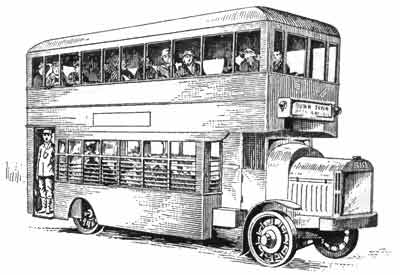
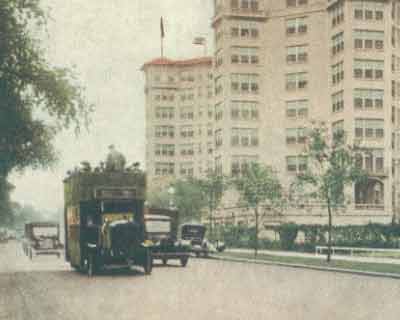
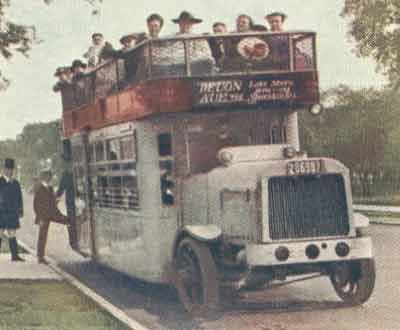
The Conklins also established one of the nation's first autobus systems,
the American Motor Coach Company, which was organized on May
2, 1901 in Chicago, Cook County, Illinois with a capital stock of $100,000.
The December 15, 1902 Automobile Review announced the debut of their first
scheduled service:
“Motor Coaches Compete with Chicago's Carettes.
“An important event to the automobile industry was the
inauguration, December 10, of a new line of motor coaches running between
Adams street and Lincoln park, Chicago. It was started by the American Motor
Coach Company. The coaches are gasoline machines built to accommodate twenty
persons. Seven vehicles were put in commission to run seven minutes apart.
Later, the company expects to put on more coaches and run them five minutes
apart. The route will be from Adams and State streets north to Randolph,
east to Wabash avenue, then over Rush street, and up Rush street to North
State street and Lincoln park.”
December 19, 1902 Horseless Age:
“A line of twelve motor coaches will be operated
between Lincoln Park and Adams street. Chicago, Ill., by the American Motor
Coach Company.”
1903 The Automobile:
“The American Motor Coach Company, of Chicago, is
looking for a Southern city with a good mileage of asphalt streets that may
take kindly to public automobile cabs, coaches and transfer wagons.”
November 7, 1912 New York Times:
“PURCHASE A CUBAN RAILWAY.; R.R. Conklin and J.M.
Tarafa Buy Puerto Principe & Nuevitas Line.
“Havana, Nov. 6, 1912 – The Puerto Principe & Nuevitas
Railway was purchased to-day by Roland R. Conklin of New York and J.M.
Tarafa of Havana. The line was built in 1835, is the oldest in Cuba, and one
of the oldest in the Western Hemisphere. It was the first railroad ever
built in the Spanish dominions, existing fifteen years before Canada had a
mile of track.
“This road, together with the Jucaro & Moronry, also
controlled by the Conklin and Tarafa interests, will form a part of the
National Railways system, including the North Coast Railway concession,
which was recently granted by the Cuban Government, and which an American
company will control, but it is stated that the bonds have been placed with
British and French bankers.”
The New York Motor Bus Company was incorporated on
December 19, 1912. Motive power intended: Gasoline, electricity or both.
Routes projected: From 14th street to 191st street, Manhattan, via various
streets and avenues not definitely determined, at the time it made
application for a franchise which it has not yet obtained.
Officers— President, Roland R. Conklin; Secretary and Treasurer, Lehman Weil.
Directors— Roland R. Conklin, Stanley L. Conklin, Harold B. Weaver, Lehman
Weil, A. J. Besuzzi, Fred F. Judd, William R. Willcox, Bainbridge Colby,
Harvey P. Miller. Main Business Office, 1 Wall Street, New York City.
In 1913 the Conklins financed a start-up gas-electric motor truck
manufacturing concern headed by Percy K. Hexter, a former New York City
livery operator who headed the Manhattan Gramm Truck agency. Hexter was formerly secretary of the New York
Liverymen’s Association and owner of Hexter’s stables, one located in Harlem
and a second at Broadway and 84th St. In 1908 he founded the
Hexter Taxameter Cab Company, which had a fleet of 50 Sultan taxicabs.
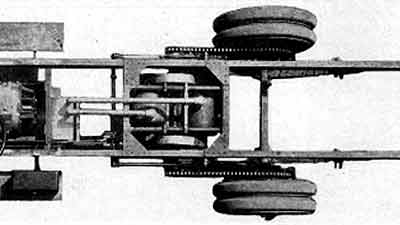
Hexter had recently designed a heavy motor truck that utilized a gasoline
engine mated to a General Electric-sourced electric transmission and
controller. Two motors were employed, each driving a rear wheel
independently through a side chain and sprockets. In order to keep the
weight down Hexter used a double-speed reduction, the first step using a
short silent chain running to a countershaft which carried a sprocket that
drove a second, larger sprocket on the rear wheel for its second reduction.
A very similar system that substituted spur gears for the chains was already
in use on the Fifth Avenue Coach Company's gasoline-electric coaches.
The first mention of Hexter appeared in the October 9, 1913 issue of The Automobile:
“Hexter Brings Out Gas-Electric Truck
“EASE of operation and of control is a predominating
characteristic of the 4-ton gasoline-electric truck designed and built by
C.K. Hexter. Power Plant Consists of Gasoline Motor, Generator Under
Driver’s Seat and Two Electric Motors
“A new company is to be formed to manufacture this
vehicle in New York City, this company to be known as the Hexter Motor Truck
Co., the name held for several years by the Gramm agency in New York City
having been relinquished by that concern which will become a branch of the
Willys-Overland Co.
“Three units make up this new vehicle, the first being
a gasoline motor forward under hood; the second an electric generator
located beneath the seat and the third two electric motors one in front of
and the other behind the jackshaft.
“The vehicle has left-steer and control and is chain
driven. A foot accelerator controls the gasoline motor; the spark is fixed
and there is no clutch, making the steering column, wheel and cab-floor
noteworthy for the absence of control levers and pedals.
“The vehicle is directly controlled by an electric
controller which gives two speeds forward. There is but one pedal, for the
brake, and one lever for the emergency brake.
“The electric generator is directly connected to the end of the crankshaft
of the gasoline motor. The gasoline motor cannot turn over without revolving the
armature of the generator.
“The generator is so wound that it speeds at about 300
revolutions per minute and throughout the idling range of the gasoline motor
the amperage is practically nothing and the voltage about 2. The current
generated at this time is not sufficient to move the truck and with the
controls arranged to drive the truck the engine can be turning at this
“It has an overall length of 240 inches and may be
turned in a circle with a diameter of 44 feet. It has a wheelbase of 13
feet, a front tread of 62 inches and a rear tread of 65 inches.
“In length the loading platform measures 144 inches and
in width 54 inches. The front of the loading platform is 8 feet from the
front of the truck. The height of the loading platform from the ground when
the truck is not loaded is 36 inches, this distance decreasing to 34 inches
when a capacity load is carried.
“When empty the truck weighs 8,000 pounds, of which
3,450 pounds is borne by the front and 4,550 pounds by the rear axle and
wheels. Of the total weight of vehicle and load 5,600 pounds is carried on
the front, and 10,400 pounds on the rear axle and wheels. The percentage of
total load on the front wheels is therefore, 35 per cent and on the rear
wheels 65 per cent. The distribution of useful load is 27 per cent, front
and 73 per cent, rear.
“The gasoline motor has a bore of 4.5 and a stroke of 6.75 inches.
The cylinders are cast in pairs with the valves enclosed. The Eisemann automatic advance
magneto is used and the G. & A. carbureter, neither of them needing
adjustment. Lubrication is by pressure. A governor is fitted to prevent the
racing of the motor.
“On a sub-frame immediately behind the motor is the
generator which is compound wound of the continuous-current type and has a
capacity of 7½ kilowatts, 60 amperes and 125 volts.
“Each of the two electric motors drives one sprocket. Each has a capacity of
26 amperes and 85 volts and a speed of 1,200 revolutions per minute. Drive is
by enclosed chains to the jackshaft.
“The controller is of the simple rotating type and all
leads and terminals are plainly marked so that all connections may be easily
made if they have been broken.
“Two brakes are provided, both located on the rear
wheels. The brake drums are 18 inches in diameter. The external contracting
brake is operated by the pedal and the internal expanding brake by lever.
The front springs, which are nearly flat, are 46 inches
long and the rear springs are underslung; they are 54 inches in length.
“The frame is channel steel with 7-inch channel side
members and is fitted with six cross members.
“Front tires are 37 by 5 inches, single solid. Rear
tires are 41 by 5 inch dual solids.”
The organization of the Roland Gas-Electric Vehicle Corp. , the
manufacturer of the Hexter Truck, appeared in the November 29, 1913 issue of The Automobile:
“To Manufacture Hexter Truck
“New York City, Nov. 29, 1913 – The Roland Gas-Electric
Vehicle Corp., incorporated yesterday with a capital stock of $200,000, to
manufacture motor trucks in this city. The incorporators are Percy K.
Hexter, R.R. Conklin and Stanley L. Conklin. The company has purchased all
rights to the gas-electric truck designed by Mr. Hester and described in the
Automobile for October 9, 1913.
“Mr. Hexter will be general manager of the new company.
“The large building at 336-342 avenue B and Twentieth
street, New York City, has been obtained and has been fitted up for
manufacturing."
In 1914 the SAE held a discussion of electric
transmissions in which Percy K. Hexter, the designer of the Hexter
Gas-Electric truck and chief engineer of the Conklin Brothers’ Gas-Electric
Motorbus Corporation, presented his experience with gas-electric
drivetrains:
“P. K. Hexter: — I will give you from my experience
what I have found out about the gasoline-electric and my ideas upon the
particular points some of the gentlemen here have taken exception to. One of
the greatest difficulties I found in the mechanically-driven car was the
cost of upkeep, due to the inexperience of the man we had to drive it. This
was in the taxicab business. I started to look for something that would
eliminate the human element more or less. I investigated the Fifth Avenue
gasoline-electric buses. I found the company had fifteen buses, seven years
old, running. They are still running every day in the week. The trouble they
had was due entirely to the way the buses were driven, not to electrical
troubles. The same identical electric equipment is in there today that was
in the buses when they were first put out. The trouble was due to the gas
engines, springs and steering gears employed, some of which have been
replaced entirely by new units.
“Gas-electrics have been in use for five years as
five-ton trucks for the United States Express Company in Chicago. They have
been most successful.
“Relative to the upkeep of the gas-electric, as far as
gasoline consumption goes I will concede that if you take a straight
mechanically-driven car and a gas-electric car and put them on a level road,
where the former can run on direct drive and conditions are ideal, you will
find an economy of gas consumption in favor of the mechanical drive. But
this docs not hold good in practice. In tests we have made using the same
identical motor that the mechanically-driven has used, we ha\e shown a
better gas consumption than the mechanical drive has shown. The main saving,
however, with the gas-electric is in the upkeep of the transmission. Taking
the ordinary mechanically-driven car and figuring out the item grease alone,
I know that in the case of a car I used to sell and handle instructions were
given to the customers to fill the transmission case every month with
grease. It used to take thirty pounds of grease to fill it. When you follow
that up with the other items of expense and compare them with the case of
the electric transmission that does not have to be filled more than once a
year, there is a saving more than offsetting any disadvantages in gasoline
consumption.
“Design of the gas-electric and certain things
installed have brought down the gasoline consumption considerably. We made a
thirteen-day run in this city, eighty-four miles a day, with an average load
of four tons, the truck making eight scheduled stops to the mile. During the
time we had some of the severest weather. We never had to stop for any
mechanical or electrical trouble. I have some figures here which are
authentic:
Cost per bus per mile (in cents) for City Type of bus
operation and maintenance:
| New York |
Gasoline |
41.298 |
| Paris |
Gasoline |
21.66 |
| London |
Gasoline |
17.00 |
| London |
Steam |
16.60 |
| London |
Gas-electric |
14.264 |
“The London General Omnibus Company are operating a
number of Tillings-Stevens gas-electric buses; I believe the number is about
260. The Tillings-Stevens people guarantee a tire mileage on their buses of
14.000. It is impossible to start the bus off with a jerk.
“The main feature in favor of the gas electric from a
practical standpoint in ease of operation. The truck can be handled and
moved at the rate of one-sixteenth of a mile an hour, without any jerk
whatever. A speed of ten miles per hour can be obtained within ten seconds.
We have another factor of safety, that of bill climbing, or rather going
downhill. With an ordinary truck going downhill it is necessary to apply the
brakes: on a steep hill, such as that at Englewood or Fort George, it is
necessary to apply both the service and emergency brakes. In this type of
construction we can take the truck down a hill without any brake on at all.
In fact a man can get off the truck and practically lead the car down the
hill, by just putting a hand on the steering gear and guiding it.
“R. McA. Lloyd:—We refer to the fact that the Fifth
Avenue buses were badly designed, that that was the cause of the bad
results. The Fifth Avenue stage company knew all about that; in seven years
they have had time to find out what the matter was. If, in spite of the bad
chassis design, they had satisfied themselves that the gasoline-electric
transmission is all tight, they probably would be going further with it.
They had one that was not a bad design, a DeDion bus in which they
substituted a single electric motor for the transmission and added a
generator to the engine; that bus was a fair illustration of what could be
done. I think the whole trouble was that the bus did not have the animation
the mechanically-driven buses had. Neither the men who drove the buses nor
the people who rode in them liked them. I think they will never get any more
of that type than they have at the present time.”
THE MOTOR TRUCK March, 1914 issue:
“HEXTER GASOLINE-ELECTRIC TRUCKS.
“THE Hexter wagons and trucks, which were designed by
Percy K. Hexter and are built by the Roland Gas-Electric Corporation, New
York City, a concern that has been building machines commercially since last
autumn, are, as the title of the company would imply, of the
gasoline-electric type, the power being generated by gasoline motors and
electric generators, and applied by electric motors, through jackshafts
and side chains in the two larger sizes, and by shaft and worm and gear in
the two smaller models. The purpose of the designer in using this method of
power transmission is to obtain the highest degree of flexibility and to
utilize the exact power necessary to drive the machines, rather than to
adhere to the conventional gasoline motor driven vehicle with a limited
number of speed ratios.
“The Hexter designs are not experiments. The first
machines produced were worked in every condition that could be found that
would test their endurance .and operating qualities. In every instance the
results were gratifying and the company was organized for producing the
trucks after a thorough demonstration of their qualities. The machines are
constructed with the view of affording long endurance in the hardest
service. The material is the best 'that can he procured and the workmanship
is high class. The construction is with ample margins of safety, and with
the minimized stresses when worked to capacity, because of the character of
propulsion, the machines are expected to have unusually long life.
“All Vehicles Have Same Characteristics.
“The 1.5 and the 3.5-ton machines are identical in
design, as are the five and seven-ton trucks, differing only in proportions
of components. There are characteristics that obtain with all sizes, such
as the use of a carburetor that is not adjustable, the use of ignition
systems that eliminate hand control, the governing of all motors to specific
maximum speeds, and the simplifying of the controlling system. In all these
machines no clutch is used. The gasoline motor is coupled to the electric
generator, and this is driven to whatever speed is necessary to obtain a
desired maximum power output from an electric motor.
“This generator is built by the General Electric
Company and is designed to have high efficiency and long endurance. It is a
standard type of construction and has been abundantly tested in continued
service. It is compound wound and designed to maintain a voltage as nearly
uniform as is practical, so that increasing the speed of the gasoline
engine does not, as might be expected with the ordinary dynamo, greatly add
to the voltage, but the amperage is increased and the electric motor is
supplied with a greater volume of current. That is to say, the potential is
maintained within a specified range, but the amperage is widely variable,
and this insures a sufficiency of power whenever it is necessary without
exceeding the safe limit. The governing of the gasoline motor insures
against excessive speed and protects the electric motor. At low engine
speeds there is sufficient power generated to operate the vehicle wherever
service may require.
“Like all well built electric motors, those used in
Hexter machines are designed so they will endure under a very large
overload for a brief period, and when occasion arises ample power is always
available.
“Change from Chain to Worm Drive.
“The original Hexter truck was of 3.5 tons capacity,
and this design is continued as the five and seven-ton types, and the most
recent creation is the design of the 1.5 and 3.5-ton machines. The power
plant and electric generator installation is the same in all, but a single
motor is used in the two smaller vehicles. This motor is suspended in a
sub-frame that carries the gasoline engine and generator, and the driving
end of the armature shaft is coupled to the main shaft by a universal joint.
The driving shaft extends to and drives the worm shaft and gear wheel
mounted in the rear axle housing. The rear axle is a full floating type, the
housing carrying the load, the driving shafts affording the traction only.
With both of these machines the drive is through the rear springs, which are
shackled at the rear ends only.
“The engine of the 1.5-ton machine is a Waukesha, with
cylinder bore of 3.75 inches and stroke of 5.75 inches, a four-cylinder,
water-cooled construction fitted with an automatic float feed carburetor,
and an Eisemann single high-tension ignition system with a fixed spark. The
fuel supply is controlled by a pedal, the purpose being to prevent a
sufficient volume 'being furnished the engine to cause it to race when idle,
this being a protection for the generator. The generator is 7.5 kilowatt
capacity. The 3.5-ton truck has a Waukesha -engine of the same type with
cylinder bore of 4.25 inches and stroke of 6.75 inches, but it is fitted
with an Eisemann dual ignition system with automatic spark advance, and the
fuel supply is similarly controlled. The generator is 7.5 kilowatt
capacity.
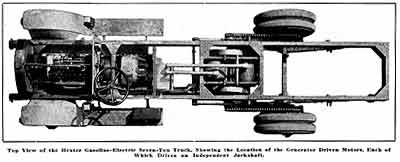
“Two Motors for Large Trucks.
“The power from the generators of the five and
seven-ton trucks is utilized by two motors, which are suspended in main
chassis frame, one forward of and the other back of the jacks haft. The
forward motor drives the right side of the jackshaft and the rear motor the
left side, the jackshaft being in reality two separate shafts that are
driven independently of each other. The pinion ends of the motor armature
shafts carry sprockets which are aligned with larger sprockets on the
driving shafts. Chain cases enclose the silent chains by which the
jackshafts are driven, the chains and sprockets operating in oil baths. From
the outer ends of the jackshafts, sprockets and chains transmit the power to
the rear wheel. There is no differential, as might be inferred,. and one
motor may be driven as much faster than the other as necessity requires,
affording equal traction no matter what the condition. The driving thrust.
of these machines is taken by radius rods. The power plants are larger and
the generators are 12 kilowatt capacity.
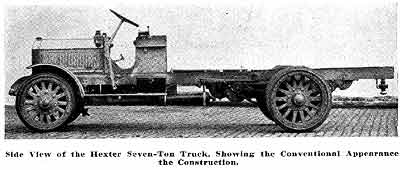
“As will be noted from the illustrations the design of
the chassis is in every way conventional. The radiator is mounted in front
of the engine, the gasoline motor is covered by a hood and is easily
accessible. The chassis frames are of heavy steel channel section and these
are carried .on semi-elliptical springs. The axles are large and are fitted
with anti-friction bearings throughout. The machines are driven from the
left side, and the fuel control is by an accelerator pedal and the electric
current is controlled by a hand controller that is exceedingly simple. The
service brake is applied by a pedal and the emergency brake by a hand lever,
both operating on drums on the rear wheels.
“Power Control Exceedingly Simple.
“The electric power control is by a controller handle
located at the side of the driver's seat that affords two forward speeds and
reverse. The system differs from that of the battery driven vehicle in that
resistance is not used, but the current is varied by use of different motor
circuits. When the forward high speed is used the motor or motors are in
parallel, and when in low forward speed or reverse they are in series. The
speeds forward are not widely varied so far as vehicle movement is
concerned, hut the low speed affords much greater torque and consequently it
is more productive of power in the event of ascending grades or in sand or
rough road. The motors are arranged in series-parallel and they will endure
the full output of the generator for 20 minutes before they will heat to a
danger point.
“There is a central position for the controller handle
in which both the motor and generator circuits are broken, and when so set
the gasoline engine may be operated without influencing the electric power
system. When operated slowly the generator does not generate sufficient
current to be effective. Because of this fact the controller lever may be
moved from one position to another without causing, movement of the machine.
Because of regulation by the foot accelerator the gasoline engine can only
be operated slowly without its use, but movement of the accelerator will
increase the speed to such a point that the truck can be moved with the
controller in any of the three positions.
“The gasoline engine is started by cranking, and from
every aspect its operation is conventional. Its range is from the idling
speed to the maximum allowed by the governor. In the low forward speed
position the fuel consumption is most economical. The customary method of
varying speed when in motion, unless the road is rough or sandy, or
ascending a grade, is by change of engine speed.
“The Roland Gas-Electric Vehicle Corporation builds
chassis only, and the purchasers have body equipment constructed to meet
their special requirements. The present capacity of the works is about 100
machines a year.”
The Hexter truck was short-lived and Percy K. Hexter returned to selling
trucks, serving as Eastern sales director for the Day-Elder, Republic and
Selden truck companies. The Conklin's reorganized the firm as the
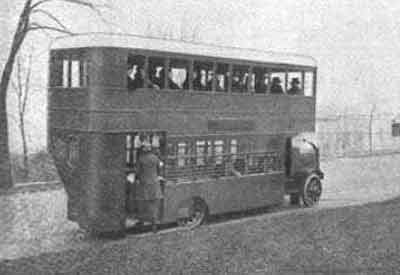
Gas-Electric Motorbus Corporation contemplating the manufacture of a
gas-electric coach for their own bus line, the New York Motor Bus Company.
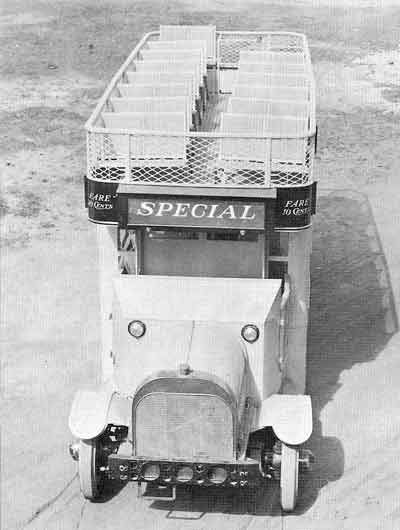
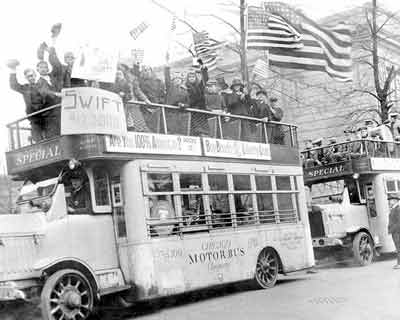
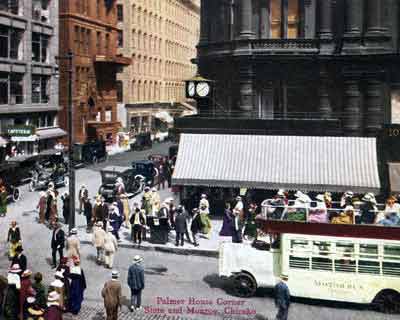
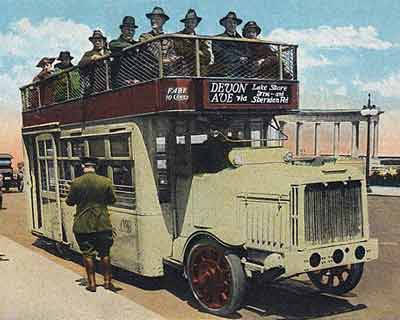
In 1913 the Conklins had formed the Chicago Motor Bus Company in order
supply the city of Chicago with a motorized transportation similar to that
operated by the Fifth Avenue Coach Company in Manhattan. In February, 1914,
it filed an application with Chicago’s Public Utilities Commission for a
certificate of necessity and convenience. The commission granted the
certificate on December 31, 1914, specifying no routes but covering the
entire city of Chicago. The certificate was granted on the condition that
Chicago Motor Bus secured individual licenses from the local municipal
authorities having direct supervision of whatever parks, boulevards, or
streets the firm planned on using for the service.
As much the same time the Conklin's New York Motor Bus Company had been bidding on
proposed motor bus lines being
considered by the Franchise Bureau of the New York City Board of Estimate.
Its competitors at the time were the Fifth Avenue Coach Co., George Loft’s
Peoples Five Cent Bus Line, the Manhattan Motor Bus Co. and a fourth yet
un-named firm headed by O.C. Brunner and W.T. Gridley.
A franchise won by the firm in 1915 was bitterly
contested by the Fifth Avenue Coach Company and the Interborough
Corporation, the operator of New York’s subway system and owner of 40 per
cent of Fifth Avenue’s stock. The October 23, 1915, New York Times gave
details of one subsequent meeting of the Board of Estimate:
“STARTS BUS FIGHT FOR INTERBOROUGH; Competition Injured
Subways in London and Paris, Counsel Tell Estimate Board. OPPOSES FRANCHISE
AWARD Fifth Avenue Coach Co. Wants a Rehearing Before Rival Concern Gets the
New Routes.
“The Board of Estimate received yesterday the report of
its Franchise Committee, recommending that the franchise for the new motor
bus routes should be awarded to the New York Motor Bus Company, in
preference to the Fifth Avenue Coach Company or O.C. Brunner and W.T.
Gridley, a third set of bidders. The Interborough, which is interested in
the Fifth Avenue Coach Company, appeared and entered a protest.
“It raised the point that as in London and Paris the
subway system had been seriously injured by the competition of the motor bus
lines, it was extraordinary that the city which was just about to become a
partner in the subway system here should set up a competitor to itself.
“The argument for the Interborough was made by W.D.
Guthrie and James L Quackenbush, general solicitor of the company, and they
both complained that no pubic hearing had been held on the advisability of a
wide extension of the bus system. It was pointed out to them, however, that
the Interborough had been asked to submit briefs on the question, and to
inform the engineer of the board what objections there were, but it had not
done so.
“Mr. Quackenbush replied that the Interborough was
accustomed to confer only with principals in such matters, and that the
Franchise Committee should have asked him to sit around a table with him and
argue the question. It had seemed so important to the company that it had
dispatched two of its chief officials, who could be ill spared, to London
and Paris to investigate the experience there, and he thought that what they
had ascertained should be considered by the city.
“Bainbridge Colby who with William R. Wilcox, appeared
for the New York Motor Bus Company, replied that it was for the city to
decide the bus question according to the traffic need of the population and
not according to it new vested-interest in strap-hangers.
“President McAneny wanted to know whether the
Interborough would have been as much opposed to the proposed bus routes, if
the franchised for them had been awarded to the Fifth Avenue Coach Company
and not the New York Motor Bus Company.
‘“If the Fifth Avenue Coach Company had obtained the
franchise.’ Replied Mr. Quackenbush, ‘and was to enter into competition with
the Interborough I should recommend my client to throw its interest in the
Coach Company out of the window rather than continue the operation of motor
buses.’
‘“Yes,’ answered Mr. Colby, ‘but the Fifth Avenue
Company was as eager as any bidder for the motor-bus franchise. You wanted
the competition as long as you thought you would be the competitor.’
“The board fixed Nov.8 as the date for a public hearing
on the general question of motor buses and Nov. 19 as the date for a public
hearing on the specific application of the New York Motor Bus Company.
“A formal protest to the grant of the franchise to a
rival concern was handed in by Richard. W. Meade, President of the Fifth
Avenue Coach Company, with a request for a re-hearing. In that he contended
the Franchise Committee had ignored the advantages of one unified bus system
throughout the city, and the Coach Company’s offer to give the city one half
of the net profits.”
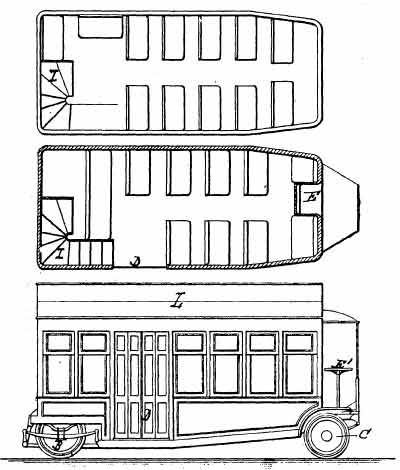
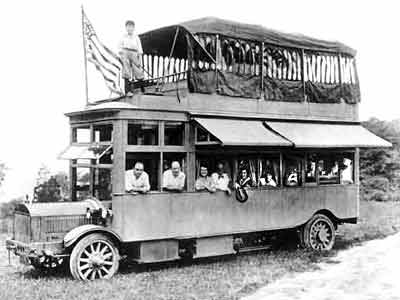
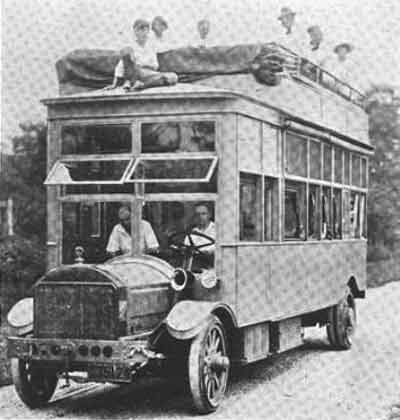
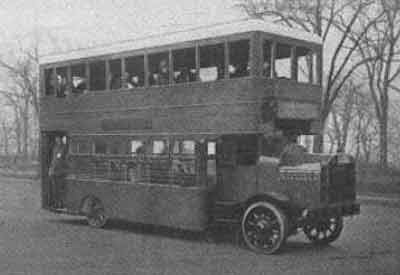
The Gypsy Van was built by Conklin's Roland Gas-Electric Motor Bus Co.
August 21, 1915 New York Times:
“GYPSYING DE LUXE ACROSS CONTINENT; Party of Ten to
Travel, Dine, and Sleep in the Big Motor Van of Roland R. Conklin. LIKE A
HOUSE ON WHEELS. Has Shower Bath, Stove, Cupboards, Ice Chest, and Closets
Enough to Satisfy Most Women.
“Roland R. Conklin, who has extensive sugar and railway
interests in Cuba, with members of his family, guests and servants - a
party of ten in all - will start today from Mr. Conklin's Summer home at
Rosemary Park, Huntington, L.I., for a transcontinental tour in perhaps the
largest and most completely equipped "gypsy motor van" in the world. Those
in the company will be Mr. Conklin, Mrs. Conklin, Roland, their son; Miss
Julia, their daughter; a young woman friend of Miss Julia; two of Mr.
Conklin’s nephews, a cook, a chauffeur, and a mechanician.
“The first impressive thing about the vehicle, which Mr.
Conklin calls his ‘land yacht,’ is its size. Over all it is twenty-five feet
in length, six inches longer than the Fifth Avenue buses. It is seven and a
half feet wide and thirteen feet high. It weights between seven and eight
tons. The size of the great automobile ceases to dominate one’s thoughts
when one investigates the comprehensiveness of its equipment. It is really a
house on wheels, though it runs smoothly at moderate speed.
“Mr. Conklin’s van is made for the accommodation of
passengers both inside and on its upper deck. Inside there are comfortable
sleeping bunks for eight persons, and there are also sleeping quarters on
the upper deck, which may be covered with a removable roof.
“Meals for the party will be cooked in a galley in the
van fitted with an electric stove. Also there is a shower bath in the car,
to which hot water is supplied from the radiator and cold water from tanks.
“Food supplies sufficient to last eight persons a week
may be carried in the van in cupboards, and an ice chest that has a capacity
for 150 pounds of ice in addition to storage room for perishable goods.
“Practically every inch of space about the car not
needed for the comfort of the passengers is utilized as a closet, cupboard,
or drawer.
“Mr. Conklin and his party will take the Post Road to
Albany. The route will then be through Buffalo, Chicago, Denver, Yellowstone
Park, Glacier National Park, San Francisco, San Diego, and Los Angeles. The
party will return to New York by steamer through the Panama Canal, leaving
the van to be shipped East.”
August 22, 1915 New York Times:
“THIS AUTO IS A FLAT ON TIRES; Motor-Driven Gypsy Van
with Kitchen, Running Water, Beds, Tables, and Even a Roof Garden
“IF the well-known Haroun-al-Raschid, Commander of the
Faithful, had ordered the most powerful Jinns acknowledging fealty to him to
produce out of thin air for his royal pleasure a vehicle which should have
the power of motion and yet be a dwelling place fit for a Caliph, the result
would have fallen far short of the actual house upon wheels which left New
York yesterday for a trip to the Pacific Coast.
“This unique motor vehicle, which he calls a ‘Gypsy
Van,’ is owned by Roland R. Conklin of this city and Huntington, L.I. He is
making the transcontinental tour with his family. With more sense of space
in many ways, although much smaller actual dimensions than the private
railroad car, this sublimated English caravan, land-yacht, or what you
will, has all the conveniences of a country house, plus the advantages of
unrestricted mobility and independence of schedule.
“Mr. Conklin decided last Spring to visit the
Panama-Pacific Exposition and conceived the idea of making the trip in an
automobile which would provide living as well as traveling facilities. The
result is the present vehicle, which has been constructed under his
direction here in New York. Instead of being obliged to lay up in a smoky
railroad terminal, it can pitch camp by some wooded stream or lush pasture.
It need follow no time tables nor stick to any track. It embodies an
extension to the field of recreation of the time-honored principle of
carrying one’s office under one’s hat.
“As speed was not a special object, a comparatively
small motor of 60 horse power could be used, especially geared for power
grades. Canvas strips for sandy sections, a knockdown, portable bridge and a
winch operated by the motor, strong enough to pull the car out of a mudhole
or ditch are special items of equipment. No such vehicle has ever been
attempted before on this scale, but his experience in designing large
vehicles for traffic, as the President of the New York Motor Bus Company,
convinced Mr. Conklin that his idea was practical, so he went ahead. The
result had been the production of a unique unit of travel.
“The body of this land yacht is mounted on a truck
chassis, of the motor omnibus type, with such changes and additions as were
necessary to meet the varied calls upon it. The inside dimensions of the
body are 21 feet in length, 7½ feet wide and 6½ feet high. On top there is a
full-sized deck, fitted with a big folding leather top and side curtains.
The body has forty-four windows, fitted with glass sash, shades and copper
wire screens. Screen doors are provided in addition to the regular doors at
both entrances.
“Probably the best way in which to get a clear idea of
all the wonders or this unique vehicle is to enter at its main door, which
is at the back, and go right through the ‘house’ from cellar to garret. As
you approach the car from the back you see a wooden door, but no steps,
unless you happen to recognize the folding steps of a pattern similar to
that used on some of the New York surface cars. When you turn the doorknob
and open the door these steps unfold easily. When you have mounted and
opened the screen door you find yourself in the rear compartment, which
probably combines more different functions with less waste of space than any
yacht or launch cabin in existence.
“At your left as you enter is a roomy icebox with
several compartments and a hundred-pound ice capacity. In one side of this a
folding metal wash bowl, not unlike those in the washroom of a railroad
parlor car, is concealed. A little pull brings this basin down into its
position for use. It is fed from the large water tanks on the roof. Above
this basin is a water filter for drinking water, one coil of which passes
through the icebox, so that chilled water of filtered quality is constantly
on tap. Next to the icebox toward the front of the car is a neat porcelain
kitchen sink, and near it is an electric range with several burners and a
large oven. A miniature dresser with spices, sugar, flour, and the like is
on the wall, and other cunningly contrived cupboards and racks hold pots
and pans and a plentiful supply of cutlery
“From the ceiling above this part of the compartment a
rack hangs which holds the folding dining room table. This is used in the
main compartment of the vehicle, and measures eight feet by two feet when
set up. Immediately over the door through which you entered there is
something more which at once arrests your attention in an inspection of the
ceiling. This is the spray head and curtain ring of a shower bath. The first
thought that enters your head is in query form. Where does the waste water
go when the shower is in use? At first glance it looks as if a bath would be
followed by a flooded kitchen. But not at all; this contingency has been
provided for in the same ingenious way with which other difficulties have
been met in the ‘Gypsy’.
“By raising a little sunken latch in the floor a
section of the flooring comes out, disclosing what looks like a small trap
door divided into four sections. When these in turn are lifted by their
latches they are found to be lined with metal and to form a sort of box, the
sides of which are several inches above the floor level and the bottom
several inches below that level. With the final touch of a rubber stopper
the shower bath arrangements are complete.
“The shower bath is about in the centre of the car’s
rear compartment. That is to say, it is midway between the wheels, but near
the entrance door. Nearer the front of the vehicle on the right side of the
compartment is a folding short stepladder to be used to reach the
companionway which leads to the upper deck or roof. This stepladder leads a
double life, however. It unfolds into a card table with a special
non-slipping surface. Below the companionway is wainscoting which conceals a
deep cupboard with shelves. In this are quite a library of books, a stock of
playing cards, films and other small articles.
“Next it, toward the front, one of the sunken latches
of which there are so many in the car, is an invitation to prying fingers.
Operated, it reveals one of the neatest examples of space-saving in the
whole structure - a writing desk which apparently unfolds out of nowhere and
contains all the fittings of the ordinary library escretoire.
“After absorbing the wonders of the rear compartment,
or sublimated galley, writing room, shower bath and wash room, according as
the mood or the time of day governs its function, the visitor aboard the
‘land cruiser’ is ready to go forward, into the central and largest cabin.
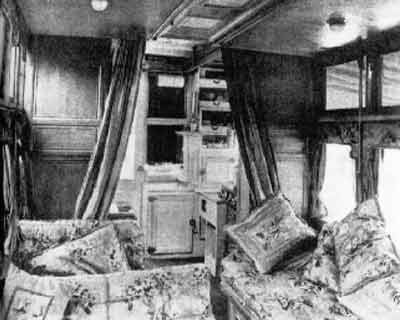
This has a triple function; it is living room, dining room, and bedroom and
most attractive it is for any of these purposes.
“The furniture is covered with attractive material,
and there is a sort of valance to match above the windows, which make up the
side walls of the compartment All the windows, by the way, open in the same
way that house windows open. They are provided with green shades, not unlike
those used in a parlor car and have wire screens on the outside. In
addition, there are awning strips and frames on the outside of the car which
can be let down to keep out sunlight or light rain at night.
“The interior woodwork of the compartment is of ash
finished in a light neutral tone of pleasing effect. The ceiling, which at
first glance appears to be solid, is finished in the same way. As a matter
of fact this ceiling contains four berths of bunks which fit into an almost
inconceivably small space when not in use, but pull down quite easily and
look like decidedly comfortable beds. They are of the same size as the lower
berths or couches; that is to say, several inches larger in each dimension
than the standard railroad sleeping car berth.
“Above each of the couches one of these berths is
located, the other two, both disappearing, being a little further forward
and set across the vehicle. There is, therefore, ample sleeping room for six
persons in this compartment. Each of the berths is provided with side
curtains hung from brass rods, which give complete privacy, and each has a
very flexible wire spring and a thick hair mattress. But their comfort
does not stop with mere bedding. A clever way has been found to provide
bureau and wardrobe space for each bunk.
“At the head of each of the upper berths, as they may
be called for convenience, in the partition between the central and rear
compartments of the car, is a closet of the ‘scientific management’
variety. When you open its door you see first a little recess, and forming
the back of this space, as it were, several drawers with the familiar socket
latches. When these are opened they are found to be deeper and more
commodious than appearances would indicate. There is lots of room for one’s
linen, cravats and small articles. In the space of recess between the door
and these drawers there is a hanger, and there is just enough room to hang a
suit neatly with the trousers folded once over a bar.
“The lighting arrangement is such that each bunk has an
electric bulb at its head, so that if it is one's custom to turn the pages
of a book while awaiting the coming of Morpheus, the habit need not be laid
down simply because one is doing motor touring deluxe instead of spending
the nights in more usual habitations.
“When you emerge on the upper deck you find it guarded
by a wire mesh rail which can be folded inward to give less over-all height
to the vehicle. Around the sides are broad lockers, with seat cushions on
top, which form delightful seats through the medium of adjustable back
racks. These lockers contain guns, fishing tackle, and a commissary supply
sufficient for two weeks. They also conceal tanks for hot and cold water,
several folding chairs and divans, with mattresses for outdoor sleeping.
Clothing can also be stored in them in a special case made to measure, half
way between a suitcase and steamer trunk. By means of the seat cushions and
sort of folding Morris chair in the centre, five persons can easily ride
abreast on the upper deck, all facing forward.
“The land yacht is not without its tender. Like the
tender of an sea-going craft, this has its abiding place on the upper deck
and is lowered away by means of davits, which are concealed from view when
not in use. Here the analogy between sea and land stops, however. The tender
in this case is a motor cycle, which is carried on its side in a compartment
on the rear of the roof. When it is desired to scout ahead in order to make
a first hand survey of the road conditions, test a bridge or measure a place
where the headroom if believed to be scanty, all that is necessary is to
unship the motor cycle and send the chauffeur off on a tour of inspection.
By the same means fresh supplies of light weight may be secured, letters
sent to any desired point, and a dozen other ‘chores’ be performed swiftly.
“The great size of the ‘Gypsy’ necessitated special
study in the matter of color. The exterior is in great part veneered with
wood, a soft tan shade having been chosen to bring out the grain of the ash.
The chassis is a quiet gray green. This combination gives the vehicle a sort
of protective coloration, as the ornithologists say, blending with the
landscape, as the main portion is in harmony with the road itself and the
balance harmonizes with the grass. All the interior fittings follow the
note of the faun gray walls. The upholstery and valences are of gray Spanish
linen, with a design in the mellow greens, blues, and reds of old tapestry.
The silk curtains also help to preserve the restful effect of the interior.
Even after a dusty day’s run the car should look fresh and inviting within.
Here, as in other features of the vehicle, the practical has not been
forgotten for a moment.
“One of the most interesting features of this
remarkable car is its easy arrangements for converting it into a veritable
camp when the owner wants to stop for the night or for fishing or shooting.
This is done by raising the top and side curtains for the upper deck and
letting out awnings against either side, which when lowered protect the main
body from sun and light rains without the closing of windows. This upper
deck is also made mosquito proof. When stopping for camp, a flag waves at
the head and a powerful searchlight can rotate in every direction. The
electrical equipment includes two fans, a drill, emery wheel, soldering
iron, &c.
“The weight of the vehicle, with its complement of
passengers, crew, and provisions, is a little less than that of a Fifth
Avenue motor bus, with its passengers. The wheelbase is 206 inches, but the
overhang in the rear is only 46 inches, measured from the rear axle centre.
A six cylinder gasoline motor, with cylinders 4¼ by 5 inches, is used. The
height from ground is, 11.6 inches and the minimum clearance 16 inches.
“The transmission is of the selective sliding dog type,
with gears always in mesh. It is really a double-gear box, as it gives nine
speeds forward and three in reverse. This unusual transmission was necessary
because of the special requirements of this vehicle. It must be able to
travel faster on good roads than the ordinary motor truck of similar weight,
and must also he able to negotiate far steeper grades and deep sand.
“The gear ratio on the lowest forward speed is 86 2/3
to 1, as compared with 26 to 1 on a Fifth Avenue motor bus. The gear ratio
of the highest speed is 8 2/3 to 1. Final drive is through worm gears. Solid
tires 5 by 36 inches, dual on the rear, are fitted.
“A pump, driven by gears from the shaft, is provided
for filling the water tanks on the roof. It will lift water from a depth 15
feet below its level. A winch, similarly driven, is attachable to the front
or the frame. A 7½ kilowatt generator, driven from the gasoline motor, and
a 30-cell battery giving 225 A.H. at 36 volts, supplies electricity for
cooking, vacuum cleaners and auxiliary lighting. A separate generator is
used for starting the gasoline motor and for lighting. Very easy riding is
secured through the employment of semi-elliptic springs, four inches wide
and 56 inches long, specially constructed. The brakes are very powerful, the
service brake acting on the rear wheel, having 260 square inches of braking
surface.
“Before starting on its transcontinental trip, this
motor land yacht was driven several hundred miles over the hills of New
Jersey and Westchester County and through the sands of eastern Long Island.
No attempt at a speed record will be made in crossing the continent, and Mr.
Conklin plans to make a number of side trips en route to interesting
places. He will follow the Lincoln Highway in the main.”
August 23, 1915 New York Times:
“CONKLIN ROAD YACHT HITS A SHOAL OF MUD; Kitchenette
Apartment on Wheels Hangs Undecided Whether to Turn Turtle. ROOF GARDEN ALL
ASLANT With "Women and Children First" Passengers and Crew Land Safe in
Ditch Surf.
“The land-going yacht in which R.R. Conklin, of the
Motorbus Company of New York, and a party of twelve are going from Rosemary
Farm, near Huntington, L.I., to the Panama-Pacific Exposition, came near
foundering on her second day out, and was obliged yesterday to send a
save-our-yacht call at 4:32 P.M. to the nearest port, Briar Cliff. The
automobile, with its kitchen, hot and cold water, beds, tables, and even a
roof garden, was stuck fast in the slippery mud which lined it channel, the
State road just north of Briar Cliff.
“Puffing contentedly, the big double-decked cross
between a Fifth Avenue bus and a prairie schooner left Long Island on
Saturday, and proceeded on the first leg of its 5,000-mile transcontinental
voyage. At the last moment a change was made in the plans, and the
automobile ship steered through Briar Cliff instead of going through White
Plains, as was first intended. A bridge only ten feet wide was the cause,
the yacht needing but twelve as a minimum.
“The rain last night didn’t bother the travelers in the
least. With the heavy floor of the roof garden to shed any moisture that
might weep through the garden roof, the yachting party could read books and
magazine from the well-stocked bookcases which folded into the sides of
their dwelling, while they reclined at their ease on couches pulled out from
the sides or down from the ceiling of this motor palace. Big electric
lights, supplied by current from the yacht’s own dynamo, shed plenty of
light.
“Yesterday they went on again and were pitching and
tossing along the road about two miles from Briar Cliff when they were
forced to turn aside to let an automobile go by. Before the chauffeur could
get control the machine had slid into the ditch and stood toppling as though
undecided whether to turn over or not.
‘“Port your helm,’ called out Mr. Conklin, but it was
too late.
‘“Women and children first,’ was the order, and the
whole party scrambled into the muddy road.
“The motor cycle tender was dispatched for aid, but all
Briar Cliff’s horses and all Briar Cliff’s men could not pull the yacht into
the road again. Machines were invited to try. They came to pull but failed
and ended by taking Mr. Conklin’s family to Briar Cliff Lodge, where they
spent the night. Mr. Conklin expects to get under way this afternoon at the
latest. He is sure that he can eventually make the coast in his motor bus
yacht.”
September 26, 1915 New York Times:
“BIG MOTOR LAND YACHT HAS REACHED CHICAGO SAFELY;
Roland R. Conklin's Modernized Gypsy Van Shows That Cruising on Wheels Can
Be Delightful Sport ;- Vistas of Trip.
“With all stains of heavy travel removed, as is fitting
on any craft plentifully supplied with running water, electrical vacuum
cleaners, and a large crew, the Gypsy, Roland R. Conklin's motor land yacht,
with its owner, his family and guests aboard, rolled into Chicago on the
afternoon of Sept. 20, one day less than a month out of its home port, New
York.
“The success of this novel motor vehicle, which provide
traveling and living quarters for a party of eight, including chauffeur and
steward, and has all the conveniences of a kitchenette apartment, with such
added features as a roof garden, bids fair to establish a new mode of travel
for the tourist. Am idea of this is given in the following description by
Mr. Conklin of the trip from New York to Chicago:
‘“Except for the incident on the first day when we were
crowded off the road and had to be pulled out of a ditch by the Briarcliff
Fire Department, the trip has been a very delightful experience. It has
started, not exactly a new for of recreation, but certainly a successful
application, under modern conditions, of a world-old sport originating with
our nomadic ancestors, namely, gypsying. We are gypsying deluxe across the
continent, and I foresee the time when, with improved roads, a family party
can have the choice of and travel many thousands of miles along wonderfully
interesting highways amid the most varied and beautiful scenery. Sitting in
the open air on the upper deck of our car as it rolls along the highways
makes one realize that surely no mode of travel has yet been developed that
can compare with it for pleasure or for enabling one to become actually and
intimately acquainted with our country.
‘“It has and entirely different feeling from that
obtained by the motorist flying along the roads with the speed of a railway
train. Even the sport of yachting, with its cruising over monotonous waters,
cannot compare with it for we have a continued change in landscape to please
the eye and keep one’s interest aroused, and there is no seasickness. One
must have enough gypsy blood in his veins, however, to be always ready to
gladly camp out on a stream or in a beautiful neck of the woods, when he
happens to come upon such a spot, perhaps hours before a day’s journey has
been completed. And one must repudiate utterly the least attempt to follow
any time schedule. To try to make any speed records would be equally absurd
in a vehicle like the Gypsy. Even over the present bad dirt roads, rendered
rough in many places by the frequent rains of Summer, we can average fifty
or sixty miles a day, and that quite suffices for us.
‘“We have spent nearly four weeks upon the road since
starting, but we have loitered along, sometimes remaining at a choice
location in camp a day or so. And then we spent a day in Albany, another day
in the Mohawk Valley as the guests of the Oneida Community, two days while
viewing the beautiful scenery of Niagara Falls, and a day in Cleveland.
‘“After experiencing the dust and poor traveling on the
dirt roads in Pennsylvania, Ohio, Indiana, and Illinois, to look back on the
concrete and macadamized stone roads of New York fills me with enthusiasm.
It is true Ohio has stretches of good roads, mostly brick, but they are only
stretches and they never seem to be going one way. Such good roads as there
are have been built by enterprising townships that have constructed only
according to local needs, and there has been but very little cooperation
among the various townships in building continuous highways. If the same
amount of money as is now set aside from all sources for good roads was
scientifically expended by some central responsible authority, having expert
knowledge as to the best type of construction and method of maintenance
under a patrol system, similar to that adopted by railways to preserve their
roadbeds, we would in a few years be blessed with good roads all over the
country.
‘“We will reach the Pacific Coast much sooner than I
anticipated when I started. At that time I hoped to be on the road for about
three months, bus business matters have arisen which will require my
attention in New York in October, and I have decided to send the car to
Reno, Nev., Sacramento, or some point on the coast where we can join it, and
cruise along the well built and beautiful roads of California a few weeks
and then return home by rail. The climate and roads of California are ideal
for traveling in such a vehicle and living a life in the open. The weather,
too, will soon be so cold in the mountains that it will not be pleasant and
an early snow would make it impossible traveling over the Divide.
‘“If the trip of the gypsy can does not more than to
call to the attention of a large number of people the desirability of good
roads, it will have served a most useful purpose. The enterprise shown by
the promoters of the Lincoln Highway in developing an interoceanic road is
of vast and far-reaching consequences. The idea has captured the public, and
this roadway will certainly be completed, and within a few years there will
be two or three more cross continental highways. It has been pointed out
time and again that in the event of ware in this country we could not
attempt to move our army successfully without means of transporting our
troops, without automobiles, such as is daily being done in Europe now, and
such transportation would require vehicles as large as mine and, therefore,
the various transcontinental roads that are being considered should be built
with a due consideration in the width, roadbed, and sharp curves of the road
to meet such national uses.”’
The story of Conklin’s Gypsy was also published in the
September 1915 issue of The Hub:
“THIS AUTO IS A FLAT ON TIRES.; Motor-driven Gypsy Van
With Kitchen, Running Water, Beds, Tables, and Even a Roof Garden
“If the well known Haroun-al-Raschid, Commander of the
Faithful, had ordered the most powerful Jinns acknowledging fealty to him to
produce out of thin air for his royal pleasure a vehicle which should have
the power of motion and yet be a dwelling place fit for a Caliph, the result
would have fallen far short of the actual house upon wheels which left New
York recently for a trip to the Pacific coast.
“This unique motor vehicle, which he calls
a 'gypsy van' is owned by Roland R. Conklin, of New York and Huntington, L.
I. He is making the transcontinental tour with his family. With more sense
of space in many ways, although much smaller actual dimensions than the
private railroad car, this sublimated English caravan, land yacht, or what
you will, has all the conveniences of a country house, plus the advantages
of unrestricted mobility and independence of schedule.
“Mr. Conklin decided last spring to visit the
Panama-Pacific Exposition, and conceived the idea of making the trip in an
automobile which would provide living as well as traveling facilities. The
result is the present vehicle, which has been' constructed under his
direction in New York. Instead of being obliged to lay up in a smoky
railroad terminal, it can pitch camp by some wooded stream or lush pasture.
It need follow no time tables nor stick to any track.
“It embodies an extension to the field of recreation of
the time-honored principle of carrying one's office under one's hat.
“Regardless of the fact that this novel transport is
not striving to maintain a. schedule, people at various towns along the
route traveled have expressed resentment at the belated arrival of
the 'Gypsy'. Industrious reporters have evidently overlooked the fact that
Mr. Conklin is traveling for his own pleasure and has no desire to make any
record runs during his transcontinental trip.
“As speed was not a special object, a comparatively
small motor of 60 horsepower could be used, specially geared for power on
grades. Canvas strips for sandy sections, a knockdown, portable bridge and a
winch operated by the motor, strong enough to pull the car out of a mudhole
or ditch are special items of equipment. No such vehicle had ever been
attempted before on this scale but his experience in designing large
vehicles for traffic, as the president of the New York Motor Bus Co.,
convinced Mr. Conklin that his idea was practical, so he went ahead. The
result has been the production of a unique unit of travel.
“The body of this land yacht is mounted on a truck
chassis, of the motor omnibus type, with such changes and additions as were
necessary to meet the varied calls upon it. The inside dimensions of the
body are 21 feet in length, iy2 feet wide and 6^2 feet high. On top there is
a full-sized deck, fitted with a big folding leather top and side curtains.
The body has 44 windows, fitted with glass sash, shades, and copper wire
screens. Screen doors are provided in addition to the regular doors at both
entrances.
“Probably the best way in which to get a clear idea of
all the wonders of this unique vehicle is to enter at its main door, which
is at the back, and go right through the "house" from cellar to garret. As
you approach the car from the back you see a wooden door, but no steps,
unless you happen to recognize the folding steps of a pattern similar to
that used on some of the New York surface cars. When you turn the doorknob
and open the door these steps unfold easily. When you have mounted and
opened the screen door you find yourself in the rear compartment, which
probably combines more different functions with less waste of space than any
yacht or launch cabin in existence.
“At your left as you enter is a roomy icebox with
several compartments and a hundred-pound ice capacity. In one side of this a
folding metal wash bowl not unlike those in the washroom of a railroad
parlor car. is concealed. A little pull brings this basin down into its
position for use. It is fed from the large water tanks on the roof. Above
this basin is a water filter for drinking water, one coil of which passes
through the icebox, so that chilled water of filtered quality is constantly
on tap. Next to the icebox toward the front of the car is a neat porcelain
kitchen sink, and near it is an electric range with several burners and a
large oven. A miniature dresser with spices, sugar, flour, and the like is
on the wall, and other cunningly contrived cupboards and racks hold pots and
pans and a plentiful supply of cutlery.
“From the ceiling above this part of the compartment a
rack hangs which holds the folding dining room table. This is used in the
main compartment of the vehicle, and measures eight feet by two feet when
set up. Immediately over the door through which you entered there is
something more which at once arrests your attention in an inspection of the
ceiling. This is the spray head and curtain ring of a shower bath. The first
thought that enters your head is in query form. Where does the waste water
go when the shower is in use? At first glance it looks as if a bath would be
followed by a flooded kitchen. But not at all; this contingency has been
provided for in the same ingenious way with which other difficulties have
been met in the 'Gypsy'.
“By raising a little sunken latch in the floor a
section of the flooring comes out, disclosing what looks like a small trap
door divided into four sections. When these in turn are lifted by their
latches they are found to be lined with metal and to form a sort of box, the
sides of which are several inches above the floor level and the bottom
several inches below that level. With the final touch of a rubber stopper
the shower bath arrangements are complete.
“The shower bath is about in the center of the car's
rear compartment. That is to say. it is midway between the wheels, but near
the entrance door. Nearer the front of the vehicle on the right side of the
compartment is a folding short step ladder to be used to reach the
companionway which leads to the upper deck or roof. This step ladder leads a
double life however. It unfolds into a card table with a special,
non-slipping surface. Below the companionway is wainscoting which conceals a
deep cupboard with shelves. In this are quite a library of books, a stock of
playing cards, films and other small articles. Next it, toward the front,
one of the sunken latches of which there are so many in the car, is an
invitation to prying fingers. Operated, it reveals one of the neatest
examples of space saving in the whole structure — a writing desk
which apparently unfolds out of nowhere and contains all the fittings
of the ordinary library escretoire.
“After absorbing the wonders of the rear compartment,
or sublimated galley, writing room, shower bath and wash room, according as
the mood or the time of day governs its function, the visitor aboard the
'land cruiser' is ready to go forward, into the central and largest cabin.
This has a triple function; it is living room, dining room, and bedroom and
most attractive it is for any of these purposes.
“The furniture is covered with attractive material, and
there is a sort of valance to match above the windows, which make up the
side walls of the compartment. All the windows, by the way, open in the same
way that house windows open. They are provided with green shades, not unlike
those used in a parlor car and have wire screens on the outside. In addition
there are awning strips and frames on the outside of the car which can be
let down to keep out sunlight or light rain at night.
“The interior woodwork of the compartment is of ash
finished in a light neutral tone of pleasing effect. The ceiling, which at
first glance appears to be solid, is finished in the same way. As a matter
of fact this ceiling contains four berths or bunks which fit into an almost
inconceivably small space when not in use, but pull down quite easily and
look like decidedly comfortable beds. They are of the same size as the lower
berths or couches; that is to say, several inches larger in each dimension
than the standard railroad sleeping car berth.
“Above each of the couches one of these berths is
located, the other two, both disappearing, being a little further forward
and set across the vehicle. There is, therefore ample sleeping room for six
persons in this compartment. Each of the berths is provided with side
curtains hung from brass rods, which give complete privacy, and each has a
very flexible wire spring and a thick hair mattress. But their comfort does
not stop with mere bedding. A clever way has been found to provide bureau
and wardrobe space for each bunk.
“At the head of each of the upper berths, as they may
be called for convenience, in the partition between the central and rear
compartments of the car, is a closet of the "scientific management" variety.
When you open its door you see first a little recess, and forming the back
of this space, as it were, several drawers with the familiar socket latches.
When these are opened they are found to be deeper and more commodious than
appearances would indicate. There is lots of room for one's linen, cravats
and small articles. In the space or recess between the door and these
drawers there is a hanger, and there is just enough room to hang a suit
neatly with the trousers folded once over a bar.
"The lighting arrangement is such that each bunk has an
electric bulb at its head, so that if it is one's custom to turn the pages
of a book while awaiting the coming of Morpheus, the habit need not be laid
down simply because one is doing motor touring de luxe instead of spending
the nights in more usual habitations.
“When you emerge on the upper deck you find it guarded
by a wire mesh rail which can be folded inward to give less overall height
to the vehicle. Around the sides are broad lockers with seat cushions on
top, which form delightful seats through the medium of adjustable back
racks. These lockers contain guns, fishing tackle, and a commissary supply
sufficient for two weeks. They also conceal tanks for hot and cold water,
several folding chairs and divans, with mattresses, for outdoor sleeping.
Clothing can also be stored in them in a special case made to measure, half
way between a suit case and steamer trunk. By means of the seat cushions and
sort of folding Morris chair in the center, five persons can easily ride
abreast on the upper deck, all facing forward.
"The land yacht is not without its tender. Like the
tender of any sea-going craft, this has its abiding place on the upper deck
and is lowered away by means of davits, which are concealed from view when
not in use. Here the analogy between sea and land stops, however. The tender
in this case is a motor cycle, which is carried on its side in a compartment
on the rear of the roof. When it is desired to scout ahead in order to make
a first hand survey of the road conditions test a bridge or measure a place
where the headroom is believed to be scanty, all that is necessary is to
unship the motorcycle and send the chauffeur off on a tour of inspection. By
the same means fresh supplies of light weight may be secured, letters sent
to any desired point, and a dozen other 'chores' be performed swiftly.
“The great size of the 'Gypsy' necessitated special
study in the matter of color. The exterior is in great part veneered with
wood, a soft tan shade having been chosen to bring out the grain of the ash.
The chassis is a quiet gray green. This combination gives the vehicle a sort
of protective coloration, as the ornithologists say, blending with the
landscape, as the main portion is in harmony with the road itself and the
balance harmonizes with the grass. All the interior fittings follow the note
of the faun gray walls. The upholstery and valences are of gray Spanish
linen, with a design in the mellow greens, blues, and reds of old tapestry.
The silk curtains also help to preserve the restful effect of the interior.
Even after a dusty day's run the car should look fresh and inviting within.
Here, as in other features of the vehicle, the practical has not been
forgotten for a moment.
“One of the most interesting features of this
remarkable car is its easy arrangements for converting it into a veritable
camp when the owner wants to stop for the night or for fishing or shooting.
This is done by raising the top and side curtains for the upper deck and
letting out awnings against either side, which when lowered protect the main
body from sun and light rains without the closing of windows. This upper
deck is also made mosquito proof. When stopping for camp a flag waves at the
head and a powerful searchlight can rotate in every direction. The
electrical equipment includes two fans, a drill, emery wheel, soldering
iron, etc.
“The weight of the vehicle, with its complement of
passengers, crew, and provisions, is a little less than that of a Fifth
Avenue motor bus, with its passengers. The wheelbase is 206 inches, but the
overhang in the rear is only 46 inches, measured from the rear axle center.
A six-cylinder gasoline motor, with cylinders 4¼ x 5 inches, is used. The
height from ground is 11.6 inches and the minimum clearance 16 inches.
“The transmission is of the selective sliding dog type,
with gears always in mesh. It is really a double-gear box, as it gives nine
speeds forward and three in reverse. This unusual transmission was necessary
because of the special requirements of this vehicle. It must be able to
travel faster on good roads than the ordinary motor truck of similar weight,
and must also be able to negotiate far steeper grades and deep sand.
"The gear ratio on the lowest forward speed is 86 2/3 to
1, as compared with 26 to 1 on a Fifth avenue motor bus. The gear ratio of
the highest speed is 8 2/3 to 1. Final drive is through worm gears. Solid
tires 5x36 inches, dual on the rear, are fitted.
“A pump, driven by gears from the shaft, is provided
for filling the water tanks on the roof. It will lift water from a depth 15
feet below its level. A winch, similarly driven, is attachable to the front
of the frame. A 7½ kilowatt generator, driven from the gasoline motor, and a
30-cell battery giving 225 A. H. at 36 volts, supplies electricity for
cooking, vacuum cleaners, and auxiliary lighting. A separate generator is
used for starting the gasoline motor and for lighting. Very easy riding is
secured through the employment of semi-elliptic springs, four inches wide
and 56 inches long, specially constructed. The brakes are very powerful, the
service brake acting on the rear wheel, having 260 square inches of braking
surface.
“Before starting on its transcontinental trip, this
motor land yacht was driven several hundred miles over the hills of New
Jersey and Westchester county and through the sands of eastern Long Island.
No attempt at a speed record will be made in crossing the continent, and
Mr. Conklin plans to make a number of side trips en route to interesting
places. He will follow the Lincoln Highway in the main.
“Latest reports from the 'Gypsy Van' are from Ohio. So
far the travelers have enjoyed a highly satisfactory trip and have
experienced no serious mishaps.”
Although it had been a long time coming, in June of
1916, Chicago's Lincoln Park Commissioners enacted an ordinance licensing
the Conklin's Chicago Motor Bus Company to operate a line of busses over
certain specific routes under their jurisdiction on the north side of
Chicago. This ordinance required the firm to pay a $20,000 advance to the
commissioners, to be applied to the annual fees due during the thirteenth,
fourteenth, and fifteenth years of the grant for the operation of its bus
line. An additional $5,000 deposit was paid as a guaranty that Chicago Motor
Bus would abide by the terms of the ordinance and the regulations of the
park commissioners.
The ordinance also required Chicago Motor Bus to pay 3
per cent of its gross receipts during the first five years, but not less
than $10,000 any one year for the privilege of operating its bus lines.
During the second five years it would pay 3% per cent, annually, with a
$11,000 minimum. During the final five years of the agreement Chicago Motor
Bus was required to pay 4 per cent of the gross with the minimum amount set
at $12,000. After giving the commission the required $25,000 down payment,
the Conklins contracted for the construction of 40 busses and 10 spare power
units with the Gas-Electric Motor Bus Company at a total cost of $370,000.
In September, 1916, Chicago Motor Bus filed a petition
with the Public Utilities Commission for a certificate of convenience and
necessity for the operation of its busses over the lines specified in the
Lincoln Park ordinance, representing that its buses would be ready for
service the following February (1917). A new certificate of convenience and
necessity was thereupon granted Chicago Motor Bus on January 15, 1917, to
operate its fleet on Chicago’s north side.
On January 6, 1917 the Roland R. Conklin applied for a new
certificate to operate its busses over the streets and boulevards on
Chicago’s south side, as the certificate previously granted on December 31,
1914, was about to expire due to the fact that Chicago Motor Bus had not yet
begun its business in the southern half of the city. The certificate was
reissued on March 7, 1917 by the South Park Commissioners providing that
Chicago Motor Bus operate its busses over the boulevards, streets, and parks
designated.
A certificate to operate under a number of streets not
covered by the Park Commission was applied for, however objections from a
group of citizens located on Woodlawn Avenue prompted a hearing to be
scheduled with the Public Utilities Commission on April 25, 1917. On the day
of the hearing Chicago Motor Bus withdrew its application to operate on
Woodlawn avenue, and as no other objections had been made, a commissioner
inquired if any one present objected to the pending issuance of the
certificate of convenience and necessity.
Much to everyone’s surprise, the counsel for a
previously unknown firm, the Chicago Stage Company, announced that said
company objected, and stated it had that day filed its application for a
certificate of convenience and necessity to operate motor busses over
substantially the same streets as the Chicago Motor Bus Company.
The Chicago Stage Company had been organized just one
day previous, by Chicago transportation interests, in order to try to get
its own certificate of convenience and necessity for the operation of motor
busses on the very same routes proposed by Chicago Motor Bus.
Attorneys for the two opposing firms filed objections
to the granting of the certificate of convenience and necessity to the
other. A flurry of hearings before the commission followed in which volumes
of evidence, both oral and documentary, was presented.
A news item likely provided by Chicago Stage interests appeared in the May 5, 1917 Electric Railway Journal:
“Motor Buses Proposed for Chicago. — The Chicago Stage
Company, an Illinois corporation, backed by the New York Transportation
Company, which owns the Fifth Avenue Coach Company, has made application to
the Chicago authorities for about 60 miles of motor-bus routes over the
boulevards and park systems there. The officers of the Chicago company are
Richard W. Meade, president; Samuel E. Morrow, secretary, and George L.
Willems, treasurer.
“These gentlemen occupy similar positions with the New
York Transportation Company. In making application in Chicago the company
has specified a 10-cent fare, has asked for a twenty-year franchise, and has agreed to
guarantee minimum payments to the municipal authorities of more than
$2,700,000. This is along the lines of the recent proposals made by the
Fifth Avenue Coach Company for additional routes in New York City.”
The Chicago Motor Bus Company was featured in the May 15, 1917 Commercial Car Journal:
“thus gradually cutting down the time between the
vehicles, with the knowledge, that when the fleet of 50 machines is in
operation, a 3 to 6-minute schedule will be maintained.
“With the full complement of 50 motor ‘buses in
operation, a portion of the service will be “Express,” to operated from
Devon Avenue, Wilson Avenue and Diversey Parkway to the “Loop,” a distance,
as the crow flies, of about seven miles. This part of the service will make
no stops between the northern terminals and Randolph Street.
“… ary of the loop. A City-bound express service will
be furnished from 6 until 9 o’clock in the morning, while one
“Homeward-bound” will leave the “Loop” beginning at 4:30 in the afternoon
and continue until 7 at night. The service will operate continuously from
6:30 A.M. until1 1:30 in the morning. As yet no schedule has been made for the
running of 'owl' 'busses.
“Seats for All
“The carrying capacity of these 'busses will be restricted to actual seating
capacity, something unheard of in transportation since Chicago was called
Fort Dearborn. The inside seats will accommodate 22 passengers, while there
are seats on the upper deck for 20 more.
“The vehicle weighs 10.200 lb. and yet is the lightest,
per passenger, ever manufactured. The driving units are manufactured by the
Gas-Electric Motor Corp, 336 Avenue B, New York, and in the event of
accident only a slight delay will be possible as the vehicles are in two
units, and when the service is in full operation provisions will be made to
replace either unit expeditiously whenever trouble may happen.
“The 'busses are the latest word in motor coach construction. The bodies
were built by the St Louis Motor Car Co. from designs by Roland R Conklin
and Harold B. Weaver, who have achieved an epoch in public vehicle
construction by providing Chicago with a “stepless” bus. The body color
scheme is fawn with maroon and scarlet trimming, presenting a most artistic
appearance, in fact the company went to considerable expense to…”
“‘Safety First’ will be an asset of the corporation, as
they require all operating employees, whether chauffeurs or conductors, to
submit to the most rigid physical and mental examination. Notwithstanding
the fact that all chauffeurs employed are trained men they will nevertheless
receive special instructions before they are permitted to operate the
‘busses. The conductors will serve a probationary course in the company’s
school in order that every patron may receive courteous treatment.
“It is the intention of the company to provide a number
of special busses for social events. The interiors of these will be
especially decorated as to
“The Chicago Motor 'Bus Co.'s garage on Broadway, just
north of Rosemont Avenue, is a new one-story structure of brick, steel,
cement and glass, erected at a cost of $40,000. The floor area is 100 x 150
ft., with ample space for 50 motor buses. An administration building in the
rear and fronting on Rosemont Avenue, now under construction, will be two
stories high and will include under its roof a repair plant, club rooms,
reading rooms, lockers and shower baths for employees. It will cover a
ground area of 85 x 180 ft. The ground cost for these two buildings was
$40000, while the administration building represents an investment of
$100,000.”
At the Parks Commission's July 12, 1917 hearing, the
applications of the two corporations were consolidated by the commission and
thereafter heard together. Hearings were had on various dates until October
9, 1917, when the hearings were concluded and the case taken under
advisement by the commission.
On January 8, 1918, the Parks Commission entered its
order and decision in favor of the Chicago Stage Company. After setting out
a history of the controversy between the two corporations, the commission
found “that the Chicago Stage Company, by reason of prior experience and
technical skill of its officers and directors and by reason of its financial
ability, is in a position to adequately serve the public needs for motor
transportation along and over the streets, highways, boulevards, and
parkways of the city of Chicago,” and granted the Chicago Stage Company a
certificate of necessity and convenience for the operation of its busses
over designated boulevards and public ways on the south side.
The Public Utilities Commission issued a further order
declaring that the public convenience and welfare did not require the
operation of two competing lines of motor busses, in effect denying the
Chicago Motor Bus Company the right to operate on the south side.
Not surprisingly, Conklin’s attorneys appealed to
the circuit court of Sangamon county, where the two cases were treated and
heard as one and the orders and decisions of the Public Utilities Commission
were affirmed. The appeal went to trial in the Supreme Court of Illinois on
February 20, 1919, the contention of the Chicago Motor Bus Company being
“the action of the commission was unreasonable and an unauthorized exercise
of arbitrary power.”
Chicago Stage’s counsel insisted the order of the
commission dated January 8, 1918, was justified by the evidence as follows;
“The stock of the Chicago Stage Company is owned by the New York
Transportation Company, the directors of which are wealthy men and are
largely the directors of the Chicago Stage Company. The New York
Transportation Company is a New Jersey corporation and owns the stock of the
Fifth Avenue Coach Company of New York. The New York Transportation
Company's stock, or a large amount of it, is owned by the Interborough
Consolidated Corporation. The Fifth Avenue Coach Company has been for some
years operating motor bus lines in New York City.”
Chicago Stage Company’s R.W. Meade testified that: “he
was president and general manager of the New York Transportation Company,
the Fifth Avenue Coach Company, and the Chicago Stage Company.” He also
testified as to the amount of time given and the efforts required in
developing and placing on a sound financial basis the business of the Fifth
Avenue Coach Company.
Meade further stated that he had investigated the
Chicago field and familiarized himself with the type and cost of bus
required. He further testified that Chicago Stage had the necessary means to
install and place its motor bus service in operation due to an August 15,
1917 agreement between it and the New York Transportation Company, whereby
the latter company agreed to furnish the Chicago concern, if necessary,
$2,000,000 for use in the development and operation of its bus lines in
Chicago.
The superintendent of the Chicago Motor Bus Company
testified that from March 25 to August 31, 1917, the number of passengers
carried was approximately 1,950,000. They had purchased property and built a
garage at a cost of about $150,000, its total expenditures including the
cost of the motor coaches being approximately $600,000. The firm had, for
some months, been operating 40 busses on Chicago’s north side and the
Commissions had received no complaints concerning the firm.
The court stated: “It seems obvious to us that in view
of the fact that appellant had been so long in the field, had spent large
sums of money in securing the right to operate and in developing its
business, as against the Chicago Stage Company, which had just come into
existence and had spent no money in the enterprise, the former should in all
Justice be entitled to the preference unless the public interests would be
best served by the latter company. In other words, if it appeared that
appellant had for months served the public efficiently and satisfactorily on
the north side and that it was able to do so on the south side, to deny it a
certificate and award it to the Chicago Stage Company would seem to be so
arbitrary as to be unreasonable.”
Consequently the justices ruled in favor of Conklin
and the Chicago Motor Bus Company finding that “If both companies
were equally capable of rendering adequate service to the public, fairness
and Justice required that preference should have been given appellant
(Chicago Motor Bus), in view of the time and money it had spent in
developing its business and rendering adequate service to the public.”
The Public Utilities Commission and the Chicago Stage
Company rejected the findings of the Supreme Court and scheduled a new
hearing on the matter for January 20, 1920. A transcript of the Public Utilities Commission's
findings, contained in Vol. 7, Opinions and orders of the Illinois Public
Utilities Commission, published in 1920, follows:
In the Matter of the Petitions of the CHICAGO MOTOR BUS
COMPANY and the CHICAGO STAGE COMPANY Relative to Certificate of Convenience
and Necessity. 6066, 6642, Consolidated.
PRACTICE—MOTION FOR CERTIFICATE ON DECISION OF SUPREME
COURT—DENIAL.
1. The motion of a bus company that it be
granted a. certificate upon the decision of the Supreme Court which set
aside a former order of the Commission refusing: such certificate as being
unreasonable, was denied by the Commission, it appearing from the decision
of the Supreme Court that no positive direction was contained therein
requiring the granting of such certificate ; that the jurisdiction of the
Commission was not questioned, and that no determination of the Commission
as to questions of fact were declared to be against the manifest weight of
the evidence.
PRACTICE—COMMISSION'S DETERMINATION OP QUESTION OF
FACT— PRIMA FACIE TRUE.
2. The terms of the Public Utility Act charge the
Commission with the duty of determining questions of fact, which when
determined, shall lie held prima facie to be true and hence a decision by
the Supreme Court setting aside an order of the Commission as being
unreasonable in the absence of a. finding or any reference to the
Commission's order as being contrary to the weight of the evidence, simply
requires the Commission to review the evidence already heard and such
further evidence as may be proffered in an effort to determine just what
should be the proper and reasonable order In the case.
EVIDENCE —CERTIFICATE OF CONVENIENCE AND NECESSITY —
INABILITY TO SUCCESSFULLY OPERATE.
3. Where the evidence unquestionably indicate that the
type of motor vehicle in use by a bus company is largely responsible for the
inability of such company to successfully operate, both from a business and
financial point of view, because of the excessive cost of maintenance of the
equipment, the Commission can not approve the granting of a certificate as
being in harmony with the public convenience and necessity.
SERVICE—INEFFICIENT OPERATION—PUBLIC NECESSITY.
4. While it is practically impossible for any number of
buses to materially reduce the congested condition of traffic in a great
city during the morning and evening hours, still a bus company can not be
said to adequately serve the public necessities when It does not even
provide the number of buses which it agreed to operate, and operates only on
a ten minute schedule.
EVIDENCE—CERTIFICATE OF CONVENIENCE AND NECESSITY—PRIOR
BUSINESS FAILURES OF OFFICIAL OF APPLICANT.
5. Evidence produced at a hearing involving an
application for a certificate concerning the financial and business ventures
of the managing official and president of the bus company seeking such
certificate tending to show that his previous affairs had in many cases
resulted in financial loss, was not given great consideration but must be
referred to in connection with publications and public advertisements of the
prospectus of a corporation which is tailing over the property and Interests
of the applicant, of which he is also the president.
PRACTICE—ISSUING CERTIFICATE—APPLICANT UNFIT
FINANCIALLY.
6. A motor bus company which issues a prospectus and
other advertisements which are misleading and designed to entrap the unwary
into investing monev in the valueless stock of a holding company with no
assets back of its enormous capitalization but those of one operating
company which has never paid operating expenses and whose assets are covered
by a blanket mortgage, is not a fit and proper instrumentality to be
entrusted with the construction, equipment and operation of a public motor
bus service, and the Commission will not grant a certificate to such an
applicant.
PRACTICE—DENIAL OF CERTIFICATE—DUTY OF COMMISSION IN
CONNECTION WITH PUBLIC INTEREST.
7. Where the evidence conclusively shows that an
applicant is totally unsound financially and unable to efficiently operate a
public motor bus service, the Commission in the exercise of its independent
judgment, is unwilling to give such a company the sanction of its approval
in its operations, and believes it would be derelict in the performance of
its duty if it failed to protect the public against the methods as pursued
by such an enterprise, and therefore, after a careful review of all the
previous evidence introduced in the cause and all the other and different
evidence subsequently produced, must refuse to grant a certificate to such a
company.
By The Commission:
This case arose by virtue of a petition for a
certificate of convenience and necessity filed by the Chicago Motor Bus
Company to operate motor bus lines in the city of Chicago over certain
routes therein designated, which certificate was subsequently granted to the
applicant to operate on the north side of the city of Chicago, and the
Chicago Motor Bus Company, after some delay, began the operation of such a
system of motor bus transportation over certain routes from the down town or
loop section of the city of Chicago; thence north to certain designated
points, and has since continued thi operation of such motor bus business
over the said routes north.
Later the Chicago Motor Bus Company filed an
application for a certificate of convenience and necessity to extend its
motor bus line over certain streets and avenues through what is generally
known as the south side territory of the city of Chicago. An intervening
petition was filed by the Chicago Stage Company, opposing the application of
the Chicago Motor Bus Company for an extension of its business to the south
side of the city of Chicago, and seeking on its own behalf a certificate of
convenience and necessity authorizing it to operate a motor bus line over
practically the same routes covered in the application of the Chicago Motor
Bus Company.
For the sake of brevity, the Chicago Motor Bus Company
will hereafter be referred to as the "Bus Company," and the Chicago Stage
Company will be referred to as the "Stage Company."
A protracted hearing was conducted by the Commission on
the application of the two companies, resulting in the orders entered
January 8, 1918, granting the application of the Stage Company and denying
the application of the Bus Company to the certificate for operation on the
south side of the city of Chicago.
The Bus Company appealed from the decision of the
Commission to the Circuit Court of Sangamon County, which court affirmed the
decisions of the Commission; and from said court the Bus Company appealed to
the Supreme Court, which court in a decision handed down February 20, 1919,
reversed the Circuit Court of Sangamon County, and set aside the orders and
decisions of the Commission, Chicago Bus Co. v. Chicago Stage Co., 287 111.,
320.
Upon the cases being re-docketed and set down for
further hearing before the Commission, the cases were consolidated for the
purpose of such hearing and will be considered and decided by the Commission
as a consolidated case, there appearing no necessity for separate orders
under the present circumstances and condition of the record.
[1] Counsel for the Bus Company made formal application
for a certificate upon the decision of the Supreme Court, setting up the
claim that such decision left nothing for the Commission to do but grant
such application; and while from a careful reading of the decision of the
Supreme Court in said case it might be inferred the court was of the opinion
on the then state of the record that such certificate should have been
granted to the Bus Company and denied to the Stage Company, yet the
Commission, being impressed with the knowledge that the Public Utilities Act
charges the Commission with the duty and the responsibility of determining
questions of fact, which questions of fact when so determined by the
Commission shall be held prima facie to be true and as found by the
Commission, and no order of the Commission may be set aside unless it
clearly appears such order was against the manifest weight of the evidence
or that the same was without the jurisdiction of the Commission, and it
being further provided by said Public Utilities Act that orders or decisions
of the Commission shall be held to be prima facie reasonable and the court
in its decision of this case, the jurisdiction of the Commission not being
questioned, made no finding that the decision of the Commission was against
the manifest weight of the evidence, but set aside the orders of the
Commission for the reason that
[2] said orders impressed the court as being
unreasonable; and there being no positive direction in such decision of the
Supreme Court to grant the certificate to the Bus Company, the Commission
was of the opinion that under the said decision of the court it should
review the evidence already heard and hear such new evidence as might be
proffered in order to determine just what should be the proper and
reasonable order to enter under all the evidence which might be before the
Commission, and so denied the motion of counsel for the Bus Company that it
be given the certificate upon the decision of the Supreme Court.
The entire record of the previous hearing was
introduced into and became a part of the record in this case and much
additional evidence in the nature of exhibits was introduced by both the Bus
Company and the Stage Company, and much oral evidence was introduced by both
parties relative to the character of the equipment and the cost of
maintenance and operation as shown by the actual operations of the Bus
Company during the time it has been in operation on the north side of
Chicago.
It is undisputed that the Bus Company has not succeeded
even under favorable circumstances and without competition in this line in
conducting its business at a profit. Its reports to the Commissioners of
Lincoln Park and its balance sheets for the years since operation began
disclose the fact that at no time has the company been making operating
expenses.
The balance sheet of the Bus Company for the period
ending December 31, 1917, shows a net loss from operation of $22,712.04.
(Stage Company Exhibit 3, page 2.) The balance sheet of the Bus Company for
the period ending March 1, 1918, shows a net loss of $50,650.32. (Stage
Company Exhibit 4.) The balance sheet of the Bus Company for the period
ending June 30, 1918, shows a net loss of $50,547.92. (Stage Company Exhibit
6.) The balance sheet of the Bus Company for the six months ending December
31, 1918, shows a net loss of $60,956.74. (Stage Company Exhibit 9.) The
balance sheet of the Bus Company for the period ending March 31, 1919, shows
a net loss of $80,610.87." (Stage Company Exhibit 11.) It is however true
that the balance sheet of the Bus Company as of August 31, 1919, indicates a
reduction of said deficit to the sum of $25,595.84.
The motor buses in operation by the Bus Company are of
a new and experimental type, and different from the usual and ordinary type
of motor vehicles. The buses are what is known as "front drive" vehicles, as
distinguished from the rear drive used on all ordinary automobiles, and
indeed on all motor vehicles except certain motor trucks designed for heavy
traffic and where the load is "dumped" in the process of unloading. In
addition this motor bus has what is called a detachable front unit, the
theory being to facilitate repairs in case any portion of the mechanism
should get out of order, or should an accident occur to the body of the bus,
the front unit not having been injured may be attached to another body and
thereby retained in' service, and a similar arrangement might be made should
the front unit or mechanical part of the bus get out of order the body might
be attached to another front unit and so continued in service.
This type of construction necessarily results in the
load being pulled by the mechanism instead of being pushed as in the
ordinary automobile where the mechanical driving force is centered around
the rear axle and the driving force applied to the rear wheels of the
vehicle, the front wheels being used directly under the control of the wheel
for steering purposes. The bus therefore consisting of two distinct parts,
it necessarily follows that the lower frame work of the vehicle is radically
different from the ordinary type of motor driven vehicles. There is no
"chassis" in the ordinary acceptance of that term, which is the lower frame
work of the ordinary automobile, and there is accordingly no equitable
distribution of the load which is permissible in the motor vehicle of the
usual construction. The entire load of the upper deck of the car is
sustained by the front and rear ends of the car, the sides being constructed
of light material and perforated by the windows and door, offering little if
any support to the body of the vehicle.
It was alleged with much force that such method of
construction was dangerous to the safety of passengers riding within the car
and on' the upper deck by reason of the apparent top heavy construction of
such a vehicle without adequate distribution of the strains incident to such
a load, and that such method of construction resulted in the constant
breaking of the windows in the sides of the vehicle caused by the straining
or buckling of the sides of the vehicle by reason of the light construction
of the vehicle and the absence of an underlying chassis or frame work
extending under the entire body of the vehicle, as in the ordinary motor
vehicle.
The evidence relative to the construction and operation
of the buses of the Bus Company and the cost of maintenance, as compared
with the buses of the Fifth Avenue Stage Company of New York City, which are
the type proposed to be used in Chicago by the Stage Company, was gone into
exhaustively by both parties to this hearing, and they were given every
opportunity to disclose fully the true situation relative to the earning
ability of these different types of motor buses and the comparative cost of
operation.
[3] It is impossible to escape the conclusion that the
type of motor bus in use in Chicago by the Bus Company is largely
responsible for the unquestioned inability of the Bus Company to
successfully operate it from a business and financial view point. The
excessive cost of the "maintenance of equipment" item in the statement of
operation of the Bus Company is in the opinion of the Commission largely
responsible for the inability of the Bus Company to make operating expenses.
Exhibit Nos. eight (8) and twelve (12) introduced by
the Stage Company are as follows:
STAGE EV. 8. 5-13-19—CHICAGO MOTOR BUS COMPANY
STATEMENT OP OPERATION FOR SIX MONTHS ENDED DECEMBER 31, 1918.
| |
|
Amount |
Per bus mile in cents |
| GROSS EARNINGS. |
$ |
|
|
| Revenue from transportation |
$ |
244,495.70 |
35.79 |
| Special bus revenue |
$ |
385.00 |
.06 |
| Advertising revenue |
$ |
4,175.00 |
.61 |
| Total transportation revenue |
$ |
249,055.70 |
36.46 |
| Non-operating revenue |
$ |
562.50 |
|
| Total revenue |
$ |
249,618.20 |
36.54 |
| OPERATING EXPENSES. |
|
|
|
| Maintenance of way and structures |
$ |
124.87 |
.03 |
| Maintenance of equipment |
$ |
72,439.61 |
10.60 |
| Depreciation reserve |
$ |
22,131.78 |
3.23 |
| Gasoline expense |
$ |
29, 856.52 |
4.37 |
| Conducting transportation |
$ |
84.083.92 |
12.31 |
| Traffic expenses |
$ |
2,125.41 |
.31 |
| General and miscellaneous expenses |
$ |
30,186.94 |
4.42 |
| Taxes |
$ |
8,952.67 |
1.31 |
| Total operating expenses |
$ |
249,901.72 |
36. 58 |
| Not earnings (loss) |
$ |
283.52 |
.04 |
| FIXED CHARGES. |
|
|
|
| Interest on funded debt |
$ |
5,491.06 |
.80 |
| Interest on unfunded debt |
$ |
983.46 |
.15 |
| Discount on funded debt |
$ |
3,650.18 |
.53 |
| Total fixed charges |
$ |
10,125.30 |
1.48 |
| Net income (loss) |
$ |
10,408.82 |
1.52 |
| Revenue bus miles |
|
683,209 |
|
I, John C. Cannon, secretary for The Commissioners of
Lincoln Park, do hereby certify that the document designated as Stage
Company Ex.. No. 8, 5-13-19— is a true and correct copy of a report made by
the Chicago Motor Bus Co. to the Commissioners of Lincoln Park. (Signed) John C. Cannon, Secretary.[seal]
STAGE COMPANY EX. 12, 5-13-19—STATEMENT OF OPERATIONS
FOR THREE MONTHS ENDING MARCH, 1919.
| |
|
|
cents per mile |
|
|
cents per mile |
|
|
cents per mile |
|
|
cents per mile |
| Gross Earnings |
|
|
|
|
|
|
|
|
|
|
|
|
| Transportation revenue |
$ |
29,667.90 |
30.30 |
$ |
26,825.80 |
28.07 |
$ |
35,626.10 |
32.56 |
$ |
92,119.80 |
30.54 |
| Special bus revenue |
$ |
|
|
$ |
34.00 |
.03 |
$ |
44.00 |
.03 |
$ |
78.00 |
.03 |
| Total Operating Revenue |
$ |
29,667.90 |
30.30 |
$ |
26,859.80 |
28.10 |
$ |
35,670.10 |
32.59 |
$ |
92,197.80 |
30.57 |
| Non-operating revenue |
$ |
239.10 |
.25 |
$ |
93.75 |
.10 |
$ |
93.75 |
.09 |
$ |
426.60 |
.14 |
| Total Revenue |
$ |
29,907.00 |
30.55 |
$ |
26,953.55 |
28.20 |
$ |
35,763.85 |
32.68 |
$ |
92,624.40 |
30.71 |
| OPERATING EXPENSES |
|
|
|
|
|
|
|
|
|
|
|
|
| Maintenance of ways and structures |
$ |
28.30 |
.03 |
$ |
21.85 |
.02 |
$ |
9.89 |
|
$ |
60.04 |
.02 |
| Maintenance of equipment |
$ |
10,511.73 |
10.74 |
$ |
9,069.76 |
9.49 |
$ |
11,213.89 |
10.26 |
$ |
30,795.38 |
10.21 |
| Depreciation reserve |
$ |
3,201.00 |
3.26 |
$ |
3,137.52 |
3.28 |
$ |
3,547.05 |
3.24 |
$ |
9,885.57 |
3.28 |
| Gasoline expense |
$ |
4,124.31 |
4.21 |
$ |
3,887.45 |
4.07 |
$ |
4,452.28 |
4.07 |
$ |
12,464.04 |
4.13 |
| Conducting transportation |
$ |
11,536,67 |
11.80 |
$ |
11,128.15 |
11.64 |
$ |
12,676.82 |
11.58 |
$ |
35,361.50 |
11.72 |
| Traffic expenses |
$ |
346.13 |
.25 |
$ |
3.50 |
|
$ |
17.25 |
.01 |
$ |
366.80 |
.12 |
| General and miscellaneous expense |
$ |
4,656.69 |
4.76 |
$ |
4,927.82 |
5.16 |
$ |
5,396.95 |
4.94 |
$ |
14,981.46 |
4.97 |
| Taxes |
$ |
1,199.01 |
1.22 |
$ |
1,133.31 |
1.19 |
$ |
1,552.77 |
1.42 |
$ |
3,885.09 |
1.29 |
| Total operating expense |
$ |
35,623.84 |
36.39 |
$ |
33,309.36 |
34.85 |
$ |
38,866.76 |
35.52 |
$ |
107,799.88 |
35.74 |
| Net earnings (loss) |
$ |
5,718.84 |
5.84 |
$ |
6,355.81 |
6.65 |
$ |
3,102.91 |
2.84 |
$ |
15,175.48 |
5.03 |
| FIXED CHARGES |
|
|
|
|
|
|
|
|
|
|
|
|
| Interest on funded debt |
$ |
1,055.00 |
1.08 |
$ |
1,055.00 |
1.10 |
$ |
1,055.00 |
.97 |
$ |
3,165.00 |
1.05 |
| Interest on unfunded debt |
$ |
76.00 |
.08 |
$ |
41.00 |
.04 |
$ |
40.98 |
.03 |
$ |
157.98 |
.05 |
| Discount on funded debt |
$ |
718.53 |
.73 |
$ |
718.53 |
.75 |
$ |
718.53 |
.66 |
$ |
2,155.59 |
.72 |
| Total fixed charges |
$ |
1,849.53 |
1.89 |
$ |
1,814.53 |
1.89 |
$ |
1,814.51 |
1.66 |
$ |
5,478.57 |
1.82 |
| Net income (loss) |
$ |
7,566.37 |
7.73 |
$ |
8,170.34 |
8.54 |
$ |
4,917.42 |
4.50 |
$ |
20,654.05 |
6.85 |
| Revenue bus miles |
$ |
96,609.00 |
|
$ |
95,580.00 |
|
$ |
109,431.00 |
|
$ |
301,620.00 |
|
I, John C. Cannon, secretary for The Commissioners of
Lincoln Park, do hereby certify that the document designated as Stage
Company Ex. No. 12, 5-13-19— is a true and correct copy of a report made by
the Chicago Motor Bus Company to The Commissioners of Lincoln Park. (Signed) John C. Cannon, Secretary.
A study of these exhibits indicates that for the period
ending December 31, 1918, the cost of maintenance of equipment was 10.60
cents per bus mile and the operation of the system resulted in a net loss of
1.52 cents per bus mile. For the period ending March, 1919, the cost of
maintenance of equipment was 10.21 cents per bus mile and the operation of
the system resulted in a net loss of 0.85 cents per bus mile. The cost of
maintenance of equipment of the Fifth Avenue Stage Company of New York City
was proven to be 3.96 cents per bus mile.
Bus Company Stipulation exhibit Nos. one (1) and two
(2) are herewith presented in order to show in the most favorable light for
the Bus Company its claims for the months indicated thereon, which are the
spring and summer months, and should show the best report for the Bus
Company. The cost of maintenance then as shown in said exhibits, indicates a
constant and gradual increase in the cost of maintenance account.
BUS CO. STIPULATION EXHIBIT 1—CHICAGO MOTOR BUS COMPANY
COMPARATIVE STATEMENT OF OPERATIONS FOR FOUR MONTHS ENDED AUGUST 31,
1918-1919.
|
GROSS EARNINGS |
|
1918 |
cents per bus mile |
|
1919 |
cents per bus mile |
|
Transportation revenue |
$ |
223,697.10 |
38.08 |
$ |
282,673.20 |
48.46 |
|
Special bus revenue |
$ |
379.00 |
.06 |
$ |
17.00 |
.00 |
|
Advertising revenue |
$ |
3,450.00 |
.59 |
$ |
686.50 |
.12 |
|
Total operating revenue |
$ |
227,526.10 |
38.73 |
$ |
283,376.70 |
45.58 |
|
Non-operating revenue |
$ |
375.00 |
.07 |
$ |
439.12 |
.08 |
|
Total revenue |
$ |
227,901.10 |
38.80 |
$ |
283,815.82 |
48.66 |
|
OPERATING EXPENSES |
|
|
|
|
|
|
|
Maintenance of way and structures |
$ |
281.96 |
.05 |
$ |
313.22 |
.05 |
|
Maintenance of equipment |
$ |
56,820.16 |
9.67 |
$ |
60,920.45 |
10.44 |
|
Depreciation reserve |
$ |
18,879.66 |
3.21 |
$ |
18,641.94 |
3.20 |
|
Gasoline expense |
$ |
25,129.73 |
4.28 |
$ |
22,467.98 |
3.85 |
|
Conducting transportation |
$ |
71,697.81 |
12.21 |
$ |
83,095.40 |
14.25 |
|
Traffic expenses |
$ |
1,304.12 |
.22 |
$ |
135.67 |
.02 |
|
General and miscellaneous expense |
$ |
18,082.09 |
3.08 |
$ |
22,445.63 |
3.85 |
|
Taxes |
$ |
7,266.33 |
1.24 |
$ |
10,945.32 |
1.88 |
|
Total operating expenses |
$ |
199,461.86 |
33.96 |
$ |
218,965.61 |
37.54 |
|
Net earnings |
$ |
28,439.24 |
4.84 |
$ |
64,850.21 |
11.12 |
|
FIXED CHARGES |
|
|
|
|
|
|
|
Interest on funded debt |
$ |
1,987.50 |
.34 |
$ |
2,620.00 |
.45 |
|
Interest on unfunded debt |
$ |
1,053.76 |
.18 |
$ |
1,280.00 |
.22 |
|
Discount on funded debt |
$ |
891.12 |
.15 |
$. |
2,874.12 |
.49 |
|
Total fixed charges |
$ |
3,932.38 |
.67 |
$ |
6,774.12 |
1.16 |
|
Net income |
$ |
24,606.86 |
4.17 |
$ |
58,076.09 |
9.96 |
|
Revenue bus miles |
$ |
587,389.00 |
|
$ |
583,303.00 |
|
This is to certify that the above is a. correct
statement of the income account of the Chicago Motor Bus Company for the
four months ended August 31. 1919. (Signed) Theodore Werner, Auditor. Subscribed and sworn
to before me this 8th day of September, 1919. (Signed) Paul E. Hartung, Notary Public.
Much evidence was introduced by the Stage Company on
the question of the ability of the Bus Company to serve its patrons on the
north side of the city and divers and various witnesses testified to a count
of the number of prospective passengers unable to secure accommodation on
the buses during the morning and evening rush hours in city traffic.
[4] This character of evidence is somewhat instructive
of the crowded condition of all vehicular traffic during such hours and it
is indeed doubtful if any number of buses which might be operated at such
hours would materially reduce the congested condition of traffic in the
morning and evening hours in a great city and especially in the city of
Chicago. It is however true that the Bus Company has not provided the number
of buses which it agreed to operate on the north side in Chicago and it
stands to reason that a ten minute schedule will not and does not adequately
serve the public necessities. The Fifth Avenue Stage Company in New York
operates during the rush hours on what amounts to virtually a thirty second
schedule on Fifth Avenue, and while it cannot serve all its prospective
patrons it has reached the natural limit of service, and allows the general
public its natural right to a portion of the public street for private cars
and other vehicles.
BUS CO. -STIPULATION EXHIBIT 2—CHICAGO MOTOR BUS
COMPANY STATEMENT OF OPERATIONS FOR THE MONTHS OF JULY AND AUGUST, 1919.
|
GROSS EARNINGS |
|
July 1919 |
cents per bus mile |
|
August 1919 |
cents per bus mile |
|
Transportation revenue |
$ |
82,342.00 |
51.87 |
$ |
78,704.90 |
51.19 |
|
Special bus revenue |
$ |
10.00 |
.01 |
$ |
7.00 |
.00 |
|
Advertising revenue |
$ |
202.25 |
.13 |
$ |
484.25 |
.31 |
|
Total operating revenue |
$ |
82,554.25 |
52.01 |
$ |
79,196.15 |
51.50 |
|
Non-operating revenue |
$ |
93.75 |
.06 |
$ |
157.87 |
.10 |
|
Total revenue |
$ |
82,648.00 |
52.07 |
$ |
79,354.02 |
51.60 |
|
OPERATING EXPENSES |
|
|
|
|
|
|
|
Maintenance of way and structures |
$ |
60.05 |
.04 |
$ |
97.65 |
.06 |
|
Maintenance of equipment |
$ |
16,067.87 |
10.12 |
$ |
18,311.58 |
11.92 |
|
Depreciation reserve |
$ |
5,120.91 |
3.23 |
$ |
4,876.95 |
3.17 |
|
Gasoline expense |
$ |
6,661.80 |
4.20 |
$ |
6,344.28 |
4.12 |
|
Conducting transportation |
$ |
24,010.03 |
15.13 |
$ |
23,987.40 |
15.60 |
|
Traffic expenses |
$ |
|
|
$ |
73.40 |
.05 |
|
General and miscellaneous expense |
$ |
5,721.14 |
3.60 |
$ |
5,848.52 |
3.80 |
|
Taxes |
$ |
3,108.97 |
1.96 |
$ |
3,123.05 |
2.03 |
|
Total operating expenses |
$ |
60,750.77 |
38.28 |
$ |
62,659.83 |
40.75 |
|
Net earnings |
$ |
21,897.23 |
13.79 |
$ |
16,694.19 |
10.85 |
|
FIXED CHARGES |
|
|
|
|
|
|
|
Interest on funded debt |
$ |
265.00 |
.17 |
$ |
265.00 |
.18 |
|
Interest on unfunded debt |
$ |
640.00 |
.40 |
$ |
640.00 |
.41 |
|
Discount on funded debt |
$ |
718.53 |
.45 |
$. |
718.53 |
.46 |
|
Total fixed charges |
$ |
1,623.53 |
1.02 |
$ |
1,623.53 |
1.05 |
|
Net income |
$ |
20,273.70 |
12.77 |
$ |
15,070.66 |
9.80 |
|
Revenue bus miles |
$ |
158,730.00 |
|
$ |
153,761.00 |
|
This is to certify that the above is a correct
statement of the income account of the Chicago Motor Bus Company for the
months of July and August, 1919. (Signed) Theodore Werner, Auditor. Subscribed and sworn
to before me this 8th day of September, 1919.
(Signed) Paul E. Hartung, Notary Public.
[5] In the previous hearing of this case much evidence
was introduced of the earlier financial ventures of Roland R. Conklin, and
the various business affairs, corporate and otherwise, with which he was
connected, the purpose evidently being to show that many of them resulted in
financial loss to those who invested therein. The Commission did not give
much consideration to that evidence and in all probability it would not be
referred to in this order were it not for the publications and public
advertisements of the prospectus of the so-called national Motor Bus
Corporation which is being promoted by "The Boughton Company," apparently a
dealer in investment securities.
Roland R. Conklin is president of the National Motor
Bus Corporation and was the owner of the entire capital stock of the Chicago
Motor Bus Company, except certain qualifying shares held by directors. The
other corporate officers of the National Motor Bus Corporation are the same
as the officers of the Chicago Motor Bus Company.
The National Motor Bus Corporation is organized with an
authorized capital stock of twenty-five million dollars ($25,000,000), of
which seven million, five hundred thousand dollars ($7,500,000) is
outstanding, and three million, five hundred thousand dollars ($3,500,000)
is offered to the public for subscription. The prospectus states that it is
organized to acquire the securities and business of the Chicago Motor Bus
Company, St. Louis Motor Bus Company, New Jersey Motor Bus Corporation, and
to form and operate motor bus companies in leading American cities.
The St. Louis Motor Bus Company is a corporation
organized under the laws of the state of Missouri with an authorized capital
of two thousand dollars ($2,000). The New Jersey Motor Bus Corporation is a
corporation organized under the laws of the state of New Jersey with an
authorized capital of two thousand dollars ($2,000). This record is silent
on the question of either of the last named corporations owning any
property, franchise or other thing of value other than its capital stock,
and the only logical inference which may he drawn from such a state of the
record is that neither corporation is possessed of anything of value other
than its capital stock. Under these 'circumstances the Commission is forced
to conclude that the only element of value behind the twenty-five million
dollars ($25,000,000) of authorized capital stock of the National Motor Bus
Corporation is the capital stock of the Chicago Motor Bus Company, which is
one million dollars ($1,000,000), and in view of the result of operations
during the past two years is of extremely doubtful value, in addition to
which this Commission has authorized the execution of a mortgage or deed of
trust against all the real estate and tangible property of the Chicago Motor
Bus Company for the principal sum of two hundred thousand dollars
($200,000).
Roland R. Conklin is president of the Chicago Motor Bus
Company and president of the National Motor Bus Corporation. If, as stated
in the prospectus, the National Motor Bus Corporation owns the entire
capital stock of the Chicago Motor Bus Company, Mr. Conklin must have
conveyed such stock to it and the Chicago Motor Bus Company and its
officials are chargeable with notice of the claims being made in its behalf
by the holding company, the National Motor Bus Corporation, and by the
Boughton Company, its agent and financial representative.
[6] It requires but the most perfunctory examination of
the records and reports of the Chicago Motor Bus Company to know the claims
set forth in the prospectus and other advertisements of the National Motor
Bus Corporation, as shown by Stage Company stipulation Exhibits 1 to 7, both
inclusive, are misleading and seem designed to entrap the unwary into
investing money in the valueless stock of a holding company with no assets
back of its enormous capitalization but those of one operating company which
has never paid operating expenses, and whose assets are covered by a blanket
mortgage.
It seems almost incredible that a group of business men
would permit the statements contained in Stage Company Stipulation Exhibit
Xo. 2 to be issued and sent through the United States mail. The sale of such
stock without a license or permit therefor is expressly prohibited by the
Illinois Securities Law.
The prospectus states that four hundred thousand
(400,000) shares of stock of the National Motor Bus Corporation have been
issued in order to secure the stock of the Chicago Motor Bus Company and the
stock of the two paper corporations organized under the laws of New Jersey
and Missouri. This statement may be true and as an indication of the value
of such stock it need only be considered that four million dollars
($4,000,000) of such stock was delivered in exchange for the one million
dollars ($1,000,000) capital stock of the Motor Bus Company, plus the two
thousand dollars ($2,000) capital stock of the New Jersey Motor Bus
Corporation, and the St. Louis Motor Bus Company.
[7] The Commission has given full and careful
consideration to the decision of the Supreme Court in this case, as reported
in 287 Ill., page 320, but feels there is other and different evidence in
this record from what it contained when first decided. The Commission fully
appreciates its duty to comply with positive directions of the Supreme
Court, and will do so but, we are not willing, in any matter involving the
exercise of our own independent judgment, to place upon the financial
operations of the Chicago Motor Bus Company, as disclosed by the record in
the case, the sanction of our approval. We believe that we would be derelict
in the performance of our duty if we were to fail to protect the public
against such methods as those pursued by the promotors of that enterprise,
and we will not share in any responsibility for their continuance. After
careful consideration of all the evidence in this record, the Commission
hereby declares the following to be its findings in this case:
(1) The Chicago Motor Bus Company, by reason of the
faulty and expensive type of motor bus proposed to be used, cannot
adequately and properly serve the public convenience and necessity over the
proposed routes on the south side of Chicago.
(2) The type of motor bus now used and as proposed to
be used by the Chicago Motor Bus Company is of such faulty construction that
the expense of maintaining it in repair is out of all proportion to the
total cost of operation, and greatly in excess of what a motor bus of the
regular type of construction would cost.
(3) The officer, operatives and employees of the
Chicago Motor Bus Company are not possessed of the requisite technical skill
and experience to properly and economically operate a motor bus system such
as will be necessary to properly serve the public as proposed in Chicago.
(4) The type of motor bus used and as proposed to be
used in Chicago by the Chicago Motor Bus Company cannot be properly and
efficiently operated, and said Motor Bus Company in continuing to use such
type of bus and in proposing to use a similar type of bus on the south side
of Chicago is not in a position to properly and adequately serve the public
by so doing.
(5) The operations of the Chicago Motor Bus Company on
the north side of Chicago have not been conducted in an efficient and
economical manner, and with the type of motor bus proposed to be used cannot
be so conducted, and the public has not been and cannot be properly and
efficiently served with such a type of motor bus so managed and operated,
and the Commission is of the opinion that to extend the operation of such a
system would not be in the interest of public service.
(6) The Chicago Motor Bus Company has not been
successful financially and the said system has been operated at an annual
financial loss, and there is no apparent reason to conclude that an
extension of such operation to the south side in Chicago would result in any
financial change.
(7) The Chicago Motor Bus Company, by reason of its
financial difficulties and the financial management which resulted in the
transfer of its direction and control to the National Motor Bus
Corporation, is not a fit and proper instrumentality to be entrusted with
the construction, equipment and operation of an extension of the motor bus
service to the south side of the city of Chicago.
(8) The representations made to the public by the
alleged present owner of the stock of the Chicago Motor Bus Company, by
means of advertisements in the public press of the financial standing and
alleged successful operation of the Chicago Motor Bus Company, render said
Chicago Motor Bus Company not the proper corporation to be entrusted with a
certificate of convenience and necessity as requested in this proceeding.
(9) The public interest will be best served by denying
the application of the Chicago Motor Bus Company for a certificate of
convenience and necessity to extend its motor bus service to the south side
of the "city of Chicago over the routes' as designated, and the said
application accordingly should be denied.
(10) The Chicago Stage Company, by reason of long
experience, technical skill of its officers and directors, and sound
financial backing, is in better position to properly serve the public in
conducting a motor bus business than is the Chicago Motor Bus Company.
(11) The vehicle or bus proposed to be used by the
Chicago Stage Company is of the regular auto type of construction, and has
been and may be regularly, continuously, efficiently, and economically
maintained and operated, and is of a far superior type of motor bus to that
used and proposed to be used by the Chicago Motor Bus Company.
(12) The Chicago Stage Company, being composed of
practically the same officers, directors and managers who for many years
have successfully, carefully, honestly, efficiently, and economically)
managed and conducted the operation of the Fifth Avenue Stage Company
in New York City, may safely and honorably be entrusted with the operation
of a motor bus business over the designated routes in the south side
district of the city of Chicago, and that the certificate of convenience and
necessity should be granted to the Chicago Stage Company as applied for.
(13) The public convenience and the public interest
will be served by granting a certificate of convenience and necessity to the
Chicago Stage Company as requested.
IT IS THEREFORE ORDERED by the Public Utilities
Commission, of Illinois, that the application of the Chicago Motor Bus
Company for a certificate of convenience and necessity to operate on the
south side of the city of Chicago, be and the same is hereby, denied.
IT IS FURTHER ORDERED that a certificate of convenience
and necessity is hereby granted to the Chicago Stage Company to operate a
motor bus system on the south side of the city of Chicago, as applied for."
The American Motor Bus Co. builds the cars for the Chicago Motor Bus Co.
The Company and its subsidiaries own two modern,
fire-proof buildings, the garage on Broadway, and the Operating Department
on Rosemont Avenue, and have arranged to acquire a site for a new terminal
on Clark Street near Wilson Avenue.
1918 New York City Directory of Directors:
Roland R. Conklin, 1 Wall St., New York, New York
Central Cuba Sugar Co., Dir.
Chicago Motor Bus Co.. Pres, and Dir.
Gas-Electric Motorbus Corporation, Dir.
Jucaro & Moron Railway Co., Pres, and Dir.
Lincoln Zinc & Smelting Corporation, Pres, and Dir.
N.Y. Motor Bus Co., Pres. and Dir.
North Shore Estates. Pres, and Dir.
Stanley L. Conklin, 1 Wall St., New York, New York
Alsop Non-Reusable Bottle Corporation, V. Pres, and Dir.
American Motor Bus Co., Pres, and Dir.
Chicago Motor Bus Co., Dir.
Gas-Electric Motorbus Corporation, Pres. and Dir.
Lincoln Zinc & Smelting Corporation. V. Pres, and Dir.
N.Y. Motor Bus Co., Incorporated, Dir.
North Shore Estates, Dir.
Rosemary Park Inc., Dir.
Haydock H. Miller, 1 Wall St., New York, New York
American Motor Bus Co., Sec'y, Treas. and Dir.
Gas-Electric Motorbus Corporation, Sec'y, Treas. and Dir.
Lincoln Zinc & Smelting Corporation, Sec'y, Treas. and Dir.
N.Y. Motor Bus Co., Incorporated. Sec'y, Treas. and Dir.
North Shore Estates, Sec'y. Treas. and Dir.
Rosemary Park Inc., Dir.
Harvey P. Miller, 583 Riverside Dr., New York, New York
N. Y. Motor Bus Co., Incorporated. Dir.
C.O. Ball,. 20th St. and Avenue B., New York, New York
Gas-Electric Motorbus Corporation. Dir.
A.J. Besuzzi, 1 Wall St., New York, New York
American Motor Bus Co., Dir.
N. Y. Motor Bus Co., Incorporated. Assistant Sec'y, Assistant Treas. and Dir.
Harold В. Weaver, 1 Wall St., New York, New York
Chicago Motor Bus Co., Dir.
Gas-Electric Motorbus Corporation. Dir.
Lincoln Zinc & Smelting Corporation. Dir.
Manhattan & Queens Traction Corporation, V. Pres, and Dir.
N. Y. Motor Bus Co., Incorporated. Dir.
Frederick F. Judd, of Judd & Co, 140 Nassau St., New York, New York
N. Y. Motor Bus Co., Incorporated. Dir.
Cecil A. Clarke, Sec'y of W. A. Hutcheson & Co., Incorporated. 140 Broadway.
American National Motor Bus Co., Pres, and Dir.
Central Nueva Paz 1014, Incorporated. Sec'y and Dir.
Jucaro & Moron Railway Co., Sec'y, Treas. and Dir.
N.Y. Motor Bus Co., Incorporated., Treas. and Dir.
Vol. 7 No. 15 pt. II of Documents of the Senate of the State of New York,
published in 1917 contained the current New York Motor Bus Co.'s vital
statistics:
NEW YORK MOTOR BUS COMPANY, INCORPORATED
Incorporated December 19, 1912. Motive power intended:
Gasoline, electricity or both. Routes projected: From 14th street to 191st
street, Manhattan, via various streets and avenues not definitely
determined, at the time it made application for a franchise which it has not
yet obtained.
1917-1918 Balance Sheet
| Assets |
June 30,1917 |
June 30,1918 |
Increase or Decrease |
| Cash |
$ |
1,840.47 |
$ |
5.52 |
$ |
D 1,834.95 |
| Organization |
$ |
106,575.41 |
$ |
240,917.52 |
$ |
134,342.11 |
| Total |
$ |
108,415.88 |
$ |
240,923.04 |
$ |
132,507.16 |
| |
|
|
|
|
|
|
| Liabilities |
|
|
|
|
|
|
| Accounts Payable |
$ |
44,515.88 |
$ |
177,023.04 |
$ |
132,507.16 |
| Common Stock |
$ |
63,900.00 |
$ |
63,900.00 |
$ |
.00 |
| Total |
$ |
108,415.88 |
$ |
240,923.04 |
$ |
132,507.16 |
Officers— President, Roland R. Conklin; Secretary and Treasurer, Lehman Weil.
Directors— Roland R. Conklin, Stanley L. Conklin, Harold B. Weaver, Lehman
Weil, A. J. Besuzzi, Fred F. Judd, William R. Willcox, Bainbridge Colby,
Harvey P. Miller.
Main Business Office.— 1 Wall street, New York City.
Report verified by Roland R. Conklin, President, July 3, 1918.
The following prospectus appeared in the August 20,
1919 Pittsburgh Gazette Times:
“First Offering
“$3,5000,000 Capital Stock of the National Motor Bus
Corporation. Par Value $10. Authorized Capital $25,000,000 (2,500,000
Shares) $7,500,000 Outstanding, Including this Issue. Full Paid and
Non-Assessable. All Common Stock, No Bonds. Transfer Agent: Registrar &
Transfer Co., 120 Broadway, N.Y. Registrar: Empire Trust Co., 120 Broadway,
N.Y.
“Property: This Corporation owns the entire capital
stock of the Chicago Motor Bus Company, successfully operating 50
double-deck buses on the North Side of Chicago, which in 1918 covered
1,411,789 miles, carrying 4,571,374 passengers.
“Additional Equipment: From the proceeds of this issue,
it is the intention of the management immediately to increase equipment to
130 buses, install a new service on the South Side and give Chicago a
thoroughly modern and satisfactory Motor Bus System.
“Arrangements are also under way to establish Motor Bus
Systems in St Louis and Newark, connecting the business sections with the
residential districts. Other cities have given assurances of hearty support
to similar plans as soon as they can be perfected.
“Earnings: The Corporation will have in operation a
minimum of 250 buses in the three cities mentioned as soon as deliveries can
be obtained. The earnings per bus per annum are conservatively estimated at
$9,300, which indicate net earnings from operation of approximately
$2,321,000. Exclusive license rights have been acquired by the Corporation
to a new ‘stepless’ Motor Bus with enclosed stairway to the upper deck. This
upper deck is covered, permitting the operation of the bus to its full
capacity regardless of weather. This is swung so low that it will pass under
trolley wires and low bridges with entire safety to passengers.
“The exceptional future for a system of modern motor
buses in leading cities cannot be over-emphasized, Motor bus organizations
in London,. Paris, Chicago and New York are enjoying remarkable prosperity.
Buses are becoming increasingly popular and profitable as a means of
passenger transportation.
“We advise the purchase of this stock. Application will
shortly be made to list it on the New York Curb and other markets.
Subscriptions will be entered and orders executed as received subject to
allotment.
“Subscription Price $7.50 a Share. The Boughton Company
Incorporated, Investment Securities, 71 Broadway.”
September 9, 1919 New York Times:
“Net earnings of the Chicago Motor Bus Company, a
subsidiary of the National Motor Bus Corporation, increased $33,466, or 77
per cent in the four months ended with August, compared with the
corresponding 1918 period.”
Sept 19, 1919 New York Times:
“Orders 80 Buses for Chicago.
“The National Motor Bus Corporation has placed an order
with the American Motor Bus Company in Chicago for eighty motor buses, which
will be used in conjunction with buses already operating in Chicago. A
contract for an additional 120 cars is now pending. It is proposed to use 50
of these in St Louis and 70 in Newark.”
November 2, 1919 New York Times:
“The Boughton Company, Inc. is issuing a booklet entitled ‘The Motor Bus
Idea.’ It gives fact concerning the National Motor Bus Corporation.”
Feb 1, 1920 Motor West:
“Large Capacity Motor Bus.; Chicago Trying Out Vehicle Designed to Reduce
Congestion in Business Section — Carries 60 Passengers
“RESIDENTS of Chicago recently were surprised to see on
Michigan Boulevard a brand-new and striking type of motor vehicle—a motor
bus with a covered upper deck practically enclosed in glass. The new vehicle
has the front-wheel drive, the floor on a level with the curbing for
convenience and speed in taking on and off passengers, and the covered
straight stairway which is safer than the winding and exposed one. The new
bus seats sixty and, while the increased seating capacity is 18 per cent
above the open-top type, in actual service the new model shows in comparison
an average increase to date of 29 per cent of passengers carried, due
undoubtedly to the greater number of protected seats available.
“The length of the car is 25 feet, the width 7 feet 6
inches; height from roadway when unloaded, 12 feet 11 inches, and 12 feet 8
inches when filled. The wheel-base is 176 inches; height of lower deck from
roadway, 12 ¼ inches. Both decks are lighted brilliantly by a generator
driven by the engine. The vehicle is heated by exhaust gases from the engine
which pass through pipes placed near the floor in the lower interior of the
car. The front tires are of the 6-inch single type, while those in the rear
are double and have a total tread of 12 inches. The power unit is
the American Motor Bus Co.'s standard type of front-wheel drive, made
detachable, and with a constant mesh transmission. The worm drive also is
used. The brakes are on the rear wheels and are placed so as to be applied
approximately to 500 square inches of braking surface.
“The low-hung body allows the passenger to enter or
leave the bus directly from the surface of the sidewalk. There are 41
windows, 15 on the lower and 26 on the upper deck, thus affording
practically an open vehicle during pleasant weather.
“The advantages of this new type of bus are: The
capacity to carry a larger number of passengers with practically no increase
in dimensions; it is capable of operation in any kind of weather or climate;
it enables the operator to obtain a maximum revenue from any given route by
providing increased accommodations during peak hours of traffic demands with
a number of units less than that required at present, reducing not only the
cost of the investment, but the maintenance and operating costs in relation
to the number of passengers carried; it tends to minimize the probability of
congestion in traffic by providing a means to transport passengers in larger
numbers in a vehicle which is flexible in its ability to seek the point of
least resistance in its progress through a congested district.”
March 1, 1920 Motor West:
“Use of Double-deck Buses Increasing
“The double-deck motor bus, with glass-enclosed upper
deck, appeared in Chicago not long ago. In Omaha, late in January,
the American Motor Bus Co. of New York installed eight lines of
double-deckers, to run to South Omaha, Dundee, Benson and Florence.”
July 1, 1920 New York Times:
“I.R.T. FUNDS FOR BUS LINES.; $1,000,000 Suit Says
Shonts Violated Franchise Agreement.
“Papers showing that Theodore P. Shonts was defendant
in a suit for $1,000,000 in Nassau County when he died were filed in court
yesterday by the Guaranty Trust Company, temporary administrator, in
connection with the application of Mrs. Shonts for $100,000 under her
husband’s will.
“The suit against Shonts was brought by Roland R.
Conklin. He alleges that Shonts had an agreement with him covering
franchises for buses of the New York Motor Bus Company and of the Chicago
Motor Bus Company, and that in violation of the agreement Shonts formed the
Fifth Avenue Coach Corporation in New York and the Chicago Stage Company
with the funds of the Interborough.”
From The Modern Motor Truck by Victor Wilfred Page, pub 1921:
“A motor bus with a covered upper deck has made its
appearance in Chicago as a part of the fleet of the Chicago Motor Bus Co. It
is shown in Fig. 32, C, and differs radically in construction from the New
York or Paris types of bus. The description which follows is taken from
"Automotive Industries." Mechanically, it is the same as those that have
been operated there for the past three years. Like the older type, it has
the front wheel drive, the floor on a level with the curbing for convenience
and speed in taking on and off passengers, and the covered straight stairway
that is safer than the winding and exposed one. The difference lies in the
covered top with glass windows in the sides, and in the seating capacity.
Whereas the older type of vehicle would accommodate 51 passengers with
seats, the new bus seats 60. Instead of the 22 enclosed downstairs seats in
the old style bus, there are 60 enclosed and protected seats, 24 below and
36 above.
“The length of the car is 25 feet, the width 7 feet 6
inches, and the height from roadway when unloaded, 12 feet 11 inches, and 12
feet 8 inches when filled. The wheel base is 176 inches, height of the lower
deck from the roadway being 12½ inches. Both decks are lighted electrically
by current from a generator driven by the engine. The vehicle is heated by
exhaust gases from the engine, which pass through pipes placed near the
floor in the lower interior of the car. The front tires are
6-inch singles, while those in the rear of the same size are duals. The
power unit is the American Motor Bus Company standard type of front wheel
drive, made detachable and with a constant mesh transmission. The worm drive
also is used. The brakes act on the rear wheels and have approximately 500
square inches of braking surface. However, the salient feature of the new
bus is the roof over the upper deck. This cover is light and is not too high
to easily clear elevated structures and trolleys under which it must pass.
Because of the low level of the upper deck the center of gravity in relation
to the roadway is low, thus minimizing unpleasant swaying.
“The front wheel drive and low hung body make the
stepless feature possible. It allows the passenger to enter or leave the bus
directly from the surface of the sidewalk. The only steps in the vehicle are
those leading to the upper deck. They are straight and enclosed.”
Journal of the Western Society of Engineers, February 1921 issue:
“American Motor Bus Corporation
“Harold Almert, M. W. S. E., Consulting Engineer, has
recently submitted a report on the American Motor Bus Corporation and the
Chicago Motor Bus Company, and the business of the two concerns has been
taken over by The Lake Shore Motor Bus Corporation, a holding company.
“The American Motor Bus Corporation, the manufacturing
concern, has resumed the manufacture of front wheel drive, stepless type,
motor busses and are bringing out a new double deck bus with a seating
capacity of sixty passengers, with both upper and lower decks fully
enclosed. The initial order will keep the factory operating at full capacity
for the year 1921.
“The Chicago Motor Bus Company, which operates a fleet
of motor busses over the boulevards of the north side of Chicago, serving a
territory which cannot be reached by the surface and elevated railways, has
obtained an amendment to its franchise permitting the operation of the new
enclosed top bus and will increase its service on the north side and shortly
start operation on the south side, together with through routes between the
north and south sides.”
March 5, 1921 Public Works:
“The Lake Shore Motor Bus Corporation, a holding
company, has taken over the business of the American Motor Bus Corporation
and the Chicago Motor Bus Company.”
Prospectus for Lake Shore Motor Bus Corp. in 1922 Fitch Bond Book:
“LAKE SHORE MOTOR BUS CORP.
“1st & Coll. Tr. S. F. 8s. Due Dec. 1, 1935.
Dated Dec. 1, 1920. Interest payable June 1 and Dec. 1,
at Central Trust Co., of Chicago. Illinois.
Tax Status—2% Federal Income Tax paid by the company
without deduction.
Authorized $1,500,000;
Outstanding $750,000; Reserved for Corp. Purposes $750,000
Purpose of Issue—Issued In connection with the acquisition of the securities
and properties by the lien of this mortgage
Denominations—Coupon $100, $500 and $1,000.
Trustee—Central Trust Co. of Chicago Illinois.
Redeemable at 102½ and interest on any interest date upon 30 days' notice.
Sinking Fund—Annually beginning 1923 within B0 days
after the date on which Its fiscal year ends, a sum equal to 25% of the
Company's not earnings after deducting Interest charges and taxes for such
year. The sinking fund payment shall be determined by an audit of the
Company's affairs, made by a certified accountant selected or approved by
the trustee.
This fund is to be applied to the purchase or redemption of this issue at not
over 102½ and interest. Bonds so acquired to be cancelled.
“Organization—Organized In 1921 to acquire all of the
stock of the Chicago Motor Bus Co. all of the property or stock of
the American Motor Bus Corp.
“Capitalization Outstanding:
Common $750,000;
Funded debt $750,000
“Secured by pledge of all of the stock (except
qualifying shares) of the Chicago Motor Bus Co. - and by a mortgage on the
fixed property of, or all of the stock (except qualifying shares) of
the American Motor Bus Corp. free of any lien on the properties and
equipment (unless such lien or liens are deposited with the trustee) and by
a first mortgage on all real estate owned or to be acquired by the Lake
Shore Motor Bus Corp.
“The Chicago Motor Bus Co. owns and operates 40 buses In Chicago.
“In June 1916 the Chicago Motor Bus Company was granted
a franchise for a term of 20 years by the Commissioners of Lincoln Park, to
operate its buses upon certain of the boulevards, parkways and streets of
the North Side of Chicago; and In April, 1917. It received a Certificate of
Necessity and Convenience from the State Public Utilities Commission
governing these routes.
“In March, 1917, it secured from the South Park
Commissioners a franchise for a term of 20 years, to operate its buses upon
certain of the boulevards, parkways and streets of the South Side. As
provided in these franchises. It has deposited $25,000 both with the Lincoln
Park and South Park Commissioners.
The American Motor Bus Co. builds the cars for the Chicago Motor Bus Co.
“The Company and its subsidiaries own two modern,
fire-proof buildings, the garage on Broadway, and the Operating Department
on Rosemont Avenue, and have arranged to acquire a site for a new terminal
on Clark Street near Wilson Avenue.
“With the completion of the present financing (as of
March, 1921), there will be available a fleet of 57 buses, including 26 of
the Sixty-Passenger All-Year Type, the latest development of the Motor Bus
Industry.
| Year ended Dec. 31: |
Gross. |
Net. |
| 1921 |
$792,060 |
$182,686 |
“Original Market — $750,000 offered Feb., 1921, by The Stanwood Co.,
Chicago.”
January 1922 Bus Transportation:
“Inclosed upper deck improves earning capacity in
inclement and cold weather. Seats sixty with weight of only 192 lb. per
seat. Company operates 1,600,000 bus-miles a year and hauls 7,500,000
passengers.; Details of Equipment and Cost of Operation of Double-Deck Buses
in Chicago
“HAVING been lifted from the receivership and
reorganized with the Lake Shore Motor Bus Corporation as a holding company,
the Chicago Motor Bus Company, which operates fifty-one buses over the north
shore drives between the Loop and Devon Avenue, has purchased twenty-five
buses of a new type from the American Motor Bus Corporation. The latter is
the bus manufacturing subsidiary of the same holding company. One bus of
this new type was in experimental use for about a year before it was decided
to adopt this design. It proved to be much better as a revenue producer than
the older open-top buses and hence the new buses of this type were purchased
this year. Ten of these are now in service and others are being built.
“A comparison of the earnings of the experimental bus
of this type with the average earnings of the three leading and three
following buses of the open-top type is given in an accompanying table. In
earnings per mile the inclosed-top averaged 16.84 per cent better than the
open-top buses; the gain was 1.26 cents for the closed-top, in earnings per
seat-mile.
“The features of the new bus are its large seating
capacity, inclosed upper deck and low weight per seat. It seats twenty-six
passengers on the lower deck and thirty-four on the upper deck, making a
total of sixty. Its total scale weight is 11,500 lb., including 240 lb. of
gasoline, or a gross weight of 192 lb. per seat. About 7,500 lb. of this is
in the chassis and 4,000 lb. in the body.
“With this new type of bus, the tractor type of power
plant used heretofore and having the entire driving mechanism mounted on the
front axle is continued. It is only by virtue of this design that the
inclosed upper deck could be built within the limits of headroom imposed.
The engine used is a 35hp. Moline-Knight manufactured by the R. & V. Motor
Company, Moline, Ill. The height of this bus from road to top of roof is 13
ft. It is 25 ft. 6 in. long over all, has a 14-ft. 6 3/16-in. wheelbase and an
overhang at the rear of 7 ft. 9 in.
“The width over all is 7 ft. 6 in. at the rear,
tapering for appearance to 7 ft. at the front. The arrangement of seats and
other details are shown in the accompanying drawings. The headroom required
for the driver is secured by a box in the floor of the upper deck, over
which the center seats at the front end are placed so that practically no
space is lost as the result of this allowance for the driver.
“The great advantage of the inclosed upper deck bus is
obviously the fact that in rainy and cold weather the capacity of the bus is
the same as it is in pleasant weather. That this is true is clearly
reflected in the comparative figures presented here. The desirability for
large seating capacity lies in the fact that the traffic handled is largely
longhaul, with comparatively few stops per mile. Thus far, the limit of
riding has been the limit of bus capacity, and on account of the long haul
and infrequent stops, therefore, it is more economical to handle the people
in larger units.
“The first type of bus built for the Chicago Motor Bus
Company seated thirty-eight people and weighed 16,800 lb. empty. The next
type seated thirty-eight people and weighed 12,600 lb. The third design
seated thirty-nine and weighed 10,500 lb., while the more recently built
open-top buses seat fifty-two people and weigh 11,000 lb.
"In addition to the sixty-seat inclosed upper-deck buses
now being built, an experimental bus of an entirely different design is
under construction. This is to be a bus with conventional rear-axle drive,
which makes necessary an open-top body. The new body, however, is expected
to seat sixty-eight people with a weight of about 175 lb. per seat, the
maximum allowable total weight being 12,500 lb. The floor will be 29 in.
above the pavement when the bus is empty. In trying out this type, the
company is not necessarily abandoning the idea of the inclosed upper deck,
but is determining whether the added capacity of this open-type bus will
offset the loss of traffic in bad weather, in comparison with the showing of
the closed-top bus. If this new large-capacity open-top bus compares
favorably in earning capacity with the new closed-top bus, there will
probably be a tendency to revert to the rear-drive bus on account of its
simpler maintenance. Still another design of bus has been made in
anticipation of a permit to operate a short-haul bus line in Chicago. The
petition for this permit specifies a line running south from Fullerton
Avenue on Lincoln Parkway and Clark Street along the west side of Lincoln
Park, over North Avenue to Lake Shore Drive and thence downtown, with
alternate buses running to the Northwestern and Union depots on the West
Side, and to the Illinois Central depot at Twelfth Street and Michigan
Avenue. This line is expected to carry many short riders to and from the
rapidly growing Upper Michigan Avenue district which lies just north of the
river. The bus designed for this service is a single-deck, one-man type. The
general appearance and seating arrangement are shown in the accompany
drawings. The seating capacity is thirty and the weight will run about 7,200
lb. A particular feature is the 15-in. step from pavement to bus floor. This
is made possible by raising the floor over the rear axle 10 in. The five
rear seats are thus elevated 10 in. above the forward eight seats. This bus
will also have a rear-axle drive.
“C.O. Ball, general manager and chief engineer, American
Motor Bus Corporation, is responsible for the designs of bus being utilized
by the Chicago Motor Bus Company, of which W. J. Sherwood is general
superintendent in charge of operation. The two companies are headed by H. H.
Jackson, president.
“Construction Details Of Inclosed Top Bus
“The body of the inclosed upperdeck bus pictured here
is made entirely of elm wood, except for the steel underframe and the No. 16
gage aluminum side sheathing, which has some gusset effect. The earlier
buses were built without underframes, and the results were not satisfactory.
The new bus bodies are therefore mounted on an underframe consisting of two
6-in., 10 1/2-lb. channels extending the full length of the body with an upward
bend to clear the rear axle and tied together with 6-in. 8-lb. channel iron crossmembers. These longitudinal channels are reinforced at the front end by
an outer pressing of 6 3/4 x 3 x 3/16-in. steel, and by an inner pressing of 5
x 2 x 7/16-in. steel, running back to the front hanger of the rear spring.
Cross sills of 3 x 4-in. wood, spaced at the same distance as the side
posts, are clamped to the underframe by U-bolts and a steel strap over the
top of the sill, no bolts or holes of any kind passing through the sills. A
2 x 2 1/2-in. longitudinal sill, or base rail, is laid on top of the main
cross-sills and the flooring on the lower deck is fastened up to the base
rail and down onto filler pieces inserted between the cross-sills, the 5/8 x
4-in. tongue and grooved pine or fir floor boards running crosswise. The
side posts are then doweled into the base rail at 25-in. centers.
“Particular attention is directed to the dimensioning
of the side posts, a detail drawing of which is reproduced. These side posts
must not only support the superstructure, but must carry a live load on the
upper deck of 5,000 lb. or more. The posts seem to have a light section, yet
despite this, the bus company claims that the maintenance cost on these
bodies has been very low.
“The strength in this design is derived from the
box-like construction into which the longitudinal members are mortised.
These are joined with the side posts, so that the maximum unsupported length
of the side posts is 19 3/4 in., which is at the lower window level. The first
tie between posts above the floor is the 7/8 x 7-in. seat panelboard which is
halved into the posts and runs the full length of the body. A 3 x 5-in.
board at the same level is screwed to the posts on the inside to form the
seat support, this also tying the posts together. The belt rail, consisting
of a 3 1/2 x 2-in. wood member, is cut out around the posts and securely
fastened to them. The posts are again tied together and supported by the 5/8 x
1 3/4-in. lower rail of the upper sash, and by the 7/8 x 5 3/8-in. upper sideboard.
The carlines or cross-members which brace the upper
deck are slightly arched, and both the posts and carlines are halved and the
latter laid on top of the posts. The main carlines at the post are made 1
7/8
in. deep by 1 1/4-in. wide, while intermediate carlines, 1 1/8 x
7/8-in., are
provided. The main carlines are braced at each post by a supporting piece at
a point 15 in. from the side post, reducing the length of the unsupported
arch by 30 in. and thus enabling the use of the light section in the
carlines. A layer of 3/8-in. Haskelite is laid on the carlines and screwed and
glued to them. The floor strips for the upper deck are then laid directly on
the Haskelite and screwed to the Haskelite and to each of the carlines, a
templet being used to locate the screws so that they do not foul against the
screws holding the Haskelite to the carlines.
“The upper side posts are made of 2 x 1 7/8-in. section,
doweled into the base rail extending along the side of the body over the top
of the lower posts. These upper parts are supported with longitudinal ties
similar to the box construction described for the lower posts. The upper
carlines forming the arched roof measure 1 1/8 x 7/8-in. The roof laid on top of
these consists of 3/8-in. Agasote, which is put on in two pieces and painted,
but no canvas is used. The edges of the roof are rounded off by using
aluminum plates and steel corners. The aluminum used in the roof is largely
made up from scraps from the side sheathing.
“The windows in the upper deck drop, while those for
the lower deck raise. No catches and no handles are provided on the windows.
They are simply fitted with Edwards antirattlers at the top and bottom of
each side, and then gaps are left in the side guards. The anti-rattlers snap
into these gaps as the window is moved, hold it at any one of three levels
and at the same time prevent rattling. A piece across the top of the upper
windows serves as a good arm rest when the window is lowered and makes a
good handle to lift the window.
“One of the most interesting features of the bus, from
the standpoint of light weight, is that the seat complete weighs only 8 lb.
These are stationary seats made with 7/8-in. frame and 3/8-in. slats. The two
side frames and center frame, or legs, are screwed and glued together and
the slats screwed to them, this work being done entirely at the
manufacturing plant of the American Motor Bus Corporation.
“Cost Of Operation
“The accompanying operating statements of the Chicago
Motor Bus Company are of particular interest inasmuch as the figures for
revenue and expenses cover a business nearly five years old and now
involving a mileage of more than 1,500,000 a year and an annual haul of more
than 7,500,000 passengers. An accumulative statement made out in
considerable detail covering the operations of the company from its
beginning, March 25, 1917, to Oct. 31, 1921, shows how the various detail
cost figures will run when averaged over a long period with fluctuating
markets and labor costs and varying operating conditions. Another statement
for the twelve-month period ending Oct. 31, 1921, gives a good idea of the
present operating details. Of course it must be remembered that these
figures cover the operation of large double-deck buses and that neither the
earnings nor operating costs can be compared with single-deck bus operation.
“Operations of the Chicago Motor Bus Company, begun in
March, 1917, and continued to date, have undoubtedly contributed materially
to the rapid growth and development of uptown Chicago, the Wilson Avenue
district on the North Side, and the intervening territory served. This
transportation has also been a factor in the remarkable improvement of the
upper Michigan Avenue district just north of the Chicago River, for this is
the only regular transportation available in this section. But like many new
transportation agencies, the Chicago Motor Bus Company has had to await
development of the business through several years to bring it to a
financially successful enterprise. The double-deck, fifty-one and
sixty-seat, two-man buses used are operated from the Loop northward over
Michigan Avenue and the North Side lake shore boulevard. Some of the buses
are run through Devon Avenue, a one-way trip of 9.5 miles. Others are turned
back at the Edgewater Beach Hotel, 7.9 miles; at Wilson Avenue and Clark
Street, 7.6 miles; and at Wilson and Sheridan, 7 miles. A few trips are also
turned back short of these points. The headway maintained from the Loop
varies from seven and one-half minutes to two minutes. The rate of fare from
the beginning has been 10 cents flat.
“Owing to its early financial difficulties, the company
has been unable to expand its facilities as rapidly as the growth in its
business would have warranted, and the amount of business handled has been
for the most part limited, therefore, in the last two years, only by the
capacity of the buses. The increasing use of these transportation facilities
is illustrated by the accompanying graph of passengers per month since the
beginning, and by the table showing the increase in per cent of the total
seating capacity sold—an increase that is marked despite increased service
both as to number of buses and seating capacity. The passenger earnings per
bus-mile have increased from 30.46 cents in 1917, which was less than the
operating cost, to 48.42 cents for the first ten months of 1921. This latter
figure will come down slightly when the months of November and December are
included, so that the revenue for the full calendar year of 1921 will be
about 48 cents per busmile. For the twelve months ended Oct. 31, 1921, the
passenger revenue was 47.02 cents per bus-mile, with miscellaneous revenue
bringing the total up to 47.94 cents. Against this, the company in the same
period had to pay operating costs, taxes, and fixed charges of 41.68 cents,
leaving a profit of 6.2 cents per busmile available for dividends.
“It will be noted that this net income is considerably
better than the average to date covering the total period of operation,
which shows a net income of only 1.47 cents per bus-mile. From this same
accumulative statement, it is seen that the passenger's 10-cent fare is
distributed 3.41 cents for maintenance and depreciation, 1.03 cents for
gasoline, 3.41 cents for conducting transportation, 1.08 cents for general
and miscellaneous, and 0.70 cents for taxes and income deductions, leaving a
net income available for paying dividends of 0.37 cent per fare collected.
“An earning capacity even better than the 6.25 cents
per bus-mile realized during the twelve months ended Oct. 31, 1921, is
expected in the future as the magnitude of the business increases and the
more efficient maintenance program and rehabilitation now under way becomes
completely effective. That improvement along this line is being made is
evidenced by the fact that maintenance of equipment in November, 1920, cost
12.14 cents per bus-mile, while in November, 1921, it cost only 7.99 cents.
Similarly the number of road failures has been reduced from an average of
eight a day up to April, 1921, to one a day at present. Important items
contributing to this improvement are the substitution of 16-in. diameter
Borg & Beck clutches for 12-in. clutches, certain changes in the gear box
worked out by the company and also adopted by the manufacturers, exchange of
the cast iron hub caps, through which the power is transmitted to the axle in
the tractor-type power units used, to cast-steel caps, etc.
“With the overhaul completed on the remaining fifteen
buses, the road failures and maintenance costs are expected to be still
further reduced. Thirty-five of the fifty driving units had been rebuilt at
the time of this writing. In the future each bus will be given a thorough
inspection every 2,000 miles, a partial overhaul semiannually, and a
complete overhaul once a year. The last will include new pistons and sleeves
for the Knight engines, as this is said to make them practically as good as
new again. For this reason, and because they believe the Knight engine
operates with more uniform efficiency than poppet valve engines, the
management of the Chicago Motor Bus Company is strong for this type of power
plant. The power units now in use are the same ones purchased in 1917,
except for the improvements that have been incorporated.
“It will be seen from the accumulative statement that
engine maintenance and body maintenance have run about equal—just about 1
cent per mile each. The item of 3.71 cents per mile for repairs to running
gear, which includes the maintenance of the transmission and driving
mechanism, clutch, brakes, etc., is high, and it is expected that the
improvements already mentioned that are under way will have a very desirable
effect on this cost item. Lubrication costs, which have averaged 0.54 cent
per bus-mile, are being substantially reduced also; for example, the cost
for lubrication in October, 1921, was 0.32 cent per mile. The single item of
fuel runs just about 4 cents per bus-mile, and tires a little more than 2
cents a mile. Solid tires are used altogether.
“The average accumulative figure for the total cost of
conducting transportation is 13.52 cents per bus-mile, of which 9.88 cents
is for wages of drivers and conductors. For the twelve months ended Oct. 31
the total cost of conducting transportation was 14.81 cents per bus-mile and
approximately 11 cents of this was for busmen's wages. The present scale is
65 cents an hour maximum.”
TABLE I—DATA SHOWING INCREASING USE OF CHICAGO BUSES
|
|
Round Trips |
Average Seats Per Round Trip |
Per Cent of Seating Capacity Used |
Passengers per Bus-Mile |
|
1918 |
74,714 |
102 |
56.34 |
3.238 |
|
1919 |
79,994 |
102 |
69.99 |
4.091 |
|
1920 |
78,708 |
103 |
74.99 |
4.423 |
|
1921* |
91,187 |
106.5 |
78.30 |
4.842 |
|
*Eleven months. |
TABLE II—STATEMENT OF OPERATIONS CHICAGO MOTOR BUS
COMPANY
FOR TWELVE MONTHS ENDED OCT. 31, 1921
| Gross Earnings |
|
|
|
| |
|
Actual |
Bus-Mile (in cents) |
| Transportation revenue |
$ |
755,230 |
47.02 |
| Special bus revenue |
$ |
577 |
0.04 |
| Advertising revenue |
|
10,595 |
0.66 |
| Total operating revenue |
$ |
766,402 |
47.72 |
| Non-operating revenue |
$ |
3,539 |
0.22 |
| Total revenue |
$ |
769,941 |
47.94 |
| |
|
|
|
| Operating Expenses |
|
|
|
| |
|
|
|
| Maintenance of way and structures |
$ |
3,168 |
00.20 |
| Maintenance of equipment |
$ |
164,703 |
10.26 |
| Depreciation reserve |
$ |
51,339 |
3.20 |
| Gasoline expense |
$ |
63,688 |
3.97 |
| Conducting transportation |
$ |
237,974 |
14.81 |
| General and miscellaneous expenses |
$ |
87,188 |
5.42 |
| |
|
|
|
| Total operating expenses |
$ |
608,060 |
37.86 |
| Net earnings |
$ |
161,881 |
10.08 |
| |
|
|
|
| Fixed charges |
|
|
|
| Taxes |
$ |
38,999 |
2.43 |
| Interest on funded debt |
$ |
2,480 |
0.16 |
| Interest on unfunded debt |
$ |
19,797 |
1.23 |
| Total fixed charges |
$ |
61,276 |
3.82 |
| |
|
|
|
| Net income |
$ |
100,605 |
6.26 |
| Revenue bus-miles |
$ |
1,606,078 |
|
TABLE III—ACCUMULATIVE OPERATING STATEMENT CHICAGO
MOTOR BUS COMPANY FROM MARCH 25, 1917, TO OCT. 31. 1921
| |
|
Actual |
per bus-mile (in cents) |
per passenger carried (in cents) |
| Maintenance of way and structures |
$ |
9,060 |
0.13 |
0.03 |
| Maintenance of equipment |
|
|
|
|
| Superintendence |
$ |
43,513 |
0.64 |
|
| Repairs to bodies |
$ |
65,713 |
0.97 |
|
| Repairs to running gear |
$ |
251,842 |
3.71 |
|
| Repairs to engines |
$ |
65,108 |
0.96 |
|
| Repairs to electrical equipment |
$ |
35,987 |
0.53 |
|
| Repairs to service equipment |
$ |
16,188 |
0.24 |
|
| Miscellaneous shop expenses |
$ |
65,776 |
0.97 |
|
| Tires (reserve) |
$ |
143,322 |
2.11 |
|
| Total |
$ |
687,449 |
10.13 |
2.56 |
| |
|
|
|
|
| Depreciation |
$ |
219,256 |
3.23 |
0.82 |
| Gasoline |
$ |
276,862 |
4.08 |
1.03 |
| |
|
|
|
|
| Conducting transportation |
|
|
|
|
| Superintendence |
$ |
59,820 |
0.88 |
|
| Conductors and drivers |
$ |
670,817 |
9.88 |
|
| Misc. transportation expenses |
$ |
46,660 |
0.54 |
|
| Lubricants |
$ |
36,391 |
0.54 |
|
| Garage employees' expenses |
$ |
103,662 |
1.53 |
|
| Station expenses |
$ |
10,171 |
0.15 |
|
| |
|
|
|
|
| Total |
$ |
917,521 |
13.52 |
3.41 |
| |
|
|
|
|
| General and miscellaneous |
|
|
|
|
| Officers' salaries and expenses |
$ |
50,023 |
0.74 |
|
| Office salaries and expenses |
$ |
40,356 |
0.59 |
|
| Miscellaneous expenses |
$ |
44,961 |
0.66 |
|
| Injuries and damages |
$ |
75,406 |
1.13 |
|
| Insurance |
$ |
41,451 |
0.61 |
|
| Stationery and printing |
$ |
10,884 |
0.16 |
|
| Storeroom expenses |
$ |
20,947 |
0.31 |
|
| Law expenses |
$ |
5,363 |
0.08 |
|
| |
|
|
|
|
| Total |
$ |
290,391 |
4.28 |
1.08 |
| |
|
|
|
|
| Total operating expenses |
$ |
2,400,539 |
35.37 |
8.93 |
| Total taxes |
$ |
119,609 |
1.76 |
0.45 |
| Income deductions |
$ |
67,803 |
1.00 |
0.25 |
| Total deductions |
$ |
2,587,951 |
38.13 |
9.63 |
| |
|
|
|
|
| Passenger revenue |
|
|
|
|
| 1917 |
$ |
307,776 |
30.46 |
|
| 1918 |
$ |
457,137 |
32.38 |
|
| 1919 |
$ |
606,037 |
40.91 |
|
| 1920 |
$ |
639,547 |
44.23 |
|
| 1921 (Ten months) |
$ |
677,484 |
48.42 |
|
| Total |
$ |
2,687,961 |
39.60 |
|
| |
|
|
|
|
| Net income |
$ |
100,010 |
1.47 |
|
| Revenue bus-miles |
|
6,786,900 |
|
|
| Revenue bus-hours |
|
640,512 |
|
|
| Revenue per bus-hour |
$ |
4.196 |
|
|
| Gallons of gasoline |
|
1,269,580 |
|
|
| Average miles per gallon |
|
5.31 |
|
|
| Average buses in service |
|
35.00 |
|
|
February 1922 Bus Transportation:
“Ten More Buses for Chicago
“At the annual meeting of the board of directors of the
Chicago Motor Bus Company, it was decided to order ten more buses of the
sixty-seat inclosed upper-deck type, described in the January issue of
Bus Transportation, and equipped with the tractor type power plant and
Knight motor. These buses will be built by the American Motor
Bus Corporation, Chicago, which now also has under construction for the
Chicago Motor Bus Company, a sixty-eight seat open-top bus with conventional
rear axle drive. . With these eleven additional buses completed, the
equipment of the bus company will include sixty-three buses. The ten
recently ordered are expected to be completed in April.”
May 1922 Bus Transportation:
“New Bus Weighs 157 lb. per Seat
“IN PREPARATION for the possible extension of service
to the South Side, where the clearances will not permit the use of the
inclosed upper-deck type bus used on the North Side, the Chicago Motor Bus
Company has recently placed in operation a sample bus of new design which
sets up a new low record for vehicle weight per seat. This bus seats
sixty-nine passengers— thirty on the lower deck and thirty-nine above—and
weighs 10,850 lb., including 40 gal. of gasoline, or 157.25 lb. per seat. In
addition to the large seating capacity and low weight, this new bus also
differs from the buses previously in use by the company in that the
conventional rear axle drive is employed instead of the tractor type. The
bus is equipped with the same 35-hp. Knight motor manufactured by the R. &
V. Motor Company, Moline, Ill., on which the company has practically
standardized.
“The use of a specially designed rear axle with the
worm mounted underneath made possible an unladen floor height of 29½ in. if
34-in. wheels are used. The rear platform, however, is but 18 in. above the
pavement, unloaded, and 14½ in. with the bus fully loaded. The step from
platform to bus floor is 11½ in. The stair steps leading to the upper deck
are 9½ in. and the stair width is 21 in. The entrance to the lower deck is
in the center of the rear end, instead of at the side, as on the former
Chicago buses, and the stairway to the upper deck is of an open design
rather than closed. The earlier buses with which comparison is made were
fully described in January issue of Bus Transportation. The arrangement of
seats on the lower deck is so laid out that a well is formed at the rear, in
addition to the rear platform, providing standing room and aiding in the
convenience of passenger interchange. The seats on the lower deck are rattan
covered with spring cushions and spring backs. This is a new feature for
Chicago buses, which adds substantially to the comfort of passengers. The
aisle width on both upper and lower decks has also been increased and this
also makes the new bus more convenient. The seats on the upper deck are of
course of the slat type on account of their exposure to the weather.
The headroom is 71 in., which is 2 in. more than in the
inclosed upper-deck buses. The interior lighting is provided with seven
15-cp. lamps on a 12-volt circuit, with one additional platform lamp, no
fixtures being used.
“The roof is made of 3/8-in. tongue and groove pine
with ¼-in. maple floor strips running longitudinally; the intermediate
carlines used heretofore are omitted. In other respects the detail
structural design is similar to that used in the inclosed upper-deck buses.
“With a 190-in. wheelbase, the body is mounted on a
chassis frame made up of two 7-in., 9¾ -lb. channels for the side members
and a 7-in. cross channel in front, an 8-in. cross channel at the rear and
6-in. intermediate cross channels with a double Z-shaped pressed cross
member, located about 6 ft. back from the front end, to support the clutch
and brake pedal brackets, gear shift, etc. Where the maximum bending moment
takes place the side members are reinforced by 6-in. ¼-in. steel pressings
with 3-in. flanges. These are riveted to the inside of the channels and
extend from a point about 3 ft. from the front end to a point about 12 ft.
from the front end. The side frames are offset 8 7/8-in. over the rear axle
and 3 in. at the front end.
“One of the notable features of this bus is its
excellent riding quality. As the bus is equipped with solid tires all
around, this has been accomplished entirely in designing the springs. The
rear springs are of the split or progressive type whereby good resiliency is
obtained at light loads, with adequate spring capacity for heavy loads.
These springs were furnished by the Mather Company, Toledo, Ohio, and are
made of chrome vanadium steel. They are 60 in. long and 4 in. wide and the
leaves are graduated from 7/16 in. to 5/16 in. in the top section and from ½
in. to 3/8 in. in the lower section. The top section contains thirteen
leaves and the bottom three. The front springs are of the ordinary type, 46
in. long and 3 in. wide.
“For the progressive type rear spring the flexibility,
as measured in pounds load per inch of deflection, is 900 under light loads,
and this is graduated up to 1,100 lb. when loaded. The result is a riding
quality that is causing much favorable comment.
“To return to the consideration of weight, the
distribution of 6,500 lb. on the rear wheels and 4,350 on the front wheels.
This is just under 60 per cent on the rear wheels. Calculating the
distribution of the live load, seventy-one people averaging 140 lb. each
would make the total live load 9,940 lb. of which 7,000 lb. would be added
to the rear wheel load and 2,940 lb. to the front wheels. This brings the
total load on the rear wheels up to 65 per cent.
“As shown in the article in the January issue of BUS
TRANSPORTATION. The inclosed top vehicle has been a substantially better
revenue producer that the open-top buses formerly used. Besides the inclosed top it has a
seating capacity of sixty as compared to fifty-one for the open-top buses.
With the necessity to use open-top buses on the South Side, it was
considered that a larger seating capacity, permitting bigger loads on fair
weather days, might offset the advantage of the inclosed-top bus in carrying
more passengers on bad-weather days. From the experience of this bus in
service on the North Side for the fifteen days from March 16 to March 31, in
comparison with the first fifty-one-passenger open-top bus preceding and
following the new bus, and with the first inclosed-top sixty passenger bus
preceding and following the new bus, the reasoning as to earning power of
the new bus seems to be justified. The excellent riding qualities of the bus
are undoubtedly a factor in this showing also. The figures in the table
below are given in the order in which the buses were scheduled.
“The average earnings per mile of the two fifty-one
passenger open-top buses was 39.4 cents and of the two inclosed-top buses
was 42.4 cents, which are compared with the 50.6 cents per mile earnings of
the bus.
“This bus was designed by C.O. Ball, general manager
and chief engineer, American Motor Bus Corporation, Chicago, which is
affiliated with the Chicago Motor Bus Company.”
| |
open top |
closed top |
new bus |
open top |
closed top |
| Seating capacity |
51 |
60 |
69 |
51 |
60 |
| Trips |
136 |
136 |
136 |
136 |
136 |
| Bus Miles |
2278.8 |
2264.6 |
2278.2 |
2319.9 |
2368.7 |
| Revenue per mile, cents |
40.6 |
41.5 |
50.6 |
38.1 |
43.2 |
Chicago Motor Coach – earliest buses (1917-1929)
| bus number |
manufacturer |
year built |
style |
| 101-152 |
CMC Shops / St. Louis Car |
1917-19 |
double deck |
| 153-175 |
American Motor Bus |
1922 |
double deck |
October 11, 1922 New York Times:
“QUITS COACH COMPANY HERE; J.A. Ritchie to Become Head of Chicago Motor Bus Lines.
“The resignation of John A. Ritchie as President of the Fifth Avenue Coach
Company was announced yesterday. Mr. Ritchie will go to Chicago to become
head of the recently organized Chicago Motor Bus Company. Associated with
him in the reorganized company will be John Hertz, President of the Yellow
Taxi Company of Chicago; Charles McCullough, a Chicago banker, and William
Wrigley Jr., the chewing gum manufacturer.
“Mr. Ritchie has been President of the Fifth Avenue Coach Company since April,
1918. Before that he was operating statistician for the Interborough subway,
elevated and surface lines, having been brought by the late Theodore P.
Shonts, when President of the Interborough, from the Illinois Central
Railroad.”
October 1922 Bus Transportation:
“Lake Shore Motor Bus Company Changes Hands.; Influential Chicagoans Take Financial
Control—Will Extend Activities to Cover North, South and West Sides of City
“FINANCIAL control of the Lake Shore Motor Bus Company, the holding company for the
Chicago Motor Bus Company and the American Motor Bus Company, the operating
and manufacturing company respectively, has been secured by John D. Hertz,
president of the Yellow Cab Company; Charles A. McCulloch, president of the
Parmalee Transfer Company and also vice-president of the Yellow Cab
Manufacturing Company, and other influential and progressive Chicagoans.
Among these are W. H. Wrigley, Jr., of chewing gum fame. John A. Ritchie,
who has been president of the Fifth Avenue Coach Company of New York City
since 1918, has been elected president, general manager and a director of
the company. As Bus Transportation was being sent to press it was announced
that Col. G. A. Green of the Fifth Avenue Company would also join the
Chicago company. The present organization of the two underlying companies
will be kept practically intact. Greatly increased service is to be given on
the present routes and new lines are to be opened.
“With service over all of the routes contemplated 300 buses will be in operation.
These, as a combination of the L type coach of the Fifth Avenue Company and
the latest open-top double-deck model of the Chicago Motor Bus Company, are
to be of an improved low-level design, worm driven, with chain-driven
transmission. The engine will be a vastly improved Moline-Knight. The
double-deck coaches are to seat sixty-eight. In addition to the
double-deckers the company will also use between twenty-five and thirty
one-man high-speed single-deck buses chiefly as feeders to the trunk lines.
“Present operating plans call for 70 miles of route on the south side, 40 miles on
the west side and 30 on the north side. The main lines will run direct to
the Loop district and the fare will be 10 cents. No transfers will be issued
except from short line to long line buses.
"Hearings have already been started before the Public Service Commission on the
application for permits to operate over the new routes mentioned above. The
statement was made by officials that the newly organized company would spend
$3,500,000 in perfecting its operations.”
October 1922 Bus Transportation:
“J. A. Ritchie Leaves Fifth Avenue Coach Company.; President of New York Concern, Famous
for His Civility Campaign, Will Head Chicago Motor Bus Company
“JOHN A. RITCHIE, president since April, 1918, of the Fifth Avenue Coach Company, New
York, N. Y., and the man who first introduced 'Civility' into a public
utility corporation and made it a popular byword, has resigned to become
head of the recently reorganized Chicago Motor Bus Company. The departure of
Mr. Ritchie for Chicago removes one of the outstanding figures in
transportation developments of New York City.
“The Chicago company has been organized to conduct a bus transportation system on
a scale larger than has ever been undertaken by a corporation in this
country, and Mr. Ritchie, as president of the new company, will occupy an
important position in the field of motor coach transportation.
“The Chicago Motor Bus Company will be the operating company. Its coaches will be
manufactured by the American Motor Bus Company, a subsidiary, of which Mr.
Ritchie also will be the head. The company possesses franchises to operate
its coaches over more than 70 miles of Chicago streets at a 10-cent fare.
Dispatches from Chicago state that the Chicago Motor Bus Company has been
capitalized at $3,000,000 and that an equally large amount will be expended
in manufacturing motor coaches of the general design of the Fifth Avenue
company coach, but of an improved type and possessing greater seating
capacity.
“Associated with Mr. Ritchie in the new company will be John Hertz, president of the
Yellow Taxi Company of Chicago; Charles A. McCullough. Chicago banker;
William Wrigley, Jr., the chewing gum man, and others.
“The present equipment of the Chicago Motor Bus Company will be utilized until
the new coaches are ready to go into service. The building program calls for
300 coaches in a year.
“Civility, a new theme in business and social relations, was introduced into the Fifth
Avenue Coach Company when Mr. Ritchie, a man in the early forties, became
president of the company. Previous to that, Mr. Ritchie had been operating
statistician of the subway, elevated railroad and surface car lines of New
York City, under the presidency of the late Theodore P. Shonts. Mr. Shonts
‘found’ Mr. Ritchie back in 1908 when the latter was connected with the
Illinois Central Railroad as investigator of accounts. Mr. Ritchie entered
the transportation business in his youth.
“Mr. Ritchie assumed charge of the Fifth Avenue Coach Company at a time when
every industrial enterprise in the country was beset by labor difficulties
as a result of the European war. As president his first aim was to establish
the most cordial relations with his employees, from the man on the coach up.
The word ‘boss’ soon disappeared from the vocabulary of the Fifth Avenue
Coach man. Mr. Ritchie adopted the policy of an open door to all, ever being
ready to listen to the complaint or suggestion of the most humble.
"Mr. Ritchie's next move was to arouse in the public mind a wholesome respect for
the courteous service of the men on the coaches and the degree of his
success in this respect is best reflected by the reports for August, which
show that there was but one complaint of incivility to every 996,310
passengers carried during the month. His most recent innovation in
transportation was the substituting of name plates for numbers on the
blouses of the coach men so the public might know with whom they were
riding. This change evoked considerable favorable comment from the public.
“Corporations throughout the country and educational institutions of every
variety joined with Mr. Ritchie in a universal appeal for a more general
practice of every-day courtesy. The civility campaigns conducted under his
personal supervision started a flood of public comment which resulted in the
compilation and publication of a series of pamphlets on the subject which
are considered as among the best ever issued by a public service
corporation. Some of these pamphlets now are in the libraries of virtually
every city in the country and the most recent of these, ‘A Harvest of
Thoughts on Civility,’ created such demand that the edition was exhausted
over night, and requests by mail became so numerous that filling them became
a virtual impossibility.
“An extended biographical sketch of Mr. Ritchie was published in Bus
Transportation for February, page 148. Further details of the reorganization
of the Chicago Motor Bus Company will be found elsewhere in this issue. Just
as Bus Transportation went to press it was announced that Col. G. A. Green,
vice-president and general manager of the Fifth Avenue Company, would also
join Mr. Ritchie in Chicago.”
November 1922 Bus Transportation:
“Chicago Company Stresses Direct Communication — Experts' Traffic Study Shows City's
Greatest Increase on South Side”
“THE Chicago (Ill.) Motor Bus Company which was recently reorganized by financial
interests with which are identified John Hertz, president of the Yellow Cab
Company, and Charles A. McCulloch, president of the Parmelee Transfer
Company, has presented its reason why it should be granted a certificate of
convenience and necessity by the Illinois Commerce Commission in hearings
which were held on Oct 10 and on Oct. 25, 26 and 27. The routes under
consideration are those leading from the Loop district to the south side
over the boulevard and passing through and adjacent to the parks in that
district.
“The new company has already obtained a franchise to operate through the parks and
boulevards under the jurisdiction of the South Park Board. The hearing will
be concluded on Nov. 6 and it is expected that if the certificate is granted
operation will begin from two to three weeks after that date.
“In seeking its certificate, the company introduced evidence by which it sought to show
that the proposed bus service will provide direct accommodation along the
boulevards and will provide more rapid, convenient and comfortable service
to and from the loop district for certain residential districts not now
conveniently served. Another contention was that it would afford an
opportunity for pleasure riding to that part of the population which does
not own motor cars, and it will particularly make available the advantages
of the parks and boulevard system. The extent of pleasure riding was shown
by figures of the north side lines of the Chicago Motor Bus Company and also
from records of the Fifth Avenue Coach Company. It was also demonstrated
that operation of a route proposed would not be injurious to the traffic of
the Chicago Surface Lines or the Chicago Elevated Railroad.
“To show the financial soundness of the new company, John D. Hertz, president of the
Yellow Cab Company, pledged the bus line to an expenditure of $3,500,000
which is already available. He placed himself on record as a witness before
the commission to this effect.
“As announced in Bus Transportation last month, John A. Ritchie and Col. George
A. Green have resigned from the Fifth Avenue Coach Company to take active
charge of the new Chicago Motor Bus Company, although it is understood that
both Mr. Hertz and Mr. McCulloch will take a prominent part in the
management of the concern. Mr. Ritchie, who has resigned as president of the
Fifth Avenue Coach Company, has been made president and general manager of
the new company, while Colonel Green has left his position as engineering
chief of that corporation to become vice-president and manager.
“Mr. Ritchie has testified before the commission that the general method of
conduct of the company will be along the lines of that of the Fifth Avenue
Coach Company. In his testimony, Colonel Green, who has made a life study of
bus transportation in this country and abroad, said that Chicago offers the
greatest opportunity for a bus transportation system of any city that he
knew. He said that he hoped to be able to give Chicago even better service
than is operated in either New York or London. The plan, he explained, calls
for two types of buses, one of the double-deck type carrying sixty-eight
passengers and the other a single-decker carrying twenty-five passengers.
“Feasibility Of Bus Service Determined By Traffic Study
“To show the feasibility, convenience and necessity of bus operation on the proposed
route, the Chicago Motor Bus Company engaged Ford, Bacon & Davis, Inc.,
consulting engineers, to make a detailed traffic and transportation study.
The results of these studies were introduced as evidence of why the
certificate should be granted. In this survey it was shown that in the
decade 1910 to 1920 the population of the south side of Chicago increased at
a greater rate than that of the city as a whole, the rate of increase being
27.3 per cent for the south side and 23.6 per cent for the city. Moreover,
of the total population increase in that period, namely, about 560,000, more
than 40 per cent was on the south side. The result of the traffic study was
that although Michigan Avenue is congested at present, the introduction of
bus service would possibly increase that congestion by 3 or 4 per cent while
the boulevard would be made available to a very large number of people. The
fact that bus service would be a prominent factor in the conversion of south
Michigan Avenue into a high-class shopping district was brought up as a
point to show why the certificate should be granted.”
November 1922 Bus Transportation:
“G. A. Green in Chicago.; Noted Automotive Engineer Resigns from
Fifth Avenue Company to Assume Position of Vice-President and Manager of Chicago
Motor Bus Company and American Motor Bus Manufacturing Company
“IF EVER a man was a step ahead of the events in the engineering industry of which he
is a part, George A. Green, the new vice-president and manager of the
Chicago Motor Bus Company and the American Motor Bus Manufacturing Company,
is that man. In these companies Mr. Green will again be associated with John
A. Ritchie, both Mr. Ritchie and Mr. Green having resigned from the Fifth
Avenue Coach Company, New York, to go to Chicago.
“Necessarily there is a community of interest existing between the two men
so long associated in one enterprise, but that alone could not have held
them together in New York or induced Mr. Green to cast his fortunes and his
future with Mr. Ritchie in Chicago. It was more than that. It was
opportunity. Opportunity held them together in New York and opportunity for
both of them has induced them to go to Chicago—opportunity for Mr. Ritchie
to apply to Chicago on an even bigger scale than he did in New York ideas of
management and personnel which have put the New York company in the
forefront of transportation organizations the world over, and for Mr. Green
opportunity to apply and extend ideas which he has about bus construction
and maintenance.
“Originality And Initiative Are Predominant Characteristics
“Long before anybody else in this country had begun to formulate ideas as to what
a bus should be George A. Green had worked out for himself a series of
axioms that has since come to be generally accepted as necessary to insure
the best operating results for large-scale bus systems. It was he
undoubtedly who arrived first at definite conclusions regarding the
necessity for light-weight buses; regarding the question of the low center
of gravity of the bus, the proper gear ratios, the best widths for frames
and springs and wheel tracks; the turning radius and the need for ease in
steering. He reduced to a science the matter of analyzing and recording
breakages and equipment failures. He also was quick to realize that
centralized unit repairs were essential for economy. His ideal of the true
bus is to give Pullman car service under unified control at a 10 cent fare.
“Mr. Green thinks in large units. Having done so much to perfect the bus mechanically,
Mr. Green has shown that greater mechanical perfection must be accompanied
by operation which has behind it the idea of securing greater gasoline
efficiency. He has said the latter, where the human element enters, is even
more difficult to attain than mechanical perfection. The best thoughts of
Mr. Green along these and kindred lines were packed by him into a paper
which he read before the Society of Automotive Engineers more than two years
ago. It is pronounced by men in the automotive industry to be a classic. In
addition to all this is the work done by Mr. Green in collaboration with
Ricardo, the noted English automotive engineer. The results of this work
were embodied in a paper also presented before the Society of Automotive
Engineers.
“Proved His Problems Before He Talked About Them
“Mr. Green has, however, looked beyond the mechanics of the matter. He is what might be
termed the engineer plus. His work toward perfecting the bus mechanically
has not so engrossed him that he has not seen the bus problem in its larger
province as a transportation agency. Mr. Green has pronounced views about
fares, personnel and other matters that the outsider might think were beyond
his personal field. These he has likewise embodied in papers presented
before engineering and transportation bodies, where they have been put to
the acid test by transportation men sometimes none too friendly to the bus
as a transportation agent. In other words, George A. Green's conclusions
ring true because as a scientist he proves things before he talks about them.
“Mr. Green a Trained Engineer
“As a foundation of all the work that he has done Mr. Green has back of him a
thorough training in engineering coupled with an apprenticeship in the shop
and in the field that it is within the grasp of very few men to attain. Thus
is an idea conveyed of the fund of information and knowledge which Mr. Green
will be able to apply to the problems that come up in Chicago, first, in
actual operation of the vehicles on the street and then in the manufacturing
activities of the American Motor Bus Manufacturing Company. Other aspects of
the remarkable career of the man were reviewed in Bus Transportation last
February.”
November 1922 Bus Transportation:
“Chicago (Ill.) Motor Bus Company has purchased nine ‘L’ type coaches and one ‘J’
type coach from the Fifth Avenue Coach Company, New York City. J. J.
Gerlach, Pittsburgh, Pa., has purchased one ‘L’ type coach from the Fifth
Avenue Coach Company. New York City. This is the second ‘L’ type purchased
by him.”
November 16, 1922 New York Times:
“FRIEND TRIED TO GET HYLAN BUS PERMIT; Head of Black
Diamond Auto Concern Tells of Seeking to Interest the Mayor. ACTED FOR
ANOTHER FIRM Denies Discussing Financing the Enterprise With the City's
Executive. STICKS TO TESTIMONY Recalled at Hearing That Hylan Was Once
Counsel for Black Diamond Company.
“Charles S. Turner, former Vice President and General
Manager of the Black Diamond Automobile Company, of which Mayor Hylan was
counsel, testified yesterday before the Transit Commission that he had been
in conference with Mayor Hylan at City Hall following his examination before
the Transit Commission….”
Roland R. Conklin was the person interested in getting
the bus permit, and he gave the following testimony detailing the
organization of his various bus operations:
“Mr. Conklin, the first witness at the session, said he
lived in Huntington, L.I., that the New York Motor Bus Company, of which he
was President, was incorporated in 1921; that the amount of stock issued was
$16,000, and that the amount authorized was $500,000; that he had operated
bus lines in Chicago and Havana, Cuba, and that he organized the American
Motor Bus Corporation, a bus manufacturing concern, with $200,000 capital
stock.”
December 1922 Bus Transportation:
“Plant Capacity Being Increased
“Reports from Chicago state that the capacity of the
cab factory of the Yellow Cab Manufacturing Company is being increased 50
per cent, while the general plant is being increased another 50 per cent- in
preparation for the manufacture of buses by the American Motor
Bus Manufacturing Company for the new Chicago Motor Bus Company.”
The July, 1924 issue of The Motorman and Conductor
contained an article from the July 16, New York Times:
“Chicago - July 15 – Plans embracing the extension of
motor coach operation to urban and rural communities in every part of the
United States are being made by the Omnibus Corporation of America,
according to a statement made today by John Hertz, chairman of the board of
directors. The corporation is a consolidation of the Fifth Avenue Coach
Company of New York and the Chicago Motor Coach company.
“Mr. Hertz said that it was not the purpose of the
corporation to enter into competition with street car companies or
railroads, but to work with them for the rehabilitation of street car
companies or parts of railroads in sections were the service was now
inadequate.”
An unrelated firm, American Motor Coach Co. was organized in 1925 to
produce medium-sized buses on extended Ford Model TT chassis. A 1925 issue
of Better Buses announced the firm's incorporation:
"New Incorporations: Wilmington, De — American Motor
Coach Co. Capital $100,000."
A concurrent issue of Bus Transportation revealed a few more details of
the new firm:
“The American Motor Coach Company, Inc., 9 East 40th
St, New York City, has been formed to produce complete buses, mounting
bodies on an extended Ford chassis. T.L. Hauseman is president, C.B.
Jennison vice president and Arthur Kooman secretary and treasurer of the new
company. Temporarily, the product will be made up by the Bethlehem Motors
Corporation ….
"The buses are to be mounted on extended 1-ton Ford Model TT
chassis. The 12-16 passenger coaches
include seats upholstered in dark brown imitation leather."
The American Motor Coach Company was short-lived although Bethlehem
Motors remained involved in the truck body business for a few more years.
(Clarence Edwards was the chief draftsman of the Bethlehem Motors
Corporation, Allentown, Pa. & Pottstown, Pa. In 1927 Bethlehem was taken
over by the Hahn Motor Truck Co., and the new firm was reorganized as the Hahn Motor Truck Corporation,
Allentown, Pa.
January 3, 1938 New York Times:
"R. R. CONKLIN DIES; RETIRED FINANCIER; Began Career in
Real Estate in Kansas City-Also Had Been Active in Cuba HEADED UTILITY
GROUPS Former Executive of the North American Trust Co. - Was a Motor Bus
Advocate.; Was Active in Cuba Had 'Motor Land Yacht'
“Roland Ray Conklin, retired capitalist and promoter,
died yesterday in the Lenox Hill Hospital of pneumonia at the age of 79.
Since 1922 he had not been active in business. In 1924 he sold his large
estate, Rosemary Farm, at Huntington, L. I. Recently he had been living at
82 Washington Place.
“Born at Urbana, Ill., Mr. Conklin was a descendant of
the English-Scotch John Conklin who settled on the north shore of Long
Island in 1640. His father, grandfather and great-grandfather were born at
Huntington, L.I.
“Working his way through college, Mr. Conklin was
graduated from the University of Illinois in 1880 and two years later was at
the head of one of the largest realty firms in Kansas City, Kan. His
interests spread widely in the West, including irrigation canals, water
works and electric street railways, and in 1893 he moved the headquarters of
his firm to New York, in time to be forced into liquidation by the panic of
that year.
“Reorganizing as the North American Trust Company, Mr.
Conklin engaged in a general banking business and in 1898 the company was
appointed fiscal agent for the United States Government in Cuba. Mr. Conklin
was vice president of the North American, 1896-99.
“Was Active in Cuba
“With the year 1900 Mr. Conklin began a series of
undertakings tending to the development of Cuba. He was one of the principal
organizers of the National Bank of Cuba and the Havana Telephone Company, a
founder and president of the Cuban Telephone Company, vice president of the
Central Cuba Sugar Company, president of the Jucaro & Motor Railway Company,
and an organizer of the National Railways Company of Cuba.
“Later he established himself in New York and bought
the estate at Huntington, L.I., which is now occupied by the Roman Catholic
Seminary of the Immaculate Conception. For two years he was president of the
Huntington Association, representing the interests of property owners in
Huntington and Cold Spring Harbor.
“Mr. Conklin was founder and developer of Roland Park
in Baltimore and of Euclid Park in Cleveland, an organizer and former
president of the Chicago Motorbus Company. He was a great believer in the
motorbus as destined to replace trolleys in city streets and as a means of
transportation across country. Before trailers were thought of he had
trailer ideas.
“Had Motor Land Yacht.
“In the Summer of 1915 he and his wife, the former Mary
Macfadden, a sister of Bernarr Macfadden, and six others, set out from
Huntington for the Panama-Pacific Exposition in a conveyance of their own
design variously described by observers as a ‘Gypsy Van,’ a ‘kitchenette
flat on wheels,’ and a ‘motor land yacht.’
“The pictures of the vehicle suggest a Fifth Avenue bus
of the next to last model with a roof garden on top. But the homelike
equipment of the bus equaled all but the most luxurious of today’s trailers.
“Among the clubs to which Mr. Conklin had belonged were
the Lotos, Coffee House and Huntington Country. Mrs. Conklin died in 1919.
Three children survive; Julia and Rosemary Conklin of this city and Roland
H. Conklin of Los Angeles.
“Services will be held at 2 P.M. tomorrow in Christ
Church, Sixtieth and Park Ave.”
© 2004 Mark Theobald - Coachbuilt.com
xxxxxxx
When motor busses came along Hertz saw in them an
adjunct to his taxicab business. Certain districts could be served better by
regular bus service than by taxis. Therefore, he began to run busses.
But just as he found it best to build vehicles ideal
for taxicab purposes, so he resolved to The recent organization of the
Omnibus Corporation of America, with a capital of $25,000,000, which has
taken over the Fifth Avenue Bus Corporation and the New York Transportation
Company, in New York; the Chicago Motor Coach Corporation; and the People's
Motor Coach Company of St. Louis. Other cities will gradually be entered,
interurban service will be organized, arrangements will be made with
traction companies to supplement their services - in short, this field is
regarded by Mr. Hertz as virtually unlimited.
Perhaps one of the greatest tributes to the genius of
Hertz was the recognition of his position in the truck and bus manufacturing
industry by the world's largest motor corporation in the fall of 1925. An
offer then resulted in the consolidation of the Yellow Cab Manufacturing
Company with the truck division of General Motors Corporation. From the
union of this one-time infant Hertz enterprise with the great giant of the
motor industry, is growing a business in the manufacture of taxicabs, motor
trucks and motor busses with net sales of $25,000,000 a year and the promise
that shortly it will stand as the largest producer of commercially operated
vehicles in the world.
The Chicago Motor Coach Company is rapidly filling its
program for supplying 650 busses on routes already mapped out. This company
alone employs 3,500 workers and has adopted the same methods for handling
them which have proved so singly successful in the taxicab organizations.
Also, coach passengers receive the same courteous treatment as Yellow Taxi
patrons have always enjoyed.
Hertz’ deals were often made on credit or in exchange
for shares of taxi companies. In the early twenties Hertz took over the
Chicago Motor Bus Co. and its manufacturing arm, the American Motor Bus Co.,
as well as New York City's Fifth Avenue Coach Co. He joined these together
in a holding company called The Omnibus Corp. and built the first Yellow
Coach Type Z in 1923. Hertz was CEO of Omnibus as late as Sept 25, 1930.
xxxxxxx
American Motor Bus dates back to 1902 when the American
Motor Coach Company was organized in Chicago. Warner Cheney
Augir, b. 28 August 1867; was living in Chicago and was vice-president
of the American Motor Coach Company in 1904.
Stanley L. Conklin was president of the American Motor
Bus Co. and was also a director of the associated Chicago Motor Bus Co.
which was owned by his brother Roland.
1913 "The Roland Gas-Electric Vehicle Corp., has been
formed with a capital... The incorporators are : Percy K. Hexter,
R.R. Conklin and Stanley L. Conklin."
“…the Chicago public is indebted to Roland R. Conklin, who has underwritten
all their obligations up to the present, with Stanley L. Conklin and Harold B. Weaver, who form the
Executive Committee of the American Motor Bus Co.”
“The bodies are built by the St Louis Motor Car Co. from designs by Roland
R Conklin and Harold B. Weaver. Who have achieved an epoch in public vehicle
construction by providing Chicago with a “stepless” bus. The body color
scheme is fawn with maroon and scarlet trimming, presenting a most artistic
appearance, in fact the company went to…”
“Jan 18, 1915 — Roland R. Conklin, Stanley L. Conklin and Harold B. Weaver, all of 1
Wall street, this city, have formed the Gas-Electric Motorbus Corp., in
Eddyville, N.Y. with a capital of $10,000. They will manufacture motorbuses.”
St. Louis Car Company body for the Gas-Electric Motorbus Co. of Chicago, 1916.
Harold B Weaver, the firm’s chief designer and body
engineer held a number of patents which were assigned to the Gas-Electric
Motorbus Co and its successor the American Motor Bus Corp.
1916 - Charles O. Ball, formerly consulting engineer, Gas-Electric Motorbus
Corp., New York, is now engineer and general manager of same company at Chicago.
1917 – Louis Renault has severed his connection as chief draftsman of the
Gas-Electric Motorbus Corp., Chicago. (not the famous Louis Renault)
May 15, 1917 Commercial Car Journal:
The 'busses are the latest word in motor coach construction. The bodies
were built by the St Louis Motor Car Co. from designs by Roland
R Conklin and Harold B. Weaver, who have achieved an epoch in public vehicle
construction by providing Chicago with a “stepless” bus. The body color
scheme is fawn with maroon and scarlet trimming, presenting a most artistic
appearance, in fact the company went to considerable expense to…”
“The Chicago Motor 'Bus Co.'s garage on Broadway, just north of Rosemont
Avenue, is a new one-story structure of brick, steel, cement and glass,
erected at a cost of $40,000.”
xxxxxxx
1917 - MOTORBUS ENGINEERING CORP.
(1) New Name.-—See American Motorbus Co. New York
City.—Item No. 1.
LAKE SHORE MOTOR BUS CORP. 1st Due Dec 1, 1933.
Dated Dec. 1, 1920. Interest payable June 1 and Dec. 1,
at Central Trust Co. of Chicago Illinois.
Tax Status—2% Federal Income Tax pair' by the company
without deduction.
Authorized $1,500,000
Outstanding; 750,000
Reserved for Corp. Purposes. 750.000
Purpose of Issue—Issued in connection with the
acquisition of the securities and properties by the lien of this mortgage.
Denominations—Coupon $100, $600 and $1,000.
Trustee—Central Trust Co. of Chicago Illinois.
Redeemable at 10214 and Interest on any Interest date
upon 30 days' notice.
Sinking Fond—Annually beginning 1923 within 60 days
after the date on which its fiscal year ends, a sum equal to 25% of the
Company's net earnlng-s after deducting Interest charges and taxes for such
year. The sinking fund payment shall he determined by an audit of the
Company's affairs. made by a certified accountant selected or opproved by
the trustee.
This fund Is to be applied to the purchase or
redemption of this issue at not over 102 1/2 and Interest. Bonds so acquired
to be cancelled.
Organization—Organized In 1921 to acquire all of the
stock of the Chicago Motor Bus Co. all of the property or stock of the
American Motor Bus Corp.
Capitalization Outstanding, Common $750,000, Funded debt $750,000.
Secured by pledge of all of the stock (except
qualifying shares) of the Chicago Motor Bus Co. and by a mortgage on the
fixed property of, or all of the stock (except qualifying shares) of the
American Motor Bus Corp. free of any lien on the properties and equipment
(unless such lien or liens are deposited with the trustee) and by a first
mortgage on all real estate owned or to be acquired by the Lake Shore Motor
Bus Corp. The Chicago Motor Bus Co. owns and operates 40 buses In Chicago.
In June 1916 the Chicago Motor Bus Company was granted
a franchise for a term of 20 years by the Commissioners of Lincoln Park, to
operate its buses upon certain of the boulevards, parkways and streets of
the North Side of Chicago; and In April, 1917. It received a Certificate of
Necessity and Convenience from the State Public Utilities Commission
governing these routes.
In March, 1917, it secured from the South Park
Commissioners a franchise for a term of 20 years, to operate Its buses upon
certain of the boulevards, parkways and streets of the South Side. As
provided In these franchises. It has deposited $25,000 both with the Lincoln
Park and South Park Commission' r.-.
The American Motor Bus Co builds the cars for the
Chicago Motor Bus Co.
The Company and its subsidiaries own two modern,
fire-proof buildings, the garage on Broadway, and the Operating Department
on Rosemont Avenue, and have arranged to acquire a site for a new terminal
on Clark Street near Wilson Avenue.
With the completion of the present financing (as of
March, 1921), there will be available a fleet of 57 buses, including 20 of
the Sixty-Passenger Ail-Year Type, the latest development of the Motor Bus
Industry.
Year ended Dec. 31:
Gross. Net.
1921 $792,060 $182,686
Original Market—$750,000 offered Feb., 1921, by The
Stanwood Co., Chicago.
xxxxxxx
CHICAGO MOTOR BUS 1916-1920
The Chicago Motor Bus Co, Chicago, Illinois, built 50
open-top double-deck buses for its own use from 1916. Low-loading rear
entrance bodies were supplied by the St Louis Car Co and detachable
front-wheel drive units built by the operating company, using Moline-Knight
sleeve-valve petrol engines. In 1919 these buses were joined by a
fully-enclosed front-wheel drive double-decker (the first in the USA) and a
similar rear-wheel drive machine. Company reorganization in 1920 led to
the formation of the American Motor Bus Co as the bus-building subsidiary of
the operating company and all subsequent vehicles were usually referred to
as American.
CHICAGO MOTOR COACH 1928
In 1923 the Chicago Motor Bus Co, Chicago, Illinois,
was taken over by John D Hertz, who established the Yellow Coach Mfg Co to
manage the company's bus-building activities, while the Chicago Motor
Coach Co ran the fleet. The operating company constructed one experimental
6wheeled single-decker in 1928.
1921 - American Motor Bus Corporation
Harold Almert, M. W. S. E., Consulting Engineer, has
recently submitted a report on the American Motor Bus Corporation and the
Chicago Motor Bus Company, and the business of the two concerns has been
taken over by The Lake Shore Motor Bus Corporation, a holding company.
The American Motor Bus Corporation, the manufacturing
concern, has resumed the manufacture of front wheel drive, stepless type,
motor busses and are bringing out a new double deck bus with a seating
capacity of sixty passengers, with both upper and lower decks fully
enclosed. The initial order will keep the factory operating at full capacity
for the year 1921.
The Chicago Motor Bus Company, which operates a fleet
of motor busses over the boulevards of the north side of Chicago, serving a
territory which cannot be reached by the surface and elevated railways, has
obtained an amendment to its franchise permitting the operation of the new
enclosed top bus and will increase its service on the north side and shortly
start operation on the south side, together with through routes between the
north and south sides.
1921 - The company is using large motor buses built by the
American Motor Bus Company of Newark, Ohio, the Ace Truck chassis being
used. Most of the buses are equipped with 40 x 8 Goodyear pneumatic tires.
1922 - G.A. Green has resigned as vice-president and general
manager of the Fifth Avenue Coach Company, New York City. To accept a
similar office with the Chicago Motor Bus and American Motor Bus
Manufacturing companies, Chicago, Illinois.
In 1922 American constructed 23 fully-closed double
deckers followed by a prototype open-top 67 seater of which 71 were
subsequently built before the business was transferred to Yellow Coach.
1923 - Chicago Bus Interests – Extensive Plans Made For
Operating and Manufacturing Units.
The announcement made last October that John D. Hertz,
president of the Yellow Cab Company, Chicago, was identified with the
interests which had acquired control of the Chicago Motor Bus Company and
the American Motor Bus Manufacturing Company….
Employees of the Yellow Cab and allied companies
subscribed to $750,000 of stock and paid for it in cash between 3 m of one
day and 10 am of the next. Evidently Mr. Hertz best have faith in his
business acumen and in the future of the motor bus enterprise under his
management.
Chicago Motor Coach Co. was created between 1920 and
1922 through the merger of three motorbus carriers, Chicago Motor Bus Co.,
the Chicago Stage Co., and the Depot Motor Bus Lines. In 1922, when it was
the second-largest urban bus company in the United States, Chicago Motor
Coach was purchased by John D. Hertz, a Chicago auto dealer and owner of the
Yellow Cab Co. In 1924, Hertz merged Chicago Motor Coach and the Fifth
Avenue Motor Coach Corp. of New York City, creating the Omnibus Corp. In
1952, when it owned nearly 600 buses, Chicago Motor Coach's operations were
taken over by the Chicago Transit Authority (CTA), the city's public
mass-transit enterprise.
In 1922, Hertz and his associates got into the
bus-building business The Lake Shore Motor Bus Company, a holding company
for the Chicago Motor Bus Company (later named the Chicago Motor Coach Co.),
was acquired. The American Motor Bus Company, a subsidiary company that
built buses in Chicago, also became a part of the Hertz organization.
American built buses for Chicago, and R&V Engine
Company of East Moline, Illinois, supplied the engines. To ensure a reliable
source of engines, Chicago Yellow Cab Company bought the R&V Engine Company
in early 1923. The company's name was changed to Yellow Sleeve Valve Engine
Works.
A perhaps apocryphal account states that Hertz also
purchased a company with patents on a gearless transmission for a hybrid
gasoline electric motor, but this purchase does not seem to have been
documented. He took over the defunct Chicago Motor Coach Company, raided
Fifth Avenue Coach of John A. Ritchie, its president and operator, and
Colonel George A. Green, its designer, and moved them into Yellow's plant.
The company provided 420 buses for Chicago, 90 for People's Motorbus of St.
Louis, and 80 for Fifth Avenue Coach. In 1924 and 1925 Public Service
Corporation of New Jersey bought 500 (at a cost of $5 million) and
Philadelphia Rapid Transit bought 579 ($6.5 million).
The branching-out process which we have seen so often
in automotive history began, resulting in the formation of Yellow Motor
Coach Company in November, 1922, and Yellow Sleeve Valve Engine Works at
East Moline, Illinois, within the following month.
Hertz added the R&V (Root and VerDerVoort) Engineering
Company of East Moline, Illinois (maker of Silent Knight four-cylinder
sleeve-valve engine) to his group in late December 1922 and renamed it
Yellow Sleeve Valve Engine Works.
A short history of Root and VerDerVoort Engineering
In 1900, William H. VanDerVoort and Orlando J. Root
established the R&V Engineering Co in East Moline, Illinois. They began
manufacturing gasoline engines and in 1904 founded the Moline Automobile
Company as a subsidiary. In 1905 this new auto company moved to a new two
storey building measuring 60 x 300 ft in size with a workforce of 125 men.
The 2 cylinder models of 1904 were replaced by forward mounted 4 cylinder
offerings with shaft drive in 1905 with production reaching 50 vehicles for
the year, but in 1906 both 2 and 4 cylinder models were offered with prices
ranging from $1000 to $2500.
The Knight engine was adopted after almost a year of
extensive testing. Having satisfied themselves of the Knight engines
superiority, a Moline Knight engine was publicly tested in a non stop test
by the Automobile Club of America. It ran 337 hours without adjustment to
motor, magneto, spark plugs or carburetor in this two week public test.
Company advertising claimed that Charles Knight was happy to grant the
Moline Auto Co. a license to build his engine because along with their nine
years successful experience as motor car producers they had fourteen years
experience as builders of gasoline engines - with R&V engine output said to
be over 20,000 per year !
The Moline-Knight was distinctive and was a car that was instantly
recognized on the boulevard. It was symbolic of reliability, comfort and
luxuriousness. All steels, wood, upholstering, leather and other materials
used in the Moline-Knight could not be faulted because the world's markets
and craftsmanship had not produced anything superior.
Realizing that the finish of the body serves to tell
the story of outward appearance, elegance and beauty, the finishing of
Moline-Knight bodies was an arduous task. Coat upon coat of elastic varnish
made of pure oils, japans and imported gums were used before the body finish
was pronounced in keeping with Moline-Knight thoroughness. Each coat was
allowed ample time to thoroughly dry before another was added and each was
rubbed down with the finest sand paper, curled hair, lump pumice stone or
steel wool as the case may require. Moline bodies would not check or flake
on account of expansion or contraction of the metal, and when ready for the
road the exterior of the body was as smooth as glass and as lustrous as a
mirror.
The engines proved so reliable that New York's fifth avenue buses adopted
the R&V Knight engine in 1915.
The Moline Automobile Co. name was changed in 1918 to
the Root and VerDerVoort Engineering Company and the Moline Knight gave way
to the R&V Knight for the 1920 Market. Like it predecessors, it was a
quality car throughout and carried a price tag similar to Cadillac.
The R&V Knight was a 6 cylinder with a distinctive V
type radiator and $4,000 price tag on its closed models. In 1921 the prices
of the sixes were increased to make way for a 4 cylinder R&V Knight. 1922
marked the peak of production with 1300 vehicles produced. In 1923 the six
cylinder model was released with a flat radiator with engines now being
built by the Yellow Sleeve Valve Engine Works. By December of 1924, the
R&V Motor Company gave up its automobile production and instead
concentrated on building truck and bus engines.
In December 1923 Hertz organized the Yellow
Manufacturing Acceptance Corporation to finance sales of his buses and
taxicabs.
On April 17, 1923, Hertz established the Yellow Coach
Manufacturing Company as a subsidiary of the Yellow Cab Company. This was
the start of the Yellow Coach bus-building firm and a new factory was opened
in Chicago in August 1923. The first bus built in this factory, a Z-67-DD,
was delivered to the Chicago Motor Coach Co. There were four types of Yellow
Coach buses programmed: a double-deck Z type, a single-deck type, a Y type
and an X type.
When production began, John Hertz had added two
important people into the business: John Ritchie and George Green, president
and general manager, respectively of New York City's Fifth Avenue Coach Co.
The Yellow Coach Manufacturing Company now had a top management team and was
well prepared for the new bus-building venture, which began at a plant in
Chicago.
The branching-out process which we have seen so often
in automotive history began, resulting in the formation of Yellow Motor
Coach Company in November, 1922, and Yellow Sleeve Valve Engine Works at
East Moline, Illinois, within the following month.
Hertz added the R&V (Root and VerDerVoort) Engineering
Company of East Moline, Illinois (maker of Silent Knight four-cylinder
sleeve-valve engine) to his group in late December 1922 and renamed it
Yellow Sleeve Valve Engine Works.
In 1924, Hertz fronted the city of Chicago $34,000 to
install the city's first traffic lights on Michigan Avenue.
Chicago Motor Coach, Fifth Avenue Coach and New York Transportation
companies.
July 2, 1924 - Bus Merger Headed by Hertz Interests
Omnibus Corp. Formed to Take Over New York and Chicago
Transport Systems
Omnibus Corp. was formed by the merger of Chicago Motor Coach,
Fifth Avenue Coach and the New York Railways Corporation. Unification,
recapitalization and reorganization of these three units under the
name of the Omnibus Corp. will permit of later expansion all
over the...
Hertz became chairman and John A Ritchie president.
Also by replacing rail operation with buses the Omnibus
Corporation will avoid the expense of maintaining the street pavement in the track area.
Another firm, the New York City Omnibus Corp. was formed in 1926 with
Ritchie president. New York City Omnibus Corporation Controlled, through
ownership of 48 per cent of its capital stock, by the Fifth Avenue Coach
(John Archibald Ritchie died in 1950 at the age of 71)
(Chicago Motor Coach had recently purchased the People's Motor Bus Co. of Chicago & St Louis,)
In early 1925 Ritchie authored an “informational pamphlet” called
the “The Future of the Motor Coach” that extolled the virtues of bus transportation.
1925 - Hertz is today president of the Yellow Cab
Company; chairman of the board of the Yellow Truck & Coach Manufacturing
Company; chairman of the Omnibus Corporation of America; chairman of the
Chicago Motor Coach Company; chairman of the Fifth Avenue Coach Company;
chairman of the New York Transportation Company; chairman of the Yellow
Coach Manufacturing Company; chairman of the Yellow Sleeve-Valve Engine
Works, Inc.; and chairman of the Benzoline Motor Fuel Company.
A merger of the General Motors Truck properties and the
Yellow interests was effected in September, 1925, when Yellow Truck & Coach
Manufacturing Company, formerly Yellow Cab Manufacturing Company, acquired
all the stock of both General Motors Truck Corporation and General Motors
Truck Company from General Motors Corporation in exchange for a controlling
interest, now above 50 percent, in the Yellow Truck & Coach Manufacturing
Company.
Negotiations had been in progress for some time with
the Hertz interests of Chicago looking toward the acquisition of an
interest in the Yellow Cab Manufacturing Company of Chicago. On August 13,
1925, the directors approved the offer of that company relative to the
transfer of the General Motors Truck Division to a new company, the Yellow
Truck & Coach Manufacturing Company, a holding company in which General
Motors Corporation acquired a majority interest. In addition to General
Motors Truck, with large plants at Pontiac, Yellow Truck & Coach
Manufacturing Company owns all or part of several other companies.
After making a step toward retrenchment by authorizing
the liquidation of the Lancaster Steel Products Company in 1926, the
directors authorized two other large investments. Yellow Truck & Coach
Manufacturing Company, in order to provide for expansion of its operations,
sold additional capital stock, for the proceeds amounting to $14,000,000.
General Motors underwrote the entire issue and secured its pro rata share.
Dec 18, 1926 - Improvement of the equipment of the New
York Railways Corporation was promised yesterday by John D. Hertz, Chairman
of its Board of Directors, in announcement of the policy of the new board
elected as the result of the acquisition of control of the company by the
Fifth Avenue Coach
The Yellow Sleeve Valve Engine Works was closed down
and all engine production was transferred to Pontiac and incorporated into
GM’s Truck manufacturing operations which now occupied a new plant completed
late in 1927. Bus manufacturing followed soon after and the Chicago plant
was sold.
Mr. P. W. Seiler has served as president of Yellow
Truck & Coach Manufacturing Company since 1927.
John A. Ritchie, Ernest Breech, and George Alan Green
(vp of engineering), invigorated Yellow Truck and Coach under GM's control
The Yellow Coach name was retired in 1943 as GM
divisions were revised during the wartime haitus in bus production. When
production of buses resumed in February 1944, the buses were identified with
GM nameplates.
The cab manufacturing company was joined by a new bus plant headed by Col
George A. Green of Fifth Avenue Coach. Born in Australia and trained in the
early days of the London bus business, Green had designed the dependable
Fifth Avenue Coach double-decker. In the summer of 1923 he worked out a plan
to modify the larger Chicago double-decker according to his New York
experience to produce a third type combining the best features of each.
Since earlier Fifth Avenue buses had been designated Type A and later ones
Type L, Green moved to the end of the alphabet and called the first Yellow
Coach "Type Z."
He accurately forecast a demand for a heavy-duty single-deck version
seating 29, which was introduced by modifying the double-deck chassis, and
for a deluxe 25-passenger bus with low headroom for fast express and
suburban lines (the "Type Y" of 1924), and finally for an economical 17 to
21-passenger feeder bus (the "Type X" of 1925).
A key feature common to the Chicago and New York double-deckers of the
1917-1922 period was the four-cylinder Silent Knight sleeve-valve engine,
manufactured under license from Daimler of Coventry by the R & V Engineering
Co. of East Moline, Illinois. Hertz added this company to his group in 1923
and renamed it the Yellow Sleeve-Valve Engine Works. Originally hostile to
the sleeve-valve concept, Green later endorsed it and became reluctant to
turn away from it for the Type Z. The fact that this engine had been tried
and proved it buses over a period of several years, whereas competitors were
still in the stage of experiments and tests, greatly aided Yellow's early
sales efforts. The Type Z gained renown as a durable and reliable city
transit bus, which was more expensive than others, but attracted many repeat
orders.
In 1925, at the request of the street railroad system of Philadelphia,
Yellow stretched the Type Z chassis from a wheelbase of 200 inches to 230
inches and cooperated with General Electric in the design and construction
of a fleet of gas-electric buses, the first ones seen in the U.S. since the
unsuccessful trial of 10 DeDions by Fifth Avenue Coach in 1912. The
so-called Z-230 or Z-33 was then offered (both gas-electric and
gas-mechanical) along with Z-200 or Z-29. In fact, every order for Yellows
that specified any kind of substantial change in equipment or dimensions was
distinguished for record-keeping purposes by its own model number, but there
were basically only a few general types.
YELLOCAB TRUCK, 1924-1927
The Yellow Cab Mfg Co, Chicago, Illinois, built the
1-ton Yellowcab Truck. Production of this Continental-engined model
continued after the takeover of the business by General Motors in 1925 and
its re-organization as the Yellow Truck & Coach Mfg Co.
YELLOW COACH 1922-1942
The Yellow Motor Coach Co. Chicago, Illinois, began
production of passenger vehicles in 1922. In 1925 the nearby Yellow Cab Mfg
Co merged with Yellow Coach to form the Yellow Truck & Coach Co, a
subsidiary of General Motors. A fleet of 71 revolutionary double-deckers,
all with transverse petrol engines mount ed at the rear, was delivered to
the Fifth Avenue Coach Co in 1933. These were one-man operated and some were
converted to diesel. Also in 1936, Pacific Greyhound Lines placed the first
Yellow Coach 'Super Coaches' in service. These seated 37 passengers and were
powered by an 11.6 litre petrol engine transversely mounted at the rear.
Baggage was stowed beneath the floor. Designated Model 719, some 329
examples were built in the first year with another 1,256 of the similar
Model 743 from 1937 to 1939.The last few 743s were powered by Detroit Diesel
engines, superseded in 1939 by the Model 744. When the company ceased,
production was continued by the parent GM concern as GM Coach.
March 1972 issue of the magazine Motor Coach Age:
CHICAGO MOTOR COACH BUSES
EARLIEST BUSES (1917-1929)
Numbers Builder Built Model
Notes
101- 152 Shops/St. Louis Car 1917-19
double deck
153- 175 American Motor Bus 1922
double deck
176- 185 FACCo 1923 L
double deck
301 American Motor Bus 1922 K
double deck
571- 640 American Motor Bus 1922-23 K
double deck
1901-1902 Ruggles 1926
© 2004 Mark Theobald - Coachbuilt.com
|