|
C.T. Silver, Metropolitan New York City
automobile dealer and part-time body designer, is mainly remembered for
inspiring the famous Kissel Gold Bug Speedster. At the height of his
career Silver ran one of Manhattan’s most prestigious automobile
dealerships and developed a reputation for producing reasonably priced
European styled speedsters on mid-priced Detroit chassis.
Silver’s shops turned out small numbers of
custom-built bodies on Apperson, Chalmers, Dort, Kissel, Overland,
Peerless, Willys and Willys-Knight chassis. His organization also
produced small numbers of co-branded “Silver Specials”; the
Silver-Knight., Silver-Peerless, Silver-Apperson and Silver-Kissel.
Conover Thomas Silver (b.18??-d. March 3, 1929)
was born in Little Silver, Monmouth County, New Jersey, an ocean-side
resort community located near Red Bank.
Nothing is known of his early life aside from the
fact that he started his automotive career as a Buick salesman at their
Brooklyn, New York sales branch which was located at 42 Flatbush Ave.
The Gossip of the Automobilists and Notes of the
Trade column in the October 10, 1909 issue of the New York Times
announced that:
“C.T. Silver, formerly with the Buick Motor
Company, has severed his connections with that concern to take the
Brooklyn Agency for the Overland Car. He will have control of the Kings
and Queens County districts.”
Overland’s Brooklyn branch was located next door
to Buick’s at 62 Flatbush Ave. and within the year Silver had become
manager of the firm’s Manhattan sales and service depot whose grand
opening was announced in the September 25, 1910 New York Times:
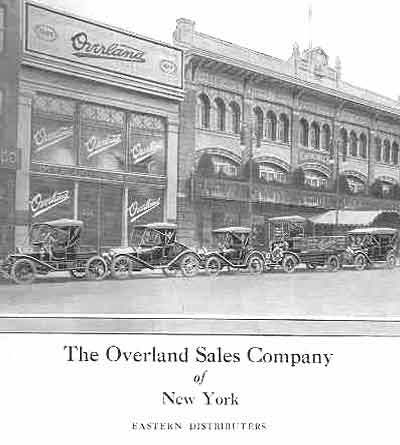
"What promises to be one of the most
interesting and prominent openings of an automobile salesroom in
Manhattan will occur to-morrow, when the Overland Sales Company will
throw open its quarters at 1599 and 1601 Broadway, New York, for public
inspection. The show room is magnificently equipped with a complete
line of cars, consisting of seven different 1911 Overland models. The
entire two-story-and-basement building will be used exclusively for the
sale and repair of Overlands: C.T. Silver will act as manager of the
salesroom.”
At that time the Overland Sales Company of New
York was associated with the New Jersey Overland Company at 228 Halsey
St. Newark, New Jersey, and the March 26, 1911 New York Times
Automobile column announced a further expansion:
"Thoroughly abreast of the times and confident
in the knowledge of having anticipated the demand for Overland cars
this season, C.T. Silver, of the Overland Sales Company of New York is
branching out in this territory on Long Island with a string of
sub-agencies”
A few days later the New York Times announced
Silver’s April 8, 1911 marriage to Elsie Ablowich, daughter of Alfred
Ablowich, owner of the Waumbek Manufacturing Co., a Manhattan garment
manufacturer located at 714 Broadway. In the late 1800s Elsie’s
grandfather had founded J. Ablowich & Co., manufacturers of shirts
and cloaks at 403 Broadway, and her three uncles - Israel, Louts and
Percy Ablowich - were all involved in the city’s garment industry.
During 1912 Silver took the first steps towards
organizing his own organization, forming the C.T. Silver Motor Company,
Incorporated: Conover T. Silver, President and Director; James A. Bell,
1760 Broadway, Secretary and Director. Manhattan Office at 1599 and
1601 Broadway, Brooklyn office at 1295 Bedford Ave.
Shortly thereafter Silver was named official
Manhattan distributor for Overland and took over the automaker’s
Manhattan, Brooklyn and Newark branches. In early 1913 Silver formed
one of the nation’s first auto finance companies, the Overland Part
Payment Company.
The January 5, 1913 New York Times reported:
“C.T. Silver, the Overland agent In New York,
has evolved a scheme to aid those desire to purchase cars on the
part-payment system. The customer pays half of the catalogue price in
cash, and 10 per cent is added to the remained, which is then paid off
in six monthly installments. The purchased is required to maintain
insurance on the car, the title to which remains with the company until
the final payment.”
On January 16, 1913 the New York Times announced
that:
“The Cross & Brown Company has leased the
two four-story buildings, 1601 Broadway and 213 and 215 West
Forty-eighth Street, to the C.T. Silver Motor Company.”
Silver must have been an extraordinary salesman
as within the year he had made a deal with the PeerlessMotor Car
Company of Cleveland, Ohio to take over its New York City branch. The
December, 28, 1913 New York Times announced:
“After January 1, Peerless cars will be handled
in this territory by the C.T. Silver Motor Company, distributors here
of the Willys-Overland product, which it will handle as well. The
organization will take up its quarters in the Peerless building on
Broadway, just above Fifth-sixth Street.”
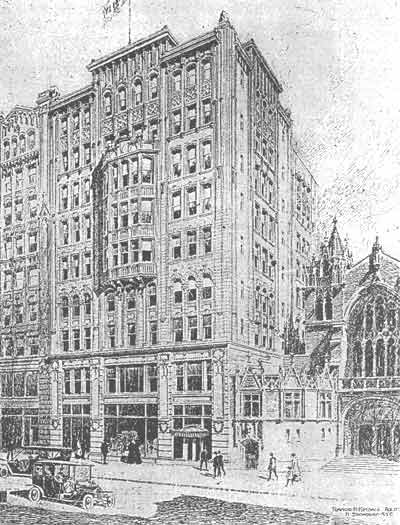
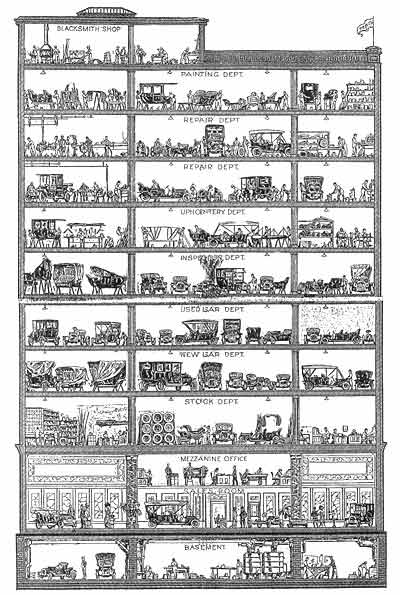
The Peerless and adjoining A.T. Demarest
buildings were designed by the famous New York architect, Francis H.
Kimball and constructed in 1909 in collaboration with consulting
engineers Purdy & Henderson and George A. Fuller Co., builders.
Located at the southeast corner of Broadway and 57th Street, the
architecturally harmonious 9-story structures remain standing today and
are listed on the National Register of Historic Buildings. The L-shaped
Peerless building included a Broadway showroom and a 57ths Street
service entrance.
The January 4, 1914 issue of The Automobile
explained their rational for giving Silver their Manhattan operation:
“Peerless Has Adopted New Selling Plan
Syndicate Now Handles High Grade Product in New York and Chicago.
Cuts Overhead Expense
Step Follows Improvements and Added Cost in Building of Car.
“Expectations of a change in policy by the
Peerless Motor Car Company as a result of the entrance into the
business of men who have been extremely successful in another field
have been realized by the adoption of syndicate selling for New York
and Chicago.
‘”It is our aim in taking this step to readjust
the proportion between car selling and manufacturing expense in
Peerless cars,’ said E. J. Kulas, general manager of sales of the
Peerless Motor Car Company. ‘We have found that selling expense
generally in the high-grade motor car business has been too high. And
so far as the Peerless Motor Car Company is concerned we are going to
correct that condition if we can.’
“Sales Are Limited.
“Because of its high quality and necessarily
high price the sales of Peerless cars are naturally somewhat limited.
When the cost of operating and maintaining a large sales and service
building in a desirable location falls only on those sales it is a very
considerable item. But if many other cars are sold with the same
equipment the overhead cost is much reduced.
“This new arrangement will enable the buyer to
select from a larger stock of automobiles the one most desirable for
his purpose, as each of these companies will carry gasoline cars of
lower price, and the Chicago house also has a line of electrics. It is
well known that the dealers’ margin of profit on automobiles is lower
than what would be considered fair in any other retail business.
“Conditions have changed in the motor car
business. The big demand has been supplied and it now becomes necessary
for the manufacturer to meet these changing conditions. The plan
adopted by the Peerless Motor Car Company is a step in the right
direction and will be copied by others.
“No Reduction in Price.
“A reduction-in the price of Peerless cars is
not thought of; in fact, it is entirely impossible. The Peerless car is
the most expensive to build of any manufactured, either in America or
Europe. It includes costly features of design adopted to secure maximum
efficiency without regard to price.
“During the past few years the Peerless Company
has been developing through researches in its metallurgical
laboratories and advanced heat- heat treating processes, a line of
motor car steels which it uses exclusively and which in strength and
wearing quality are far superior to any previously known in the
industry.
“These steels have greatly increased the life
of the Peerless car, but they have also increased the cost of
production. This year manufacturing cost has also been increased by the
addition of nearly $400 worth of equipment.
“This steadily mounting manufacturing cost has
made necessary a reduction in expense somewhere. And it seemed to us
that to reduce building overhead which in no way affects the
satisfaction of the purchaser in his car, was the place to make it.’
“In Chicago, John R, Buck, general manager of
the Peerless Motor Car Company, will join the McDuffee Organization
with all the men who have been most successful in developing the
Peerless Chicago business and In New York the corresponding members of
the branch, staff will he taken into the C T. Silver Company.”
Peerless’ Manhattan branch was associated with
the Peerless Newark Branch located at 37 William St.
The January 15, 1914 issue of Motor Record
announced an addition to the Silver Company’s board of directors:
“Oathout Becomes Silver’s Partner.
“Charles W. Oathout, at one time the Jackson
agent in New York, has acquired an interest in the rights of the C.T.
Silver Motor Co., the Overland agent, which recently took over the
Peerless agency also and with it the palatial Peerless branch on Upper
Broadway. Oathout, who has been elected treasurer of the Silver company
and will also serve as sales manager, which indicates that he will take
an active part in the business.”
From the January 31, 1914 New York Times:
“Arrangements have been perfected by the C.T.
Silver Motor Company, Peerless and Overland distributors, by which the
representation for those cars in New Jersey will be taken over by the
C.L. Fitzgerald Motor Company, which has been formed for that purpose.
In the new company which will also take over Mr. Silver’s Newark
branch, will be C.L. Fitzgerald, Herbert H. De Wilde, and William J.
McAvoy.
Overland introduced the all-new Willys-Knight in
late 1914. The new vehicle was slated to compete against other premium
American cars such as Packard and Cadillac and its radiator shell was
uncomfortably similar to that of the Packard. The Willys-Knight was
also the nation’s first popularly-priced automobile quipped with the
Knight sleeve-valve engine.
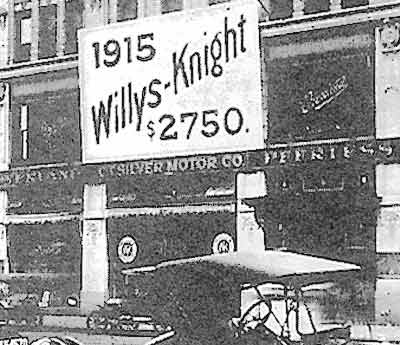
To drum up business for the new car,
Silver put up two huge banners on the Peerless building
advertising the $2750 1915 Willys-Knight that could be seen for blocks.
The upper banner was situated so that it could be seen from Times
Square.
He also produced a small number of custom-bodied
Willys-Knight roadsters that he sold as Silver Knights. The custom
turtle-decked roadster was built in his own shop and included cut-down
doors, a distinctive folding Victoria top, and downsized headlamps that
resembled a backwards bullet.
The February 7, 1915 News and Notes of the
Automobile Trade column of the New York Times reported:
“Since the automobile show C.T. Silver had the
marble showroom of the C.T. Silver Motor Company dressed up and has
been holding a special exhibition of bodies fitted to chassis of the
Overland, Peerless, and Willys-Knight cars. There are some beautiful
expressions of the body builder’s art on display. Mr. Silver has
invested $75,000 in these special bodies, to illustrate how individual
tastes can be worked out.”
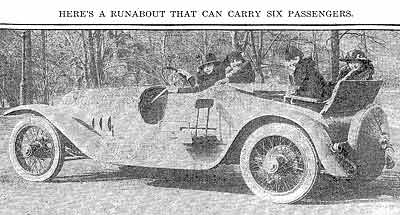
The April 18, 1915 New York Times included a
picture of one of Silver’s first custom-bodied vehicles. The pictured
runabout included Silver’s novel “seat in a drawer”. The caption
follows:
“Here’s a runabout that can carry six
passengers.
“This is the latest special runabout body shown
by the C.T. Silver Motor Company on a six-cylinder Overland chassis.
Although it is normally a two-passenger body, folding seats, two in the
rear deck, and one of a sliding type at each side above the running
boards, give a load capacity of six.”
Silver’s concealed outrigger seats were found on
many of his custom-designed Overland, Willys-Knight, Apperson and
Kissel roadsters. The simple, yet clever, design enabled occasional
passengers to ride on the outside of the body on a folding seat that
emerged from a drawer on each side of the body. The design would appear
on a number of custom-bodied vehicles during the next decade, and was
included on a number of Marmon and Paige (Paige-Daytona) production
roadsters.
Silver started building and designing custom
bodies soon after he moved into the massive Peerless building in 1914.
The upper floors of the structure had all the necessary equipment need
for custom body building and Silver’s craftsmen were culled from
Manhattan’s best carriage building houses.
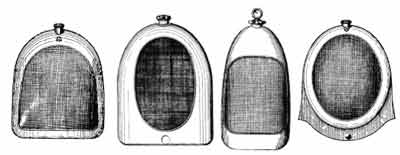
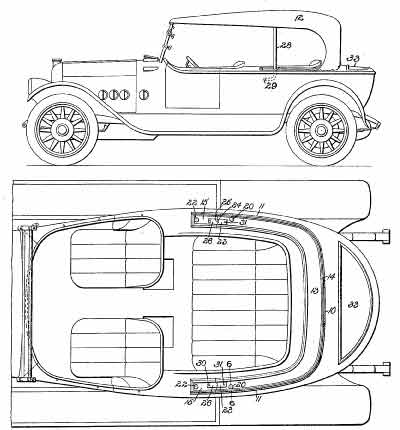
Most of his custom-bodied vehicles featured
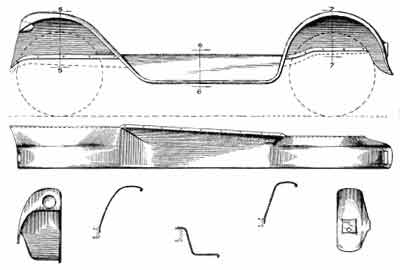
distinctive radiators that helped to disguise the chassis. Between 1914
and 1918 Silver filed 12 patent applications, half for radiator shell
designs, the others for various body-related items such as fenders,
hoods, convertible tops and body designs.
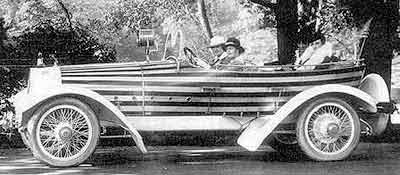
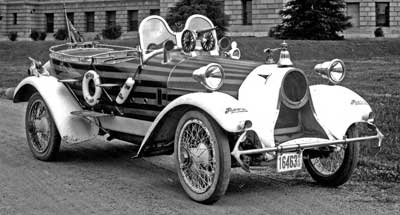
The October 17, 1915 New York Times included a
picture of another unusual Silver design:
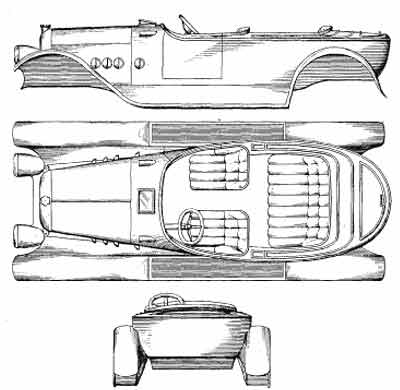
“Novel Automobile On the Lines of a River
Launch.
“One of the most unusual bodies to make its
appearance on “Automobile Row” is show above. It is a boat body on an
Overland chassis, now on view in C.T. Silver's salesrooms. The body is
built of alternate two-inch strips of mahogany and white holly, and the
deck is in birds-eye maple. Mounted on the circular radiator is a
ship’s bell, while a nickel propeller serves to keep the spare wheel in
place. The front bumpers represent anchors and those at the rear, oars.
The upholstery is pigskin.”
The December 1915 issue of The Rudder also
featured the vehicle:
“A Land Runabout of Nautical Design
“Cruising down Broadway recently, the lookout
man megaphoned that there was a peculiar-looking craft at anchor on the
port bow, so we instanter put over the helm and drew alongside. She
proved to be the Silver Bird, a neat little runabout of about 12 feet
length, specially built for the С. Т. Silver Motor Company, on an
Overland six-cylinder chassis. Seeing that her appearance, while not
strictly shipshape, was of elegance and along nautical lines, we
decided to give her a berth in the December Rudder.
“Her hull is planked, not painted, in alternate
layers of white holly and mahogany, while she is decked forward for
three parts of her length with the same wood, this also forming a
housing for the engine, which is installed right forward. The cockpit
and after deck is railed off. The spare wheel aft is held in position
by a real bronze, 14-inch diameter propeller, and she carries an anchor
on either bow. On the forward deck is a searchlight and electric signal
bell.
“Putting all joking to one side, it occurred to
us that an automobile along these lines would interest yachtsmen,
particularly power owners. With the detachable wheels removed, she
would not altogether look out of place in davits, in cases where the
owner of a long-distance cruiser desired to tour the district when
putting in to strange ports and thus combine automobiling with the
pleasure of yachting. So, in future, we can expect one sport to help
the other in this manner, instead of throttling each other.”
The March 16, 1916 issue of the New York Times
announced that Silver had acquired a new Brooklyn salesroom:
“Brooklyn Auto Building Lease
“A new automobile building to be erected in
Brooklyn on the south side of St. Marks Avenue, fronting 62 feet, 140
feet west of Franklin Avenue, has been leased to the C.T. Silver Motors
Company for a term of years at an aggregate rental of $50,000. It will
be used by the Overland Automobile Company as a service station.”
During early 1916 the Automobile announced a
number of management changes at Silver’s Brooklyn and Newark satellites
as well as the addition of a new Bronx satellite:
“Seeback N. Y. Chevrolet Mgr.—L. J. Seeback,
formerly manager of the Brooklyn branch of the C. T. Silver Motor Co.,
New York City, and later of the Newark branch, has been appointed
manager of the New York City sales of the Chevrolet Motor Co.
“Scharps Promoted—C. E. T. Scharps, who
recently joined the C. T. Silver Motor Co., New York City, as
advertising manager and assistant to Mr. Silver, has been promoted to
the position of manager of the Newark, N. J., branch. Mr. Silver, who
handles the Overland, Willys-Knight and Peerless business in this
territory, has also made G. Franklin Bailey director of branches. W. E.
White has been put in charge of the service department.
“Charles Rifenberg, who for a time managed the
service station of the King Motor Co., will superintend the service
station of the Silver Motor Co., Overland distributor in Bronx. W. J.
Taylor has joined the Washburne Corp., Moline-Knight distributor, as
sales manager and efficiency expert. Mr. Taylor entered the Overland
company in 1914 as efficiency engineer. Last year he joined the Silver
Motor Co. and continued on the same work.”
Silver’s Newark branch was run by an associated
firm, the C.L. Fitzgerald Motor Company. During the same period Silver
became the Manhattan distributor for the Dort Motor Car Co. of Flint,
Michigan. A longtime associate of William Crapo Durant, Josiah Dallas
Dort resigned his position as vice-president of Chevrolet in 1913 and
started production of the Dort in 1915.
The front page of the July 16, 1916 issue of the
New York Times announced the death of Paul Smith, a vice-president and
sales manager of the Chalmers Motor Co. of Detroit:
“PAUL SMITH SUICIDE BY LEAP AT BILTMORE;
General Manager of Chalmers Motor Car Co. Jumps from the Thirteenth
Floor. HAD CLOSED $6,250,000 DEAL Wife Recently Summoned from Detroit
Because Husband Was Suffering from Despondency.”
“Paul Smith, Vice President and General Manager
of the Chalmers Motor Car Company of Detroit, Mich., killed himself in
a fit of nervous despondency yesterday morning shortly after 10 o'clock
by leaping from the window of his room on the thirteenth floor of the
Hotel Biltmore.”
The $6,250,000 deal mentioned in the Times was
negotiated between the late Mr. Smith and Conover T. Silver. Another
article in the Automobile column of the same day’s paper gave further
details:
“C.T. Silver announced last week that he had
given up the Overland agency and that he had closed a $6,250,000
contract with the Chalmers Motor Company to handle the Chalmers car in
this territory after Aug. 1. In the announcement of the new arrangement
was the following: "The deal by which Mr. Silver takes over the
Chalmers was engineered and closed by Paul Smith, Vice President and
Sales Manager of the Chalmers Motor Company. Mr. Smith states that it
is the most important move yet made by his company, and that Mr. Silver
will have 100 per cent co-operation from every department of the
Chalmers Company.” Mr. Silver will take over the Chalmers line at once.
The territory which he will have is approximately the same as that in
which he has worked during the last six years. It takes in Greater New
York, Long Island, Staten Island, a big part of New Jersey, and a slice
of Connecticut, with a branch in Bridgeport. He will also take care of
the entire Atlantic seaboard of Chalmers parts. The policy of the
Willys-Overland Company for some time has been to have branches in the
big centers instead of big agencies, and it is expected by the local
trade that steps to do this in New York City will be taken at once.”
Silver wasted no time and by the middle of
October had a couple of custom-bodied Chalmers in his Broadway
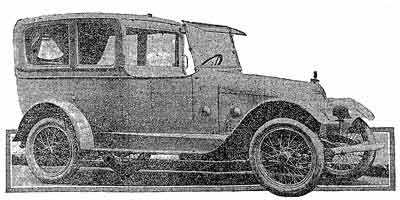
showroom. An elegant-looking Chalmers town car was featured in the
October 22, 1916 issue of the New York Times:
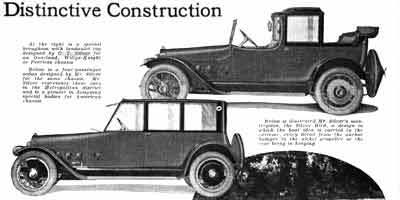
“Brougham In Accordance With New Auto
Nomenclature.
“Brougham” as a type of car has been loosely
used by manufacturers, but now its meaning is fixed by the new
nomenclature of the Society of Automobile Engineers. It is a “limousine
with no roof over the driver’s seat”. “Town car,” much employed for
this type, is not included in the classification of the S.A.E. The
brougham shown above was designed and built by C.T. Silver. It is
mounted on a Chalmers “35-B” chassis, and is finished in French gray
and upholstered in gray cloth. Bullet headlights and a massive foreign
type radiator are characteristics.”
Less than a year after Silver’s $6 million dollar
Chalmers’ distribution deal was announced, the May 1917 issue of Motor
Record reported that Silver had been dropped as the Metropolitan New
York Chalmers distributor:
“A direct branch of the Chalmers Motor Co., of
Detroit, will handle the selling of Chalmers cars in the Metropolitan
territory, including New York City. Steps base been taken for the
incorporation of the Chalmers Sales Co., which will be the name of the
new branch. C.H. King, who has been with the Chalmers company since
only last July, will be head of both the sales and service departments.
Headquarters of the branch will he maintained at 1826 Broadway, where
retail sales will be continued. Since last July the Chalmers New York
territory has been in the hands of C. T. Silver, who also handles the
Dort car. Mr. Silver will confine his attention exclusively to the sale
of that car for the time being.”
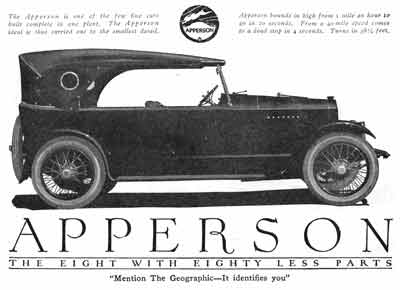
In 1917 Silver acquired two new vehicles lines,
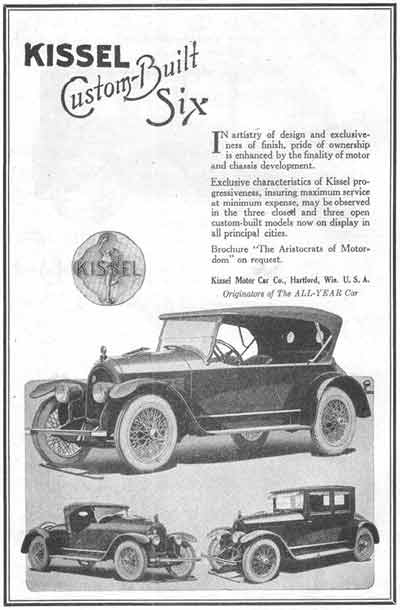
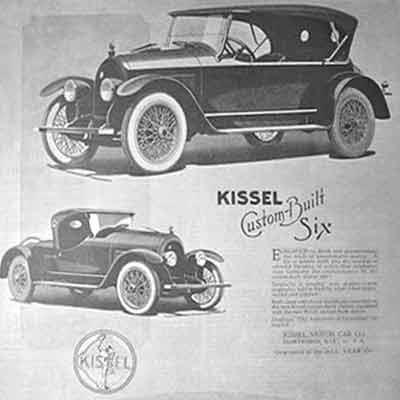
Kissel and Apperson. Manufactured in Hartford, Wisconsin since 1906,
the Kissel Motor Car Company manufactured high quality “Kissel Kar”
passenger cars and commercial vehicles. The Apperson was another high
quality chassis manufactured in Kokomo, Indiana by Edgar and Elmer
Apperson, two brother who in 1896 had helped found Haynes-Apperson.
Silver announced that:
“The Kissel will be marketed in conjunction
with the Dort and Silver-Apperson and like the latter will be modified
to meet the requirements of the high class customer”.
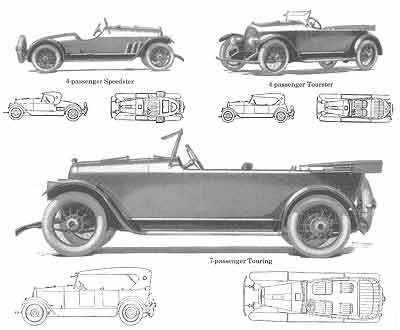
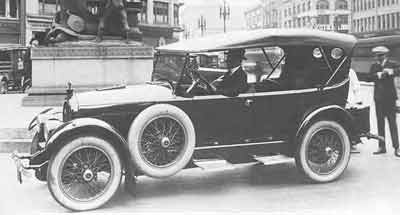
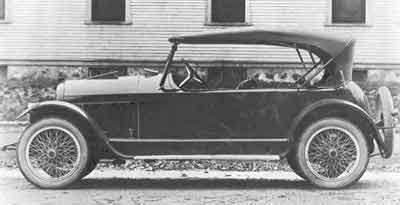
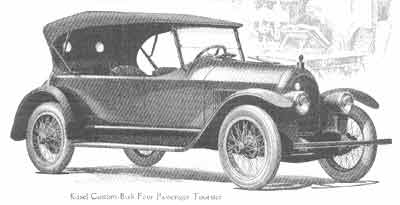
Silver showed three open custom-bodied Kissels -
a speedster, tourster and 7-passenger touring – which were advertised
as “Kissel Kar Silver Specials” at the January 1918 New York Auto Show.
The four-passenger, two-door tourster was equipped with sliding front
seats, a novel idea at the time.
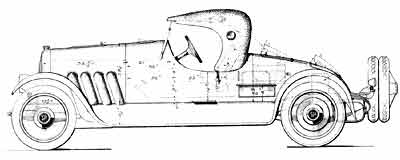
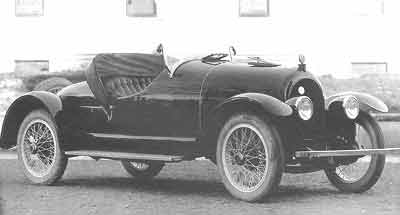
Also at the show was a Silver-boded Apperson V-8
speedster that was nearly identical to the Silver-Special Kissel
speedster. Kissel’s body engineer and designer, Fritz Werner, utilized
Silver’s original Silver-Apperson speedster blueprints as a starting
point for the production version of the Kissel Speedster which enter
into production later that year as a 1919 model.
Although the Kissel and Apperson speedsters bore
identical coachwork from the cowl-back, Silver designed different
radiator shells, hoods and fenders for the two makes and they all
included “C.T. Silver, Inc., New York” hubcaps. While the Apperson was
very attractive, the double-drop frame of the Kissel created a more
sporting look, and its chrome yellow monochromatic paint scheme, made
it the hit of the show.
The speedster, painted in a monochromatic chrome
yellow, was the inspiration for the Kissel “Gold Bug” speedster that
was later manufactured by Kissel. In fact all three of the Silver
Special show cars made it into production on a limited scale, and were
included in Kissel’s 1918-1919 catalogs as Silver Specials.
Both speedsters were equipped with wire wheels,
Houcks on the Kissel and Frayers on the Apperson, a decision that
Silver would soon regret.
Apperson added two Silver Specials to their 1919
lineup; the roadster as seen at the New York Auto show, and a touring
loosely based on the Silver-bodied Kissel touring. Both vehicles shared
a 130”wheelbase 33.8 hp V-8-powered chassis and the Silver Special
Touring sold for $3500, $1000 more than the normal 7-passenger touring.
On January 12, 1918, the New York Times reported
on a law suit initiated by the American Wire Wheel Corp. against C.T.
Silver:
“Suit Over Auto Wheels; Wire Corporation
Accuses C.T. Silver of Infringement.
“Litigation over the use of automobile wire
wheels which, it is alleged, infringe the basic patent rights held by
the Wire Wheel Corporation of America was instituted yesterday in the
United States District Court by the corporation against C.T. Silver of
1760 Broadway. The suit is in the nature of an injunction against the
use of the Frayer wheel on the Silver-Apperson cars which are being
exhibited in the Grand Central Palace show.”
The Frayer Wire Wheel was named after its
designer, Lee Frayer, and manufactured in Columbus and Springfield Ohio
by a succession of firms, called the Frayer Demountable Wire Wheel
Co., the F. & H. Wire Wheel Co., and the Phelps Mfg. Co. Frayer was
eventually sued by the Wire Wheel Corporation of America for patent
infringement, and any firm found using his products was included in the
legal action.
Silver abandoned his Dort distributorship in late
1917 and the February 1918 Motor Record announced his successor:
“The New York Dort agency, formerly handled by
the CT Silver Motor Co., has passed to a new dealer, FW Wright, Inc.,
225 West 57th street.“
The June 16, 1918 New York Times ‘Auto Trade
Notes’ column revealed more changes in store for the Silver
organization:
“An important change in the Automobile Row
section around Fifty-seventh Street will be made on July 5, when C.T.
Silver will move from his large quarters at 1760 Broadway to 509 Fifth
Avenue, between Forty-second and forty-third Streets. He will have the
use in the rear of a private entrance from Forty-third street, giving
ingress and egress to cars. He will display the latest models of the
Silver-Apperson and Kissel Kars.”
The Wire Wheel Corporations suit against Silver
was amicably adjudicated by US District Court Judge Hand as reported by
the August 15, 1918 issue of The Automobile:
“Wire Wheel Corp. Gains Decision
“NEW YORK, Aug. 8—The Wire Wheel Corp. of
America has received a decision in the matter of its proceedings to
restrain C. T. Silver of New York as agent of the Silver Apperson car
from selling or otherwise disposing of a number of Fryer wire wheels
purchased by the Apperson company from the Phelps Mfg. Co. It was held
by Judge Hand of the U. S. District Court that there seemed to be but
small doubt but what the Freyer wheel infringed upon the triple spoke
patent, but that inasmuch as Mr. Silver had but a few cars fitted with
these wheels on hand and no irreparable injury was likely to be
suffered by the Wire Wheel Corp. he would deny a motion for a
preliminary injunction if the defendant filed a bond in the sum of
$2,000 to cover such damage as might be shown to have been sustained by
such infringement at the final hearing of the case.”
Soon after Silver’s move to Fifth Avenue he
rapidly downsized his automotive empire, and unlike many other early
motormen, Silver left the business solvent and at the top of his game.
Although he was no longer involved in automotive
sales or custom bodies, Silver remained active in the automotive real
estate business for a few more years.
The October 26, 1920 New York Times reported on a
recent acquisition:
“Buys Brooklyn Motor Building
“The Packard Motor Car sales and service
building, located at the junction of Flatbush and Eighth Avenues and
St. John’s Place, and facing the main entrance to Prospect Park,
Brooklyn, has been purchased by C.T. Silver, a well-known automobile
distributor.”
Silver had been pouring his automotive profits
into real estate which turned out to be a wise move, considering the
massive losses experienced by automotive retailers in the post-war
depression of 1919-1920.
Silver invested in a number of non-automotive
properties, which included a number of large Brooklyn apartment
buildings, a Mount Kisco estate and a Coney Island gated community.
During the 1920s the New York Times reported on a
number of Silver acquisitions as follows:
August 10, 1921 New York Times:
“Royal Castle, a costly apartment house at the
corner of Clinton and Gates Avenues, was sold by Rogers Alexander to
C.T. Silver and a group of associates.”
February 10, 1922 New York Times:
“C.T. Silver purchased 68-10-72 Columbia
Heights, Brooklyn, and has given in part consideration therefore his
country estate at Sea Gate. The amount involved was in excess of
$200,000.”
(Sea Gate was a private, gated community at the
far western end of Coney Island at the southern tip of Brooklyn.)
February 20, 1923 New York Times:
“C. T. Silver sold the property known as
Waterview Apartments.”
March 10, 1925 New York Times:
“Mrs. C. T. Silver, whose husband, formerly of
C. T. Silver, Inc. auto dealers, is now a real estate operator at 100l
West Fifty-seventh Street.”
January 30, 1929 New York Times:
“Sale by C. T. Silver to the Primrose
Corporation of Mount Vernon.”
Conover T. Silver passed away on March 3, 1929,
leaving his wife Elsie Ablowich Silver; a daughter, Iola Silver; a son,
Conover T. Silver Jr.; and a sister, Margaret Reed.
Various real estate columns mentioned Silver’s
real estate partners, of whom Harold F. Stone was the best known.
Following Silver’s death Stone became president of Silver’s real estate
holding company, which became known as the estate of C.T. Silver.
Harold F. Stone and his brother, Adolph F. Stone,
were the owners of F. & W. Grand Company, a nationwide chain of
5¢-10¢-25¢ stores. On November 8, 1929 F. & W. Grand Co. merged
with another 5¢-10¢-25¢ store chain known as Isaac Silver &
Brothers, forming F. & W. Grand-Silver Stores, Inc.
Although the C.T. Silver Company and Isaac Silver
& Brothers Company share the same surname, I could find no link
between the two firms other than that both companies were controlled by
Harold F. Stone. The estate of C.T. Silver continued to operate in the
Metropolitan New York real estate field as late as 1944.
Frederick G. Neece of Pennsdale, Pennsylvania,
the owner of the only known surviving example of C.T. Silver’s
coachwork, wrote me recently about his 1916 Willys-Knight (aka
Silver-Knight) Model 84 roadster:
"The car I have is built on a standard Willys
Knight Model 84 chassis, model year 1916. The paperwork I received from
the former owner indicates that the car, or chassis?, was built
in August or September of 1915. The car has a very interesting
history, which I'm trying to unravel.
"The history of my car, in a nutshell, appears
to be that it was either designed by, or built for, Blanche Stuart
Scott. She was the first woman to fly an airplane solo, and the
only female student of Glenn Curtiss. She held a variety of
"firsts" in aviation. She was also the second woman to drive
across the US, which she did for promotional purposes for the Overland
Co in 1910. I have done a lot of research on her, and believe,
and am trying to establish concretely, that she worked for CT
Silver. After graduating from a finishing school she moved to New
York, where she worked selling cars. I'm suspecting that she
worked for CT Silver, and that it was through that connection that she
was able to make connection with Willys of the Overland Co. If
the car was not in fact built for her, it was built to her
specifications for the famous silent movie actress Pearl White. I
have been searching for a photo of Pearl White with my car, but have
not had any luck turning one up yet. I did however, find a photo
of Pearl White driving a CT Silver boat tailed touring car. I
have also been successful in turning up a handful of photos of other
cars built by Silver. Apparently his cars were popular with
actresses and performers of the period.
"My car is a pretty interesting piece, being a
six passenger "runabout" - as I've found that Silver apparently termed
the design. The car is very similar to the photos you see of a
white car he built with a group of ladies in it. That car
has drawer-type seats that pull out of the sides of the body, while my
car has the earlier "outboard" seats that are doors that open
and fold out over the running boards. The car has no doors,
bucket seats, and a rumble seat with folding upper deck lid similar to
what Rolls Royce used into the 20's. Interestingly too, if you
compare my car to a Kissell Gold Bug, you can see that everything was
already there in my car. His ideas were formulated, but not yet
refined into what would become the Gold Bug. According to the
Willys WOKR club, and the AACA, this is the only known surviving
example of CT Silver's work. That's why I thought you might be
interested to know of the car. I would be glad to send any pics
of the car that might be of interest to you. I believe the car
will also be on display at the Curtiss Museum this year when the
celebrate the 100th anniversary of Blanche Scott's historic flight."
© 2004 Mark Theobald - Coachbuilt.com with
special thanks to Frederick G. Neece
|