|
|
|
| |
|
 |
||||||||||
|
||||||||||
| |
||||||||||
|
||||||||||
|
||||||||||
|
||||||||||
|
|
|||||||||
Quinsler & Co., a firm originally founded in 1870 as Emond & Quinsler, is best known as the predecessor to George W. McNear. Quinsler’s first factory was located at 1624 Washington St. on the corner of W. Concord St. near the present day Boston Medical Center. Born in September, 1844 to two German immigrants living in Canada named Johanas and Anna Quinsler, George J. Quinsler was apprenticed to a Boston carriage builder, after which his great skill came to the attention to another Canadian-born coachbuilder named Joseph P. Emond, (b. 1835) who brought him into his long-established firm, making him a partner sometime around 1870. The 1866 Sampson, Davenport & Co. Roxbury (Mass.) Directory lists Joseph P. Emond, carriage painter, Felton place, house 4 Regent pl. An article in the July 1911 issue of Carriage Monthly confirms that Joseph P. Emond started his business prior to the start of the Civil War:
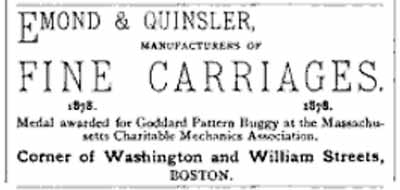
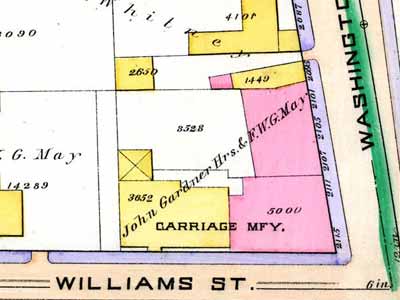
Joseph P. Emond was born in 1835 in Quebec, Canada to Joseph and Elizabeth Emond and after a public education made his way to Boston, where he was apprenticed to one of the city’s numerous carriage builders. By the time the Civil War started he had established his own carriage works, and in 1870 entered into a partnership with George J. Quinsler. Joseph P. Edmond married Elizabeth A. Woodman at about the same time he established his carriage works and to the blessed union was born a son, William Homer Emond, who was born in Roxbury, Suffolk County , Massachusetts on November 29, 1861. Joseph P. Emond’s first wife, Elizabeth A. (Woodman) Emond passed away while William H. was a youngster and he subsequently married Mary E. Baker (daughter William M. and Sarah T. Baker) on August 7, 1871 in Boston. His occupation was listed as carriage mfr. on the marriage certificate and his son William H. Emond was 9 years old at the time. George J. Quinsler was married in Boston in October 11, 1876 to Antonia G. Marten (b. April 1852) and to the blessed union were born Geneveve M. (b. Aug. ,1880) and Phillips B. (b. Aug., 1888) Quinsler. The partner’s carriage factory was located in the Boston, Massachusetts borough of Roxbury at the corner of Williams and Washington Sts. The 1875 Boston directory lists the firm as Emond & Quinsler. One of their two exhibits won a Bronze Medal at the 1874 Massachusetts Charitable Mechanic Association Exhibition, which was held at Faneuil and Quincy Halls, Boston during September & October 1874:
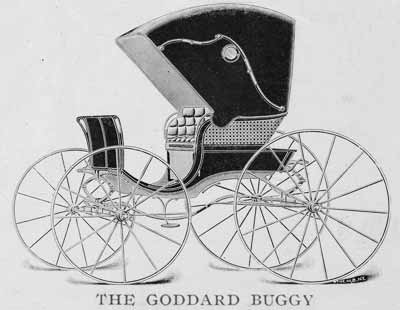
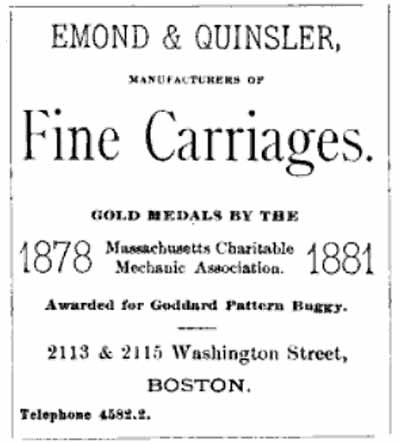
During the 1870s the Goddard pattern buggy, a drop front 4-wheel buggy designed by Boston’s Thomas Goddard, 146 Federal St., Boston (1861 address), was the most popular vehicle of the day, replacing the pre-Civil War two-wheeled chaise. An apprentice of Boston’s Walter Frost (b.1796), Goddard enjoyed an enviable reputation, and his hand-made buggies took a full three to six months to be completed, the majority of that time spent on their exquisite paintwork. Goddard’s vehicles were considered to be the best of the best, and priced accordingly. Born in Cambridge, Middlesex County, Massachusetts on July 13, 1805 to William and Sarah (Warner) Goddard , he died in Boston on February 19, 1894 aged 88 years. Goddard retired in 1872, and Joseph F. Pray (b.1832-d.Mar. 6, 1904) purchased his business and with it the right to produce the ‘Goddard pattern’ buggy. At the time, Pray Bros. Carriage Works was one of Boston’s leading vehicle constructors, have been founded by his father, Joseph C. Pray (b.1810-d.Dec. 4, 1890) in, 1845, whom he succeeded in 1863. By 1870 the number of Boston carriage builders numbered close to 50, and almost every one of them offered some type of Goddard buggy. Pray continued to employ most of Goddard’s staff, and soon erected a handsome brick manufactory in Boston’s South End at the corner of James and 32-36 East Concord Sts., built with the financial assistance of his brother, Benjamin (b.1839) who had become a successful commission merchant. Although it was extensively remodeled into 26 condominiums in 1987, the Pray Bros. factory still retains most of it original looks. The July 1880 issue of the Harvard Register included the following Emond & Quinsler display ad:
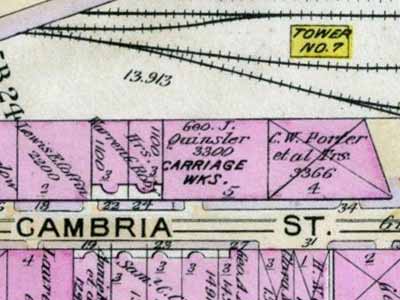
George J. Quinsler left the partnership at the end of 1883, establishing Quinsler & Co. at 26-34 Cambria St., just across the street from the present-day Berklee College of Music. Joseph P. Emond not only retained the partner’s 2113-2115 Washington St. factory, but kept the trade name until 1889 when his son, William H. Emond, became a partner. During the fall of 1884, the two firms bearing Quinsler’s name competed against each other at the annual Mass. Charitable Mechanic Association Exhibition which was held at the Huntington Ave. and Newton St. Exhibition Building, Boston during September & October 1884. Their three entries follow:
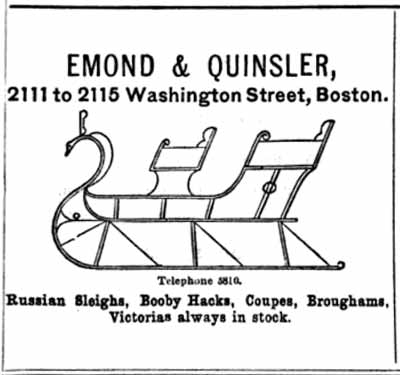
As late as June 1888 Emond continued to use the Emond & Quinsler trade name as shown by the following display ad in that month’s issue of the Boston Journal of Health:
The 1890 edition of Clarke’s Boston Blue Book lists a J.P. Emond on Centre St., next to the Dorchester Industrial School (incorporated ‘for the purpose of training to good conduct, and instructing in household Iabor, destitute or neglected girls.’), in the southern Boston borough of Dorchester. William H. Emond was married in Boston on October 29, 1891 to Hortense E. Shaw (b. 1867 in Roxton Falls, Conn. to William & Elizabeth Shaw). Unfortunately Hortense contracted cerebral Meningitis in July of 1893 and within the week was dead, passing away on July 16, 1893 at the age of 26. Emond remarried in Boston on Nov. 1, 1898 to Bessie L. Wood (daughter of Lyn P. and May E. (Jack) Wood. The Emonds also constructed automobile bodies and were listed under the Auto Advertisements: Bodies and Body Parts heading in the March, 1907 issue of the Carriage Monthly. William was active in the Carriage Manufacturers Association, and in 1905 was elected secretary of the organization. Although William H. Emond’s star was rising, his family’s business was failing, with the July 1908 issue of Carriage Monthly reporting on their pending bankruptcy:
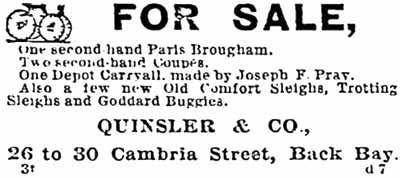
The bankruptcy proved to be a blessing for all involved, Joseph retired and William took a job as a body engineer and designer with the H.H. Franklin Mfg. Co. of Syracuse, New York. A classified ad in the December 7 & December 10, 1889 Boston Evening Transcript follows:
George J. Quinsler’s business expanded after leaving Emond & Quinsler, enabling him to pursue other activities. Quinsler and his wife Antonia were keenly interested in the history of old Boston and in 1892 purchased the city’s oldest known house. Built in 1651, the James Blake House was restored by the Quinslers and then sold to the city of Boston in 1895 who turned it into a museum. Today, it’s one of Boston’s oldest known buildings and is the only surviving example of West England country framing in the United States. A temporary strike at the Quinsler plant made headlines in the July 29, 1893 issue of the Boston Daily Globe:
The strike in the Quinsler plant soured relations between the owner and his employees so Quinsler began looking for a partner that would allow him to slowly withdraw from the firm’s management. The April 1895 issue of The Hub reports his success:
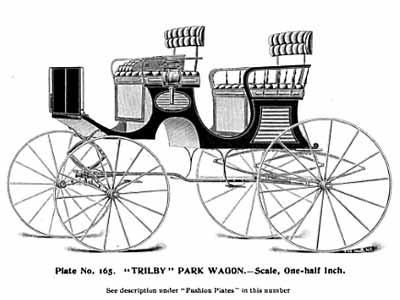
A Trilby Park Wagon built by Quinsler was pictured in the July 1895 issue of the Hub, its description:
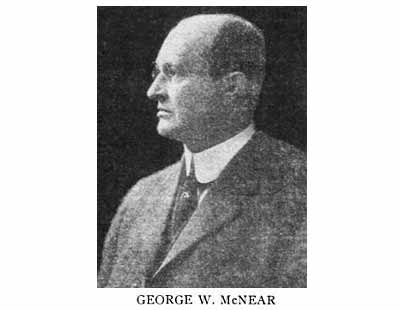
To clear up the confusing McNear family genealogy it must first be stated that at that time there were a lot of George W. McNears whose paternal ancestry can all be traced back to a Scottsman named John McNear. He emigrated from northern Scotland in 1725, settling in the Province of Maine, where he became prominent in the Indian wars and was noted for his bravery during the troublesome Colonial times. John McNear’s grandson, Captain John McNear, was born to his seafaring father (also named John) in Edingberg, Sweden on March 6, 1777 (he was lost at sea on or about October 1, 1829) who had 12 children with his wife Elizabeth (aka Betsy) Erskine (b.1783 in Bristol, Maine), a sister of Colonel Erskine, one of the first settlers of Pemaquid, Maine. Two of their sons (Baker & John) spawned multiple generations of George W. McNears.Captain John’s son, Baker McNear (b. 1808-d. Aug. 31, 1887) was the grandfather of coachbuilder George W. McNear (b. 1861-d.1931). Captain John’s son, John (b.????), also a sea captain, was the father of California-based shipping and grain magnate George W. McNear (b. 1837-d.1910), who was often referred to as ‘The Pacific Coast Wheat King’. The George W. McNear of our story was named after his great uncle, George W. McNear (1), Baker McNear’s brother, who was born on January 18, 1813. He died in Boston at Captain Baker McNear's home March 26, 1842. Various US Censuses provide a brief chronology of his direct ancestors and early life: The Watertown, Middlesex, Massachusetts 1850 US Census states that Baker McNear, occupation Mariner, was born in Bristol, Maine in 1808. His father was John McNear, born in Edingberg, Sweden and his mother was Elisabeth Erskine born in Bristol, Maine. Baker’s wife Mary Cook was born in Massachusetts in 1817 (1815), and died on December 29, 1899 in Watertown, Mass. Four children were born to Baker and Mary as follows: George W. McNear (b. 1836 in Mass.) ; Charles H. McNear (b. 1840 in Mass.); Emily McNear (b. Jan. 6, 1847 in Chelsea, Mass.); Mary McNear (b. 1838 in Mass.) Their son George W. McNear (b.1836) married Marie Brown (b.1840 in England) sometime around 1860. The 1860 US Census lists Baker McNear’s residence as, Brooklyn, Kings County, New York, but no information for either George W. or his newlywed wife are included, and it is assumed they may have gone to England to get married and were absent at the time of the census. For reasons that have yet to be uncovered the McNears relocated to Missouri after their marriage. George W. McNear (our subject) was born in Eagleville, Harrison County, Missouri during July, 1868 to George W. and Maria (Brown) McNear. Eagleville was a small farming hamlet located 15 miles north of Bethany, the county seat about halfway between Kansas City, Missouri and Des Moines, Iowa. By the time of the 1880 US Census, 12 yo. George W. McNear was living with his widowed mother and his paternal grandparents; Baker & Mary McNear, in Watertown, Middlesex County, Massachusetts. After school the mechanically-inclined youngster tried his hand at handyman, teamster and according to one account, acted as a messenger for Cambridge resident Henry Wadsworth Longfellow, the most popular poet of the day, which indicates he must have moved to Boston. Shortly thereafter McNear was apprenticed to Boston's famous carriage builder Chauncey Thomas & Company where he learned the carriage trade from the ground up. Numerous talented individuals worked their way through the Thomas shops in a large part due to his close association with the Carriage Builders National Association, who’s Manhattan-based Technical School for Carriage Draughtsmen and Mechanics provided him with a steady supply of talented energetic craftsmen and engineers. Famous Thomas employees included brothers’ Charles A. and Fred Fisher (auto body mfrs.), C.A. Willey (paint mfr.), Frank W. Tucker (tire distributor), Oscar H. Schildbach and George W. McNear. Apprenticed to the Thomas works in 1880, McNear embarked upon a course of study at the CNBA school, and in 1892 became Thomas’ chief engineer and his renderings and body drafts were often featured within the pages of the carriage trades. In 1895 he left the Thomas works, entering into a partnership with George Quinsler, a well-known builder located at 26-34 Cambria St. in the Back Bay section of Boston, the April 1895 issue of the Hub reporting:
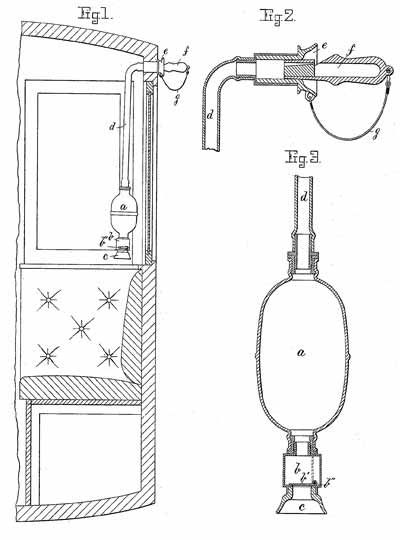
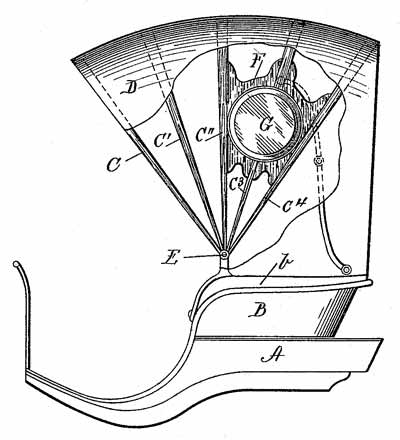
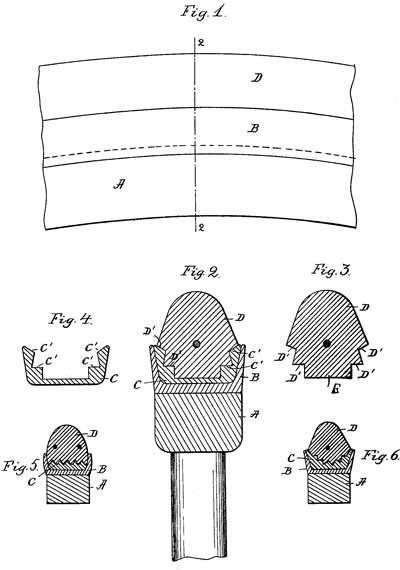
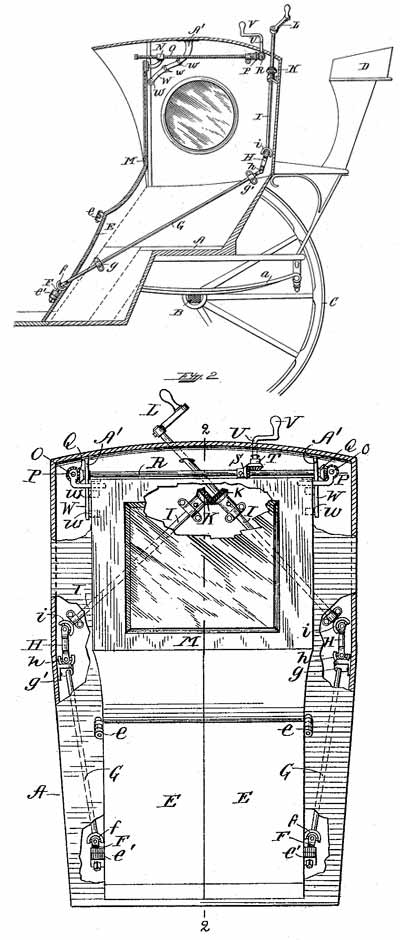
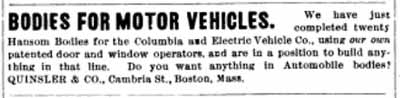
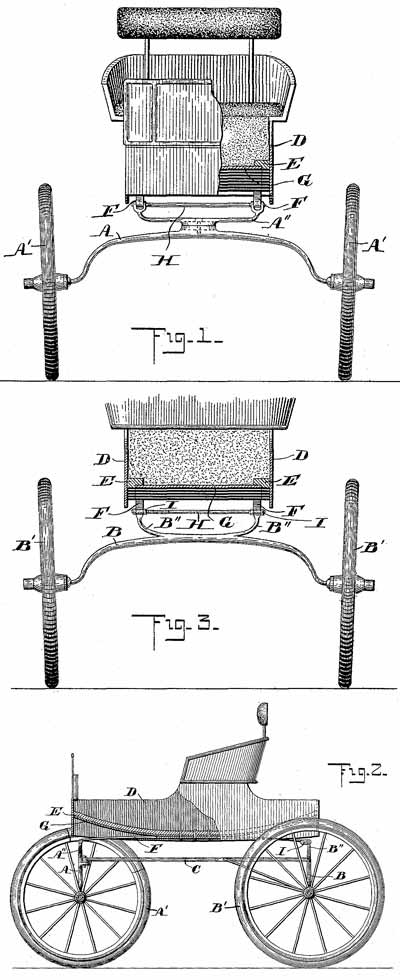
At that time, George J. Quinsler, of Quinsler & Co., was looking to retire from the business, and an arrangement was made in 1905 whereby McNear became Quinsler’s chief draftsman and designer as well as a part owner of the firm. McNear married Lilly (aka Lillie) Cousins on June 14, 1893 in Boston, Massachusetts. Lilly was born in Massachusetts in December 1868 to Leonard and Sarah (Egerton) Cousins. The 1900 US Census reports that George W. McNear lived in Newton, Middlesex County, Massachusetts with his wife Lilly and two sons, Egerton Baker McNear (b. April 11, 1894) and George Rodger McNear (b. July 9, 1897) aka G. Rodger McNear. Quinsler was assigned two US Patents: Speaking Tube Apparatus - US Pat. 277508 – Filed October 14, 1882 - Issued May 15, 1883 Vehicle - US Pat. 689123 - Filed Sep 23, 1901 - Issued Dec 17, 1901 In partnershops with Geroge W. McNear Quinsler was awarded three patents: Buggy Top Side Light: US Pat. 607705 - Filed May 14, 1898 - Issued Jul 19, 1898 Rubber Tire for Carriage Wheels: US Pat. 628284 - Filed Oct 28, 1898 - Issued Jul 4, 1899 Hansom Cab: US Pat. 638141 - Filed Aug 18, 1899 - Issued Nov 28, 1899 An advertisement in the November, 1899 issue of the Horseless Age announced that Quinsler & Co. had built 20 hansom cab bodies for the Electric Vehicle Company, the producers of the Columbia Electric and was “prepared to execute any kind of automobile bodywork”. Apparently their Back Bay customers were
purchasing
automobiles with some frequency as Quinsler decided to build their own
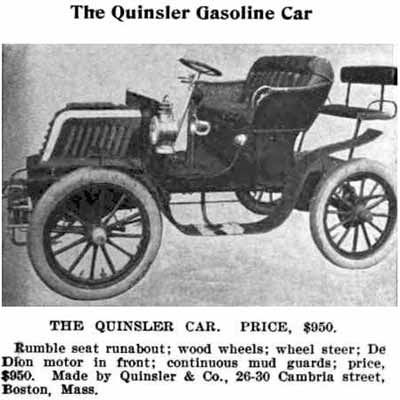
automobile in 1904. Called the Quinsler, it was a small 2-seat runabout
with a
removable dickey seat, powered by a 7-h.p. DeDion 1-cylinder gasoline
engine that
sold for $950. McNear was well-known Boston automobilist and in 1906 was elected president of the Bay State Automobile Association as reported in theNovember 24, 1906 issue of Automobile Topics:
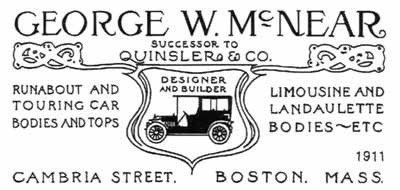
McNear served as president of the Bay State Automobile Assoc. until 1916 when he resigned to become president of the Massachusetts State Automobile Association (Massachusetts chapter of the American Automobile Association), which had an office at 93 Massachusetts Ave., rm. 220, Boston, Mass. He later served as president of the Vehicle Manufacturers' Association of New England. The 1906 Boston Automobile Show brochure included a striking Packard limousine designed by McNear and after 1911, the firm’s advertisements read: "George W. McNear, successor to Quinsler & Company." The February 11, 1909 issue of Motor Age reported on Quinsler's withdrawal from the firm:
The March, 1909 issue of Carriage Monthly also covered the dissolution:
The McNear family lived at 191 Auburn St., Newton, Massachusetts at the time. In addition to automobiles, McNear was also involved in the building and maintaining motor yachts. A surviving advertisement reveals they were also dealers for Ralacco Marine Engines, which was a popular engine constructed by the S.M. Jones company of Toledo, Ohio. Within two years of McNear taking over Quinsler & Co., he renamed the firm, as reported in the July 1911 issue of Carriage Monthly:
McNear was included in a tour of the Boston Automobile Show which appeared in the March 17, 1915 issue of the Boston Daily Globe:
A large McNear display ad accompanied the following item in the March 5, 1916 Boston Sunday Globe:
Another McNear ad appeared adjacent to the following article published in the March 3, 1918 Boston Globe:
The May 3, 1918 Boston Globe announced McNear’s purchase of the former Holtzer-Cabot Electric Co. factory, 14-18 Station Street,, a four-story yellow brick structure located across the street from the Brookline Railroad depot:
The new factory allowed the firm to branch out into the lucrative commercial body business and the firm is known to have built parlor cars, school buses and delivery trucks for many area governments, schools and businesses. The McNear story is continued HERE © 2012 Mark Theobald - Coachbuilt.com
|
|
|||||||||
|
||||||||||
|
||||||||||
|
||||||||||
|
||||||||||
|
|
||||||||||
| |
||||||||||
|
||||||||||
|
|
||||||||||
|
||||||||||
| |
||||||||||
|
||||||||||
|
|
||||||||||
|
|
||||||||||
|
|
||||||||||
|
© 2004-2012 Coachbuilt.com, Inc.|books|disclaimer|index|privacy |
||||||||||