|
|
|
| |
|
 |
||||||||||
|
||||||||||
| |
||||||||||
|
||||||||||
|
||||||||||
|
||||||||||
|
|
|||||||||
|
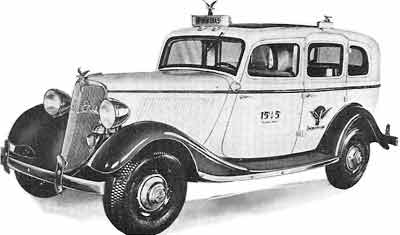
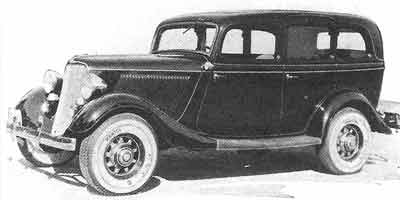
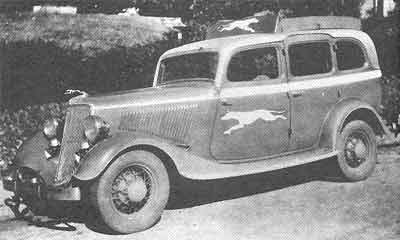
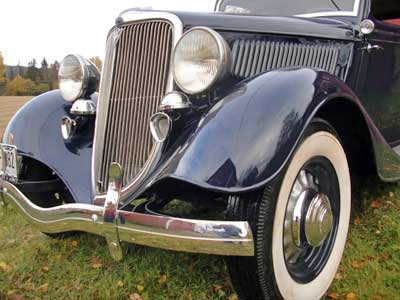
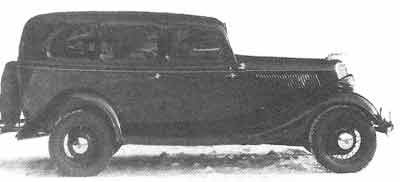
Although they shared the same name, the retailers of the 1933-34 New Era-Ford were unrelated to the firm headed by Archie Andrews that exploited the ill-fated Ruxton automobile of 1929-1930. New Era Motors Corp., 1775 Broadway, New York City, began development of a Ford V-8 –based taxicab which was designed with Manhattan-based fleet operators in mind. The LeBaron division of Briggs Mfg. Co, one of Ford’s main body suppliers. designed the coachwork and the first examples of the budget-priced conveyance began gracing the streets of New York City during 1933. Marketed as a New Era-Ford, the 6/7-passenger Sedans, Limousines and Taxicabs started with a Brigg’s-built Ford Model 40 Type 78B Sedan Delivery body shell mounted to a 112-inch Model 40/40A chassis to which was added various parts from the Ford/Briggs parts bin such as front doors from the Fordor Sedan. A set of extra-tall rear doors were installed allowing passengers with hats to enter the rear compartment without having to remove their headgear. New Era branded grill and hood ornaments were installed and depending on the end user, various interiors were then fitted by LeBaron. Priced at $995 fob Detroit, the New Era-Ford Taxi included accommodations for 5 or 6 passengers in the rear compartment; safety glass throughout; leather upholstery, a special heater; cowl and pillar lamps; integral chrome rub rails; safety bumpers; trunk carrier, lighted signs; and disc wheels fitted with General low-pressure Jumbo tires. A picture of a Greyhound-badged Taxi in the Ford Motor Company Archives reveals that the Taxi was also used by bus companies for shuttling small groups of passengers between the bus depot and their hotels. The $975 New Era-Ford sedan was fitted with Bedford cord and woolen fabric broadcloth. The $1040 limousine also included a glass-windowed divider and leather driver’s compartment. Heavy duty wire wheels and full chrome wheelcovers were standard although New Era's advertising usually included the optionalchrome-plated 16” Cleve-weld 9-spoke wheels and Martin whitewall balloon tires. Jump seats were also standard and the diminutive vehicles could carry from between five to seven passengers proving popular with livery operators in Metropolitan New York and Philadelphia. Period advertising claims the New Era-Fords were also available with a 4-cylinder in place of the flathead V-8 although the number of vehicles outfitted with the four is unknown, as is the number of New Era-Fords built. The July 30, 1933 issue of the Syracuse Herald included the following news item:
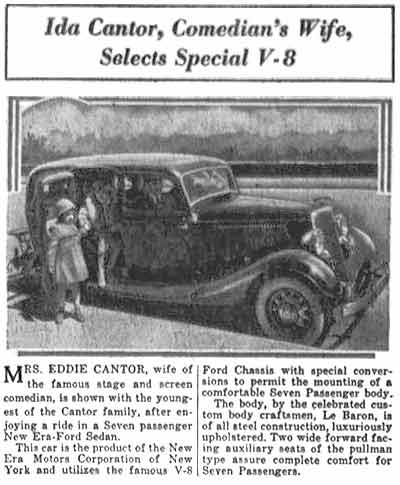
To help advertise the vehicle New Era circulated the following press release/photo featuring comedian Eddie Cantor’s wife, Ida and youngest daughter emerging from the rear compartment of a New Era-Ford:
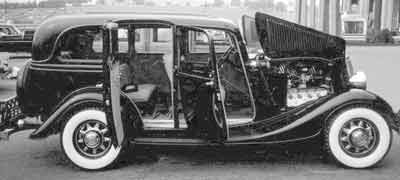
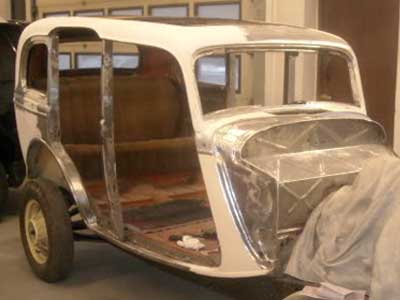
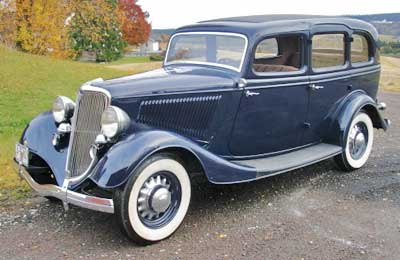
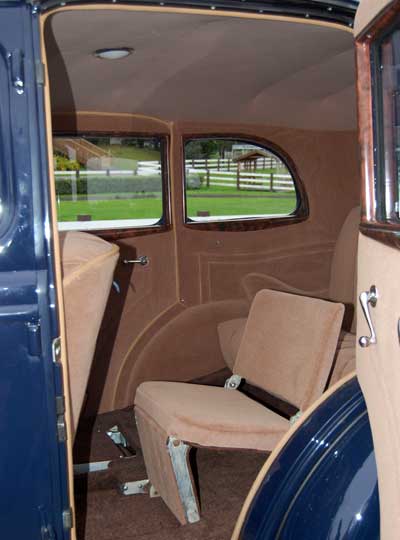
Of the approximate one hundred New Era-Fords thought to have been produced only three are known to exist, two in the United States and a third in Norway which is owned by Early Ford V8 collector Ola Hegseth of Oslo. The story behind the two decades-long resurrection of Hegseth’s car is an interesting one, and he graciously supplied us with four pictures of the car during and after its restoration. His 7-passenger New Era was one of 4-5 used New Era sedans exported from the U.K. to Norway between 1935-1937, all of which ended up being used as taxicabs. Sometime after its arrival in Oslo, Norway the original Ford chassis/drivetrain was discarded in favour of a 6-cylinder chassis/drivetrain sourced from a 1926 Oldsmobile. The taxi eventually ended up in Oppdal, a small village located in Sør-Trøndelag county about 40 miles south of Trondheim. He learned of the car via an item in the June 1980, issue of AmCar Magazine where the writer stated that he had stripped the car of its Oldsmobile engine, transmission and rear axle for use in the restoration of his own 1926 Oldsmobile. Hegseth was well aware of how rare the car was having read about them in the V8 Times, the journal of the Early Ford V8 Club of America of which he was its European correspondent. Hegseth travelled to Oppdal to inspect what remained of the vehicle, which for the previous 15 years had been sitting outside serving as a feed storage shed for sheep. He purchased what remained and transported it to Oslo where he separated the bodyshell from the incorrect Oldsmobile frame and set about finding a correct 112” wheelbase chassis/drivetrain from a 1933-34 Ford donor. Hegseth purchased a complete numbers-matching 1934 Ford V8 Fordor Sedan donor from a fellow V8 Club (RG 102 Norway) member who had recently suffered a stroke and embarked upon the restoration of his New Era. The front third of the New Era’s body - including the cowl and main framework from just in front of the B-pillar forward - was unsalvageable so sheet metal from the donor Fordor was used to rebuild the body shell. Luckily the rear two-thirds of the car – including all four doors - was salvageable despite the fact it contained numerous bullet holes created during the many years it sat out in the herder’s field. The bodywork was handled professionally by a good friend who worked on the project in his body shop as time allowed. Hegseth completed the drivetrain and chassis restoration fairly quickly and waited patiently for the next five years while the New Era’s body was returned to its original condition. The body was first fitted to the restored frame in November of 2007, and after a series of minor adjustments was finally ready for the paint booth in April, 2010. Material for the interior was supplied by LeBaron Bonney, although some pieces had to be custom-made and fitted as the rear doors of the New Era were noticeably taller than that of a standard Model 40A Fordor Sedan. Hegseth completed the restoration of his New Era in August of 2012 just in time for his 70th birthday receiving a ‘Best in Show’ award at its first public appearance two months later. One of the American survivors, a beautiful black 1934 7-passenger sedan owned by Larry R. Bailey of Cleveland, Georgia, was displayed at a recent AACA Fall Meet in Hershey. At least one of the New Era/LeBaron limousines was outfitted by Rosemont, Pennsylvania’s Derham Body Co. for a budget-minded client. As did Brewster and Cunningham, Derham also created their own Ford-based Town Car during 1934. The Rosemont firm purchased several dozen (sounds too high) unused circa 1930 Ford Model A Town Car bodies and installed them on new 1934 Ford V-8 cowl and chassis. The resulting vehicle included roll-up driver’s windows and a retractable roof for the chauffeur that could be stored in a compartment located at the top of the sliding glass partition which was mounted between the B-pillars. When outfitted with jump seats, the rear compartment could hold up to five passengers and like its New Era-Ford cousin, the Derham-Ford Town Car proved popular with livery operators in Metropolitan New York and Philadelphia. © 2013 Mark Theobald - Coachbuilt.com with
special thanks to Ola Hegseth
|
|
|||||||||
|
||||||||||
|
||||||||||
|
||||||||||
|
|
||||||||||
| |
||||||||||
|
||||||||||
|
|
||||||||||
|
||||||||||
| |
||||||||||
|
||||||||||
|
|
||||||||||
|
|
||||||||||
|
|
||||||||||
|
© 2004-2013 Coachbuilt.com, Inc.|books|disclaimer|index|privacy |
||||||||||