|
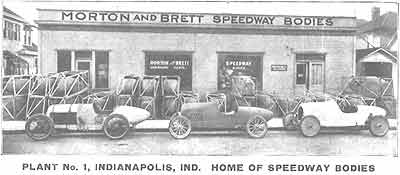
Elvin D. Morton, a Canadian living in Indianapolis and a partner, Jack
Brett, opened an auto body and paint shop at 811-815 East Twenty-Third St.
Indianapolis, Indiana sometime before the start of 1918. A classified ad in
the May 20, 1918 Indianapolis Star announced:
“Automobiles painted by
Morton & Brett are easily recognized by their indestructible crystal finish;
all prices. We are now equipped to handle this work in addition to special
bodies. Morton & Brett, 811-815 East Twenty-third St. North 9300 or
automatic 41-189.”
Another Indianapolis Star classified dated November, 10, 1919 reads:
“Morton & Brett, High-grade special bodies and painting for all cars. 811
E. Twenty-third St., North 9300.”
With help from depressed used Model-T prices, Dirt track racing, which
had become dormant during the First World War, experienced a revival in
1919, and by 1920 thousands of amateur racers were competing in short track
races across the country. Indianapolis was at the center of this renewed
activity and a number of small manufacturers were poised to take advantage.
The best-known of them was the Chevrolet Brothers Manufacturing Company,
manufacturers of Frontenac race equipment. Located at 410 W. Tenth St,
Indianapolis, the small firm introduced an OHV head for the Model T that
became popular with the Model T racers. The Chevrolet Brothers, Louis,
Gaston and Arthur, soon developed a whole line of speed equipment for the
Model T, and included in their mail-order catalogs were one-man speedster
bodies built by Morton & Brett.
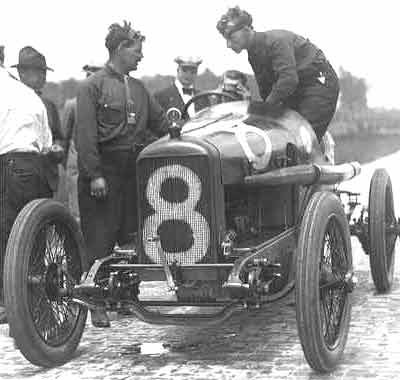
The Chevrolet Brothers had used Morton & Brett-built bodies on their
early Frontenac and Monroe Indy racers and close examination of Louis and
Arthur’s 1916 Indianapolis entries reveals that their Speedster bodies were
identical to those built and patented by Morton & Brett at the end of the
war.
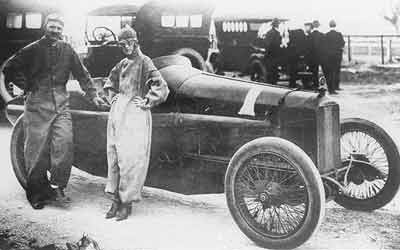
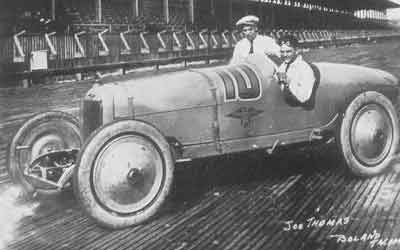
There was no 1917 or 1918 race, but the 1919 Frontenacs and 1920 Monroes
of Louis and Gaston Chevrolet wore the same bodies, albeit with different
radiator shrouds, with Gaston winning the event in 1920. The Indy winning
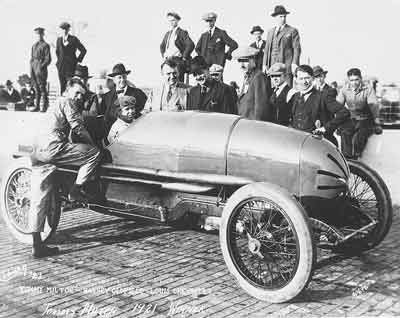
1921 Frontenac piloted by Tommy Milton also wore a Brett & Morton-style
body.
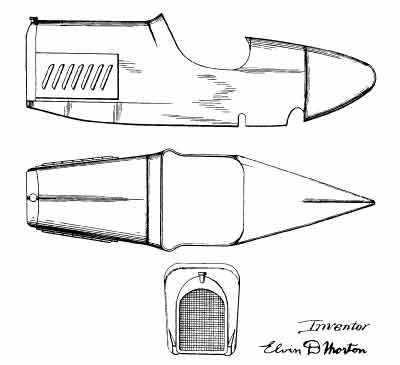
Elvin D. Morton is credited with the design of those early speedster
bodies and applied for a U.S. patent on September 20, 1919, for his
“Speedway Body for Motor Vehicles of the Ford Type” which was awarded design
patent # D54668 on March 9, 1920.
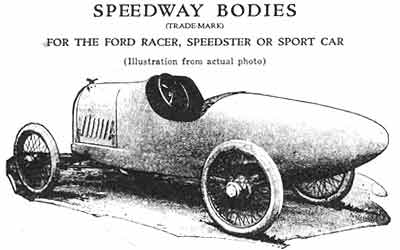
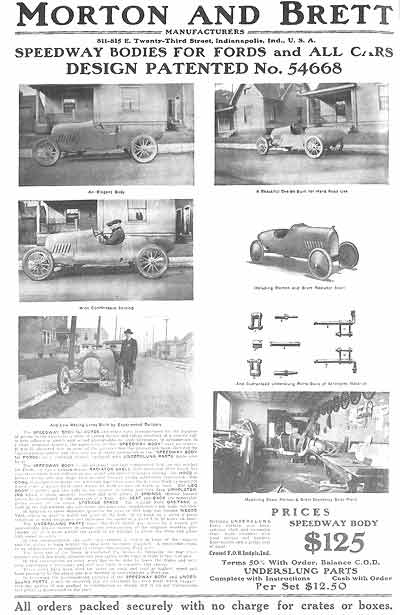
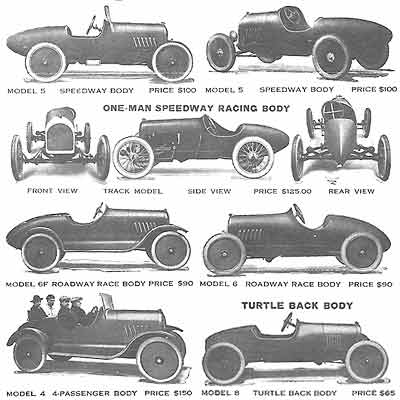
By 1919 Morton & Brett’s Speedway bodies were being marketed through
their own catalogs and advertisements. A number of other Indiana-based Model
T speed equipment retailers - Chevrolet Brothers (Frontenac), Craig-Hunt,
Faultless, Laurel, and Green Engineering - marketed their own Speedway
bodies many of which were identical to those first introduced by Morton &
Brett in the late teens.
Although I can’t state conclusively that Morton& Brett built any of them,
many Model T Speedster owners and historians believe that Morton & Brett
built most of them. One exception was the Mercury Body Co. of Louisville,
Kentucky, whose speedster bodies bore little to no resemblance to those
produced by any of the Indiana manufacturers.
A transcription of a circa 1921 Morton & Brett advertisement follows:
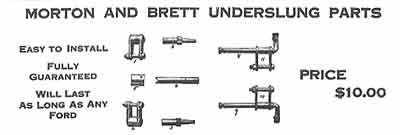
“UNDERSLUNG PARTS
“The MORTON & BRETT Underslung Parts need very little introduction, as
well over 30,000 sets are in use throughout the world and the construction
is accepted by all in a position to criticize as the only practical and safe
method to lower the Ford frame without impairing the long service due to the
wonderful Ford construction. Racing drivers throughout the world endorse and
use them in rebuilding Ford cars for speed purposes.
“Our Underslung Parts are fully guaranteed and are constructed of
maganese bronze, government and S.A.E. formula, which at the same time as
being an excellent bearing is at least 75% stronger than steel, and breakage
through any cause is practically unheard of. The remaining parts, such as
bolts, etc, are nickel steel machined to fit perfectly and combining to make
an exact method of obtaining the low center of gravity necessary for
excessive speed.
“DISCS
“These discs increase the strength of the whole 25% and are made of the
best material for the purpose as shown in all photographs. Supplied for both
inside and outside each wheel, 8 discs in all, crated for shipment, Price,
$6.00.
“GENERAL SPECIFICATIONS OF ALL MORTON AND BRETT BODIES
“BODY
“All MORTON & BRETT Bodies are made of 20 gauge material especially made
for bodies and coated for us to prevent rust. Although this is far more
expensive than regular iron it allows us to supply our customer with a
non-rust body which will stand any weather. The lumber used in our jobs is
selected and shipped direct to us from the mills and although much more
expensive than oak is one of the prime factors of the success and the long
life of our bodies.
“RADIATOR SHELL
“The well known full-hammered MORTON & BRETT Radiator Shell giving a
foreign appearance, is offered with models 4 and 5 and one-man body.
Included with this feature are also the necessary parts such as extension
filler, making a complete unit.
“HOOD
“The hood, which is of the MORTON & BRETT 3-piece design, is perfect
fitting and has large deep pressed louvers for proper ventilation at high
speed.
“WEDGE TAIL
“The MORTON & BRETT Wedge Tail has stood the most rigid tests for
balance, wind resistance and beauty of appearance. POSITIVELY the speed of
the- Ford car will be increased five to ten miles per hour when our bodies
are used. The strength of the tail due to the design and construction is
capable of stopping an automobile when in contact with its radiator without
damaging the tail.
“STEERING
“All bodies are equipped with necessary apparatus to lower steering.
“CARRYING SPACE
“By simply pulling forward the seat back the whole rear end is at once
offered for storage space. Provision is also made in this compartment for
the gas tank where it is easily installed.
“COWL
“The cowl is designed to comply with requirements of racing drivers and
the shape diverts the wind and dust over the driver's head also adding a
beauty and finish only found on MORTON & BRETT Bodies. For the purpose of
strengthening, a heavy steel rod is placed all around the cowl over which
the metal is rolled making the edge very smooth and completing the finish.
“LEG ROOM
“Leg room is ample for grown people and particular attention has been
given to the comfort of passengers.
“UPHOLSTERING
“The upholstering, which is covered with high grade enamel goods of the
plain type to prevent the accumulation of dust, is well padded and sprung.
To drive a MORTON & BRETT Body all day only proves beyond a doubt the
comfort in our products.
“PAINT
“No extra charge whatever is made for two coats of sand filler paint und
this method of painting is adopted to obtain the lowest transportation
charges. All bodies are painted green.
“CRATING AND BOXING
“No charge whatever is made for crating in the best possible method. All
crates under 34 inches high and all bodies weigh less than 210 pounds when
completely crated ready for shipment.
“BODY, HOOD AND RADIATOR SHELL COMPLETE ONLY $100.”
Morton & Brett marketed their own double cam heads for the Model T and by
1922 underslung parts and speed equipment became an important part of their
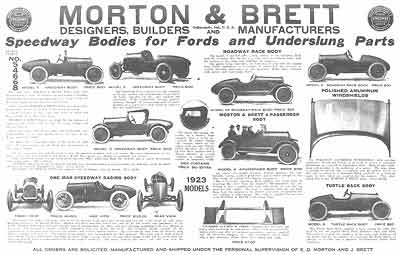
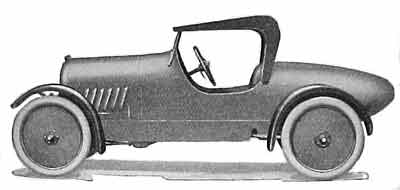
Indianapolis operation. In addition to Speedway bodies, they offered disc
wheel covers, polished aluminum windshields, aluminum steps, cycle fenders,
convertible tops and side curtains, and even complete speedster-based road
and race cars into the late 1920s.
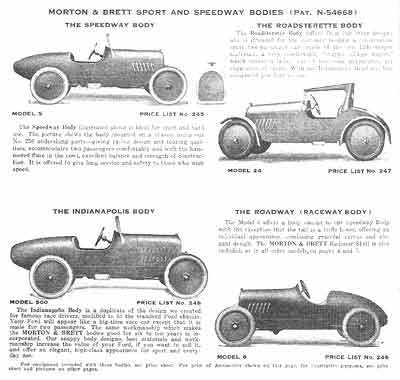
Starting in 1923 Morton & Brett offered an all-new 4-Passenger Speedway
Body (Model 4) and 2-passenger Turtle Back Body (Model 8). Also offered was
an all-new line of speedster bodies which were marketed as Roadway race
bodies, which were given the Model 6 and 6F designation. Morton & Brett’s
new Roadway bodies looked identical to the Race-Way speedster body that was
built by another speedster body manufacturer, the Race-Way Body Company of
Indianapolis, whose factory was located in Muncie, Indiana.
A transcription of a circa 1922 Race-Way advertising flyer follows:
“The Race-Way is an Aristocrat Born in an Auto Body Mansion”
The Race-Way speedster body was very similar to the “Speedway” body
except the tail was lower and more rounded in order to better conform with
the fenders of a stock Model T. Following is the text from a circa 1922
Race-Way flyer:
“Race-Way Body Craft
“The Race-Way is an Aristocrat, born in an Auto Body Mansion where Body
Craft is an Art. Every needed machine, die, jig, or tool is at the instant
command of the workman skilled in their respective use. The Race-Way is the
pride of the artist that designed it and the craftsman that perfected it.
“The Race-Way is a type that must stand severe usage. It is knocked about
and driven hard at all times. Its sporting call to the brawn of the young,
to be put to the test at command, is a temptation irresistible, and its
endurance power must be there.
“The Race-Way materials are selected with the safety of its occupants in
mind - its sills, its frame, and its metals are the best obtainable. It is
constructed to endure.
“In design the Race-Way meets the ideal of its type. One design of
perfection is the aim. It is a studied, tried, tested and balanced design of
grace and rigidity with a genuine appeal-not a lot of haphazard "hope to
please you", "take your choice" mishaps.
“The Race-Way is a design developed from the World's Classic Auto Races,
come to stay, and it is worthy of the finest Body Craftsmanship.
“Briefly told Race-Way Bodies
“ARE MADE OF FINEST QUALITY 20-GAUGE POLISHED BODY STEEL THROUGHOUT
“Radiator Shell fits standard core without use of screen, Brass Water
Extension Filler, Hood Louvered Sides, Flared Cowl, Dash drilled for coil
box and steering post, Spring Cushioned Wide Seat, plenty of leg room.
Seat-back easily pulls forward, giving access to metal floored tail
compartment that holds standard Ford Gas Tank, with additional room for
luggage. Tail made of single piece of metal on each side; wide, heavy Side
Aprons. Primed in Light Brown. Crated. Takes actual weight in shipping, 355
pounds. Price $122.50 complete f.o.b. Muncie, Ind.
“Mounted on new or used Ford Chassis, makes the most practical and best
small Sport Car in the World-Regardless.
“RACE-WAY UNDERSLUNG EQUIPMENT
“Strongest, Safest, Fastest, Easiest to install
“In order to make a racy speedster of your Ford with road safety, class
and speed, it is necessary to lower the frame and body line. All Ford track
race cars of merit are underslung. The Race-Way Underslung parts are
universally recognized to be the simplest, cheapest and easiest to install
of any method. They are rigid and correct in design. No give-n-sway at any
speed. Holds car firmly to road. Drops the frame 7 inches. Gives the car
straight line drive, with road clearance of 50 inches. Lengthens the wheel
base 3 inches. Not necessary to alter drive shaft. Does not interfere with
the steering gear. No machine work necessary to install; parts are
complete-nothing more to buy.
“Race-Way underslung parts are the original parts for lowering the Ford
frame and springs. Each set of parts guaranteed to make the frame suspension
stronger than the original Ford. Price, $12.50 full set, with instructions
for mounting.”
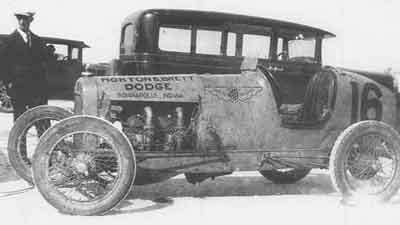
By the late 1920s Morton & Brett were major distributors and
manufacturers of aftermarket Ford and Dodge speed parts which were sold to
the nation’s macadam, board and dirt track racers through regional
distributors and mail order catalogs. In October of 1924 the firm became the
erstwhile managers of the Hoosier Motor Speedway, a dirt track located at
Thirty-Eighth St. and Pendleton Pike, Indianapolis, Indiana.
A search of newspaper classifieds from papers across the country reveals
aftermarket Ford speedster bodies were most popular between 1920 and 1922.
The earliest ads date from early 1918 and by 1923 I noticed a sharp drop-off
in frequency. By 1925 only used bodies were advertised, typically priced
between $20-35, including windshields. I could find no ads for any Ford,
Chevy or Dodge-based speedster or generic speedster body dated 1926 or
afterwards.
Throughout the rest of the decade they built rolling chassis, engines and
complete racecars for many of the grass-roots racers that competed in the
Midwest and with backing from the Grapho Products Co., an Indianapolis-based
(2234 Alvord St.) manufacturer of automobile parts, master pin and bushing
blanks, and graphite-based lubricants, entered and qualified a single car in
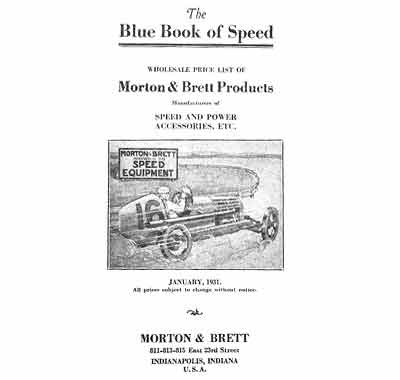
the 1931 Indianapolis 500.
Piloted by veteran Indy driver, John Boling (also ran in 1920), and mechanic
Buddy Boles, the #48 Morton & Brett Special finished a poor 36th after
breaking a connecting rod during the 7th lap of the race collecting only
$270. The also entered cars in the 1930 and 1933 Indy 500s by failed to
qualify. I’ve been unable to locate any Morton & Brett business activity
after 1933 which is not surprising as by that time the Depression had forced
many small auto-parts manufacturers out of business.
Professional Car historian Bernie deWinter IV wrote me the following
account of a Morton & Brett speedster once owned by his father:
“I can send you some photos of a 1922 Model T speedster with a Morton &
Brett body that was built in 1925. I'm familiar with it because my dad owned
it in the early '50's when he was building up his '15 T runabout from parts.
The car was built locally, and my dad actually got to meet the man who built
it, when he was going back to a local car show where it was on display for a
few days.
“At any rate, it hardly looked like a homebrewed conversion, as it even
had some kind of original accessory frame horn extensions at the front,
along with Dayton wire wheels, and a huge chrome exhaust pipe that ran the
full length of the right side and used to get red hot. It would do 70 mph,
and that was with a stock Model T two speed planetary transmission and stock
rear end, with no auxiliary transmission; with a Ricardo head instead of an
overhead valve setup. He owned it at a time before anyone seemed to know
what a speedster was, so it wasn't a valuable car then. He only had $100
invested in purchasing it, and that involved a partial trade of a 1927 T
coupe that he had bought 2 weeks earlier.
“The car was advertised for sale in the local paper's classified ads by a
man who had a little business of buying up Model T's and parting them out,
so that coupe was more valuable to him than the speedster was; seeing as how
the speedster had so few stock parts left on it that would be useful to
anyone else who owned a T. That was the first Model T I had any experiences
in, and I can vaguely remember riding in it. He sold the car in 1954 when he
first got the '15 on the road, and it's floated around since. The last time
anything on it turned up, it was in the form of a small painting in the
front of the 4-91 issue of ROAD & TRACK, and was published as a space
filler, but there was no mistaking the car at all. And people wonder why
I've got a weakness for Model T's...
“Morton & Brett's claim to fame was building bodies for Indy cars in the
'20's, but with that being a limited market, aftermarket bodies for
speedsters was probably their main business. It would be safe to say that
their boattail speedster bodies were probably the best looking bodies of
their type for that purpose, even though there were fancier bodies such as
those offered by Mercury. A Mercury body may have been fancier, but it
didn't have that race car look about it like a Morton & Brett body.
“You'd be surprised at how many different firms there were that offered
aftermarket bodies like that for a Model T. Actually, aftermarket bodies for
Model T's was an industry in itself. Speedsters fall into a gray area, as
far as the antique car hobby is concerned, in that they're seldom ever
anything close to what a "purist" would appreciate, yet they're such a
significant part of history in their own right.
“That gray area is probably where a lot of my sentiments are, as I
appreciate original cars and authentically restored cars, but at the same
time, I've seen too many cars worth appreciating that fell into those gray
areas. The previously mentioned Morton & Brett bodied speedster was one, as
is my dad's '15 T runabout. It was built or restored to the then
contemporary standards of the early '50's; which were far different from
what's taken over in the intervening years. That runabout is finished in '49
Cadillac dark green with dark brown leather upholstery and a light tan top
and boot, with black fenders, running boards, and splash aprons, and more
brass than what was supposed to be on a '15, with the wheels in a natural
wood finish. The car has a look that charms a lot of purists, and it's been
so well known that way that it would be a travesty to ever try to make the
car perfectly authentic now, simply because nobody would ever recognize it
if that was done.
“For that matter, my dad's '28 Model A phaeton fell into a weird
situation when it was first restored, too. The car was originally finished
in a shade of blue that was listed as a Model A taxicab color only at the
time of its restoration, which was between 1959 and ‘61. A lot of purists
had fits over the color on it, and my dad kept a door hinge in the side
curtain compartment under the rear floor to prove the originality of the
color. In '63 or ‘64, someone bought an un-restored '28 phaeton out of an
estate in Columbus, Ohio, and it wasn't two shades off the color on my dad's
'28. By the time of the national Model A meet in Dearborn in the Summer of
'65, there were several other '28 phaetons that turned up there in that same
color. During that time period, it was learned and documented that when huge
batches of paint were mixed wrong, it got used instead of being dumped, and
sometimes it proved so popular that it had to be offered the following year
because of its popularity.”
© 2004 Mark Theobald - Coachbuilt.com with special thanks to Glenn Pullin
& Bernie deWinter IV
|