|
|
|
 |
||||||||||
|
||||||||||
|
|
||||||||||
|
||||||||||
|
||||||||||
|
|
||||||||||
|
|
|||||||||
|
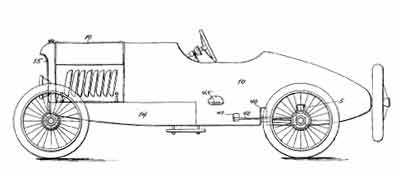
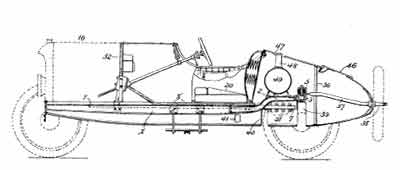
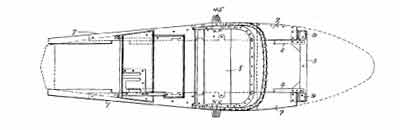
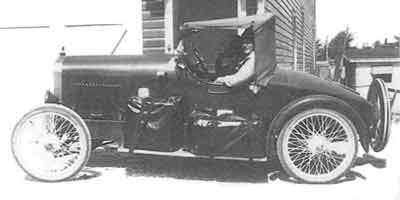
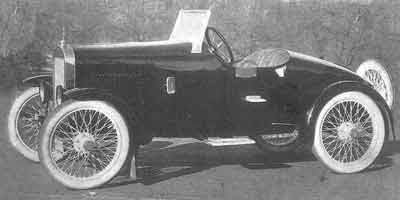
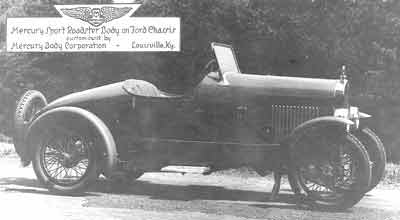
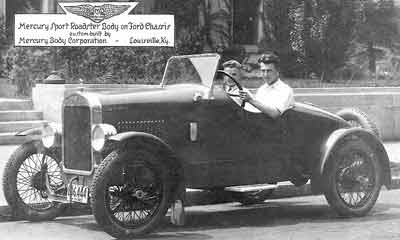
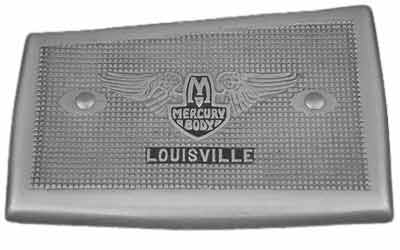
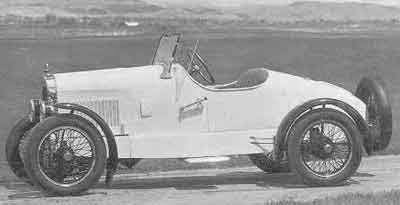
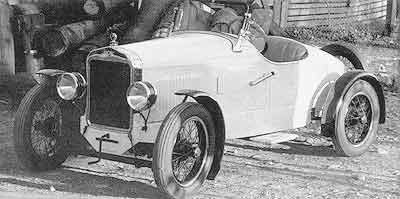
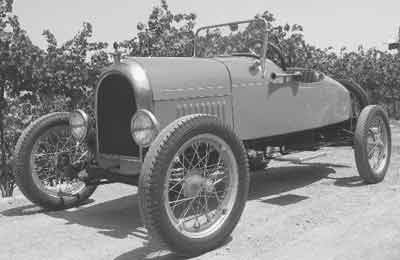
Keeling Gaines Pulliam Jr. and Charles Ellsworth McCormick of Lexington, Kentucky, and Morris Julian Crutcher (Maury Crutcher) of Detroit, Michigan, all graduates of the University of Kentucky at Lexington Mechanical Engineering program and members of the Gamma Iota chapter of the Sigma Nu Fraternity, organized the Mercury Body Corporation in early 1920. In March of 1920, C.E. McCormick submitted a speedster body design to the US patent office. Approved in November of that year, the patent was assigned to the Mercury Body Corporation of Lexington, Kentucky Maury Crutcher served as the firm’s production manager, K.G. Pulliam, head of sales, and McCormick, chief engineer. The partner’s sleek prototype speedster was well received and the firm was capitalized at $250,000 with an announcement that production of five bodies per day would commence on September 1st, 1920 in the firm’s Cincinnati, Ohio manufacturing facility. They also planned on producing a “closed body for winter use”. The press release stated that Cincinnati was selected:
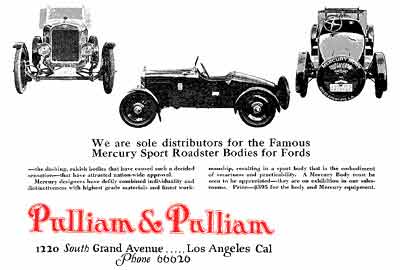
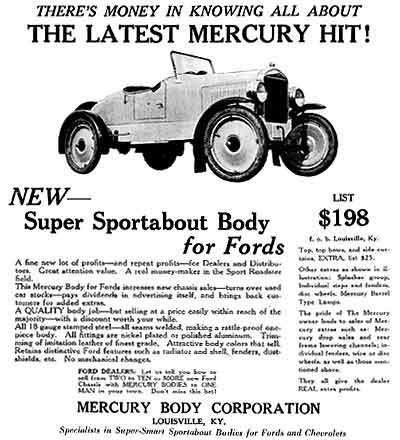
Apparently plans for the Cincinnati plant fell through and in early 1921 a new factory was located in Louisville, Kentucky at 2821 Garfield Ave., just down the street from the Louisville rail yard. The New York Times reported that in October of 1922 Mercury Body Corp. was recapitalized for $1,151,000. Keeling Gaines Pulliam Jr. moved to Los Angeles in 1921 and established a western sales branch at 1220 South Grand Ave., Los Angeles. Organized as Pulliam & Pulliam (the second Pulliam was his father, Keeling Gaines Pulliam Sr.), Motor West announced that the firm was Los Angeles’ latest entry in the growing automotive manufacturing field. Period advertising stated that Pulliam & Pulliam were the manufacturers of the Mercury Sport Body:
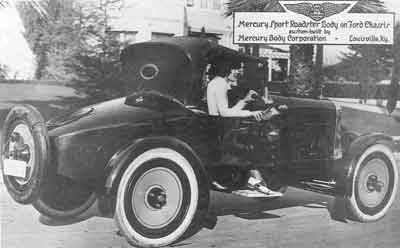
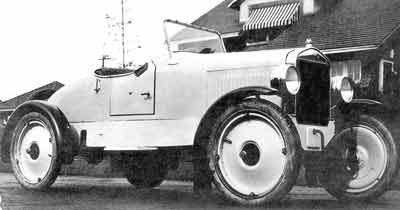
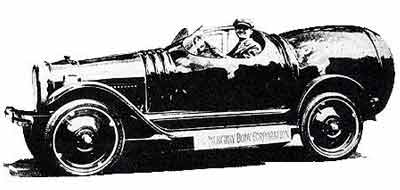
Mercury Body Corp. advertising listed Pulliam as the firm’s Western district manager. In 1923 Pulliam & Pulliam sponsored Frank Gegoux and his Mercury Speedster "Desert Pal", in a record-breaking 7-day trip from Los Angeles to New York. Mercury’s two-passenger speedster body was originally designed for the Ford Model T chassis, but in 1923 they introduced a slightly modified version for use on Chevrolet 490 Superior chassis. Although McCormick’s original design did not include any doors, the firm's Super Sportabout line included a passenger side door in response to customer requests. Also available were cycle fenders, convertible tops, headlamps, windscreens, lowered frame rails, cast aluminum steps and other body-related accessories. Mercury’s products were sold either direct or via regional Ford and Chevrolet dealers in the Untied States and Canada. Over time, the demand for Mercury’s Speedster body declined and the firm turned to producing commercial bodies. A 1925 issue of Operation & Maintenance magazine included a picture of a soda bottle-shaped Nu-Grape soda advertising car with the following description:
After producing an estimated 1600 bodies the firm was sold and reorganized in 1926 as the Jackson Body Company, but soon after withdrew from business. The Jackson Body Company of Louisville, Kentucky was unrelated to the Jackson Body Co. of Jackson, Michigan which was absorbed by the Monroe Body Co. in 1906. Another unrelated Jackson Body Company was organized by Samuel Frank during 1916 to serve as a blacksmith and carriage repair shop. Located in Jackson, Wisconsin at N169W20827 Main St., Frank soon branched out into building wagons, and by the early twenties entered into the manufacture of commercial bodies. Now known as Jackson Truck Body Inc., the 90+ year-old firm continues to manufacture custom-built truck bodies at N168W20640 Main St., Jackson, Wisconsin. © 2004 Mark Theobald - Coachbuilt.com
|
||||||||||
|
||||||||||
|
||||||||||
|
||||||||||
|
||||||||||
|
||||||||||
|
|
||||||||||
|
|
||||||||||
|
|
||||||||||
|
||||||||||
|
|
||||||||||
|
|
||||||||||
|
|
||||||||||
|
© 2004-2012 Coachbuilt.com, Inc.|books|disclaimer|index|privacy |
||||||||||