|
|
|
 |
||||||||||
|
||||||||||
|
|
||||||||||
|
||||||||||
|
||||||||||
|
|
||||||||||
|
|
|||||||||
|
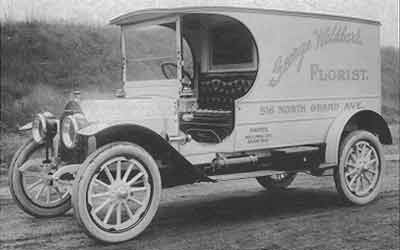
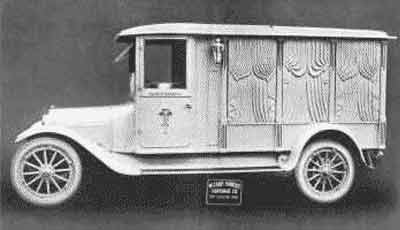
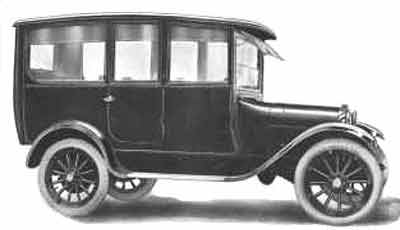
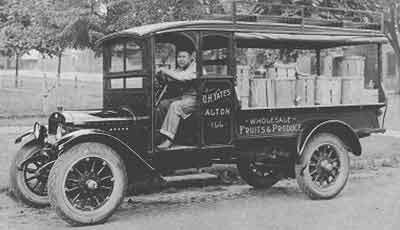
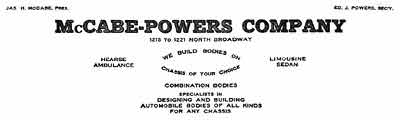
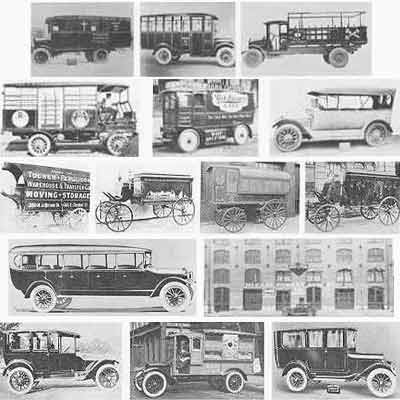
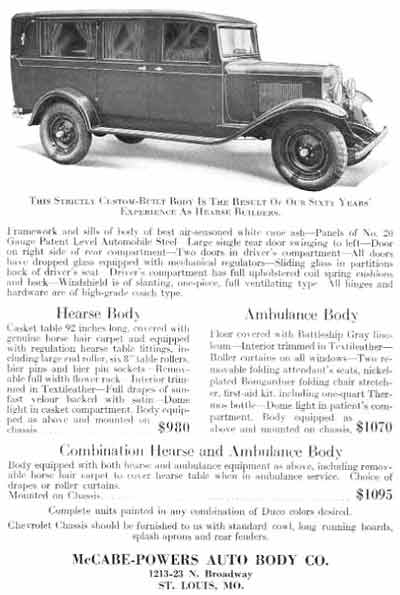
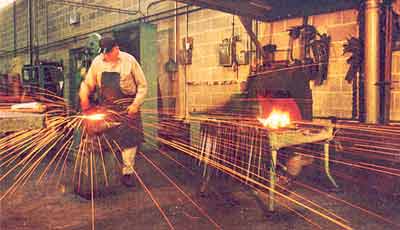
James H. McCabe was born on February 2, 1846 to Thomas and Anne McCabe in Carigallen, County Leitrim, Ireland. The McCabe family emigrated to the United States in 1855, arriving in New York and eventually settling in Providence, Rhode Island. An old-world craftsmen himself, Thomas McCabe apprenticed James to the firm of Moulton and Remington, a Providence carriage builder. Following three years learning the trade, James was loaned out to the famous Boston carriage smiths, Whittier and Bros. before returning home to Moulton and Remington where he completed his apprenticeship and contemplated his future. An opportunity soon presented itself and James traveled to the frontier outpost of Crete, Nebraska where he repaired wagons for settlers traveling on the famed Westerling Trail. Following a year of backbreaking work as well as a visit by some Indian Braves who were looking for sandpaper to sharpen their arrows, McCabe called it quits and traveled east where he found employment with Thomas O’Farrell, an established St. Louis, Missouri carriage builder. O’Farrell soon made him a full partner and the firm of James H. McCabe and Thomas O'Farrell, Carriage Builders undertook the building of wagons, light buggies, and a few fine carriages. The firm prospered, especially after the War’s end, but McCabe became frustrated with the firm’s small size and limited capitalization. In 1871, he sold his share in the firm and began working for the Michael-Young Carriage Company, another St Louis maker who enjoyed the benefits offered by a large factory and capital to match. By 1877 he had saved up enough money to purchase a full partnership in the firm which was renamed the McCabe and Young Carriage Co. McCabe and Young relocated in 1884 to larger facilities at 1122-28 N. Main St. (now N. 1st St.) where they remained until 1893 when McCabe erected a new modern factory 3 blocks west at 1213-21 N. Broadway. Between 1885 and 1901 they established a permanent salon at St Louis’ magnificent Exposition Building, the first building in the country to have a built-in 5000 lamp lighting system operated by its own generator. In 1889 John J. Rich made a substantial investment in the firm, and they adopted a new name, McCabe-Young and Company, as well as the indicia and motto of Rich’s ancestral home, the Isle of Man. The firm survived the panic of ’93 and spent the rest of the decade exploring new vehicle types, producing an entire range of vehicles that included huge overland stage coaches, hearses and invalid coaches and rubber-tired buggies. Promotional wagons were popular and one memorable design was the giant gold-skirted globe built for St Louis’ Globe Shoe and Clothing Company. Enter Edward J. Powers (187?-1937), a recent graduate of St Louis’ Christian Brothers College, who started working for the firm in 1896. The following year, both Mr. Rich and Mr. Young passed away and their shares were purchased by Powers and a new partner named Paul H. Bierman. The firm was renamed the McCabe-Bierman Wagon Company. After selling his father’s shares in the firm, William Young established his own St. Louis carriage works, Wm. Young Carriage Company, at 4524 Delmar Ave., where he produced carriages, wagons and later on automobile bodies. The close of the century saw the McCabe-Bierman Wagon Company well established as St Louis’ leading carriage maker. Many of the firm’s specialty products were advertised in the leading trade magazines of the day. For instance, a 1900 issue of Ice and Refrigeration included a large McCabe-Bierman display ad which pictured the firm’s ice wagons, brewery wagons and delivery and transfer trucks. At the large Broadway plant, steam powered milling equipment cut dimensional lumber into pieces that were then assembled into the vehicle bodies. The McCabe-Bierman blacksmith shop produced many of the metal components used in the manufacture of buggies and specialized delivery vehicles. James H. McCabe was one of the two hundred organizers of the 1904 World's Fair, which was held in St. Louis. The firm’s Palace of Transportation exhibit earned them a silver medal and a wagonette shown at the Fair and restored by the firm in 1969 is on display at the St. Louis History Museum. Bierman retired from the firm in 1906 and sold his stock to Edward J. Powers resulting in the firm’s reorganization as the McCabe-Powers Carriage Company. Although a handful of self-powered char-a-banc (bus) and truck chassis were bodied in the first decade of the 20th century, it wasn’t until 1910 that the firm’s automotive coachwork came to the forefront. Most of their early work was on locally-produced chassis such as Dorris, Gardner and Moon. They offered custom coachwork for local distributors as well, some attractive vehicles were built on Victor, Chalmers and Stanley chassis. Truck and station buses were built for local businesses on heavy-duty Autocar, Mack and Traffic chassis. Motor hearses and invalid coaches became an early specialty and the firm produced a number of attractive coaches on REO, Dorris and other mid-priced chassis. A handsome gray eight-column McCabe-Powers carved-panel hearse on a 1915 REO chassis still exists and is owned by Ronald Heatley of the Professional Car Society. Following the 1914 launch of Ford’s St Louis assembly plant, a corresponding line of McCabe-Powers commercial bodies were developed. Similar bodies were later made available for the Graham/Dodge Bros. chassis, and McCabe-Powers was soon offering commercial body brochures for both chassis. For 1916 McCabe-Powers offered a comprehensive line of professional vehicles ranging from simple casket wagons to elaborate carved-panel hearses. The sturdy yet inexpensive Dodge Brothers chassis was becoming popular with builders who formally used Ford Model T's and McCabe-Powers bodies were placed on 35hp Dodge chassis starting this year. Starting in the late 1800s, the firm was successful at marketing bodies to specific niche markets, and the practice continued into the 1920s. Specially-designed delivery vehicles were supplied to bakeries, newspaper publishers, florists, beer distributors, dairies and green grocers. By 1920, the firm had been providing specialty vehicles to undertakers and hospitals for close to 50 years. They began to favor the sturdy and dependable Dodge Bros. business car chassis and offered ambulances and hearses in a choice of styles. The 100 series was a purpose-built, single use body style available as a traditional carved panel hearse or leaded-glass ambulance or invalid coach. The dual-purpose 200 series offered limousine styling and removable second- and third-row rear seats and could be used as a seven-passenger sedan/pall bearer coach or a hearse or ambulance. For 1922 McCabe-Powers offered their traditional carved-panel coach as well as a number of limousine-style combination coaches and ambulances. An ambulance pictured in their 1922 catalog was painted in contrasting black & white and featured frosted leaded-glass rear windows, wide white-wall tires and a cord-operated emergency warning bell mounted on the radiator. For 1923 McCabe-Powers introduced an arched-top ambulance with a corresponding arched rear window and matching attendant's door which were fitted with very attractive leaded glass. James H. McCabe, the firm’s founder, retired in 1923 and his partner, Edward J. Powers, purchased all of his stock, gaining complete control of the company. Following his retirement, he remained in St Louis and remained active in civic affairs right up until his death on June 4, 1928. Edward J. Powers brought his two sons into the firm at the start of the Depression, and they learned the held various positions in the firm’s manufacturing, marketing, and administration departments. John J. Powers’ expertise lay in sales and marketing while Edward J. Powers Jr. became competent in the management of the factory. Sales of the firm’s line of professional vehicles and delivery vans remained strong through the beginning of the Depression and they were amongst the first commercial body firms to introduce a welded, all-steel body and were also pioneers in the use of aluminum. A 1930 issue of the Commercial Car Journal pictured a 15-unit fleet of aluminum-bodied delivery vans that the firm had made for the Colonial Bakery Co.:
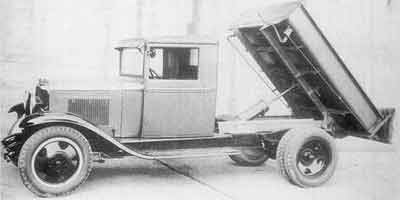
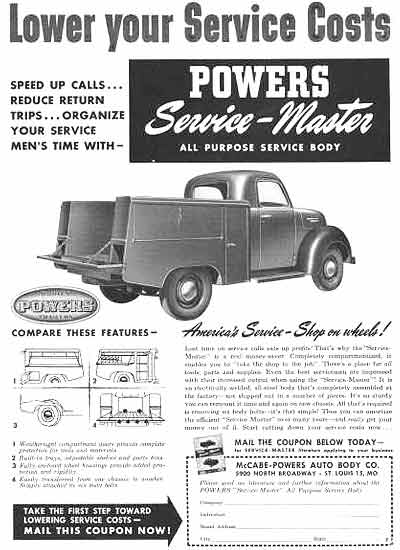
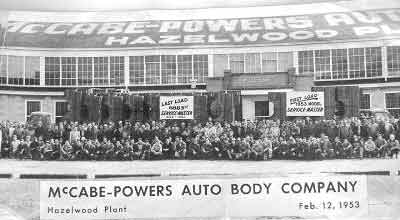
Fleets were made for regional business on Chevrolet, Ford, and REO chassis. The Depression began to take its toll on their competition, but the Powers family’s management skill kept the firm going and 1933’s repeal of Prohibition brought a renewed interest in the firm’s beer delivery bodies. The following year they delivered their first line construction body and in early 1935 they manufactured their first general service body. The new bodies were well-received and in 1936 a fleet of 20 service bodies was ordered by a regional power & light company. A year later they manufactured their first hydraulic dump body. In 1937 McCabe-Powers held an exhibition of their various product lines at the St Louis Coliseum which created a great deal of national interest for the company’s new utility bodies. A month after the coliseum show, Edward J. Powers, Sr., died. His widow became president of the firm although day-to-day control of the company rested with his two sons, John J. Powers and Edward J. Powers, Jr. The last hearse ever made by McCabe-Powers was used to transport the body of Edward J. Powers Sr. to its final resting place. Following the death of Edward J. Powers Sr., the firm focused on the production of specialized installation and maintenance utility bodies for electric, power, gas, telephone, and water companies as well as stand-up route delivery bodies for dairies, bakeries, breweries, department stores and newspaper publishers. The 1938 Chevrolet Silver Book contains an ad for McCabe-Powers stand-up delivery bodies. In 1940 a new modern plant was erected at 5900 N. Broadway, which gave the firm a total of 4 plants in metropolitan St Louis.; the new one at 5900 N. Broadway; the existing factory at 1213-21 N. Broadway, James H. McCabe’s original site at 1317 N. 9th St. and an adjacent storage facility located on N. 8th St. Although they’re no longer standing, the firm’s original downtown St. Louis plants were located along Biddle St., just two blocks north of the Edward Jones Dome which is about 1/2 mile north of the Jefferson National Expansion Memorial/Gateway Arch. The 5900 N. Broadway plant was located 6 miles to the north of the Arch, just east of I-70, Exit 246A. During World War II, McCabe-Powers manufactured specialty truck bodies and trailers for the Army Quartermaster Corps. Mobile photo labs, machine shops and shoe repair trailers were just some of the items that helped earn the firm an Army-Navy “E” Award on February 2, 1944. The “E” award was the Army-Navy Award for Excellence in War Production and was normally awarded when a firm completed a large order for the US War effort or filled an order in a short period of time. At the ceremony, the employees would be given an enameled pin mounted on a card certifying their contribution to the war effort with a message from the president. The employer would be presented with an “E’ flag and banner and outstanding employees would be presented with a special certificate. When peacetime production commenced in August of 1945, the firm focused almost exclusively on their public utility truck bodies although step vans and dry and insulated truck bodies continued to be produced into the 1960s. By 1948 the firm had outgrown their 8-year-old Broadway plant, so a new facility was constructed in Hazelwood, Missouri, a northwest suburb of St. Louis located near St. Charles. When it came online, the firm introduced their all-new Powers-branded Service-Master line of bodies which were designed to fit the needs of service contractors, carpenters, electricians and plumbers who needed secure compartmentalized storage on the jobsite. The 1950 issue of Bus Transportation magazine, an industry journal, announced that:
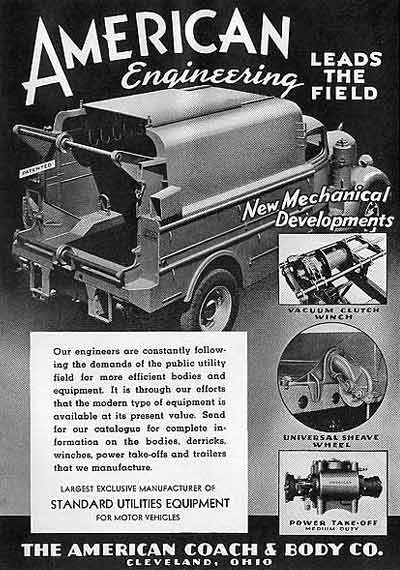
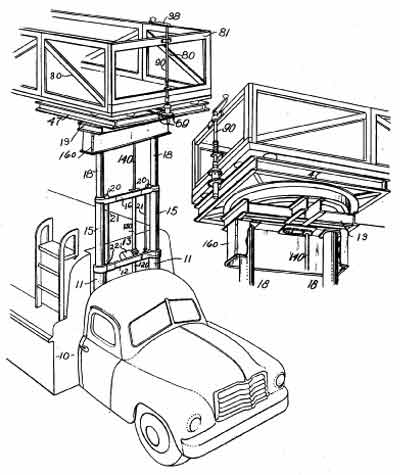
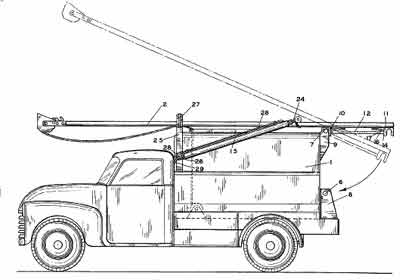
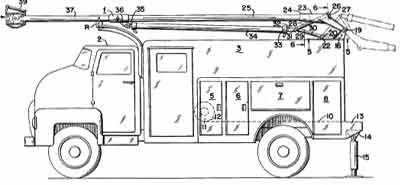
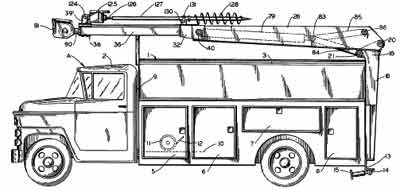
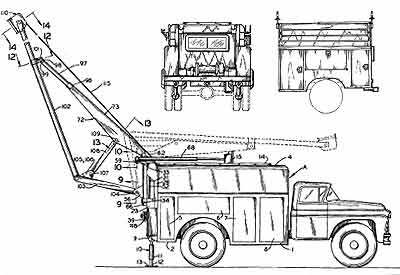
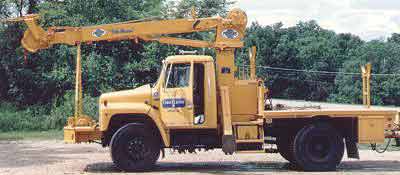
With the acquisition of American, the Powers Public Utility Division of McCabe-Powers became known as the "Powers-American" division of the firm. Other purchases included the Halline Equipment Company of Portland, Oregon and the American Equipment and Body Company of Los Angeles, California. All body manufacturing was consolidated at McCabe-Powers St. Louis facilities although the Halline Equipment Co. continued to operate under its own name. The Portland firm manufactured electric and hydraulically powered ladders and telescopic booms and buckets and was instrumental in the continued growth of McCabe-Powers during the following decade. Edward J Powers Sr.’s widow had been McCabe-Powers’ president and chairman since his death in 1937. When she passed away in 1951, Edward J. Powers, Jr. became president and John J. Powers became chairman of the board. The two brothers continued product expansion in the utility field providing transit maintenance, line construction and public utility bodies equipped with revolving fully hydraulic aerial ladders and hydraulic towers for public utilities. In 1953 a new Powers-American service depot in Oakland, California was selected to manufacture the firm’s new line of Pole Master hydraulic derricks which were marketed to the state’s numerous public utilities. The Oakland plant was initially located at 403 Derby Ave. but soon relocated to large quarters at 1401 Middle Harbor Rd. By 1959 the firm’s production schedule exceeded the capabilities of that facility and it moved once again to even larger quarters at 625 Cedar St., Berkeley. By that time the firm marketed their bodies in two distinct lines, the Powers-American line of utility contractor bodies and the Powers Service-Master line of all-purpose service bodies. The firm’s hydraulic derricks, pole trucks and augers were sold under the Powers-American brand. An ad in the 1953 Chevrolet Silver book read as follows: “The service-master body is backed by more than seventy-five years of body-building experience. Every inch of body space is utilized to best advantage... to set a new standard in service body efficiency and appearance. Available in 3 lengths, 74 ½", 84 ½" and 102" - all 48 ½" wide inside and 42" tall.” Standard bodies were available with sliding or high steel roofs and could be order with side boxes, ladder racks, meter trays and pipe carriers for ½-, ¾- or 1-ton chassis. Larger custom-built bodies were also available on special order as were the firm’s custom-built crew-cabs. The Powers-American division manufactured the world's most complete line of utility construction bodies which could be equipped with Pole-Master derricks, Sky-Master aerial booms, Earth-Master Augers, or Halline hydraulic/electric ladders, towers and buckets. The Pole-Master derrick rotated a full 360° and could precisely position and hold 70 foot 10,000 lb. utility poles on up to a 15% grade. The cavernous service body could accommodate large transformers and cable reels of up to 32’ in diameter. The Powers-American service body offered customers a low center of gravity and when equipped with heavy-duty hydraulic outriggers certain models of the Sky-Master boom could lift as much as 10 tons. The basic model had a lifting capacity of 8,000 lbs. with an overall reach of either 55 or 70 feet. Although it was available in a stand-alone version, the Earth-Master auger was typically paired with a either a Sky-Master boom or Ole-Master derrick and was capable of digging straight, clean holes 10½ feet deep and 30 inches in diameter. When Edward J. Powers, Jr., died in March of 1958, his brother, John J. Powers, assumed the firm's presidency. The extent of McCabe-Powers' involvement in the production of equipment for major utility firms was dramatized in 1963 when their body serial numbers reached the 100,000 mark. The Sky-Master, Pole-Master, and Earth-Master utility bodies, all introduced in the 1950s remained the firm’s core products into the 1980s. By that time, McCabe-Powers’ two metropolitan St Louis plants were no longer capable of keeping up with the firm’s expanding marketplace so their board of directors authorized the purchase of a 45-acre site in northwest St. Louis County near the firm’s existing Hazelwood facility. Construction of the 277,000 sq. ft. 8900 Frost Avenue plant in Berkeley, Missouri was completed in 1964, consolidating the firm’s former St Louis and Hazelwood operations. John J. Powers died later that year and for the first time in the company’s long history a person unrelated to the firm’s founders took the helm. A longtime McCabe-Powers manager named Robert J. Sonderman was elected chairman and the firm’s general manager, R. Brooke Daly was elected President. Following Sonderman’s retirement in 1969, Daly took over as chairman. A third generation member of the Powers family, Edward J. Powers, III was elected president and general manager of the firm in May of 1973. He succeeded R. Brooke Daly, who continued on as chairman. George E. Walsh and Carl "Corky" Kinyon were promoted to executive vice presidents from vice presidents. Ten years later, the board of directors elected to sell the firm's assets, which included 46 US patents, to American Fleet Services, Inc., a national truck maintenance organization. Today the former McCabe-Powers plant in Berkeley is the home of the Tactical Aircraft and Missiles Systems division of McDonnell Douglas/Boeing. Edward J. Powers III passed away on March 25, 1995. Today his son, Christopher GM Powers, runs a website dedicated to the history of the firm. © 2004 Mark Theobald - Coachbuilt.com with special thanks to Thomas A. McPherson
|
||||||||||
|
||||||||||
|
||||||||||
|
||||||||||
|
||||||||||
|
|
||||||||||
|
|
||||||||||
|
|
||||||||||
|
||||||||||
|
|
||||||||||
|
|
||||||||||
|
|
||||||||||
|
© 2004-2012 Coachbuilt.com, Inc.|books|disclaimer|index|privacy |
||||||||||