| |
|
 |
||||||||||
|
||||||||||
| |
||||||||||
|
||||||||||
|
||||||||||
|
|
|||||||||
|
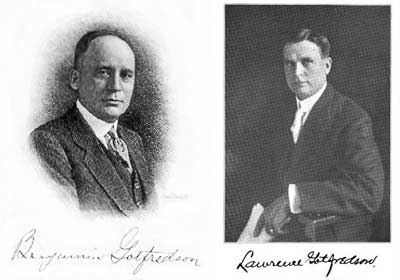
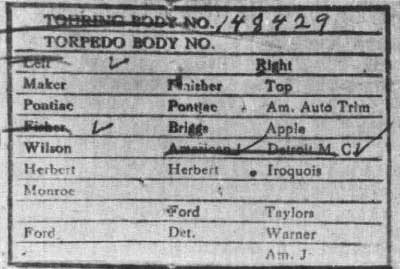
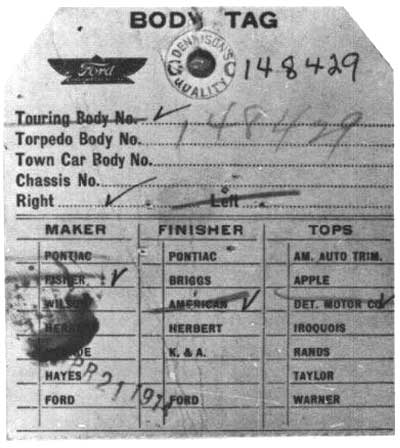
FYI: During the teens and twenties there were at least two (and likely many more) firms unrelated to our subject that used the 'American Auto Trimming Co.' moniker; one in Indianapolis, Indiana at 640 East Ohio St., another in Phoenix, Arizona at 1517 North Fifth Street. Primarily known today as the founder of a Detroit, Mich./Walkerville, Ont.-based truck manufacturer that bore his surname, Benjamin Gotfredson (b. Feb. 14, 1863 d. Jan. 23, 1938) also served as president of the Saxon Motor Car Co. and owned a handful of businesses that were all involved in the manufacture of automobiles. In addition to producing buses, taxis, trucks and trailers, Gotfredson-owned firms trimmed and painted bodies for Saxon, Studebaker and Ford, manufactured coachwork for Wills St. Claire, Jewett (Paige –Detroit) and Peerless, and distributed Cummins Diesel engines. The Gotfredson-owned American Auto Trimming Co. had plants throughout the United States and Canada located adjacent to Ford Motor Co. assembly plants, and is also known to have trimmed and painted bodies for Saxon and Studebaker. George Walter Mason (b.1891-d.1954) the founding president of American Motors Corp., served as American Auto Trimming's purchasing agent during the teens. American Auto Trimming trimmed and painted the majority of Ford Model T bodies produced by third-party coachbuilders (Fisher, O.J. Beaudette, C.R. Wilson, etc.) during the teens and early twenties. Included to the right is an image of a 1914 Model T body tag, with checkboxes indicating who made it and who trimmed it. Other firms known to have trimmed Model T bodies include Briggs Mfg. and Kelsey Auto Body (a division of Kelsey Wheel). A related enterprise, the Gotfredson Body Co. / Wayne Body Co. of Wayne, Michigan produced coachwork for Paige-Detroit (Jewett), Wills St. Claire, and Peerless, and was the first employer of automotive designer Gordon Buehrig. Although they were no longer under Gotfredson's ownership, his former Canadian holdings survived into the 1950s and are known to have manufactured truck chassis as well as automobile and truck bodies for Studebaker, Erskine, and Ford. Although Benjamin Gotfredson held the reins of his automotive empire, he was assisted by numerous individuals, which include his brother Lawrence Gotfredson (b.Sep. 15, 1861-d.Feb. 13, 1943), his son Robert Benjamin Gotfredson, his father-in-law, Jacob Kolb, and 2 longtime business partners, Frank Henderson Joyce and Mark H. Coleman. Brothers Lawrence and Benjamin Gotfredson were born in New Denmark Township, Brown County, Wisconsin - Lawrence on September 15, 1861; Benjamin on February 14, 1863* - Niles Hilbert (b. Mar. 2, 1814 d. Feb. 22, 1894)and Laurentine (Hjorth) Gotfredson (b. Mar. 8, 1824 d. Apr. 12, 1898). Originally from Langeland, Denmark, their parents emigrated to North America in 1848, and after a brief stay in Milwaukee, Wisconsin became the pioneer settlers of New Denmark Township, which was located 15 miles southeast of Green Bay. (*Although the month and date of Gotfredson's birth remained consistent, his exact year of birth is open to conjecture. During his lifetime various census and news items list his year of birth as 1863, 1864, 1868, 1869, and 1870; his grave marker states 1863 so that's what I'm using.) Niles Gotfredson spent his summers farming, and his winters harvesting timber, assisted in both activities by Lawrence and Benjamin, who attended the New Denmark rural school when in session. Lawrence spent two winters in Green Bay, attending the Green Bay Business College, after which he returned to the family's farm, engaging in the sales of farm implements on a small scale with his younger brother Benjamin. The pair engaged in business under the style of Gotfredson Brothers, opening a hardware and implement store in Cooperstown, Wisconsin during 1878 which was followed by a satellite in Seymour, two year later. Buggies were added to the mix of agricultural implements and hardware and in the spring of 1888 they opened up a Green Bay branch in a 42' x 60' two-story wooden storefront located at 1155 Main St. Their listing in the Patron's Directory of Foote & Brown's Plat book of Brown County, Wisconsin, pub. 1889, follows:
Each year brought increased trade to the firm and the market for their goods grew constantly. In 1896 the brothers erected a new Green Bay wareroom on Washington Street which was replaced in 1900 by a massive one-story 48' x 198' wooden facility. In the meantime they also established a wholesale division for which they erected a spacious 60' x 175' warehouse adjacent to the Fox River alongside the Green Bay & Western (formerly Green Bay, Winona & St. Paul) Railway. Gotfredson Brothers' wholesale operations were eventually sold off to the Wisconsin Hardware Company, as reported in the September 15, 1904 issue of Iron Age:
Shortly thereafter the name was changed to the Morley-Murphy Hardware Company as indicated in the November 3, 1904 issue of Iron Age:
The Gotfredson brothers retained all of their Wisconsin retail operations which for many years involved the buying and selling horses, Benjamin having charge of the retail department of the store and the horse business. In the course of the latter enterprise he became enamored with the daughter of a Detroit, Michigan stable and livery operator named Jacob Kolb, marrying her in 1904 and becoming a partner in his new father-in-law's livery and stables (Kolb-Gotfredson Horse Co.) a few months later. During that same year (1905) the Gotfredsons constructed a 5,390 sq. ft. brick flagship hardware store in downtown Green Bay that included all of the latest conveniences; elevators, central heating, electric lights and telephone. Benjamin's marriage to Mary Clara Kolb, who was 20 years his junior, was not his first. His first wife was Augusta Emilia (aka Amelia) Graner (b. Jan 27, 1871 in Green Bay, Wisconsin), daughter of Robert, (b. May 1835 in Germany- d. 1880) and Johanna Ernestine (Jachmann) (b. Apr 1843 (or 1848) in Germany—d.1885) - Robert Graner being a well-known Green Bay livestock dealer and former butcher. Benjamin and Amelia's union was blessed with the birth of a son, Robert Benjamin Gotfredson (b. Sep. 6, 1896-d. Mar. 1, 1966), who was born on Sep. 6, 1896 in Green Bay, Brown County Wisconsin. Gotfredson separated from and divorced his first wife sometime prior to his June 20, 1904 marriage to Mary Clara Kolb (b. Feb. 17, 1883 in Michigan - d. Jul. 25, 1964 in Los Angeles, CA) the daughter of his future business partner Jacob and Mary (Lawrence) Kolb. The marriage yielded no children, the 1917 Detroit Directory lists them living at 306 West Grand boulevard; their 1922 lists them at Garden Court Apts., 2906 Jefferson Ave. E. Phone #Edgewood 773. Benjamin's brother Lawrence (b. 1861) married Florence "Flora" Rahr, daughter of Henry Rahr, proprietor of the Rahr Green Bay Brewing Co., on October 24, 1893. To the blessed union was born two sons, Henry and Roy Gotfredson. Flora divorced Lawrence Gotfredon in 1903 after her husband was caught in a hotel room with his 'typewriter' (the live type, not the machine). Lawrence Gotfredson remarried on June 14th 1910, to Miss Beulah Witherell (b. Apr. 2, 1889 d. Jun. 11, 1960), a daughter of two pioneer Green Bay settlers, Mr. and Mrs. W.J. Witherell. To the blessed union were born two children, Phyllis I. (b. 1913) and Lawrence B. (b. 1917) Gotfredson. Lawrence and his family remained in Green Bay for the rest of their lives although Benjamin relocated to Detroit after his marriage to Clara Kolb. At the beginning of 1909 the Gotfredsons announced that they were getting branching out into retail automobile sales as reported in the January 1, 1909 issue of the Cycle & Automobile Trade Journal:
The April 1, 1909 issue of Motor Age confirmed January's announcement:
Their automobile sales experiment was short-lived as the October 20, 1909 issue of Horseless Age reported that the Gotfredsons' had sold their retail automobile operations to Zimmer & Malchow:
Shortly thereafter they sold off their retail hardware business to two employees. Green Bay native John B. DuBois (b.1869-d.1936) joined the Gotfredson hardware operation in 1901, as a partner in the Green Bay Implement Co. another Gotfredson owned firm. When the Brothers retired from the retail hardware business they sold it to DuBois and another employee, Amie (Amos) Haevers (b.1875-d.1936), as recorded in the May 1910 edition of Engineering Review reporting:
In 1924 DuBois reorganized the firm as the DuBois-Massey Company although the Gotfredson Real Estate company continued to own the property until their deaths with Lawrence serving as vice president of the Bank of Green Bay. The virtually simultaneous sales of the Gotfredsons' Green Bay businesses coincided with the creation of the American Automobile Trimming Co. in Detroit, which was formed by the Gotfredson Brothers and a group of investors all associated with the Kolb-Gotfredson Horse Co., which was a reorganization of a cattle-trading firm founded by Jacob Kolb (II)'s father sometime after 1855. The younger Kolb (II)was born in Detroit, Wayne County, Michigan on February 8, 1859, to Jacob and Isabella (Mitchell) Kolb. His father Jacob Kolb (I) (b. Oct. 28, 1829 d. Apr. 25, 1905) having emigrated to the United States in 1855 from his native Hessen-Darmstadt, Germany, his mother from Edinborough, Scotland. Soon after his arrival he came to Detroit, where he engaged in the buying and shipping of cattle, with operations extending into a large portion of Michigan and Ontario, Canada. In the early 1870s he became active in the huckster and livery business, and in 1878 established the Gratiot Ave. horse market at 471 Gratiot Ave. His youngest son, George W. Kolb (b. Feb. 9, 1871), joined the family business in the mid-1880s, and George's May 15, 1894 marriage to Emma Lutz coincided with his father's retirement and his appointment as president. Jacob passed away on April 25, 1905. George's entry in R.L. Polks' 1907 Detroit Business Directory follows:
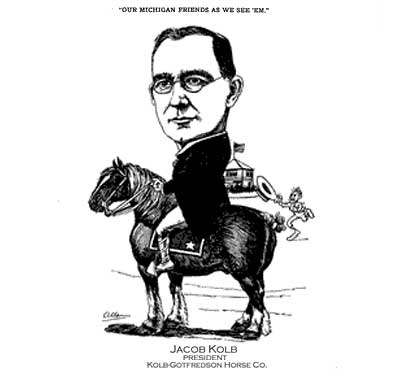
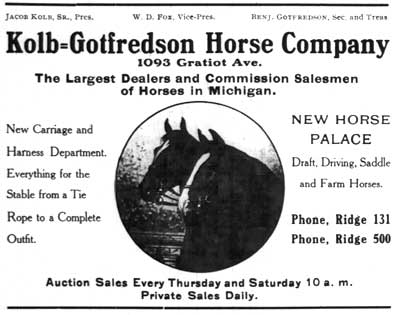
George and Jacob had a sister, Catherine (b. 1869) who married William S. Brandon in 1890. After a public education in the Detroit public schools, Jacob's namesake and eldest son, Jacob Kolb, Jr. (b.Feb. 8, 1859) went to work for a well-known Detroit horse dealer named Joseph H. Bushor, with whom he formed a partnership in the same line. He subsequently bought out his partner, and for a short time was associated with George Cox, as Kolb & Cox, after which he established the Kolb Horse Co. at 1113 Gratiot av., Detroit. On January 11, 1881, its proprietor, Jacob Kolb (II), was united in marriage to Mary Lorent, the daughter of Nicholas Lorent, of Detroit, and to the blessed union was born three children; Jacob A. (aka Jacob Kolb jr. or Jacob Kolb III - b. Nov. 26, 1881-d. Jul. 11, 1907) Mary Clara (b. Feb. 17, 1883-d. Jul. 25, 1964), and Matilda Catherine (b. Nov. 9, 1884-d. Nov. 18, 1971 – m. William J. Karp) Kolb. Jacob A. Kolb was a graduate of Assumption College, at Sandwich, Ontario, and was associated with his father in business at the time of his death. In August of 1905, Jacob Kolb's son-in-law, Benjamin Gotfredson, made a sizeable investment in Kolb's Detroit operations, prompting its reorganization as the Kolb, Gotfredson Horse Co., which was capitalized at $60,000. In January of 1908, the business was incorporated with an increase in capital stock to $150,000 and the following officers: Jacob Kolb, Sr. (Jacob Kolb II), president; William D. Fox, vice-president; and Benjamin Gotfredson, secretary and treasurer. A period description of the Kolb-Gotfredson Horse Co. included in Albert Nelson Marquis's Book of Detroiters, (pub. 1914) follows:
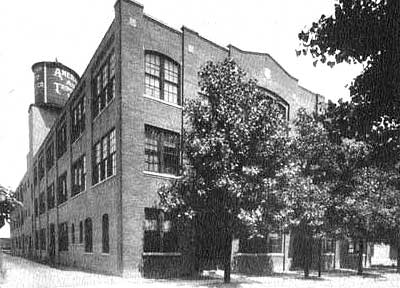
An existing color postcard provides a detailed scene of 'Auction Day at the Kolb-Gotfredson Horse Co., Detroit, Michigan. Carriages, Buggies and Wagons. Auction Sales Thursdays & Saturdays.' The pair were also involved in real estate and in late 1914 formed a realty company with Edward Bushor. Capitalized at $25,000 the Kolb-Gotfredson Realty Co. was formally organized on December 26, 1914. As owners of a Maxwell automobile distributorship the Gotfredson brothers realized the days of the horse and carriage were numbered. In the course of business Benjamin Gotfredson had become acquainted with Frank H. Joyce (b. 1872 – d.1956), a well-known distributor and manufacturer of Saddlery and Harness Goods located at 128-132 Jefferson Ave., Detroit. Joyce was like-minded and together with Mark H. Coleman, cashier of the Kolb-Gotfredson Horse Co., the three men embarked upon a new business venture. Joyce was well-connected within Detroit's fledgling automobile industry and saw an opportunity in providing local manufacturers with automobile body trimming and finishing services. A vacant manufacturing facility at 742 Meldrum Ave., Detroit, was located, employees hired, and contracts procured amongst his contacts. The three men formed the American Auto Trimming Company in November of 1909, with Benjamin Gotfredson as president, Frank H. Joyce as vice president and Mark H. Coleman (b. Mar. 24, 1883-d.Aug. 10, 1953) as secretary. Frank Henderson Joyce was born in Windsor, Essex County, Ontario, Canada in May of 1872 to Alfred W. (b.1847) and Cynthia A. (b.1848) Joyce. The 1881 Canadian Census indicates Frank's father was a cabinetmaker and also lists two siblings, Frederic W. (b.1870) and William M. (b.1875) Joyce. After a public education in the Windsor schools he joined the firm of Armstrong & Graham, 128-132 Jefferson Ave., Detroit, a leading harness manufacturer founded in 1880 by Edwin E. and Henry I. Armstrong and Burke M. Graham, rising to the position of sales manager. Soon after his 18th birthday he went into business for himself at 441 Michigan Ave. The 1893 edition of Knight, Leonard & Co.'s 'Detroit of Today, the City of the Strait' describing his business operations in great detail:
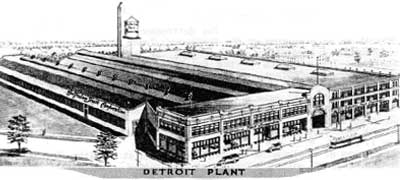
Joyce married Calla Noble (b.Sep. 1873 in Colorado) in 1895 and to the blessed union was born five sons: Nobel (b. Jul. 1897), Frank H., Jr. (b.1898), William N. (b. Jan. 1899), Philip A. and Herbert. Both William N. and Frank H. jr. served with the British Royal Air Force during the First World War. In 1922, Joyce partnered with Hugh Chalmers of Chalmers Motor Cars to form the Joyce Manufacturing Company in Detroit. He headed this firm while retaining an interest in the Windsor branch of Gotfredson Ltd. Today Joyce is well-known in Windsor as the original owner of a brick and half-timbered Tudor Revival style house located at 3975 Riverside Dr. East in Windsor, Ontario, Canada. The English beam and stucco structure is set on a massive lot fronting Riverside Dr. and the Detroit River and was constructed for Joyce in 1926 by George Masson of the firm of Sheppard and Masson and is currently the home of the Academie Ste. Cecile International School. American Auto Trimming's third incorporator, Mark H. Coleman, was placed in charge of the finances and accounting. Mark Hiram Coleman was born in Barry County, Michigan on March 24, 1883 to Frank E. and Augusta (Moon) Coleman. After a public education in the Battle Creek schools he attended the Battle Creek Business and Kalamazoo Colleges, entering into business as a cashier with the Schneider Tent & Awning Co. of Detroit. In 1909 he took a similar position with the Kolb-Gotfredson Horse Co. and later that year helped organize the American Auto Trimming Co. On October, 4, 1904 he married Olive M. Riley, of Battle Creek, and to the blessed union was born two children, Reed Mark and Genevieve R. Coleman. Lawrence Gotfredson became connected with American Auto Trimming shortly after the firm's organization, prompting a 1910 reorganization with Lawrence replacing Frank H. Joyce as vice-president, and Joyce assuming Coleman's former duties as Secretary-Treasurer. Although personally unfamiliar with the automobile body and trimming business, the Gotfredsons hired experienced men to oversee American Auto Trimming's operations. B. M. Diver, a former body engineer and designer with the New Haven Carriage Co., Sievers & Erdman, the Columbus Buggy Co. and Woods Motor Vehicle Co., served as superintendent of its Meldrum Ave. facility. The firm's first customers included Ford and Studebaker and Michigan factory inspections between 1909 and 1912 reveal the size of its operations in its early days. Four different facilities were listed in the report, one for auto body finishing, one for auto top manufacturing, and two for auto trimming. What follows is the contents of reports included in 'Annual Report #31, State of Michigan Dept. of Labor', which was published in 1914:
The 1916 edition of the same publication 'Annual Report #33 State of Michigan Dept of Labor, pub. 1916' provides additional data, although plant numbers are not included:
The Oct 31, 1912 issue of American Machinist announced an addition to the firm's Meldrum Ave factory:
The November 9, 1912 issue of Construction News was more specific, stating that the $8,000 contract was for the construction of an office building:
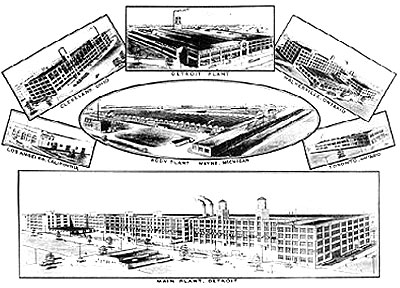
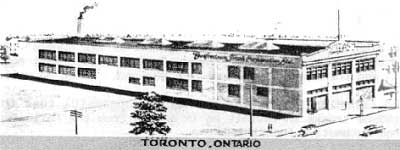
American Auto Trimming's operations were not limited to Detroit, and by 1911 a Gotfredson-owned Canadian subsidiary, American Auto Trimming Company Ltd., was painting and trimming bodies for the Ford Motor Co. of Canada's assembly plants in Walkerville, and Toronto, Ontario. Located in the former factory of the Ontario Basket Co., the firm's Walkerville plant was enlarged into surrounding property as demand for the Model T increased. Walkerville was named after Hiram Walker (1816-1899), the celebrated Canadian distiller of Walker Club whiskey which was renamed Canadian Club in 1880. Starting in 1856 Walker built homes and factories for his employees and suppliers adjacent to the Walker factory, incorporating it as Walkerville in 1890 to avoid annexation with Windsor. Not only did Walker own all of the land and homes within the city's boundaries, he held controlling interests in most of its business as well, most of which shared his surname, Ontario Basket Co. being an exception. In 1904 Gordon MacGregor, then proprietor of the Walkerville Wagon Works, acquired a license to build Fords in Canada, creating the Ford Motor Co. of Canada in which its American partner held 51% interest. The rapid success of the Model T quickly outstripped the Walkerville factory's capacity which was expanded in 1911 and again in 1913. Ford's Detroit suppliers were encouraged to set up satellites on the Canadian side of the Detroit River, with American Auto Trimming being one of the first. During American Auto Trimming's early days the eventual president of Nash-Kelvinator, George W. Mason, worked for the firm as a purchasing agent, the September 17, 1922 issue of the Oakland Tribune reporting:
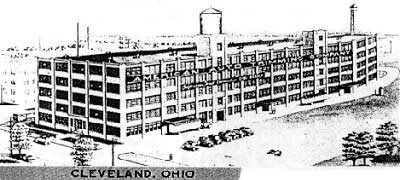
As Ford expanded across the country, so did American Auto Trimming, the 'Recent Incorporations' column of the August 19, 1916 issue of Automobile Topics reported on the firms move into Ohio:
The September 1916 issue of the Hub reported on the acquisition of a East 79th Street plant in Cleveland, which was controlled by a recently organized Ohio Corporation:
A biography of Lawrence Gotfredson included the following description of American Auto Trimmings operations just prior to the start of the First World War:
With American Auto Trimming doing well, Benjamin Gotfredson found time for other business opportunities, the January 10, 1918 issue of Automotive Industries reporting on his election as President of the Saxon Motor Car Co.:
Saxon was reorganized at the end of 1919 as reported in the 1921 edition of Poor's Manuals of Industrials:
Although Saxon was experiencing difficulties, American Auto Trimming continued to expand as evidenced by the following item in the August 23, 1919 issue of American Contractor:
The firm's name was so-well known at the time that newspaper advertisements for the 1919-1920 Columbia Six included the following ad copy: 'Painting and Trimming by the American Auto Trimming Co.' The December 11, 1919 'Men of the Industry' column of The Automobile (Automobile industries) announced Gotfredson's resignation as president of Saxon:
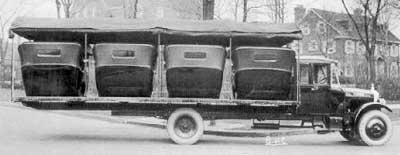
The success of American Auto Trimming created logistical problems for the firm due to their having to collect and deliver thousands of automobile bodies on a weekly basis. Increasingly larger numbers of trucks became involved in collecting the bodies 'in-the-white' from the bodybuilders, transporting them to American Auto Trimming's plant, then returning them for mounting on finished chassis at the automobile manufacturers' assembly plant. At this point in our story we turn to a first-hand witness, Nelson R. Brownyer (b.Jul. 10, 1900-d.Feb. 4, 1995), who will describe the various activities taking place at the American Auto Trimming Company at that time. In 1977 Toronto-based transport historian Rolland Lewis Jerry (b.1924-d.2002) interviewed the former Gotfredson engineer (Brownyer) for a two-part article on Gotfredson Trucks in Old Cars magazine. Brownyer provided much insight on Gotfredson's numerous business enterprises and for the next few paragraphs will be quoted repeatedly in regards to American Auto Trimming's operations during his tenure with the firm, which stretched from 1921 until 1925. Brownyer recalled to Jerry that the whole operation depended on trucks:
The firm's success resulted in a need for a substantial number of new trucks for its Canadian operations. According to Brownyer:
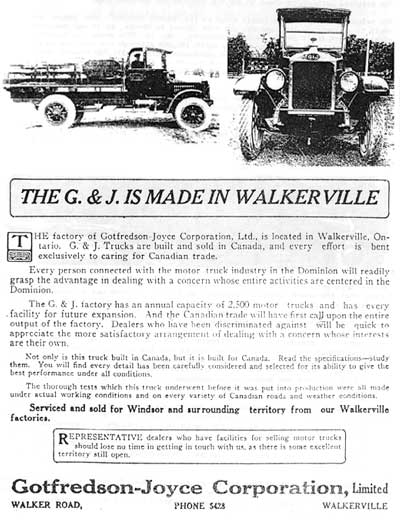
The firm trucks were assembled in a disused portion of American Auto Trimming's plant in Walkerville. Brownyer recalled: "They worked out as well as any trucks the company could have bought on the open market. So, it was decided to build a few commercially for Canadian customers." American Auto Trimming was not a name that rolled of the tongue easily, so the firm top two executives decided to organize a separate firm named after themselves for the purpose, the April 29, 1920 issue of The Automobile (Automotive Industries) reporting on the firm's organization:
A concurrent issue of Industry Week revealed that Gotfredson's son, Robert B. Gotfredson, would serve as vice-president:
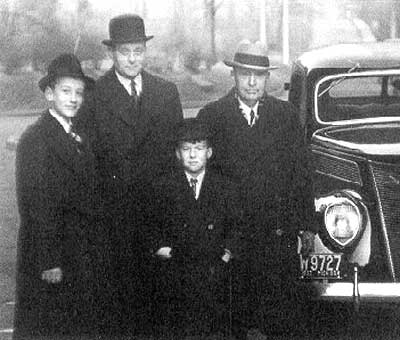
Born in Green Bay, Brown County, Wisconsin, on September 6, 1896 to Benjamin and Augusta Emilia (aka Amelia) Graner (Benjamin's 1st wife) Gotfredson, Robert Benjamin Gotfredson received his early education in the public schools of Green Bay, graduating from Notre Dame High School in Indiana, when the University of Notre Dame maintained schools for boys of all age levels. He graduated from the University of Michigan in 1918 with an AB degree in business administration, giving up the last weeks of his senior year to enlist in the Army as an infantry private. Just after graduation from the University of Michigan he married Charlotte (?) and to the blessed union was born three children: Mary Cecilia (b.1924); Benjamin J. (b.1925); and Robert L. (b. 1928) Gotfredson. (Gotfredson remarried Charlotte Barlum in 1932 – what happened to his first wife is a point of conjecture) Following a short tour of Camp Custer Gotfredson attended officer training school at Camp Lee, Va., emerging as a Second Lieutenant just as World War I drew to a close. Discharged in 1919, Gotfredson got a job at Ford Motor Co.'s Dearborn Tractor Plant spending time in its machine shop, motor assembly dept., service dept. and assembly lines. He took a position as branch service manager at Ford's Charlotte, N.C. division after which he served in the same capacity at a couple of the firm's plants in New England. His was offered a managerial position at Ford Motor Co.'s plant in Russia, but he declined accepting instead an offer to join the recently-formed Gotfredson-Joyce Corp. Ltd. as salesman. Incorporated on January 30, 1920, the Gotfredson-Joyce Corporation, Limited was capitalized at $100,000, its officers and corporate members being; Benjamin Gotfredson and Mark Hiram Coleman, manufacturers; Robert Benjamin Gotfredson, salesman, (all of Detroit, Michigan); Frank Henderson Joyce, manufacturer, (Ford City, Ontario*); and Walter George Bartlet, barrister-at-law (Windsor, Ontario). *Just as Walkerville was associated with Hiram Walker, Ford City was another suburb of Windsor connected with an industrialist. Founded by the Ford Motor Company Ltd. in the early 1900s, Ford City encompassed the neighborhood immediately surrounding the growing Ford assembly plant located at the corner of Riverside Dr. and Drouillard Rd. Located within the municipal boundaries of Windsor, Ford City's boundaries east to west were Pillette Ave. to Walker Rd., and north to south Riverside Dr. to Grand Marais Blvd., with Drouillard Ave. serving as it main drag. A 1935 reorganization merged Ford City, Sandwich and Walkerville into the City of Windsor, and the three neighborhoods ceased to be separate municipal entities. The first batch of trucks were constructed in the early summer of 1920, Brownyer reflecting that the idea was that Joyce's son would direct the truck venture, but for various reasons, this plan was abandoned. A short time afterward, Benjamin's son Robert B. Gotfredson was placed in charge and Brownyer entered the picture soon afterward:
The May 14, 1921 issue of Michigan Manufacturer & Financial Record recorded the expansion of the Gotfredson-Joyce truck line:
The 'Financial Notes' column of the June 16, 1921 issue of The Automobile (Automotive Industries) announced the recapitalization of the firm:
The 'New and Enlarged Shops' column of the November 24, 1921 issue of American Machinist announced the establishment of a Toronto sales and service depot:
In the Fall of 1922 Frank H. Joyce parted ways with the Gotfredson Brothers, simultaneously 'retiring' from the American and Canadian branches of American Auto Trimming and the Gotfredson-Joyce Corp. Ltd. In collaboration with his son William A. Joyce and Hugh Chalmers* (b.1873-d.1932), the founder of the Chalmers Motor Co., Joyce formed an auto finishing firm positioned to compete directly against his former partners. (*Interestingly Chalmers and Benjamin Gotfredson were both major investors in the original Saxon Motor Co.) Christened the Joyce Manufacturing Co. after its president, the new enterprise acquired space in a disused Fisher Body plant located at 2970 Jefferson Ave. (E. Jefferson, corner of McDougall St.) and production commenced in late November, the September 30, 1922 issue of Automobile Topics reporting:
During the buildup to the First World War, Fisher Body Corp's Aeroplane Division refitted Fisher Body's Plant No. 17, (located at the southwest corner of McDougall and Jefferson Aves.) and manufactured components for the Curtiss J-1 trainers and deHavilland DH-4 fighters produced by the firm from 1917-1918 at its newly constructed Clark St. facility which later housed its Fleetwood Body division. The October 5, 1922 issue of Automotive Industries reported that the firm's initial capacity would be 150 bodies per day:
The November 1922 issue of the Automotive Manufacturer confirmed the lease of the Fisher Body plant:
Little information can be found concerning Joyce Manufacturing's operations after its formation although the evidence suggest it remained in business into 1924 when Automotive Industries reported the firm's principals went on holiday:
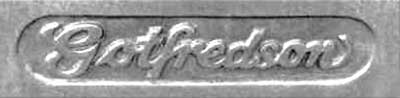
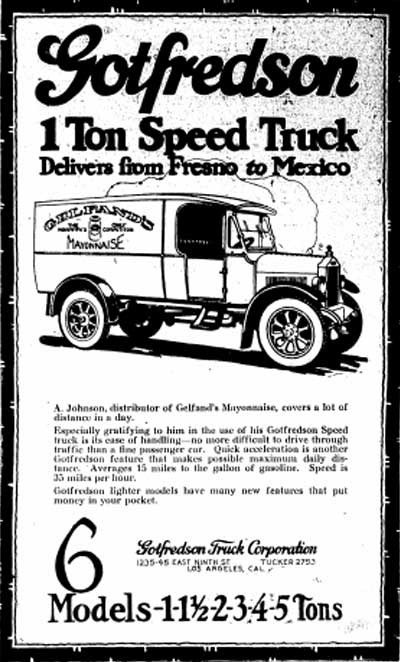
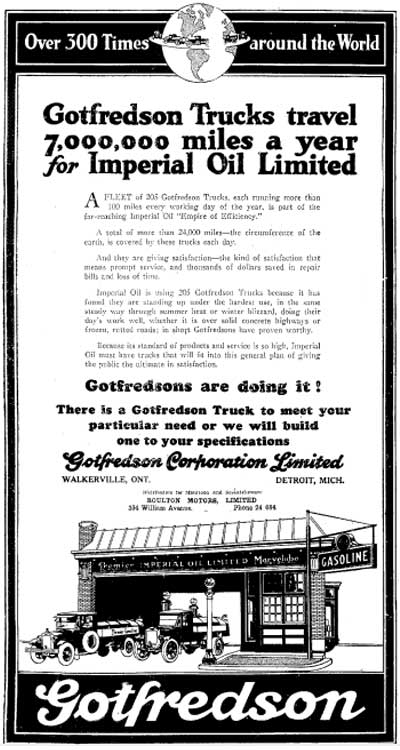
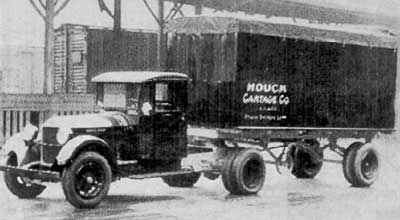
I expect the firm remained in business about as long as the American Auto Trimming Co. (1925-1926) and by 1927 Frank H. and William N. Joyce had partnered with William M. Lee in the Joyce-Lee Real Estate Co. Joyce's 'retirement' prompted an early 1923 reorganization of Gotfredson-Joyce as the Gotfredson Truck Corp. Ltd. with Benjamin Gotfredson, president, Robert B. Gotfredson: vice-president - general manager, and M. H. Coleman, secretary. The firm's chief engineer, N.S. Reed, left at about the same time, and Nelson R. Brownyer replaced him: "I was called into the front Office where young Gotfredson told me that as of now I was the new chief engineer. While I'd worked at the Paige-Detroit Motor Car Company before joining Gotfredson, and I had some familiarity with trucks, I didn't know much about designing them. Not only was I told that I was chief engineer, but I was also told that I had to design a new 5-ton Gotfredson in a matter of weeks so it could be shipped to England." Brownyer delivered the vehicle just in time for its passage to Great Britain aboard the USS George Washington which sailed from Montreal with Gotfredson's very first RHD Gotfredson export model. At the time the Gotfredson Truck Corp. Ltd. offered a truck for everyone with 9 distinct models with capacities ranging between ¾- to 6-tons, priced between $1,700 and $5,000. Two factors distinguished Gotfredson trucks from the competition, the most obvious being its distinctive cast aluminum radiator. Cast in four parts, Gotfredson's signature logo appeared at the top over a red surround. Brownyer explained that it was an expensive radiator to produce:
Gotfredson frame rails were constructed using nickel steel ship channel (structural steel used in ship-building) instead of the pressed-steel units found on the competition. Brownyer relates:
Canadian production proved so successful that the firm decided to produce trucks in the United States as well, the April 12, 1923 issue of The Automobile (Automotive Industries) reporting:
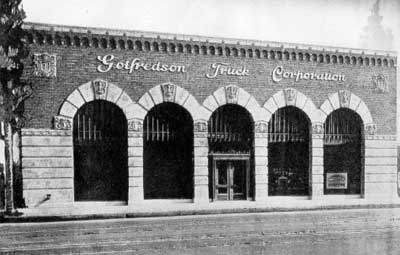
Magazine advertisements from this period also listed factory branches in London, England and Sydney, Australia. In the United States Gotfredson established factory branches in Detroit, Chicago, Cleveland and Los Angeles. As American Auto Trimming's Meldrum Ave. plant was working at capacity, Gotfredson installed his American truck-building operations in a disused portion of the Kolb-Gotfredson Horse Co. at 3601 Gratiot Ave. The horse company had remained in operation through the end of the First World War and portions of the massive structure were being used by American Auto Trimming. With the establishment of the Detroit satellite Brownyer was now in charge of the engineering at both factories recalling:
To which historian Rolland L. Jerry added:
One of Brownyer's contributions to the Gotfredson truck was the introduction of an external contracting drum brake placed directly on the final drive worm-shaft at the rear axle in lieu of the traditional transmission brake commonly used at the time. At that time air brakes had yet to be adapted for motor trucks, Brownyer recalling that:
The Timken-Detroit Axle Co., Gotfredson's supplier, was not initially happy with Brownyer's system, fearing the increased demand and fatigue it placed on its components. However its displeasure was short-lived and Brownyer recalled that:
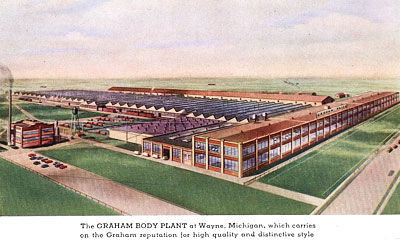
By 1924 most of the country's production automobile manufacturers and production body builders had begun to paint and trim their vehicles in-house and Gotfredson's painting and trimming business began to suffer. The demand for production bodies remained strong however, so Gotfredson searched for a suitable metro Detroit property that could be used for body production. The former Harroun Motors Corporation factory, located 20 miles west of Detroit, was available. Located on Sophia St. in Wayne, Michigan, the plant was erected in 1888 for the Prouty & Glass Carriage Co., a continuation of the Detroit Carriage Woodwork Co., which was organized in 1882 and located at 38-40 Randolph St., Detroit, Michigan. The October 12, 1916 issue of the Automobile announced Harroun's acquisition of the Prouty & Glass factory:
Like the vast majority of small automobile manufacturers established during the teens, Harroun experienced a rapid growth prior to the start of the First World War, and a rapid decline afterwards, and the firm was declared bankrupt in June of 1922. The combination of a suitable plant, a skilled local work force and access to the main lines of the Michigan Central and Pere Marquette railroads - which intersect at Wayne Junction, the site of the plant - made it ideal for composite automobile body production and Gotfredson purchased it from Harroun's receivers in mid-1924. Construction of a 40,000 sq. ft. addition commenced soon afterwards and Gotfredson announced that production of coachwork for Paige automobiles would start in early fall of 1924. Gotfredson installed C.S. Briggs (b.1872), the former president of the Briggs-Detroiter Co. (manufactured automobiles from 1912-1917), as plant manager and organized a new firm, Gotfredson Body Corp., to handle its Wayne, Michigan operations, its listing in the 1925 Wayne business directory being:
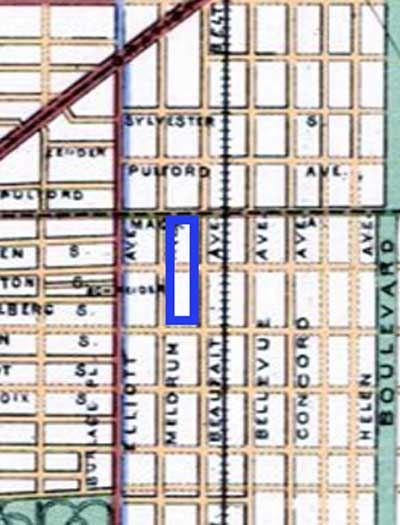
Claude Strait Briggs (C.S. Briggs) was born in Battle Creek, Calhoun County, Michigan on August 13, 1872 to Elias Howell and Anne Eliza (Hoyt) Briggs. His parents, both natives of New York, came to Michigan as children, and during the Civil War his father served under Generals Custer and Sheridan. To the blessed union was born 7 children, 4 of whom survived into adulthood: Claude S., Arthur C. (b. July 30, 1878), J. S. and Mrs. Frank J. Burrows, all of Detroit. Briggs graduated from Plymouth High School, Battle Creek, and after numerous positions in various enterprises entered into the wholesale dental supply business in 1901 with his younger brother Arthur C., a pharmacist by trade, forming the Briggs Dental Co., a wholesale dental supply distributor. Allen H. Kessler joined the firm and it was reorganized as the Briggs-Kessler Company, with Claude S. Briggs as the president, Arthur C. Briggs as vice president and Allen H. Kessler as secretary and treasurer. In 1909 Briggs became involved with the K-R-I-T Motor Car Co. as an investor and in 1910 joined the United States Motor Co., becoming general manager of sales for the Brush Runabout Co. In 1911, in partnership with John A. Boyle, Briggs formed the Briggs Detroiter Co., serving as president and general manager. From 1912-1917 they manufactured the Detroiter automobile, a low-to-medium-priced assembled car that by 1917 looked like the less-expensive Dodge Bros. automobile. Following the War he served in various capacities with a number of Detroit concerns before going to work for Gotfredson. 1924-25 was a period of transition for Gotfredson's automotive operations, and American Auto Trimming in particular, but to better understand the situation some background information on the location of its Detroit plants is in order. At one time or another American Auto Trimming, whose offices were located at 607 Mack Ave., utilized plants located at 669 Mack Ave., 232 West Fort St., 742 Meldrum Ave., and 1093-1113 Gratiot avenue – all Detroit. The firm's main complex was located in the city block bordered by Meldrum & Mack Aves, and Beaufait & Berlin Sts. Close inspection of the neighborhood today reveals that there is no longer a Berlin St. Anti-German sentiment was very high in the years following the First World War and the City of Detroit renamed a number of streets whose names sounded 'too German', with Berlin being renamed as Benson St. Another change was the address of American Auto Trimming's main factory. During the early 1920s all addresses in Detroit were re-numbered (starting Jan 1, 1921) with its original address of 742 Meldrum Ave. becoming 3100 Meldrum, which is an address sometimes associated with the Briggs Mfg. Co.'s Mack Ave. plant (which burned to the ground in 2010) for reasons that will become clear very shortly. R.L. Polk's Detroit City Directory 1925-26 (prepared during late 1924) provided the following information for Gotfredson's Detroit operations:
A 1931 US Federal Court Case provides the sequence of events that resulted in American Auto Trimming becoming the Wayne Body Corporation. Although Benjamin Gotfredson was the principal shareholder of all of the firm's listed in the 1925 Detroit directory, the Gotfredson Truck Corp. and Gotfredson Land Co. were not involved in the process. In Wayne Body Corporation, Petitioner, v. Commissioner of Internal Revenue, Respondent. Docket No. 35896. Promulgated October 28, 1931:
As I understand the sequence of events, in 1924 Gotfredson formed a shell corporation, Gotfredson Body Corp. with the goal of using it to purchase the Wayne, Michigan factory of the bankrupt Harroun Motor Corp. enabling the firm to enter the lucrative production automobile body manufacturing field. Shortly after the March 2, 1925 board meeting the Gotfredson Body Corp. purchased the assets and real estate of the American Auto Trimming Co. in exchange for an equal amount of stock in the recently organized (1924) Gotfredson Body Corp., at which point in time American Auto Trimming Co. ceased to be. The Gotfredson Truck Corp., an entirely separate corporation (although it shared the same directors, officers and shareholders), was not involved in any of the Gotfredson Body Corporation's dealings. Soon after the reorganization took place it was announced that Gotfredson's Meldrum Ave plant was being sold to the Briggs Mfg. Co., their chief competitor. I imagine the Tuesday, May 12th 1925, announcement must have come as a great surprise to many of the firm's customers and smaller investors. A statement issued at that time, attributed to Benjamin Gotfredson, inferred that:
He maintained the sale ultimately benefitted the firm's body building operations in Wayne, Mich.; Cleveland, Ohio; and Walkerville, Ontario – although in fact the three firms were not corporately related. Details of the sale were provided in the May 14, 1925 Issue of Automotive Industries:
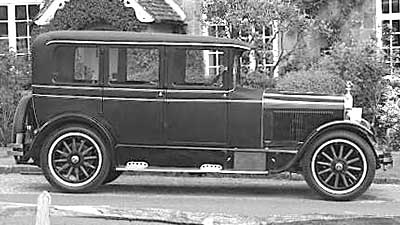
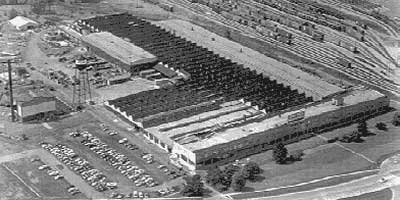
The sale of its main factory to Briggs prompted a temporary relocation of the former American Auto Trimming Co.'s painting and trimming operations into a disused body plant owned by the Kelsey Wheel Corporation at 570-576 Kirby Ave., West, Detroit, Michigan. Soon after Briggs 1927 purchase of LeBaron, the 4th and 5th floors of Briggs' Mack Avenue (American Auto Trimming's Meldrum Ave.) plant was used by LeBaron Studios, which was headed by Ralph Roberts and his staff of hand-picked designers. The plant supplied coachwork for Packard into the mid-1950s, despite the fact that it was considered an official Chrysler body plant following the Chrysler Corp.'s 1953 purchase of Briggs. One of LeBaron’s first jobs for Briggs was the design of the 1928 Graham-Paige. Flush with cash from the sale of Dodge to Dillon-Read, the Graham Brothers – Ray A., Joseph B. and Robert C. - purchased the Paige-Detroit Motor Co. during 1927, and asked Briggs to design them a new automobile. Hugo Pfau and Roland Stickney of LeBaron’s New York office were assigned the project and they came up with a very attractive car with a rounded-off Hispano-Suiza-inspired grill and front end. In place of their standard renderings, Briggs/LeBaron supplied the Grahams with a clay replica of the car to better visualize its unique styling features. Hugo Pfau believes that this was the first use of a clay model to sell a client on a new design. Initial bodies were built by Briggs, however as sales took off, the Grahams purchased the Wayne Body Corp. (old Harroun Motor Car) factory in Wayne, Michigan and turned it into the Graham-Paige Body Corp. which eventually supplied 90% of the firms coachwork. However, LeBaron got the contracts for most of Graham-Paige’s custom bodies including the attractive dual-cowl phaetons and town cars seen in the late twenties. So in a cruel twist of fate a former Gotfredson Body Corp. / Wayne Body Corp. plant produced bodies (for the 1928 Graham-Paige) that were designed and engineered in another former Gotfredson Body Corp. (Meldrum Ave.) plant. In 1924 20-year-old Gordon Buehrig, one of the Classic-era's best-known automobile designers, began his automotive career as a body draftsman at the Gotfredson Body Corp.'s Wayne, Michigan plant, serving under Walter L. Jones, Gotfredson's chief body engineer. During his 2 years with the firm he assisted Jones with shoring up closed body designs for Wills Ste. Claire, Jewett, Paige-Detroit and Peerless. It's known that Gotfredson supplied the coachwork for the 1926 Wills Sainte Claire Gray Goose Traveler and 1924-25 Jewett 6 Brougham. According to Doug Thamert, a leading Jewett historian:
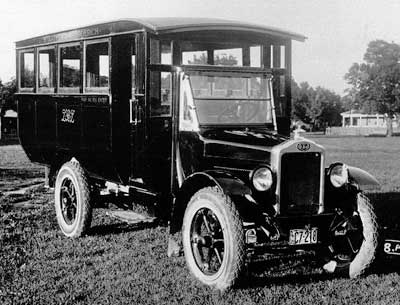
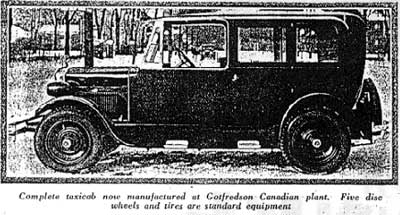
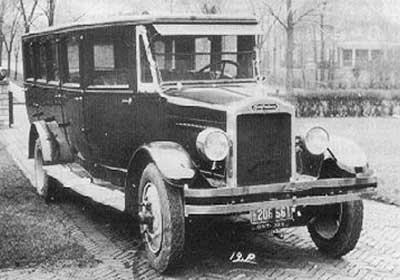
Although the production of Gotfredson's truck chassis is beyond the scope of this biography, the firm's buses and taxicabs are of interest, with the production of both types of vehicles commencing at its Walkerville, Ontario plant starting in late 1924. As the firm had yet to begin the manufacture of automobile bodies, the coachwork was supplied by the Canadian Top & Body Co. Ltd., of Tilbury, Ontario (a suburb of Windsor), the same firm that supplied it with truck cabs. According to Nelson R. Brownyer:
Brownyer was placed in charge of the vehicle's engineering, adding the Detroit plant was involved in its own, unrelated, taxicab project: "In 1925, a cab operator in New York City wanted us to produce cabs for him." Brownyer recalls the Detroit-built cab featured a Minerva-style radiator instead of the distinctive cast aluminum units found on the firm's Canadian-built taxicabs.
Brownyer adds. Unfortunately only the pilot model was constructed and no contract was forthcoming. However a fair number of Canadian-produced taxicabs were constructed at the Walkerville plant. The March 12, 1925 issue of Automotive Industries included articles on the Gotfredson taxicab and Gotfredson 21-29 passenger bus chassis, the taxicab article follows:
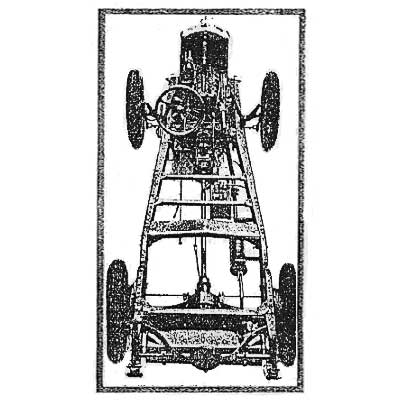
The Gotfredson bus chassis came about in response to the conversion of the Detroit Street Railway's rolling stock from streetcars into buses. Gotfredson hoped to gain a contract and set Brownyer on designing two purpose-built drop-framed chassis, a tandem axle for high-capacity double-decker coachwork, and a single axle for conventional use. The March 19, 1925 issue of Motor Age included the following article on the Gotfredson 21-29 passenger bus chassis:
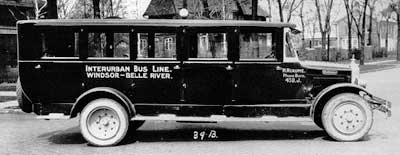
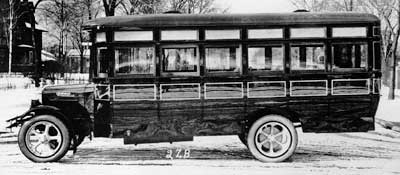
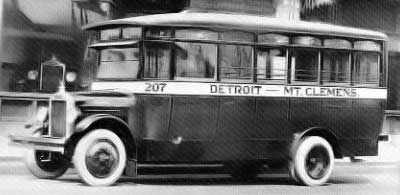
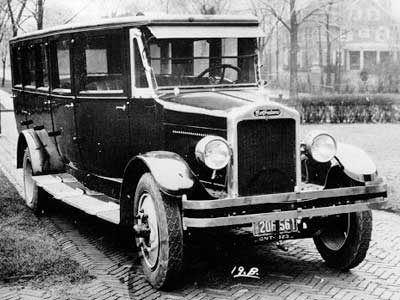
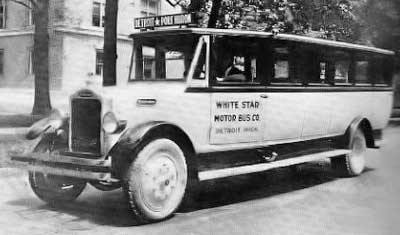
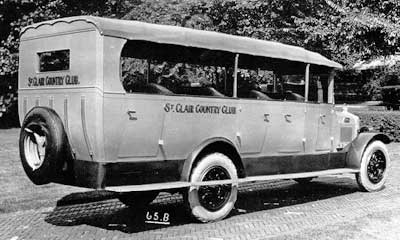
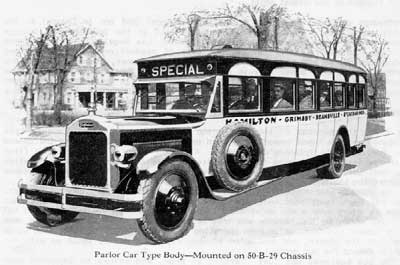
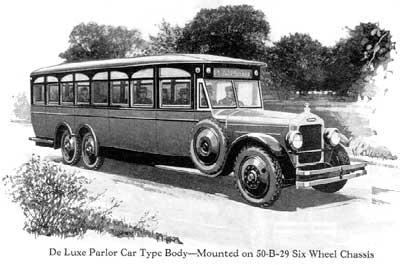
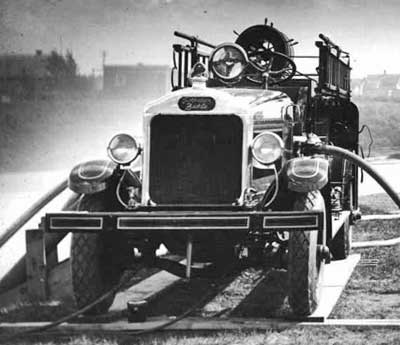
Although the Detroit Street Railway ended up purchasing bus chassis from Philadelphia's Safeway Six-Wheel Co., Gotfredson bus chassis proved popular in Canada and were manufactured in small numbers at Gotfredson Corp. Ltd.'s Walkerville assembly plant. Most attractive were the parlor coaches built for a handful of Canadian and American operators. Gotfredson built fire engine chassis were supplied to Woodstock, Ontario's Bickle Fire Engines Ltd. who offered them as a low-cost alternative to their premium Ahrens-Fox sourced chassis from 1925-1929. In 1927 the city of Toronto's Fire Dept. purchased 5 Gotfredson-Bickle triple combination pumpers, the largest single order of Gotfredson-Bickle apparatus known to have been delivered. According to automotive historian Brooks T. Brierley, the short-lived Canadian-built Brooks steam car (Brooks Steam Motors, Ltd. 1923-1926, Stratford, Ontario) utilized an American Auto Trimming Ltd. -built Meritas-cloaked composite fabric body:
Brooks also produced small numbers of taxicabs and a prototype 29-passenger parlor-style bus whose aluminum coachwork was built by the Buffalo Body Co. of Buffalo, New York. In March of 1925, Gotfredson's Canadian operations (American Auto Trimming Co. Ltd. and Gotfredson Truck Corp. Ltd.) were merged and reorganized as Gotfredson Corp. Ltd., the April 1925 issue of Iron Trade Review reporting:
In an April 1925 interview with the Windsor Star, Gotfredson Ltd.'s general manager, Charles S. Porter, stated:
Although auto trimming was no longer a viable business, the former American Auto Trimming Ltd. Plants embarked upon the construction of composite automobile bodies for Studebaker Ltd. of Canada, producing coachwork for the firm's Studebaker and Erskine automobiles. Although everything was copacetic at the firm's Canadian facilities, things at Gotfredson Body Corp.'s Wayne, Michigan plant had been shaky from the start and things really began to go south in early 1926. Walter H. Jones, Gotfredson Body Corp.'s chief engineer, and Gordon Buehrig, his talented assistant, abandoned ship early in the year, the Michigan Manufacturer and Financial Record reporting:
Buehrig would spend the better part of the next three years wandering from one drafting job to the other; his first position with Dietrich Inc. (1926), his second at Packard (1927), his third with General Motors Art and Colour (1927) and his fourth with Stutz (1928). In 1929 he took a more permanent position with E.L. Cord for whom he designed some of the most famous cars of the 1930s. In July of 1984 Buehrig described his tenure at the Gotfredson Body Corp. (1924-1926) to David R. Crippen, an archivist at the Henry Ford Museum:
Resignations were not confined to the firm's body-building business; Gotfredson Truck Corp's chief engineer Nelson R. Brownyer left the firm during 1926, the SAE Journal reporting:
Although Gotfredson trucks never caught on in the US as well as they had in Canada, production at the Detroit branch slowly increased during 1925 and 1926 looked to be a banner year with orders on the books for a number of Detroit-based companies such as Detroit Edison Co., Michigan Bell Telephone Co., Coca-Cola Bottling Co. of Michigan, Detroit Taxicab & Transfer Co., United Fuel & Supply Co., and Film Truck Service Co. In an effort to shield the Gotfredson Truck Corp. from the bad publicity surrounding the similarly-named body plant in Wayne, Michigan, in early 1926 Gotfredson reorganized the Gotfredson Body Corporation as the Wayne Body Corporation. It was reported that the firm had trouble fulfilling a large order of (Jewett) closed bodies for the Paige-Detroit Co., and that it was losing money on the bodies it managed to get out the door. Timing was a second problem, while the acquisition of the Wayne properties seemed like a good idea in 1924, by 1926 the production body business had changed enough that manufacturers were no longer interested in traditional composite wood-framed metal-sheathed coachwork, preferring the all-steel bodies that had recently been introduced by Budd and Briggs. As luck would have it an opportunity presented itself in mid-1927 that got Gotfredson out of the Wayne Body quagmire. The Graham brothers (Joseph B., Robert C. and Ray A. Graham) had recently sold their interest in Dodge Bros. to Chrysler interests and were eager to get back into automobile manufacturing. Paige-Detroit's Harry Jewett was looking for a buyer and on June 10, 1927 the Grahams assumed control of Paige-Detroit. The purchase coincided with another notice that the Graham Bros. had also purchased the 240,000 sq. ft. Wayne Body Corp. plant. Although appraised at $1,250,000, the heavily-mortgaged property sold for considerably less and in fact Gotfredson Corp.'s annual report for the year ended Dec. 31, 1927 (included below) infers it incurred a loss on the sale. In his book, 'The Graham Legacy: Graham-Paige to 1932' historian Michael E. Keller mentions the deal:
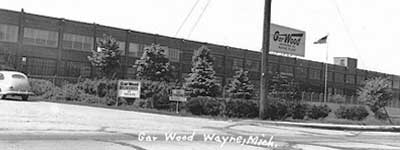
The Graham Brothers re-badged a number of Jewett and Paige models and within the year announced a new line of 6- and 8-cylinder models which were marketed as Graham-Paige automobiles. By mid-1928 demand was so high for the new Graham-Paige, the brothers constructed a second body plant in Evanston, Illinois to keep up with demand. (Under Gotfredson the Wayne, Michigan plant produced coachwork for Paige-Detroit (Jewett), Wills St. Claire and Peerless (1924-1927), after which it was sold to the Graham Bros. who used it for Graham-Paige body production through 1936. After the War it served as the home of Kaiser-Frazer, who used it to produce the Frazer prior to consolidating its manufacturing operations at the former B-24 plant at Willow Run during 1947. During the same year the factory was acquired by the Gar Wood Motor Co, who used it to manufacturer the firm's popular line of refuse collection truck bodies, ending production in 1971 when they consolidated its operations into the firm's Tennessee facility.) While the Graham's purchase of the Wayne, Michigan plant had greatly reduced the firm's liabilities, the heavily mortgaged former American Auto Trimming Co. plants in Cleveland and Los Angles continued to be a drain on Gotfredson's bottom line. The June 2, 1928 issue of the Journal of Commerce reported on the Gotfredson Corp.'s 1927 annual report:
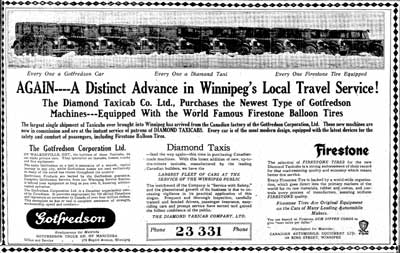
Although the firm entered 1928 with a surplus on the books, the actual situation was far worse than the rosy scenario depicted above would indicate. To make it appear that the US Gotfredson Corp. was still a going concern Benjamin Gotfredson, (the president and chief shareholder of both companies) merged the marginally profitable US Gotfredson Truck Corp. with the unprofitable US Gotfredson Corporation. Things were so bad that back in July of 1927, property owned by Gotfredson's Canadian Corporations were put up as collateral for loans and/or credit that was extended to the U.S. Corporation. To make matters worse profits from Gotfredson's Canadian operations were being funneled into the bank accounts of his US-based operations to keep it afloat. As president and chief shareholder of all the affected firms Benjamin Gotfredson suffered the greatest losses, and despite the influx of cash and credit his meager Detroit-based truck manufacturing operations failed to turn a profit and within the year, his house of cards came crashing around him. Gotfredsons Canadian operations were declared bankrupt, the February 21, 1929 issue of the Winnipeg Free Press announced the appointment of a receiver for the firm's Canadian operations:
The receivership didn't end at the border and despite a hastily-organized meeting with its creditors, bankruptcy proceedings were initiated against the US Gotfredson Corporation by Motor Products Corp. and Timken-Detroit Axle Co. within the month. However, the bankruptcy proceedings didn't prevent Gotfredson's son from forming a new truck manufacturing outfit whose organization was announced in the April 23, 1929 issue of Automotive Industries:
The building that housed the Robert Gotfredson Truck Corp., was owned by the Kolb-Gotfredson Realty Co., and had no corporate connection with the bankrupt Gotfredson Company, and consequently remained available. The relationship between Benjamin Gotfredson and his various holdings was briefly described in a 1929 Court of Appeals Case (AMERICAN AUTO TRIMMING CO., v. LUCAS, Commissioner of Internal Revenue) where it was decided that 'the Detroit and Cleveland companies were affiliated in one group, and the Horse Company, the Realty Company, and the Land Company in another group':
POST BANKRUPTCY Cleveland, Ohio: A portion of American Auto Trimming's vacant Cleveland plant was subsequently leased out to the Facto Auto Body Company, a firm formed by William Chester Colburn to manufacture automobile bodies for its Cleveland neighbor, the Jordan Motor Car Co. The firm was organized on February 20, 1929 and took over a portion of the former American Auto Trimming Co. plant which was located in northeast Cleveland at 12910 Taft Ave., a little over a mile away from Jordan, who was located at 1070 East 152nd St. Detroit, Michigan: Detroit Truck Plant: Owned by the Kolb-Gotfredson Realty Co., a firm unaffected by the bankruptcy, the former Kolb-Gotfredson Horse Co. facility served as the home of the Robert Godfredson Truck Corp. which was founded shortly after his father's firm entered into bankruptcy, the April 23, 1929 issue of Automotive Industries reporting:
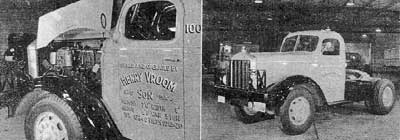
The Robert Gotfredson Truck Corp. has the distinction of being one of the first American truck manufacturers to offer a Cummins Diesel engine as standard equipment. According to Cummins its first Diesel truck customers were the Indiana Truck Corp. of Marion, Indiana (August 1932), then the Robert Gotfredson Truck Corp. (October 1932) and finally the Sterling Motor Truck Co. of West Allis, Wisconsin (November 1932). Robert B. Godfredson specialized in the manufacture of custom-built heavy-duty diesel-engined trucks, whose powerplants were supplied by Diesel Sales of Michigan Inc., a related firm he established in 1933. The firm abandoned the manufacture of their own truck cabs in 1936, turning to ready-made Yellow Truck & Coach (GMC) units which were utilized until production ceased in 1946. By that time the firm was one of the nation's largest distributors of Cummins Diesel engines, remaining so until 1955 when it was purchased by a group of Canadians and reorganized as Cummins Diesel Michigan, Inc., a 1955 issue of Canadian Transportation reporting:
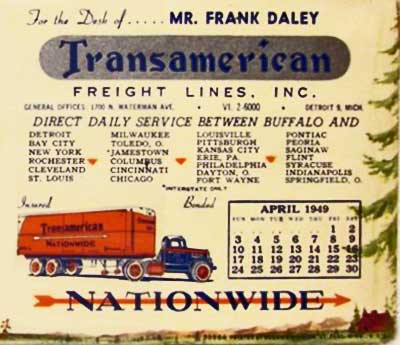
Cummins Diesel Michigan's new headquarters was relocated to a new structure at 3760 Wyoming Ave, Dearborn and in 2003 the firm merged with Cummins Interstate Power Inc. forming Cummins Bridgeway LLC with headquarters in Hudson, Michigan. It remains the exclusive Cummins distributor in Michigan, Ohio, Western Pennsylvania and some adjacent counties in Kentucky, Indiana, and West Virginia, and maintains thirteen branch locations throughout their territory. The 100 year old Kolb-Gotfredson Horse Co. building on Gratiot remains standing today (2012) as a Faygo bottling plant (re-numbered to 3579 Gratiot Avenue in the 20s - all addresses in Detroit were re-numbered starting Jan 1, 1921). Shortly after he organized his truck manufacturing concern Robert B. Gotfredson purchased the assets of a small Toledo, Ohio freight carrier named Triangle Freight Forwarding Co. Triangle had purchased two Gotfredsons on credit and when the firm's business tanked during the early Depression it filed for bankruptcy with the Robert Gotfredson Truck Corp. being one of its largest creditors. At the firm's bankruptcy auction Robert Gotfredson personally purchased its assets in a bid to protect his investment, and in the process became the owner of its rolling stock and its Chicago, Cincinnati, Dayton, Detroit and Toledo terminals. According to Gotfredson:
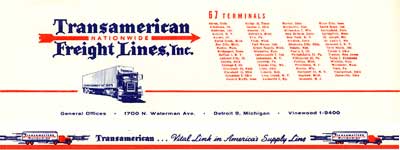
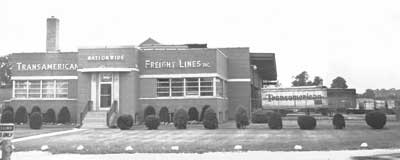
He relocated its main office from Toledo to Detroit and reorganized the firm as Transamerican Freight Lines Inc., slowly building up the firm until it became the 11th largest freight operator in the country, with divisions devoted to hauling steel, perishable goods and LTL (less-than-truckload) freight. The firm had its own trailer shop in Detroit (Waterman) where it built and modified trailers to suit the needs of its various divisions – a former employee recalls stretching closed trailers by 8' to create longer rag-top units. It had a large Chicago-East Coast intermodal operation with freight moving from Chicago to Cleveland over the road and from Cleveland to New-Jersey via piggy-back trailers on the Pennsylvania Railroad. At the time of Robert B. Gotfredson's passing in 1966, the firm's 3,000 employees operated 4,299 pieces of equipment out of 82 terminals in 29 states, and claimed annual sales of $65 million. Not surprisingly Transamerican utilized large numbers of Cummins-equipped Gotfredson trucks during its very early years, later turning to conventional and COE units built by Mack, GMC, Ford, International, Kenworth, Diamond-Reo, and White. Its steel hauling division employed heavy duty conventional tractors supplied by Henderson, Sterling, Autocar, Diamond-T, Mack and International. Robert L. Gotfredson succeeded his father, Robert B. Gotfredson, after his March 1, 1966 passing. His brother, John B. Gotfredson, becoming vice-president and operations manager. In 1973 the Gotfredsons sold Transamerican to a group of investors formally associated with Interstate Motor Freight. Heavily in debt at the time, the new management made many attempts to turn it around, but couldn’t overcome the long-lasting effects of the Arab Oil Embargo of 1976 and went bankrupt in 1976. The bulk of its assets were purchased at auction by Campbell "66" Express of Springfield, Missouri which went out of business in 1986. Both Winross and First Gear made small scale replicas of Transamerican Freight Lines rigs, and both are highly prized by collectors today. Wayne, Michigan body plant: After the sale to the Graham Bros. it was sold to Graham-Paige who used it for a portion of Graham-Paige's body production into 1936 when the firm's body-building operations were consolidated at its Evanston, Illinois body plant. After the War the factory served as the home of Kaiser-Frazer, who used it to produce the Frazer Automobile prior to consolidating its manufacturing operations at the former B-24 plant at Willow Run during 1947. During the same year the factory was acquired by the Gar Wood Motor Co., who used it to manufacturer the firm's popular line of refuse collection truck bodies, ending production in 1971 when they consolidated its operations into the firm's Tennessee facility. Los Angeles, California factory branch: Designed by Morgan, Walls and Clements and located at 1235 East 9th Street, the $100,000 235' x 175' Los Angeles branch was hailed as a modern work of architecture at its August 1, 1924 grand opening. Gotfredson hired G.O. Fried, an experienced automobile man, to manage the operation which included a magnificent showroom at the front and a spacious well-equipped service center at the rear. Following its parent company's 1929 bankruptcy, the facility was used by a couple of automotive enterprises, eventually becoming the home of the Quality Electric Company who occupied the structure during much of the 1930s, 40s and 50s. The address was changed to 1235 East Olympic Blvd. in honor of the 1932 Summer Olympics which were hosted by Los Angeles and in recent times the showroom was used as a restaurant and the service dept. by a paper box company. Ultimately the building was taken over by a wholesale grocer, Best Grocery Wholesale Ltd., who occupies it today. Walkerville/Windsor, Ontario, Canada Truck & Body Plants: Gotfredson's bankruptcy directly affected Studebaker's operations and the automaker's Canadian subsidiary took immediate steps to insure that the supply of Erskine and Studebaker bodies remain uninterrupted. D.R. Grossman, Studebaker of Canada Ltd.'s general manager, immediately leased the portion of Gotfredson Corp. Ltd.'s Walker Rd facility that had been building its bodies from Gotfredson's receiver, providing employment for 110 former Gotfredson employees that had been thrown out of work. Another group of former Gotfredson employees and managers made arrangements with the Canadian Bank of Commerce and National Trust Company to finance the purchase of the firm's Canadian truck-building operations from the receiver, the May 1929 issue of the Commercial Car Journal reporting:
Officers of the new firm were Frank Mitchell of Walkerville, president; Arthur Cobham of Toronto, vice president; and James Barth of Windsor, secretary-treasurer. In addition to all the preceding officers the directors and shareholders included Lawrence Latimer of Montreal and Fredrick Anderson of Walkerville. The deal allowed Trucks & Parts Ltd. to take possession of all of Gotfredon's Canadian operations which included the firm's Walkerville factory and offices, and the firm's two service centers located in Toronto and Montreal. Their advertisements stated that while the firm continued to produced Gotfredson-branded trucks, it was unaffiliated with any other firms bearing the same name. Trucks & Parts fulfilled whatever orders remained on the books and after which orders were taken for new vehicles. Although 133 Gotfredsons were turned out by the firm during 1929, that fall's stock market crash put a damper on new orders and only 37 trucks were produced in 1930. Trucks & Parts was soon given control of the plants producing Studebaker and Erskine bodies and bid on whatever contracts were available, receiving an order in 1931 for 850 bodies to be produced in batches of 100 as demand warranted. Truck & Parts Ltd. became Gotfredson Trucks Ltd. In 1932 to better reflect its core business. Sales for the year only numbered 30 trucks, but considering the times, Gotfredson suffered less than some larger manufacturers. In 1933 the firm became the official distributor of Diamond T trucks in Eastern Canada, although sales were less than spectacular with only 20 units reported sold by the end of the year. Sale of Gotfredson trucks were significantly down from the previous year with only 13 units reported as sold midway through the year. In 1934 Gotfredson's 924 Walker Rd. body plant received a large order from Ford of Canada for truck cabs and an assortment of stake and rack bodies. The firm was also entrusted to produce shipping crates for Ford of Canada's overseas shipments and is recorded as having assembled station wagons bodies and having trimmed other low production vehicles such as the Ford convertible coup. In 1938 Gotfredson Trucks Ltd. was reorganized once again, this time to Gotfredson Ltd. However, the Ford contracts kept coming with Gotfredson supplying truck cabs and bodies for Ford military vehicles, contracts that were extended after the official start of the War. The 1943 Windsor City Directory lists the firm's headquarters at 2489 Seminole, its officers being; F.H. Anderson, president; T.H. Anderson, vice president; J. H. Barth, secretary-treasurer; and G. A. Hope as assistant secretary. Also listed were the firm's 3 main plants, the commercial motor bodies (plant 1) at 924 Walker Rd; Plant 2 at 1030 Walker Rd. and plant 3 at 2489 Wyandotte. At the end of hostilities business picked up and manufacture of Ford truck cabs, stations wagons and convertible resumed, with the firm expanding into a portion of Windsor's old Studebaker assembly plant. The firm operated under the "Ford Free Issue" supply stream, meaning the automaker supplied the firm with whatever parts and supplies were needed – Gotfredson supplying manufacturing facilities and labor only. The firm continued to manufacture limited production bodies and subassemblies until Ford's Oakville, Ontario plant came on line after which much of Gotfredson's property was purchased by Ford Motor Co of Canada. A few remaining Gotfredson Ltd properties were acquired by American Motors Canada Ltd. for use as a trim and upholstery plant. Some of the firm' facilities remain standing today although the main body plant located at 985 Walker Rd., Windsor, succumbed to fire on June 30, 1985. © 2012 Mark Theobald - Coachbuilt.com, special thanks to Wm. Jason Flatt, PE, Historic Preservation Specialist for the City of Green Bay. Appendix One – Alma Trailer Co., Alma Michigan After a decade in real estate Frank H. Joyce returned to the automobile business (actually the auto trailer business) in late 1936 when he accept a position as president of the Alma Trailer Company, of Alma, Michigan. The December 1937 issue of Automobile and Trailer Travel provides the details:
(Adolph H. Lichter, who gained his early years of training in the Launer Carriage Works, in Vienna, Austria, and was later employed by Brewster & Co., makers of custom built bodies.) Appendix Two - General Auto Trimming, Detroit, Michigan According to a 'Life In Detroit' column penned by the AP's William H. Beatty on October 3, 1930, Gotfredson was also involved in Detroit's parking lot business:
Unfortunately, Beatty got one important fact wrong, the name of the firm. The auto trimming firm on Lafayette Street was General Auto Trimming, not American Auto Trimming, and its owner was Max Golberg, not Benjamin Gotfredson. Goldberg's Service Parking Grounds went on to become not only Detroit's largest operation (36 lots in 1936) but also one of the nation's first large-scale parking operator with lots in Toledo, Chicago, Pittsburgh and Washington D.C. © 2012 Mark
Theobald - Coachbuilt.com
|

|
|||||||||
|
||||||||||
|
||||||||||
|
||||||||||
|
||||||||||
|
|
||||||||||
|
||||||||||
|
|
||||||||||
|
|
||||||||||
|
|
||||||||||
|
© 2004-2012 Coachbuilt.com, Inc.|books|disclaimer|index|privacy |
||||||||||