|
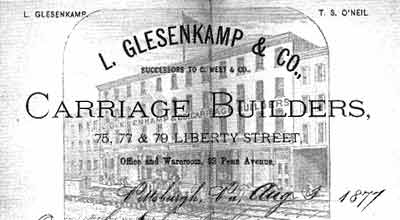
L. Glesenkamp Sons
& Co. was the successor to C. West & Co. and located at 75, 77, and 79
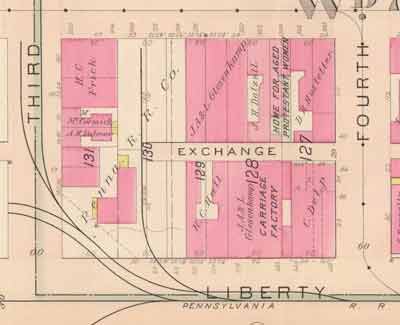
Liberty Street (re-numbered in 1885 as 317, 319, 321, and 323 Liberty) with
offices and a wareroom at 92 Penn Ave. (re-numbered in 1885 as 318-320
Penn.)
Columbus West (b.1818-d.1880) was born in 1818 in Maryland. After he
completed an apprenticeship with a local coachbuilder he worked for various
vehicle makers in the east, eventually making his way to Pittsburg,
Pennsylvania where in 1847 he established a carriage works with a Mr.
Blatchett at 194 & 195-197 Penn Ave. West & Blatchett’s factory was located
in the heart of Pittsburgh’s Fort Duquesne business district, on what would
become some of the most valuable land in Modern Pittsburgh.
Fort Duquesne (originally called Fort Du Quesne in honor of the
governor-general of New France) was a fort established by the French in 1754
at the junction of the Allegheny and Monongahela rivers.
The blessed union of Columbus West and Troy, New York native, Catherine
Edell (b.1815-d.1903), produced 2 sons, James W. and John, who by 1860 had
joined their father’s business. Columbus West’s younger brother Lafayette
F. West (b.1826) moved to Pittsburgh to join his brother’s firm, eventually
establishing his own Pittsburgh butcher shop.
Soon after their 1848 arrival in New York City, two young German
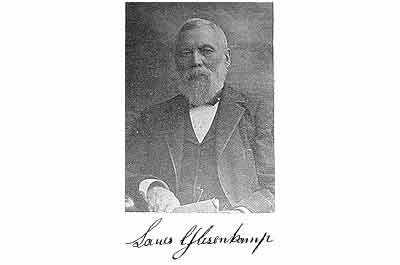
brothers, Louis J. (b.1826-d.1898) and William Glesenkamp (b.1831- d.1906),
were scouted by a Columbus West associate and soon relocated to Pittsburgh.
The Glesenkamps were born in Belm, in the kingdom of Hanover, Germany. Louis
J. Glesenkamp’s first name is often mis-spelled as Lewis. William Glesenkamp
was already a Pittsburgh native by 1850, and was included in that year’s
census as a blacksmith.
In 1852 Louis J. Glesenkamp bought out the interest of Mr. Blatchett, and
West & Blatchett was reorganized as C. West & Co., C. West and L.
Glesenkamp, proprietors.
In 1854 the firm was awarded a certificate for Best Rockaway Buggy by the
Pennsylvania Agricultural Society at the group’s annual exhibition and in
1859 Columbus West was commissioned to either build or procure a steam fire
engine for the city’s Eagle Fire Company.
By 1860 Louis’ younger brother William Glesenkamp was placed in charge of
the firm’s smithworks. A period text advertisement follows:
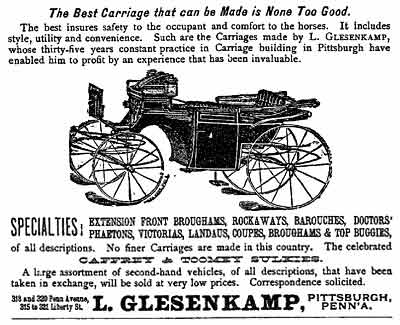
“GLESENKAMP, L. & WEST, C. - C. West & Co - MANUFACTURERS OF Carriages,
Rockaways, Buggies. Sulkies AND SLEIGHS, No. 197 Penn Street, Pittsburgh, Pa.”
The Wests and Glesenkamps were all listed in the 1860 Pittsburgh
directory as follows:
Glesenkamp Louis, C. West & Co. home at 213 Penn
West & Co., carriage manufacturers, 194 Penn
West Columbus, of C. West & Co., 18 Hay
West James W., coach painter, 18 Hay
West John, painter, 230 Penn
West Lafayette, of C. West & Co., 195 Penn
Both the Hay St. and Penn St. numbers refer to the same group of
buildings. Hay St. was renamed Fourth St. sometime before 1872.
In 1866 the City of Pittsburgh acquired the C. West & Co. factory in
order to construct the new Mercantile Library Hall. A new factory was
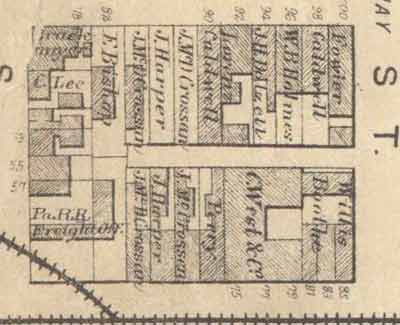
constructed by the partners in 1867 at 75-79 Liberty St. (re-numbered in
1885 as 317, 319, 321, and 323 Liberty), just one block away from the
freight offices of the Pennsylvania Railroad. In 1868 an office and wareroom
were built just behind the Liberty St. factory at 92 Penn Ave. (re-numbered
in 1885 as 318-320 Penn).
When Louis Glesenkamp bought out the interests of Columbus West when he
retired in 1875, Louis’s brother, William, along with Columbus West’s son,
Edward M. West, re-established the firm at 63-64 Duquesne Way (renumbered in
1885 as 420-422 Duquesne Way). The building was acquired from James
Hutchinson and was located a couple of blocks away from the L. Glesenkamp
works at the southwest corner of Duquesne and Evans alley, between Fourth
and Fifth Sts. The firm went by various names including C. West & Sons, C.
West & Co.
For a number of year’s immediately following the sale, Louis Glesenkamp
advertised that L. Glesenkamp was the successor to C. West & Co., which
caused some confusion, as C. West was still in business, albeit at a new
address. ]
One of Louis Glesenkamp’s sons, John W. Glesenkamp, served as an
apprentice coachbuilder in his father’s shops, but chose not to enter the
firm. Instead he became partners with a former New Yorker named James W.
O’Neil, in the Monongahela House Stables, which were formerly run by J.P
Hanna. Doing business in the style of J.W. O’Neil & Co., Glesenkamp and
O’Neil had twenty stalls full of fine horses as well as a stock of coaches,
hacks, carriages, phaetons and buggies. They were well-known dealers in
horses and also supplied metropolitan funeral directors with vehicles and
horses for funerals.
L. Glesenkamp & Co. received a number of awards at the 1882 Pennsylvania
Exposition:
"Pennsylvania Agricultural Society. – 1882 Annual Report
LIST OF AWARDS OF PREMIUMS.
Exhibition of 1882.
CLASS 73—Business Vehicles.
L. Glessenkamp & Co., Pittsburgh, close carriage, folding top, Bronze
medal.
L. Glessenkamp & Co., collection of close carriages, folding tops, Silver medal.
L. Glessenkamp & Co., collection of phaetons, &c., Silver medal.
L. Glessenkamp & Co., collection of buggies, Bronze medal.
L. Glessenkamp & Co., collection of two-wheeled vehicles. Silver medal.
L. Glessenkamp & Co., sleighs, one and two horse, Bronze medal.
L. Glessenkamp & Co., sleighs, one and two horse, Diploma.
L. Glesenkamp and Thomas S. O’Neil were listed as partners in the firm of L.
Glesenkamp Co. in the 1880 Pittsburgh City Directory. Also listed was
William Glesenkamp, of C. West & Co. which was now a totally separate firm,
located at 63-64 Duquesne Way (renumbered in 1885 as 420-422 Duquesne Way).
By 1890 the Pittsburg directory listed Thos. S. O’Neil separately:
“THOS. S. O'NEIL & Co., Manufacturers and Dealers in OF EVERY
DESCRIPTION. HARNESS, LAP ROBES, HORSE BLANKETS, Etc., Etc. 5821 to 5825
PENN AVENUE, EAST END.”
Some confusion arises from the fact that Pittsburgh re-numbered Penn Ave
and Liberty St. in 1885. Consequently the post 1885 address of 318-320 Penn
Ave. used to be 92 Penn Ave. The same goes for 319-323 Liberty St which used
to be 75-79 Liberty St. prior to the change.
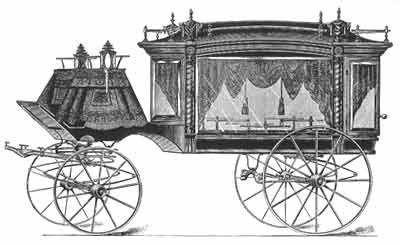
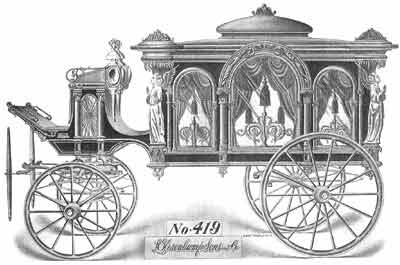
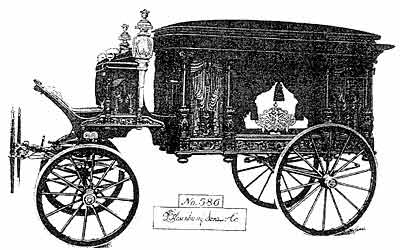
Sometime prior to 1890 the firm started building funeral coaches, and
their 1890 directory advertisement stated the fact:
“L. Glesenkamp, builders
of funeral cars and Berlin Coaches.”
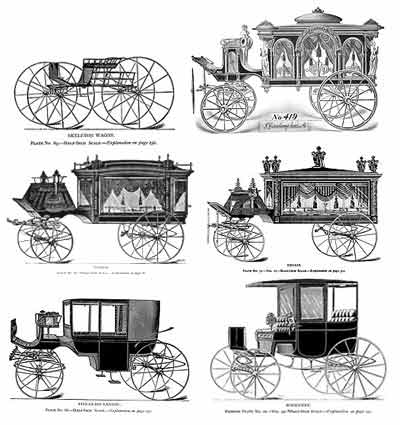
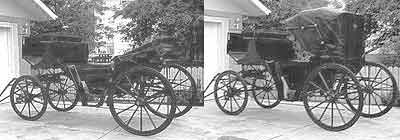
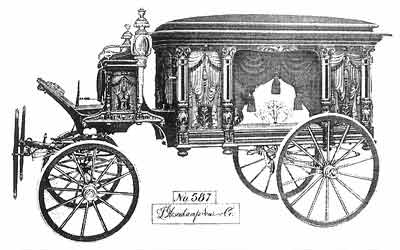
The June 1908 issue of the Hub ran a picture of an Elaborate Funeral Car
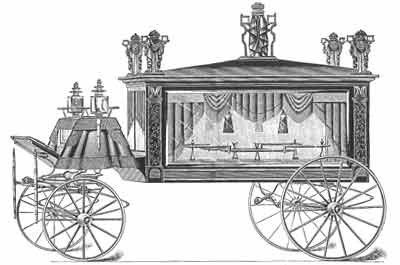
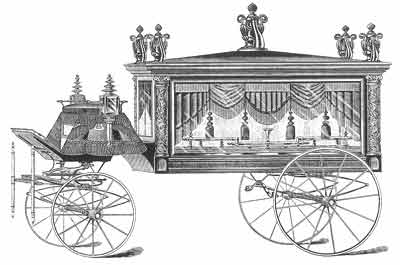
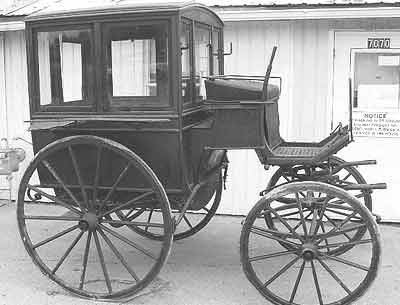
with Brake and Ornamental Boot that was built by the firm and the Carriage Monthly occasionally included renderings of the firm’s funeral coaches as follows:
December 1884 issue, Plate No. 66. Five-Glass Landau.
December 1884 issue, Plate No. 69. Skeleton Wagon.
June 1885 issue, Plate No. 18. Hearse.
August 1898 issue, Plate No. 22. Rockaway.
January 1892 issue, Plate No. 73. Hearse.
February 1891 issue, Plate No. 81. Adult Funeral Car.
March 1903 issue, Plate No. 673. Funeral Car.
From 1883 to 1886 C.H. Vorhees (born 1852, Detroit, Michigan) held the
position of draftsman and superintendent of L. Glesenkamp, Sons & Co. Prior
to the appointment Vorhees had worked for Brewster & Co., Charles S. Caffrey
Co., Holcomb Bros. and Henry Killam & Co. After his stay at Glesenkamp, he
worked for the Kalamazoo Buggy Co. and for C. R. & J. C. Wilson, Detroit,
Michigan. In September, 1896, he was engaged with the La Porte Carriage Co.
as superintendent and draftsman, and was still there in the early 1900s.
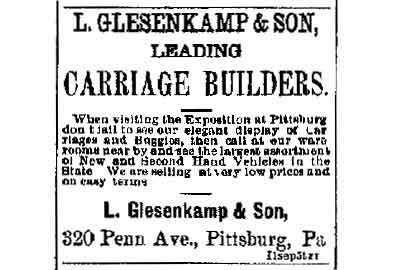
L. Glesenkamp & Son were exhibitors at the Pittsburgh Point Exhibition
Halls' premiere in 1889. ‘Industries and wealth of Pittsburgh and Environs’
published in 1890 gave the following description of the Glesenkamp works:
“The factory is four stories in height, and 75x100 feet in dimensions,
while it is fully equipped with the latest improved machinery and appliances
run by steam power. Upwards of 150 skilled hands are here employed in the
manufacture of the finest lines of buggies, phaetons, coupes, Victorias,
broughams, coaches, surreys, “T” carts, etc.
"Quality has ever been the first consideration, and the firm use the
finest of materials only, while they have become nationally famous for
originating the most artistic styles of fine carriages, elaborately
finished, and in every way representative of the carriage maker’s art. The
leading citizens of Pittsburgh use vehicles of their manufacture
exclusively, while the firm supplies the best class of trade throughout
Ohio, Kentucky, Missouri, Indiana, Illinois, and throughout Pennsylvania
generally. Mr. L. Glesenkamp is one of the acknowledged experts in his
branch of trade, the representative thereof in western Pennsylvania, and the
firm is to be congratulated upon the large measure of success attending its
ably directed efforts. Mr. J.A. Glesenkamp is a most efficient office man,
while Mr. L. Glesenkamp, Jr., (another son) who acts as superintendent, is
a valued assistant to his father in the sops, and the concern is the best
managed carriage factory we have ever inspected.”
Joseph A. Glesenkamp was born in Pittsburgh in 1862, to Louis and Mary
Riley Glesenkamp. After a public education he attended Newell's Institute
and graduated from Duff's College in 1880 after which he entered his
father's business, thoroughly acquainting himself with all aspects of the
firm. He was subsequently made a partner and the firm was reorganized as L.
Glesenkamp & Son. Following the prolonged 1897 illness of his father he took
over the day-to-day management of the firm aided by his younger brother,
Louis Glesenkamp Jr.
Louis Glesenkamp Sr., the founder of the firm bearing his name, passed
away after a prolonged bought of respiratory failure on Saturday, May 21,
1898. The following obituary appeared in the June 1898 issue of Carriage
Monthly:
“Louis Glesenkamp, of Pittsburg, Pennsylvania, head of the carriage
manufacturing house of L. Glesenkamp, Sons & Co., died after a week’s
illness at his home, 4816 Liberty avenue, Pittsburg, on Saturday, May 21st.
He was born in Belm, Hanover, January 7, 1826, and learned the trade of
carriage building in his native town. He came to New York in 1848, and made
that city his home for some months. He came to Pittsburg, where he has lived
ever since. He was there but a short time when he saw an opening for fine
carriage work, and offered his services. He soon became recognized as the
most advanced and skillful workman in the carriage craft in Western
Pennsylvania. It is said of him that in his early carriage building, he
executed some jobs the like of which has never since been attempted or
accomplished.
“In 1853, he opened an establishment of his own, which soon became noted
for the excellence and originality of work turned out. He showed not only
workmanlike skill, but remarkable business ability, and soon established a
large and prosperous carriage building establishment. He was married in
1852, and is survived by a widow and six children. Two of his sons now
control the business. Mr. Glesenkamp, though an old man, was very active and
paid strict attention to business, seldom missing a day at his desk. During
his career as a carriage builder, he brought to this city much work which
had been done abroad. His work was known far and wide for originality of
design and excellence of execution in all the finer details of work. He
established a standard of excellence, which has remained ever since as a
model for others. His life was lived not merely to make money and do work,
but to achieve a high ideal in his craft. This he has nobly done, and with a
modesty of demeanor that won for him hosts of friends. Thus passes away
another of the old time carriage builders, whose memory will remain long.
His work is his most fitting gift to his craft.”
The July 1898 issue of the Hub also covered the sad event:
“Louis Glesenkamp, the oldest carriage manufacturer in Pennsylvania, and
the head of one of the old business firms in this city, died on May 21 at
his home, 4816 Liberty avenue. Mr. Glesenkamp has been ailing for several
years with asthma, but had not at any time been in a serious condition. For
the past eight months, however, he had been confined to the house, yet he
attended to every detail of his business, and was not taken dangerously ill
until last Tuesday. He was compelled to take his bed, and it was then that
his family began to fear for his life. He gradually became weaker, and on
Thursday it was seen that he could not live much longer. Yesterday he slowly
sank until death came at just 7 o'clock.
“Louis Glesenkamp was widely known in all parts of the State. He was born
in Belm, in the kingdom of Hanover, Germany, Jan. 7, 1826. He received his
education there, and then learned the trade of carriage building. Mr.
Glesenkamp came to America in 1848. He remained in New York for a few
months, and then moved to Pittsburg, where he opened a carriage factory and
where he resided up to the time of his death.”
Another Hub article also dating from July, 1898 dealt with the Glesenkamp
estate:
“Pittsburg‑‑The will of Louis Glesenkamp, the well known Pittsburg
carriage builder, was filed for probate on May 25. The estate is valued at
$100,000. Mary Glesenkamp, wife of the testator, is bequeathed the household
goods, and insurance policy for $10,000 and the real estate on Liberty
avenue, Twentieth ward, she now has possession of. In addition to this the
wife is bequeathed the testator's interest in the firm of Glesenkamp Sons &
Co., she having the right to continue in the business or dispose of her
interest as may suit her. In the event of the wife's desire to sell her
interest it is directed that Joseph Glesenkamp, a son, be given the first
chance to purchase. Real estate on Liberty and Penn avenues, Twentieth ward,
now occupied as a carriage factory, valued at $75,000, upon which there is a
mortgage of $30,000, is bequeathed to his sons Joseph and Louis Glesenkamp.
If the sons decline to accept the mortgage, the real estate shall be sold,
and the proceeds of the sale shall be counted in as part of the estate for
general distribution. To Mary Glesenkamp, a grand-daughter, is left $1,000.
The residue of the estate is to be divided into six equal parts. One part is
to be used in the purchase of a house for Catherine Glesenkamp, a
daughter‑in‑law, and her children. The other parts are to be divided among
Mrs. Sarah O'Neil, Mrs. Mary J. Carr, Mrs. Amelia Skelly, daughters, and
Joseph and Louis Glesenkamp, sons. The latter are appointed executors.”
A little more than a year after Louis Glesenkamp passed away, a major
fire destroyed his Liberty St. factory.
A Period account:
“Fire In Pittsburgh.
Pittsburgh. Pa,. July 18. - The carriage factory of L. Glesenkamp & Son
at Third and Liberty streets was destroyed by fire Tuesday night. Loss,
$60,000, well covered by insurance.”
The firm’s office and wareroom on Penn Ave were spared, but the blaze
totally destroyed the firm’s 319-323 Liberty St. factory which housed the
woodwork, ironing and varnishing departments. The insurance money was used
to re-build the factory and William B. Scaife & Sons, were awarded a
contract to construct a steel frame building to house a new boiler which
supplied steam heat and power to the rebuilt Glesenkamp works. Louis
Glesenkamp’s widow, Mary died on February 2, 1902, giving James A. and Louis
Jr. complete control of the firm.
For many years L. Glesenkamp & Co. owned two railcars that were used to
transports raw materials to and finished carriages from their Pittsburgh
factories. A description of the cars from the 1904 Official Railway
Equipment Register follows:
“GLESENKAMP CARRIAGE LINE.
“Cars operated are marked "Glesenkamp Carriage Line," and numbered 320
and 325
“The dimensions are as follows: Car 320, height from top of rail to top
of running board. 13 ft. 10 ½ in.; height from top of rail to eave, 13 ft. 2
½ In.; width over eaves, 9 ft. 7 ¼ in.; length (outside), 40 ft.. 10 In.;
end door, 8x9 ft.; side doors, 7x9 ft.; Car 325: height from top of rail to
top of running board, 13 ft. 10 in. ; height from top of rail to eave, 13
ft. 2 ½ in.; width over eaves, 9 ft. 8 In.; length (outside), 40 ft. 10
In.; end door, 8x9 ft. ; side doors, 7x9 ft.
Report movements and mileage, and send remittances to L. Glesenkamp,
Sons & Co., Pittsburgh, Pa. Return cars to Pittsburgh & Western Division B.&O.R.R..
Allegheny Yards when empty. Load clean freight only.”
In 1909 the Glesenkamp brothers announced they were spending an
additional $15,000 to modernize the Liberty St factory. At the 4th annual
Pittsburgh Automobile Show, which was held at Duquesne Gardens beginning
March 26, 1910, the firm displayed examples of the automobile coachwork. A
regional newspaper stated:
“The displays of bodies were live centers of
interest Saturday night, for two local firms, L. Glesenkamp & Sons Co., and
the E.J. Thompson Co.”
The July 1912, issue of the Commercial Vehicle, contained the following
announcement:
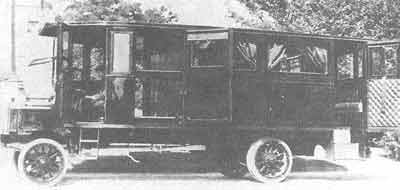
“A Complete Funeral Car
“A NOVEL funeral car has been completed for J. J. Flannery & Bro.,
Pittsburgh, Pa. The chassis is a Packard with a special body built by
Glesenkamp Sons & Co., Pittsburgh. It is a single-unit vehicle having a
compartment for the driver, one immediately in rear of it for the casket and
the major part of the vehicle a carriage with accommodation for thirty-two
persons. There is a fourth compartment for flowers, which is located above
and in rear of the chauffeur's space. The vehicle is intended to serve as a
complete funeral car.
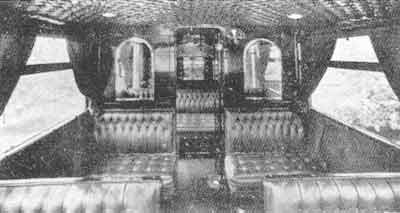
“The body, finished in dark panels with blank moldings, has the usual
carriage finish. The chassis color is azure blue. The interior is
oil-finished mahogany, the seats are upholstered in dark blue leather and
the sides of the interior is the same leather.
“The vehicle is lighted throughout by electricity and carries electric
fans and telephone system connecting with the various compartments. Special
fixtures include washstand, water coolers, etc.
“The chassis was planned specially for the particular job and is shod
with solid rubbers all around, single tires in the front and duals in the
rear. There are three side entrances, one for each of the different
compartments of the vehicle.”
A number of firms built funeral omnibuses in the early days of the
motorized coach and more often than not they were one-off vehicles built on
commercial truck or bus chassis manufactured by commercial vehicle body
builders, and not regular professional car manufacturers.
Known manufacturers include:
1910 - Fred Hulberg - New York, NY
1912 - L. Glesenkamp Sons & Co.- Pittsburgh, PA
1915 - J.C. Brill – Philadelphia, PA
1918 - Fifth Avenue Coach Co – New York, NY
1919 - Fitzgibbon & Crisp - Trenton, NJ
1920 - William Merz - Philadelphia, PA
1982 - Airstream-GMC Funeral Coach
Unfortunately the debut of the Glesenkamp Funeral Omnibus did not result
in additional orders and the increasing popularity of popular priced
automobiles brought the firms carriage building business to a crawl.
By 1916 L. Glesenkamp Co. had sold its Liberty St factory to the
Pennsylvania Railroad and relocated to 6118 Station St. at Collins Ave. An
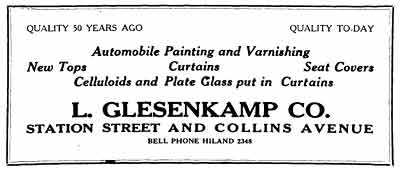
advertisement in the 1917 Pittsburgh Jewish Community Book follows:
“Automobile Painting & Varnishing, New Tops, Curtains and Seat Covers.
Celluloids and plate glass put in curtains. Quality 50 Years Ago, Quality
To-Day”
The 1918 City Business Directory continued to list the firm under
Automobile Painting, but it’s likely Glesenkamp did not survive the
Depression of 1919-1920, as it was noticeably absent from subsequent
editions of the Pittsburgh Directory.
Joseph A. Glesenkamp is listed in the 1922 Pittsburgh City Directory as a
manufacturers’ agent with an office at 603 Wabash Building, an 11-story
Beaux-Arts building that housed the Wabash Terminal Train Station on the
ground floor which was located across the street from the old Glesenkamp
factory at the corner of Liberty Ave and Ferry St. (formerly Stanwix St.).
Louis Glesenkamp Jr.’s listing gave his occupation as automobile salesman
with a business located at 317 Chislett St.
© 2004 Mark Theobald - Coachbuilt.com with special thanks to Thomas A.
McPherson
|
|
|