|
|
|
 |
||||||||||
|
||||||||||
|
|
||||||||||
|
||||||||||
|
||||||||||
|
|
||||||||||
|
|
|||||||||
|
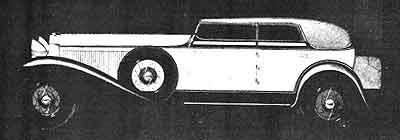
Disaster struck the Derham organization in 1928 when the firm’s patriarch and founder, Joseph J. Derham died unexpectedly at the age of 63. His passing caused a rift between his offspring that threatened to change the course of the firm for the first time. Philip wanted the firm to modernize by greatly increasing its production, thereby reducing its per-unit costs by utilizing the proven economies of scale theories then prevalent in the auto industry. However, James and Enos, his two younger brothers were opposed to any drastic changes, and wished to keep the firm running as their father had intended. The majority views of James and Enos prevailed and Philip left the company to form his own firm. Funded by a Bryn Mawr-based European car importer by the name of William Floyd, the Floyd-Derham Company was formed in 1928 with William Floyd Sr., president; Philip Derham, Vice-President; and Floyd’s son William Jr., Secretary. Philip Derham handled all the design and drafting work while the actual bodies were built at Alexander Wolfington, Sons and Company, a well-known Philadelphia commercial body builder. The Floyds already had a high visibility showroom and service depot in Bryn Mawr, located less than a mile from Derham’s Lancaster Ave. showroom. When the Floyd-Derham name was added to the Floyd’s Bryn Mawr showroom, it caused quite a stir as well as a bit of confusion in Rosemont as to who was who. Floyd-Derham’s first Salon entry was a Minerva that they exhibited at the Chicago Salon in the Fall of 1928. At December’s New York Salon, they exhibited an Isotta-Fraschini convertible sedan at the Isotta-Fraschini stand, but unfortunately it was the last time that the firm’s work would appear at any salon. It was early 1929 before the first few Floyd-Derham bodies appeared and by that time, the stock market crash was looming on the horizon. Although Floyd-Derham had a backlog of orders, the Floyds imported car business began to flounder and they pulled the plug on the Floyd-Derham project. Luckily for Philip Derham, his work attracted the attention of Duesenberg, and he was soon hired on as their chief body engineer. James and Enos Derham felt some responsibility for their brother’s misfortune and as their firm’s name was involved, they helped Wolfington Sons and Co complete the remaining orders at their own shop. Not surprisingly, there was an announcement in early 1930 that Alexander Wolfington, Sons and Company had "resumed the manufacture of custom bodies." And among their first products was a gorgeous Duesenberg convertible sedan that was designed by Philip Derham for John B. Stetson, a member of the Stetson Hat family who was also the ambassador to Poland from 1925-1930 (Duesenberg chassis #2147). Wolfington also built another Duesenberg for John Eberson, a movie theater designer later in the same year (Duesenberg chassis #2240). This is the more famous Wolfington "Royal Phaeton" dual cowl phaeton that currently resides in the automotive collection of the Reynold's Alberta Museum in Wetaskiwin, Alberta, Canada. The vehicle's unusual design is jointly credited to Derham, John Eberson and J. Herbert Newport, who had recently joined Duesenberg as an assistant to Gordon Buehrig. The departure of Philip Derham proved to be damaging to the Derham firm at least in the short term. Not only did Philip use the family’s name for his own shop, he took along a number of long-time employees and lured a number of Derham’s customers to his new business. The new Floyd-Derham Co. created confusion among Derham's old customers who didn't realize there were two separate companies. But luckily the firm was short-lived, and Derham took care of any problems that may have been caused by the associated firm. Although little is known of Philip Derham’s tenure at Duesenberg, he worked alongside three of the classic era’s most brilliant designers, Gordon Buehrig, J. Herbert Newport Jr. and Alex Tremulis. Buehrig was hired by Duesenberg as its chief body designer after a meeting with its vice-president, Harold T. Ames, a few days after the 1929 Indianapolis 500. J. Herbert Newport Jr. had been with Studebaker, Dietrich and Brunn before joining Duesenberg in February of 1933. Tremulis was hired in 1933 to assist Newport and eventually became the firm’s chief stylist after Buehrig left the firm to work for Budd in 1936. In 1934 Derham partnered with Newport in a side-project to develop a fast, lightweight custom-bodied sport coupe that could be mounted on a Ford Model A chassis that was to marketed as the Aeronaut. They were not alone in their scheme to re-body the popular Model A. Two long-established builders – Brewster and Cunningham – developed similar models during the same time period, but only the Brewster-Fords reached the market in any numbers. In the Feb-Mar 1973 issue of Special Interest Auto (#15), Newport reflected on the Aeronaut project:
Alex Tremulis was also involved in the project and in the Apr-May 1973 issue of Special Interest Auto (#16), he told of his experience with the short-lived Derham project:
© 2004 Mark Theobald - Coachbuilt.com
|
||||||||||
|
||||||||||
|
||||||||||
|
||||||||||
|
||||||||||
|
|
||||||||||
|
|
||||||||||
|
|
||||||||||
|
||||||||||
|
|
||||||||||
|
|
||||||||||
|
|
||||||||||
|
© 2004-2012 Coachbuilt.com, Inc.|books|disclaimer|index|privacy |
||||||||||