|
Trenton, New Jersey’s Union Wagon
Works was established in 1849 on the western edge of Trenton. In 1869 the
original firm’s founder retired and sold the works to two of his employees,
woodworker Patrick J. Fitzgibbon, and blacksmith Philip D. Crisp.
Located
at the intersection of Bank and Warren Sts., the pair conducted business as
the Union Carriage Works, Fitzgibbon & Crisp, proprietors. They exhibited at
Philadelphia's 1876 Centennial Exhibition where the firm was described as
“one of the most complete” manufacturers of its kind in the country, ranking
with the “great wagon manufacturers of the Northwest.”
Fitzgibbon created the firm’s magnificent coachwork and Crisp turned out
the carriage gear and hardware in the firm’s smithworks. The works now
occupied a handful of three and four story brick structures running along
the main line of the Philadelphia & Reading Rail Road, which gave it easy
access to raw materials as well as markets in Philadelphia, New York City
and Eastern New Jersey.
In addition to its fine carriages and commercial wagons, the firm also
produced large numbers of horse-drawn trolley cars. When the horse-drawn
vehicles were replaced by electric street railways in the late 19th and
early 20th Century, Fitzgibbon & Crisp eagerly entered the streetcar
business, producing vehicles for a number of local and regional operators.
The 1881 Trenton City directory: has four entries relating to the firm:
“FITZGIBBON & CRISP, Union
carriage works, 28, 30 and 32 Bank
UNION CARRIAGE FACTORY (Fitzgibbon & Crisp), Bank n Warren
Crisp, Philip D. (Fitzgibbon & Crisp), h 106 Spring
Fitzgibbon, Patrick J. (Fitzgibbon & Crisp), h 40 Bank”
On October 4, 1888, the firm’s factory was partially destroyed by a fire
which caused $90,000 in damage, reportedly covered by insurance. They were
back in business by the beginning of 1889 as evidenced by the following news
item from the February 1, 1889 issue of the Trenton Evening Times:
“The ‘Reading’ cabs made their appearance on the street for the first
time this morning. Only two have been sent to Trenton. They are Nos. 159 and
160. The cabs are not cabs, but coupes, somewhat larger than those in
ordinary use, and have the word "Reading" painted on them. They are very
handsome, and were made by Fitzgibbon & Crisp, of this city, who have orders
for eight of them, four to be used in this city.”
The Aril 2, 1980 issue of the Trenton Evening Times contained the
following loosely disguised advertisement:
“Fitzgibbon & Crisp
“In making this review of the various prominent firms it is interesting
to note the advances that have been made in each industry. With these
remarks special attention is directed to the reliable and popular carriage
and wagon manufactory of Messrs. Fitzgibbon & Crisp, located Nos. 28, 30 and
32 Bank Street. This is the leading and largest works of its kind in the
State. They build all kinds of light family carriages, from the light track
sulky to the stately coach, and from a light grocer's wagon to the heaviest
truck, also Rockaways, phaetons, buggies, etc , while in their show rooms
can usually be seen one of the finest stocks of these productions to be
found in the State. Their work has a reputation for being of the very best,
which extends to all parts of the country. This house enjoys a liberal and
influential patronage from many of our most prominent citizens. The members
of this firm have devoted many years of experience and care to this most
important branch of business, and are widely known both in private and
commercial life as honorable business men, well deserving of the success
they have achieved.”
On January 27, 1893 the Trenton Evening Times reported:
“The Fitzgibbon & Crisp Carriage and Wagon Company has been incorporated
with an authorized capital stock of $125,000. The works and main office will
be in this city.”
In 1894 Fitzgibbon & Crisp manufactured a familiar Trenton landmark,
Peter G. Curtin’s pioneer lunch wagon, which stood on Broad Street in front
of the City Hall every night until it was replaced in 1911. The lunch wagon
hours were usually from 9 P.M. to 4:30 A.M., one of its busiest periods
being when the crowds from the Taylor Opera House stopped by for a snack
while awaiting the last trolley home.
Tragedy struck the firm on the morning of April, 19, 1899. A headline in
that evening’s Trenton Evening Times announced:
“Phillip D. Crisp, Carriage Maker, Hanged Himself This Morning
“Two of His Employees Found Him Suspended by a Rope From a Joist in the
Stock Room of the Fitzgibbon and Crisp Works at 7 o'clock This Morning rand
Though the Body Was Still Warm, Life Was Extinct.
“SAD ACT OF SELF DESTRUCTION BY AN ESTEEMED CITIZEN
“The Cause is Attributed to the Effects of an Attack of the Grippe, From
Which He Had Never Fully Recovered - The Deceased Was Highly Esteemed by All
Who Came in Contact With Him - A Conscientious Workman, to Whose Unremitting
Care was Due Much of the Success of the Great Carriage Works.
“Philip D. Crisp, one of the best known business men of this city, and a
member of the firm of Fitzgibbon & Crisp, one of the largest carriage and
wagon manufacturing companies in the State, committed suicide by hanging
just before 7 o'clock this morning, in the stock room of the workshops on
Bank street. Poor health is the reason assigned by the family and friends of
the dead man for the rash act, although unconfirmed rumors of his financial
embarrassment have been current during the day.
“Mr. Crisp has always enjoyed good health until a few months ago, when he
was stricken with the grippe, and from that he never fully recovered. He has
since complained almost continually of severe pains in the head and at times
was almost distracted with the agony of his suffering. It was only last
evening that he said to one of the workmen, while preparing to leave the
shop: "O, my head! My head! If this keeps on I don't know what I will do. I
never felt so badly in all my life." Dr. William Rice, who has been the
attending physician during Mr. Crisp's illness, said the disease left him in
the state of melancholy which is so common among grippe patients, and which
has been the cause of so many suicides during the past few years.
“Rumors of Financial Embarrassment.
“The rumors of his financial troubles have been denied by those who are
in a position to know of his affairs. A member of the firm told the writer
that the finances of the corporation were all right, and that so far as he
knew Mr. Crisp's personal accounts were in good shape. The latter statement
was afterward corroborated by one of the city's best known bankers. Mr.
Crisp left home about half-past six o'clock this rooming, his usual time,
and walked directly to the shops. His family noticed nothing unusual in his
manner, and with those who met him on the street he exchanged greetings in
his usual genial way. He arrived at the shop before many of the men had
reported for duty, but as that was his usual custom it created no comment
among the few who were present. He passed unnoticed into the buildings in
the rear and ascended the stairs to the second floor.
“When Last Seen Alive.
“That was about twenty minutes before seven, and that was the last time
he was seen alive. About fifteen minutes later Frank Murphy and Alfred
Anderson, two of the firm's employees, entered the stock rooms and were
horrified to see their employer hanging by his neck from the ceiling. Murphy
was the first to make the gruesome discovery, and his shout of warning to
his companion alarmed the other workmen, and they came running into the
apartment. Mr. Crisp's body was hanging with the feet within a few inches of
the floor, and Anderson raised it up while Murphy cut the rope which had
been drawn tight by the weight. When the body was released the head fell
back limp and lifeless, and the men realized that they were too late.
Hoping, however, that a spark of vitality might yet remain, messengers were
dispatched for a doctor.
“The Doctors Are Sent For.
“Dr. W. S. Lalor, of North Warren street, was the first to respond, and
he was followed a moment later by Dr. R. R. Rogers, Jr., the county
physician. A hurried examination was made, but the fears of the men were
realized, life had been extinct when the body was cut down. The rope with
which Mr. Crisp ended his career was a new one, and had been brought by him
from his home. It was usually kept in the show rooms, and had been used on
several occasions for removing vehicles from the establishment. It was used
for that purpose yesterday, and was left at Mr. Crisp's residence last
evening. He placed it in his pocket this morning, saying he would take it
back to the shop. When he was found one end had been securely fastened to a
post near the floor, the other had been extended through the bridging in the
ceiling joists above, and then tied in a slip knot about his neck. From
appearance he had evidently stood on a wheel to adjust the noose, and had
then swung himself into eternity. The early finding of his body prevented
any discoloration, and the appearance of the face was calm and peaceful,
despite the awful end. When the doctors determined that he was beyond human
aid, Coroner Disbrow was telephoned for, but before his arrival Coroner
Walker appeared and after viewing the remains gave permission for their
removal.
"A Most Highly Respected Citizen.
“Mr. Crisp has long been known as one of the most highly respected
citizens of Trenton. He was honored and esteemed by all, and had friends in
every rank of life. Among those who loved him best were the men in his
employ, many of whom had served him for nearly twenty years. His dealings
with the business world were always open and above board, and through his
efforts much of the good reputation of the firm was obtained. He has lived
in Trenton nearly 40 years. He was a blacksmith by occupation, and was
employed for several years in the different shops about the town. In 1869 he
and P. J. Fitzgibbon formed a partnership and located in the present stand
incorporated in 1893 with a capitalization of $125,000. Since that time the
business has been materially increased and the product has also been sold in
all parts of the United States and in many foreign countries.
“His. Home Life.
“Mr. Crisp was man led, and his wife and three grown daughters survive.
The latter are Mrs. Joseph Williams, of Spring street; Mrs. Harry Michel, of
West Hanover street, and Miss Hattie Crisp, who resides at home. William H.
Crisp, the well-known grocer, was a brother of the deceased. He resided on
Spring street in a handsome brick dwelling, and always took particular pride
in the care and keeping of his home. He has recently
had the property renovated and improved. His home life was a congenial
one, and the blow is a sad one to the loved ones who are left behind. Mr.
Crisp was always actively interested in municipal affairs, but never held
any public office, as he devoted his time wholly to his business. He was a
member of several secret and benevolent associations. The funeral, which
will be under the direction of Undertaker Harry A. Ashmore, has not yet been
fully arranged for.”
The August 15, 1899 issue of the Trenton Evening Times included the
following item of interest:
“Taken a New Position.
“Harry Fitzgibbon, of South Broad street, has severed his connection with
the Prudential Insurance Company and has taken a position with his father in
the firm of Fitzgibbon & Crisp, the wagon builders.”
The 1900 Trenton City Directory contained three entries related to the
firm:
“FITZGIBBON & CRISP CARRIAGE AND WAGON CO; THE, (Patrick J Fitzgibbon),
36 Bank
Fitzgibbon Harry J, wagon builder, h 141 Philemon
FITZGIBBON PATRICK J, (Fitzgibbon & Crisp Co), h 344 Bellevue ave”
The 1901 Industrial Directory of New Jersey states that the firm’s 30
employees were engaged in the manufacture of wagons and carriages.
The New Jersey Bureau of Industrial Statistics, New Jersey Bureau of
Statistics of Labor and Industries stated in their 1903 annual report, that
in February of 1902:
“The Fitzgibbon & Crisp Carriage & Wagon Company of
Trenton has been absorbed by a combination of carriage manufacturers, which
includes about a dozen firms. The old name will be retained. The capital
stock of the local company is $125.000. The establishment is the largest of
its kind in the state.”
The carriage combine hinted at in the article never materialized and the
firm remained in the hands of the Fitzgibbon & Crisp families. A 1903 issue
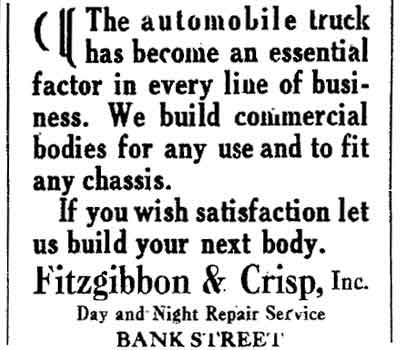
of The Automobile announced that Fitzgibbon & Crisp had built a
gasoline-driven rail car for a local interurban railway.
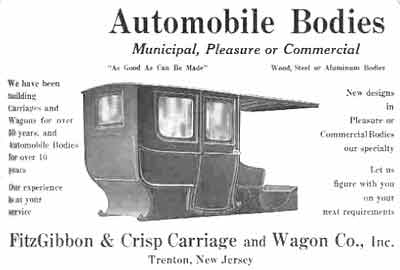
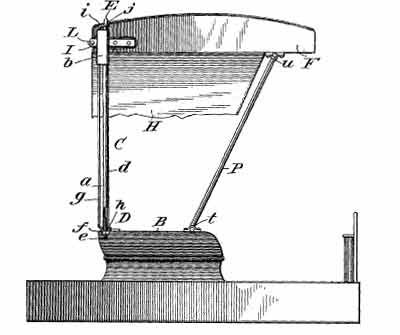
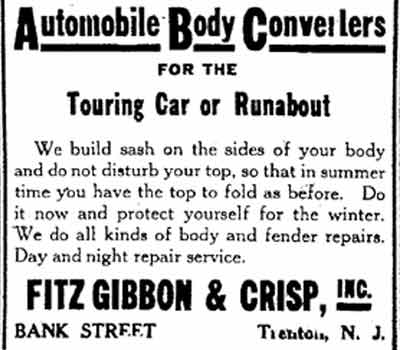
At about the same time they started building wood bodies for some of the
regions pioneer automobile manufacturers and by 1908 their listing in the
Trenton City directory advertised that fact:
"Fitzgibbon & Crisp Carriage & Auto Body Co., 36 Bank St - Wood and
metallic bodies, auto tops."
The firm’s founder, Patrick J. Fitzgibbon, died on October 20, 1910, and
the presidency was assumed by his son, Harry J. Fitzgibbon.
The June 17, 1911 issue of the Trenton Evening Times announced:
“Fitzgibbon & Crisp Busy.
“The Fitzgibbon & Crisp Company delivered last week the following auto
bodies: Six-passenger opera “bus” to United States Motor Company of
Philadelphia, for a Sampson chassis; a 12-passenger station bus to the Knox
Company, of Philadelphia; an elaborate undertaker's car to Ivins & Taylor,
on a Thomas chassis, and a fore-door touring body finished in brown and
mounted on an Otto chassis.”
Despite his years of experience, Harry Fitzgibbon was unable to keep the
Fitzgibbon & Crisp Carriage & Wagon Co. in the black after the death of his
father and following a complaint by the firm’s largest creditor, the Trenton
Trust and Safe Deposit Company, a bankruptcy court appointed Charles Walker
receiver in early 1912. At the end of the year, the judged ruled the firm
insolvent and ordered the firm’s property and assets to be auctioned at a
public sale to take place on January 14, 1913.
The Trenton Evening Times published a notice of the sale in early
January:
“Wagon and Body Plant
RECEIVER'S PUBLIC SALE
Tuesday January 14, 1913, 2 PM
“The plant of the Fitzgibbon & Crisp Carriage and Wagon Co., located in
the heart of Trenton, N.J., including land, buildings, machinery, stock,
fixtures, work finished and unfinished, and all personal property, except
book accounts. The plant has been profitably operated by the receiver since
June 1912.
“Sold subject to a mortgage lien of $40,000 represented by a bond issue
maturing in 1922 (not in default) and city taxes due, to amount about
$3,000. The sinking fund for the retirement of bonds is worth about $17,000.
“Terms: 10 per cent, purchase price cash; balance upon delivery of deed,
after confirmation of sale by court.
“Further information upon application to receiver.
A LIVE, GOING, ACTIVE PLANT.
Receiver Fitzgibbon & Crisp Carriage & Wagon Company, Bank Street”
A trio of Trenton businessmen - all directors of the Trenton Trust and
Safe Deposit Co.; H. Arthur Smith, James C. Tattersall and Lion L. Woodward
- believed that with proper management the firm could be salvaged. They
arranged to purchase the firm from the firm’s receiver and reorganized it as
Fitzgibbon & Crisp, Inc., with Woodward shouldered with the task of making
the firm profitable.
Within a few short weeks a plan to manufacture a Fitzgibbon automobile
was promoted by Woodward who proposed an additional capitalization of
$100,000 to finance the venture. The automobile venture did not go beyond
the planning stage, however the announcement garnered the struggling firm
some much-needed publicity.
In August and September, 1913, 2 motorized ambulance bodies were
constructed for the US Army’s Quartermaster Corps., Medical & Hospital dept.
The bill for both bodies was $4,682, or $2,341 each, a rather pricey amount
for the time.
Fitzgibbon & Crisp had a long-term relationship with the Thornton-Fuller
Automobile Co. of Philadelphia, Pennsylvania. Organized on December 11,
1911, Thornton-Fuller was the Philadelphia distributor of the Simplex and
later Crane-Simplex automobile.
Samuel S. Thornton, a principle of the firm, had earlier served as the
sales manager for J.M. Quinby & Co.’s Philadelphia branch.
Thornton resigned from Quinby to open Thornton-Fuller, and was given
Simplex’s Philadelphia, Eastern Pennsylvania and Southern New Jersey
distributorship, which up until that time was held by Quinby. Bad blood with
Colonel Quinby led to Fitzgibbon & Crisp’s lucrative arrangement with the
Simplex’s Philadelphia sales branch.
At that time Fitzgibbon & Crisp was not well-known for their funeral
cars, but all that changed when they began limited production of the funeral
omnibus, the first example being announced in the February 28, 1914 Trenton
Evening Times:
“LOCAL FIRM TURNS OUT FUNERAL CAR
"What is unquestionably one of the finest bodies ever built for a motor
vehicle has just been completed by Fitzgibbon & Crisp, Inc. builders of
carriages and wagons. The body has been erected on Packard automobile
chassis and is to be used as a funeral car. It was intended that the car be
tried here in this city by Murphy's undertaking establishment, but the plans
did not materialize and the car will be shipped to New York. The car is done
in black and is capable of carrying a casket, bearers and mourners. The
upholstering is the finest ever put in an automobile. The vehicle can also
be used as a club car.”
A few months later another business feature/advertisement appeared in the
April 4, 1914 Trenton Evening Times:
“FITZGIBBON & CRISP PLANT ALWAYS BUSY
Firm Makes Specialty of building Automobile Bodies to Order – Quick
Repairs
“Issuing no catalog and not having any traveling salesmen but enjoying a
business that necessitates the running of their departments overtime is the
unique position enjoyed in the business world by Fitzgibbon & Crisp, the
local wagon and automobile top manufacturers. The employees of the firm have
been, working over time almost continuously for the past year and one
department works all night.
“The success secret of Fitzgibbon & Crisp is that they employ artisans -
men who thoroughly understand the work assigned to them. Some of these
mechanics have been in the employ of the firm thirty years and their long
experience has made them expert. The work that these men turn out is the
trade-getter for their firm. Their product, by elegance and fineness of
construction, invariably brings a return order.
“In securing these artisans, Fitzgibbon & Crisp have made it an aim to
get the best possible in respective trades. After this line of men is
secured, the firm, by its fair treatment, is usually successful in retaining
them. Everything is harmonious between the men and the firm and labor
disputes are unheard of.
“Fitzgibbon & Crisp specialize in design work, such as the making of
commercial bodies, special design bodies for limousines, ambulances, hearses
and other undertaker vehicles. The firm at present has in its warerooms two
funeral coaches that were made especially for a New York undertaker. These
coaches are a work of art. They each hold twenty-eight people and contain a
separate compartment for the casket and family of the deceased. The
furniture is of solid mahogany, and each hearse is lighted by electricity
and contains a special ventilating system.
“The firm has also in its warerooms two limousine automobiles that were
built for the United States government. They were ordered for army generals
for use in Washington and San Francisco. These cars, which are handsome in
design, are convertible so that the medical department may use them as
ambulances.
“Fitzgibbon & Crisp are the largest builders of commercial bodies in the
state. They are kept so busy in this and the special design line that an
order for 10,000 pleasure bodies was recently refused. Their special bodies
are usually designed for the high-grade cars. They might properly be termed
a firm that makes bodies to order. While the firm specializes in design
bodies, it still continues to build and repair wagons and carriages. Orders
for this line of work are quite large and are continually being received. In
order that the fellow that constantly uses his wagon or automobile may not
be inconvenienced for any length of time, the firm has opened a night
service department. By this department, the man who is unfortunate enough to
have a breakdown may have his damaged vehicle repaired and ready for
service, in a comparatively short time. This department has become popular
and its mechanics are busily employed. James C. Tattersall is president of
the Fitzgibbon & Crisp Company, and the vice president is H. Arthur Smith,
L.L. Woodward is the secretary treasurer.”
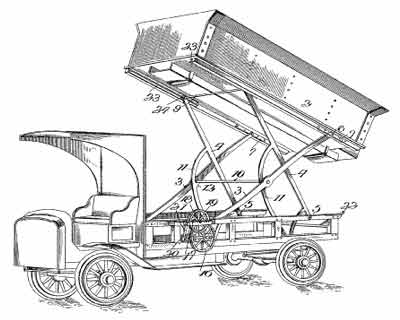
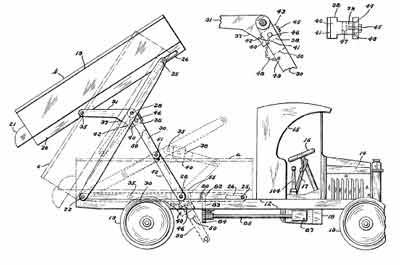
On February 20, 1915, Fitzgibbon & Crisp’s Lion L. Woodward applied for a
patent for a dumping wagon, which would eventually bring the firm lots of
business from regional municipalities.
The August 23, 1915 issue of the Automobile reported:
“Trenton Body Builds — Fitzgibbon & Crisp, Trenton, NJ, maker of
automobile bodies, will build an addition to its plant on Bank street.”
The November 30, 1915 issue of the Trenton Evening Times gave a few more
details of the planned addition:
“The Fitzgibbon & Crisp Wagon and Carriage Company is spending $100,000
in an addition, which will give 200 more men employment and place the firm
in a position next Spring to make an enormous quantity of automobile bodies
with which they have been experimenting recently.”
In fact it was decided to locate the new facility 3/4 of a mile away from
the Bank Street factory at the southwest corner of Calhoun and Dunham Sts.,
adjacent to a siding of the Philadelphia & Reading Rail Road Co. Once it was
up and running, all paint, trim and body building activities were
transferred to the new facility at 467 Calhoun St.. The firm’s old Bank St
plant was subsequently turned into an auto service center.
The new body facility allowed them to get into the lucrative interurban
rail car manufacturing business and for the next decade small numbers of
electric railcar bodies were built in Trenton.
Before Fitzgibbon & Crisp specialized in commercial bodies they produced
bespoke bodies, primarily on Mercer and Crane-Simplex chassis. Production
bodies were also supplied to the Trenton-built Mercer automobile which was
built by the Roebling and Kuser families. Peak production was in 1916 when
some 1,400 cars were built.
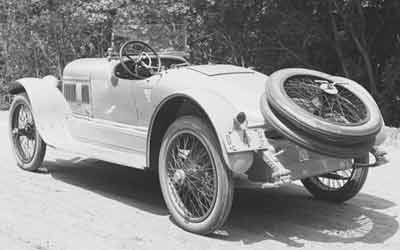
After former Packard Vice-president Emlen S. Hare took over Mercer in
late 1919, the Trenton automaker turned to building more luxurious motorcars
and Mercer’s stylish Raceabout and Sportabout bodies were built by
Fitzgibbon & Crisp.
Fitzgibbon & Crisp’s 1916 NJ Corporate Tax record stated the firm had
$150,000 in authorized capital stock and paid a 1% tax of $150.
Trenton Evening Times, March 23, 1917
“FORD CAR BODIES MADE LUXURIOUS
“Fitzgibbon & Crisp, Inc. Exhibit Attractive Features at Auto Show
“Fitzgibbon & Crisp, Incorporated, have exhibited for the first time
their especially-designed bodies for Ford cars at the Automobile Show
yesterday afternoon. Unusual interest was aroused among dealers and public
and an interested crowd surrounded the exhibit, afternoon and evening. F.F.
Woodward of Fitzgibbon & Crisp, Inc. states that the plant is building a
number of these bodies to meet the demand for comfortable riding bodies for
Ford chassis that will permit of special colors and trimming.
“The one exhibit is painted a rich dark green and trimmed in French
tapestry with green plush head lining. It has silk roller curtains in the
rear and is cozy as can be with rug carpet. Yale locks on the doors, large
inside compartment for packages and room for an extra seat, which can be
furnished, if desired. The gasoline tank is built in the back of the body
and is filled from the outside. The body is of steel and all mountings are
of nickel. It is complete in every detail, with even a rain-vision
windshield.
“The body on exhibit is the first one to be completed, but others will be
seen upon the streets soon, and one of the first will be used by Fitzgibbon
& Crisp themselves. Considering the grade of materials used and the
excellent workmanship, the bodies are very reasonably priced and doubtless
many Ford owners will invest in them.”
Another Fitzgibbon & Crisp funeral omnibus was constructed in 1919 on a
Pierce-Arrow truck chassis. Designed to eliminate the funeral procession
from urban traffic, it could carry a driver, casket and 19 mourners and
pallbearers. The Albert Brown Mortuary of Oakland, California utilized a
picture of the vehicle in its advertising during the mid-1970s, although the
advertisement does not claim they ever owned or operated such a vehicle.
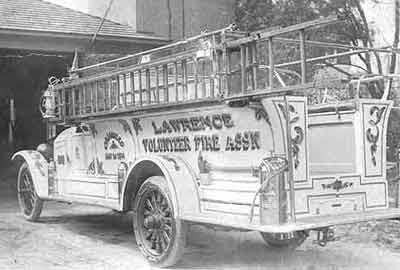
Fire trucks were another Fitzgibbon & Crisp product as evidenced by a
June 10, 1917 article in the Trenton Sunday Times Advertiser:
“A fully-equipped automobile chemical engine, costing $2,800, has been
delivered to the Lawrence Road Fire Co. by the C.P. Weedon Motor Co. of
Trenton, which was awarded the contract some months ago. The chassis is the
same as is used in the Jeffrey ton-and-one-half trucks and the body was
built by the Fitzgibbon & Crisp Co. of Trenton. The machine is the latest
model and the Lawrence Road Fire Co. is justly proud of its appearance. It
carries two 40-gallon tanks, ladders, hooks, axes, bars, lanterns, hand
extinguishers and other equipment and can, if needed, transport 18 men.”
The Firm’s entry in the 1920 Trenton City Directory listed the following
officers; Lion L. Woodward, president; Lloyd H. Rockhill treasurer; and
Samuel Simon, secretary. James C. Tattersall was still involved with the
firm as was H. Arthur Smith, the President of the Trenton Trust and Safe
Deposit Co. Two associated firms were listed at the firm’s Calhoun and
Dunham Sts. factory; Fitz Gibbon & Crisp Co. and All Weather Conditioning
Co.
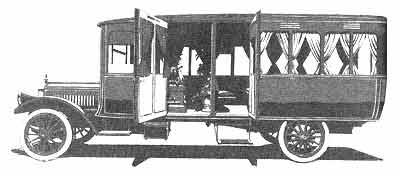
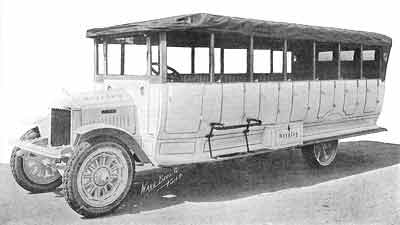
In addition to funeral cars, Fitzgibbon & Crisp manufactured many types
of commercial bodies. A modern forty-two passenger sight-seeing bus body was
pictured in Kingston Forbes’ ‘The Principles of Automobile Body Design’,
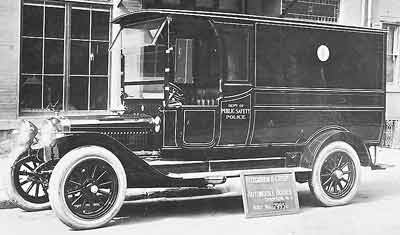
published in 1922. The Trenton Police Department were also Fitzgibbon &
Crisp customers, pictures exist of a circa 1920 Paddy Wagon that was
affectionately known as the Black Mariah.
The Thornton-Fuller Automobile Co. of Philadelphia was a long-time
Fitzgibbon & Crisp customer and in 1924 commissioned them to build an
armored body for a heavy-duty Dodge Bros. chassis. Thornton-Fuller had been
appointed the Philadelphia territory distributors for Dodge Bros. in 1921,
and would later organize a commercial vehicle division to handle Graham- and
Dodge-Bros trucks.
Thornton was an original Dodge Brothers dealer, having been identified
with the marque since its 1914 debut. In 1914 he sold 400 Dodge vehicles, in
1926 that number had risen to 7,800. In his role as one of the nation’s
largest Dodge distributors, Thornton was given a seat on Dodge Bros. board
of director in 1927. Under the leadership of his son, George H. Thornton,
Thornton-Fuller remained an important Dodge-Plymouth distributor until 1964.
On Jan 12, 1922 Trenton resident Joseph Gasser patented a combined high
hoist and dump wagon which was assigned posthumously to the New Jersey Twin
Hoist Co., 4-12 Wood Street, Trenton. The January 1922 patent was a notable
improvement over Gasser’s earlier patents for similar devices which were
filed on February 21, 1920; October 11, 1920; October 12, 1920; August 29,
1921; January 6, 1922; June 22, 1922. It is unknown if Gasser sold the
manufacturing rights to his hoists and dumping wagons to Fitzgibbon & Crisp,
but the similarities of the two designs look to be more than coincidental.
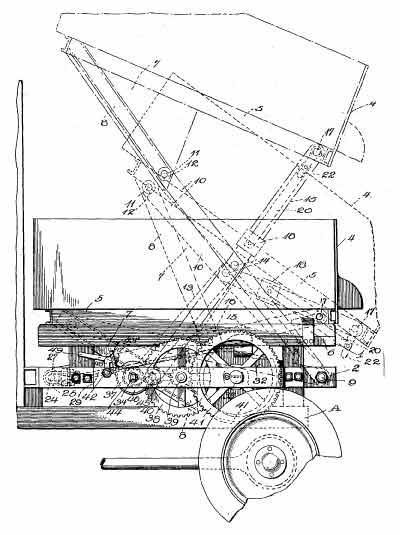
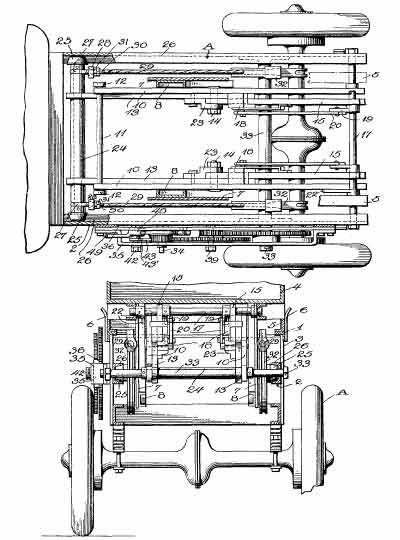
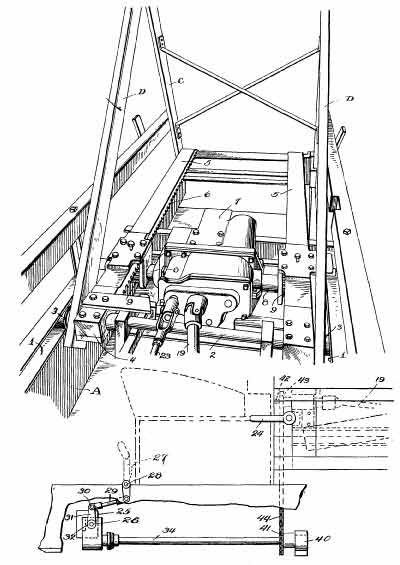
In early 1924 Fitzgibbon & Crisp announced to the trade that they were
building a complete line of hydraulic and gear driven hoists and dump bodies
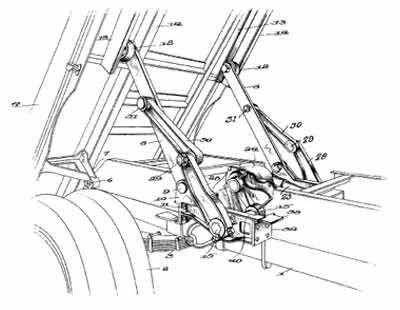
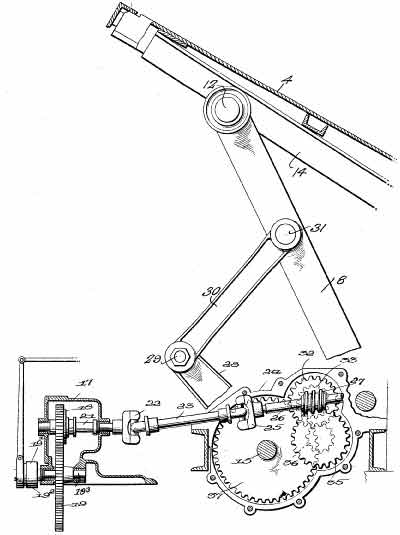
from 1000 pounds to seven tons. A single patent was applied for by body
engineer On December 19, 1924 Joseph Dale Herron applied for a patent for
dumping mechanism which was assigned to the firm. A 4-page illustrated
catalog of Trenton Hoists and Bodies for standard Ford one-ton Trucks was
released by the firm in 1925.
In the mid twenties a fair number of inte-rcity coach bodies were
constructed, many on purpose-built Safeway Six-wheel bus chassis. One
example included a distinctive oval rear side window with a brass railing
wrapped around an exposed rear observation platform. Individual seats
accommodated thirty-three passengers who were warmed by vertical radiators
of Fitzgibbon & Crisp design. Loading or unloading was via a 32-in door
located to the right of the driver. At the left rear was located an
emergency door that exited onto the rear observation platform.
Between 1924 and 1927 Fitzgibbon & Crisp bodied twenty-seven double-deck
Six-Wheel coaches for the Surface Transportation Corp. of New York City.
In 1926 Lion L. Woodward was rewarded for his work in turning around
Fitzgibbon & Crisp by his election as President of Ardmore, Pennsylvania’s
Autocar Company. At that time Autocar was suffering from poor sales and
increased competition which resulted in a failed reorganization of the firm
in 1925. It was hoped that Woodward would work his magic on the Ardmore
truck-maker.
In the short term the new arrangement proved beneficial to both parties.
Fitzgibbon & Crisp’s factory was located only 45 miles away from Autocar’s
Ardmore, Pennsylvania plant and during 1926 the firm bodied a record number
of Autocar chassis.
The Lower Merion School District, Ardmore, Pa., inaugurated its
transportation system with district-owned and operated vehicles in 1914 with
six Autocar buses. Lower Merion’s all-new 1926 fleet consisted of five
35-passenger Autocar and one 35-passenger Mack all bearing Fitzgibbon &
Crisp school bus bodies. The firm’s school bus bodies were built in 25- and
46-passenger versions for use with Autocar’s 2½-ton, six-cylinder Ranger
chassis.
Unfortunately Woodward died (on January 16. 1927) within a year of
assuming the new post and was replaced by Robert Page Jr., the manager of
the truck-maker’s Boston branch. Back in Trenton, Fitzgibbon & Crisp’s board
of directors promoted the firm’s chief engineer, Hudson T. Winner, to
President.
In 1929 Fitzgibbon & Crisp introduced a new high lift coal body for
mounting on light duty Chevrolet, Dodge, Ford and other light-duty truck
chassis. Power for lifting and shaking was transmitted by chain via a power
take-off incorporated into the vehicle’s drive-train. A two-cylinder
hydraulic hoist could elevate the body by 7 ft for dumping. It could be
equipped with multiple loading compartments allowing for precise accounting
of deliveries. The body floor was 18 in. lower than standard truck bodies
with a total capacity of 14 cu. yd., with 6 yd. from floor to load line.
In 1930 Fitzgibbon and Crisp built a furniture van body on a Mack 3½ -ton
chassis with a wheelbase of 19 ft. 2 in. for a New York City firm. When the
6 ft. 2 in. wide side doors and full-width tail gates were closed they fit
flush, harmonizing with the remainder of the body, even to the 2 in. molding
intended to act as a panel guard in traffic.
The 1931 Industrial Directory of New Jersey states that Fitzgibbon and
Crisp’s 195 employees were engaged in the production of ‘auto bodies’. At
that time the term ‘auto bodies’ included bodies for buses and commercial
vehicles as well as passenger cars.
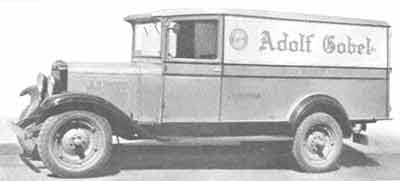
As early as 1930, the firm furnished the New Jersey Dairymen's League
with six aluminum insulated bodies. Soon after Fitzgibbon & Crisp developed
a new dry-ice refrigerator body, that would soon prove popular with the
regions grocers and dairymen. The new bodies were cooled by the patented
Ice-fin system, a conductive cooling system whereby a highly conductive
metal surface carries heat from the loading compartment to a sealed
Carbon-dioxide compartment.
By using resistance pads the Icefin system of single surface conduction
melted the refrigerant more slowly, providing a constant temperature that
could be easily maintained right up until the CO2 cake dissolved.
Consequently no advantage could be gained by over-icing or in putting into
the ice chamber more ice or carbon dioxide than would be actually required.
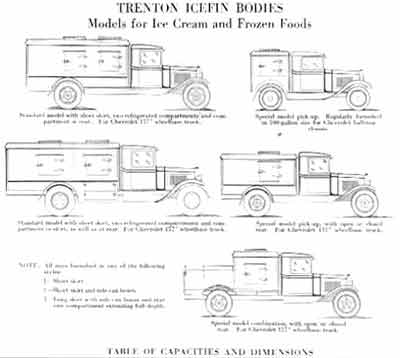
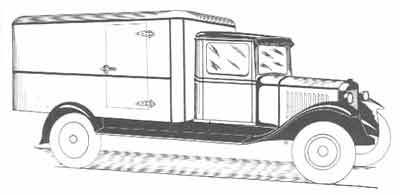
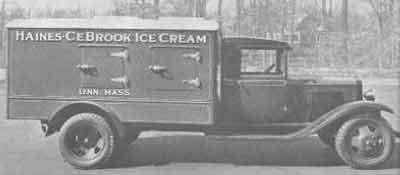
The firm’s new line of Trenton Insulated bodies for ice cream and frozen
food haulers featured the patented Icefin system which came installed in an
insulated three or four cu. ft. bunker in the roof of the truck.
Named for the series of highly conductive radiating fins extending across
the front and bottom of the ice bunker, the Icefin system could be powered
by three different cooling systems; traditional ice, chemical (carbon
dioxide) dry ice or standard mechanical refrigeration. In semi-trailers the
later system consisted of a small four-cylinder engine-powered Servel
compressor with coils arranged in sections around the top of the trailer. In
a self-contained refrigerated trucks the Servel compressor would be powered
by the engine via a belt-driven compressor.
The Trenton line included heavily insulated ten-ton capacity
semi-trailers which were divided into individual metal-lined compartments
that could be varied to match the required environment of its cargo using
multiple Ice-fin controllers.
The trailer body was insulated with 3½ in. high grade insulation with
aluminum panels on the interior. When fully loaded each 22’ trailer could
haul either 2,000 gallons of frozen products, 150 40-quart cans of milk, or
a combination of the two.
The firm’s 1932 catalog, Trenton Bodies for Ice Cream Trucks, catalog
1031, devoted 20 pages to illustrations and descriptive matter on truck
bodies using the Icefin system of solid CO2 refrigeration.
The following text is from a 2-page Frozen-Food Refrigerator Bodies
brochure:
“In the transportation of ice cream and other frozen foods it is very
important that temperatures well below freezing be maintained at all times,
despite hot weather, long routes and frequent opening of the doors, for even
momentary thawing of frozen products is ruinous.
“These requirements are fulfilled by Icefin Conductor Plate
Refrigeration, using Solid Carbon-Dioxide as the refrigerant. The advantages
of the Icefin system are many and important.
1- Positive temperature control. The Trenton Icefin system can be
regulated to maintain any temperature down to 40 degrees below zero F.
2- Uniform temperatures. Intensity of refrigeration does not depend upon
nor vary with the amount of CO2 in the system. (Note: In a body lacking
positive control, the temperature rises as the refrigerant is consumed.)
3- Economy. Consumption of Solid Carbon Dioxide is limited to the amount
necessary to maintain the desired temperature and depends upon length of
route, initial hardness of ice cream, etc. None is wasted. (Note: Bodies
lacking positive control are apt to waste solid CO2 by cooling to excess
when first charged with refrigerant.)
4- Dependability. No moving parts, thermostats, circulating gases,
liquids or other trouble makers. Control is accomplished by varying the
number of resistor units between the CO2 ice and the conductor plate.
5- Maximum payload. The ice reservoir is located in the roof of the body
and heat from the interior is conducted to it by a metal plate which forms
the ceiling of the compartment; thus none of the loading space is occupied.
“Other systems of refrigeration
Trenton Bodies can also be furnished with Ice and Salt, Frozen Brine or
Mechanical Refrigeration.
“Body Insulation and Construction
Trenton low temperature bodies are insulated with 2 inches of Armstrong’s
L.K. corkboard. 2 inches of balsa wood and one-half inch of special
one-piece panel - a total of four and one-half inches of substantial,
unbroken insulation. The corkboard is protected on either side with
refrigeration paper and thoroughly waterproofed.
The interior tanks are 18-gage Armco iron, with a 4-gage boiler plate
bottom.
The framework is of oak, joined by mortise and screws. Exterior panels of
ply metal.
“Guarantee
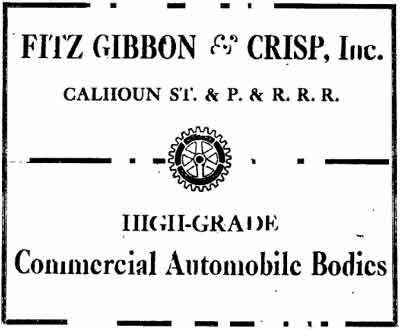
Performance, workmanship and materials are fully guaranteed by Fitz
Gibbon & Crisp, Inc., pioneers in the development of Solid Carbon-Dioxide
refrigeration, and builders of high quality custom bodies for more that 80
years.”
The following text is from a 2-page Non-Frozen Food Refrigerator Bodies
brochure:
“Trenton Icefin Bodies for Meats, Dairy Products and other Non-Frozen
Perishables (Water Ice of Solid CO2 Refrigeration)
“Trenton Icefin Bodies for carrying butter, cheese, eggs, meats and other
perishables, are generally equipped with the Trenton Icefin Cooling Unit,
which can be furnished for use with either Solid, Carbon Dioxide or Water
Ice.
“The unit should not be confused with ordinary metal bunkers, which may
have a similar outward appearance, but which do not employ the Icefin
principle of refrigeration and temperature control, by means of which the
desired temperature can be attained and maintained with but slight variation
and minimum consumption of refrigerant. The Icefin unit is protected by
patents pending and is made only by Fitz Gibbon & Crisp, Inc.
The unit is small, compact and practical. Essentially it consists of a
container, across the front and bottom of which are a series of radiating
fins which serve to conduct heat directly to the ice inside of the unit.
Temperatures are controlled in a very simple manner by varying the number of
resistor units between the ice and the conductor plate. A baffle so directs
the air that it sweeps rapidly over the fins, setting up a positive
circulation at high velocity, which reaches and uniformly cools the entire
body providing far greater capacity than is possible with ordinary bunkers,
baskets or ice-boxes.
Installation or removal require but a few minutes time.
“Body Insulation and Construction
Substantial oak frame mortised, glued and screwed. 3 inches high grade
insulation. Panels of autobody steel. Interior lined with Aluminum or ply
wood, as desired. One door on right side, single door at rear. High grade
chromium plate hardware. Heavy duck roof, finished in aluminum. Shelving as
desired. Body well ironed throughout. Finished in any color desired.
“Other methods of Refrigeration
Trenton Bodies can also be furnished with Mechanical, Frozen Brine or
Icefin Conductive Plate refrigeration.
“Guarantee-Performance, workmanship and materials are fully guaranteed by
Fitz Gibbon & Crisp, Inc., pioneers in the development of Solid
Carbon-Dioxide refrigeration and builders of high quality custom bodies for
more than 80 years.”
The firm used both cork and Kapok insulation in the body sides, ends,
roof and partitions of Fitzgibbon & Crisp’s insulated bodies, depending on
the requirements of the customer.
Kapok refers to a light weight fiber insulation obtained from the fruit
of the Asian Kapok (silk cotton) tree. Both cork and Kapok fiber matting
were commonly used for insulating refrigerated truck bodies prior to the
introduction of spun glass (fiberglass) insulation in the mid 1930s.
When it was first introduced, truck body builders reserved the use of the
expensive spun glass matting for under-floor applications as it was the only
insulation available that didn’t deteriorate when exposed to standing water.
After World War II, fiberglass was the insulation of choice until it was
replaced by styrene foam paneling in the late 1950s.
Four self-bailing, sealed drains were built into each corner to
facilitate easy removal of condensation. Fitzgibbon & Crisp also used a
layer of balsa wood and spun glass insulation under the steel and aluminum
floor in the event moisture leaked through the seams of the floor.
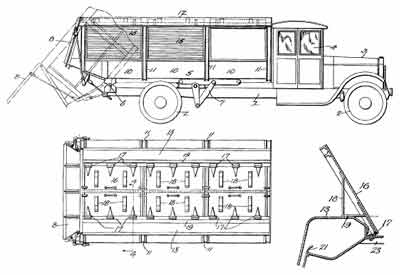
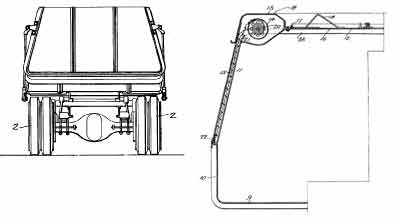
On April 7, 1931 Hudson T. Winner, Fitzgibbon & Crisp’s president,
applied for a patent for a multi-compartment garbage hauling body and was
soon promoted to President of the firm. The firm’s chief salesman, Donald W.
Drummond, was promoted to Vice-president in charge of sales at the same
time.
The new body was well received and in 1932 Fitzgibbon & Crisp received an
order for 400 large refuse bodies from the City of New York that formed part
of a brand-new 774 vehicle refuse fleet.
By 1933 the Trenton Ice Cream Bodies catalog included 18-pages of
illustrations and specifications:
“Trenton Bodies, manufactured by Fitz Gibbon & Crisp, Inc., for use with
ice cream, are made in several different types — solid carbon-dioxide,
mechanical. By using the patented system Fitzgibbon & Crisp can reduce the
weight of the finished truck body or trailer by 20%.”
A 1933 announcement in the Commercial Car Journal follows:
“New Hydraulic Body Hoist - A new hydraulic body hoist with high-angle
lift and quick action; a complete, self-contained, compact unit has been
announced by Fitz Gibbon & Crisp, Inc., Trenton, N.J. The maker claims that
an abundance of power is provided without subjecting either chassis or hoist
to undue strain.”
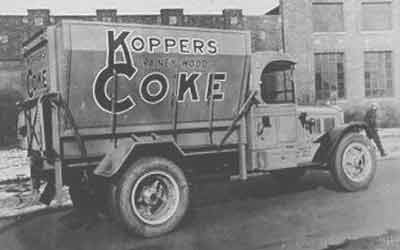
In the mid-Twenties the Koppers Seaboard Coke Co. of Kearny, New Jersey decided to popularize the use
of coke as a domestic heating fuel, and within a few years fleets of
purpose-built coke
delivery trucks were found on the streets of every major city in the
Northeast. As Coke was somewhat bulkier
than coal, it required a special body, many of which were supplied by
Fitzgibbon & Crisp.
Soon after Prohibition ended in December, 1933, Fitzgibbon & Crisp
introduced a series of low-bed beer barrel and keg bodies for the brewing
industry. The capacity of the standard body was 42 whole barrels, or 82
half-barrels, or 265 cases. Kegs or cases were unloaded through hinged or
sliding type doors on both sides of the body. Empties were loaded at the
rear of the body in spaces left by full cases moving forward.
In 1934 Fitzgibbon & Crisp manufactured 2 Hand Test rail car bodies for
the Sperry Rail Service of Danbury, Connecticut. Hand Test cars were
self-propelled truck-based vehicles used for inspection and verification of
track defects. For over one hundred years, Sperry had been the leader in the
field of building and leasing rail flaw detector cars, and they’re still in
business today at
www.sperryrail.com
In 1933 Fitzgibbon & Crisp introduced a new line of trailers and truck
bodies that would be marketed under a separate brand called ‘Universal
Trailers’. A satellite sales office was established in the brand new
McGraw-Hill Building, at 330 West 42nd St., New York, New York, manned by
industry veterans Bruce R. Dourte and Harry R. Jacobson. Prior to the
establishment of the New York City office, the sales department had been
located in Trenton at 168 W. State St..
The Universal line included insulated bodies cooled by the firm’s
patented Icefin system.
A 1934 issue of Power Wagon included the following description of a
Universal trailer made for F.G. Vogt and Sons, Inc., a Philadelphia meat
packer:
“Body is of composite construction using aluminum panels on the outside.
Insulation is of kapok and body is equipped with Icefin cooling units. Power
brakes are Bendix-Westinghouse air brakes and power unit is a White
tractor.”
“Pioneers and leaders in the field of refrigerated truck and trailer
bodies. You can be assured of premium freight rates with a Fitz Gibbon
Refrigerator Body on a Universal Trailer.”
Soon afterwards Fitzgibbon & Crisp built a number of streamlined bodies
for engine under the seat (aka COE) Autocar chassis. One 19-ft streamlined
furniture van was built in 1935 using a streamlined Autocar cab for the A.H.
Stiehl Furniture Co., 28 West 20th St., New York, New York. Dimensions of
the side loading body were 19 feet long, 8 feet wide, 6½ feet high.
In 1935 Fitzgibbon & Crisp built the refrigerated bodies for Borden’s
first Golden Crest milk trucks. Thirty 1½- and 2-ton Dodge chassis were
leased from the Madrid Motor Corp. 2550 Haverford Rd, Ardmore, Pennsylvania,
and delivered to Fitzgibbon & Crisp’s Trenton plant for installation of
special insulated and refrigerated bodies built to Borden Silver Seal
specifications.
In 1935 Fitzgibbon & Crisp president, Hudson T. Winner, sold his interest
in the firm in order to form the Winner Manufacturing Company. The firm
initially produced resin-covered rafts and would go on to fill numerous
wartime contracts which included reinforced plastic pontoon bridges and 28’
Naval assault boats.
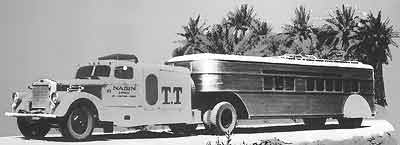
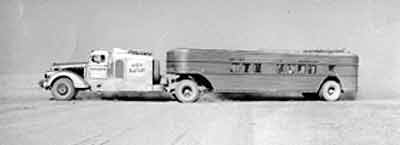
In 1936 the Edward G. Budd Manufacturing Company received an order from
the Nairn Transport Company, Ltd., for two stainless steel bus trailers,
built on the principle of the firm’s lightweight streamlined trains. The
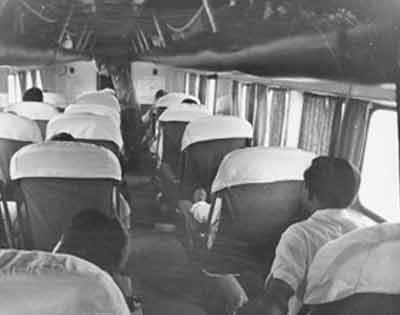
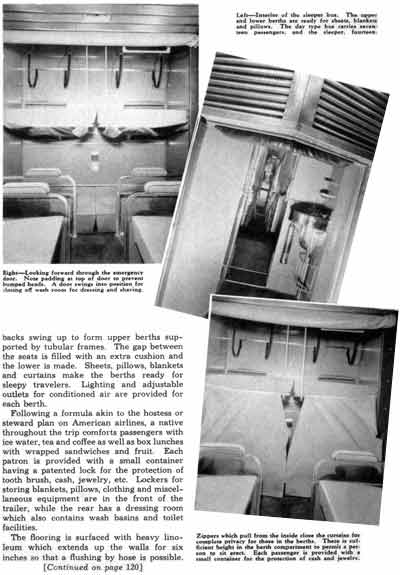
first trailer had luxurious accommodations for 19 seated passengers, the
second for 14 horizontal travelers who would spend their long journey in
private upper or lower sleeping berths.
Budd contracted with Fitzgibbon & Crisp to build the interiors of the
luxury air-conditioned coaches, the first recorded use in a motor coach. The
novel air conditioning system was developed by the Carrier Corp. of
Syracuse, New York, and installed by Fitzgibbon & Crisp in its Newark, New
Jersey factory in early 1937.
The two custom-built tractors were powered by a 150 hp Cummins Diesel
engines and built by the combined efforts of two Cleveland Manufacturers,
White Motor Co. and Van Dorn Iron Works. The vehicle had a custom-built
radiator, Timken axles and purpose-built Firestone tires.
The Whites’ 4x2 drive was found to be more effective at maintaining high
speed in the hard, flat desert than Nairn’s previous 6x6 Marmon-Herrington
tractors. The Cummins diesel provided 9mpg, a spectacular achievement
considering just ten years previous the firm’s gasoline-powered Six-wheel
coaches had averaged a paltry 2.5 mpg.
The unusual land yachts were described in great detail by Edgar M. Jones
in the October, 1937 issue of Modern Mechanix:
"Desert Travel - Modern Style by Edgar M. Jones
"SHUTTLING across the sands of the Syrian desert,
between Damascus and Bagdad, are two shiny, new trailer-busses, fresh from
the shops of Philadelphia. Built by Budd for the Nairn Transport Company of
Syria, with the same technique of welded, lightweight, stainless-steel that
made the now famous Zephyr trains, the new busses are a close approach to
the luxury of a deluxe railroad car.
"As in any public carrier, passenger comfort is of
prime importance. Accordingly, the plans incorporated Budd experience in
making railroad streamliners and auto bodies, with the Nairn need for an
economical, speedy, lightweight, rugged bus which could travel the rough
terrain with a minimum of trouble. To guard against the extreme temperatures
of desert night and day (zero at times and often as high as 140 degrees),
complete insulation and conditioning of air was specified. Leg room to equal
Pullmans cut passenger capacity to seventeen in the day bus and fourteen in
the sleeper. Extra wide chairs limited double seats to one side of the aisle
and singles to the other.
"The new busses lop nine hours from former crossing
time and make the six-hundred-mile trip over trackless waste in fifteen
hours, while passengers comfortably sway on rubber cushions. Coach seats
face the front, but the sleeper is divided into compartments with seats
facing each other. At bed time, the seat backs swing up to form upper berths
supported by tubular frames. The gap between the seats is filled with an
extra cushion and the lower is made. Sheets, pillows, blankets and curtains
make the berths ready for sleepy travelers. Lighting and adjustable outlets
for conditioned air are provided for each berth.
"Following a formula akin to the hostess or steward
plan on American airlines, a native throughout the trip comforts passengers
with ice water, tea and coffee as well as box lunches with wrapped
sandwiches and fruit. Each patron is provided with a small container having
a patented lock for the protection of tooth brush, cash, jewelry, etc.
Lockers for storing blankets, pillows, clothing and miscellaneous equipment
are in the front of the trailer, while the rear has a dressing room which
also contains wash basins and toilet facilities.
"The flooring is surfaced with heavy linoleum which
extends up the walls for six inches so that a flushing by hose is possible.
"Walls, doors, and partitions are faced with birch
plywood. The ceiling is made of perforated aluminum which acts to deaden
sound. All windows are of safety glass and are curtained with drapes. A
silvery corrugated exterior, looking for all the world like something made
from Mother’s washboard, has some properties for deflecting sun rays, but
any persistent outside heat or cold is stopped by insulation four inches
thick in the roof and two inches thick in the sides.
"Powered by a 150 h. p. Diesel motor, the tractor unit,
sheathed in aluminum, furnishes a cab for the driver and his helper, air
conditioning equipment, and space for baggage. At the rear of the tractor
unit are hinged wings to enhance the streamlined effect.
"Five 6.6 volt batteries connected in series and
located in the tractor unit comprise the 32 volt lighting system for the
bus. When the motor isn’t running, interior lighting is used sparingly.
Compression for the cooling system is obtained from a gasoline engine. Air
intakes are in the roof and exhaust fans on each side push out the warm air.
Filled to capacity with passengers, baggage, water, and two hundred gallons
of fuel oil, the total weight goes over fifteen tons.
"The one and only scheduled stop between points is
Rutbah which is the nearest thing in real life to the movie conception of
desert outposts. Grim walls, radio towers, and detachments of soldiers
remind travelers of Beau Sabreur and the Foreign Legion. The hotel, a large
restaurant, and an ice-making plant do a thriving business at this meeting
point for air and motor travelers . Possessing the only wells which do not
go dry during the hot spell, Rutbah attracts the Arabs who camp outside the
fort with their camels and livestock.
"During the rainy months of January and February, water
collects in the hollows of the desert. Puddles and mud, hundreds of yards
wide and several miles long, spot the trail. As there is no telling the
extent of this area, it is impracticable to detour. Drivers with an acquired
Oriental fatalism on coming to mud, warn passengers, then drive at full
speed to slide across on the belly of the bus. As a concession to this
practice, the new trailers (turtle-like) have completely enclosed bottoms.
Sandstorms force a complete stop (seldom over an hour or so). The tight
fitting doors and windows prevent discomfort.
"To the astonished natives and wondering resident
Europeans, the new busses are but the most recent surprise that Norman Nairn
delights in springing upon the slow-moving East. He was the first to have a
speed boat to skim the Mediterranean near Beirut; the first to own an
airplane. Always wanting speed, Nairn now in his forties, has made a record
of spectacular but profitable ventures."
In 1937 architect Hugh Stubbins designed a Trailer Home for possible
manufacture by the firm. Surviving renderings in the collection of the
Frances Loeb Library at the Harvard Design School show the trailer home in
plan, section and axonometric views.
As did most commercial body builders at that time, Fitzgibbon & Crisp
continued to offer streamlined truck bodies and trailers. One ‘ultra-modern’
unit was built in 1938 for Dutchland Farms on a COE GMC chassis. The firm’s
popular lines of Trenton refrigerated bodies and Universal Trailers
continued to be offered as late as 1940.
In late 1940 the firm’s board of directors accepted an offer to purchase
their Trenton body plant at 467 Calhoun St. (at Dunham St). The buyer was
the newly created Philco Corporation, who wished to relocate their
industrial lead-acid storage battery plant from Philadelphia to Trenton.
The timing couldn’t have been better for Fitzgibbon & Crisp’s
stockholders as within a few short months, most of their all-male workforce
would either have enlisted or been transferred to an essential Armed Forces
supplier. The deal was finalized in early 1941 and by mid-1941 batteries
were running off the assembly lines of the Storage Battery Division of
Philco Corp., which was now manned by a number of former Fitzgibbon & Crisp
employees.
When he found himself out of a job, Harry R. Jacobson, Fitzgibbon &
Crisp’s New York City sales representative, formed the Universal Trailer
Sales Corporation and continued selling trailers and truck bodies from his
office in the McGraw-Hill Building at 330 West 42nd St, New York, New York.
Trade Names: Trenton (refrigerated bodies, high lift coal bodies), Lion,
Universal (trailers & truck boxes). Lion Bodies was listed in the 1929
Chilton directory as a subsidiary, and was likely named after the firm’s
deceased former President Lion L. Woodward.
In 1947 Philco’s Trenton Battery Division was acquired by the
Gould-National Battery Co., a Buffalo, New York-based battery manufacturer.
When Gould-National went out of business in the early 1980s, it became the
home of Magic Marker Industries, the manufacturer of the famous “Magic
Marker” brand permanent felt-tipped marker. The firm abandoned the site in
1989 and filed for bankruptcy.
Locally known as the ‘Magic Marker site’, the 4-acre site contained
numerous hazardous materials, and between 2003 and 2007 the City of
Trenton’s Dept of Housing and Economic Development excavated more than
18,000 tons of contaminated soil clearing the way for a proposed 42-unit
housing project. A City of Trenton press release states: “The Magic Marker
site is a local and national ‘poster child’ for brownfield remediation”.
One of the firm’s original factory buildings, 20 Bank St. (aka 101-107
South Warren Street), has been restored and was placed on the NJ Register of
Historic Places in 1990 as NJRHP ID#1769 - Fitzgibbon & Crisp Factory.
© 2004 Mark Theobald - Coachbuilt.com with special thanks to
Moe Crosby
|