|
The Fisher Body Company, later the Fisher Body Division of GM, had strong
family roots. It was founded by seven brothers whose grandfather, Andrew Fisher, emigrated from Northern Germany
around 1835 and set up a blacksmith shop in Ohio. His son Lawrence Fisher worked in the blacksmith shop. Later, with
his brother Andrew and his brother-in-law, he set up a carriage works, himself directing the woodworking facilities.
Ironworking, woodworking, carriage-building, and brothers working closely together all reappeared in the remarkable
success of the Fisher Body Company.
Lawrence Fisher stressed craftsmanship above all else. All of his sons worked in the family business before leaving
home. His brother Albert Fisher, who also learned carriage making from Lawrence, established Standard Wagon Works in
Detroit in the late 1880s. At Uncle Albert's suggestion Fred Fisher, eldest of Lawrence Fisher's seven sons, decided
to seek his fortune in Detroit.
In 1902, Fred found work as a draftsman at C. R. Wilson Company, joined by his brother Charles in 1904. Wilson, the
largest maker of horse-drawn carriage bodies in the world, also built auto bodies for a handful of pioneer
automakers, including Oldsmobile, Cadillac, Ford, Peerless and Elmore. The brothers worked there until 1908, when
they quit over salaries. Uncle Albert offered Fred and Charles jobs in his carriage shop and the brothers gratefully
accepted.
Uncle Albert's Standard Wagon Works had supplied some 50 bodies for the fledgling Ford Motor Co. Fred and Charles
recognized that bodies for horse-drawn carriages would not do for motorcars. Automobile bodies needed an entirely
different technology. For example, driving a car via its rear wheels put a different set of stresses on the body
than pulling a carriage by its front axle; also the higher speeds and greater vibration of motorcars demanded
suitable engineering advances.
At this point, the two brothers invited Uncle Albert to join them in their own auto-body business. Between the three
of them, they had connections, expertise, good ideas -- and Uncle Albert agreed to supply capital. On July 22, 1908,
Albert, Fred and Charles Fisher formed the Fisher Body Co., capitalized at $50,000, with $30,000 cash paid in by
Uncle Albert.
Early customers included Ford, Herreshoff, EMF and Oldsmobile. Walter Flanders, a partner in EMF, suggested that the
new company build an inexpensive closed car body. Closed cars at that time were not only expensive but were
considered undesirable by Ford. As Fred and Charles began to experiment with closed sedan bodies, Uncle Albert not
only protested but soon wanted out of the new venture altogether.
At this point the Mendelssohn name entered the Fisher story. The younger Fishers didn't have enough money to buy
Albert out, but mentioned their plight to Louis Mendelssohn, an architect and civil engineer who, with his brother
Aaron, was a major stockholder in the Herreshoff Motor Co. Asked how much Albert wanted for his share, Fred
answered, "$30,000 by noon." Louis supplied it. As chairman of the board, Louis Mendelssohn oversaw the financial
side of the operation. He supervised the purchase, design and construction of new buildings and eventually
negotiated the sale of Fisher Body to General Motors. His brother Aaron joined in 1910 as supervisor of the general
office. Aaron's son Herbert entered the business in 1911 and Louis's son Paxton was put in charge of Plant #1.
Changes came fast in Fisher Body's earliest years. In 1909, the company set up a formal engineering department for
open bodies, with a chief engineer, four body draftsmen and a man responsible for dies and patterns. Its production
capacity was 10 open bodies a day. The rapidly expanding automobile industry soon demanded more of the company.
In 1910 Cadillac ordered 150 closed bodies, and Flanders placed a similar request. To meet this challenge, a
separate closed-body engineering section was created, with a separate staff of engineers and draftsmen, a designer,
a blueprint checker and a trim engineer. Finally the Fisher Closed Body Co. was formed, in December 1910.
More expansion followed. In 1912, Fisher organized a Canadian adjunct, Fisher Body Co. of Canada, Ltd.,
headquartered in Walkerville, Ontario, across the river from downtown Detroit. Lawrence P. Fisher joined his brothers
in 1912 as superintendent of paint and trim, followed in 1913 by Edward F. and Alfred J. Fisher, who worked in every
department of the plant before being given more responsible duties. Finally, William A. Fisher arrived in 1915 from
the Fisher Auto Top Co., a large supplier of canvas car roofs.
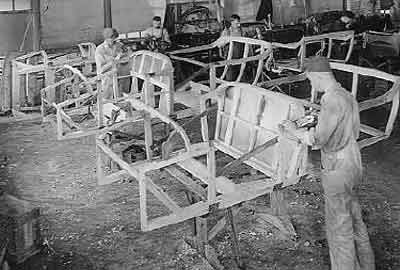
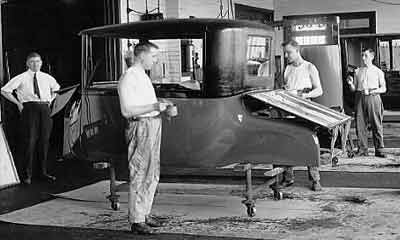
To meet the challenge of growth, Fred and Charles developed new manufacturing techniques. They pioneered precision
woodworking on a mass-production scale, developing jigs and fixtures that made it possible to mass-produce identical
wooden parts for auto bodies for the first time. Wooden components, interchangeable from one body to another, no
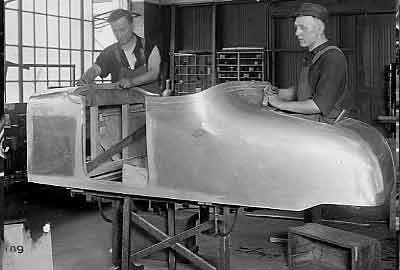
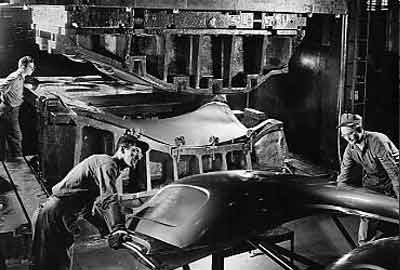
longer had to be hand fitted as in carriage-making. Fisher also pioneered a crude but effective sheet-metal stamping
technique.
Unbeknownst to many, the Ford Motor Company
relied upon
outside suppliers for most of its coachwork during its first quarter
century.
It’s hard to determine who made Ford’s first automobile bodies but soon
after
the Model T was introduced the names of various Michigan-based
sheet-metal,
millwork and body-building firms begin to appear on Ford’s supplier
list.
Initially most of the Model T’s bodies were
supplied by
Ford's existing auto body suppliers C.R. Wilson (1903) and Everitt
Brothers
(1908). O.J. Beaudette (1910), Kelsey-Herbert Co. (1910), American Body
Co.
(1911), Hayes Mfg. Co.(1911) Milburn Wagon Co. (1911), Fisher Body
Co.(1912), and the Kahler Co. (1915). Wm. Gray & Sons supplied Henry
Ford’s Windsor assembly plant with automobile bodies from 1906-1912. Regardless of their
origin,
all of the Model T’s bodies were interchangeable; however the
individual parts
in a body would not necessarily fit a similar-looking body if it was
made by a
different manufacturer.
Fisher Body supplied roadsters, touring cars, phaetons, and closed carriages to many makes. By 1914, Fisher Body Co.
was building 105,000 car bodies a year, most of them open. And by 1920, the total came to 328,978, most of them
still open. Closed car bodies were meeting with customer resistance, not so much because "no one in his right mind
would ride behind that much glass," as Henry Ford once opined, but because the car manufacturers were jacking up
prices of closed bodies far beyond what they were paying for them.
As Fisher's volume went up, their unit price per closed body went down. But the automakers to whom Fisher supplied
bodies did not discount closed cars proportionately. The Fishers asked auto manufacturers to sell closed cars more
cheaply, but it was years before carmakers passed the Fishers' savings on to their closed-body customers. (In 1922,
Essex introduced the first closed coach at a price similar to a touring car.)
The years before Word War I marked even more expansion, with the construction of several new plants, construction of
new buildings, and the acquisition of some 62,000 acres of timberland in Northern Michigan. By 1914, the company had
grown with such speed that there were 10 plants in operation around the Detroit area and in Canada. According to
historian Arthur Pound, Fisher's combined profits for 1913-14 came to $369,321, then $576,495 in 1914-15, and $1.4
million in 1915-16.
In 1916 Fisher merged its two U.S. companies and its Canadian operations, and the Fisher Body Corp. was incorporated
in New York, with a stock authorization of $6 million.
The company occasionally considered the possibility of building not just bodies but complete cars. It seemed the
logical next step. Fisher could sell bodies to themselves more cheaply than to others, and a line of Fisher cars
would assure a steady demand, unaffected by market vagaries. The topic kept coming up over the years, but the Fisher
brothers could never bring themselves to take the final plunge.
After World War I, Fisher again considered total auto manufacture, but the attractions of that plan were eclipsed by
another. Three established automakers contemplated acquiring Fisher Body Company as a wholly-owned subsidiary: Ford,
Studebaker, and General Motors. GM's Pierre S. DuPont and Alfred P. Sloan, Jr., perhaps attracted by Fisher's tidy
corporate and organizational structure, struck the bargain with Louis Mendelssohn and the Fisher Brothers.
GM's buyout of Fisher Body took place in two steps -- one in 1919 and the final one in 1926.
Fisher prepared for the 1919 transaction by increasing its capitalization from 200,000 to 500,000 shares of common
stock. The extra 300,000 new shares of stock were then purchased by General Motors at $92 a share, a total of $27.6
million. This arrangement gave GM control of production, finances and 60% of the stock, but left day-to-day
managerial leadership to the Fisher Brothers. The Fisher brothers all went into General Motors and became GM board
directors and active staff officers.
Step 2 came in 1926: GM traded 664,720 shares of its own stock, with a market value of $208 million, for the
remaining 40% of Fisher Body stock.
Part of the 1919 agreement stated that GM would buy all its car bodies from Fisher for the next 10 years at cost
plus 17.6%. After 1919, one of the few independent auto manufacturers who received Fisher bodies was Walter P.
Chrysler. His open body styles for 1925 and 1926 were largely supplied by Fisher. But after that, Fisher made bodies
only for General Motors cars.
The Fisher Division of GM acquired Fleetwood Body Corporation in 1925 for $650,000. What they bought was mostly a
name. Fleetwood's Pennsylvania plant was small and obsolete even then, but its reputation ranked at the top of the
coach-building industry. Fleetwood became Cadillac's in-house coachbuilder, and GM promoted its name nearly as much
as Fisher's.
The classic Cadillacs of the early 1930's -- the first-generation V-16s and V-12s -- were all engineered and
Fleetwood-bodied under Lawrence P. Fisher's auspices and at his urging. It was his intention to make Cadillac
America's top-rated prestige car. He brought in Maurice Olley from Rolls-Royce to improve Cadillac's ride and
campaigned hard to put Cadillacs into the White House garage. Ultimately his strategy paid off.
Other important Fisher Division acquisitions of the 1920's included the England Manufacturing Company of Detroit;
International Metal Stamping Company, Shepard Art Metal Company, and the Ternstedt Manufacturing Company, which soon
produced all of Fisher's hardware and trim.
A significant development from Ternstedt was the modern window regulator mechanism, introduced in 1921. Ternstedt
engineers also produced GM's VV (vision and ventilation) windshield for 1925 and, in 1933, introduced No-Draft
ventilation.
In 1922 Fisher purchased the O.J. Beaudette Co. of Pontiac, Michigan a
firm that supplied Ford with well over 2,000,000 bodies from 1909-1922.
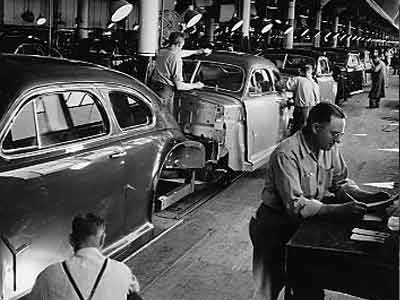
By 1924 Fisher boasted 44 plants and 40,000 workers, and was turning out over half a million car bodies a year.
Fisher Division didn't follow the lead of Budd and others in turning to all-metal bodies in the teens and 20's. All
six of the active Fisher Brothers were brought up in the woodworking tradition, and had themselves originated and
perfected techniques for using wood in auto bodies. In the year 1924, the auto industry consumed more hardwood
lumber than the furniture and building trades combined; Fisher alone used 250 million board feet of lumber. When
Budd began making all-steel bodies for Dodge in 1914, Fisher had already taken on millions of board feet of timber,
a commitment that grew, figuratively and literally, with time.
Fisher owned plants in most heavily populated sections of the country. GM bought another 160,000 acres of timberland
in Tennessee, Louisiana, Georgia and Washington, and melded it into the Fisher empire. In 1926 several mills and
lumber companies were added, all of which gave Fisher Division an extremely heavy commitment to framing all their
car bodies in wood.
In the late 1920s and early 1930s, while other automakers played up the virtues of their all-metal bodies, Fisher
waged a wood war. GM ads claimed that "an arrow sheathed in metal" was stronger than either the arrow or a metal
tube alone; and claimed that a hammer used a wooden handle to absorb shock.
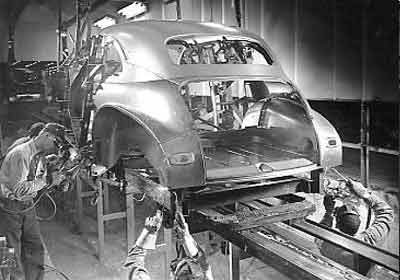
Fisher and GM continued to use wood framing in all their cars until the 1937 model year. Fred and Charles Fisher,
the company pioneers, left GM in 1934. Immediately after their retirement, Fisher Division began converting to
all-steel bodies. It took until 1937 to get the wood out.
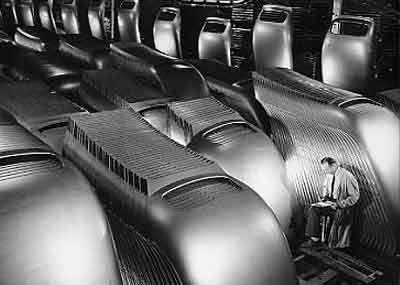
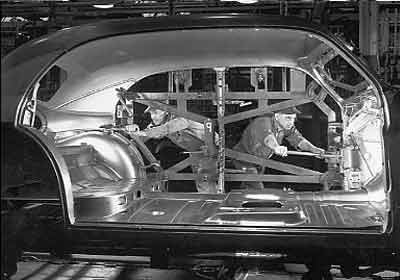
In another major shift, General Motors became one of the first automakers to get away from fabric roofs. Roof
inserts for closed Fisher Bodies called for a million yards of special fabric in 1924. In 1935-36, Fisher Division
introduced the Turret Top: a seamless metal roof. GM's competitors spread rumors that the all-steel top would drum
at certain speeds and, with all windows rolled up, could damage passengers' hearing. Despite these rumors, the
Turret Top soon became an industry standard.
Fisher Body Company was known for other innovations. In 1920, Fisher made the first scientific use of insulation in
an automobile to reduce noise and keep out heat and cold. It also narrowed the windshield pillars to provide
increased vision. Fisher Bodies had the first dependable window regulator for closed cars.
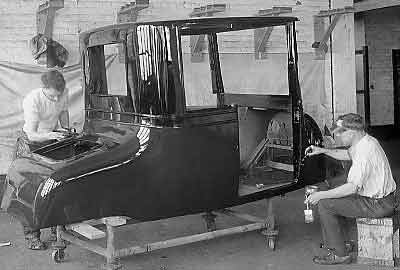
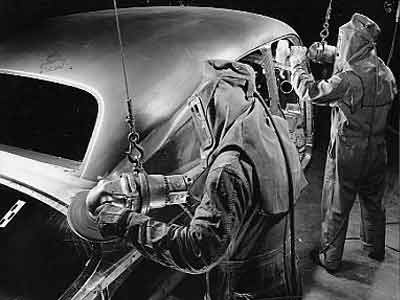
In 1923, Fisher Body made one of its most important contributions to the automobile world when it pioneered the use
of lacquer instead of paint and varnish for bodies. This proved one of the greatest advantages in attaining volume
production, helping to bring the closed car within reach of the average buyer. Instead of taking four weeks to paint
and trim a body finished in varnish, it took six hours. Color became important in automobile styling.
Fisher was the first to slant windshields to eliminate glare for oncoming drivers. In 1927 Fisher installed safety
plate glass, and introduced adjustable sunvisors.
More recently, the Ternstedt unit of Fisher Body developed No-Draft Ventilation, using a small pane of glass pivoted
on top and bottom to control air inside the car. Front door arm rests, locks inside door handles and door lock
buttons on the inside the garnish moldings were also Fisher firsts.
After Fred and Charles retired, the old urge to go into independent auto manufacture re-entered the thinking of the
four remaining Fisher brothers. They talked among themselves about acquiring control of the Hudson Motor Car Co.
With the Hudson acquisition in mind, the Fishers commissioned Roscoe C. (Rod) Hoffman, a consulting engineer in
Detroit, to design and build several rear-engined prototypes for possible eventual production as Hudsons. World War
II interrupted these plans.
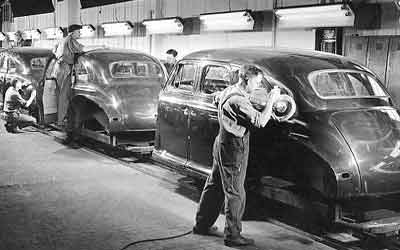
World War II brought drastic changes to the plants of Fisher Body Division of General Motors. As an example of the
production turnaround after Pearl Harbor, Fisher Body Plant No. 1 in Flint produced its last car body in January
1942 and 16 days later started assembly of the M-4 General Sherman tank. The first tank was completed 47 days later.
At the peak of the war years, Fisher Body employed around 68,000 men and women. Hundreds of training classes were
required to teach them completely unfamiliar jobs.
For four years, Fisher plants produced tools of battle: airplane components, Sherman tanks, M-10 tank destroyers,
M-36 "Slugger" tanks, the M-26 General Pershing tanks, B-25 Mitchell bombers, big guns, artillery shells and
aircraft instruments, the B-29 Superfortress bomber, and the experimental fighter plane, the XP-75, cowlings for the
B-17 Flying Fortress. Fisher's Ternstedt Manufacturing Unit made gyro horizon indictors, incendiary bomb noses, fins
and rockets and 20mm cannon parts. Fisher began building 90mm anti-aircraft guns and even bigger 120mm guns weighing
30 tons at their Grand Rapids plant. Fisher plants also turned out massive and complicated breech housings for Navy
guns. The plant also made artillery shells. And there were also diesel engine crankcases for Navy ships, along with
200 tools and droppable fuel tanks for Navy planes.
After the war, the Fisher brothers' plans to take over Hudson revived. Queen Wilhelmina of the Netherlands, who
owned most of Hudson's stock, let the Fishers know through an intermediary that she was willing to sell. The
Fishers, excited, started spending time inside the main offices of Hudson and also in their own plant. When news of
these visits hit Wall Street, investors saw a Fisher takeover as the best thing that could happen to Hudson. The
price of Hudson stock skyrocketed. The Fisher brothers' enthusiasm waned and the opportunity passed.
Beginning in 1956, Fisher Body introduced a number of safety-related industry firsts, including the first panoramic
windshield and safety interlocking mechanism designed to keep doors closed even under severe impact. Fisher Body
designed GM's first air bag system, producing them for high-end 1974-76 GM cars. Geared to make 100,000 at Fisher
plants in Euclid, Ohio and Flint, Michigan, the project was dropped when only 10,000 were sold in three years.
Fisher Body Division also implemented the federal regulation calling for an ignition interlock system, making it
impossible to start the car without first buckling up, beginning with 1974 cars. But a public outcry finally led to
a Congressional repeal of the federal standard a year later.
Later in the 1970s, Fisher Body later began designing automatic (passive) belt system, but this project was put on
hold when emphasis shifted to persuading consumers to used the seatbelts already installed. During this period
Fisher Body took on the problem of corrosion, and made possible a three-year warranty against rust-through. Finally,
after its history of reliance on wood and then on steel, a quest for lighter vehicles, the Syracuse, N.Y. Fisher
Body plant became the division's first all-plastics plant.
|
Frederick J. Fisher |
1878-1941 |
63 yo |
|
Charles T. Fisher |
1880-1963 |
83 yo |
|
Lawrence P. Fisher |
1881-1961 |
72 yo |
|
William A. Fisher |
1886-1969 |
83 yo |
|
Edward F. Fisher |
1891-1972 |
80 yo |
|
Alfred J. Fisher |
1892-1963 |
70 yo |
|
Howard A. Fisher |
1902-1942 |
40 yo |
© 2004 Mark Theobald - Coachbuilt.com
Addendum:
Former O.J. Beaudette Co. plant - Baldwin and Kennet Roads Pontiac, MI
Charles and Fred Fisher, two of the seven Fisher brothers born into a
second generation carriage-building family, followed family tradition and
became highly skilled carriage craftsmen. They left their home in Norwalk,
Ohio and moved to Detroit after gaining employment with the C.R. Wilson Body
Company. Shortly thereafter, with financial support from their Uncle Albert,
Charles and Fred established their own automotive business: Fisher Body
Company. As the company evolved, brothers Edward, Alfred, William and
Lawrence joined the business. (Their youngest brother, Howard, was never
involved with the automotive company, but was in charge of operations for
the Fisher Building in Detroit.) Advances in car body design became Fisher
Body's specialty. Innovations such as interchangeable body parts, modular
body production, and the creation of inexpensive closed body styling, led
the company to become the largest autobody manufacturer in the world prior
to World War I. In 1910, Cadillac became their first major customer placing
an order for 150 autobodies. Closed body styling quickly gained popularity,
and by 1914, Fisher Body was producing 105,000 units/year; by 1917, they
were manufacturing 370,000 bodies/year. As a result, a separate Fisher
Closed Body Company was formed. Enormous success also led the Fishers to
open a company in Canada. Ultimately, the three companies merged into Fisher
Body Corporation. In 1919, the Fishers sold 60 percent interest in the
corporation to General Motors and were in turn contracted to provide bodies
for all GM vehicles. Also in 1919, the Fishers purchased the O.J. Beaudette
Company in Pontiac and used the facility to produce parts for Chevrolet cars
and bodies for Oakland Motor Car Company. Fisher Body Corp. rapidly expanded
in the 1920's and was in need of a larger facility. Construction began on a
new plant at Baldwin and Kennet Roads in 1922, and the Beaudette factory was
eventually shut down. In 1926, GM purchased the remaining 40 percent share
of Fisher Body Corporation and it became a division of General Motors.
Fisher Body Plant contributed to the military effort during World War II by
ceasing automobile production and building both the 90mm army anti-aircraft
gun and the five inch navy gun mount. Pontiac's Fisher Body Plant still
stands today.
|
|
|