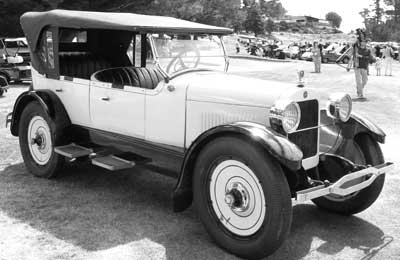
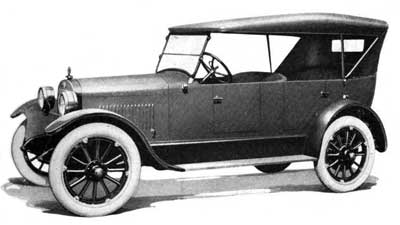
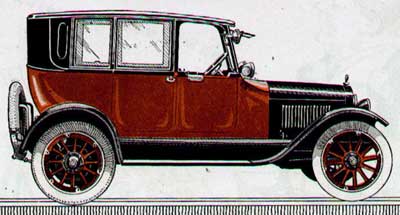
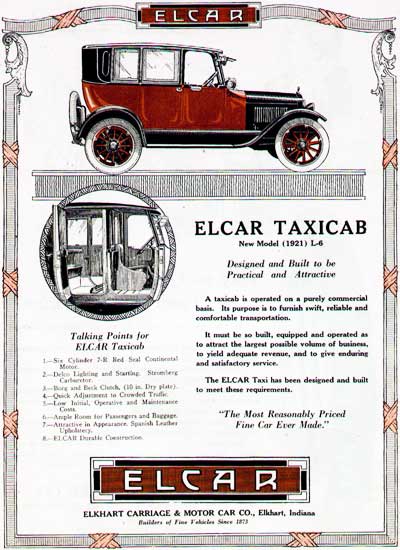
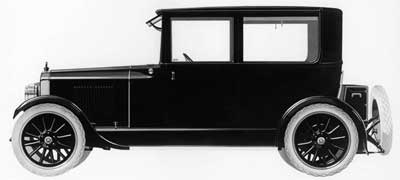
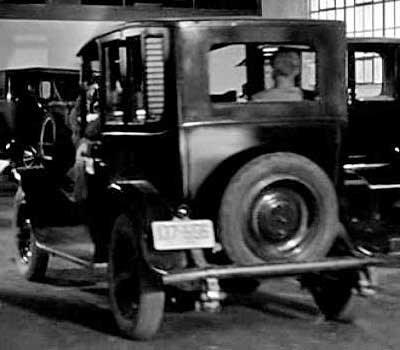
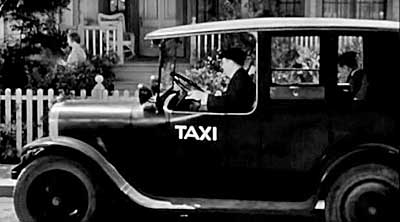
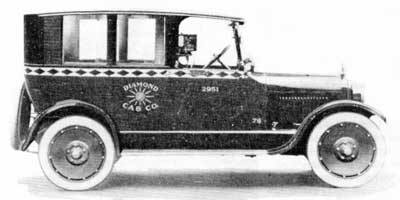
|
Although virtually unknown today, the
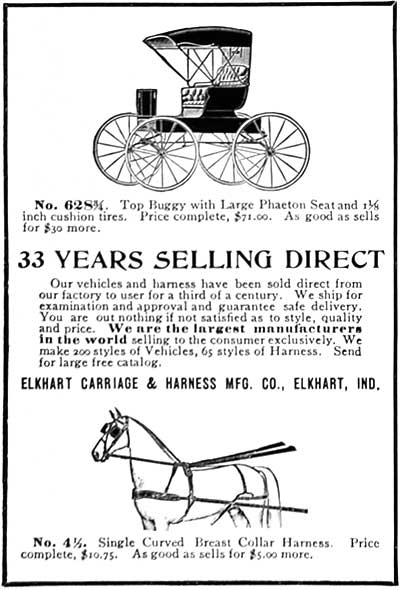
Elkhart Carriage and
Motor Car Co. of Elkhart, Indiana was responsible for creating the
Elcar
automobile, one of America’s finest assembled automobiles, and was also
a major
player in the bespoke taxicab field, a niche market that kept its
employees
busy after the market for assembled cars dried up during the early
stages of
the Depression.
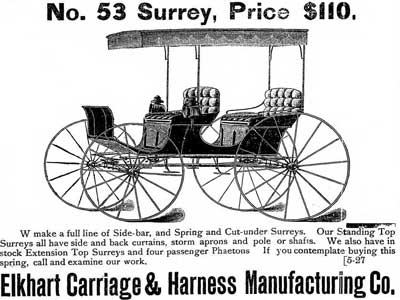
The firm’s predecessor, Elkhart Carriage
& Harness Mfg.
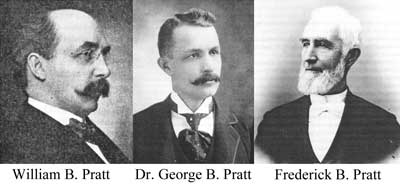
Co., was founded by Frederick B. Pratt, a Vermont-born businessman who
first
became successful in the dry good business in the decade immediately
preceding
the Civil War.
Frederick Brooks Pratt was born in
Springfield, Windsor
County, Vermont on December 18, 1822 to Herbert and Caroline (Brooks)
Pratt. Both
sides of the family were involved in the dry goods business, his father
established a Springfield shop prior to 1820, his uncle William Brooks
was a
partner in Emerson & Brooks which was established in 1825. Although
young
Frederick was groomed for a career in law, he elected to follow in his
father’s
footsteps and upon reaching his majority he took a position with one of
Boston’s major dry goods retailers.
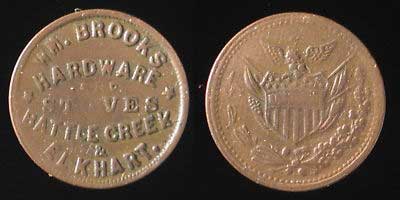
In 1846 he ventured west to join his uncle
William Brooks
who had relocated to Battle Creek, Calhoun County, Michigan, where his
uncle
was the proprietor of the town’s most popular hardware store. On March
7, 1850
the incorporated village of Battle Creek held its first election and
William
was elected its first president.
On November 30, 1848, Pratt married
Charlotte E. Byington (b.1827-d.1915)
a native of New York state and a daughter of Rev.
Joel and Delia (Storrs) Byington and to the blessed union was
born five
children; three of which were born in Battle Creek; William Brooks
(b. May 23, 1853-d.1926),
George Byington (b. May, 1858-d.1937), and Agnes L. (m. Wolf -
b.1857-d.1882) Pratt. A
fourth
child, Edward (aka Eddie, b.1866-d.1873), was born in Elkhart, but
passed away
at the age of seven after contracting Scarlet Fever.
In 1855 Pratt left his uncle’s employ
forming a competing
firm - Pratt, Rue & Rogers - with two partners, but by 1858 was
forced out
of business and went back to work for his uncle as a clerk at a
recently-established Brooks hardware store in Elkhart, Indiana. The
business
prospered and within a few short years Frederick was placed in charge
of the
Elkhart satellite which relocated to a new facility located at 82 Main
St.
On the 10th of October, 1863, William Brooks
sold his
Elkhart hardware business to Alexander A. Pope, a partner in the Battle
Creek hardware
firm of Putnam & Pope. Pratt remained with the firm as manager and
in June
of 1871 purchased the business from Pope which was thereafter conducted
in the
style of F.B. Pratt & Co. with
Pratt’s eldest son William B. officially joining his father upon
reaching his
majority.
According to Elkhart, Indiana realtor
Charles H. Fieldhouse
(b.1883-d.1969, the son of Elkhart banker John W. Fieldhouse), legend
has it
that sometime in 1873 Frederick Pratt was caught admiring a new buggy
that was
on display in front of a competing merchant’s showroom. Armed with a
ruler and
a notebook, Pratt proceeded to copy down its exact dimensions which
attracted
the attention of the buggy vendor who dispatched him with a stiff kick
in the
ass. Fieldhouse claimed that from that point on Pratt became determined
to
build his own buggies and soon afterwards hired master blacksmith
Charles
Hughes to lay up a simple buggy in a wooden structure located at the
foot of
West Marion street.
Apparently the results were satisfactory and
in 1874
Frederick and his oldest son William began manufacturing buggies under
the firm
name of F. B. Pratt & Son., the July 22, 1874 edition of the
Elkhart
Observer reporting:
“F.B. Pratt is making arrangements to build
up a large
carriage trade here some day. Somehow or other everything F.B. Pratt
puts his
hand to turns into gold or its equivalent. He has already engaged the
best
mechanic in the country, and is located next door to Butterfield’s
livery
stable.”
The following advertisement appeared in the
December 2, 1874
issue of the Elkhart Observer:
“F. B. Pratt & Co. are bound to do the
largest wagon
business ever done, in the county. They have concluded to build lumber
wagons,
sleighs, bobsleds and all kinds of work usually done in carriage shops.
They
are determined that their work shall be as good and well finished as
any that
can be got. Mr. Pratt has just employed Mr. Ogle, one of the best
painters in
the county, to scrape off all the varnish from the work they had
finished, and
repaint and finish it all again, as he thought they were not finished
as they
should be. Mr. Pratt says this is a part of the expense of learning the
business, but when he gets it learned he shall know it all as well as
any one.
We guess he will. They are going to sell lumber wagons complete, double
box,
whiffletrees, neck yoke and spring seat at $65, old price $90. Cutters
about
half price. Knee bob sleds, with three knees, §35, old price $55. Open
buggies,
$75 to §100, old price §125 to $150. Covered buggies, §125 to §175, old
price
§225 §250. If these prices will not build up a large trade we don't see
what
can. They have cutters and bob sleds now on hand.”
Another in the April 23, 1875 Elkhart
Democrat Union:
“More and More Extensive:
“The rapidly increasing notoriety of F. B.
Pratt's
experiment in the way of manufacturing elegant strong and substantial
buggies
and carriages, at about two-thirds the money purchasers have heretofore
had to
pay for them, is proof that some things can be done as well as others.
Orders
are now coming in from all quarters, both from individuals and dealers,
and
quite a number are now nearly ready to ship to parties in California
from whom
orders have been lately received. The usual style of a $150 buggy is
sold by
Mr. Pratt for $100, perfect in make and finish throughout. Top buggies
and
carriages are sold at proportionate reduction in price. The calls for
vehicles
have become so numerous that the capacity of his present shops is
insufficient
to meet the demand, and more room for operations will ere long be
added. It is
already one of the big institutions of Elkhart and is growing bigger
all the
time. Mr. Pratt says he has been bothered by a lack of expert carriage
painters, and there is an opening for such if application is made soon.
Also a
couple of good blacksmiths are wanted. Address F. B. Pratt, Elkhart
Ind.”
The carriage business now occupied most of
Pratt’s time so during
the same month (September, 1875) he sold his hardware business to
Rawson &
Raynolds utilizing the proceeds to construct a 3-story yellow brick
manufactory
for the carriage works at the south-west corner of Pratt and East
streets, the
March 17, 1876 issue of the Elkhart Democratic Union reporting on the
building’s construction as follows:
“F.B. Pratt is rushing ahead his new
carriage and buggy
manufactory over at the east end of Pratt street.”
Ironically in June of 1877 Alexander A. Pope
repurchased the
former Brooks hardware store from Rawson & Raynolds and returned to
the
hardware business in a large way, doubling its capacity for doing
business by
adding 80 feet to the length of the building.
Just three years after completing their first
buggy, the PRatt Works had evovled into a full fl;edged buggy factory,
the May 25, 1877 issue of the Elkhart Democratic Union reporting:
“The Great Enterprise
“In concluding this article some reference
may be made to
the Elkhart Buggy Manufacturing Establishment of F.B. Pratt; and this
institution is one of the largest in the State, and calculations are
made to
enlarge the area by an addition of 40 by 100 ft., the business covering
three
floors together with wood and blacksmith shops one hundred and fifteen
feet
long.
“The pay roll of the present company runs up
to $300 a week,
whilst their work finds a market all over the West, South, California,
and some
in the Eastern States. What is the reason of this success? Simply the
chief
employees are picked men. The Superintendent Mr. Thomas Gilfilan, whose
whole,
heart and soul is interested in placing Pratt & Co., ahead of
anything in
the Northwest, came from Erie Co., Pa, and in Cleveland held the
position of
superintendent in the leading buggy manufactory of that city,
afterwards
holding a good position in Indianapolis. Next in charge of the heavy
work in Studebakers
at South Bend, always respected and always ahead. While
bravely fighting in the 83rd Pa.; he
was twice wounded. He is now superintendent for Pratt & Co.
“Turning to the blacksmith department, we
find C. G. Hughes.
This gentleman, foreman of the ironing department; came from Snyder
Co., Pa., to
Elkhart, ten years ago, with thirty years’ experience. What he does not
know in
the blacksmithing line, probably is not worth knowing at all. Mr.
Hughes lives
on Pratt St., and has a reputation for mechanical skill that the best
might
envy and few ever obtain.
“The foreman of the trimming shop stands
unrivaled. His name
is J. Haywood, and he hails from New Haven, Conn. He also formerly held
a
position at Studebakers. Captain Hayward served gallantly in the 1st
Conn. Cavalry where he won the esteem of his superior officers, also of
the men
he commanded.”
Frederick’s second eldest son, George B.
Pratt, elected to
pursue a career in medicine rather than work in the family’s carriage
works. In
1874 he enrolled in the medical school of the University of Wooster,
Cleveland,
Ohio after which he studied surgery at Columbia College, New York City,
finally
returning to Elkhart in late 1877 to set up a local practice in
partnership with
Dr. Allen.
The firm was included in Chapman’s 1881
history of Elkhart as follows:
“F.B. PRATT & CO.
“The members of this firm have gained a high
position in the
world of manufactures. For a number of years they have been extensively
engaged
in the construction of vehicles and now employ from 60 to 80 men. Their
carriages and buggies are well built and deserve the large patronage
which has
been accorded the company.”
Although George had become a successful
Elkhart physician
the sudden passing of his younger sister Agnes in 1882 caused him to
re-evaluate his decade-long opposition to joining the family firm and
soon
afterwards he accepted a management position with F.B. Pratt & Son
at which
time he was given a third share in the firm, which was conducted
thereafter as
F.B. Pratt & Sons.
On May 24 1883 George B. Pratt married
Miss Helen
Higginbotham of South Bend at her home. George B. Pratt withdrew from
the
medical profession and joined the family business at about the same
time
(1882). His wife became quite ill in 1884 and she moved to Minneapolis
to
recuperate, with George dividing his time between Elkhart and
Minneapolis for
the next four years during which time he represented the firm at trade
shows
and exhibitions through the Midwest from Chicago to New Orleans.
(Mrs. Pratt’s health improved to the point
where the couple
moved back to Elkhart in 1888, but her illness returned and Helen
Higginbotham
Pratt passed away in October of 1889.)
The June 25, 1885 edition of the Elkhart
Weekly Review
reporting on the construction of another multi-story building that
would
eventually house the firm’s paint, upholstery and shipping departments:
“F.B. Pratt and Co. have begun the
erection of a
building 60x100, for the accommodation of their large business.”
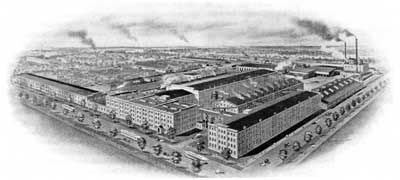
A new four-story building followed soon
afterwards increasing
the firm’s usable floorage to 87,000 sq. ft., which was joined to the
earlier
structures by means of an enclosed walkway over East St.
Within a year after completing the new
structures a
disastrous fire destroyed a significant portion of the Pratt Carriage
Works during
the early evening of July 15, 1885, the July 16, 1885 edition of the
Elkhart
Weekly Review providing the following details:
“Details of the Fire
“The first seriously destructive fire that
has visited
Elkhart for some years wrought its destruction last evening. Shortly
after 8
o'clock the cries of a small lad announced to the crowd of passers on
Main
street, that a fire had broken out in the paint shop of Pratt &
Son's
Carriage Manufactory, and before the cry had echoed along the streets
to the
city hall, dense black smoke, fringed here and there with a lace work
of flame,
was rolling upward. The volume came from a comparatively small center
at first,
but before the fleetest runner could go from Main Street to the scene
it had
increased, and the smoke filled the entire sky. The spread was rapid,
and long
before the fire department arrived, the entire building was wrapped in
the
destroying element.
“The alarm brought out the firemen but in
putting the horses
to the hose cart someone blundered, and as a result the double-tree was
broken
as the cart left the house, causing a delay of some minutes. Of course
every delay
was disastrous, and the flames were spreading from the single building
to the surrounding
structures.
“Finally the hose arrived, however, and
streams were at once
turned on the smaller fires and all except that in the blacksmith shop
were
quickly extinguished. Meanwhile, however, the paint shop was falling
in, and as
the walls went down the flames went up hotter than ever. Several times
the
houses across the street were on fire, and the occupants moved out, but
finally
the firemen were enabled to give the surrounding buildings sufficient
attention
to extinguish all flames on them. The office, a brick structure, with
iron
roof, was threatened, but fortunately the efforts of the firemen were
rewarded.
“Only the policy pursued by Messrs. Pratt
& Co. of
detaching buildings avoided the destruction of the entire works. As it
was, the
paint shop was the only structure entirely destroyed. The blacksmith
shop was badly
burned, but the tools were comparatively uninjured. The storage houses
were
scorched, but none were burned, the damage to other property resulting
entirely
from its removal.
“The street and adjacent vacant lots were
literally covered
with wagons, buggies and carriages in all stages of completion.
Furnishings and
trimmings were scattered about promiscuously, and it will be a wonder
if the
loss from removal is not considerable.
“Property Destroyed
“The building burned was used for different
purposes. On the
lower floor was the storage room for wheels and prepared wood-work.
Several car
loads of wheels were burned, and large quantities of wood in all shapes
for
buggy work were burned. Besides this there were large quantities of
work under
way for display at the fall expositions.
“Of course this work was very valuable, and
its loss very
great. On the same floor was the packing room. Over this was the paint
shop in which
were carriages and wagons in all stages of completion, and the loss
here is
very heavy. Some of the material it has taken years to accumulate, and
it
cannot be replaced in years.
“Origin
“The fire when discovered was near the
center of the east
side of the paint shop on the second floor. It had no sooner appeared
as a
small beginning than it spread so rapidly that it was almost impossible
to
enter the building on that side, and before any work could be removed
the
entire building was filled with a dense smoke. The origin is a mystery.
The alarm
was brought up town by some small boys, but meanwhile men at work in
the shops
were doing all in their power to stay the flames. The watchman was on
his way
to the building when the alarm was given. The origin is supposed to be
spontaneous
combustion.
“The Insurance
“The building was insured in several
responsible companies,
and the loss therefore not total. Yet it would be impossible to insure
such
works to anything like their full worth. The property was insured in
the following
companies: Queen, North America, Pennsylvania, Westchester, New
Hampshire, Home
Mutual, German, of Freeport, Buffalo German, Rochester German. Total
insurance;
$20,000. The estimated loss is $30,000.
“Notes
“The railroad fire boys did their duty nobly
last night. The
firemen showed excellent skill in handling the hose at the fire. The
water
works proved their utility to the satisfaction of the most exacting
last
evening. It did not take long to gather a very large crowd last night.
“The buildings on Division Street, to the
east of the fire,
were threatened from falling shingles and debris; the new house of
Frank Sage
was once or twice seriously in danger.
“The engine, boiler, and most of the
machinery were
unharmed. This will expedite the starting up of the works, if the
proprietors'
conclude so to do. Over 150 men are thrown out of employment. The
harness
department was not destroyed. The property in the trimming room was
badly
damaged by water.
“The labors of the L.S. & M.S. Fire
Brigade were
highly appreciated. The boys worked heartily, and considering the fact
that they
were obliged to be on hand at 6:30 this morning, they stuck to it well.
They are
entitled to all praise. Mr. Worcester, the new superintendent, was out
among
the boys as energetic as any of them.
“Dr. Pixley had just bought a phaeton and it
had only
yesterday been taken to the packing room for the thills, etc. It was
burned. Dr.
Haggerty lost a carriage left for repairs. Lan. McGowan's bus was
burned in the
paint shop.
“Most of the tools in the blacksmith shop
were saved. The hose
burst almost as soon as a stream was turned on from the Division street
hydrant
last night. No wonder, when the distance is considered. The wonder is
that any
water could be thrown at all. If the hose had not burst last night the
destruction would have been limited to one building. Word from Pratt's
shop at
Goshen was he was on his way here, last night.
“The ruins were visited by a large number of
people to-day.
They presented a sorry sight, with the remains of months of toil piled
in small
heaps on the ground.
“It is by no, means certain that Pratt &
Sons will
rebuild here. It would be a serious loss to the community if they
should go
elsewhere. Pratt & Sons' began work in their harness department
this
morning. Over a hundred men are still out of employment by reason of
the fire.
“F.B. Pratt & Sons have begun temporary
repairs on their
blacksmith shop, and will have it ready for the workmen in a day or
two. The
adjusters have all been here but one, and he will be here soon.”
The July 30, 1885 edition of the Elkhart
Weekly Review
reported that plans to rebuild the factory were well underway:
“F.B. Pratt & Sons will erect buildings
enough to secure
to them 70,000 of floorage. This would give them the equivalent of 55
rooms 70
feet long and 18 feet wide, the size of the average store. They will
begin work
in a few days on their building. The plans are not yet fully matured.”
On August 6, 1885 it was announced that the
Board of Trade
of the city of Cedar Rapids, Iowa had convinced F.B. Pratt & Sons
to relocate
to their municipality with the promise of cash, land and various
subsidies and
tax incentives. However the Pratt’s attorneys spent the next week
looking over
the offer and on August 13, F.B. Pratt & Sons announced they would
remain
in Elkhart and their new factory was 100% operational by the end of the
year.
On January 17, 1888 the Pratts formed a new
firm, the Elkhart
Carriage & Harness Manufacturing Co., to take over the assets of
F.B. Pratt
& Sons, the January 23, 1888 edition of the Elkhart Daily Review
providing
more details about the new organization which now included Elkhart
businessman
Otis D. Thompson who purchase a 10% interest in the firm for $9,100 in
cash:
“The firm of Bickel & Thompson has been
dissolved by
mutual consent. Mr. Bickel will conduct the Real Estate Exchange and
their
general office business the same as before their co-partnership. Mr.
Thompson,
who has always been a manufacturer in spirit, retires from the firm,
with the
best wishes of his late partner. Today he connected himself with the
Elkhart
Carriage & Harness Manufacturing Co. as a stockholder and active
member of
the company. The business of this popular firm has been growing very
rapidly
and a material enlargement has become an absolute necessity. We
congratulate
the Messrs. Pratt and Mr. Thompson alike, upon this happy union. It
seems to be
a splendid arrangement all around. Would it not be a wise idea for some
of the
rest of our young men to put their capital, brains, and hands into
manufacturing
in Elkhart. This seems to be the practical way to keep the city going.
Of Mr.
Bickel, who remains where he has labored for 14 years, it is
unnecessary to
speak. We all know he will continue to work for Elkhart.”
The January 30, 1888 edition of the Elkhart
Daily Review
provided a few more details:
“Today article of incorporation for the
Elkhart Carriage
& Harness Manufacturing with a capital, stock of $100,000, were
filed with
the County Recorder. The stockholders are Messrs. F. B., W. B. and G.
B. Pratt and O. D. Thompson.”
The August 30, 1888 of the Elkhart Sentinel
reveals some of
the firm’s new capital was being put to good use:
“The Elkhart carriage and harness
manufacturing company have
broken ground for an addition to the south end of their harness
manufacturing
department. To look them over, one would suppose that the company’s
buildings
were plenty large enough to accommodate any business, but it seems that
they
must be continually enlarging and spreading out.”
Later that year Elkhart real estate
developer Herbert E.
Bucklen approached the Pratts to see if they were interested in
relocating
their carriage works to his new ‘Riverside’ industrial park, so named
as it
located on the north side of the St. Joseph River approximately one
mile from
the city center. The proposed removal was detailed in the
October 23,
1888 edition of the Elkhart Daily Review:
“If our people desire the increased
prosperity of the city
they must bear in mind and put into practice the fact that it must be
assisted,
as is done in other cities that achieve marked commercial importance.
This is
especially true in the case of the removal of the Elkhart Carriage and
Harness
Works to the North Side which itself will be equivalent to two new
manufactories, in the doubling of the capacity of that establishment
and the
immediate placing of an entirely new institution in the vacated
buildings, as
is guaranteed by Mr. H.E. Bucklen. So far all the money raised for this
purpose
has been secured on the North Side and it is but right that the
community
generally should assist in the enterprise in which it is immediately
interested, consequently a general canvass will be made in a few days
and
should be liberally met.”
During the next few months final
arrangements were negotiated
between Bucklen and the Pratt family and on August 19, 1889 the Elkhart
Daily
Review announced the results:
“The Bucklen-Pratt Deal Consummated
“The most extensive business deal probably,
that has ever
been entered into in Elkhart, and certainly the one of the greatest
ultimate
importance, has just been consummated in the final settlement of the
transfer
of property by the Messrs. Bucklen and Pratt, the latter representing
the
Elkhart Carriage and Harness Manufacturing Co. The matter has been
under
earnest consideration for over a year, and now that it is settled it
means much
more than is apparent on the surface. The matter in brief is that Mr.
H. E.
Bucklen takes the property at present occupied by the Elkhart Carriage
and
Harness Manufacturing Co., while the present occupants will remove to
the north
side of the St. Joseph River, and occupy six acres of land contributed
by Mr.
Bucklen.
“This will allow the Elkhart Carriage and
Harness
Manufacturing Co. to enlarge their capacity even more rapidly than
their growth
in the past has compelled them to do, while undoubtedly the buildings
vacated
by them will be filled by some other manufacturing concern, and other
establishments are soon to follow for the north side, as that is Mr.
Bucklen's
purpose, and purpose with Mr. Bucklen is synonymous with success, as
his
brilliant business career has amply testified.
“It will be necessary for the Carriage and
Harness Mfg. Co.
to begin at once the erection of their north side buildings, as they
must begin
operations in them December 1st, consequently there is a great prospect
for
employment for Elkhart workmen. The buildings are to be of brick, and
some idea
of the size may be gained from the fact that over one hundred thousand
square
feet of floor-room will be required.
“Mr. Bucklen, with his characteristic
generosity has opened
a new era of prosperity for Elkhart, and all public spirited Elkhartans
cannot
fail to feel a high degree of gratitude toward him. He has taken an
interest in
Elkhart's welfare that promises to make it more than ever the city that
is the
special pride of Northern Indiana. All honor to Mr. Bucklen.
“The work of developing the scheme and
bringing it to a head
has been in the able hands of Mr. E. C. Bickel, and that he has
conducted the
matter in a masterly manner is well indicated by its success.
“The new buildings on the north side are to
be connected
with the C. W. & M. by a switch which will be put in before the
buildings
are ready for occupancy.
“The Pratt shop now offers a splendid plan
for some
institution of importance. They are well arranged for the purpose for
which
they have been used, and are adapted for other purposes. At once a move
should
be made to secure some enterprise that would employ men and put these
buildings
to good use.
“The generosity of Mr. Bucklen in taking
them off the hands
of the present occupants should be supplemented at once vigorous
efforts to put
them up such use as will in a measure remunerate him, and at the same
time add
to the industrial establishments of Elkhart. The city is now on the eve
of a
rejuvenation, and there is no reason why its future should not be much
brighter
than its past. Now let every citizen take hold of this matter and help
to
secure some enterprise to occupy the Pratt shops as soon as that
company shall
take possession of its new ones.”
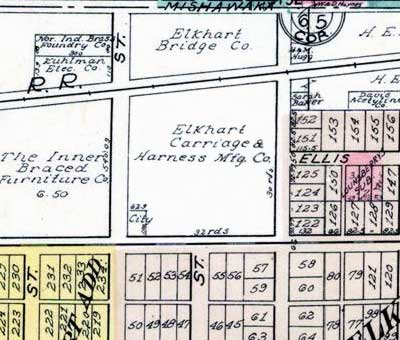
Further details as well as the exact
location of the new
factory - the northwest corner of W. Beardsley Ave. and N. Michigan St.
– was
provided in the August 22, 1889 issue of the Elkhart Sentinel:
“SOMETHING FOR ELKHART.
“The Elkhart Buggy Works to Move to the
North Side.
“A big deal was completed in this city
Saturday evening, and
one that means a great deal for this city. The Elkhart carriage and
harness
manufacturing company have transferred their factory building on Pratt
street
to Mr. H.E. Bucklen, that gentleman paying eighteen thousand dollars
for them,
and other interested parties five thousand more. The company also
receives six acres
of land situated at the southeast corner of the fairgrounds—thirty rods
on
Michigan street and thirty-two on Beardsley avenue. By the terms of
their contract,
the carriage company is obligated to erect buildings equivalent to
three brick
structures each three stories high and 60 x 200 feet in size.
“In other words, the buildings must contain
one hundred and
eight thousand square feet of floor room. The exact shape of the
buildings has
not yet been decide upon, but the company will send representatives to
all of
the largest carriage companies in the country to get ideas, and then
they
propose to erect the model carriage and harness factory of the country.
“The Elkhart & Western railway company
also agree to
build a track from the factory to the C. W. & M. road near the
Cassopolis
road, a distance of about a mile, and Manager Beckley of the O. W.
& M.
agrees to operate the road. This will give the carriage and harness
company a
railroad outlet, as well as the other factories that are expected to be
located
in the same vicinity in a short time.
“This deal is a big one, as it is understood
to include
several others which for obvious reasons are not in shape to be made
public at
present. The factory site that Mr. Bucklen gets possession of is a
valuable
one, and he does not propose to let it lie idle. Negotiations are now
on to
start it up as soon as it is vacated, and our people may be called on
to give
the project a lift. If they are, the Sentinel hopes that it will not be
refused. There are great things on for Elkhart, and we must each one do
our
part. Another factory will probably be located on the new railroad near
the
carriage works. The deal is well along, and it will probably be closed.
“For a long time the shops of the Elkhart
carriage and
harness company have not been large enough to accommodate their
business, and
they have received several flattering offers to go west. Their trade is
largely
in the west, and a change of location in that direction could not fail
to be
advantageous in the matter of freight rates. But they, like everybody
else,
prefer Elkhart, and they determined to remain in this city, and were
glad to
make an arrangement whereby they can spread out to their heart's
content. Their
business has grown to an enormous extent, and they will now be situated
so that
they can reduce the cost of handling their work while in the process of
manufacture to the lowest possible amount.
“The other details of this immense trade
will unfold
themselves gradually. But the Sentinel feels like congratulating
Elkhart on the
fact that Mr. Bucklen evidently meant it when he said that he would do
more for
Elkhart this year than he did last. This investment of twenty-five
thousand
shows that his confidence in Elkhart is not affected by the dull times,
but
that he proposes to push the city to the front.
“May he be more than successful.”
Construction commenced soon afterwards and
the October 10,
1889 issue of the Elkhart Daily Review announced:
“The workmen are engaged on the fourth
stories of the two main buildings of the Elkhart Carriage and Harness
works, and
the roofs have been put on some of the buildings.
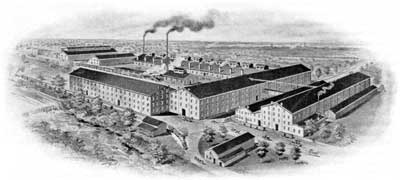
The move to the new factory was completed in
early December
1889 and within a few short months Bucklen’s new tenant, the Kalamazoo
Cart Co.,
had relocated to Elkhart reorganizing as the Indiana Buggy Co., with
both
Mssrs. Bucklen and Pratt subscribing to significant portions of the
firm’s new
stock.
In the meantime Bucklen was busy lining up a
tenant for the
soon-to-be vacated Pratt Street carriage works, finding a good prospect
in the
Kalamazoo Cart Co. who was looking to expand their operations.
The prospect was first mentioned as a
possible tenant in the
following letter which was published in the September 14, 1889 edition
of the
Elkhart Daily Review:
“KALAMAZOO, Mich, Sept. 12, 1889
“HON. 0. Z Hubbell, ELKHART, Ind.
“Dear Sir — Since I was at your place our
people have
considered the matter carefully and decided that to move to Elkhart
would
entail a heavy burden on us which would be a dead loss. We do not
believe this would be counterbalanced by any advantages which Elkhart
as a
place of business
seems to offer. This being the case, we do not feel warranted in making
the
change at present, unless Elkhart is willing to offer other inducements
than
those of location and a good plant.
“The only reason for our looking elsewhere
at all, is to
secure more room which we are obliged to have at once. This need first
led us
to consider the advisability of occupying the Pratt buildings. I am
well
pleased with the plant, and very favorably impressed with Elkhart, and
if your
people would raise us $2,500—this being the estimated cost of moving—we
will
move our entire works there and take a large portion of our help with
us. In
this case we would enlarge our present business and add other vehicles
than
carts and road wagons, our object being to work at once into the
carriage
business.
“This would result in our employing a
largely increased
force of workmen, most of whom would be mechanics. Our pay roll for the
first
six months of this year was over $13,000, and with the large increase
in our
working force required, this amount would very much larger the coming
year.
“If your people do not desire to pay cash
down, we will
agree to take notes of responsible parties, payable as follows:
“One thousand dollars when we begin
operations in Elkhart,
and five hundred dollars every six months thereafter until the entire
amount is
paid, it being the understanding that if we fail to conduct the
business on as
large a scale as at the present time, the notes shall at once become
void and
payment on them be stopped. We shall be obliged to make definite plans
for the
future at once, and while we do not wish to show undue haste in the
matter, yet
we shall look for an early reply from you.
“Trusting that you will see the justice of
our position, I
remain,
“Very truly yours, C. H. GLEASON, Secy.”
As the Kalamazoo firm was considering other
offers from
Goshen, Indiana and Niles, Michigan, a group of Elkhart businessmen saw
to it
that the required $2,500 was raised in the next few weeks and on
October 31,
1889 the Elkhart Sentinel reported the following result:
“The Kalamazoo Cart Company – or, as it will
be known
hereafter, the Indiana Buggy Company – has filed its articles of
incorporation with
the county clerk.”
Indiana Buggy Co. officers and shareholders
included George
B. Pratt, J.L. Wolf, and C.H. Gleason, its secretary & general
manager.
Unfortunately the new buggy maker did not
enjoy the success
of the former occupant of the Pratt street factory and was forced into
bankruptcy within the year, the September 18, 1890 edition of the of
Elkhart
Weekly Truth reporting:
“A receiver was appointed by Judge Van…et
last Friday for
the Indiana Buggy Co. by mutual consent between certain of their
creditors and
the company. Cashier W. Knickerbocker of the First National Bank was
made
receiver, under a $50,000 bond. This action is no indication of
decreasing
business, but was taken simply to protect outsides who have added to
the
capital of the company, who anticipate no trouble in taking care of
their
indebtedness.”
The February 12, 1891 issue of the Elkhart
Weekly Truth
reported on the findings of the receiver:
“Mr. Knickerbocker, the receiver of the
Indiana Buggy
Company, has deemed best for the creditors to close it up until some
arrangement is made to place the tools, machinery and effects of the
concern in
the hands of parties who will give it new life. And manage its affairs
successfully. There can be no doubt of Mr. Knickerbocker’s wisdom in
pursing
this policy, and in a reasonable length of time the company will
probably reorganized
and the factory started up with renewed vigor. Mr. Gleason, the late
manager,
has returned to his home in Kalamazoo.”
The receiver held a sale of the Indiana
Buggy Company’s
assets on Friday, June 19, 1891.
During the summer of 1891 Frederick B. Pratt
decided to
retire, his withdrawal from the day-to-day affairs of the Elkhart
Carriage &
Harness Co. coinciding with a reorganization of the Indiana Buggy
Company, of
which he was a major stockholder. The new firm’s budget-priced
Indiana-brand
buggies were distributed by the Elkhart Carriage Company, allowing the
Pratts to
compete directly against the nation’s low-priced vehicle manufacturers
without suffering
a loss of prestige.
The Pratt family had long been active in the
civil affairs
of Elkhart, with Frederick B. in particular providing city blocks full
of
housing and campaigning for improvements to the city’s infrastructure
that
would benefit all of its citizens. Attorney and Pratt stockholder and
board
member Otis D. Thompson served as Elkhart County Clerk starting in late
1882
after which he served as mayor of Elkhart from 1892 until 1894.
At the January 1894 board meeting of the
Elkhart Carriage
& Harness Co. Frederick B. formally announced he was relinquishing
control
of the firm to his two sons; George B. and William B. Pratt, at which
time he
sold them his entire holdings in the firm, 18 shares of which were
presented to
Otis D. Thompson, in honor of his years of service to the firm as its
attorney.
In May of 1895 Otis D. Thompson sold his
approximately 10% share
in the firm to the Pratt brothers giving them complete control of the
Elkhart
Carriage and Harness Co. of which William B. Pratt served as
President –
George B. Pratt holding the position of
plant manager at the associated Indiana
Buggy Company across town.
Midway through 1897 George B. Pratt
announced he was
withdrawing from his participation in the Indiana Buggy Co., and would
henceforth devote his whole time and attention to the business
activities of
the Elkhart Carriage and Harness Co., the June 17, 1897 issue of
the
Elkhart Weekly Truth reporting:
“Largest On Earth
“Pratt Carriage Works to Lead All
Competitors.
“Important Changes Being Made.
“Elkhart Carriage and Harness Concern to Be
Vastly Enlarged -
George B. Pratt Withdraws From the Indiana Company - Force Increased.
“It has been known for some time that the
Elkhart Carriage
and Harness Company has been contemplating a change in its business
which would
necessitate the erection of several new buildings, and an increase of
its force
sufficient to double the capacity of the factory. The matter has been
somewhat of
a secret as the company did not wish to disclose its plans until they
had been
fully matured.
“That time has now arrived and the company
is ready to
announce the plans which will mean a great deal to its employees and
the city
in general.
“Heretofore the Elkhart Carriage and Harness
Company, which
is composed of W.B. and George B. Pratt, has used a vast amount of work
which
has been turned out; by the Indiana Buggy Company, in which George B.
Pratt is
a large stockholder, and in which factory he has been acting in the
capacity of
superintendent and business manager.
“When the change mentioned has been
accomplished all this
work will be performed in the new factory of the Elkhart Carriage and
Harness
Company. Mr. George B. Pratt will withdraw from the Indiana Buggy Works
and
devote his whole time and attention to a part of the business of the
Riverside
factory.
“The new buildings to be erected will more
than double the
capacity of the present factory and will furnish about 130,000 feet of
floor
space. They will consist of two new structures, one of which will be 80
x 208
feet in dimensions, the other 80 x 144 feet and each will be four
stories in
height. Besides these two entirely new structures, one of the present
buildings, which is 60 x 144 feet in dimensions and only two stories in
height,
will have two new stories added.
“The force of employees will be doubled and
the business
which has hitherto been so successful under the unique methods pursued
by this
company will doubtless assume greater proportions than ever before.
“The Indiana Buggy Company will continue to
conduct its
business on the plan now pursued by it and it has been so arranged that
the
withdrawal of Mr. Pratt will in no wise inconvenience the management of
that
factory.”
As the board of the Indiana Buggy had
recently rejected an
offer by the Pratts to take over their firm, it seems as if the
preceding
announcement was a calculated move by the Pratts to force the board of
the
Indiana Buggy Co. to sell out, a strategy that ultimately proved
successful as
indicated by the following article which appeared in the next issue
(June 24, 1897) of the Elkhart Weekly Truth:
“Buggy Works Sold
“Indiana Buggy Works Absorbed in Pratt's
Riverside Plant.
“Both Factories To Run On One Plan
“The Final Papers in the Sale Were Signed
Today - Erection
of the Proposed New Building Indefinitely Postponed.
“The business of the Indiana Buggy Company
has been
purchased by George B. and W.B. Pratt. The transfer will have the
effect of
postponing for an indefinite length of time the erection of the
proposed large
addition to the Elkhart Carriage and Harness Company's factory in
Riverside.
“The announcement, which was made
exclusively in ‘Truth’,
that Mr. George B. Pratt would withdraw from the management of the
Indiana
Buggy Company was received with astonishment by the employees of that
company
and the information that the Pratts will soon assume absolute ownership
and
control of the business will doubtless be equally surprising to many of
them.
“It has been stated that the manner in which
the Indiana
Buggy Company has conducted its business was not in conformity with the
ideas
of Messrs. Pratt. The unique methods pursued by them in the management
of the
Elkhart Carriage and Harness Company's business have proven so
successful and satisfactory
that they concluded to withdraw from the Indiana Buggy Company and
devote their
whole time and attention to the control of the Riverside factory.
“When this course was determined upon a
proposition to
purchase the Indiana Buggy Company's business was made by the Pratt
Brothers,
but at that time the other stockholders thought it advisable to
continue the business
under its present name and the proposition was rejected.
“It was at this point that the Pratts
decided to enlarge the
Riverside factory to accommodate their rapidly increasing business, and
arrangements were made to proceed with the erection of the necessary
additions.
“The present change of plan was finally
brought about
through the acceptance of the Elkhart Carriage Company of a subsequent
proposition made to them on last Monday by the Indiana Buggy Company.
These gentlemen
say they knew nothing about the carriage business and that the success
which the
company has achieved has been largely due to the energy and business
ability of
Mr. George B. Pratt, the retiring manager. This condition of affairs
has
induced them to reconsider the matter, hence the proposition made to
the
Elkhart Carriage and Harness Company.
“The lease of the building now occupied by
the Indiana
Company at the foot of Pratt street extends for several years and the
Elkhart
Carriage and Harness Company will manage the business of both factories
under
the plans now employed only at the Riverside works.
“It is probable that Mr. George B. Pratt
will remain at the
downtown factory and that the office business will be transacted at the
Riverside works. It was expected that the building of the new additions
to the
Riverside factory would furnish employment during the greater part of
the
summer to a large number of workingmen and for this reason the present
change
of plans will be greatly regretted, but it is argued, that the increase
of-business which will probably result from the consolidation of the
two
factories will come sooner than if it had been necessary to wait for
the
erection of new buildings.”
In the years 1895 through 1898 the Elkhart
Carriage &
Harness Co., and Indiana Buggy Co. jointly produced an average of
10,000
buggies a year. The 1899 Annual Report of the Officers of State of the
State of
Indiana reveals that at the time of their June 1899 factory inspections
the
Elkhart Carriage & Harness Co. employed 250 males, and 6 females
while the
associated Indiana Buggy Co. employed 100 males and 6 females, putting
the
total employment at the Pratt’s two enterprises at 362 hands.
Fire apparatus became another product of the
firm in 1899
when they were awarded a contract to produce hose wagons for the City
of
Elkhart. The wagons were highly regarded and orders for similar
vehicles were fulfilled during the early part of the
Twentieth
century.
The June 22, 1899 edition of the Elkhart
Weekly Truth
announced a further expansion of the Beardsley Ave. factory of the
Elkhart
Carriage & Harness Co.:
“A NEW FACTORY BUILDING
“Elkhart Carriage & Harness Company Will
Erect a New
Building.
“The Elkhart Carriage and Harness
company is
preparing to build a large addition to its already mammoth factories in
Riverside. The new structure will be 66 x 150 feet in size and four
stories high.
It will furnish 42,240 square feet of floor space and will be used as a
warehouse building. It will be connected with the main factory building
with
passageways on each floor. The largely increased business of the
company makes
the erection of this building a necessity.”
During 1900 George B. Pratt acquired the
rights to a much
improved pole and shaft coupling designed by Elkhart native Robert O.
Neville,
the September 13, 1900 edition of the Elkhart Weekly Truth announcing
the
formation of a firm to exploit the device:
“The Elkhart Carriage Specialty
Co. was
incorporated yesterday with the following officers: Pres., G.B. Pratt;
Vice
Pres., C.T. Swaffield; Sec., Robt. O. Neville; Treas, I.W. Short. The
above
officers together with Alex. Montgomery constitutes the stock holders.
The
object of the company is the manufacture and sale of the Neville Pole
and Shaft
Coupler.”
The February 9, 1901 issue of Scientific
American described
Robert O. Neville’s invention (US Patent No. 666,206 - filed June 15,
1900 –
issued January 15, 1901) as follows:
“Pole Or Shaft Coupling - Elkhart, Ind. Mr.
Neville has
devised a simple anti-rattling coupling which holds the pole-iron or
thill-irons connected with the draw-shackles, while the pole or thills
are in
use, or when they have been placed in an upper or lower position for
the
storage of the vehicle, or when the animals are unharnessed. The device
is so
constructed that the thill iron or pole iron may be quickly
disconnected from
the draw-shackles. The coupling is manufactured by the
Elkhart Carriage Specialty Company and Indiana
Buggy Company, of Elkhart, Ind.”
The 1902 Annual Report of the Officers of
State of the State
of Indiana reveals that during the previous year the Elkhart Carriage
&
Harness Co. employed 154 males, and 21 females while the associated
Indiana
Buggy Co. employed 125 males and 6 females, putting the total
employment at the
Pratt’s two enterprises at 307 hands.
The death of the firm’s 81-year-old founder
appeared on the
front page of the Saturday July 18, 1903 issue of the Elkhart Daily
Truth:
“Death Relieves Mr. F.B. Pratt
“Passed Away at 6 O’Clock This Morning Aged
81 Years
“Suffered Long With Paralysis
“Retired From Business About Ten Years Ago –
Funeral Monday
at 4 O’Clock
“Frederick B. Pratt, one of Elkhart's oldest
and most
respected residents, died this morning at 6 o’clock of paralysis. He
had been,
an invalid for the past year; and during last month was unconscious
most of the
time. He was 81 years old, and lived in this city for about 45 years.
“Mr. F.B. Pratt was born in Springfield,
Vt., December 18,
1822. His father was anxious that he study law after leaving school,
but he
thought he would prefer the mercantile business, and left school at
eighteen to
go to Boston, where he was with one of the largest dry goods houses for
five
years.
“He came west when he was 23 years old, and
started in
business at Battle Creek, Mich. He married Miss Charlotte E. Byington
when he
was twenty-five. When he was about thirty a company was formed called
Pratt, Rue
& Rogers. When Mr. Pratt was thirty-five years-old his health gave
out, and
for some reason about a year later the firm was forced to make an
assignment.
It took some time to close out the business, and unfortunately there
was
nothing left for any member of the firm.
“When Mr. Pratt was about thirty-six years
old the family
moved to Elkhart, and he started in the retail hardware business with
the help
of his uncle, Mr. Wm. Brooks. After he had been in Elkhart a few years
the block
occupied at this time by C.E. Crane & Co. was built, and the
hardware business
has been carried on in this building for more than forty years. About
thirty
years ago Mr. Pratt took his son, Mr. W.B. Pratt, into business with
him, and
the company was known as F. B. Pratt & Son.
“Very soon after this change was made, the
new company began
the manufacture of vehicles, and sold out the hardware business to
Messrs.
Rawson & Reynolds. Twenty years ago Mr. Pratt's second son, Mr.
G.B. Pratt,
came into the business, and a stock company was formed called the
Elkhart Carriage
& Harness Manufacturing Co.
“Ten years ago when Mr. Pratt was seventy
years old, he
decided he did not care to remain in business; in fact, he had not been
very
active in the business for several years previous. He felt that he did
not
longer care to assume the risk that there is in doing quite a large
business,
and sold his stock in the Carriage Co. to his two sons.
“Mr. Pratt united with the Presbyterian
church in Battle
Creek when he was twenty-five years old, so that he was a member for
fifty-five
years. He was not a member of any secret organization.
“The only near relatives living are his
wife, his sister,
Miss Louisa J. Pratt of Detroit, Mich., his two sons, W. B. and G. B.
Pratt,
and six grandchildren.
“The funeral will be held at the family
residence Monday
afternoon at 4 o'clock, Rev. Dr. Frazer officiating.”
The senior Pratt’s passing coincided with
the cessation of
manufacturing activities at the old F.B. Pratt carriage factory which
were
repurposed as storage facilities, one of which was destroyed by fire in
mid-July, the July 20, 1904 issue of the Elkhart Daily Review reporting:
“ANOTHER SERIOUS FIRE
“Indiana Buggy Storage and Crating Building
Badly Damaged.
“Fire was discovered on the top floor of the
big storage and
crating building of the Elkhart Carriage & Harness Mfg. Co.'s
"Indiana
Buggy" plant near the east end of Pratt street a few minutes after 1
o'clock this afternoon.
“For a time the entire plant, consisting of
this building
and those on the east side of East street, and the planing mill of
Newman Bros,
on the south were thought to be inevitably doomed.
“The building is a four-story brick with
slate roof, with a
Pratt street frontage of 60 feet and a depth of 100 feet, reaching
almost to
the Newman mill, which fronts on East street. It contained finished
stock,
crating and packing material. The flames were first discovered by
Charles Hatch,
who saw smoke issuing from the roof when he stepped from his boarding
house on
Pratt street. He ran to the building and notified the employees, who
plied the
company's private fire-fighting apparatus, and in the meantime gave the
alarm.
The first city alarm was sounded at 1:05, and at 1:20 a general alarm
summoned
all the four call companies. The South Side company, which was the last
to
arrive, was on the scene at 1:40.
“The early efforts of the firemen were
handicapped by low
water pressure, it being impossible to reach the points of danger from
any
vantage points which the firemen could gain. That this lack was not due
entirely to the force of the pumps at the pumping station was evidenced
by the
fact that the streams from two of the lines reached to the gable of the
building
from the ground, while others did not reach further than twenty-five
feet.
“One explanation is that five streams were
drawn from the
Pratt street main, which is but 4 inches in diameter. There were also
two streams
from the Franklin street main and one from the Division street main,
and these
were the ones that gave as much pressure as could be expected. The
gauge showed
that the pressure on the system was 85 pounds beginning soon after the
first
alarm was sounded.
“Against these discouragements the firemen
had to battle,
but they were aided by the excellent construction of the building, and
at 1:45
to 1:50 it began to appear as though the fire would be confined to that
building.
“A wind direct from the north made it
advisable for
employees of the Newman mill to continually throw water on that
building so
that falling sparks could not start a blaze. Residents of houses just
west of
the burning building began to get their effects together, preparatory
to moving
out.
“Soon after the discovery of the fire the
electric current
running into the building was shut off. The employees carried
considerable of
the crated products out of the building before the flames rendered
further
entrance to the building extremely dangerous.
“The east side of the roof fell in at 1:30,
and it was then
that spectators at a distance began to realize the possible scope of
the
danger. By 2:15 the firemen were certain they had It under control, and
with the
subsidence of the flames they were enabled to approach closer to the
source of
heat. Increased water pressure also aided. The entire roof fell in, but
up to 2:20
none of the floors had fallen and at that time were not expected to.
The
elevator, however, made a great crash as It fell.
“At 2:35 a large portion of the fourth floor
fell in. At
2:45 the firemen were rounding up the work of extinguishing the flames.
At 2:45
a portion of the east gable wall fell, carrying Charles Shupert down
with It.
For a time there was much excitement, but he finally emerged apparently
unhurt.
Fifteen feet to the east, and connected to some extent with the damaged
building,
was another of similar construction, two stories high with 37-foot
frontage and
100-foot depth. It is used for similar purposes and for the office. The
fire
did not extend to this, and the minor damage done there was by smoke.
“The plant is a part of the Elkhart Carriage
& Harness
Manufacturing Co., whose main works are in Riverside. One of the
members,
George B. Pratt, was on the ground, but the other member, William B.
Pratt, is
at his summer home at Wilnocqua, Wis. The buildings belong to H. E.
Bucklen.
“The exact cause of the fire is unknown.
Spontaneous
combustion was suggested, but employees thought this improbable. Livy
Chamberlain, who carries all the Insurance on the building and
contents, says
that it is ample to cover the loss, but he does not deem it advisable
this early
to quote estimates.
“Notes
“A barn on Division street nearly caught
from a spark, but
the flames were extinguished with a garden hose. Fireman Will Curtiss
was
overcome for a time by the smoke and heat, but quickly recovered. Mac
Dotson
injured one hand during the fight.”
July 21, 1904 Elkhart Daily Review:
“Indiana Buggy Co. Filling Orders Regardless
of Fire Damage.
“The loss to the Elkhart
Carriage & Harness Mfg. Co. caused by the fire at its Indiana Buggy
Factory Wednesday
afternoon is estimated at $15,000.”
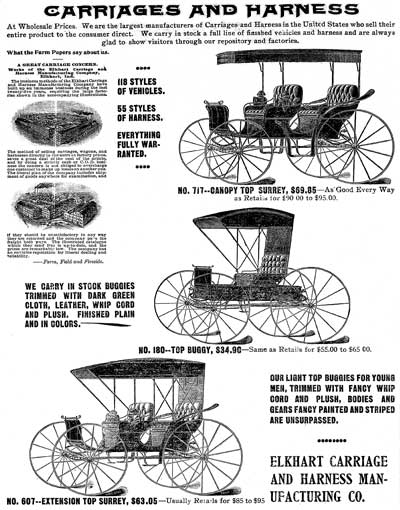
The firm soldiered on through the early part
of the 20th century doing business as usual although profits
were being
negatively affected
by two separate forces. Large multi-product catalog retailers such as
Sears,
Roebuck and Montgomery Ward were slowly encroaching upon the once
strong sales
of the Pratt’s line of budget-priced carriages and buggies. The profits
created
by the sale of such vehicles were already minimal and increased
competition had
driven the prices so low, that it made little sense to continue their
manufacture. The second problem affecting the firm’s future was harder
to
pinpoint, but a gradual decrease in orders for the firm’s fine
carriages, their
most profitable product, was more troublesome. Those vehicles were
historically
purchased by wealthy Americans, and as time wore on, those wealthy
Americans
were forgoing the purchase of new carriages in favor of new
automobiles.
Even the Pratt family was not immune to the
new mode of
transportation, as evidenced by the following item in the September 10,
1908 issue
of the Elkhart Daily Review:
“Bought Fine New Automobile.
“When G. B. Pratt and family returned the
other day from
their touring trip to the Berkshire Hills in Massachusetts and other
eastern
points they came in a new Locomobile of sixty horse power—a machine
that is
attracting much attention from those who are informed on such matters.
It is of
the 1909 model.”
Included in the very same newspaper was the
following
article, announcing that the firm was officially abandoning the Indiana
Buggy
plant, which it continued to lease from Herbert E. Bucklen:
“A Change Of Methods
“Plan of Utilizing Big Plants Is Modernized
“Elkhart Carriage & Harness Mfg. Co.
Will Abandon
Manufacture In Indiana Plant – Latter For Storage.
“The Elkhart Carriage & Harness Mfg. Co.
has decided to
do all its manufacturing in the Beardsley avenue plant and to use the
old
Indiana Buggy Co. plant at the foot of Pratt street simply for
warehouse
purposes during the next two years of the company's lease of that
plant. After
that the company expects to build whatever buildings are necessary on
the grounds
contiguous to its present big plant on Beardsley avenue.
“The above change has been in contemplation
for some time,
but the decision was not made until last night. It is expected to be in
full
operation by October 1.
“The new plan follows the trend of the times
in industrial
administration, and is expected to prove of advantage to the company
and to the
employees. In certain instances there will necessarily be changes
because of
the present duplication of certain kinds of employees where, under the
new
plan, but one will be required in the same position.
“But the manufacturing force at the
Riverside plant will be
practically doubled, while the cost of running the machinery portions
will be
greatly reduced, nearly split in two.
“The change now announced is the logical
result of the progress
of events tor some years back—there has been no Indiana Buggy Co. for
several years,
and what has popularly been called the 'Indiana buggy works' has simply
been adjunct to the Elkhart Carriage & Harness Mfg. Co. plant.
“The Elkhart Carriage & Harness Mfg Co.
is a corporation
of $150,000 capitalization, with only the three legally required
incorporators—
W. B. and G. B. Pratt and Miss Mary Pratt.
“The Indiana plant was built by F.B. Pratt,
deceased, father
of W.B. and G.B. Pratt and founder of the larger carriage industry in
this
city, and was used as the 'Prattshop' until 1889, when H.E. Bucklen,
as one inducement to locate a new and bigger plant in his "factory
section" of Riverside, bought the Indiana plant. In 1891 operations
were
resumed in the Indiana by a reorganized company, and the factory has
remained
in continuous operation. In 1897 the Pratts bought up the Indiana stock
held by
all others, and since then only that family has been interested. Four
or five
years ago the Indiana company was technically wiped out by an
arrangement
between the brothers.”
In 1906 the firm began construction of
prototype motorized
buggies and by the end of March, 1909 its first product, a 2-cylinder
air-cooled
number
selling for $430, was placed on the market, the March 25, 1909 issue of
the
Elkhart Daily Review reporting:
“Making An Auto Buggy
“Elkhart Institution Offers On Market
Vehicle That Should
Sell Readily
“The Pratt Motor Buggy is the name of the
newest output of
the Elkhart Carriage & Harness Mfg. Co. For several years this
company has
been experimenting with auto buggies with the view of beginning their
manufacture as soon as a cheap practical model could be obtained. The
buggy
that is now to be put on the market is not an experiment, but has been
tested
in every conceivable way for the past three years. The auto buggy has
already
been given a space in the regular advertising catalogue and its
manufacture
started. Several machines have been sold, and one is being used daily
by
members of the firm.
“The machine sells for $430. It is so
constructed that it
can be used every day in the year, being air-cooled to avoid freezing
up in
cold weather. It looks almost exactly like an ordinary buggy, having
hard
rubber tires. The engine gives sufficient power to travel over all
kinds of
roads, and gives a speed of from five to twenty-five miles on country
roads and
thirty miles an hour on paved streets. One gallon of gasoline will
carry it
about thirty miles. The buggy is made in only one style now, but
arrangements
are being made to build surreys.”
Although it’s inconceivable that Frederick
B. Pratt’s sons
could have approved of their actions, on December 2, 1909, the Elkhart
City Council
passed ordinance #472 officially changing the name of the street on
which the
elder Pratt had constructed his first buggy works from Pratt Street to
Marion
Street, the very same name that it goes by today. The original
buildings were
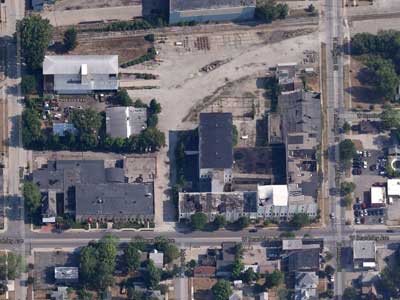
razed many years ago, the properties currently housing the Elkhart
Police Dept.
to the north and its bi-level parking garage to the south.
By that time a decision had been made to
forgo the
manufacture of any more horseless carriages and to concentrate on a
conventional Mercedes-type motor car which was christened the
Pratt-Elcar and
debuted in late 1909. As was the practice common at the time, only the
car’s
wooden coachwork was constructed from scratch, the rest of the
components being
sourced from various third parties and assembled in the factory – an
assembled,
rather than manufactured, automobile.
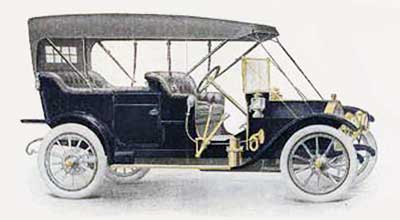
The right-hand-drive $1800 (medium-priced)
Pratt-Elkhart
30-35 was built on a 113-inch wheelbase chassis equipped with a
full-floating
rear axle with ¾ elliptic springs and wood-spoke wheels shod with 34” x
4”
rubber tires. A Mercedes-type honeycomb radiator was mounted up front,
with power
coming from a Waukesha ‘Unit Power Plant’ 4-cylinder gasoline engine
equipped
with a Bosch and Remy electrics and a Schebler carburetor. Lighting was
furnished by Gray & Davis and power to the rear wheels was
transferred via
a Johns Manville clutch and Cotta transmission.
For 1911 the bore of the pair-cast Waukesha
L-Head Unit
Power Plant increased from 4 ¼” to 4 ½” (the stroke remained the same
at 4 ¾”) as
did the car’s wheelbase which increased 4” to 117”. Also included in
the $1800
advertised price was a pair of front doors which had not been included
on the
touring car coachwork the previous year.
Also introduced that year was a line of 4 h.p.
1-cylinder Motorcycles marketed under the Pratt moniker for a
reasonable $235. Unfortunately sales were less than anticipated
and the line was not continued the following year.
The Elkhart moniker was dropped from their
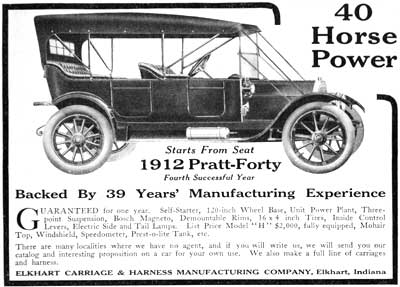
automobile line in 1912, and
a new $2,250
six-cylinder model, the Pratt Model 50, joined the $2,000 4-cylinder
Pratt Model
40. Both of which were fitted with a standard Prest-o-lite acetylene
starter, a
new 120” wheelbase chassis and a choice of coachwork all of which was
painted
Richelieu blue with pearl gray striping unless special ordered. A
pressed steel
double-channel front axle was paired with a full-floating rear axle
that
utilized internal expanding hand and foot brakes mounted side-by-side.
Roller valve
lifters and a helical gear-driven camshaft were part of the 4 and
6-cylinder
Waukesha Unit Power Plant engines which was marketed as the
‘nickel-chrome
motor’ due to the fact that a nickel-chrome alloy was utilized where
wear was a
factor.
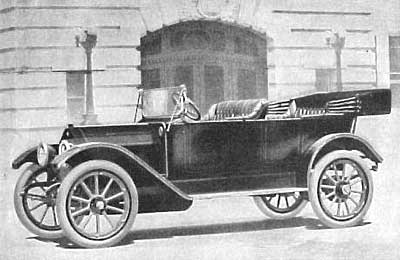
The 1913 Elkhart line included the new
budget-priced Model
30 which mated a block-cast 4-cylinder to a separate unit gearbox all
riding on
a 114”wheelbase. The Model 40 was largely unchanged while an all-new
Model 50
debuted which continued as the firm’s sole 1914 offering. The Model 50s
hood
blended seamlessly into the cowl and the spare tire was moved to the
rear of
the tonneau in an early attempt at streamlining. The 122” wheelbase
senior
model was also available as an enclosed-drive limousine which was
priced at $3,000.
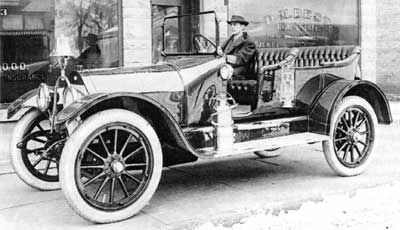
A new Pratt Model 6-50 debuted in 1915 whose
347.8 cu. in.
Continental 6-cylinder engine, Brown-Lipe gearbox and Timken axles were
fitted
to a spacious 132” wheelbase which rode on 37” x 4 ½” Goodyear rubber.
Prices
were cut substantially with the roadster and 5 –passenger touring
priced at
$2,150; the 7-passenger at $2,250; and the enclosed-drive limousine no
longer
available.
During the year the factory’s board
transferred the firm’s
harness manufacturing equipment to the LaPorte Harness Co. LaPorte,
Indiana who
would continue to supply the firm with harnesses until carriage
production
ended during the war. The also decided to enter the medium-priced field
with an
all-new car which would be marketed as the Elcar, a trade name derived
from the
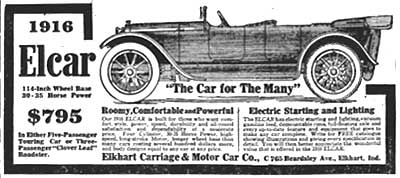
firm’s corporate name, (EL)khart (CAR)riage. The $795 4-cylinder
Elcar’s debut
coincided with a $300,000 recapitalization (from $100,000) and
reorganization of the firm as the Elkhart Carriage and
Motor
Co., the November 22, 1915 issue of the Goshen Daily Democrat reporting:
“The petition of the Elkhart Carriage and
Harness
Manufacturing Company to change its name to the Elkhart Carriage &
Motor
Co. was granted.”
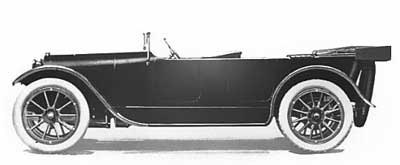
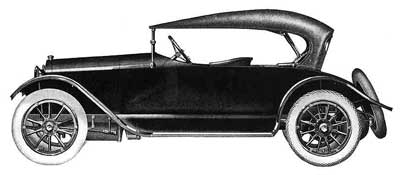
Powering the $795 114” wheelbase 5-passenger
touring and
3-passenger cloverleaf roadster was a 37.5 h.p. Lycoming 4-cylinder,
Model DXU
engine, a popular engine which was also used by Crow-Elkhart,
Partin-Palmer and
Tulsa. The block-cast L-head 4 included a 2-bearing crankshaft and a
detachable
cylinder head.
The all-new 1917 Elcar was announced in the
pages of the January
4, 1917 issue of Motor Age:
“Elcar
“The Elcar for the coming season will be
furnished in
five-passenger touring car, four-passenger touring roadster and a
two-passenger
roadster designated as models D, E and F, all on the same chassis. The
chassis
is quite different from that of 1916.
“The wheelbase has been increased to 115
inches and the
design of the frame itself is different. The cone clutch is replaced
with a
dry-disk type and the position of the gearshift and emergency brake
levers is
such as to be more convenient for the driver. The new spring suspension
is
semi-elliptic front and rear and spiral bevel gears are used and a
new
floating axle with roller bearings at each end of the wheel hubs.
“Elkhart Carriage and Motor Car Co., Elkhart,
Ind.”
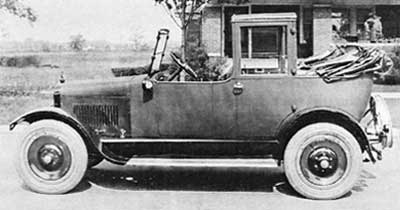
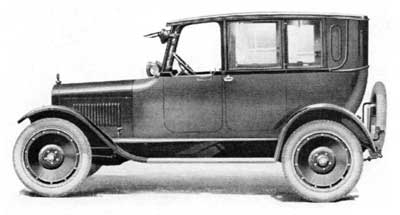
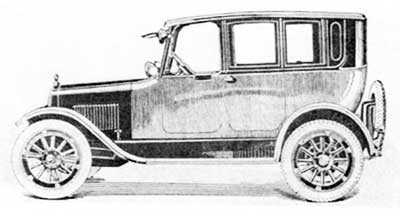
By this time Elcar had begun limited
production of
automobile bodies for third parties, a line that included jitney bodies
for
taxicab operators and panel van bodies for commercial cars and trucks.
The
production of bodies for commercial use was not reported as a distinct
category
until 1916 although it’s likely small numbers had been constructed at
various
times during the previous decade.
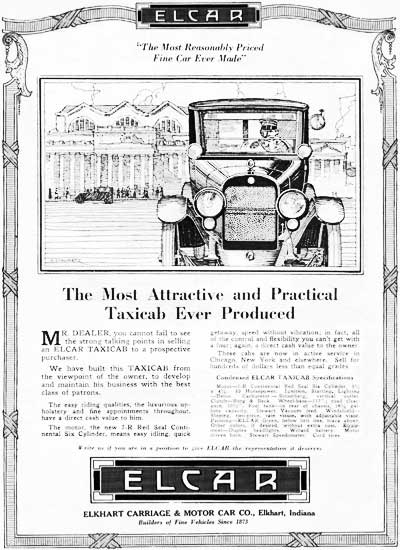
Although the production numbers of complete
taxicabs during
1916 are unknown as they were included in the completed motor car
totals,
‘jitney body’ production was listed at 330 during the same period.
During fiscal
1917 sales of complete taxicabs amounted to $61,444, or approximately
50 units.
Sales of jitney bodies to third parties were now included in the
commercial
bodies total which also included utility and delivery van bodies. The
firm’s
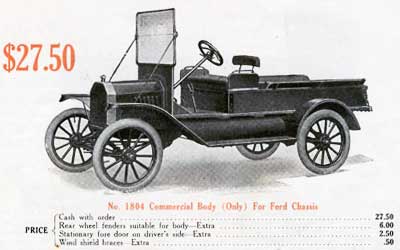
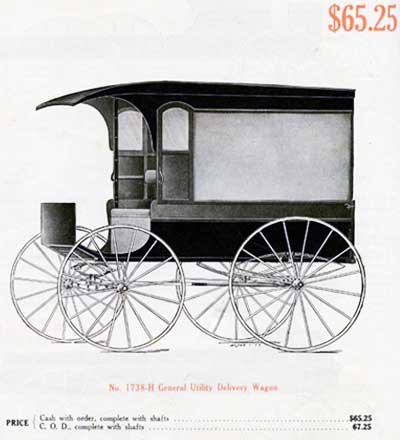
1917 carriage catalog included a line of 2- and 4-wheeled trailers as
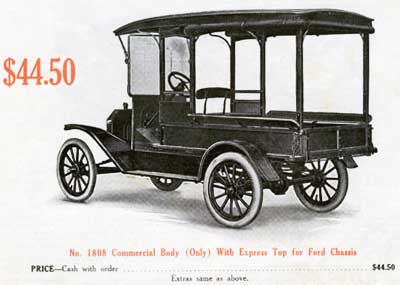
well as
an assortment of utility bodies designed for Ford Model T and TT
chassis.
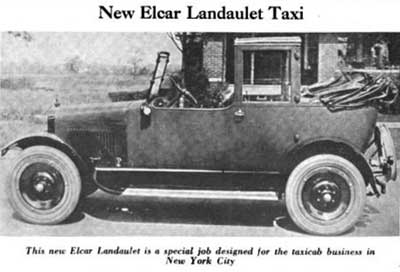
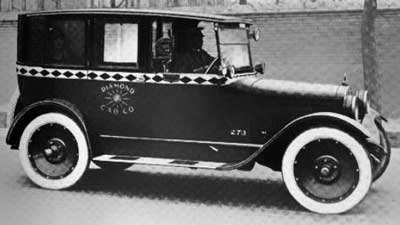
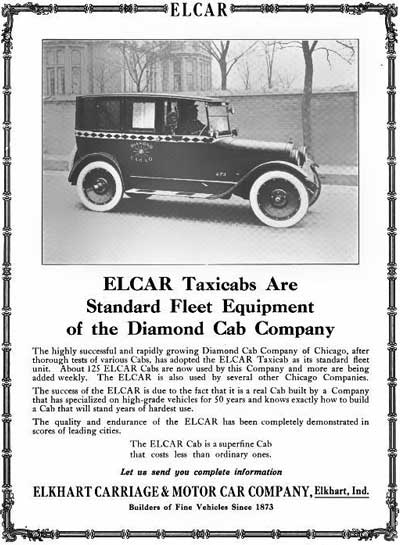
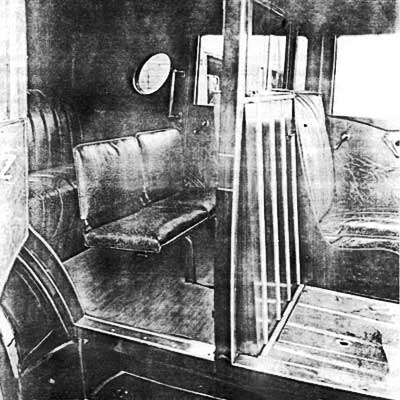
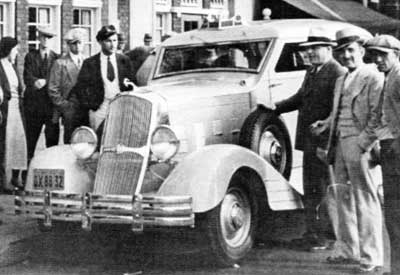
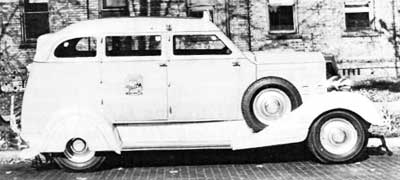
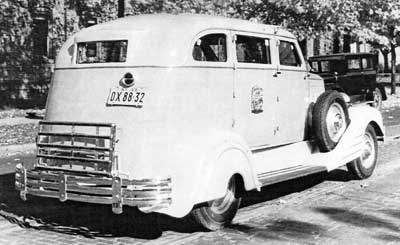
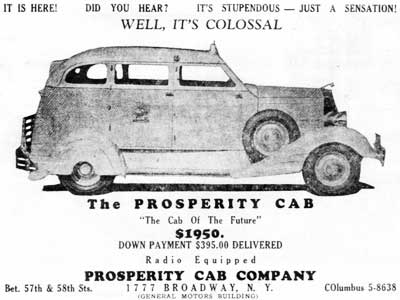
A similar number of Elcar taxicabs
(approximately 48) were constructed
during 1918 and from 1919 on taxicab production was included with
regular
automobile production, although a number of large orders (one for 1,000
complete cabs) were announced in the trades during the early 1920s.
Not only did Elcar supply coachwork for others
firms, they even
constructed complete automobiles - the 1918 Texan automobile was a
badge-engineer Elcar and fully 5% of the firm's pre-war revenue came
from work for third parties.
The 1918 Elcar line was announced in the
January 3, 1918
issue of Motor Age:
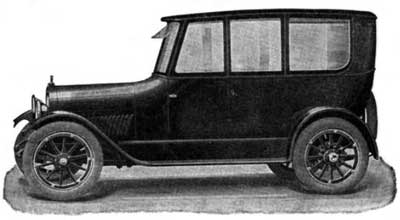
“Elkhart, Ind. - ELCAR has added a six to
its line for 1918
which in addition to the newcomer includes a five passenger touring of
improved
design, four passenger roadster with small doors for the rear
compartment and a
five passenger sedan. These bodies fit either the four- or six-cylinder
chassis,
because the frame is the same in each case. Detailed improvements
include a
longer radiator core, heavier frame, better tank support and tire
carrier and
Timken bearings for all wheels. The front springs are 2 in. wide now
and
Hotchkiss drive has been adopted for both models There. are many
refinements in
the engine also.”
A new Elcar body style, the Sportster, was
announced to the
trade in the May 30, 1918 issue of Motor Age:
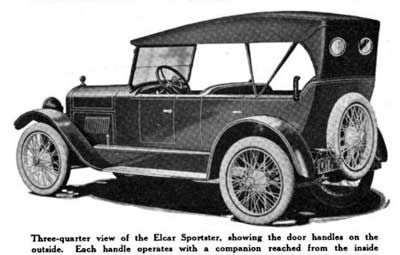
“New Elcar Sportster
“A new four passenger sportster model in
both four and six
cylinder types is announced by the Elkhart Carriage & Motor Car
Co.,
Elkhart, Ind. The sportster takes the standard Elcar four or six
chassis and
differs from the regular models only in body and exterior refinements.
The body
is custom built with beveled edge, giving a clean cut appearance.
Beveled plate
glass curtain lights with nickeled rims are used in the rear and the
steering
column has been extended to give a racy appearance and afford more room
in the
driver's compartments. Nickeled door handles are on the outside each
handle
operating with a companion reached from the interior. The front doors
are
square instead of U shaped and the same sharp lines are carried out in
the rear
doors. The beveled body edge is in a darker color than the body,
affording a
rather pleasing effect. The sportster models are finished in olive
green, coach
blue, olive brown, maroon, beaver brown, and moleskin colors. The
standard
Elcar chassis is identified in both four and six outside the powerplant
unit.
In the four the Lycoming engine is used, developing 37.5 hp at 2100
rpm. The
six uses the Red Seal Continental engine. The wheelbase is 160 in.;
axles are
of the Salisbury type and the bearing equipment is Timken. The price of
the
four passenger sportster with four cylinder engine is $1,175 and with
the six
cylinder engine $1,375.”
An across the board price increase was
instituted midway
through the year, the June 20, 1918 issue of Motor Age reporting:
“Elkhart, Ind. June 17 - The Elkhart
Carriage & Motor
Car Co has advanced the price of its Elcar four cylinder touring and
roadster
models from $1,095 to $1,175 and the six cylinder touring and roadster
models from
$1,295 to $1,375, effective June 10. Improvements have been added to
the models
and include the adoption of beveled plate glass with nickeled rims in
the rear curtains
as regular equipment.”
At the end of fiscal 1916, only 1,345
buggies and carriages
had been produced, an amount which dropped to 533 in the following year
(1917)
and by 1918 only 300 carriages were shipped by the time the firm
started
working on a 4,500 piece rush order for ambulance bodies for the US
Government
at which time what remained of the firm’s buggy and carriage making
jigs and tooling
was disposed, the contract being announced in the October 24, 1918
issue of Motor
Age:
“ELKHART ON WAR WORK
“Chicago, Oct. 21 - The Elkhart Carriage
& Motor Car Co.,
Elkhart, Ind., is devoting a large part of its equipment to finishing a
Government order for 4500 ambulance bodies and is running night and
day,
Sundays included. Production of the Elcar also is being continued.”
Although hostilities between Germany and the
Allied ended on
November 11, 1918, the following article from the January 22, 1919
issue of the
Elkhart Review makes no mention of the fact that the 4,500 piece
military
ambulance body order was canceled shortly after the Armistice:
“Elkhart Motor Co. To Complete Army Contract
March 5
“The Elkhart Carriage and Motor Car Company
will have
completed its contract for the construction of army ambulances by March
5, and
will then return to the manufacture of automobiles exclusively, it was
announced today.
“Lieutenant W.S. Downey and his staff
consisting of Sergeant
J.B. Wait, Sergeant J. M. Steinau, Sergeant R.K. Bowerman and Sergeant
Allan
Olson, who were sent to Elkhart by the government to inspect the
products of
the Elkhart Carriage and Motor Car Company, took their medical
examination for
discharge this morning. It is thought they will be discharged about
March 5.”
Although
the firm constructed $250,000 worth of ambulance bodies and shipping
crates it's unlikley that any of them ever made it to Europe before the
conflict ended. While some were undoubtedly placed into military
service, it's likely the remainder of the crated knocked down bodies
were sold as Army surplus.
For 1919 the Lycoming Model DXU 4-cylinder
engine was
replaced by the lighter and more efficient Model K although the
6-cylinder
Continental remained unchanged. Like a number of its competitors,
Elkhart
Carriage and Motor Car Company enjoyed its best year ever during the
post-war
boon of 1919, selling 4,000 cars during the model year.
The restyled Elcar lineup for 1920 featured
the same
straight-line coachwork that had been introduced on the 1918-1919
Sportster and
was notable for the debut of a new 3-passenger coupe and five-passenger
sedan
in both the 4 and 6 cylinder lines. An updated 50 h.p. Continental
Model 713
Red Seal motor was introduced in the 6-cylinder line which was
competitively
priced at $1,595 in touring form, the Lycoming-equipped 4-cylinder
priced at
$1,395.
The boon of 1919 quickly turned into the
bust of 1920 and
Elkhart Carriage’s executives sought out new avenues of revenue to keep
its
factory busy. Rampant deflation brought about a drastic drop in
wholesale
prices and the consequent drop in orders for new cars put the
automobile
industry in a panic. Fortunately the demand for taxicabs remained
steady and late
in the year Elkhart Carriage’s engineers had a new 7-R Continental
6-cylinder
equipped Elcar L-6 taxicab ready in time for the January 1921 Chicago
Auto
Show.
As Elkhart was located just 110 miles due
East of the
nation’s second largest city, the L-6 cab found favor with operators in
the
Windy City, many of whom placed orders for the attractive new taxicab
which also
offered a distinct performance advantage over its mainly 4-cylinder
equipped
competitors.
The disc-wheel equipped Model L-6 cab shared
the new for
1921 Elcar 117” wheelbase with the rest of the Elcar lineup and early
in the
year a second taxicab, the M-6, was introduced. Designed exclusively
for New
York City operators, the M-6 included a lower-price Rutenber 6-cylinder
engine
and replaced the right front passenger seat with an external exposed
baggage
compartment all of which was priced at a competitive $2,200, a $300
savings
over the firm’s Model L-6 taxicab. The cabs were also available with a
closed
or open driver’s compartment and in October of 1922 an attractive
landaulet
(collapsible rear quarter, very popular with sightseers) debuted in
both the
L-6 and M-6 taxicab lineup.
The firm issued a taxicab brochure that
included
testimonials from L-6 users that boasted that after travelling 75,000
miles on
two sets of tires, they were trading in their old Elcar cab on a new
one solely
because they wanted their loyal customers to enjoy a brand-new taxicab
once a year.
Also offered during the year was a
budget-priced,
Rutenber-equipped ‘Export Special’ that found favor with many overseas
customers, some of which were outfitted with taxicab coachwork.
Elkhart Carriage & Motor Car Co. only
sold 2,000
vehicles in 1921 and the Elcar lineup remained virtually unchanged into
1922
save for a 1" increase in wheelbase (to 118") and the adoption of
drum headlamps on its passenger cars.
An Elkhart Carriage & Motor Car Co
display ad in the
June, 1922 issue of National Taxicab and Motorbus Journal:
“ELCAR Taxicabs Are Standard Fleet Equipment
of the Diamond
Cab Company.
“The highly successful and rapidly growing
Diamond Cab
Company of Chicago, after thorough tests of various Cabs, has adopted
the ELCAR
Taxicab as its standard fleet unit. About 125 ELCAR Cabs are now used
by this
Company and more are being added weekly. The ELCAR is also used by
several
other Chicago Companies.
“The success of the ELCAR is due to the fact
that it is a
real Cab built by a Company that has specialized on high grade vehicles
for 50
years and knows exactly how to build a Cab that will stand years of
hardest use.
“The quality and endurance of the ELCAR has
been completely
demonstrated in scores of leading cities.
“The ELCAR Cab is a superfine Cab that costs
less than
ordinary ones. Let us send you complete information: ELKHART CARRIAGE
&
MOTOR CAR COMPANY Elkhart Ind., Builders of Fine Vehicles Since 1873.”
Family-owned since 1873, the Elkhart
Carriage and Motor Car
Co. was sold midway through 1922 to a group of Auburn, Indiana
businessmen who
included Arthur M. (Mike) Graffis; George W. Bundy; Flay B. Sears;
and
Wilson H. Denison, the July 13, 1922 issue of Motor Age reporting:
“ELCAR COMPANY CHANGES HANDS
“FORT WAYNE, Ind. - July 10 – The
controlling interest in
the Elkhart Carriage & Motor Car Co. has been secured by four
Auburn men – A.M.
Graffis, G.W. Bundy, F.B. Sears, and W.H. Denison, who are now managing
the
plant. W.B. Pratt and George B. Pratt have retired from the company,
which
manufactures the ‘Elcar’ automobile.
“In the reorganization of the concern Sears
will become
president and general manager; Graffis will be secretary Denison will
be
treasurer and Bundy will act as general superintendent.”
The October 5, 1922 issue of Automotive
Industries announced that the Driggs Ordnance & Mfg. Co. of New
Haven, Conn. had been awarded a contract to produce taxicabs for
Manhattan's Diamond Taxicab Co.:
“Diamond Cab Built by Driggs Company
“Contract Given to Produce Vehicles—Expected
Production of
2,000 Within Year
“NEW YORK, Oct. 2 — Driggs Ordnance &
Manufacturing Corp.,
with a plant at New Haven, Conn., whose connection with the automobile
industry
has been featured by the production of the Driggs passenger car, has
contracted
with the Diamond Taxicab Co. of New York to produce the vehicles which
this new
concern will put into operation. It is expected that 2000 taxicabs will
be
turned out inside the next year.
“Inasmuch as the Diamond Company has
announced that it will
furnish transportation at 20 cents a mile, Driggs has been called upon
to
produce a light vehicle that will give from 20 to 25 miles to the
gallon in the
way of fuel consumption and capable of economical operation.
The contract between Driggs and Diamond was
mysteriously withdrawn on October 23, 1922 and two weeks later Driggs
announced they were going to produce and market their own line of cabs.
Unhappy with Driggs’ decision to market
their own line of
taxicabs, the Diamond Taxicab Co. of New York, elected to take their
business
elsewhere, selecting the Elcar Motor Co., which was already producing
taxicabs
for an associated Diamond organization in Chicago. A photograph of the
A.M.
Graffis-designed Elcar Landaulet taxicab appeared in the November 14,
1922
issue of Motor Age with the following caption:
“New Elcar Landaulet Taxi - This new Elcar
Landaulet is a
special job designed for the taxicab business in New York City.”
The very same cab had previously been featured in
the October 28, 1922 edition of Automobile
Topics:
“New Elcar Taxicab Is Landaulet Type
“To meet the demand of taxicab service in
cities where taxis
are used largely for sight-seeing trips the Elkhart Carriage &
Motor Car
Co. has designed a landaulet body for its Elcar six cylinder taxicab
chassis.
The top is readily lowered giving the cab a distinctive appearance. For
theatre
parties the generous interior room and comfort make the cab ideal. The
Elkhart
company has been building coaches for fifty years.”
The pictured vehicle was the very same
design that Elcar
produced for Diamond, with news of their contract being announced in
the December
14, 1922 Motor Age:
“Elcar Makes Diamond Cabs
“ELKHART, Ind. Dec. 11 - Contracts have been
signed by the
Elcar Motor Co. of this city and the Diamond Taxicab Co. of New York
City under
which the local concern will build the vehicles which will be operated
by the
New York organization. The Diamond company's initial order is for 1000
taxicabs
of the landaulet type and it is expected that the first shipment of
five
carloads will go east within a week. The cab is the creation of A.M.
Graffis,
the Elcar engineer, and the feature of it is an adjustable top which
can be
quickly lowered without interfering with protection from wind and dust
from any
angle. After the New York installation, the Diamond company plans to
invade
other big centers like Boston, Philadelphia, Washington and Baltimore.”
The 1,000 unit contract with Diamond called
for the delivery
of 100 cabs per month, which made it the largest operator of Elcar
taxicabs,
with Chicago second. The rest of the firm’s output during the year went
to
smaller operators in Buffalo, Long Island City and St Louis.
The 1923 Elcar line featured smoother lines,
new fluted
one-piece fenders and two separate chassis, a 112” wheelbase for the
4-cylinder
4-40 and 118” for the 6-cylinder 6-60. The former equipped with a new
206.4 cu.
in. (3-3/8" bore x 5" stroke) Lycoming Model CF engine, the latter
with a 242 cu. in. (3-3/8" bore x 4-1/2" stroke) Continental Model 8R
Red Seal engine.
The 4-40 was available in four body types,
two sedans and
two touring versions. On the 6-60, there were three sedans, including a
five-
passenger, three-door brougham as well as the "Speedway" phaeton and
a touring car. The Sport Sedan, easily the most chic of the lot, was
also the
most costly and sold for $2,195. Conversely, the bare-bones touring car
could
be had for a modest $1,395.
The upcoming 1923 Elcar line was previewed
in the December
28, 1922 issue of Motor Age:
“Elcar Line Includes Fours and Sixes;
Lycoming Elcar
Engine Used in Four Cylinder Models and Continental 8R in Sixes
“The new Elcar line comprises both
four and six
cylinder models. The line includes a five-passenger phaeton and
speedway sport,
three-passenger roadster, five-passenger sedan and brougham. The
three-passenger roadster is designed for practical use. It is very
roomy, seating
three passengers comfortably, and has three ample storage spaces: One
In the
rear deck with large opening, provided with lock and key; another with
door on
right side, also fitted with lock and key; and a third back of and
extending
the full length of the seat, provided with hinged lid.
“The interior of the four-door
five-passenger sedan has
every necessary provision for luxurious comfort, deep soft cushions,
upholstered attractively in a neutral shade of all-wool broadcloth,
lighted by
a cut crystal dome light and corner lights, and equipped with oxidized
silver
hardware. Handy pockets on either side for gloves or packages provide
extra
convenience, while silk curtains on rollers Insure seclusion or shut
out
glaring light.
“The brougham is compactly comfortable and
cozy. A good
style luggage trunk with suit cases inside of same Is regular
equipment. The
rear seat of the brougham is very wide, extending across the car. The
two front
seats are separate, of the Pullman type. The right-hand seat has a
hinged back
and the seat itself is also hinged, permitting it to be readily folded
and
tilted out of the way to permit access to the rear seat.
“The Elcar fours are available in
the following
models: Five-passenger touring, sedan and sport car. The Lycoming
Elcar engine
is used. The sixes use the Continental 8-R engine.
“Prices on the Elcar sixes are as
follows:
Brougham, $1995; Speedway Sport, $1595; Sedan, $1995; Phaeton, $1395.
All
prices are F. O. B. Elkhart, Indiana.”
During early 1923 Elcar introduced a
Lycoming 4-cylinder
Model CF powered taxicab for budget-minded fleet operators. The new
Elcar
4-cylinder taxicab was available in both standard (L-4) and landaulet
(M-4)
versions, with the latter selling for $2,100. Both models were
constructed on a
112” wheelbase chassis, specifically reinforced for taxicab service.
Its 1923 taxicab brochure boasted that Elcar was:
“... the
largest manufacturer of 6-cylinder cabs in the world... The average man
or woman
wants to ride in as much style and comfort as is possible to obtain,
even
though the conveyance is a public one... The Elcar Taxicabs are not
converted
passenger models. They are built on especially constructed chassis in a
factory
fully equipped for the purpose."
1923 sales were down slightly from the
previous years at
1,800 units, with taxicabs estimated to make up approximately 50% of
sales.
Movie buffs may recognize the
circa 1923 Elcar Model L-4 taxicab
that was prominently featured in the 1939 Warner Bros. feature
‘The
Roaring Twenties’, which stared James Cagney as Eddie Bartlett - a hard
working
WWI veteran that painstakingly builds up a taxicab corporation in the
years
immediately following the end of the First World War.
Elcar's updated 1924 automobile and taxicab
bodies were a
noticeable improvement on the firm’s earlier cars, most noticeable was
the
faux-Rolls-Royce radiator shell appearing on the firm’s passenger cars.
Most
attractive was the $1,650 Model 6-50 Brougham which included disc
wheels, cycle
fenders, running board-mounted trunk, cowl lamps, ‘cadet’ sun visor,
oval opera
windows, and a padded top with landau bars.
The all-new Model 6-50 was powered by a new
195.6 cu. in.
Continental 7U engine mounted on a 112-inch wheelbase chassis shared
with the
Model 4-40 which was powered by a 206.4 cu. in. 42 h.p. Lycoming Model
CF
engine. The 1924 Model 6-60 sported
all-new coachwork mated to a 118” wheelbase chassis powered by a
Continental
8-R engine.
Elcar management believed a new flagship
8-cylinder would
produce more sales for its passenger car division and in August of 1924
introduced the all-new 1925 Model 8-80, which was powered by Lycoming’s
new 261
cu. in. 65 h.p. in-line 8-cylinder Model H engine. The flagship 8-80
was priced
from $2,315 to $2,865 depending on the body style which ranged from a
two-seat
roadster to a 7-passenger brougham. Constructed on a 127 ½ wheelbase
chassis,
all Elcar Model 8-80s were fitted with Lockheed hydraulic brakes and
the Elcar
Rolls-Royce-style radiator shell.
The 1925 Elcar lineup remained basically
unchanged from the
1924 models save for the substitution of a more powerful 70 h.p.
Lycoming Model
2H engine in the Model 8-80.
The firm’s taxicab business was
reinvigorated by a large
order from a new Manhattan operator named Jules (aka Julie) Martin
(originally Julius Modgilewsky) who ordered a
fleet of 4-cylinder
cabs constructed on a 117” wheelbase chassis to his specifications, and
bearing
the name of his firm on the radiator shell. Martin and his partner,
John Ulman,
had recently founded the Royal Martel Corp. and had received a Federal
trademark on the name on February 25, 1925. They hoped to get a small
piece of
the lucrative Manhattan taxi market which was dominated by Checker and
Yellow,
both of whom were directly related to similarly-named Midwest taxi
manufacturers.
Elcar cabs were popular with independent
Manhattan operators,
and Martin, who gained notoriety as a hack union organizer, was hoping
to get
union member into one of his Royal Martel cabs. Elcar’s Mike Graffis
incorporated Martin's requirements into the standard production Elcar
taxi and
production commenced on the Royal Martel-badged taxicab in November of
1925.
During the following 18 months 300 Royal Martels – in both limousine
and
landaulet versions - would make their way to Manhattan.
Martin, who had gained much notoriety during
the Manhattan
Taxicab strike of 1924, paid homage to the union struggle by placing a
‘Unity’
shield on the side of each Royal Martel, which were often referred to
as ‘Unity
Cabs’.
For 1926 Elcar replaced their Continental
6-cylinders with a
new 207 cu. in. 55 h.p. Lycoming 2S 6-cylinder engine. They
consolidated their
6-cylinder offerings into one model, the 6-65, which was offered in 3
body
styles on a new 116” wheelbase chassis equipped with hydraulic brakes
and
balloon tires. The firm’s 4-cylinder Lycoming migrated to the same 116”
chassis
and received a new Model designation, 4-45. The flagship 8-80 became
the 8-81
thanks to a new 74 h.p. 297 cu. in. Lycoming Model 4H straight-8
engine. 3- and
5-passenger models were constructed using the 127” chassis introduced
the
precious year while the elegant 7- passenger models rode on a new 132”
wheelbase chassis.
The Elcar Motor Co. sponsored a supercharged
Miller-engined
‘Elcar Special’ at the 1926 Indianapolis 500. Although the team
suffered a
tragic setback when the team’s original driver, 23-yo L. Herbert (Herb)
Jones,
was killed in testing on May 27, 1926, the team’s mechanics put the
wrecked car
back together in time for 1924 LeMans winner John Duff, to qualify it
28th – and by the time the race was called due to rain on lap 160, Duff
had
moved up
to 9th position.
Despite the new models, strong Indianapolis
finish and 300-unit taxicab order, Elcar's total sales failed to exceed
the
2,000 unit mark for 1926 and in September of that year Flay B. Sears
hired and
outsider, R.A. Rawson - the former manager of the Indianapolis Stutz
factory
branch, as sales manager.
During the late Twenties Elcar enjoyed a
small business in
rebuilding Elcar taxicabs for regional operators. Used straight-8
Elcars were
popular with Chicago liveries who converted the reliable
Lycoming-powered cars
for taxicab service. Elcar's service
manager, Forrest Liest, had all the required parts in stock and very
often a
cab could be returned to service a day after its arrival in Elkhart.
1927 marked the debut of Elcar’s
‘shock-less’ chassis, which
was standard across the entire line which now included the 6-70 six (60
hp
Lycoming Model WS straight-6); 8-82 light eight (62 hp Lycoming Model
GT
straight-8) and flagship 8-90 series (84 hp Lycoming Model 4H
straight-8) – the
slow-selling 4-cylinder line was no more. ‘Shock-less’ referred to the
Beiflex
rubber/fabric shock insulators (oil-less rubber shackles) that were
used in
place of metal shackles on the front and rear springs.
The Beiflex system promised noiseless
suspension and better
isolation from the vibration associated with irregular road surfaces.
The Beiflex
shackles were supplemented by rubberized engine mounts, oversized
wheels and
tires and cork body insulation, which made the 1927 Elcar line the
smoothest-running
marque on the road.
Elcar sponsored another supercharged
Miller-engined 'Elcar Special' at the 1927 Indianapolis 500. Piloted by
Al Cotey, and
qualifying 29th the car retired on lap 27 due to a failed universal
joint, finishing
21st overall.
Elcar somewhat re-aligned its lineup for the
1928 model
year, introducing a new budget-priced light eight Model 8-78 which used
the
same engine and 123” wheelbase as the previous year’s Model 8-82 but
with
smaller wheels and tires. The 1928 ‘Travel- Air‘ Model 8-82 was fitted
with a
new 70 hp. Lycoming Model GS straight eight and the flagship Model 91
(127”
wheelbase) and Model 92 (134” wheelbase) soldiered on with the 84 h.p.
Lycoming
Model 4HM straight eight.
A new flagship Model 120 ‘Big Eight’ was
introduced mid-year
that was easily recognized by its vee’d upper radiator shell.
Originally fitted
with the 84 h.p. engine of its predecessors, a new 120 h.p. Lycoming
Model DM
straight-8 replaced it by the end of the year.
For 1929 the Model 8-78 was re-numbered as
the Series 95 and
the Model 8-82 as the Series 96 to keep
in line with the new easier to decipher system introduced on the
flagship
Series 120 one year earlier. The faux Rolls-Royce radiator shell was
dropped in
favor of a new ‘radiator modern’. A
complete choice of body styles was offered in all the Elcar lines with
optional
extra-cost paint and trim packages such as ‘Royal’ and ’Princess’
supplementing the standard equipment.
Although Elcar made a continuous effort to
improve upon each
previous years’ product, a lack of a strong dealer network put it and
its
‘assembled-car’ competitors, Gardner, Jordan, Moon and Roamer at a
distinct
disadvantage in the marketplace. Historically
the above firms would take whatever distributors they could get. In
smaller
markets the dealers’ primary source of revenue was the service of all
makes and
models, with Elcar sales often a low priority. In larger markets, more
often
than not, the Elcar dealer handled numerous competing franchises, all
housed in
the same showroom.
Although Elcar management stated production
would be doubled
for the 1928-29 model year, the reality was an increasing number of
unsold cars
forced the plant to substantially reduce its workforce in mid-1929,
months
before the Wall street crash forced it into insolvency.
Although sales of new Elcars were close to
non-existent, the
firm continued to introduce new models and prepared a new
‘Lever-Engined’ Elcar
for the 1930 model year. Designed by engineer Alvah L. Powell, the
engine
featured two shorter connecting rods joined together by a lever
attached to the
side of the extremely tall crankcase via a pivot.
The February 1930 issue of Motor announced
Elcar’s new
lineup and its adoption of Powell’s engine, of which its correspondent
was not
impressed:
“Elcar Adopts Powel Lever Motor
“Elcar sprung an innovation at the New York
Show by
announcing two chasses equipped with the Powel Lever Motor. Both are
L-head
sixes. One has a bore of 3 inches, a stroke of 8 inches and a piston
displacement of 340 cubic inches. As show below, the crankpin rotates
through a
4-inch diameter circle on both engines, a lever being used to double
the piston
stroke. Due to the increased piston displacement the smaller car, Model
83, is
geared 2.4 to 1, and the larger car, Model 85, Is geared 2.1 to 1.
While these
unusually high rear axle gears are interesting, MoToR has been unable
to
discover why the Powell Lever Motor offers any notable advantages over
conventional engines of the same piston displacement. Both these
chasses have
four speeds.
“Elcar has also added the model 140, an
eight with a
135-inch wheelbase, rated at 140 horsepower at 3300 revolutions per
minute. It
has an underslung worm-drive rear axle which permits a low chassis, the
overall
height being 66 inches. A vee-shaped radiator is used and body lines
are
unusual on the two types comprising the line – namely, the sedan and
convertible sedan.
“In addition, Elcar is continuing its
previous models,
including three eights and a six. The models 130 and 96 eights have a
four-speed transmission while the 95, similar to the 96, has a three
speed
transmission. The six-cylinder model 75 has a three-speed transmission.
“The 140 and 1930 have a 3 3/8 by 4 ½ - inch
engine; the 96
and 95 and the six have a bore and stroke of 2 7/8 by 4 ¾ . The price
range is
$1,095 to $2,750.”
Surviving photographs of the Elcar Model 140
reveal it was a
very attractive car, but unfortunately only a handful of the expensive
cars
were constructed and there were no survivors. The handful of
Lever-engined
Elcars fared little better, the sole surviving Lever-engined Elcar
chassis was
parted out, its engine going to complete an equally rare Lever-engined
Kissel.
The collapse of the economy did nothing to
stop the
precipitous decline in sales and by late August when production was
halted only
900 Elcars had been constructed for the 1930 model year. July saw the
merger of
the Powell and Elcar interests into a holding company called the Lever
Motors
Corp. of Indiana, but the Lever-engine manufacturer quickly realized
how bad
Elcar’s financial position really was and began courting Hartford,
Wisconsin’s
Kissel Motor Co., which was a more viable partner.
Although Elcar should have failed during
1930, they were
buoyed by an order for additional taxicabs from an acquaintance of
long-time
Elcar customer Jules Martin named Lawrence Fay (b.1888-d.1933). Like
Martin,
Larry Fay was a long-time Manhattan fleet operator who by 1924 operated
a
reported 400 taxicabs.
Fay was an admirer of Martin’s Elcar-based
Grand Martel
taxis and in early 1930 expressed an interest in having Elcar construct
a line
of cabs with his name on the radiator shell. Like Martin, Fay did not
shy away
from money-making illegal activities, and early in his career gained a
reputation as a run-runner, specializing in importing hooch across the
Canadian
border. The profits were poured into various enterprises which included
his cab
company (Fay Cab Corp.) and two well-known nightclubs, ‘El Fey’ on
West 47th
Street, and the Del Fey, which opened up down the street when the El
Fey was
padlocked during a well-publicized prohibition raid.
Fay also had an interest at one time or
another in ‘El Vie’,
the ‘Parody’, the ‘Silver Slipper’, the ‘Cotton Club’ and most famously
the Casa
Blanca at 33 West 56th Street. The El Fey was the longest lived and
best-known
and featured ‘Queen of the Night Clubs’ Texas Guinan as
erstwhile
‘manager’ and emcee of the nightly floorshow which was produced
by Nils Thor Granlund.
Unsurprisingly, the taxicabs constructed for
Mr. Fay wore an
‘El Fay’ radiator badge, and were based upon Elcar’s standard
Lycoming-powered
6-cylinder 128” wheelbase taxicab which included a padded top and a
sliding
roof over the driver. The well-accessorized cabs included a unique
chrome stone
guard over the radiator and chrome spare tire covers on the fenders.
Also
included were the same counterclockwise swastika logos that adorned his
El Fey
nightclub, which prior to 1933 were simply symbols for good luck.
The dawn of the depression years took a toll
on Fay’s wealth
and operations and it is unknown if he took delivery on all 100 of the
‘El Fay’
cabs he ordered from Elcar in 1930. The following year he began working
as a
manager / partner at the Casa Blanca night club, 33 West 56th street,
and
following a New Year’s Eve celebration was gunned down by the Casa
Blanca’s
disgruntled doorman, dying the next day, January 1, 1933.
On December 15, 1960, The Untouchables
(1959 TV
series) during its second season did 'The Larry Fay Story'.
This
episode (the 37th for the series) dealt with Larry Fay's activities in
the New
York City milk price-fixing case. Also, Fay's life served as the
basis for James Cagney's character, Eddie Bartlett, in the 1939
gangster
film, The Roaring Twenties. Texas Guinan, his longtime girlfriend,
was given
the Hollywood treatment in 1945’s ‘Incendiary Blonde’ a Paramount
production
that starred Betty Hutton as ‘Queen of the Nightclubs’.
Elcar constructed taxis for another
Manhattan operator
during late 1930, this time the cabs were badged Paragon, and their
purchaser
was M.A. Lichtman, president of the Paragon Cab Manufacturing Corp.,
1836
Broadway. The firm had been incorporated earlier in the year as follows:
“New York — Paragon Cab Mfg. Corp.
has been
incorporated with $10,000 capital by M. A. Lichtman, 152 West
Forty-second street.”
The Paragon shared many of the accoutrements
of the El Fay
taxicab adding Ryan head and cowl lights and an illuminated banner
above the
windshield.
In August 1929 former Durant and Chevrolet
distributor Harry
M. Wahl announced he was reviving the Mercer Motor Co., announcing that
3,000
all-new Mercer automobiles would be constructed during 1930. During the
fall of
1930 two Mercer prototypes were constructed in the now-underutilized
Elcar
plant, an attractive convertible coupe and a demonstration chassis.
Wahl had made an arrangement with the
Massachusetts
coachbuilder Merrimac to supply its coachwork which would be mostly
shared with
the duPont automobile to cut costs, and an attractive catalog was put
together
in time for the car’s debut in the Grand Ballroom of the Hotel
Montclair during
the 1931 New York Auto Show, which was held during the first week of
January, 1931.
The Beiflex-equipped 135” wheelbase chassis
and 140 h.p.
Continental Model 12K straight-8 drivetrain were shared with the Elcar
Model
140, and save for its one-off Merrimac convertible coupe coachwork and
Mercer
badging, the car displayed was a 1931 Elcar Model 140. Despite the fact
that
the attractive car was given a number of positive reviews and Wahl
claimed to
have signed up some enthusiastic dealers, the car never entered
production. One
month later Wahl suffered a heart attack, two months later Merrimac
entered
into bankruptcy and Elcar was in such severe financial straits it
cancelled its
planned production of Model year 1931 automobiles and was declared
insolvent
that Fall.
After the show the two Mercers were sold to a
Dover, New Jersey Elcar
distributor
named Minarchi, remaining there for the next quarter century when they
were
discovered and subsequently purchased by Elcar enthusiast and historian
William
S. Locke, who remained their custodian for the next half century. The
Merrimac-bodied 1931 Mercer is currently owned by Dave and Denise
Sanders who displayed it at Pebble Beach in 2012.
However, Elcar was not done yet. Former
Elcar executive Arthur
M. (aka Mike) Graffis was appointed receiver on October 10, 1931, and
was
instructed by the bankruptcy court to continue to complete cars,
including
taxicabs, that were already in the process of manufacture. Also
retained were a
few key office workers, as well as a short-staffed parts and service
department.
During 1932 a skeletal crew of a dozen Elcar
mechanics
stayed busy constructing ‘Paragon’ and ‘El Fay’ taxicabs in batches of
35. Once paid for, the revenue was used to
finance the next batch of cabs, and the process continued into the
summer of
1933 when their old Manhattan-based taxicab customer, Jules Martin,
proposed that
Elcar build him an all-new streamlined taxicab. After hashing out the
details
with Graffis, Martin returned to Manhattan to sell the concept, which
looked
unlike
any cab built before, to his independent operators/drivers.
Martin’s Allied Products Mfg. Corp. would handle
the manufacture
of the vehicle which he christened the ‘Prosperity’ in hopes of turning
the
current economic tide around. Back in New York he formed the Prosperity
Taxicab
Corp. to handle the sales and marketing of the vehicle and on October
31, 1933
he returned to Indiana in order to reveal the completed prototype
‘Prosperity’
at a special ceremony at the Elkhart Hotel.
As soon as the photographs marking the
ceremony were taken,
Martin hopped into the ‘cab of the future’ and took off for New York
City where
he would hold a series of similar events during the coming weeks.
Shortly after
Martin’s arrival in Manhattan he learned that the man in charge of
building the
Prosperity, Elcar receiver Arthur M. (Mike) Graffis, had been killed in
a
November 4, 1933 traffic accident.
The bankruptcy court replaced Graffis with
C.L. Sawyer and Martin
forged ahead his planned introduction of the Prosperity, which took
place at a
gala dinner for 100 on November 21, 1933 in a rented ballroom inside
the
General Motors Building, which was also the home of the Prosperity Cab
Corp.
offices (1777 Broadway). Two days later he held an open house for the
public which
was well-attended by both taxicab owners and operators. Taxi Age
included
pictures of the taxicab in its November 27, 1933 issue describing it as
‘stupendous…
colossal… sensational’. Although I’m a big fan of the Prosperity, a
more
appropriate description might be ‘odd...’.
The beltline of the cream-colored car was
almost a foot
higher than other cars of the day. The car’s A-, B-, C- and D-pillars
were correspondingly
cut down, the raised window openings looking similar to those found on
the
chopped tops of brothers Sam & George Barris. The car included rear
spats
with the centers cut out and the front and rear of the car made
extensive use
of chrome accessories, which included the radiator shell, rear luggage
rack and
3-bar taxicab bumpers. Passengers rode on an overstuffed Pullman-style
bench
seat which was affixed to a Continental straight-6 mounted to an Elcar
taxicab
frame.
Apparently Martin was pleased by the
reception as within the
week he was back in Elkhart where he leased a portion of the factory
from the receiver,
purchasing what remained of Elcar’s parts, tooling and inventory for a
mere $2,000.
Allied Products Mfg. Co. was now in the cab manufacturing business.
The first batch of Prosperity cabs were
scheduled to be
delivered midway through January 1934, but the New York City Police
Department
wasn’t happy with the cab’s ‘peek-a-boo’ windows, causing the City’s
Hack Bureau
to bar the Prosperity from operating within the city limits.
On February 4, 1934 an irate Martin parked
two Prosperity
cabs smack dab in the middle of City Hall Plaza so that Mayor LaGuardia
and his
associates could get a first-hand look at them, an event that was
recorded in
the February 10, 1934 issue of the New York Times:
“An effort to persuade Mayor LaGuardia to
overrule a police
order barring a fleet of seventy-five ‘Prosperity Cabs’ from operation
was made
by Jules Martin. The cabs were barred after Second Deputy Police
Commissioner
Harold L. Allen had reported that they were of the ‘peek-a-boo’ type,
designed
more for concealment than for beauty.
“Two of the cabs were inspected by Paul J.
Kern, one of
Mayor LaGuardia’s secretaries. Aldermanic President Bernard S. Deutsch
and
other members of the Board of Estimate also examined them. The vehicles
were
parked in City Hall Plaza all day, but Mayor LaGuardia did not see them
until he
was leaving for the day.”
Unfortunately no further action was
forthcoming from the
Mayor’s office, forcing Martin to take the City to court. The hearings
and ensuing
trials took months to be resolved, with large competitors such as
Parmalee testifying
that "In this city, there isn't any room for a peek-a-boo cab." The
matter
was eventually placed before New York Supreme Court Justice William T.
Collins
who issued an order for the New York Police Department to show cause
for the
banning of the Prosperity.
During that time “fewer than two dozen”
Prosperities had
been completed, and with the negative attention the cab had received in
Manhattan, the majority had been sold to small operators in Cleveland
and
Philadelphia and Martin pulled the plug on the Prosperity project.
However, he
did not abandon the Elkhart factory.
By this time the supply of Elcar parts had
been exhausted so
Martin made arrangements with the Chrysler Corp. who in the Fall of
1934 agreed
to supply him with Dodge taxi cowl & chassis. A prototype was
approved by
the New York City hack bureau and Martin began taking orders for the
attractive
Allied-Dodge taxicab, which he boasted in a February 1935 trade
advertisement were
already sold out.
In the mean-time Martin had procured a 1935
Graham Model 69 4-door
sedan which was transformed into the ‘Super-Allied’ taxicab by the crew
back in
Elkhart. At this point in time, Jules Martin’s cab-building operation
came to a
dramatic end due to his involvement with one Arthur Flegenheimer, who
was
better known as mobster Dutch Schultz.
Martin had started out in the taxicab
business as a Checker
Cab driver / manager and like his fellow Elcar Cab aficionado, Larry
Fay, had
long-standing ties to bootleggers and at one time owned a
nightclub called
Chez Evelyn at 228 West Fifty-Second Street. Martin’s longtime partner
in the
taxicab business was Jess Donatella, another cab driver who helped
Martin
organize the independent hacks via a series of strikes in the late
1920s. Martin
was also connected with the White Horse Cab Company, which incidentally
operated
a fleet constructed by the Checker Cab Mfg. Co.
His success with the taxi strike brought him
to the attention
of Flegenheimer, who gave him a job as one of
his enforcers,
and later his most trusted lieutenant. Both men were subsequently
indicted (and subsequently cleared) in connection with an investigation
into illegal activities
involving
the Manhattan Cafeteria Workers Union.
Martin’s association with Flegenheimer made
him quite
wealthy, and he allegedly used his ill-gotten gains to finance the
Allied Products
Mfg. Co., the firm which purchased Elcar’s assets from the receiver in
1934. Martin’s
taxicab manufacturing operations came to an end on March 5, 1935 when
his stabbed
and bullet-riddled body was found dumped alongside a service road
leading to the
Troy, New York dump, the March 06, 1935 New York Times reporting:
“TROY 'RIDE' VICTIM WAS ST. ALBANS MAN; Wife
Identifies Body
of Julius Martin, Head of Indiana Taxicab Body Plant.
“TROY, N.Y., March 5. - The 'ride' victim
found
in a roadside ditch just over the Troy city line Sunday morning was
identified
by his wife today as Julius Martin of 116-26 222d Street, St. Albans,
L.I., a
taxicab body manufacturer. The Department of Justice at Washington
identified
him as Jules Magelfsky of New York, arrested on a charge of desertion
June 2,
1917, from Fort Slocum and fingerprinted at that time. Mrs. Martin said
she
never knew him by any other name than Martin. They were married at the
City
Hall in New York City in January, 1920.
“According to a check-up by District
Attorney Ranney, Martin,
a former New York city taxicab driver and union organizer, was head of
a
concern in Elkhart, Ind., which makes taxicab bodies, he traveled
frequently
between New York and Elkhart, sometimes by taxi, but since an injury to
his
foot he had been using a New York Central train via Albany.
“Mrs. Martin said he left home Saturday
morning for such a
trip and when she did not hear from him by Sunday she started
inquiries. On reading
the story of the Troy crime in a newspaper, with the name Martin, she
arranged
to come here and investigate. She said her husband, who was 36 years
old and
did not drink, smoke or gamble, and she could think of no motive for
his
murder, as she knew of no enemies.
“The wife admitted that Martin usually had
from $500 to
$2,000 in his pocket on his trips to Elkhart and that he carried a
wrist watch,
which was missing.
“John Martin, known also as Jules Martin,
lived with his
wife, Ida, and two children at 116-26 222d Street, St. Albans. Although
his home,
a one-family frame structure of two stories, was closed, neighbors said
Mr. Martin
had been in the house a week ago when he returned from Elkhart, Ind. A
taxicab
with Indiana license plates is in the Martin garage.
“The Martins have lived in St. Albans three
years. The
children, Priscilla, 13 years old, and Berel, 7, attend school there.
Mrs. Martin’s
maiden name was Ida Vernick.”
At a May 11, 1937 Luncheon, New York State
Attorney General
Thomas A. Dewey 'fondly' recalled him as:
“...one of the worst gangsters New
York
has ever produced, and the actual operating head of the racket... Jules
Martin was
so successful as a modern racketeer that his name was unknown to the
press, the
public, or the court and little known even to the police.”
A number of subsequent trials and
investigations surmised
that Martin was killed because Schultz
suspected that Martin was skimming from the Cafeteria Workers Union
(aka Café Racket) putting the money into his taxicab business. The
accusation stems from his accountant, Otto Berman, who discoved a
$70,000 disparity in the union books, while preparing for Schultz'
upcoming trail for income tax evasion.
Martin’s ‘last ride’ started at
Manhattan’s
Grand Central Station where he was seen in the company of Flegenheimer
associates George ‘Bo’ Weinberg and J. Richard (Dixie) Davis
(Flegenheimer’s attorney). What exactly happened next is open to
conjecture, however
the generally accepted story was provided by eyewitness
J. Richard
(Dixie)
Davis, Flegenheimer's attorney, while he himself was on trial in 1937.
On the evening of March 2, 1935, they (Weinberg
& Davis) escorted Martin by train from Manhattan
to the Troy, New York station after which they proceeded to the Harmony
Hotel in Cohoes, New York (a suburb of the twin cities of Albany/Troy)
where Flegenheimer was holed up awaiting the upcoming trial.
A belligerent Martin denied
Berman's
charges and began arguing with Dutch - both men had been
drinking
heavily - and things took an ugly turn
when
Schultz sucker-punched Martin, who eventually fessed up to taking
$20,000 of the $70,000, money he felt he was 'entitled to'.
Attorney Davis related what happened next:
"Dutch Schultz was ugly; he had been drinking
and
suddenly he had his gun out. The Dutchman wore his pistol under his
vest, tucked inside his
pants, right against his belly. One jerk at his vest and he had it in
his
hand. All in the same quick motion he swung it up, stuck it in Jules
Martin's mouth
and pulled the trigger. It was as simple and undramatic as that - just
one
quick motion of the hand. The Dutchman did that murder just as casually
as if
he were picking his teeth."
As Martin contorted in his final agonies on the
floor, Schultz apologized to Davis for killing a man right in
front of him. Davis later admitted his shock when he read a newspaper
story
about Julie Martin being found shot to death on a snow bank but also
with a dozen
stab wounds to his chest. To which Dutch Schultz dead-panned:
"I cut his
heart out."
Actor Mike Star portrayed Martin in the 1991
Gangster drama
‘Billy Bathgate’, which starred Dustin Hoffman as Dutch Schultz.
Loosely based
on factual events the film was based on E.L. Doctorow’s historical
novel of the
same name.
A handful of unfinished vehicles that
remained at the Allied
Products factory in Elkhart were sold off and the plant shuttered until
1936 when
Elkhart businessman Milo Miller, who had relocated his Sportsman
Trailer Co. from
Mishawaka, Indiana to Elkhart
in 1934,sold that firm to Schult Trailer and began
manufacturing
travel trailers under the Elcar trade name. The business was later
relocated to
nearby Bourbon, Indiana and after the Second World War was acquired by
Divco-Wayne – the last Elcar-branded trailer being produced in 1968.
The Elcar plant later became the home to the
woodwind
division of Selmer, who manufactured Bundy clarinets and flutes there
into the
1980s. Plans for razing the long-vacant factory were announced on
November 29, 2012,
although it’s unknown if they’ve been carried out.
Anyone interested in reading more about Elcar and
its predecessors should pick up a copy of William S. Locke's 'Elcar
and Pratt
Automobiles; The Complete
History' before it goes out of print and gets expensive.
Click
here to
get your copy today!
©2013 Mark
Theobald for coachbuilt.com with special thanks to William
S.
Locke and
Karl S. Zahm
Appendix 1 - Brands of Taxicabs manufactured by
Elkhart
Carriage/Elcar:
Allied, Allied-Dodge,
Diamond, Elcar, El Fay,
Grand Martel, Paragon, Prosperity, Super-Allied, Unity.
Appendix 2 - Similarly-named firms:
F.B. Pratt & Co. was unrelated to the
similarly-named Plainfield, Wisconsin drug store operated by Fletcher
B. Pratt.
Also unrelated to the firm discussed above were
the following
Elkhart-based automobile manufacturers:
Elkhart
Carriage & Motor Car Co. (1909-1912 Sterling); the Elkhart Carriage
& Mfg.
Co. (1908 Elkhart) and it's successors: Elkhart Carriage & Motor
Co., Elmer Automobile Co. and H. Elmer Co.
(1909-1912).
|