|
The Bender, Robinson Co, Inc. was a Delaware
Corporation - sometimes referred to as Bender-Robinson or Bender &
Robinson - organized in 1913 to manufacture automobile bodies. The firm
was a reorganization of Bender & Robinson, a firm formed sometime
around 1890 by John Bender and Andrew Robinson to produce fine
carriages. The small factory was located at the corner of North 11th
and Roebling Sts., in the Williamsburg section of Brooklyn, New York,
near Greenpoint Park, (renamed in 1910 as McCarren Park).
Some bespoke work was done by Bender, Robinson
Co. for Manhattan automobile importers and retailers and between 1914
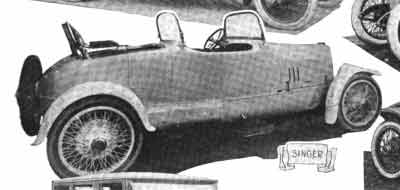
and 1917 the firm supplied production bodies for the Singer Motor Co.
Inc. whose 630 Jackson Ave., Long Island City, New York manufacturing
facility was located less than two miles away from the Bender, Robinson
Co. factory.
The 1880 US Census lists John Bender (I) as a
carriage maker in Flushing, Queens.
John Bender (I) was born in 1816 in Wittenberg
(misspelled as Witenburgh), Germany. In Germany he married his wife
Minnie, and the blessed Union produced two sons, John (II), born in
Wittenberg in 1852, and Fredrick born in Wittenberg in 1853.
The 1880 US Federal census lists John (II) as a
carriage blacksmith and Fredrick as a carriage painter. Other members
of the firm included Jacob Miller, a 45-year-old wheelwright, born in
Wittenberg; L. Grossman, a 30-year old wheelwright born in Wittenberg;
E. Washwell, a 30-year-old wheelwright born in Prussia; John Metzgar,
an 18-year-old apprentice born in New York; John Donohoue, a 14-year
old apprentice born in New York; T. Garowelly, a 30-year-old
horse-shoer born in Ireland; and Sawler Bender <b.1866>, the
14-year-old daughter of ??? Bender, who was employed as a servant and
born in New York.
In the early 1890s Bender decided to relocate his
carriage business closer to lower Manhattan, and entered into a
partnership with a Brooklyn carriage builder and blacksmith named
Andrew Robinson. The pair established their business at the corner of
North 11th and Roebling Sts., Brooklyn in the style of Bender, Robinson
Co.
The factory was conveniently located to the
Robinson family home which was located at 537-541 Lorimer St., less
than a half-mile from the Bender, Robinson carriage factory. Bender
searched for a new residence near the factory and on May 29, 1894, the
New York Times reported:
“At an auction in the Trinity Building
Salesroom yesterday, Messrs. Smyth & Ryan sold to John Bender, at
$4,000, the property at 91 and 93 North Seventh Street, Brooklyn, north
side, about 60 feet east of Wythe Avenue, 40 x 75 with a three-story
and basement brick tenement on one lot and a two story frame on the
other.”
91-93 North Seventh St. was also located within a
half-mile of the new Bender, Robinson factory and as was the custom at
the time, both proprietors (and a majority of their employees) now
lived within walking distance of their business.
During the first part of the twentieth century,
John Bender (II)’s three sons; Herman (1883-1964), John
(III)(1887-1967) and Joseph (1890-1967), began working for their father
at his Brooklyn carriage shop. The three Bender brothers joined Andrew
Robinson’s son, Andrew Jr., who was already working for the firm when
Herman, the eldest Bender started his apprenticeship. On Mar 9, 1898,
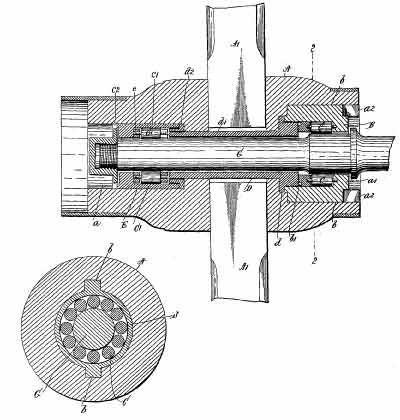
Andrew Robinson Jr., had filed a patent application for a carriage axle
box: US Pat. #620673.
The four apprentices started off working on
carriages and were first-hand witnesses to the firm’s transition from
manufacturing carriages to automobiles. Bender, Robinson Co. enjoyed a
good reputation amongst New York City’s early automobile importers and
produced a number of automobile bodies for Manhattan’s best-known
independent automobile body designer, Karl H. Martin.
That well-earned reputation led them to enter
into a contract to supply production automobile bodies for the
recently-organized Singer Motor Co. in late 1913. To gain much needed
capital for the new contract, the firm was incorporated in the state of
Delaware as Bender, Robinson Co. on November 13, 1913. Their listing in the 1916 Manhattan directory reveals they had relocated to 355 West Fifty-Second Street, Manhattan.
Bender, Robinson Co. exhibited two bodies on
Singer chassis at the January 1916 New York Auto Salon. The New York
Times’ coverage of the event on Tuesday January 14, 1916 included a
description of one of the vehicles:
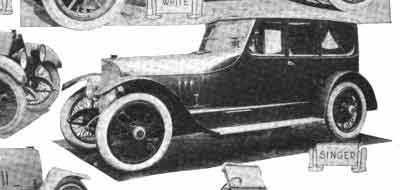
"In the Singer space a striking car is
appointed white sedan with sloping front windows and adjustable seats.
The arrangement is for a plate glass roof with curtains to protect from
the sun. The seats are upholstered in a rich nut brown velvety
material. The woodwork is inlaid with mother of pearl. The body is by
Bender, Robinson & Co."
The January 9, 1916 issue of the Automobile
covered both Singers:
“This year the Astor Salon is not an importers'
salon as there are only five foreign chassis on the floor, and these
are not of design new to the American public, Peugeot, Rolls- Royce,
Lancia and the Delaunay-Belleville.
“The American cars on the floor are the Singer,
White, Daniels, F. R. P., Simplex-Crane, Brewster-Knight and Owen
Magnetic. In addition to these there is another foreign car on the
floor, the English Daimler, which exhibits a town body by Henry
Labourdette of Paris. The Holbrook company, body maker of New York
City, is showing a Cadillac eight chassis fitted with a Berline design,
a Packard with a landaulet and a White with a landaulet body. Healy has
several bodies on Locomobile chassis and Bender & Robinson are
showing two special bodies on Singer chassis. The regular Singer bodies
are also manufactured by Bender & Robinson.
“Ingenious methods for concealing the extra
seats in the seven-passenger touring design are shown in the Singer
bodies. These slide into the front of the compartment folding into the
back of the front seats and being covered by a shutter. Folding
arrangements for seats and body parts are carried out with a neatness
which hardly permits of detection of the folding parts. In all of the
work at the Salon, the Bender & Robinson special roadster with
folding rear deck is a good example of the thoroughness in this work.
When the rear compartment is folded open an upholstered seat with
upholstered arm rests is provided and when closed the flat deck of the
roadster conforms exactly with the ordinary lines of a two-passenger
car.
“Sedan Bodies Are Popular
“Sedan bodies with V-shaped front, the apex
being at the front end of the inclosed body, seem to be quite popular.
One of these is shown on the Singer chassis, another on the White and
also on the Cadillac. These give an added length to the body and add to
the appearance of lowness. They are difficult, however, to maintain
rain-tight in front and careful provision has to be made on the
windshield for shedding the rain and not allowing it to work through
crevices.”
Noted auto body designer and engineer George J.
Mercer mentioned the Bender, Robinson–bodied Singers in a column in the
January 20, 1916 Automobile entitled “1916 Body Design is
Uniform” which is excerpted below:
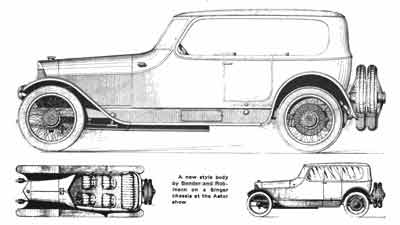
“V Windshield Types
“Fig. 12 is a V-type windshield Sedan exhibited
on the White, it is painted in white and black, and the trimming
corresponds; the roof is leather covered and it makes a very neat,
compact body that is not too extreme to suit the taste of refined
people. There was another V windshield body shown by Holbrook that was
larger, and another the Bender & Robinson exhibit on the Singer,
this body being very low, as indicated in the drawing. It can be opened
(permanent roof fashion) and the roof is entirely of glass, to enable
the occupants to get light from above. This job was the most extreme
design at the show, it was finished in good taste, both outside and in,
and the right balance altogether gave the body a racy, but not an
overdone appearance; for its class it hit the mark and did not shoot
beyond.
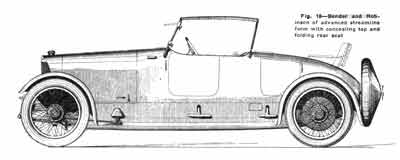
“Fig. 18—Bender and Robinson of advanced
streamline form with concealing top and folding rear seat (caption).
“Fig. 18 is another Bender & Robinson
creation. It was tastefully painted and trimmed and was one of the few
that approached a true streamline in its entire contour. It strongly
resembles their larger body.”
Charles Singer, Jr. one of the heirs to the
Singer Sewing Machine Co., had been general sales manager for the
Palmer & Singer Mfg. Co., the predecessor of the Singer, since
1910. When that firm went bankrupt in 1914, Singer purchased the name,
patents, goodwill and parts of Palmer & Singer and set up the new
business in the former Alco service facility in Long Island City.
Unfortunately production of the Singer ceased with America's entry into
World War I on April 4, 1917, and shortly thereafter Bender, Robinson
Co. was forced into bankruptcy. Historian G.N. Georgano estimates that
Singer produced 500-550 automobiles, most of them prior to the start of
the World War.
After an initial July 22, 1917 hearing, the
Federal Court in Manhattan appointed B.B. Lewis trustee for the firm’s
receivers on August 3, 1917. Additional motions were heard in the case
on November 12, 1917 by Judge Augustus A. Hand and on December 24, 1917
Federal Judge Manton declared the firm insolvent.
In 1920 Bender, Robinson Co.’s corporate charter
was revoked by State of Delaware for non payment of their annual
incorporation fee.
After their stunning debut at the 1916 Auto Salon
a number of northern Ohio- and Indiana-based automobile manufacturers
had approached the Bender, Robinson Co. to see if they were interested
in establishing a body plant in their part of the country. At that
time, the partners were uninterested, but the when the firm was forced
into bankruptcy eighteen months later by the evaporation of Singer body
orders, the three Bender Boys started making inquiries.
Realizing that their business prospects in the
metropolitan New York area were severely limited, the trio eventually
entered into a contract with Ohio-based financiers and relocated to
their hometown of Cleveland, Ohio in 1919. In late 1919 the Bender Body
Co. was organized with at capital stock of $75,000. Incorporators
included Herman Bender, Emanuel J. Uhlyarick, Herman Kronenbergeer,
John Kern and Peter Boeowski.
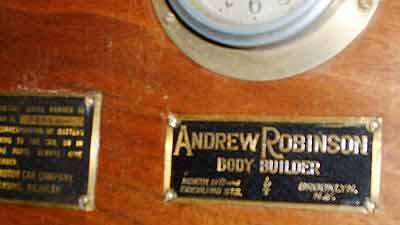
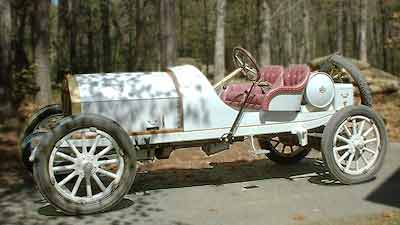
One Bender, Robinson-bodied car, a 1914 REO
runabout (pictured in color to the right), recently owned by Jerry
Singer of Cleveland, Georgia, bears a coachbuilder’s plate from
Andrew Robinson, Body Builder, N. 11th & Roebling St., Brooklyn.
At that time the R.M. Owen Co. was the Manhattan
distributor of for Premier and REO automobiles, so it’s likely that
Jerry Singer’s REO was bodied by Bender, Robinson. As to why the plate
only bears Robinson’s name remains a mystery. The R.M. Owen Co.
(Raymond M. Owen and his brother Ralph Owen) were also the
manufacturers of the short-lived Owen Magnetic automobile, a car built
using the Entz patent electric transmission. Bender, Robinson are
thought to have bodied a handful of early bodies for that chassis as
well.
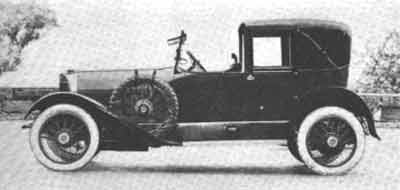
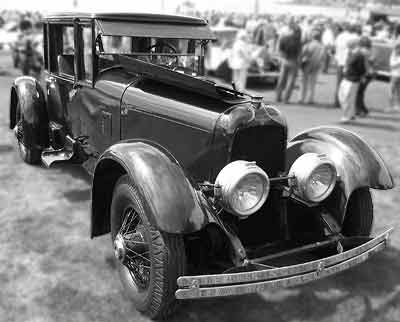
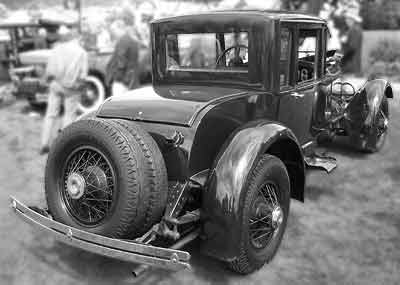
Early Duesenberg Model As were bodied by the New
York distributor who purchased bodies from northeast coachbuilders who
included H.H. Babcock, Springfield and Woonsocket. The first production
Model A, chassis no. 600, survives today bearing an attractive circa
1917 Bender and Robinson opera coupe body.
As the Model A debuted in 1921 it remains a
mystery as to why an old body was used. Duesenberg historian Randy Ema
reports that the vehicle’s serial number, 600, verifies that it is the
very first production Duesenberg and states that after being used as a
demonstrator it was sold in 1922 to Samuel Northrup Castle, a founder
of the Castle and Cook Co., a Hawaiian sugar cooperative. The beauty of
that car reveals how far ahead of the curve Bender, Robinson's designs
were for that time.
The following transcript mentions the
relationship between R.M. Owen Co., Karl H. Martin and Bender, Robinson
Co.:
“MARTIN v. BENDER et al (Supreme Court,
Appellate Term, First Department December 29, 1916.)
“1. Brokers <S=»84(1)
— Actions — Burden Of Proof.
“In suit for balance of commission for
procuring order for automobile bodies, payable upon delivery thereof,
it was incumbent upon plaintiff to prove either delivery or that
defendant's failure to make delivery was due to its fault.
“2. Appeal And Error <J=»880(3)
— Objection.
"Where a defendant against whom judgment has
been rendered is not liable, but makes no separate motion to dismiss,
error in rendering judgment against him cannot be urged on appeal by a
codefendant.
“Appeal from Municipal Court, Borough of
Manhattan, Fifth District.
“Action by Karl H. Martin against John Bender
and another. From a judgment of the Municipal Court for plaintiff,
after trial before the court without a jury, defendants appeal.
Judgment reversed, and new trial ordered.
“Argued November term, 1916, before LEHMAN,
WHITAKER, and FINCH, JJ.
"John W. Remer, of New York City, for
appellants. Joseph M. Williams, of New York City, for respondent.
“LEHMAN, J. The plaintiff has recovered a
judgment for the agreed value of services rendered by him as broker in
procuring for the Bender-Robinson Company a contract to build four
automobile bodies. The contract of employment was in writing, signed by
defendant John Bender, and provided that:
“ ‘In the event of a sale by you * * * at a
price of $1,455, * * * we agree to pay you, upon receipt by us from
Owen Company of $300 deposit per body, the sum of $100 upon acceptance
by us of said deposit and balance of $105 upon delivery, making your
total on each body $205.’
“It is undisputed that the plaintiff procured
for the Bender-Robinson Company a sale of four automobile bodies to be
built by them, and that the defendant has received a deposit of $1,200,
and has paid the plaintiff the sum of $400 upon the acceptance of the
deposit, as provided in the contract. The plaintiff has now recovered a
judgment for the additional sum of $105 upon each of the four bodies
which he "sold" for the defendant, or $420.
[1] The contract upon which the plaintiff sues
is clear and unambiguous. Under that contract the sum of $105 becomes
payable to the plaintiff only upon the "delivery" of the bodies to the
purchaser. It is perfectly evident that the defendant agreed to pay the
sum of $105 only when delivery was made, and the plaintiff must prove
either that delivery was made or that the failure to make delivery is
due to the defendant's fault. The plaintiff pleaded that the delivery
had not been made, owing to the negligence and default of the
defendants, and that as a result the contracts have been canceled. If
the evidence supports this allegation, the plaintiff has made out his
cause of action.
“The evidence, however, is so confused that it
is impossible to determine what the facts are. The plaintiff was not,
on his direct case, required by the trial justice to prove either
delivery or that the non-delivery was due to the defendant's fault.
Although this is the only issue in the case, the evidence thereafter
was brought out in such jumbled form that it is not intelligible. It
appears undisputed that the R.M. Owen Company made this contract for
four bodies, and then canceled it almost immediately, because
they were not satisfied with the work done by the defendants
on previous contracts. Obviously, if the contract was
canceled by reason of work done on previous contracts, then the
cancellation was, so far as concerns the defendants' rights under this
contract, arbitrary, and not due to defendants' fault. If this were the
only testimony in the case, of course, judgment should be ordered for
the defendant; but there is some evidence that thereafter the Owen
Company and the defendants agreed to modify the cancellation, so that
it should apply only to two bodies. What occurred thereafter is veiled
in darkest mystery. The defendant could not deliver the bodies until
the Owen Company delivered to them the chassis upon which the bodies
were to be placed. No chassis were delivered and no chassis were
demanded by defendants. An officer of the Owen Company, produced as
plaintiff's witness, testified that no chassis would have been
delivered if demanded because the contract was canceled; on the other
hand, the plaintiff testified that the bodies were never ready for the
chassis. Whatever may be the real facts, the plaintiff cannot recover
until he has proven that the cancellation of the contract or the
non-delivery of the chassis was due to defendants' default.
“[2] Defendant also claims that in any event
there can be no judgment against John Bender individually. Apparently
that is true; but, inasmuch as the defendant Bender made no separate
motion to dismiss, the point should not be considered on appeal.
Judgment reversed, and a new trial ordered,
with $30 costs to appellant to abide the event. All concur.”
© 2004 Mark Theobald - Coachbuilt.com
|