|
Born in 1882, Albert (Adalbert) G. Bela was a
Slovakian national who emigrated to the United States sometime prior to
the turn of the Century. It's more than likely that his first name was
actually Adalbert, the Slovakian version of Albert. Little is known
about the man prior to 1905 when he was amongst the organizers of the
Pettingell Machine Co.
The Pettingell Machine Co. was named after its
founder, Charles Franklin Pettingell, who established an Amesbury,
Massachusetts machine shop in the early 1870s that specialized in the
manufacture of carriage and wheel-building apparatus.
Charles Franklin Pettingell was born on February
12, 1847 at Salisbury, Massachusetts (now Amesbury) to Amos (b. Jun 15,
1817-d. Mar. 27, 1883) and Mary (Lawton) Pettingell, a local contractor
and builder.
At the time Amesbury was one of the top three
carriage-building centers in the United States, the others being
Cincinnati, Ohio and New York City. Between 1870 and 1890, the industry
transitioned from producing completely hand-made vehicles built to
order to mass-produced conveyances whose components (wheels, carriage
gear, dashes, etc.) were built in large factories by mostly unskilled
labor using machines tools supplied by Pettingell and others.
By 1873 Pettingell had established his own
machine shop and business must have been good as he married S. Ellen
Bartlett, the 20-year-old daughter of W.H. and Louise Bartlett on
December 16, 1874.
Pettingell licensed wheel-making equipment from
local carriage-makers such as Joseph Richardson Locke of Locke &
Jewell (manufacturers of the Warner patent wheel) in addition to
devising his own time-saving appliances. (Although Locke's patents were
not specifically assigned, he apparently licensed his designs to
Pettingell as the machines are nearly identical.) Pettingell was soon
advertising the Locke-based C.F. Pettingell Rim and Felloe Rounding
Machine to the carriage industry in the popular carriage trades.
A circa 1880 description of Locke & Jewell's
business follows:
"The wheel factory of Locke & Jewell at
Patten's Hollow was established in 1867 and is doing a large business
in manufacturing wheels and carriage parts, and have recently added to
their other branches the manufacture of carriages. The whole amount of
business for 1880 was $100,000, and the number of workmen employed was
fifty-two. During the year they have manufactured six hundred
carriages."
The Draft-book of Centennial Carriages displayed
in Philadelphia at the International exhibition of 1876, has the
following entry:
"C. F. Pettingell, of Amesbury, Mass., makes a
specialty of carriage-wheel machinery, to which he has given his
attention for several years past, and has produced a large and valuable
assortment—so large, indeed, that it would be quite useless to attempt
to describe them in this connection; but we present below a list of the
principal kinds, which he either keeps in stock, or is prepared to make
to order:
"Patent rim planing machine. Hub
mortising-machine, with cutter or cones. Polishing-machine for
polishing spokes. Polishing-machine for polishing carriage-parts.
Polishing-machine, for polishing rims. Rim-rounder. Rim boring-machine.
Round tenoning-machine. Spoke tenoning-machine. Lathes, with or without
centering-machine. Spoke smutting-machine, or re-tenoner. Spoke
facing-machine. Surface-planer for rims. Polishing-machine, for
carriage-woodwork. Surface-planer for rims. Polishing-machine, for
carriage woodwork. Power mortising-machine. Foot-power
mortising-machine. Surface planers. Dressing-machines.
Rabbeting-machines. Saw tenoning-machines. Rounding-machines.
Boring-machines."
In 1887, one year before Amesbury's legendary
"Carriage Hill Fire" of Maundy Thursday - April 5, 1888 - a much
smaller blaze heavily damaged C. F. Pettingell's machine shop and the
adjoining Locke & Jewell carriage and wheel works which were
located on Mechanics Row. Both firms rebuilt and remained in business
throughout 1888 when most of their competition was busy rebuilding.
Although Pettingell was spared in the famous 1888
blaze, a much smaller blaze that occurred on October 10, 1891 severely
damaged both Locke & Jewell's and the adjacent Pettingell
manufactories which were both located on Mechanics Row, adjacent to
Patten's Pond.
The fire was mentioned in the October 11, 1891
Utica Daily News (Utica, NY) as follows:
"In Amesbury Mass., the carriage manufactory of
Locke & Jewell and several surrounding buildings, were burned
yesterday. Loss $125,000."
Both firms rebuilt but by 1897 only Pettingell
remained in business, Locke & Jewell had retired and sold off their
assets to their neighbor.
The business section of the August 21, 1894
Boston Globe included a small item concerning the firm:
"ORDERS COMING IN: Business is Looking Up In
Amesbury and Merrimac.
"AMESBURY, Aug 20 — The settlement of the
tariff question has caused business here to boom. Today the Pettingell
Machine Works, one of the best known concerns in the country, started
up after a two months' shut-down."
Existing advertisements reveal that by that time
Pettingell offered approximately thirty different labor-saving machines
for the carriage-building industry. Products included tenoners, tilting
arbor bevel saws (table saws) and irregular template dressers for
wooden working plus friction cutters and rolling formers for sheet
metal fabrication and their ever-popular rim and Felloe rounding
machines.
The Twentieth Century brought a steady decline in
Pettingell's wheel and woodworking machine business. In mid-1905 a
group of Amesbury businessmen and Pettingell employees headed by Albert
G. Bela (the subject of this write-up) purchased the failing business
from Pettingell for pennies on the dollar, reorganizing it on November
14, 1905 as the Pettingell Machine Co.
Bela and his backers felt the firm's machine
shops could be re-purposed to turn out the new metal-finishing machines
needed by Amesbury's burgeoning automobile body builders and set about
designing new machines that greatly reduced the amount of time needed
to turn out a metal-skinned composite automobile body.
Their most successful invention was the
Pettingell Automatic Hammer which was thoroughly tested at Amesbury's
numerous auto body factories before being marketed to the nation's
composite automobile body manufacturers. US Patent Office
assignments reveal that some of Pettingell’s metal-working machines
were designed by Amesbury resident George L. Knights, a former bicycle
manufacturer.
The firm's numerous metal working machines were
the perfect companions to their woodworking offerings, and new
composite body-building enterprises often ordered the bulk of their
equipment straight out of the Pettingell catalog (highlights of which
are presented in the left margin).
The Pettingell Machine Co. was dissolved in 1915
(according to the General Court of Mass. proceedings 1917 edition.) and
reorganized. Although he had stayed on as a junior partner in the firm
bearing his name, Charles I. Pettingell, Charles Franklin Pettingell’s
son, left the firm and went to work for the Walker-Wells Body Co., one
of Amesbury’s large production body builders.
Concurrent with the 1915 bankruptcy of the
Pettengell Machine Co. its former president, Albert G. Bela, began
supplying bodies in the white for the Winton Motor Carriage Co of
Cleveland, Ohio.
When completed the bodies were transported across
town to Biddle & Smart where they were finished, painted, and
trimmed after which they were transported via rail to Winton's
Cleveland assembly plants. Production bodies soon followed for Winton's
neighbor, the White Motor Co., and Syracuse, New York's Franklin
Automobile Company.
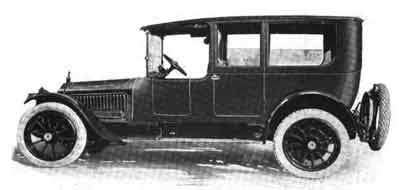
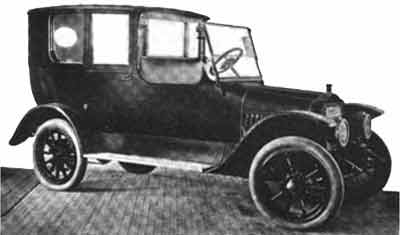
Bela also built small numbers of full-custom
bodies for Boston's automobile dealers. Bela-bodied Liberty, Lenox and
National chassis were displayed at Mechanics Hall during the 1917
Boston Auto Show and the firm is known to have built coachwork on Cole,
Marmon, Mercer, Packard, Peerless and Simplex chassis.
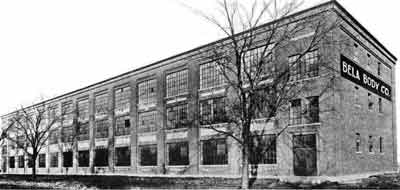
By mid-1916 orders were sufficient to require
additional manufacturing capacity and a vacant factory in nearby
Framingham was purchased from the Standard Woven Fabric Co. in order to
keep up the demand. Subassemblies built in Amesbury were transported to
the new Framingham plant for final assembly, painting and trimming.
The purchase of the Framingham plant was
mentioned in the September 1916 issue of the Hub:
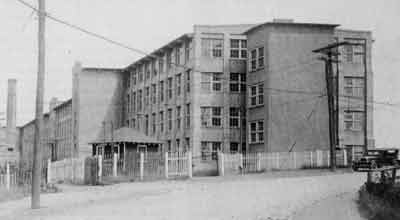
"The Standard Woven Fabric Co., which recently
moved to Walpole, Mass., has sold its plant at Framingham and it is to
be occupied by the Bela Body Co., of Amesbury, who will operate the
whole property for the production of automobile bodies. The main
building is of modern concrete construction, 53 by 224, three stories,
having about 40,000 ft. of manufacturing space, and an attached
fireproof boiler house, all equipped with sprinkler system and other
modern conveniences. There is 108,720 ft. of land bordering on the
railroad. Town assessment places $43,550 on the building and $7,570 on
the land, making a total of $51,120."
The purchase was funded by an initial stock
offering of $600,000 which was shortly followed by an additional
offering of $300,000 shares via the following prospectus, published in
the March 17, 1917 issue of the Boston Globe:
"TAX FREE IN MASSACHUSETTS
$300,000 BELA BODY COMPANY 7% Cumulative Preferred Stock (Closed
Issue). Transfer Agent—Metropolitan Trust Company, Boston, Mass.
Dividends Payable Quarterly, December 1st, etc.
"CAPITALIZATION:
| |
Authorized
|
Issued
|
|
7% Cumulative Preferred Stock
|
$300,000
|
$300,000
|
|
Common
|
$500,000
|
$600,000
|
"This company builds at its plants in Amesbury
and Framingham the highest grade, one piece, aluminum, custom bodies,
and has placed them on many chasses, including the following: PACKARD,
SIMPLEX, MARMON, MERCER, PEERLESS, COLE. Large orders have been taken
from the following companies direct: FRANKLIN, WHITE, WlNTON. At the
Boston Auto Show bodies built by this company may be seen on the
LIBERTY, LENOX, NATIONAL. Three-fourths of the stock has been sold.
Circular and Price on Application.
"EARNEST E. SMITH, Inc. Specialist in New
England Investments, 68 Devonshire St., Boston."
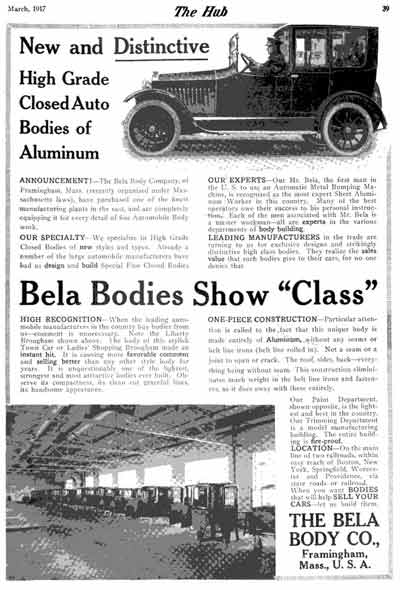
The following display ad appeared in the March,
1917 issue of The Hub:
"New and Distinctive High Grade Closed Auto
Bodies of Aluminum
"ANNOUNCEMENT!—The Bela Body Company, of
Framingham, Mass. (recently organized under Massachusetts laws), have
purchased one of the finest manufacturing plants in the east, and arc
completely equipping it for every detail of fine Automobile Body work.
"OUR SPECIALTY—We specialize in High Grade
Closed Bodies of new styles and types. Already a number of the large
automobile manufacturers have had us design and build Special Fine
Closed Bodies
"OUR EXPERTS—Our Mr. Bela, the first man in the
U. S. to use an Automatic Metal Bumping Machine, is recognized as the
most expert Sheet Aluminum Worker in this country. Many of the best
operators owe their success to his personal instruction. Each of the
men associated with Mr. Bela is a master workman—all are experts in the
various departments of body building.
"LEADING MANUFACTURERS in the trade are turning
to us for exclusive designs and strikingly distinctive high class
bodies. They realize the sales value that such bodies give to their
cars, for no one denies that Bela Bodies Show "Class"
"HIGH RECOGNITION—When the leading automobile
manufacturers in the country buy bodies from us—comment is unnecessary.
Note the Liberty Brougham shown above. The body of this stylish Town
Car or Ladies' Shopping Brougham made an instant hit. It is causing
more favorable comment and selling better than any other style body for
years. It is unquestionably one of the lightest, strongest and most
attractive bodies ever built. Observe its compactness, its clean cut
graceful lines, its handsome appearance.
"ONE-PIECE CONSTRUCTION—Particular attention is
called to the fact that this unique body is made entirely of Aluminum,
without any seams or belt line irons (belt line rolled in). Not a seam
or a joint to open or crack. The roof, sides, back—everything being
without seam. This construction eliminates much weight in the belt line
irons and fasteners, as it does away with these entirely.
"Our Paint Department, shown opposite, is the
lightest and best in the country. Our Trimming Department is a model
manufacturing building. The entire building is fire-proof. LOCATION—On
the main line of two railroads, within easy reach of Boston, New York,
Springfield, Worcester and Providence, via state roads or railroad.
When you want BODIES that will help SELL YOUR CARS—let us build them.
"THE BELA BODY CO., Framingham, Mass., U. S. A."
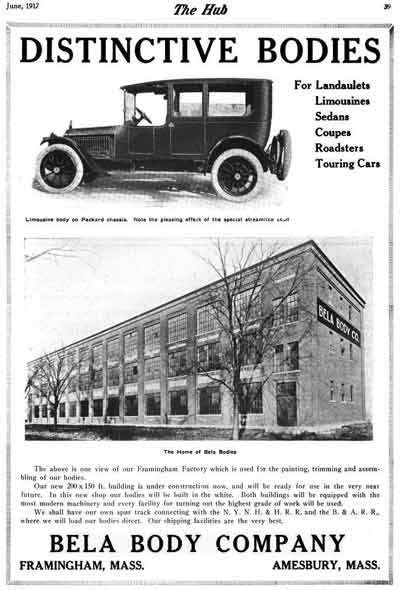
Display ad from the June, 1917 issue of The Hub:
"Distinctive Bodies For Landaulets, Limousines,
Sedans, Coupes, Roadsters, Touring Cars.
"Limousine Body on Packard chassis. Note the
pleasing effect of the special streamline cowl.
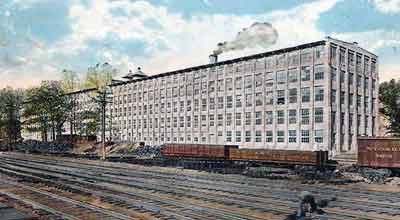
"The Home of Bela Bodies
"The above is one view of our Framingham
factory which is used for painting, trimming and assembling of our
bodies.
"Our new 150 x 200 ft. building is under
construction now and will be ready for use in the very near future. In
this shop our bodies will be built in the white. Both buildings will be
equipped with the most modern machinery and every facility for turning
out the highest grade of work will be used.
"We shall have our own spur track connecting
with the N.Y., N.H. & H.R.R. the B.& A.R.R. where we will load
our bodies direct. Our shipping facilities are the very best.
"BELA BODY COMPANY, FRAMINGHAM, MASS.
AMESBURY, MASS."
The June 19, 1917 issue of the Boston Evening
Transcript reported:
"BELA BODY CO. Plant Enlarged.
"Framingham, June 9—The Bela Body Co. has
completed its new concrete building, covering 40,000 square feet of
land. The company now has one of the largest factories for the
production of high grade aluminum automobile bodies in New England."
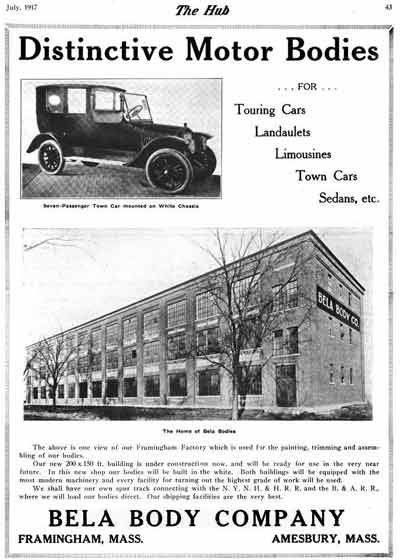
The following display ad is from the July, 1917
issue of The Hub:
"Distinctive Motor Bodies For Touring Cars,
Landaulets, Limousines, Town Cars, Sedans, etc.
"Seven Passenger Town Car Mounted on White
Chassis.
"Our New Plant at Framingham, Massachusetts
"This new up-to-date factory is used for the
painting and trimming of our Bela Bodies, also for the final assembling
and mounting. Our new addition to this plant, 150 x 200 ft., will take
care of our metal and woodworking departments, and there will be a full
force of body builders in it in about three weeks. The shipping
facilities are ideal, being able to load our finished work on our own
track on the B. & A.R.R. and the N.Y., N.H. & H.R.R. The whole
plant is designed and built to give SERVICE and QUALITY WORK.
"BELA BODY COMPANY, FRAMINGHAM, MASS.
AMESBURY, MASS."
The August 25, 1917 issue of the Boston Globe
announced the election of Boston Franklin dealer and H.H. Franklin Mfg.
Co. board member Otto A. Lawton as Treasurer of the Bela Body Co.:
"OTTO A. LAWTON ELECTED TREASURER OF BELA BODY
CO.
"Otto A. Lawton has been elected treasurer and
a director of the Bela Body Company. The company has secured an
additional contract to build bodies for the Franklin Company that will
require the erection of a new building having about 20,000 feet floor
space. The company has enough business on its books to keep the plant
operating at capacity until the middle of next Spring. Mr. Lawton is a
director of the H. H. Franklin Manufacturing Company, makers of the
Franklin automobile."
Lawton, the president and treasurer of the
Franklin Motor Car Company of Boston, was originally sent to Boston in
1906 by the H.H. Franklin Mfg. Co. to serve as the factory branch's
auditor. He was appointed manager of the concern in 1908, and two years
later purchased a controlling interest in the firm. As owner of one of
Franklin's largest distributors, Long was subsequently elected to the
H.H. Franklin Mfg. Co. board of directors, a position he held into the
1930s.
The 1918 SAE Directory listing for Lawton follows:
"Lawton, Otto A., owner, manager, Franklin
Motor Car Co., Boston, Mass.; president, Franklin Motor Car Co.,
Portland, Maine; treasurer, director, Bela Body Co., Framingham, Mass.;
director, Back Bay National Bank, Boston, Mass.; director, H. H.
Franklin Mfg. Co., Syracuse, N. Y."
Within a year of the 1917 stock offering, Bela's
board of directors accepted an offer to purchase the firm from
Framingham, Massachusetts shoe manufacturer, Richard H. Long.
Richard Henry Long (b. Sep. 4, 1865-d. Apr. 16,
1957) was the son of a prominent Massachusetts shoe manufacturer who
took over the family business upon the death of his father, John, in
1889. Originally located in South Weymouth, Long relocated the factory
to Belchertown during the early 1890s and by 1896 employed 50 hands. At
the turn of the century Long moved into larger quarters in Springfield
and in 1902 purchased an existing factory in South Framingham for the
manufacture of his popular line of men's footwear. Located on Fountain
St., halfway between Farm Pond and Waverly St. (Route 135), the wooden
structure remained a local landmark until it was torn down a few
decades ago.
The shoe business grew and in November of 1904
Long leased a Boston factory formerly occupied by L. Prang & Co.
for the manufacture of a new line of women's shoes. A second building
was added to the Framingham complex in 1908 and all shoe manufacturing
operations were consolidated there. During the early stages of the
First World War Long supplied the British government with various
canvas and leather goods used to outfit the British troops. When the
United States entered the conflict Long supplied the US Army with
harnesses and other leather products.
His son (Richard F. Long) later stated that at
the height of the War, his father's firm held $24 million worth of
government supply contracts. However US Government documents reveal
that although Richard F. Long (R.H. Long's eldest son) stated that the
US government ordered 5 million gas mask knapsacks to congressional
investigators, the actual order was for only 1 million knapsacks, and
with a cost of roughly 50 cents each, that specific contract actually
amounted to a little more than half a million dollars.
Regardless, Long clearly needed additional
manufacturing capacity and in mid-1918 purchased the Framingham factory
of the Bela Body Company. Auto sales had suffered a steep decline with
the entry of the United States into the European conflict and A.G. Bela
and his partners were anxious to unload their automotive holdings.
The sale of the business was announced in the
August 16, 1918 issue of the Boston Globe:
"Ernest B. Smith & Co. announce the sale of
the Bela Body Company at Framingham to Richard H. Long of Framingham.
The Bela Body Company has been producing for the last two years high
grade aluminum bodies for automobiles, but it is understood that the
new owner will change the character of the business, idling the plant
for the manufacture of war materials."
Just shy of the three-month anniversary of the
Bela Body Co. sale the Armistice was signed and Long's
multi-million-dollar contracts were abruptly canceled.
When Long purchased the business he assumed
whatever contracts Bela Body was in the process of fulfilling and with
the end of the War, they resumed the manufacture of Franklin body
sections. In 1919 Long closed down the Amesbury body plant and moved
all body-building operations into Bela's Framingham buildings where he
commenced the manufacture of entire sedan bodies for Franklin.
A walkout by Bela Body workers was reported in
the December 2, 1919 issue of the Boston Globe:
"WORKERS WALK OUT AT TWO LONG PLANTS
Ask Time and a Half for Increase in Hours; Bela
Body Employees Given Longer Schedule - More Production Desired
"Special Dispatch to the Globe
"FRAMINGHAM, Dec 1—A disagreement arising
between employees of the Bela Body Company, manufacturers of automobile
bodies, and the company over a weekly schedule, the men, including
metal workers, painters and upholsterers, left their benches today. The
men in the Clark St. works were the first to go out. They were followed
later in the day by the employees in the Fountain St. factory.
"The men had been on a five-day week schedule
of 45 hours since early in the Summer. It being stated at the time the
rule went into effect by the R. H. Long interests, which operate the
Bela Body Company plants, that the plan would be tried out for a few
months, probably until October. There was an extension until November,
however.
"The company last week informed its employees
that owing to the large number of orders the factories would be
operated on a 48-hour week schedule to increase production, the
operatives to be granted an increase in wages for the three extra
hours, as well as time and a half for all over 48 hours.
"It is understood the operatives insisted on
time and a half for all above 45 hours, hence the disagreement. It is
further said that the operatives are displeased over the discharge of
some of their fellow workmen.
"Last week machinists of the R. H. Long
Machinery Company, who were also enjoying the 45-hour weekly schedule,
won’t out on strike when requested to work three additional hours.
Their demand was similar to that made by the Bela Body workers, time
and a half for the three hours, to which the company would not agree.
"It was reported that many of the striking
machinists resumed work, accepting the company's offer. It was said
that others had also made application for their old jobs."
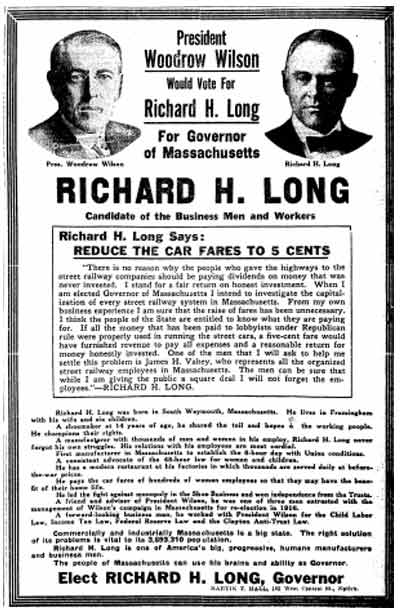
Although Long was a well-known businessman, his
political career remains his lasting legacy.
Long first ran for public office in 1912 as the
unsuccessful Democratic candidate for Lieutenant Governor. A wealthy
man, he reasoned that if he owned a newspaper, his chances of winning
an election might increase so soon afterwards he purchased a
controlling interest in the Boston Telegram. Tales of successful "boy
cobblers" within its pages helped him garner the Democratic nomination
for Governor of Massachusetts in the 1918 and 1919 elections.
The September 25, 1918 Boston Daily Globe
reported:
"Long Wins Over Gaston by 2700, Barry Is Third.
"Richard H. Long of Framingham was nominated as
the Democratic candidate for Governor of Massachusetts in the primary
election yesterday. His plurality over Col William A. Gaston, who ran
second, was about 2700. Ex-Lieut. Gov. Edward P. Barry was about 4500
votes behind Col Gaston.
"The vote for Governor on the Democratic
ticket, with 11 towns and Quincy, Everett and New Bedford missing, but
with their votes estimated on the basis of the rest of the State and of
previous votes in those places, was: Long, 23,454; Gaston, 20,761;
Barry, 10,335.
"The early returns indicated that Col. Gaston
had been nominated. He carried Boston by a plurality of 2267 over Mr.
Barry, who was second in this city. Mr. Long was 1528 votes behind Mr.
Barry in Boston. As the figures from the rest of the State came in,
however, Col Gaston's
apparent plurality was gradually wiped out ;
the other cities went, for the most part, for Mr. Long: and he quickly
went from third to first place. He carried Worcester by about 1000,
Lynn by 800, Holyoke by 775, Springfield by 700, Fall River by 400,
Marlboro by 275, Lawrence by 200, Fitchburg by 150 and Lowell and
Chicopee by about 100 each.
"The towns, especially those in the middle and
western parts of the State, also went for Mr. Long, and his nomination
was soon made certain. The result was a surprise except to Mr. Long and
his closest supporters, who have maintained from the beginning that he
would be nominated.
"The vote of Boston for Governor was: Gaston,
12,111; Barry, 9854; Long, 8326. Barry carried Wards 9, 10 find 11 his
own section of the city, but every other Boston ward went for Gaston.
Ward 5, the home of Martin Lomasney, gave Gaston 1313 votes, Barry 640,
and Long 125."
Long lost the November 4, 1918 election to the
Republican favorite Calvin Coolidge, by a margin of 16,773 votes, The
official 1919 (Nov. 4, 1918) Massachusetts Governor's election results
follow:
"From an examination of the returns, it appears
that votes were cast as follows: —
"For Governor.
|
Calvin Coolidge of Northampton has
|
214,863
|
votes
|
|
Richard H. Long of Framingham has
|
197,828
|
votes
|
|
Sylvester J. McBride of Watertown has
|
7,757
|
votes
|
|
Ingvar Paulsen of Boston has
|
1,913
|
votes
|
|
All others
|
9
|
votes
|
"And Calvin Coolidge is elected"
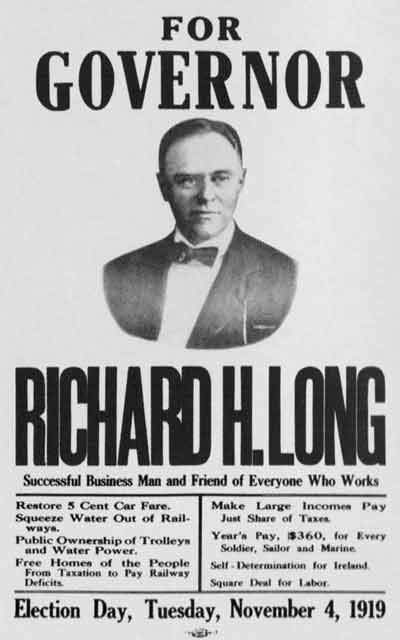
Due to his narrow defeat in 1918, Long was easily
nominated to represent the Democratic party in the November 4, 1919
election.
The August 15, 1919 Boston Globe announced his
candidacy:
"RICHARD H. LONG FILES HIS PAPERS - Democratic
Nomination for Governor Sought
"Richard H. Long of Framingham yesterday filed
papers as candidate for the Democratic nomination for Governor with the
Secretary of State. Mr. Long was the candidate of his party last year.
His papers, as filed yesterday, contained 1222 signatures, 203 from
Hampden County, 266 from Essex. 340 from Middlesex and 353 from
Worcester."
Long faced the same opponent as in 1918, Calvin
Coolidge, but this time the incumbent Governor Coolidge defeated him in
a landslide victory. The main reason for the defeat was due to the
public's approval of how he (Coolidge) handled the bloody 1919 Boston
Police strike where 80% of the city's policemen went on strike after
the police commissioner refused to allow them to unionize.
Widespread crime and rioting ensued requiring the
intervention of the State militia, which resulted in the tragic deaths
of two rioters. Coolidge criticized the striker's actions in a
much-publicized telegram sent on September 14, 1919, to Samuel Gompers,
President of the American Federation of Labor. A transcription of that
telegram follows:
"Mr. Samuel Gompers
President American Federation of Labor
New York City, N.Y.
"Replying to your telegram, I have already
refused to remove the Police Commissioner of Boston. I did not appoint
him. He can assume no position which the courts would uphold except
what the people have by the authority of their law vested in him. He
speaks only with their voice. The right of the police of Boston to
affiliate has always been questioned, never granted, is now prohibited.
The suggestion of President Wilson to Washington does not apply to
Boston. There the police have remained on duty. Here the Policemen's
Union left their duty, an action which President Wilson characterized
as a crime against civilization. Your assertion that the Commissioner
was wrong cannot justify the wrong of leaving the city unguarded. That
furnished the opportunity, the criminal element furnished the action.
There is no right to strike against the public safety by anybody,
anywhere, any time. You ask that the public safety again be placed in
the hands of these same policemen while they continue in disobedience
to the laws of Massachusetts and in their refusal to obey the orders of
the Police Department. Nineteen men have been tried and removed. Others
having abandoned their duty, their places have, under the law, been
declared vacant on the opinion of the Attorney General. I can suggest
no authority outside the courts to take further action. I wish to join
and assist in taking a broad view of every situation. A grave
responsibility rests on all of us. You can depend on me to support you
in every legal action and sound policy. I am equally determined to
defend the sovereignty of Massachusetts and to maintain the authority
and jurisdiction over her public officers where it has been placed by
the Constitution and law of her people.
"Calvin Coolidge
Governor of Massachusetts"
By Election Day it would have taken a miracle to
defeat the immensely-popular Governor and Long was soundly defeated by
125,101 votes - 317,774 to 192,673 - more than seven times Coolidge's
margin of victory in the previous election.
After suffering an embarrassing defeat in the
1920 Democratic Gubernatorial primary Long decided to retire from
politics and return to business. During the Spring of 1920 Long
announced the construction of a million dollar manufacturing facility
in Worcester, which was carried by the Boston Globe in its April 2,
1920 edition:
"TO BUILD $1,000,000 PLANT AT WORCESTER
"Richard H. Long Said to Be Head of Auto Concern
"Special Dispatch to the Globe
"WORCESTER. April 1— Negotiations for the
purchase of a large tract of land in the North End of Worcester as the
site for a $1,000,000 plant to manufacture automobile bodies were
practically completed today and it is expected, the papers will be
passed tomorrow.
"It is reported that the plant will give
employment to 4,500 hands and homes for many of them are to be erected
on land surrounding the shop.
"Richard H Long of Framingham is said to be at
the head of the concern. The deal for the purchase of the land has been
made by Worcester men."
The death of his wife, Mabel H.L. Long, in a
nationally covered July 10, 1920 plane crash put the project on hold
for the next few months but construction commenced at the end of March,
1921 as recorded by the New York Times in its March 26, 1921 issue:
"R.H. Long begins erection of new factory in
Worcester, Mass."
The April 1, 1921 issue of Lumber announced:
"NEW AUTO BODY PLANT
"Worcester, Mass., March 28. – Richard H. Long
of Framingham, has announced plans for building a large factory here
for the manufacture of automobile bodies. Operation will begin early
next Fall with a force of 2,000 men and, ultimately, expects to employ
about 10,000."
Another magazine that carried the announcement
was April 16, 1921 issue of Boot and Shoe Recorder, "the magazine of
fashion footwear":
"Worcester, Mass.—Richard H.
Long of Framingham started the erection of a five-story
building, which will accommodate 10,000 employees and will be devoted
to manufacture of automobile bodies."
The construction of the Worcester plant coincided
with a reorganization of the Bela Body Co. as the Richard H. Long Co.
From 1921 on all third party bodybuilding activity would be handled by
the Long Company. The last mention of Bela Body Co. was in relation to
the firm supplying coachwork for the Amesbury / Framingham-built
Temple-Westcott automobile, an assembled 6- cylinder mid-priced car
which was built in very small numbers (approximately 20) starting in
1921. The History of the Temple-Wescott firm is scarce at best. The
firm's entry in Kimes & Clarke's Standard Catalog of American Cars
1805-1942 follows:
"TEMPLE-WESTCOTT — Framingham, Massachusetts —
(1921-1922) — Temple-Westcott is a conundrum. Apparently the car, which
was a six, was built in the shops of the Bela Body Company in
Framingham. A total production of both ten and twenty Temple-Westcotts
has been reported, but for whom were the cars built? That remains a
mystery. The possibility that the vehicles were produced on special
order for a Temple Westcott dealership in the area seemed likely, but
alas there were no dealerships during the early Twenties in Boston,
Framingham or Amesbury that carried the name of either Temple or
Westcott. And there was no relationship between this car and the
Westcott then being built in Ohio. When the Bela Body Co. subsequently
moved to Amesbury, the Bela plant in which the Temple-Westcotts had
been built was acquired by the Dennison Company."
Kimes & Clark have the Bela Body chronology
backwards, but I can add that I also could not locate any additional
information on the Temple-Wescott, nor its incorporators or
distributors. However, the Jackmann-Jameson Co., 910 Commonwealth Ave.,
Boston (coincidentally the former Hume Carriage Co. building) were
listed as the New England distributors of the Ohio-built Westcott and
may somehow be connected.
To keep himself busy after his wife was killed in
an aircraft accident in 1920, Richard H. Long decided to start making
automobiles. In an address made on March 10, 1922, Long stated that
planning for the Bay State commenced one year previous, March 10, 1921.
He hired Herbert C. Snow (1884-1974), a former
Winton engineer who was between jobs, to design the chassis. Decades
later Snow
recalled his short tenure at the firm:
"Leaving Winton I went to the R. H. Long
Co.
of Framingham,
Mass. They owned the Bela Body Company which had been building complete
bodies
for the Franklin Co... Mr. Long thereupon decided to build a car of his
own. I
was hired to do the job. The car was called the Bay State. Several
hundred of
these were built. Upon
completion of this design, I went to the
Velie Motor Car Co. at Moline, ill., as Chief Engineer in January
1924."
Snow is
remembered today for his work as Auburn's chief engineer where he
worked on such legendary vehicles as the Cord L-29, Auburn Speedster,
and Cord 810/812.
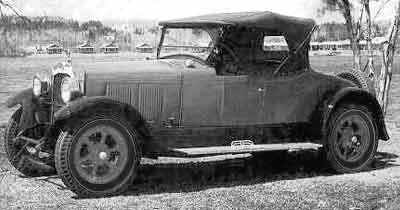
Even before one sketch was drawn Long had a name for
his car, Bay State. It was made in Massachusetts, the Bay State, and it
was going to be sold only in Massachusetts.
Long formed a new firm, the Bay State Automobile
Co. and slowly began production of the Bay State automobile in the
former Bela Body plant that he had acquired in August of 1918. In 1920
Long acquired the services of Fredrick Howe Clark as chief engineer of
his various manufacturing facilities. Clark moved to Worcester in 1921
to oversee construction of the firm's new (67) Millbrook Street
factory.
August 14, 1921 Boston Globe:
"BAY STATE CAR MADE BY RICHARD H. LONG
"The Bay State motor car made its first
appearance here Friday, when a number of friends of Richard H. Long,
the Framingham shoe manufacturer who is building it, were invited to
inspect and ride in it from the Courthouse. It is a sedan, and Mr. Long
proposes to sell it at a low figure. He is going to cater first to the
New England trade and later increase production and sell elsewhere. His
plans now call for the delivering the car free at any point in New
England, driving it over the road to customers.
"The new car is attractive, substantially built
and rides easily. It has a six-cylinder Red Seal Continental motor, 3 ¼
x 4 ½, with Delco ignition and a wheelbase of 121 inches. Equipment is
complete. The body was built in Mr. Long's factory at Framingham. He is
just finishing another plant at Worcester, 600 feet long by 75 wide, of
six stories. The first unit of several such structures where he
proposes to turn out a number of cars.
"For the present the cars will be sedans and
touring models. Later on other models will be added to the line. He has
equipment for making his own parts in the near future. The first cars
will be ready for delivery this Fall. He has secured Mr. Snow of
Cleveland, formerly with Winton, to work with his own engineering
department.
"Richard F. Long, the oldest son, also has
charge of the automobile body plant, where bodies for other cars have
been turned out for some time, will be active in the management of the
motor car production."
The preview was also covered in the August 24,
1921 issue of Motor World:
"NEW LONG MOTOR CAR IS VIEWED IN BOSTON
"BOSTON, Aug. 22—The Bay State motor car has
made its first appearance on the streets of Boston. A number of friends
of Richard H. Long the Framingham shoe manufacturer, were invited to
inspect and ride in it from the courthouse. It is a sedan and
Long proposes to sell it for $2,500. He is going to cater first
to the New England trade, and later increase production and sell
elsewhere. His plans now call for delivering the car free at any point
in New England, driving it over the road to the customers.
"The new car has a six cylinder Red Seal
Continental motor 3 ¼ x 4 ½ with Delco ignition and a wheelbase of 121
inches. The body was built in Long's factory at Framingham. He is just
finishing another plant at Worcester 600 feet long by 75 feet wide of
six stories, the first unit of several such structures where he
proposes to turn out a number of cars. For the present the cars will be
sedans and touring models. Later on other models will be added to the
line. He has equipment for making his own parts in the near future. The
first cars will be ready for delivery this fall. An engineer has been
obtained."
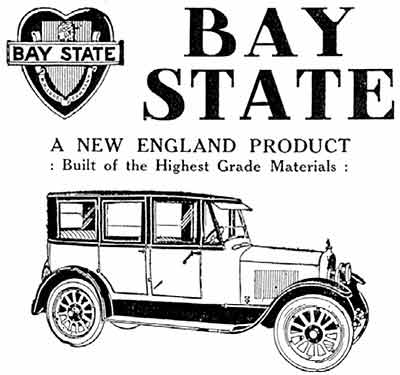
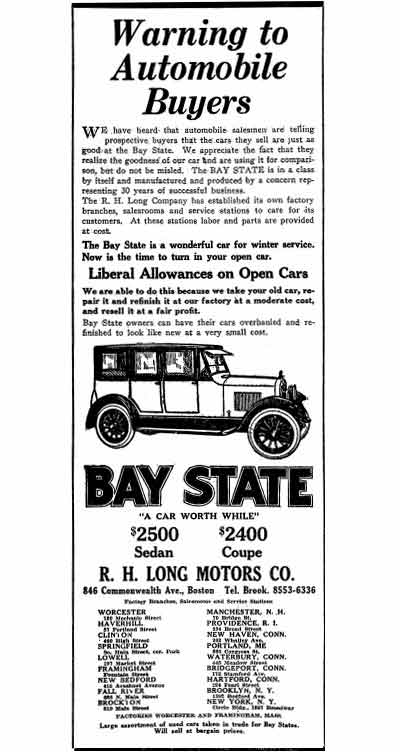
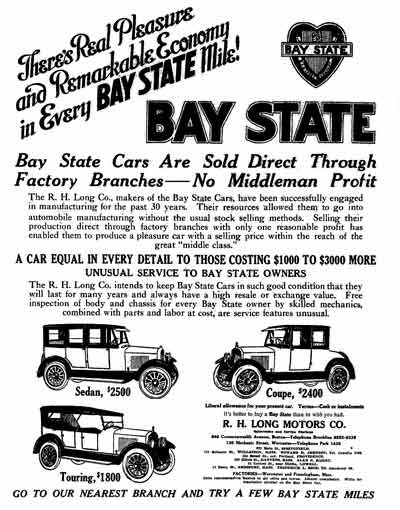
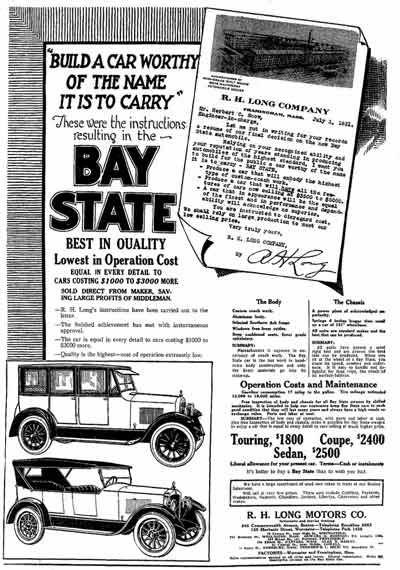
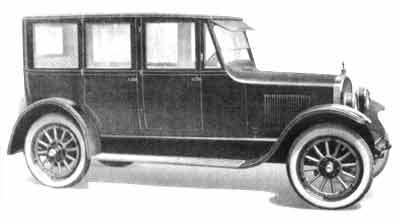
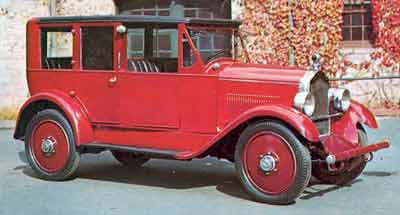
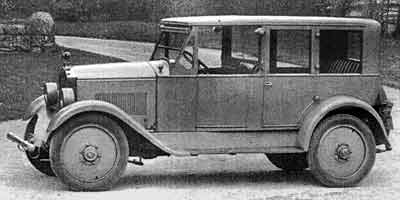
The Bay State was revealed to the nation on the
mezzanine of the Hotel Commodore in during the January 1922 New York
Automobile Show. The Long-built aluminum-skinned sedan body of the Bay
State was a masterpiece and featured "Nineteen coats of filler, varnish
and paint" according to sales literature. Built on two wheelbases, 121"
and 128", The Bay State's initial offerings included a touring,
roadster coupe and sedan priced from $1,800-$2,500. Soon afterwards new
body styles were added which included a brougham, phaeton, sport sedan,
sport touring, and a seven-passenger sedan, which was offered at $2,750.
The January 26, 1922 issue of Printers Ink
contained the following:
"Bay State Pleasure Car Advertised
"Newspaper advertising is being used by the
R.H. Long Company, Framingham and Worcester, Mass., to advertise the
Bay State Pleasure Car. The advertising is handled by Chambers &
Wiswell, Inc., Boston advertising agency. The car is manufactured by
the same interests that control the R.H. Long Shoe Company."
During 1922 coach-building activities for
third-party firms (Franklin, Hudson, Temple-Wescott, and others)
continued alongside production of the Bay State but increased sales of
the Long-built automobile soon found the firm short on space forcing
Long to temporarily purchase coachwork from another New England
coachbuilder, the Woonsocket Mfg Co. of Woonsocket and Providence,
Rhode Island.
March 12, 1922 Boston Globe:
"BAY STATE MAKES REAL IMPRESSION
"Automobile dealers throughout the country are
watching with interest the strides made by Richard H. Long of
Framingham in the manufacture of automobiles. Mr. Long, previous to the
War, was engaged exclusively in the manufacture of shoes. He is now
producing the Bay State car, an automobile of high quality in every
detail of material and workmanship.
"During the World War the R.H. Long Company's
corps of skilled engineers and mechanics produced for the Nation a
great variety of goods, many of which had never before been
manufactured in this section of the country.
"Among these productions was the manufacture of
high-grade automobile bodies.
"After completion of war-time activities a
rigid, intelligent investigation resulted in Mr. Long's determination
to manufacture a car having appearances and performance of exclusive,
high-priced cars, but selling within the reach of the great middle
class.
"The same efficient war-time organization with
an additional number of the company's best automobile experts, were
retained to manufacture the Bay State car.
"Mr. Long has been actively engaged m the
manufacture of automobiles for about one year. Far-extending research
work has been conducted and severe experiments have been made over a
much longer period. The untiring efforts on the part of his
organization have been rewarded by the Bay State car.
"The leading feature of the Bay State
automobile is the even balance of the car. That is the reason that it
runs smoothly and uses such a small amount of gasoline and is so easy
on tires. The Bay State car is expected by many automobile experts to
make many friends in the great middle class."
An October 1922 advertisement in the Boston
Herald lists the addresses of the Bay State' distributors:
"R. H. LONG MOTORS CO.
846 Commonwealth Ave., Boston Tel. Brook. 8553-6336
"Factory Branches, Salesrooms and Service
Stations:
|
WORCESTER
|
|
130 Mechanic Street
|
|
HAVERHILL
|
|
87 Portland Street
|
|
CLINTON
|
|
480 High Street
|
|
SPRINGFIELD
|
|
S. Main St., cor. Park
|
|
LOWELL
|
|
107 Market Street
|
|
FRAMINGHAM
|
|
Fountain Street
|
|
NEW BEDFORD
|
|
415 Acushnet Ave
|
|
FALL RIVER
|
|
886 N. Main Street
|
|
BROCKTON
|
|
810 Main Street
|
|
MANCHESTER, N.H.
|
|
70 Bridge Street
|
|
PROVIDENCE, R.I.
|
|
314 Broad Street
|
|
NEW HAVEN, CONN.
|
|
802 Whalley Ave.
|
|
PORTLAND, ME.
|
|
880 Congress Street
|
|
WATERBURY, CONN.
|
|
445 Meadow Street
|
|
BRIDGEPORT, CONN.
|
|
178 Stamford Ave.
|
|
HARTFORD. CONN.
|
|
294 Pearl Street
|
|
BROOKLYN, N.Y.
|
|
1309 Bedford Ave.
|
|
NEW YORK, N.Y.
|
|
Circle Bldg,. 1837 Broadway
|
"FACTORIES WORCESTER AND FRAMINGHAM, MASS.
Long Motors Co. 846 Commonwealth, Boston, Mass."
In early 1923 Long's contract with Franklin
expired and along with it the firm's production body building business.
For a short time sales of the Bay State expanded to regions outside of
Massachusetts with distributors as far away as Chicago.
However by late 1923 R.H. Long's automotive
holdings were in serious trouble, so much so that he organized a new
firm, R.H. Long Motors Co., to protect his assets. The news was
announced in a late 1923 issue of Steam magazine:
"The R.H. Long Motors Co., Framingham, Mass.,
has been incorporated under State laws with capital of $1,500,000 to
take over and operate the plants of the R.H. Long Co. at Framingham and
Worcester, specializing in the production of a six-cylinder car.
"Arrangements been perfected for the
establishment of a factory branch at 252 Central Avenue, Newark, NJ.
Richard H. Long is president and treasurer."
Details of the proceedings were contained in the
December 3rd, 1923 issue of The Automobile:
"3 Creditors Petition Long Bankruptcy: Charge
Preferential Payments Were Made Where Company Was Insolvent.
"Boston, Dec 3 – An involuntary petition in
bankruptcy has been filed in the United State District court against
the R.H. Long Co. The petitioners are three creditors with small
claims, who charge preferential payments last November, when, they
allege, the company was insolvent.
"Two Committees Were Named
"Boston, Dec. 1 – Following a meeting held at
one of the larger banking houses here a few days ago, plans were made
for handling the affairs of the R.H. Long Motors Co., the R.H. Long Co.
and the R.H. Long Shoe Co., all of Framingham, through two committees.
"One is composed of Wilbur W. Higgins of the
Old Colony Trust Co., George E Pierce of the National Shawmut Bank,
both of Boston, and John W Bargefrede of the First National Bank,
Brooklyn, N.Y. to act for the secured creditors. The other is made up
of G.L. Margeson, B.F. Goodrich Co.; TM Regan, the American Credit
Indemnity Co. of Boston, and one other to be selected later to look
after the unsecured creditors. The appointment of these committees is
the aftermath of meetings held during the last few days by Robert
M. Falkenau of the Irving Bank-Columbia Trust Co., Brooklyn, NY, and WW
Shepard of the Worcester Bank & Trust Co. and Higgins.
"The business has been turned over to the
Caswell & Woods Associates, industrial engineers, as a result of
"lack of liquid working capital and a consequent inability on the part
of the companies to meet their current liabilities." According to the
report of the committee of investigation, Chaswell & Woods
estimates the assets of the three companies at about $1,875,000 and the
direct liabilities as about $1,200,000 and their
contingent liabilities at approximately $800,000."
"Builds Bay State Car
"The principal business of the Longs companies
is the building of automobiles known as the Bay State. This work was
undertaken several years ago when the R.H. Long Co. had completed its
Government work. Long previously had done some body building
for automobile making concerns. He sent to Cleveland and
secured a designer formerly with Winton, and the Bay State was placed
on the market, its closed models — the first produced — selling at
$2500. Salesrooms were opened in Boston and other cities, and a plant
was secured at Worcester in addition to the one at Framingham. Long has
not operated the shoe plant since Sept. 1, last.
"He and his family practically control the
shares of stock of all three companies. The creditors committee is
optimistic over the possibilities of straightening out the
difficulties. In its report it says: The R.H. Long Co. is the parent
company. Substantially all the stock is owned by Richard H. Long and
members of the Long family. The R.H. Long Motors Co. owns the principal
manufacturing plant at Framingham, the Worcester factory
erected last year, the inventory of the finished Bay State
automobiles and materials for their manufacture, and the equipment
contained in the plant at Framingham.
"The R.H. Long Shoe Co. owns the inventory,
machinery and accounts appertaining to the manufacture of shoes. The
R.H. Long Co. owns the stock of the two subsidiary companies, a
considerable amount of land in Framingham, upon which are located a
large wooden shoe factory, several brick buildings for the manufacture
of shoe machinery and certain dwelling houses and farm buildings,
together with inventory which includes ware materials believed to have
substantial value.
"It did own a large tract of land adjacent to
the new factory building in Worcester. This land has been transferred
to R H. Long as trustee for the RH Long Company. The principal business
of the companies today is the manufacture of automobiles. The RH
Long Motors Co. does the manufacturing and the RH Long Co. the selling.
The RH Long Shoe Co. has not been operated since Sept. 1, 1923. Its
inventory has been substantially liquidated.
"Government Claims Pending
"The assets and liabilities figures listed by
the Bureau of Internal Revenue suggest an additional tax liability of
possibly $1,400,000. Mr. Long, however, expresses the belief that
additional taxes, if any, will be very small. The tax situation,
however, calls for immediate and careful study.
"The report quotes Caswell & Woods with
saying:
"'With the advance of the comparatively small
amount of cash reserves, the liquidation of the companies investments
and, with careful supervision over such liquidation by representatives
of the creditors, creditors may more reasonably expect to receive
substantially full payment of their claims that would be the case if
court proceedings would now intervene and compel an immediate
conversion of asserts into cash at a forced sale.'
"They have also advised your
committee that in their opinion the appointment of a
receiver at the present time would jeopardize the chances of
satisfactorily disposing of the tax situation."
The Associated Press covered the bankruptcy in a
December 6, 1923 wire story:
"LONG MOTORS CO. IN BANKRUPTCY
"BOSTON, Dec. 6 (By Associated Press)—The R.H.
Long Motors Co, with factories in Framingham and Worcester, was
petitioned into bankruptcy in the federal district court today, "
"The petitioning creditors, who allege
preferential payment to other creditors, are the Federal National Bank
of Boston, with a claim of $27,600 on a promissory note: Bay State
National bank, Lawrence, $12,000 on notes; Manufacturers National bank,
Lewiston, Me., $12,000 on a note, and Chambers & Wiswell, Boston,
$2,908 for advertising.
"A petition in bankruptcy recently was filed
against the R. H. Long Co., parent company of the R.H. Long Motors Co.
and the R.H. Long Shoe Co., after a creditors' committee had reported
that the concern was embarrassed by lack of liquid assets. Richard H.
Long of Framingham, former Democratic candidate for governor, heads the
R. H. Long Co.
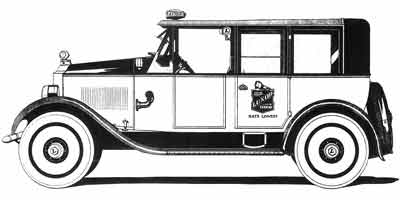
In the months immediately preceding the
bankruptcy announcement the Long organization sought out tenants for
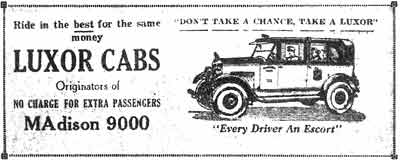
its idle factories. The Luxor Cab Manufacturing Corp., a
Manhattan-based cab distributor owned by Allie S. Freed began building
taxicabs in one of the former Bay State plants under the watchful eye
of Morris Heit, Luxor's manufacturing supervisor.
Coincidentally, Luxor had recently begun
manufacturing taxicabs in the Hagerstown, Maryland plant of the Moller
Motor Car Co., the manufacturer of the Crawford Automobile. Unlike the
R. H. Long enterprise, Moller was well-financed, built their own
high-quality coachwork, and was conveniently located near Freed’s
current and potential customers.
The following article appeared in the January 28,
1924 Hagerstown Morning Herald:
"IN PERMANENT HOME
"Luxor Taxicabs Being Made On Third Floor Of
Building.
"The Moller Motor Car Co., which recently
purchased the old Crawford Bicycle Works, later the Maryland Pressed
Steel Co. and the Poole Engineering Co., has moved the Luxor
taxicab factory to the third floor which will be the permanent place
for the manufacture of these taxicabs. The Moller Motor Car Co. is also
making its line of goods in other parts of the building. This plant is
destined to be one of the busy factories in Hagerstown."
Freed had his own design and management team that
not only designed the vehicles but also oversaw their production. A
skilled delineator named Wehrle did all the design and engineering work
while Heit took care of the manufacturing end. The pair made regular
trips between Framingham, New York City and Hagerstown, and occupied
their own offices in all three cities.
Like the Crawford, the Luxor was an assembled
vehicle, and was built using a heavy-duty 114-inch wheelbase chassis
equipped with Budd disc wheels, Brown-Lipe transmission and a
4-cylinder Buda light truck engine.
The Luxor’s heavy-duty fenders were stamped out
of sturdy sheet steel and its Moller-built limousine and landaulet
taxicab bodies were painted cream and light blue with red striped black
moldings. The same spherical illuminated radiator caps found on the
Dagmar were employed as were bi-lateral colored carriage lamps housed
under a nickel-plated lion’s head.
The leather-upholstered interiors were of a
quality not normally seen in a taxi and the sturdily built taxicabs had
a suggest list price of close to $3,000. When given a choice, the
typical cab customer would choose to ride in a Luxor over any of its
competitors.
Apparently Luxor's Framingham operations were
going smoothly as the May 14, 1924 issue of the Automobile reported the
sale of the former Bay State factory to Luxor:
"Main Factory of Long Acquired by
Luxor Cab
"FRAMINGHAM, MASS., May 14— Guy Murchie,
receiver for the R.H. Long Co., maker of the Bay State car, has
been given authority by Judge Morton of the Federal court to sell the
main factory of the company here to the Luxor Cab Manufacturing Corp.
of Hagerstown, Md. The price is to be $250,000. The Luxor company plans
to build cabs in the plant. And open sales rooms in Boston shortly for
the sale of its cabs."
During much of 1924 Luxor cabs were manufactured
on the production line formerly used to produce the Bay State. Luxor
also utilized unused Bay State components for their taxicabs, and close
examination of the two vehicles reveals that the Luxor and Bay State
shared the same chassis, drivetrain and coachwork, most of which was
supplied by the Woonsocket Mfg Co.
Despite the fact that Bay State's main assembly
plant had been sold off to Luxor, the firm's creditors elected to keep
the remaining plant open as reported by the August 21, 1924 issue of
Motor Age:
"Creditors Vote To Continue Bay State Car
Production
"Boston Mass., August 18th, 1924 – The Bay
State Car is to be continued in production contingent upon court
approval, under a plan worked out by the creditors of all the R.H. Long
companies. It was voted to form a corporation to take control of the
affairs of the companies and under the plan of a three years extension
of credit operated them, paying off one-third of the indebtedness each
year.
"The creditors will have control but working
with them will be R.H. Long, and some of the other identified with the
company. This plan will be placed before the court that appointed a
receiver some time ago under which the companies were being operated.
Guy D. Murchie, receiver, will make his report and then the plan will
be acted upon favorably because the creditors see in this move a chance
to prevent the R.H. Long companies from going into bankruptcy.
Meanwhile the Luxor Cab Company has taken over part of one of the R.H.
Long factories for building taxicabs."
Even though they were built in two different
cities, the Framingham- and Hagerstown-built Luxors shared the same
parts and were nearly identical in appearance save for slight
variations in the coachwork.
In late 1924 Luxor sued another Manhattan cab
operator, the Leading Cab Co., for appropriating the cream and light
blue paint scheme of the firm’s taxicabs. New York State Supreme Court
justice Levy ruled in favor of Luxor and granted them an injunction
forbidding Leading Cab et al. from using the Luxor colors.
Luxor’s vice-president, attorney Joseph Sapinsky,
stated:
"The taxicab industry and even some lawyers who
should know better. They seemed to have been of the opinion that a
taxicab manufacturer could acquire no property right on a color
combination and that everyone was free to appropriate a competitor's
good will. This mistaken idea was due to a misreading of the Yellow Cab
cases."
The following text is from a 1925 Luxor
advertisement:
"The Meaning of LUXOR The Better Taxicab
"To The Taxicab Owner
"Taxicab Transportation has graduated from the
converted pleasure car and "rattle-trap" stage. Now it is a highly
specialized business. Experience proves conclusively that the operation
of Taxicabs can be made profitable, providing equipment of the very
highest order is used.
"This equipment must be supplemented by a
service that is both economical and efficient in addition to being
courteous. The careful buyer of Taxicab equipment will find that the
selection of LUXOR; The Better Taxicab is the most logical. The
construction of LUXOR and the units built into it are of the highest
order, assuring long life and freedom from mechanical trouble.
"To The Riding Public
"And for the riding public. LUXOR is the most
logical selection. Its rich and dignified appearance, set off by a
careful driver in his made-to-fit uniform will incite and satisfy that
desire to ride in Luxury and Comfort.
"One glance will tell you why. LUXOR receives
preference over any other taxicab, especially as the cost is no higher.
"The riding public welcomes LUXOR and gives it
their enthusiastic support. Ownership and Operation of the Better
Taxicab proves that it is an investment of the highest order, and one
that will bring large profits and priceless good-will. Production is
being rapidly sold up, we strongly recommend immediate action in the
purchase of The Better Taxicab."
The demand for the Luxor was so great that Freed
continued to use both manufacturing facilities throughout 1924. In
fact, Moller’s success with its recently introduced Dagmar luxury car
prompted Freed to announce the pending production of his own luxury
car, the Standish, in the September, 1924 issue of Autobody:
"The Luxor Cab Manufacturing Co. Framingham,
Mass., builder of the Luxor taxicabs, expects to begin production soon
of a 6-cylinder car to be known as the "Standish." The open models will
list at about $2100 and the sedan at $2595. The company occupies the
former Long plant in which the Bay State cars were produced."
A single prototype (possibly two) was produced
and, not surprisingly, eyewitnesses claimed the car looked like a
Dagmar with wire wheels and a Mercedes-style grill. No production
Standish’s were forthcoming and after being used by Freed as a daily
driver, the prototype disappeared.
The pending sale of the Bay State Automobile
Co.'s assets was announced in an October 1924 issue of the Automobile:
"Bay State Plant Sold; Production to
Continue.
"FRAMINGHAM, MASS., Oct. 1 (1924) — The Bay
State Motor Co. has purchased all the merchandise, machinery,
cars, goodwill and other property of the Bay State Automobile Co. from
Guy H. Murchie, the receiver. As a result, the factories where the Bay
State cars were being turned out for the past few years will resume
operations this month when about 500 employees, who have been out of
work for a long time, will be reemployed.
"The new corporation will operate under the
direction of Richard H. Long, who founded the company. No
report has been issued as to the price paid to Mr. Murchie, but the
plant alone is valued at more than $600,000.
"The Long Motor Sales Co. is to have charge of
the sales of the output."
At that time Long had recently purchased an
interest in the Jephson, Scott Body Co., a small East Orange, New
Jersey coachbuilder that produced production bodies for Crane-Simplex.
Although the Crane-Simplex was a magnificent car,
the chassis was little-changed from its pre-War ancestor and proved to
be a financial disaster. Production was halted during 1923 and the
directors of Jephson, Scott sought additional investors to keep the
plant going. An interested party was located in the form of Richard H.
Long, the manufacturer of the Bay State automobile, and owner of the
now defunct Bela Body Co.
At the time one of Long's numerous auto-related
businesses, the R.H. Long Motors Co., was headquartered in Newark at
252 Central Avenue, less than a mile away from the Jephson-Scott body
works. He saw his investment in the firm as an economical way to get
back into the auto body building business and hoped to use the firm's
coachwork on the Bay State if and when production resumed back in
Framingham.
Although J.M. Quinby & Co. - the predecessors
of Jephson, Scott - had withdrawn from business in 1915, the firm's
principle owners, William and Henry Ogden, elected to hold onto the
name when they auctioned off what remained of the firm's assets in
1917. Ernest Kay, Quinby's former treasurer, negotiated a deal with the
Ogdens whereby he and Richard H. Long would license the name for their
new business.
In April 1923 the pair reorganized Jephson-Scott
as the J.M. Quinby & Co. To finance the new enterprise, the pair
formed the Long, Kay & Company, a brokerage house whose sole
business was the sales of shares in the “new” J.M Quinby & Co. Inc.
for which they raised $200,000 through a sale of preferred stock.
Although it would be illegal today, the pair pocketed $40 for every $85
they placed in the Quinby coffers, a practice that was common in the
years before the strict regulations that were made necessary by the
stock market crash of ’29.
The reorganized J.M. Quinby & Co. Inc.
prospered for a short period, but within the year its business took a
turn for the worse and Long took over as president to protect his
investment. He reduced the workforce and by the end of 1925 its outlook
had greatly improved. By that time the Bay State had been out of
production for almost two years, however Long found a booming business
in the commercial body field, in particular building bus bodies for New
Jersey's public transit system.
Unfortunately the firm’s output never exceeded
25% of capacity and dividends were never paid out to its shareholders,
so in 1926 they took Long and Kay to court over the matter.
"Proceeding by Thomas Schroeck and others
against J.M. Quinby & Co., formerly known as the Jephson, Scott
Body Company, Inc., and another, for mandamus."
The judge found that no wrongdoing had been
committed and rejected the shareholders’ petition. The firm lasted for
a couple more years but didn’t survive the decade, going out of
business for good in 1929.
During 1924 and early 1925 Long readied plans to
resurrect his failed Bay State auto manufacturing empire, but a lack of
financing caused the deal to fall through. An Associated Press new
article dated August 20, 1926 reveals he made some attempts to repay
his investors:
"BANKRUPT FIRMS WANT TO PAY DEBTS IN FULL
"BOSTON. Aug. 20— (AP) Counsel for the R.H.
Long company, the R.H. Long Shoe company and the R.H. Long Motors
company, all of Framingham, which were petitioned into bankruptcy more
than two years ago, today filed with Referee Robert K. Goodwin a
schedule calling for 100 per cent payment to creditors. As a part of
the plan the R.H. Long operating company would issue three-year
promissory notes in part payment to creditors. The plan will be
submitted to the United States court here on Monday."
Most likely the news article was related to his
bid to obtain a franchise from the Cadillac Motor Company, which
ultimately succeeded in 1927 when the R.H. Long Motor Sales Co. opened
a Cadillac dealership in Framingham. Strong sales resulted in the
procurement of a GMC franchise in 1929 and a Pontiac distributorship in
1931.
Although he never again ran for public office,
Long remained active in the state's Democratic Party serving as a
Delegate to the Democratic National Convention in 1928.
Surprisingly the Long Auto Group, a direct
descendant of R.H. Long Motor Sales Co., remains in business today,
enjoying the enviable position of being one of New England's largest GM
dealership groups. Its founder, Richard H. Long, remained at his desk
into his early eighties, passing away at the age of 91 on April 16,
1957.
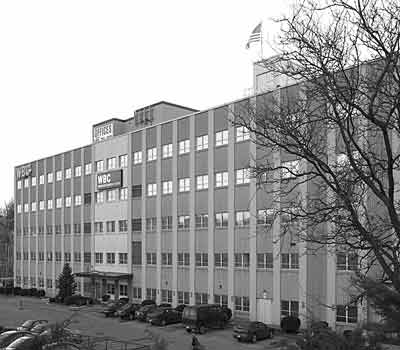
Long's Worcester plant (67 Millbrook St. )
remains standing in North Worcester just West of where Interstate 190
merges with Interstate 290. Popularly known as the old Thom McAn
building, the five story, 270,000 square ft. concrete and steel
structure was purchased for $3.3 million by Worcester Millbrook LLC in
1999 and renamed the Worcester Business Center.
"We're proud to own this Worcester landmark
property," said John Boynton, Worcester Millbrook's managing partner at
the time of the sale. "It has played an important role in Worcester's
business history from its early days as a manufacturing facility for
the Bay State automobile, and through thirty years as the headquarters
of Thom McAn Shoes. We hope to return it to prominence once again as
the Worcester Business Center."
In 2007 the building was sold for $10.4 million
to a Boston-based investment group, Worcester Business Center LLC.
© 2004 Mark Theobald - coachbuilt.com
|