|
J. Paul Bateman (b.1869) and his younger brother
John M. (b. 1875) established their own carriage building operation in
Cumberland County New Jersey, just before the turn of the century.
The Batemans were the sons of Joseph & Harriet Bateman, two resident of
Vineland, New Jersey. Most of the Batemans of Cumberland County, New Jersey,
were direct descendants of William Bateman who emigrated to Boston from his
native England in 1630. His offspring moved to Salem County, New Jersey in
1697, and by the Nineteenth century were well distributed throughout the
southwestern part of the state.
The Bateman boys came to national attention when the September 1899 issue
of The Motor Vehicle Review announced that:
"Bouton & Bateman, Vineland, New Jersey, are establishing a motor vehicle
manufactory."
Evidence of manufacture is lacking, and it’s likely the venture was
stillborn before a prototype was built. However, the Batemans continued to
produce small numbers of carriages in their Vineland, New Jersey manufactory
into the early teens.
Sometime around 1915 J. Paul Bateman parted company with his brother and
relocated to Bridgeton, New Jersey, a larger town located 12 miles west of
Vineland. He established his own funeral coach manufactory on Jefferson St.,
Bridgeton. Bateman elected to specialize in motor hearse bodies and by mid
1915 was offering his budget-priced coaches to funeral directors throughout
southern New Jersey as well as
Bateman followed Meteor's successful formula by direct-marketing low-cost
funeral vehicles to prospective customers by advertising in the pages of the
funeral trades. For 1916 the firm advertised that a Bateman-built
eight-pillared Studebaker coach could be had for as little as $1,650
complete, the cost of the coachwork only $800.
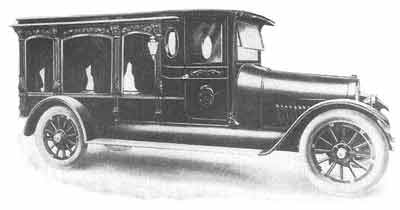
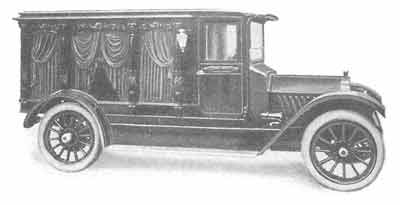
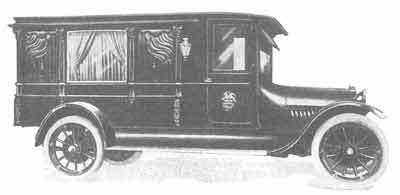
Although the budget-priced Studebaker was their best seller, Bateman also
mounted bodies on a number of mid-priced chassis which included Buick,
Cadillac, Cole, Crow, and Reo. Bateman’s eight-pillared coaches could be
ordered with large exterior windows, elaborately carved external panels as
well as a small vertical oval window behind the front doors – all extra cost
items not included in the $800 base price.
On May 2, 1916, J. Paul Bateman sold his interest in the firm bearing his
name to the J. Paul Bateman Co., a corporation formed for the purpose of
taking over and expanding his successful funeral car business. As its
president, Bateman held a substantial portion of the new firm’s stock and
remained on the payroll as its manager and chief salesman. According to the
1918 Industrial Directory of New Jersey, the J. Paul Bateman Co. was
capitalized at $12,000, and employed 50 hands.
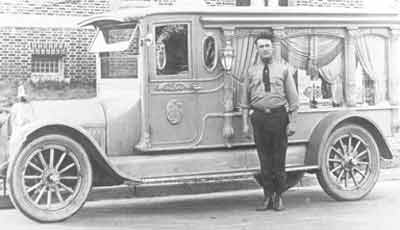
In 1917 Edenton, North Carolina Undertaker Louis F. Zeigler contracted
for a Studebaker 1/2 ton chassis and a J. Paul Bateman hearse body from
local car dealer J. H. Mc Mullen, Jr., for the sum of $1,895. Pictured to
the left, alongside his brand new Studebaker Hearse, was his son Haywood
Sawyer Ziegler (1896-1969), who at age 21 was working for his father. In
later years a grandson, Haywood Sawyer Ziegler, Jr. (1923-1975), ran the
business until it closed in the 1970's.
By early 1919 Bateman and his firm’s board of directors no longer saw eye
to eye and he resigned from the firm bearing his name. On June 5, 1919, J.
Paul Bateman and his younger brother John M. Bateman formed a competing
business, the Bridgeton Hearse & Ambulance Co.
However, the brother’s continued to advertise that the vehicles produced
by Bridgeton Hearse & Ambulance were:
“Built by J. Paul Bateman, Manager of Bridgeton Hearse & Ambulance
Company, Bridgeton, N. J.”
The September 1, 1919 issue of the Casket included a Bridgeton
advertisement in which, in boldfaced type, the words,
“Original Bateman Hearse,” appear, and the further words, “J. Paul
Bateman, Manager,” were also used in connection with the advertisement. The
advertisement further stated:
“The past year I have called on hundreds of undertakers. Many have wanted
to trade in their auto hearses. They would say 'I bought one a year ago, but
my trade demands a better one-' You avoid mistakes when you buy the
original Bateman hearse. They are built by the Bridgeton Hearse & Ambulance
Company, J. Paul Bateman, Manager.”
Understandably, the directors of the competing J. Paul Bateman Co. were
not happy with the advertisements and sued Bridgeton Hearse & Ambulance
hoping to stop the misleading ads. While the suit was awaiting trial,
Bateman’s former partners reorganized the firm as the Auto Hearse
Manufacturing Company.
At the trial, which took place in January, 1920, the defendant, J. Paul
Bateman, and his firm, the Bridgeton Hearse & Ambulance Co., were found to
be engaging in unfair competition, and the judge’s proclamation follows:
“I will accordingly at this time, pending final hearing, enjoin
defendants specifically from advertising in the manner they advertised in
the ‘Casket’ of September 1, 1919, and enjoin them generally from in any way
making representations by advertisements or otherwise of a nature calculated
to lead others to believe that the product they are supplying is the product
of complainant company.”
The Auto Hearse Manufacturing Co. did not survive much longer succumbing
to the post-war depression, however under the direction of J. Paul Bateman,
the Bridgeton Hearse & Ambulance Co. prospered and continued to offer
low-priced funeral coaches and ambulances to budget-minded funeral
directors.
The firm’s 1924 catalog featured a number of carved-panel funeral coaches
mounted on Dodge Bros. chassis. A choice of two different carved-panel
coaches were offered to Bridgeton customers. The first was subtly-pillared
combination coach that featured restrained carved-panels and a large center
window with ray-patterned draperies, while the other was a traditional
8-columned unit with traditionally carved drapes and a small center window.
The Bateman Body Co. of Vineland, New Jersey, is believed to be a related
firm, but details are lacking.
What follows is the transcription of the January 12, 1920 hearing held in
the New Jersey Court of Chancery in regards to the lawsuit filed by the Auto
Hearse Company against the Batemans:
“Auto Hearse Mfg. Co. v. Bateman, Et Al. (109 Atlantic Rep. 735)
Court of Chancery of New Jersey, January 12, 1920
“1. Unfair Competition — Evidence — Affidavits — Questions For The Court.
Where, in a suit based upon a charge of unfair competition, defendants in
their answering affidavits deny having intentionally injured the complainant
or deceived the public, upon motion for an injunction pendente lite such
averments may be accepted as evidence of intention; but it is for the court
to determine whether defendants' acts were actually calculated to deceive.
“2. Unfair Competition—Effect Of Sale Of Good-will.
The sale by a person of his business conducted under his own name,
including its good-will, did not, in the absence of express agreement,
prevent him from conducting a competing business; it merely denied him the
right specifically to solicit the trade of the customers of the business he
sold.
“3. Unfair Competition—Personal Name—Effect or Sale Of Business
Conducted Under One's Own Name.
The sale by a person of a business conducted under his own name did not
prevent him from using that name in a competing business, so long as the
name was not employed in a manner calculated to deceive the public.
“4. Unfair Competition—Sale Of Business—Use Of Trade-name In Competing Business.
One who has sold his business to another should not, upon engaging in a
competing business, employ a trade-name in such a manner as to lead the
public to believe that the product of the competing business is that of the
former business.
“5. Unfair Competition—Application For Preliminary Injunction— Resolution Of Court.
Upon an application for a preliminary injunction in a case of unfair
competition doubts as to the effect of the defendant's course of action must
be resolved in favor of the defendant.
“Suit in equity. Hearing upon order to show cause why an injunction pendente
lite should not be granted. Injunction granted.
“Albert R. McAllister, of Bridgeton, for complainant; Francis A. Stanger,
Jr., of Bridgeton, for defendants.
“Leaning, V. C.: Complainant seeks an injunction restraining defendants
from engaging in unfair competition. At the return of an order to show
cause, answering affidavits were filed and read in behalf of defendants; by
those affidavits some of the averments of the bill were controverted, others
were not.
“The verified averments of the bill which have not been controverted
disclose that prior to May 2, 1916, J. Paul Bateman was sole owner of a
business conducted in Bridgeton in his own name, which business included the
construction of hearses and other bodies for motor and horse-driven
vehicles. On that date he conveyed his business and its good-will to
complainant corporation, which had then been formed to take over and
continue the business. The name of the corporation so purchasing the
business was J. Paul Bateman Company; its name has recently been changed to
Auto Hearse Manufacturing Company.
“Prior to the transfer of the business to complainant corporation, J.
Paul Bateman advertised in the trade journal pertaining to funeral directors
and undertakers over his own name that he was the builder of "Bateman motor
hearse body"; immediately and continuously after the transfer, complainant,
under the name of J. Paul Bateman Company, and while J. Paul Bateman was its
president, inserted in the trade journals advertisements in which "Bateman
bodies" were featured, and during the same time the order blanks used by
complainant stated, among other things, that the order was for
a "Bateman motor hearse body," and during the period in which J. Paul
Bateman was mechanical superintendent of complainant, and while he was
traveling through the eastern part of the United States soliciting orders
for complainant, orders secured by him for complainant were on the order
blank above referred to.
“June 5, 1919, J. Paul Bateman severed his connection with complainant,
except as a stockholder, and formed a partnership with his brother in a
competing business under the name of "Bridgeton Hearse & Ambulance Company."
Order sheets used by defendants state, among other things, "J. Paul
Bateman, Manager Bridgeton Hearse & Ambulance Company, Jefferson Street,
Bridgeton, N. J.," and further read: "J. Paul Bateman, Bridgeton, N. J.—Dear
Sir: Please enter my order for (blank) Bateman motor car (blank) body."
“Defendants have circulated a letter announcement, at the head of which
letter the words "J. Paul Bateman, Manager," appear followed by the words
"Bridgeton Hearse & Ambulance Company," and the type used for the name J.
Paul Bateman is larger and features that name. Photographs have been printed
and circulated by defendant company showing a motor hearse body, and the
words, "Built by J. Paul Bateman, Manager of Bridgeton Hearse & Ambulance
Company, Bridgeton, N. J.," appear directly beneath the cut. In the issue of
the "Casket" of September 1, 1919, there appears an advertisement of
defendant company in which, in boldfaced type, the words,
"Original Bateman Hearse," appear, and the further words, "J. Paul
Bateman, Manager," are used in connection with the advertisement; that
advertisement also states in part as follows:
“‘The past year I have called on hundreds of undertakers. Many have
wanted to trade in their auto hearses. They would say 'I bought one a year
ago, but my trade demands a better one-' You avoid mistakes when you buy the
original Bateman hearse. They are built by the Bridgeton Hearse & Ambulance
Company, J. Paul Bateman, Manager.’
“It is also undisputed that confusion of the trade has resulted, but the
defensive affidavits indicate that such confusion has been less than is
claimed by complainant.
“The answering affidavits make no specific denial of the matters above
set forth; but the affidavit of J. Paul Bateman states that all business of
defendant company has been transacted under its name of Bridgeton Hearse &
Ambulance Company with his name appearing only as manager, and that there
has never been any attempt on his part or on the part of defendant company
by advertisements or otherwise to lead any person to think that defendant
company is connected in any way with complainant company, or that it is
handling or selling any product manufactured by complainant company, and
that in fact all advertising done by defendant company has been to the
direct opposite; and that neither he nor defendant company has intentionally
or fraudulently done anything to injure complainant company or deceive the
public. The affidavit of John Bateman, the partner, also states that neither
he nor his company has intentionally or fraudulently done any act or thing
to injure or deceive the public regarding business transacted.
“These averments of the two partners comprising defendant company, in so
far as they relate to the specific verified averments of the bill describing
the stationery and advertisements of their company, can only be properly
understood as admitting the accuracy of the averments of the bill describing
such stationery and advertisements, but denying that their effect on the
trade and the business of complainant is that claimed by complainant. Their
averments that they have not intentionally or fraudulently done any act or
thing to injure complainant or to deceive the public may be properly
accepted on this preliminary hearing as facts so far as intentions are
concerned; but it is obviously for the court to determine whether what has
admittedly been done by defendants has been calculated to deceive the public
by leading the trade to believe that products theretofore on the market and
known to the trade under a trade-name owned by complainant were the products
which defendant was selling, and thereby injure complainant.
“The sale by J. Paul Bateman of his business conducted under that name,
including its good-will, did not deny him the right to conduct a competing
business in the absence of an express agreement on his part not to do so; it
merely denied to him the right to specifically solicit the trade of the
customers of the business he sold. Nor did such sale deny to J. Paul
Bateman the right to use his own name in a competing business, so long as
his name was not used in a manner calculated to deceive the public and in
that manner gather the fruits of the business he had sold. Hilton v.
Hilton, 89 N. J. Eq. 182, 104 Atl. 375, L. R. A. 1918F, 1174 [8 T. M. Rep.
259]. But the sale of the business and good-will necessarily included as
assets sold any established trade-names of the business, and such
trade-names often comprise some of the most valuable assets of modern
business.
“The undisputed proofs disclose that, at the time the business was sold
by J. Paul Bateman to complainant company, he had advertised that he was the
builder of "Bateman motor hearse body," and that complainant company, under
his management, continued to advertise "Bateman bodies" and used order
blanks which stated that the order was for a "Bateman motor hearse body." It
accordingly seems impossible to escape the conclusion that it is unfair and
unlawful competition for defendants to now advertise as their product
"original Bateman hearses." Especially is that so when the hearse so
advertised is specifically and conspicuously associated with the name "J.
Paul Bateman, Manager." It will also be noted that in the "Casket"
advertisement of September 1, 1919, the "original Bateman hearse" is
referred to in a manner to clearly indicate that it is the hearse which for
the preceding year J. Paul Bateman had been selling, whereas prior to June
1, 1919, he had been selling that hearse for complainant. Indeed, it seems
almost impossible to escape the conviction that the conspicuous use of the
name "J. Paul Bateman, Manager," as described in the bill, is not only
calculated to deceive the patrons of complainant, but is in fact intended to
lead such patrons to believe that a product heretofore supplied by
complainant is the very product defendants are now supplying.
“The right of J. Paul Bateman to use his own name in business cannot be
doubted, but his right to use it in a manner and for the purposes last
suggested may well be doubted. It is also difficult to conceive any reason
for order blanks of defendant company to read, "J. Paul Bateman, Bridgeton,
N. J.—Dear Sir," and refer to a "Bateman motor car," other than a purpose to
induce the trade to believe that the product theretofore known under the
tradename of "Bateman motor hearse body" was the product defendants were
selling.
But in an application for a preliminary injunction doubts of the nature
suggested must always be resolved in favor of defendants. But I see no
reason to doubt that in advertising the "original Bateman hearse" defendants
are engaging in unfair competition and leading the public to believe that
their product is that which has been heretofore manufactured by complainant
and known under the trade-name already referred to as owned by complainant,
especially when the advertisement refers to that product in a way to
indicate that it is the product that J. Paul Bateman was selling a year
prior to that time.
“I will accordingly at this time, pending final hearing, enjoin
defendants specifically from advertising in the manner they advertised in
the "Casket" of September 1, 1919, and enjoin them generally from in any way
making representations by advertisements or otherwise of a nature calculated
to lead others to believe that the product they are supplying is the product
of complainant company.”
© 2004 Mark Theobald - Coachbuilt.com with special thanks to Thomas A.
McPherson
|