|
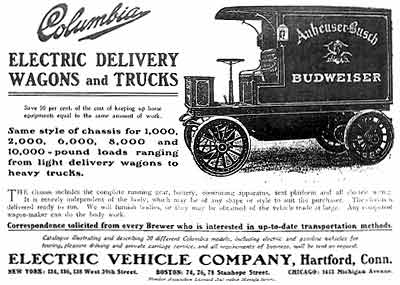
In 1903 the Anheuser-Busch Brewing Association of
St. Louis, Missouri ordered two massive electric truck chassis from the
General Vehicle Company of Long Island City, New York. Twenty four feet
long and ten feet wide, they had a capacity of 30,000 pounds worth of
brew, and proved to be too big. Subsequent experiments with
significantly smaller 1 to 3½-ton electrics proved more successful and
within 5 years, the St Louis brewer owned a fleet of 45-50 beer trucks
as evidenced by the following article from the January 1909 issue of
the Commercial Vehicle:
“The example of the Anheuser-Busch Brewing
Association stands as one of the most favorable arguments for the
machines to the advertising account in order to make the books balance.
For a time Adolphus Busch was in a quandary. He might have abandoned
the use of the cars entirely had he not at someone's suggestion
employed the best electric expert that he could find to take charge of
his immense garage. After this step was taken conditions immediately
began to improve, until now there is no doubt that the use of
power-driven vehicles is something more than economy to this particular
concern.
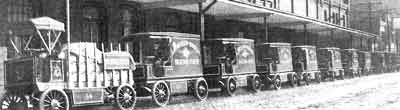
“Forty-five to fifty machines are in daily
service. Approximately there are twenty-five 1-ton General Vehicle
trucks, five 3-ton vans of the same make, six 2 ½-ton machines of
Anheuser-Busch make, seventeen 1½-ton Pope-Waverly machines, made from
a special design by George Marian so as to be 20 per cent heavier than
the stock vehicle, two Knox gasoline wagons of 1½-ton and 3½-ton
capacity, one 3½-ton American motor truck, and one 1½-ton gasoline
vehicle designed by Marian.”
1919 marked a number of changes for the St, Louis
Brewer, the company was renamed Anheuser-Busch, and the post-war
Depression and pending commencement of Prohibition resulted in the
firm’s first loss. According to Anheuser-Busch historian, Ronald Jan
Plavchan:
“Anheuser-Busch, which had never before failed
to make a profit on its operations in any year for which records exist,
showed substantial losses in 1919 ($2,478,985), 1920 ($1,572,255), 1921
($1,329,072) and 1922 ($218,270).”
Anheuser-Busch was the nation’s largest brewery,
and before the start of Prohibition the firm’s 3,000 employees produced
over 1 million barrels of beer per year. Starting in 1919 the firm
instituted massive layoffs, and introduced a number of new products
such as ice cream, yeast and grape soda.
One outgrowth of Anheuser-Busch’s new ice cream
business was the manufacture of products that could both store and
transport the extremely temperature-sensitive product. The firm’s
Vehicle Department quickly set about designing and building a whole
series of ice cream cabinets and delivery truck bodies, which were all
built using the same hardware and technology. A slightly less insulated
version of the ice cream bodies was developed that proved popular with
dairymen.
A third totally un-insulated line of truck bodies
known as the 'Adolphus' was also developed using the same body shells
that were marketed to dry goods vendors and transporters. They also
built small numbers of architecturally-inspired horse-boxes as well as
a complete line of city service buses and intercity motor coaches. The
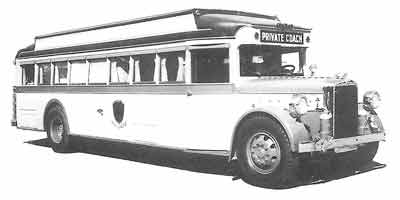
Body Works also built a luxurious private coach on a 1931 Yellow Coach
chassis for Adolphus Busch III. The vehicle still exists and can be
seen at the St. Louis Museum of Transportation.
Anheuser-Busch’s A.B.C. (Automatic Brine
Circulation) refrigerated truck bodies were popular in the Midwest and
the firm produced two separate catalogs, one for their standard
refrigerated bodies that were marketed to dairymen, green grocers and
butchers and a second catalog which featured heavily insulated bodies
specifically designed for ice cream distributors. Clarence Birdseye’s
frozen food technology had yet to be perfected and a need to transport
non-dairy frozen foods didn’t develop until after the start of the
Depression.
Originally developed for use in refrigerated rail
cars, the A.B.C. system was also adaptable to delivery truck as show in
the October 1920 issue of the Journal of the American Society of
Heating and Ventilating Engineers:
"The construction of the automatic brine
circulation system is such that it is not limited to refrigerator-cars,
but may be applied to any moving vehicle such as trucks, boats, etc.
Already the system has been installed by a Chicago ice-cream
manufacturing concern in a number of their large electric
delivery-trucks. In these trucks there is but one tank with pipes,
through which the brine circulates and then returns to the tank. The
swaying and jolting of the trucks have the same effect of circulating
the brine as in the case of railroad cars.”
By the late twenties solid carbon dioxide (dry
ice) and electrical refrigeration units had replaced the messy A.B.C.
refrigeration systems used on Anheuser-Busch’s insulated shipping,
storage and delivery bodies.
Following the 1933 repeal of the Volstead Act,
the firm’s Vehicle Department abandoned their body building activities
for outside customers and concentrated on the manufacture of beer
transport and delivery bodies for in-house use.
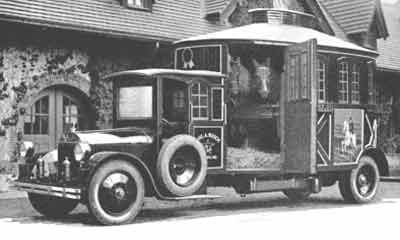
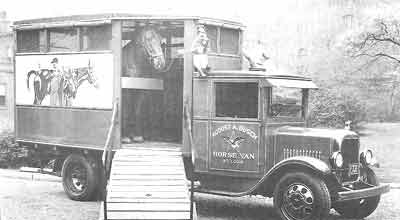
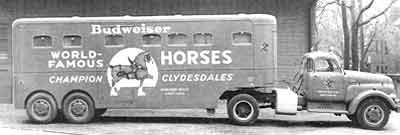
They also were put in charge of manufacturing the
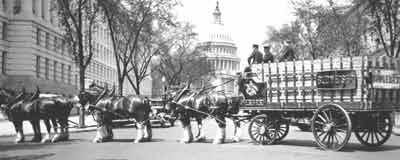
oversized beer wagons towed by the world-famous Clydesdale horses,
which had been recently purchased by Adolphus Busch III to celebrate
the firm’s resumption of beer manufacturing. The body works also built
the giant horse boxes that were needed to transport the massive
Clydesdales from appearance to appearance.
Although the main emphasis of Anheuser-Busch's
Vehicle Department was the manufacture of commercial bodies, they
produced a number of interesting specialty products for other markets.
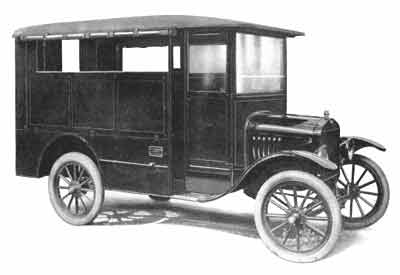
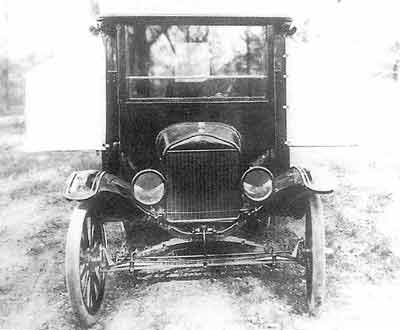
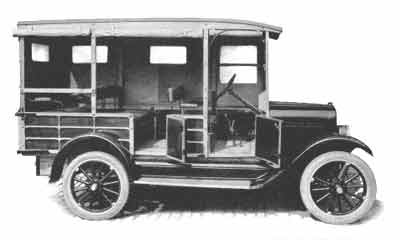
The most successful of these was the Lampsteed Kampkar, a recreational
vehicle body designed for the Model T that debuted sometime around 1920.
The Kampkar was designed by Samuel B. Lambert
(b.1894-d.1930), the son of Arthur W. Lambert, the treasurer of the
Lambert Pharmacal Co., the St. Louis-based manufacturer of Listerine.
The Kampkar bodies were sold in a completely
knocked-down (CKD) kit that was easily shipped across the country via
rail and was distributed through authorized Ford dealers. Painted a
distinctive forest green direct from the factory, both sides of the
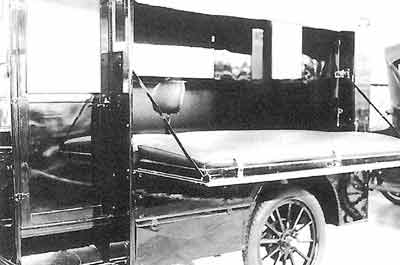
rear compartment folded down, Pullman style, creating two 42” wide
double beds.
When placed upright, the center portion of the
bed formed a pair of bench seats that ran parallel to the sides of the
body. The driver and front cab passenger sat on the forward portions of
the two benches, their backs supported by movable back rests.
A circa 1921 Kampkar brochure:
”Make this the kind of a vacation you've always
dreamed about - enjoy the splendor of Yellowstone, the majesty of the
Grand Canyon, visit balmy Palm Beach or the great North Woods. Go
anywhere you wish - on your own schedule, over your own railroad system
in your own private car, stopping at your own hotel, eating your own
cooking at your own table - all in great comfort and at a price you can
easily afford.
“The Lampsteed Kampkar Body, complete with full
equipment and ready to mount on a standard model "T" Ford Chassis costs
only $535.00 including war tax.”
A Kampkar ad in the July 1923 issue of Field and
Stream stated:
“Deep, restful sleep is made certain by two wide,
comfortable beds four feet from the ground - high, dry and safe.”
Samuel B. Lambert held a number of
transportation-related patents and when production of the Kampkar ended
in the late Twenties he founded his own aviation firm, the Lambert
Aircraft Engine Corp. Lambert was piloting one of his aircraft en route
to the Detroit All-American Aircraft Show in April, 1930 when his
propeller snapped and he plunged to his death.
Considering their low production numbers, a
surprising number of Kampkars still exist in museums and private and
collections. The Zagelmeyer Auto Camp Company of Bay City,
Michigan offered a similarly-named Model T camper body called the
Kamper-Kar.
The main advantage of the Zagelmeyer Kamper-Kar
over the Lampsteed was that it featured an automatic pop-up top that
allowed its owners to stand inside the vehicle once the side berths
were lowered. Zagelmeyer’s $1000+ Kamper-Kar body was significantly
more expensive than the Lampsteed Kampkar and as it was produced in far
fewer numbers that may explain why there’s only one known survivor.
Zagelmeyer also produced camping trailers and turn-key camper
conversions on Reo and Chevrolet chassis.
Another product of the Anheuser-Busch Vehicle
Department’s Body Shop that was marketed to consumers was the Rancher,
a wood station wagon that was designed to compete with similar
offerings from Babcock, Cantrell and others. As was the Kampkar, the
Rancher was nationally distributed in completely knocked down (CKD)
form and could easily be adapted to Chevrolet, Dodge, Ford and White
chassis.
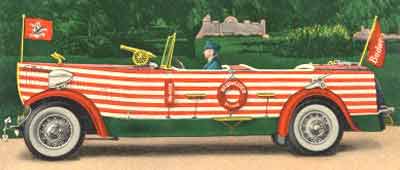
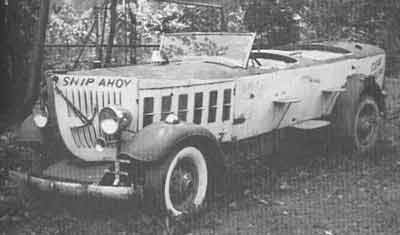
The Anheuser-Busch Vehicle Department also
created the coachwork for the firm’s nautically-inspired advertising
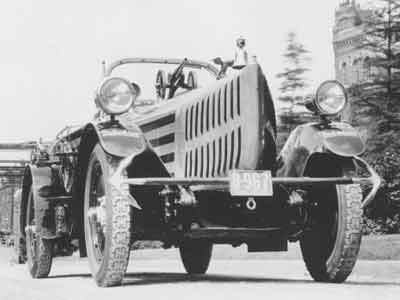
vehicles. The inspiration for the Bevo Boats, as they were popularly
called, did not originate within Anheuser-Busch and came from legendary
Manhattan automobile dealer Conover T. Silver.
Silver was the Manhattan distributor for
Willys-Overland, Peerless, and went on to create the legendary
Silver-Apperson and Kissel Silver-Special Speedsters. Headquartered in
the upper floors of the 9-story Peerless Building was Silver’s custom
body operation and just before the start of the First World War he
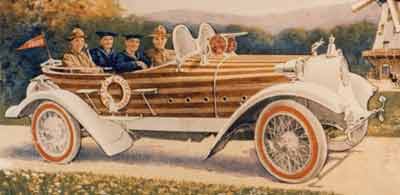
created a nautically-inspired vehicle on an Overland chassis which was
featured in the October 17, 1915 issue of the New York Times:
“Novel Automobile On the Lines of a River
Launch.
“One of the most unusual bodies to make its
appearance on “Automobile Row” is show above. It is a boat body on an
Overland chassis, now on view in C.T. Silver's salesrooms. The body is
built of alternate two-inch strips of mahogany and white holly, and the
deck is in birds-eye maple. Mounted on the circular radiator is a
ship’s bell, while a nickel propeller serves to keep the spare wheel in
place. The front bumpers represent anchors and those at the rear, oars.
The upholstery is pigskin.”
The December 1915 issue of The Rudder also
featured the vehicle:
“A Land Runabout of Nautical Design
“Cruising down Broadway recently, the lookout
man megaphoned that there was a peculiar-looking craft at anchor on the
port bow, so we instanter put over the helm and drew alongside. She
proved to be the Silver Bird, a neat little runabout of about 12 feet
length, specially built for the С. Т. Silver Motor Company, on an
Overland six-cylinder chassis. Seeing that her appearance, while not
strictly shipshape, was of elegance and along nautical lines, we
decided to give her a berth in the December Rudder.
“Her hull is planked, not painted, in alternate
layers of white holly and mahogany, while she is decked forward for
three parts of her length with the same wood, this also forming a
housing for the engine, which is installed right forward. The cockpit
and after deck is railed off. The spare wheel aft is held in position
by a real bronze, 14-inch diameter propeller, and she carries an anchor
on either bow. On the forward deck is a searchlight and electric signal
bell.
“Putting all joking to one side, it occurred to
us that an automobile along these lines would interest yachtsmen,
particularly power owners. With the detachable wheels removed, she
would not altogether look out of place in davits, in cases where the
owner of a long-distance cruiser desired to tour the district when
putting in to strange ports and thus combine automobiling with the
pleasure of yachting. So, in future, we can expect one sport to help
the other in this manner, instead of throttling each other.”
The vehicle was featured in the 1916 film
"Gloria’s Romance" which starred Billie Burke after which it was
acquired
by Anheuser-Busch’s Advertising Department, which used it to launch
their new Bevo malt beverage. Re-christened the Bevo Victory Boat, at
the start of the War the Oakland-chassised advertising vehicle was sent
around the country to help sell War Bonds.
Bevo was a near-beer concocted from barley malt,
rice, hops, yeast, and water which took its name from the Bohemian pivo
(beer) and contained less than one-half percent alcohol. It was
developed in anticipation of a 1916 ban on the consumption of alcoholic
beverages by the US Armed Forces. Bevo was by far the most popular of
the many near beers of the time and at its peak of popularity sold more
than five million cases annually.
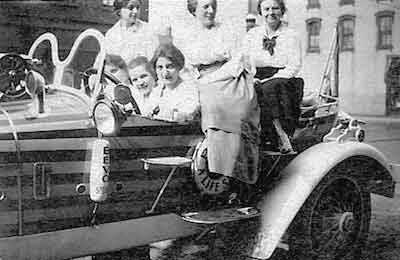
The Bevo Victory Boat joined another Bevo related
mascot, “Renard the Fox” (based on the protagonist of a medieval French
folk-tale) who was created to help advertise the new beverage.
Sometime during 1917 Anheuser-Busch’s Vehicle
Department face-lifted the C.T. Silver built Oakland chassised vehicle.
Pictures of both vehicles survive and although in later years Anheuser
Busch claims to have built the vehicle, it's clear their only
contribution was to put a false bow over the front end of Silver's
creation.
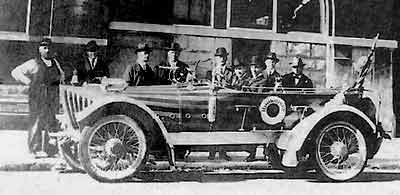
A second, all-new version of the Bevo Boat were
constructed in Anheuser-Busch’s St. Louis body shops sometime between
1920 and 1923. Although the new vehicle was inspired by C.T. Silver's
circa 1915 creation it featured all new coachwork, Disteel wheels and
was reportedly built on a Pierce-Arrow chassis. The second vehicle
featured the same alternating color wooden-planked hull design of the
Silver Bird and was finished in a clear varnish.
Eagle-eyed Dorris owners suggest the vehicle’s
chassis was not built in Buffalo, and was actually constructed in St
Louis by the Dorris Motors Corporation. Although surviving pictures
reveal a set of small Dorris hubcaps on the vehicle, it doesn't prove
that the chassis was built by the same manufacturer. It's more likely
that the caps were added by Anheuser-Busch's mechanics to hide the real
identity of the chassis.
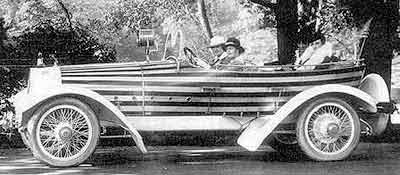
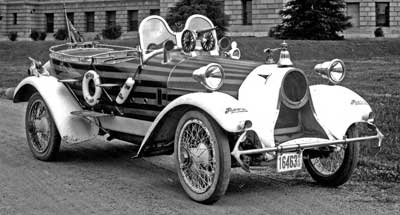
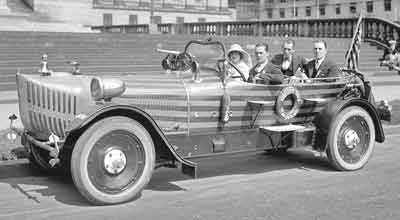
Internally referred to as Anheuser-Busch Land
Cruisers, the Bevo Boats advertised other Anheuser-Busch products as
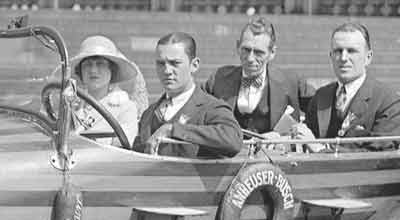
evidenced in the picture to the left that was taken in 1924 in front of
the US Treasury Building in Washington, D.C. The unhappy driver in the
close-up is Adolphus Busch III, the son of the then-current president
of Anheuser-Busch, August Anheuser Busch, Sr., and grandson and
namesake of the firm’s founder, Adolphus Busch I.
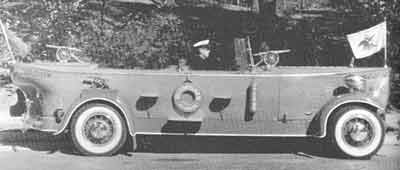
A totally re-designed third series Land Cruiser
(later renamed as the Budweiser II) appeared in 1929-1930 on a
Pierce-Arrow chassis that utilized a flat rear end, similar to those
found on the era’s inboard speedboats built by Gar Wood and others.
Once again the vehicle's body/hull was constructed of alternating
wooden planks and although it was originally coated in a clear varnish,
it was repainted in horizontal red and white stripes following the
repeal of the Volstead Act.
A fourth series Pierce-Arrow-chassised Land
Cruiser (known as the Budweiser III) appeared sometime around 1933-34
and featured the front end of the 1929-1930 Land Cruiser with a new
sculpted rear end treatment resembling that found on a similarly-sized
sailboat of the era.
All remaining Land Cruisers / Bevo Boats were
rechristened as Budweiser I’s, II’s and III’s when Prohibition ended in
1933. One of the circa 1933-34 vehicles was supposedly displayed at a
mid-thirties Indianapolis 500.
Historians believe total production of all
boat-shaped Anheuser-Busch advertising vehicles is thought to be eight,
although confirmation is lacking. Pictures exist of four distinct
vehicles and although it’s possible there were more, its interesting to
note that no two Land Cruisers / Bevo Boats are ever pictured together.
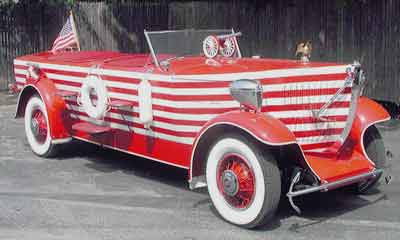
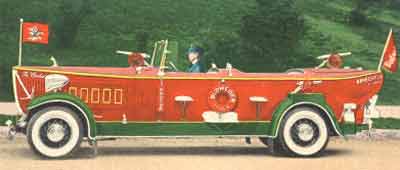
Of the four variations there is only one extant,
a circa 1929-1930 Budweiser II. Unfortunately sometime during its
lifetime its original Pierce-Arrow chassis was discarded and replaced
with one from a 1930 V-12 Cadillac Sport Phaeton.
The recently-restored survivor is finished in red
with white stripes and includes a host of unusual features such as a
red leather interior, Woodlite head and cowl lights, bi-lateral anchors
and life preservers, anchor-tipped front bumpers, an ornamental
propeller, Wig-Wag taillights, and three onboard Winchester cannons.
What
follows is the text from a circa 1923
Anheuser-Busch Vehicle Department catalog advertising the division’s
various products and body-building activities. The brochure included
renderings of the first C.T. Silver-built Bevo Boat, photographs of the
Lamsteed Kampkar and Rancher station wagon as well as images of the
firm’s full line of commercial truck bodies:
“Anheuser-Busch Bodies
“The Development of Thirty-Five Year’s
Experience
“Behind the Busch-built Motor Truck Body you
buy is the experience gained from more than thirty-five years devoted
to the manufacture of rolling stock and delivery equipment for or own
agencies and branch offices.
“Each job is constructed in large, modernly
equipped shops under the personal supervision of the most capable shop
management that can be employed. Dependable service and long life are
assured by skilled workmen and sound construction. The lumber used is
air-dried for greatest tensile strength. Forged and hand-wrought
bracings support points of strain. Under-frame sills and bars are
arranged to fit any type of chassis.
“Building this way takes time. It adds to the
cost of manufacture. But in no other way is it possible to get extra
years of useful service and the low upkeep and operating costs for
which Busch-built bodies are famous from Broadway to the Golden Gate.
“Spread throughout the following pages you will
see Busch-built bus bodies that carry children across long stretches of
open country to the school-house miles away - Rancher bodies that bring
the comforts and conveniences of the city to suburban and country homes
– Kampkar bodies for vacationists, hunters and fisherman – refrigerator
truck bodies for ice cream, meat, milk and kindred delivery service –
armored truck bodies which protect cashiers and bank messengers from
the depredations of pay-roll bandits.
“Anheuser-Busch facilities are also available
for automobile painting, enameling, varnishing, upholstering, complete
wagon building and repairs, truck body repairs and truck wheel renewing.
“Your request for any special information you
may desire will receive prompt and courteous attention.
“Bevo Ponies
“These six ponies were selected from among
hundreds as the most perfect specimens of their type that could be
found anywhere. For the greater part of three years they toured the
country, appearing at various state fairs ad horse shows. The carriage
to which they are hitched was built by Anheuser-Busch.
“Prairie Schooner
“Designed and built in the Anheuser-Busch
shops, this picturesque prairie schooner has been exhibited at state
fairs throughout the country, and has aroused much interest wherever
shown.
“Bevo Victory Boat
“During the World War the Bevo Victory Boat
pictured here was placed at the disposal of the United State government
by Anheuser-Busch. For nearly two years it toured practically every
exaction of the country, being used by the Army and Navy for recruiting
purposes. The unique body, designed and built by Anheuser-Busch, shows
how we can adapt our facilities to the production for special types to
meet any requirement.
“The Largest Ox In The World
“This is Tom, owned by Anheuser-Busch and said
to be the largest ox in the world. He is 6 feet 6 inches in height, 9
feet 8 inches from stem to stern and weighs 3,000 pounds. His keeper,
Bill Farris, is also a giant, standing 6 feet 6 inches in height. The
trekking cart is the type used throughout Mexico in primitive days. It
is constructed entirely of wood – even wooden pegs being used in place
of nuts and bolts. Built by Anheuser-Busch for advertising purposes.
“Refrigerator Bodies With One-Piece Seamless
Tank Bottoms to Prevent Tank Leaks from Vibration
“A.B.C. Refrigerator Truck Bodies provide
perfect refrigeration of perishable foods – ice cream, milk, meat and
dairy products of all kinds.
“For the ice-cream manufacturers, they
eliminate brine drip and rust non truck chassis, reduce annoyance and
unnecessary expense. For the meat packer or distributor of similar
perishable products, they provide proper refrigeration during the
transportation interval between refrigerator car or warehouse
refrigerator and the retail dealer’s store.
“A.B.C. Refrigerator Truck Bodies are rigid,
composite units built by skilled workmen in the Anheuser-Busch shops at
St. Louis. Sills and framing are of oak and maple. Pure corkboard
insulation, set between two layers of heavy, water-proof insulating
paper, is used. Inside they are finished with 5/8-inch and 7/8-inch
cypress, thoroughly oiled.
“The refrigerator tank is built of heavy black
iron with a one-piece seamless bottom – an exclusive Anheuser-Busch
featured which prevents tank leaks from vibration. Circulating coils of
heavy iron-pipe – 2½ inches inside diameter – assure rapid circulation
of brine. Tank and pipes are heavily coated with iron primer. Bodies
are built to hold any temperature desired for the commodity to be
transported. Ice cream bodies are built with copper bottom and side
lining in fresh ice compartment.
“A perfectly smooth, unbroken surface,
excellently adapted to sign painting is assured by exterior paneling of
three-ply Haskelite water-proof veneer. There are no moldings, cracks
or tongue-and-groove joints to mare the continuity of the panel, or to
form water pockets and start decay. All joints are thoroughly
impregnated with white lead during construction.
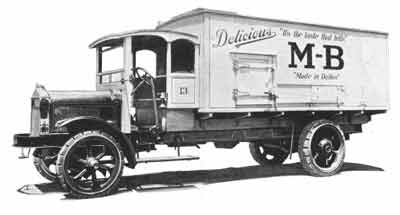
“One of a fleet of seven trucks with A.B.C.
Refrigerator Truck Bodies operated by the M-B Ice Kream Co. of Dallas,
Texas. The body is a 3 ½ ton Ice Cream Delivery Body, mounted on a 3 ½
- ton White chassis, and has a capacity of 350 gallons of ice cream,
4,300 pounds of fresh ice and 1,000 pounds of salt. Over-all height of
this truck, from ground to hatch cover, is ten feet.
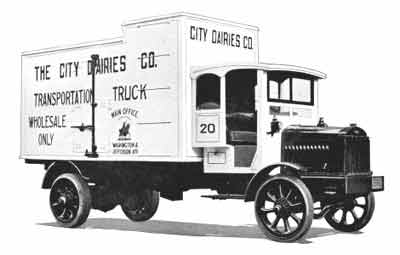
“This A.B.C. Refrigerator Truck Body insures
delivery of capacity loads in prefect condition for the City Dairies
Company, of St. Louis. One hundred and fifty to 300 pounds of ice and
25% salt provide perfect refrigeration for 24 hours, maintaining
temperatures lower than 10 degrees. The motion of the truck in transit
causes an automatic brine circulation.
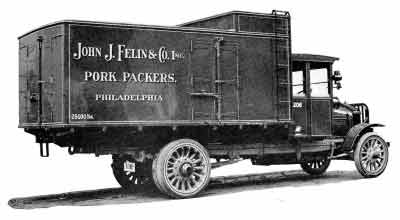
“Perfect refrigeration is as essential to meats
as to ice cream. That’s why John J. Felin & Co. Inc, of
Philadelphia, use this A.B.C. Refrigerator Tuck Body for delivery
purposes. Inside, the body is 13 feet 5 inches long and 6 feet 10 ½
inches wide. Height under the tank is 4 feet – under pipes, 4 feet 1
9/16 inches.
“210 gallons of ice cream, 3,700 pounds of
fresh ice and 600 pounds of salt is an ordinary load for this 2½- ton
A.B.C. Ice Cream Refrigerator Truck Body in service for Burdan Bros. of
Pottstown, Pa., Mounted on a 2 ½-ton chassis, the overall height of the
complete truck is 9 feet 3 inches from ground to top of hatch cover.
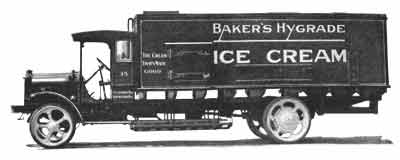
“Freedom from brine drip and tank leaks from
vibration is assured by this A.B.C. Refrigerator Truck Body in service
for the Baker-Evans Ice Cream Company, of Cleveland, who are well and
favorably known throughout the entire Ohio metropolis. Even in warmest
weather, a cold, even temperature can be maintained for 24 hours.
“Busch-built armored truck bodies like this one
provide protection for cashiers, bank messengers, etc., and assure safe
transportation of large sums from one place to another, regardless of
the depredation of pay-roll bandits.
“‘Budweiser Chief:’ Equipped with housetop
rails and irons for tarpaulin protection. Cab fitted with adjustable
glass windshield, side roller curtains and drop windows. Furnished with
or without cab.
“The ‘Adophus’; A general utility truck body,
especially adapted fro hauling light and bulky cargoes. Furnished with
housetop rails and irons for tarpaulin protection and advertising
purposes. Can be furnished with or without the cab.
“The Lamsteed Kampkar* - For Vacationists – For
Campers – For Outdoor Honeymoon Tours
“The Lamsteed Kampkar - a special Busch-built
body for campers, tourists, etc. - weighs less than a Ford sedan, yet
can be quickly converted into a restful, convenient camp – anywhere.
Provides ample seating room for six. Equipped with two wide,
comfortable beds, six rain- and dust-proof lockers, compartments for
water container, refrigerator, folding table, cooking and table
utensils. Two people can mount this body, section by section, on a
standard Model T Ford chassis in about two hours.
“Looks comfortable, doesn’t it? And it is! Four
people can sleep in real comfort on these two beds, securely protected
front, side and rear with water- and vapor-proof canvas. Just one of
the many features which make touring in a Kampkar so enjoyable.
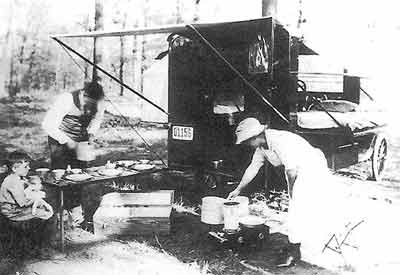
“All set for breakfast! Notice the convenient
arrangements of beds, gasoline cooking outfit, table dishes, ice box,
and sun shade. In five minutes two persons can make up the beds, put
away the dishes and cooking utensils, and drive off across the country
in the Kampkar.
“This is how the beds make up. The side
partition folds down and provides space for the Marshall spring
cushions which form the ‘mattress’. Notice the ample seating room
provided on each side. The whole family can ride in comfort in the
Kampkar without crowding.
“The Rancher - A Compact, Commodious
Busch-built Body for Dodge, Chevrolet and Ford Chassis
“The Rancher Body is available in the straight
utility and compact hunting and fishing types. The first is especially
designed to meet the needs of country clubs, large estates and suburban
and country homes; the latter for hunters and fisherman. Either can be
driven through parks where commercial trucks can’t go.
“In both types eight passengers ride in real
comfort. Removable seats provide plenty of leg-room, and added carrying
capacity if desired.
“Deep, restful spring cushions provide
downright comfort even over rough roads. Snugly fitted duck curtains
with large, extra heavy celluloid lights afford cozy protection and
good vision in bad weather.
“In the compact hunting and fishing types,
disappearing compartments take duffel easily; galvanized containers
carry furred or feathered game or iced fish in cleanliness and safety;
a cork-line partitioned ice chest keeps foods fresh and inviting and
beverages deliciously cold.
“Any Ford, Dodge or Chevrolet dealers will
secure and mount a Rancher Body for you. Get in touch with the one
nearest you.
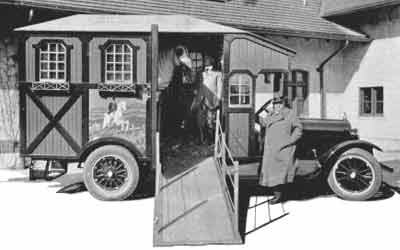
“A.A.B. Horse Transport Bodies - An
Indispensable Unit for Every Stable and Breeding Farm
“Months of careful training and conditioning
are required to bring a thoroughbred to top form for an important race
or show. Hours of patient grooming and constant exercising are
necessary. But all the trainer’s efforts are wasted unless the horse
reaches the show ring or race track without mishaps.
“A high-spirited horse needs protection even on
a short haul to a local race track or horse show, or to a nearby
railroad. A.A.B. Horse Transport Bodies, made in models for either one
of two horses, provide that protection.
“They safeguard the nervous animal from the
heavy traffic encountered on suburban roads and city streets – from the
sudden cutting in of automobiles – from the crowding of curious and
admiring passers-by. They eliminate the causes of sudden jumps and
slips on hard pavements, which lead to splints, spavins, stocky legs
and other serious ailments that render him unfit for showing or racing.
“Every convenience that will add to the horse’s
comfort is provided. A ramp at the rear and the side assures easy
entrance and exit. To enter, the horse is walked up the rear ramp; on
arrival at the coliseum or track, he is walked down the side ramp. Ramp
folds up out of the way inside the body when the transport is in motion.
“Standing between a front and rear bar, each
covered with upholstered padding, and between pneumatic side pads, the
horse is supported and protected against bad rubs and injury.
“There is a place for the groom to site where
he can talk to his horse and quiet him while in transit. Ample space is
provided for water tank, clothing, shelves, lockers and hay rack.
Sufficient elasticity to absorb the jolts and jars of the road is
assured by a floor of corkwood – a practical drainage system provides
perfect sanitation.
“When not engage in transport work, these
special Busch-built bodies can be used for general hauling on the farm,
or as ambulances in an emergency. Thus, their three-fold usefulness
makes them indispensable units for every stable and breeding farm.
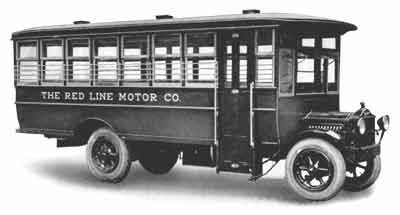
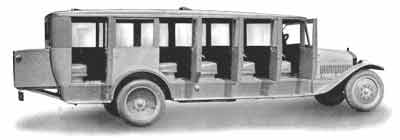
“Busch-built Bus Bodies
“Used for short passenger hauls where train
facilities are inadequate – for carrying children across long stretches
of open country road to the school-house miles away – and to supplement
the facilities of street cars, subways and elevated systems – buses
with Busch-built bodies have added to human comfort, convenience and
profit.
“Complete information and prices will be gladly
furnished on request."
*Andy
Dorris owns the prototype Lamsteed Kampkar which was constructed upon a
Dorris chassis, a vehicle manufacturer founded by his grandfather
George P. Dorris, Sr. The Lamsteed moniker was derived from the two St
Louis businessmen who marketed the vehicle, Mssrs. Lambert and
Steedman. The demonstrator was far too large to mount on a Model T so
Anheuser-Busch utilized a 1919 Dorris chassis for that one vehicle, the
significantly smaller production Kampkars utilized Ford Model T chassis.
© 2004 Mark Theobald - Coachbuilt.com with special thanks to Andy Dorris
|