| |
|
 |
||||||||||
|
||||||||||
| |
||||||||||
|
||||||||||
|
||||||||||
|
|
|||||||||
|
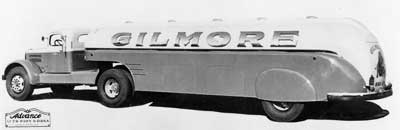
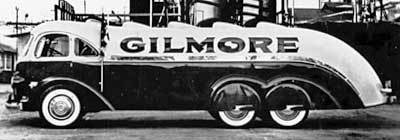
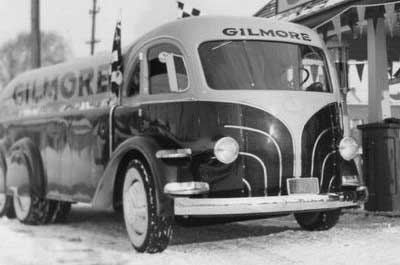
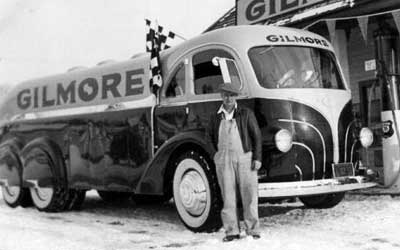
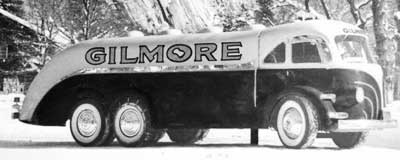
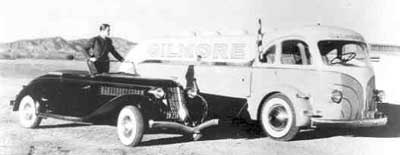
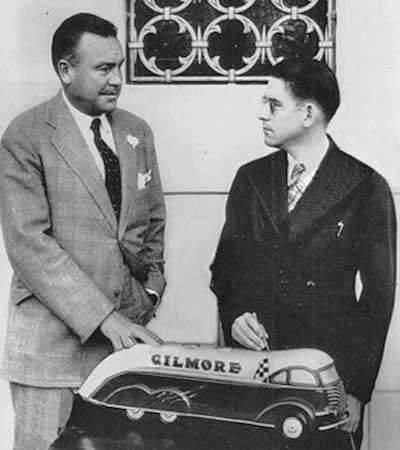
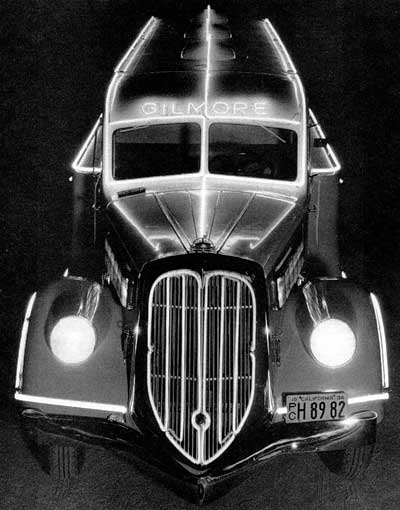
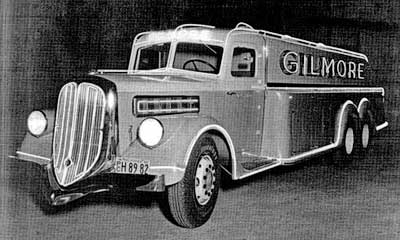
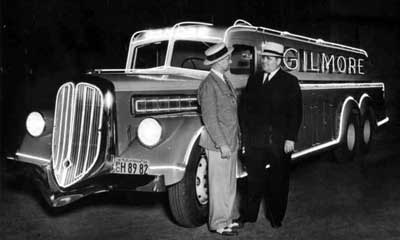
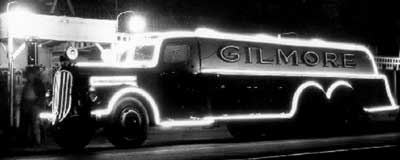
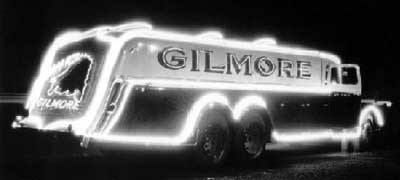
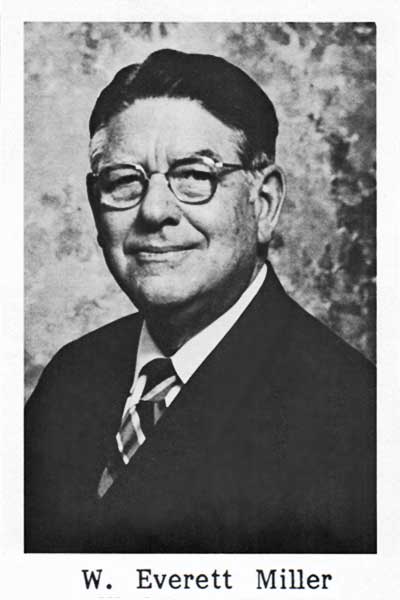
Advance was founded in 1919 by Italian-born Medardo Morgagno (b. March 24, 1891 in Gorli, Italy-d. December 28, 1985 in Ventura, CA) who sailed from Genoa, Italy to New York on board the ‘Duca degli Abruzzi’ steamship, arriving on September 14, 1909. He became a US Citizen on August 22, 1912, his Declaration of Intention (naturalization) papers list his occupation as machinist, his address as 1420 Catalina St., Los Angeles. Morgagno was a skilled woodworker and combined his two talents by producing early commercial bodies for Los Angeles growing commercial and industrial community. The firm's advertisements stated "since 1919" but little is known of Advance Auto Body’s activities prior to March 1926 when Bridgeman’s magazine reported that 230 tons of structural steel was used in the erection of the firm’s new 1-story factory, which was located at the corner of N. Mission Rd. and East Macy St. at 1000 Macy Street, Los Angeles,California. Morgagno (aka ‘Joe’ Morgagni) specialized in tank trucks, but bid on any project that walked in the door. His most popular client was the Gilmore Oil Co., a well-known west coast petroleum products manufacturer and distributor headed by Earl Bell Gilmore (b.1887-d.1964). Originally founded in 1900 by Earl’s father, Arthur F. Gilmore, Earl B. oversaw the expansion of the firm which eventually became the west coast’s largest oil and gasoline distributor with 2 refineries, 50 distribution centers and nearly 3,500 affiliated service stations. Gilmore sponsored land speed and Indianapolis racecars and constructed California’s first purpose-built midget raceway, Gilmore Speedway. Although his oil business (acquired by Socony-Vacuum Oil Co. aka Mobiloil in 1940) is mostly forgotten, the Los Angeles Farmer's Market, constructed by Gilmore in 1934, remains one of LA’s chief tourist attractions. Advance Body's and Gilmores’s most famous creations were designed by Wellington Everett Miller, a well-known Los Angeles-based designer who had designed cars for a who's who of early Hollywood, his clients having included Rudolph Valentino, Tom Mix, Douglas Fairbanks, Mary Pickford, Clark Gable and Frank R. Strayer. Other designs were completed for restaurateur Antonio Luciano (aka Tony Lucey), oilman Henry R. Dabney, railroad executive Albert K. Isham, and Los Angeles car dealers Ralph C. Hamlin (Franklin) and Earle C. Anthony (Packard). One of Miller's most notable creations for Gilmore was a streamlined COE dual axle tanker with a curved windshield and mesh grill that was used on economy runs. The second was another tanker which featured a custom aerodynamic front clip mated to a Mack Model BM conventional cab & dual axlechassis. It’s prominent feature being an extensive on-board blue, red and gold neon lighting display designed by W.C. James, head of Twentieth Century Pictures (later 20th Century Fox) special effects dept. The 600 feet of neon tubing required 15,000 volts of electricity, supplied by four generators located under the hood. Gold neon was used on the radiator shell, blue neon for the truck’s silhouette and side lettering and red neon for the cab lettering and the rear-mounted Lion mascot and slogan. One press photo shows a front ¾ quarter view of the illuminated truck with Earl B. Gilmore on the left and W. G Julier, head of Gilmore’s transportation division on the right. A second shows the rear ¾ view while a third shows the front ¾ view sans Gilmore executives, its text follows:
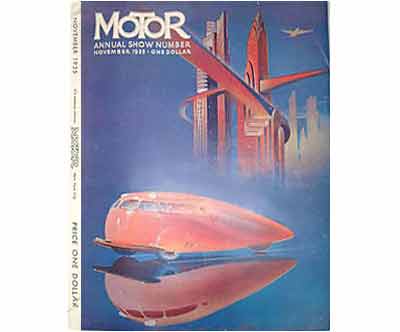
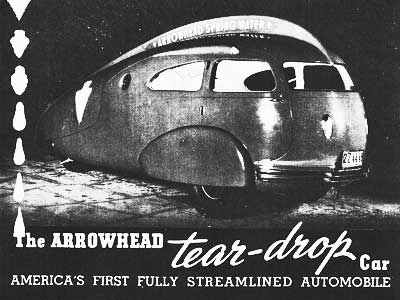
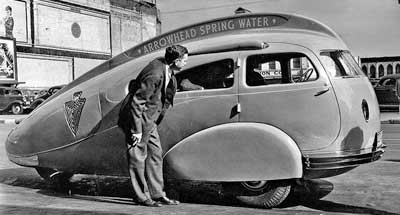
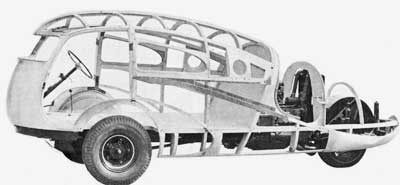
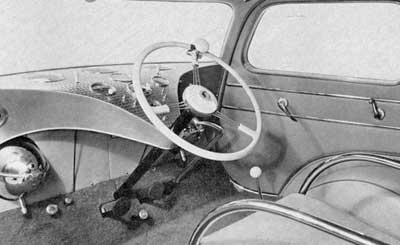
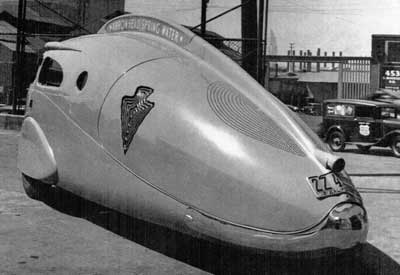
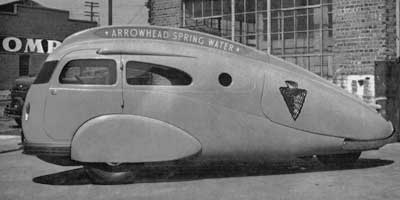
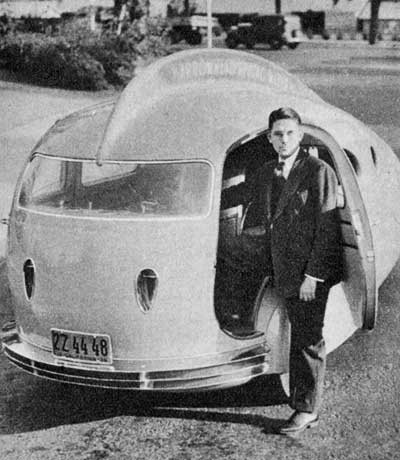
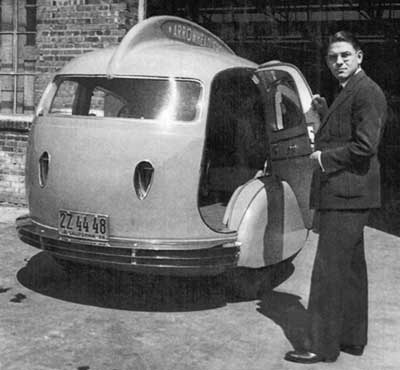
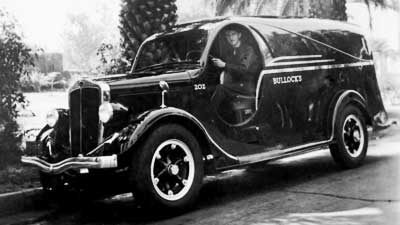
Another famous Advance-built Miller-designed project was the teardrop-shaped Arrowhead 3-wheel automobile which was constructed for the Arrowhead Spring Water Co. of Los Angeles. The advertising vehicle was pictured on the cover of the November 1935 issue of MoToR where it was referred to as the “Car of 1960”. The rear-mounted flathead Ford V-8 was mounted backwards, transferring power to the front wheels via a standard transmission mated to a standard torque tube, axle and differential. The car was steered through the single rear wheel, and was similar in layout to Buckminster Fuller’s Dymaxions. Only one of the reportedly $8,000 vehicles was built and a circa 1960 article stated that the car still existed, however its current whereabouts are unknown. In 1936 they constructed a streamlined remote radio truck for KMTR, a large Los Angeles-based radio station. When the station’s owner, Willard Fonda, got into financial trouble and stopped making payments on the vehicle, Advance Auto Body was forced to repossess it. Advance Auto Body also constructed a small number of Miller-designed streamlined White delivery trucks for Bullocks Department Store in 1935-36. At least one of the attractive vehicles survives and is currently undergoing restoration at Full Circle Restorations in Lockeford, California. In 1936-37 Advance Auto Body constructed a handful of motorcycle taxi bodies for a San Francisco cycle dealer who had intended on establishing a motorcycle taxi service in Shanghai, China. The Japanese invasion of 1937 put a hold on the plans and the vehicles ended up serving tourists in San Francisco. In 1937 the firm modified a plain-looking 3-year-old bakery truck into an attractive streamlined job for the Julia Lee Wright bakery of Los Angeles. It’s assumed more Miller-designed streamlined trucks were constructed by the firm, but photographic evidence is lacking. He remained with Advance until September of 1940 when he had a disagreement with Morgagno and resigned. In 1941 Autobody & the Reconditioned Car recorded that Advance Auto Body Works had constructed an unusual six-wheeled trailer body made of “duralumin parts”. During the twenties Rudy Stoessel, the founder of Coachcraft, worked for a number of early Los Angeles commercial body builders, which included Advance Auto Body Works, Columbia Night Coach, and the Standard Carriage Works. In 1946 the firm relocated to a spacious new facility located at 4700-4950 Anaheim-Telegraph Rd., a 1946 issue of Western Trucking reporting:
In 1951 the firm withdrew from business and leased their factory to North American Aviation, a 1951 issue of Western Trucking reporting:
Advance Auto Body’s second factory is still standing, and forms part of a large factory complex situated at the corner of N. Mission Rd. & E. Macy St. (Cesar E. Chavez Ave.). Macy Street was renamed and is known today as Cesar E. Chavez Ave. The name and location of their former employees new digs is currently unknown, however I discovered three possibilities in and around Los Angeles that all use Advance or Advanced in their names; Advance Auto Body Shop, N. Fair Oaks Ave., Pasadena; Advance Auto Body, 4121 Marine Ave., Lawndale; and Advanced Auto Body, 8110 S. Broadway, Los Angeles. © 2004 Mark Theobald - Coachbuilt.com
|

|
|||||||||
|
||||||||||
|
||||||||||
|
||||||||||
|
||||||||||
|
|
||||||||||
|
||||||||||
|
|
||||||||||
|
|
||||||||||
|
|
||||||||||
|
© 2004-2012 Coachbuilt.com, Inc.|books|disclaimer|index|privacy |
||||||||||